

Your bank has offered to raise your credit card limit — or you’re thinking of asking for one — and now you’re stuck wondering what it does to your CIBIL score. Will a higher limit help you? Will requesting it hurt you? The honest answer is that a credit card limit increase CIBIL score outcome depends on four separate things: your credit utilisation, whether the issuer runs a fresh inquiry, your repayment behaviour, and how the change gets reported to the bureaus.
None of these move on their own. A bigger limit by itself doesn’t earn you anything — it only changes the math behind your utilisation ratio, and what you do with that extra room decides whether your score benefits or suffers. There’s no fixed number of points you’ll gain, and no guaranteed improvement at all.
Quick Answer: Does a Credit Card Limit Increase Affect CIBIL Score?
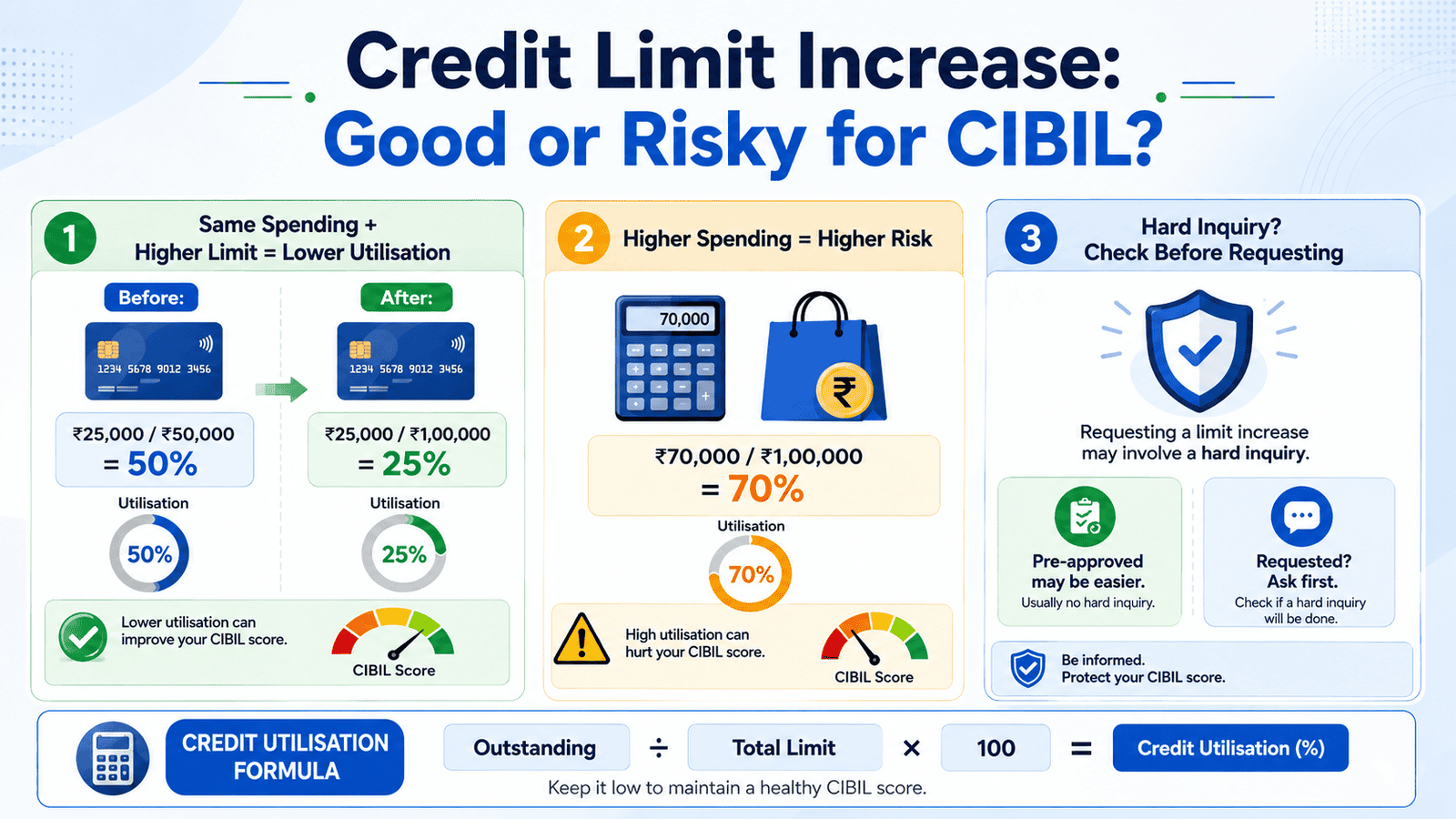
Credit card limit increase CIBIL score impact is usually positive or neutral if your spending stays the same and your credit utilisation falls. For example, ₹25,000 outstanding on a ₹50,000 limit is 50% utilisation, but on a ₹1,00,000 limit it becomes 25%. It can hurt if it leads to overspending, missed payments, or a hard inquiry.
Key Takeaways
- A limit increase does not directly guarantee a better CIBIL score — it only changes the inputs that feed your credit utilisation ratio.
- If your spending stays the same after a higher limit, your utilisation ratio drops, which lenders generally read as a healthier signal.
- If your spending rises along with the limit, the benefit disappears and your outstanding balance can climb faster than before.
- Ask your card issuer whether the increase involves a fresh bureau inquiry — pre-approved offers and self-requested increases aren’t always treated the same way.
- Paying your full bill on time remains a stronger factor in your score than the size of your credit limit.
- A higher limit is borrowing capacity, not extra income — treat it as headroom, not spending power.
Key Facts at a Glance
| Situation | Likely CIBIL Impact | Why It Happens |
|---|---|---|
| Limit increases, spending stays the same | May help | Utilisation ratio falls as available credit rises |
| Limit increases, spending rises to match | Neutral to negative | Utilisation stays high or climbs; no real benefit |
| Issuer runs a hard inquiry to approve the increase | Small, temporary dip possible | A hard inquiry is recorded on your credit report |
| Pre-approved increase with no fresh check | Usually neutral | Depends on issuer — some skip a bureau pull entirely |
| Full bill paid on time every month | Supportive over time | Payment history carries more weight than limit size |
| Minimum due paid repeatedly after the increase | May hurt | Rising interest and outstanding balance signal stress |
How Credit Card Limit and CIBIL Score Are Connected
Your credit card limit is the maximum amount your issuer allows you to borrow on that card at any point. It’s not money you own — it’s borrowing capacity the bank has extended to you based on your income, repayment history, and existing exposure.
The bridge between your limit and your credit score is credit utilisation ratio — the percentage of your total available credit that you’re currently using. It’s calculated as outstanding balance divided by total credit limit, multiplied by 100. Bureaus such as TransUnion CIBIL treat this ratio as one of the stronger behavioural signals in your credit report, because it shows how close you run to your borrowing ceiling.
What Changes When Your Limit Goes Up
If your outstanding balance stays where it was, a higher limit mathematically lowers your utilisation ratio. Lenders generally view lower, steadier utilisation as a sign that you’re not depending heavily on revolving credit — that can support your score over time.
What Doesn’t Change
Your repayment history doesn’t reset. Late payments, missed EMIs, or a habit of paying only the minimum due continue to weigh on your score exactly as they did before the increase. A bigger limit doesn’t erase past behaviour, and it doesn’t buy you a clean slate.
Why Repayment Behaviour Still Matters More
Payment history is consistently one of the most heavily weighted factors in how Indian credit bureaus assess risk. A ₹1,50,000 limit with disciplined, on-time repayment will generally serve your score better than a ₹5,00,000 limit paired with missed due dates. The limit is the backdrop — your behaviour is what actually gets reported.
Real Example: Rohit’s Credit Limit Increase
Rohit, 29, works as a salaried professional in Pune earning around ₹55,000 a month. He uses one credit card for fuel, groceries, online shopping, and the occasional EMI purchase. His outstanding balance sits at ₹25,000 on a ₹50,000 limit — a 50% utilisation ratio, which is on the higher side.
His bank offers to raise his limit to ₹1,00,000. If Rohit’s spending stays roughly the same, his outstanding balance of ₹25,000 against the new ₹1,00,000 limit works out to just 25% utilisation — a meaningfully lower figure that may read more favourably on his credit report over the following reporting cycles.
But if Rohit lets his monthly spending creep up because the extra room feels available — say, his outstanding balance rises to ₹70,000 — his utilisation jumps to 70% on the same new limit, which is worse than where he started. The limit increase itself didn’t hurt him; his spending decision did.
The key insight: the limit increase only creates an opportunity for a lower utilisation ratio — it’s Rohit’s spending discipline that decides whether that opportunity turns into a real benefit.
When Issuers May Consider a Limit Increase
Card issuers don’t apply identical rules, but a few patterns show up across most Indian lenders when they evaluate score needed for cards and limit-increase eligibility:
- A regular, verifiable salary or income pattern over recent months
- A clean repayment history with no recent missed or delayed payments
- Reasonable existing usage of the card rather than consistently maxed-out balances
- No recent defaults or overdue amounts on other credit facilities
- The issuer’s own internal risk policy, which can vary from bank to bank and isn’t publicly published
There’s no single fixed score or income threshold that guarantees a limit increase — eligibility is assessed case by case, and the same profile might get different offers from different issuers.
How to Calculate Credit Utilisation Before and After a Limit Increase
Credit Utilisation Ratio (%) = (Outstanding Balance ÷ Total Credit Limit) × 100
Where: Outstanding Balance = amount currently owed on the card | Total Credit Limit = the maximum limit approved by the issuer
| Credit Limit | Outstanding | Utilisation Ratio | Risk Signal |
|---|---|---|---|
| ₹50,000 | ₹25,000 | 50% | Higher — worth monitoring |
| ₹1,00,000 | ₹25,000 | 25% | Lower — generally healthier |
| ₹1,00,000 | ₹70,000 | 70% | High — spending rose with the limit |
The same ₹1,00,000 limit can look safe or risky purely depending on how much of it is actually used. This is also worth checking across all your cards together — if you hold two cards with a combined limit of ₹1,50,000 and a combined outstanding of ₹75,000, your overall utilisation is 50%, even if one card individually looks fine.
Comparison: Pre-Approved vs Requested Credit Limit Increase
| Factor | Pre-Approved Increase | Requested Increase |
|---|---|---|
| Who initiates it | Issuer, based on your account history | You, through the app, net banking, or customer care |
| Bureau inquiry | Often soft or none | May involve a hard inquiry |
| Documentation | Usually none — based on existing data | May require income proof or updated documents |
| Approval certainty | High, but not guaranteed until confirmed | Depends on current score and issuer policy |
| Borrower risk | Lower — passive offer | Slightly higher — active check possible |
Whether an increase involves a hard inquiry vs soft inquiry depends entirely on the issuer’s internal process — some banks assess pre-approved offers using data they already hold, while a self-requested increase more often triggers a fresh credit report pull. It’s worth asking your issuer directly before accepting or applying.
If Your Reported Limit or Outstanding Looks Wrong
Occasionally the limit or outstanding balance shown on your credit report doesn’t match your actual card statement. If that happens:
- Compare your latest card statement against your credit report figures line by line
- Contact your card issuer first — most reporting errors originate at the lender’s end
- Keep the service request or reference number from that conversation
- If the issuer confirms an error but it isn’t corrected, raise a dispute directly with the credit bureau, such as TransUnion CIBIL
- Follow up periodically until the correction reflects on your report — this isn’t always instant
Safe Limit Increase Checklist
- Can you comfortably pay your full bill every month, not just the minimum due?
- Has your monthly spending already been creeping upward before this offer?
- Are you currently paying only the minimum amount due on any card?
- Have you confirmed with the issuer whether this increase involves a hard inquiry?
- Do you genuinely need the extra limit, or does it just feel like a nice-to-have?
Remember: a higher limit is not extra income. It’s borrowing capacity the bank is willing to extend — what you owe at the end of the month is still money you have to repay in full to avoid interest charges.
How to Decide What’s Right for You
your spending is already controlled and you pay your full bill on time every month — accepting a limit increase can lower your utilisation ratio without adding real risk.
you occasionally carry a balance but manage it responsibly — a modest increase may help, but track your spending closely for the first few months.
you’re currently paying only the minimum due or carrying high balances across cards — a higher limit is likely to add pressure rather than relieve it. Stabilise repayment first.
you’re planning a major loan application in the next few months and want to avoid extra inquiries on your report — consider postponing a requested increase and ask your issuer whether a pre-approved route avoids a hard pull.
you’re unsure whether the increase involves a bureau check — ask the issuer directly before accepting rather than assuming either way.
Common Mistakes to Avoid
Treating the Higher Limit as Extra Income
Some cardholders start spending more simply because the room exists.
This defeats the entire purpose of the increase — your outstanding balance rises along with the limit, and your utilisation ratio never actually improves. In some cases, it ends up worse than before.
Instead, keep your monthly spending pattern the same and let the extra limit sit as unused headroom.
Increasing Monthly Spending Right After the Increase
A new, bigger limit can feel like permission to spend more freely.
If your spending rises proportionally, your utilisation stays flat or climbs — you get none of the potential score benefit and carry a larger absolute debt.
Give it a few billing cycles before changing your spending habits, if at all.
Paying Only the Minimum Amount Due
Paying the minimum keeps your account technically current but leaves most of the balance outstanding.
Interest accrues on the unpaid amount, often at 3–4% per month depending on the issuer, and your utilisation stays elevated month after month — undermining any benefit from the higher limit.
Pay the full statement balance whenever possible, especially in the months right after a limit increase.
Missing the Due Date
A single missed payment can affect your score more than a limit change ever will.
Late payments get reported to bureaus and stay on your credit history for an extended period, and issuers may also charge late card payment impact fees on top.
Set up autopay for at least the minimum due, and try to clear the full amount manually before the due date.
Requesting Multiple Increases or New Cards in a Short Span
Applying for several increases or new cards close together can generate multiple inquiries.
A cluster of inquiries in a short window can look like credit-seeking behaviour to a lender reviewing your report, even if each individual request was reasonable.
Space out requests, and only pursue an increase when you have a clear reason for it.
Ignoring Utilisation Across All Your Cards
Some cardholders only track the card that just got a limit increase.
If your other cards are running high balances, your overall utilisation across all cards combined may still look risky to a lender, regardless of one card’s improved ratio.
Check your total outstanding against your total limit across every card, not just one.
When This May Not Be the Right Choice
A credit card limit increase may not be the right move if you already have unpaid dues sitting on your card, or if you notice a pattern of impulse spending that a bigger limit would only make easier to act on.
It’s also worth pausing if you’ve recently missed an EMI or card payment — that’s a signal to stabilise your repayment discipline before taking on more available credit. If you’re planning a significant loan application in the near future and want to minimise fresh inquiries on your report, it may be worth waiting.
And if you’re simply not confident you’ll stick to controlled spending once the extra room is there, it’s reasonable to decline or delay the offer.
If any of these apply to your situation, it may be worth exploring other options before committing.
Official Rules and Where to Verify
Credit scores in India are calculated by independent credit bureaus using data reported by your lenders — not by the card issuer directly. Because each bureau may receive slightly different reporting timelines or use its own scoring model, your score can vary between bureaus at any given time.
- TransUnion CIBIL — for your CIBIL score and credit report
- Experian India — for a cross-bureau view of your credit behaviour
- CRIF High Mark — another bureau your lenders may report to
- Equifax India — useful for comparing figures across bureaus
Before assuming checking your CIBIL score yourself will affect anything, know that reviewing your own report is a self-check and is treated differently from a lender-initiated inquiry. Credit reporting rules, lender assessment methods, and bureau processes can change. Always verify current details from the relevant bureau, lender, or official regulatory source before acting.
Expert Tips
- Keep your utilisation low even after a limit increase — treat the extra room as a buffer, not a target to fill.
- Set up autopay or a calendar reminder a few days before your due date so payments never slip through.
- Avoid converting every large purchase into an EMI just because the limit allows it — each EMI adds to your reported exposure.
- Review your statement carefully before the due date to catch any unfamiliar charges early.
- Use the higher limit mainly as a safety buffer for emergencies, not as a reason to raise your card limit repeatedly.
- Check your utilisation across all cards together, not just the one that changed.
Frequently Asked Questions
Does increasing my credit card limit improve my CIBIL score?
It can help if your spending stays the same, because your utilisation ratio falls. It doesn’t guarantee an improvement, and the effect isn’t instant.
Can a higher credit card limit reduce my CIBIL score?
Yes, indirectly — if the increase leads to higher spending, missed payments, or a hard inquiry that temporarily affects your report.
Should I accept a pre-approved credit card limit increase?
If your repayment habits are disciplined and you don’t expect to spend more just because the limit is higher, accepting can be reasonable. If you’re unsure of your spending control, it’s worth thinking it through first.
Does a credit card limit increase create a hard inquiry?
It depends on the issuer. Pre-approved offers based on your existing account history often don’t involve a fresh check, while a self-requested increase is more likely to involve one. Confirm with your issuer before proceeding.
What is a good credit utilisation ratio after a limit increase?
Lower utilisation is generally viewed more favourably, though there’s no single universal cutoff that applies to every lender or every situation.
Can I get a loan more easily after increasing my credit card limit?
Not automatically. Lenders assess loan applications on income, existing obligations, and overall repayment history — a higher card limit alone doesn’t guarantee easier loan approval.
Should low CIBIL score borrowers request a credit card limit increase?
Borrowers with a lower score or recent repayment issues are generally better off focusing on consistent, on-time payments first, since issuers may be less likely to approve an increase in that situation anyway.
What happens if my reported credit limit doesn’t match my actual card limit?
Compare your statement against your credit report, contact your issuer to correct it, and raise a dispute with the bureau if the issuer confirms an error that isn’t fixed.
Final Verdict
A credit card limit increase CIBIL score outcome comes down to behaviour, not the limit itself. If your spending stays controlled and you continue paying your full bill on time, a higher limit can lower your utilisation ratio and support a healthier credit profile over time. If it leads to more spending, missed payments, or unnecessary inquiries, it can work against you.
Before accepting or requesting an increase, ask your issuer about the process, track your utilisation across all your cards, and treat the extra limit as a buffer rather than available spending money. Always verify your latest credit report, lender requirements, and bureau process before making a credit-related decision.
This article is for educational purposes only and should not be treated as personalised financial, credit, or legal advice. Credit scores, credit reports, lender eligibility criteria, and bureau processes can vary and may change over time. Please verify current details with the relevant credit bureau, lender, official regulatory source, or a qualified professional before making any credit-related decision.

Neha Menon writes simple, borrower-first explainers on CIBIL scores, credit reports, bureau disputes, DPD, loan settlement impact, hard inquiries, and practical credit score recovery. She focuses on helping Indian borrowers understand lender-reported data, avoid credit mistakes, and take safer next steps without false promises.