
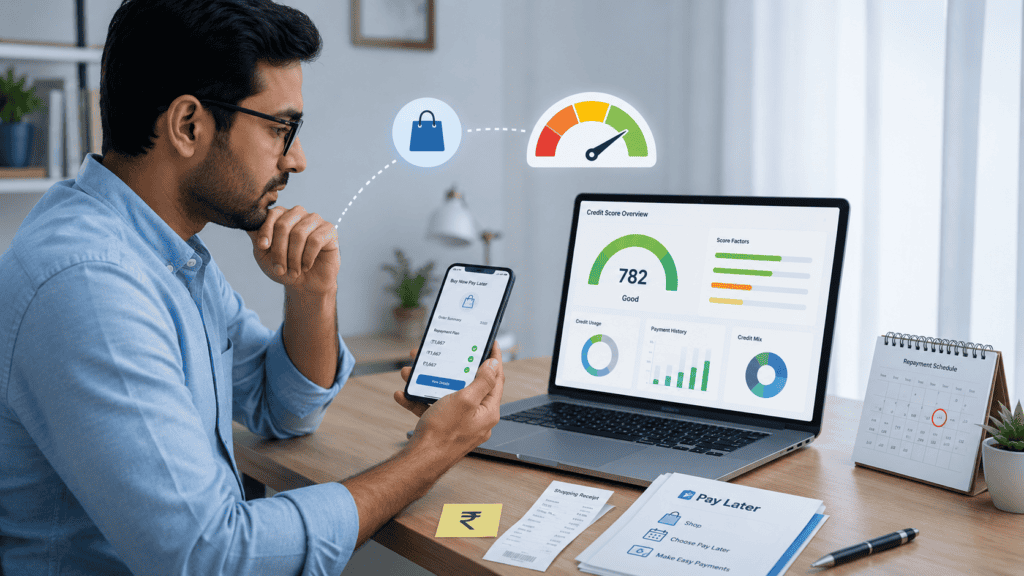
You tap “Pay Later” at checkout, split a ₹5,000 purchase into three parts, and move on with your day. It feels like a shopping feature — not a loan. But depending on who is actually lending you that money, buy now pay later impact on CIBIL score can be real, and many borrowers only find out when a Pay Later account shows up on their credit report months later. Whether it helps you or hurts you depends on one thing: how your provider reports your repayment behaviour to the bureaus. This article walks through when BNPL touches your CIBIL report, what a missed due date can trigger, and how to check — and fix — your report if something looks wrong.
Quick Answer: Does BNPL Affect Your CIBIL Score?
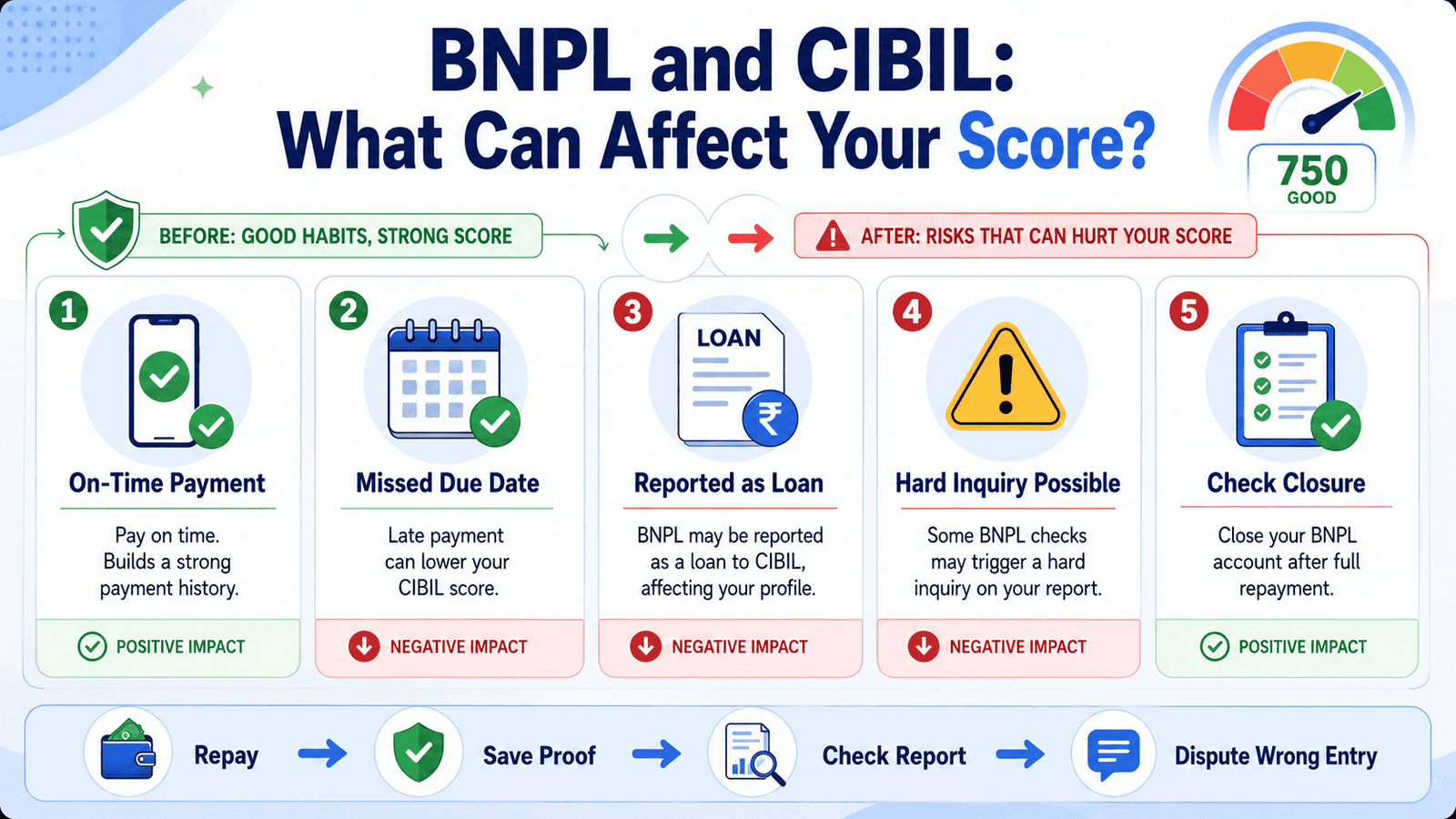
Buy now pay later impact on CIBIL score depends on whether the provider or lending partner reports the BNPL account to credit bureaus. If reported, on-time repayment can support a clean repayment record, while missed dues, overdue status, or multiple open Pay Later accounts can hurt future loan or credit card approval.
Key Takeaways
- BNPL should be treated as a form of short-term credit, not free money — the reporting behaviour behind it depends on the lending partner, not the app’s branding.
- Not every Pay Later provider reports to TransUnion CIBIL, Experian, CRIF High Mark, or Equifax in the same way, so two BNPL apps can behave very differently on your credit report.
- A missed due date is the single biggest CIBIL score impact factor with BNPL — the purchase amount matters far less than whether you paid on time.
- After you repay a BNPL amount in full, checking that the account shows “closed” rather than “active” or “overdue” in your credit report is a step most users skip.
- Running several BNPL accounts at once, especially close to a home loan, car loan, or credit card application, can make your credit exposure look higher than lenders would like to see.
- Provider fees, penal charges, and exact reporting timelines vary and change, so always confirm current terms directly with the app or lender [CONFIRM — verify current figure before publishing].
Key Facts at a Glance
| Question | What Generally Applies | What You Should Do |
|---|---|---|
| Is BNPL a loan? | It can be, if a bank or NBFC is the actual lender behind the app | Read the terms to identify the lending partner |
| Does it appear in CIBIL? | Only if the lender reports it as a credit account | Check your credit report periodically |
| What helps your profile? | On-time repayment, if reported | Pay before the due date, every time |
| What hurts your profile? | Missed dues, overdue status, multiple open accounts | Limit active BNPL accounts and track due dates |
| What to check after paying? | Whether the account is marked closed | Verify closure status in your credit report |
Buy Now Pay Later Impact on CIBIL Score: How It Actually Works
BNPL is usually a deferred-payment or short-instalment credit product, offered at checkout by an app, an e-commerce platform, or a payments company. The “Pay Later” button you see is just the front end. Behind it, the actual money is often lent by a bank, an NBFC, or a regulated digital lending partner working with the app.
This distinction matters. The app’s name has no bearing on your BNPL app risks or on whether your usage gets reported to a bureau. What matters is the lending entity behind it, and whether that entity treats your account as a reportable credit facility.
Why the Lending Partner Decides the CIBIL Outcome
According to RBI’s Digital Lending Directions, regulated entities are expected to disclose key terms clearly, including who the actual lender is. If that lender is a bank or NBFC reporting to bureaus, your BNPL account can appear on your credit report the same way a small personal loan would — with an account type, a sanctioned amount, a repayment status, and an overdue flag if you miss a due date.
Why Reporting Isn’t Guaranteed — or Uniform
Some BNPL products function more like an internal wallet credit line and may not always be reported the same way across bureaus. This is exactly why two people using two different Pay Later apps can have completely different experiences — one sees no change in their report, another finds a new loan account after their very first purchase. Because policies and thresholds vary and can change, always read your provider’s terms before assuming your usage is invisible to credit bureaus.
Real Example: Rohit’s ₹5,000 BNPL Purchase
Rohit, 29, works in IT in Bengaluru and earns around ₹55,000 a month [CONFIRM — verify current figure before publishing]. He used a Pay Later option to buy a ₹5,000 gadget [CONFIRM — verify current figure before publishing], split into three instalments over three months by the app’s lending partner, an NBFC.
Rohit paid the first two instalments on time through auto-debit. The third failed because his linked account had insufficient balance for two days. The app flagged the payment as overdue and charged a late fee. Because the NBFC reports to credit bureaus, this overdue status appeared on Rohit’s credit report a few weeks later — just as he began preparing to apply for a credit card upgrade.
He didn’t lose his job or take on a big loan — a two-day delay on a small instalment was enough to create a visible overdue mark. The insight: with BNPL, timing discipline matters more than the size of the purchase.
Eligibility and Pre-Activation Checklist
Before You Activate BNPL, Check This
- Identify whether a bank or NBFC is named as the actual lending partner in the app’s terms.
- Look for any mention of credit bureau consent, a hard or soft check, at activation.
- Note the exact repayment date, applicable charges, and how account closure is confirmed.
- Check whether auto-debit is enabled on an account that reliably holds sufficient balance.
- If you are planning a home loan, car loan, or credit card application soon, weigh whether adding a new visible credit line is worth it right now.
How a Missed BNPL Instalment Can Snowball
Take a simple case: a ₹5,000 purchase split into three payments of roughly ₹1,700 each [CONFIRM — verify current figure before publishing]. On its own, this is manageable. The risk grows when someone runs three or four BNPL purchases of ₹2,000–₹3,000 each [CONFIRM — verify current figure before publishing] across different apps in the same month — the due dates can overlap, and a temporarily tight month can turn into two or three missed payments at once, even though each individual amount is small.
Late fees, penal charges, and the exact point at which a missed payment gets reported as overdue are set by each provider and can change, so treat any specific number you see in an app as provisional until you confirm it. What you can control is timing: track due dates the way you would late Pay Later dues on a credit card statement, not as an afterthought.
| Stage | What Happens | What to Do |
|---|---|---|
| Due date approaches | App sends a reminder; auto-debit may be scheduled | Confirm sufficient balance a day in advance |
| Due date missed | Late fee may apply; account may be marked delayed | Pay immediately and note the confirmation |
| Continued non-payment | Provider may report the account as overdue to bureaus, if applicable | Contact the provider and clear the dues in full |
| After full repayment | Account should move to closed status, if reported | Verify closure directly in your credit report |
Comparison: BNPL vs Credit Card vs Personal Loan
| Product | Reporting Possibility | Late Payment Risk |
|---|---|---|
| BNPL | Depends on provider | High if unmanaged |
| Credit Card | Almost always reported | High — interest compounds fast |
| Personal Loan | Always reported | Moderate — fixed EMI schedule |
BNPL tends to suit small, planned, short-term purchases where you’re confident about repaying within weeks. A credit card gives more visibility into your spending and, if paid in full, avoids interest — but late payment costs more per rupee than most BNPL structures. A personal loan makes sense only for larger, planned needs, never for routine shopping. None of these is “always best” — the right choice depends on whether you can repay on the exact date, every time, without exception.
What to Do If a Pay Later Account Looks Wrong in Your Report
If you spot a BNPL account you don’t recognise, one that shows overdue after you’ve paid, or one that’s still “active” long after closure, take these steps:
Step 1 — Pull Your Credit Report
Download your report and locate the exact entry: lender name, account number, amount, status, and closure date.
Step 2 — Gather Proof
Collect payment confirmations, bank statements, and any closure message from the app or lender.
Step 3 — Contact the Provider First
Reach out to the BNPL app and the underlying lending partner, since they control what gets reported. This directly affects your Pay Later report entry.
Step 4 — Raise a Formal Dispute if Needed
If the provider doesn’t correct it, you can raise a credit dispute directly with the bureau, using your evidence. Correction timelines vary by bureau and case, so don’t assume a fixed number of days [CONFIRM — verify current figure before publishing].
Keep every reference number and screenshot until the entry is fixed and you’ve reverified it.
BNPL Safety Checklist
- Use BNPL only for purchases you’ve already budgeted for — not impulse buys.
- Avoid running more than one or two active Pay Later accounts at a time.
- Pay before the due date, not on it — give auto-debit a buffer day.
- Save every payment confirmation until the account shows closed.
- Recheck your credit report a few weeks after your last payment to confirm closure.
How to Decide What’s Right for You
you’re confident you can repay every instalment on the exact due date — BNPL for a small, planned purchase is reasonable.
your income or expenses vary month to month — skip BNPL for anything beyond what you could pay outright.
you’re applying for a home loan, car loan, or new credit card in the next few months — keep your visible credit exposure low and avoid opening new BNPL accounts.
you can pay a credit card bill in full each month — BNPL’s fixed, short instalments may actually be easier to track than revolving card debt.
cash is available and the purchase isn’t essential — a debit card avoids credit exposure altogether.
Common Mistakes to Avoid
Treating BNPL as Free Money
It’s a repayment obligation, not a discount.
Users who forget this often stack multiple BNPL purchases without tracking the combined repayment load, then find several dues clustering in the same week.
Track BNPL the same way you’d track any EMI — with a due-date list.
Ignoring “Small” Dues
A ₹500–₹2,000 due [CONFIRM — verify current figure before publishing] feels too small to worry about.
But if reported, an overdue mark doesn’t scale down with the amount — a small missed due can carry the same weight on your report as a larger one, potentially affecting future loan approval odds.
Pay every BNPL due in full, regardless of size.
Running Multiple BNPL Apps Simultaneously
Each app looks harmless alone.
Together, they can raise your visible short-term credit exposure and increase the odds of a missed payment slipping through.
Limit yourself to one active BNPL account at a time.
Not Reading Late Fee and Closure Terms
Terms differ by provider and change over time.
Assuming your last app’s rules apply to a new one can lead to surprise charges or reporting you didn’t expect.
Check current terms each time you activate a new Pay Later option.
Skipping the Post-Repayment Credit Report Check
Paying off a BNPL due doesn’t guarantee instant closure in your report.
An account left showing “active” or, worse, “overdue” after full repayment can quietly affect your profile for months.
Recheck your report a few weeks after your last payment.
When This May Not Be the Right Choice
BNPL may not be the right choice if your income is unstable or delayed some months, if you already have overdue loans or credit card dues, if you’re about to apply for a major loan and want to keep your credit profile clean, or if you tend to make impulse purchases you later regret. If any of these apply to your situation, it may be worth exploring other options before committing.
Official Rules and Where to Verify
For the most accurate, current picture of your credit standing, verify directly with the source rather than relying on an app’s in-app score estimate:
- TransUnion CIBIL — for your CIBIL score and detailed credit report
- Experian India and CRIF High Mark — since score and report data can differ across bureaus
- RBI — for digital lending rules governing regulated lenders and lending partners
Credit reporting rules, lender assessment methods, and bureau processes can change. Always verify current details from the relevant bureau, lender, or official regulatory source before acting.
Expert Tips
- Set a repayment reminder two to three days before each BNPL due date, not on the day itself [CONFIRM — verify current figure before publishing].
- Don’t activate BNPL just to “check eligibility” — some activations can involve a credit bureau check.
- Close unused Pay Later accounts you no longer need, rather than leaving them dormant.
- Before any major loan application, pull your credit report and confirm every BNPL entry shows the correct status.
- Keep BNPL usage limited to purchases you could have paid for outright if needed.
Frequently Asked Questions
Does Buy Now Pay Later affect CIBIL score?
It can, but only if the lending partner behind the app reports your account to credit bureaus. Reporting practices vary by provider.
Will BNPL show as a loan in my CIBIL report?
If the underlying lender is a bank or NBFC that reports credit accounts, yes — it may appear with an account type, status, and repayment history.
Can one missed BNPL payment reduce my credit score?
If the missed payment is reported as overdue, it can affect your score. The size of the purchase matters less than the fact that it was late.
Does activating Pay Later create a hard inquiry?
Some providers may run a credit check at activation, which can be a hard or soft inquiry depending on the process. Check the app’s terms before activating.
Is BNPL better than a credit card?
Neither is universally better. BNPL suits small, planned purchases with fixed instalments; a credit card offers more flexibility but higher risk if you carry a balance.
How do I remove a wrong BNPL entry from my CIBIL report?
Gather proof of payment or closure, contact the BNPL provider first, and if unresolved, raise a formal dispute with the credit bureau.
Should I use BNPL if I am planning to apply for a home loan or personal loan?
It’s worth being cautious. New, visible credit accounts close to a major loan application can affect how lenders view your overall credit exposure.
Final Verdict
Buy now pay later impact on CIBIL score isn’t a fixed rule — it depends entirely on who’s lending behind the app and how they report your account. Used carefully, for planned purchases you repay on time, BNPL can be a manageable, low-friction way to spread a cost. Used carelessly, across multiple apps with due dates you’re not tracking, it behaves like any other missed EMI. If you want to check your score and confirm your BNPL accounts are reporting correctly, that’s the safest next step before your next application. Always verify your latest credit report, lender requirements, and bureau process before making a credit-related decision.
This article is for educational purposes only and should not be treated as personalised financial, credit, or legal advice. Credit scores, credit reports, lender eligibility criteria, and bureau processes can vary and may change over time. Please verify current details with the relevant credit bureau, lender, official regulatory source, or a qualified professional before making any credit-related decision.

Neha Menon writes simple, borrower-first explainers on CIBIL scores, credit reports, bureau disputes, DPD, loan settlement impact, hard inquiries, and practical credit score recovery. She focuses on helping Indian borrowers understand lender-reported data, avoid credit mistakes, and take safer next steps without false promises.