
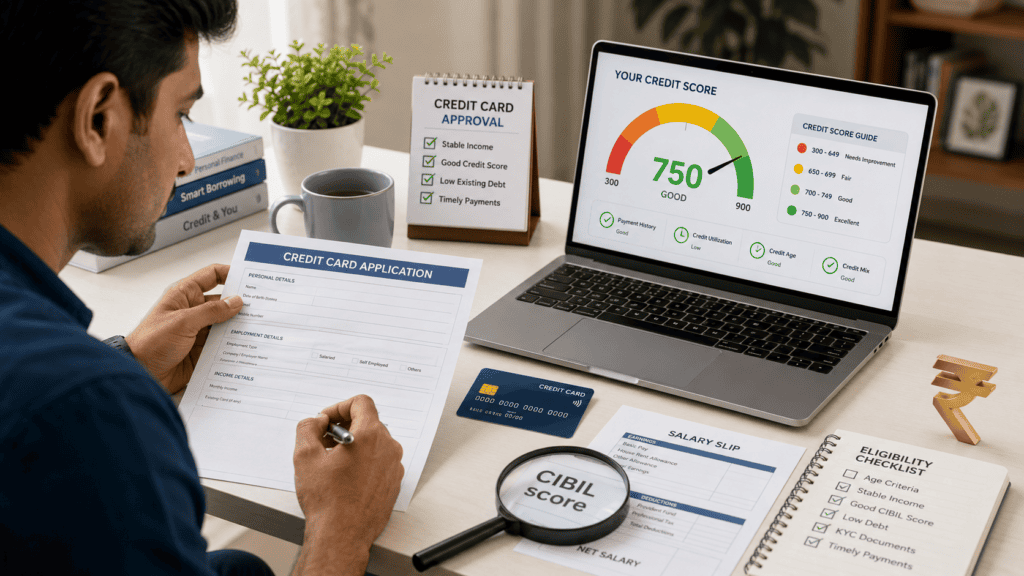
Your CIBIL score sits at 690, and you’re staring at a credit card application form wondering if you’re about to waste a hard inquiry on a guaranteed rejection. This is the most common confusion around the minimum CIBIL score for credit card approval — readers expect one fixed number that either clears them or blocks them. It doesn’t work that way. There’s no RBI-mandated minimum score that every bank follows. Each issuer runs its own underwriting, and your score is just one input alongside income, existing debt, and repayment history. This article walks through realistic score bands, what banks actually check beyond your score, and what to do if your profile is thin or shaky — without pushing you into applying everywhere at once.
Quick Answer: Minimum CIBIL Score for Credit Card
The minimum CIBIL score for credit card approval is usually around 700–750, but there is no fixed RBI rule. Banks also check income, repayment history, existing debt, credit utilisation, and recent hard inquiries. A lower score may still work for secured or entry-level cards.
Key Takeaways
- A score of 700–750 is generally considered a stronger range for unsecured card approval, but no issuer guarantees approval at any fixed number.
- Your monthly income, existing EMI obligations, and credit utilisation can matter just as much as the score itself during underwriting.
- Applying to four or five card issuers within a month can generate multiple hard inquiries, which may make your profile look credit-hungry to future lenders.
- A missed payment or written-off account in your credit report can outweigh a decent score during a bank’s internal risk review.
- Beginners with no credit history can often start with a secured credit card against a fixed deposit, where approval depends more on the FD than on a score.
- Keeping your credit utilisation below roughly 30% of your limit on existing cards generally signals healthier repayment capacity to issuers.
- If you’ve been rejected recently, waiting and reviewing the rejection reason is usually safer than reapplying immediately elsewhere.
Key Facts at a Glance
| Question | What Generally Holds | What to Check |
|---|---|---|
| Is there a fixed minimum CIBIL score? | No single RBI-fixed number exists for all cards | Each issuer’s own eligibility page |
| Commonly preferred range for unsecured cards | Roughly 700–750 and above | Issuer-specific criteria before applying |
| What matters besides score | Income, existing EMIs, utilisation, recent inquiries | Your own credit report and salary slips |
| Option for low or no score | Secured credit card against a fixed deposit | FD lien terms and card fees at the bank |
| Main risk of multiple applications | Repeated hard inquiries can lower approval odds | Number of inquiries in last 3–6 months on your report |
What Is the Minimum CIBIL Score for a Credit Card?
Most Indian banks and NBFCs lean toward applicants in the 700–750 range when evaluating unsecured credit card applications. That’s the number you’ll see repeated across most credit education content, including TransUnion CIBIL‘s own consumer guidance. But treat it as a general signal, not a cutoff line carved into a rulebook.
Here’s what actually happens behind the scenes. Each bank runs its own underwriting model. One issuer might approve a 680-score applicant with a stable government salary and zero existing debt. Another might decline a 740-score applicant with three existing credit cards already near their limits. The score gets you into the conversation — it doesn’t write the approval letter.
Premium and super-premium cards — the ones with airport lounge access and high reward multipliers — typically expect a stronger profile altogether: a higher score, demonstrably higher income, and a longer, cleaner credit history. Entry-level and beginner cards are usually more forgiving on all three counts.
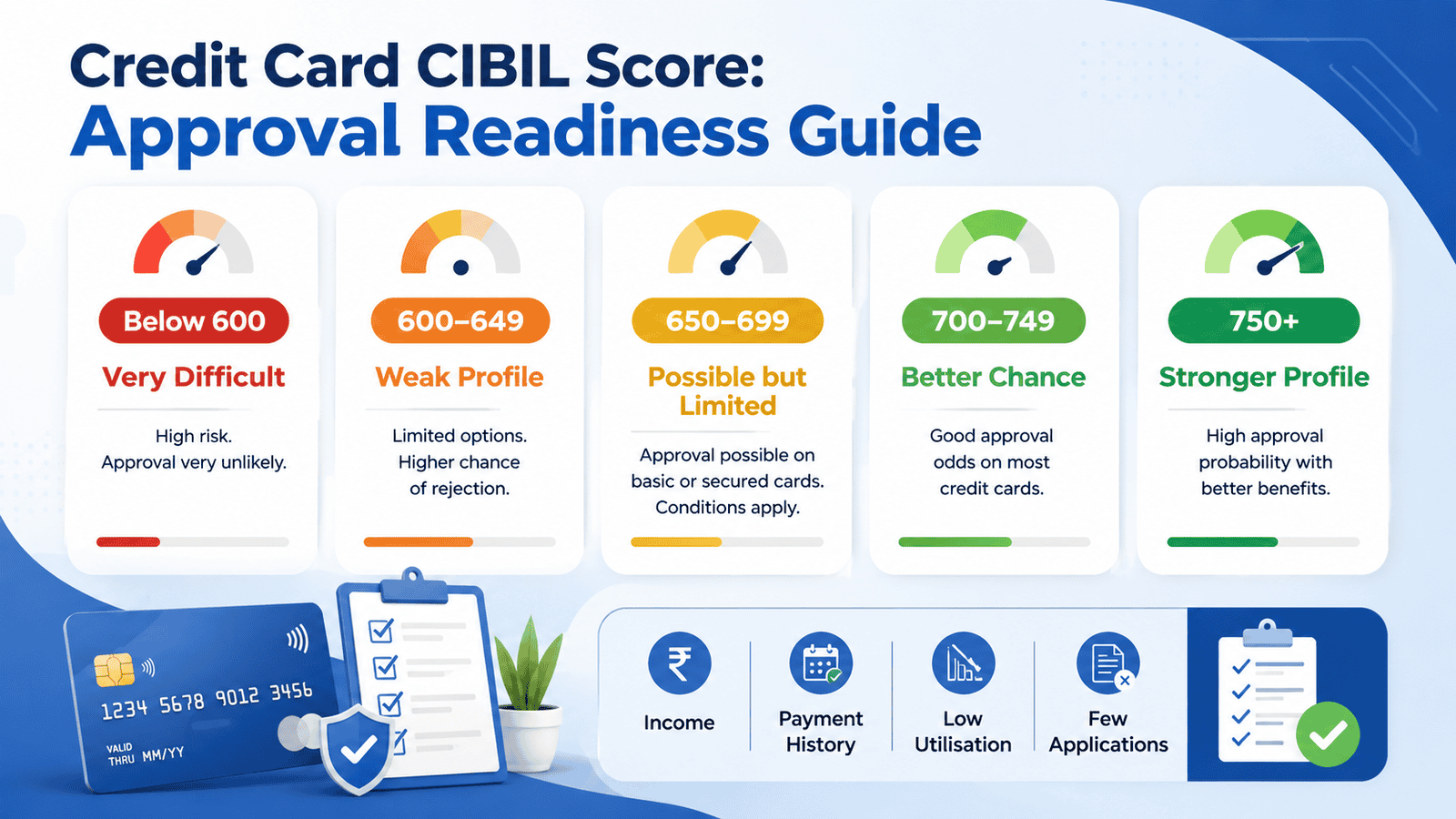
CIBIL Score Bands and Credit Card Approval Chances
| Score Band | Approval Readiness | What to Check First |
|---|---|---|
| Below 600 | Difficult | Report errors, overdue accounts, settlement history |
| 600–699 | Limited Chance | Income stability, existing EMI load, recent inquiries |
| 700–749 | Better Chance | Utilisation on existing cards, employer category |
| 750 and above | Stronger Profile | Still confirm income criteria for the specific card |
Notice the language: readiness, not guarantee. Even in the 750+ band, a bank can still decline you over a high debt-to-income ratio, a very recent job change, or an internal policy that’s unrelated to your score entirely.
Why There Is No Fixed CIBIL Score for Every Credit Card
Three things drive this variation, and understanding them stops you from over-indexing on the score alone.
Different banks, different underwriting
Every issuer builds its own risk model using bureau data, internal default history, and business priorities. A bank trying to grow its card base aggressively may accept thinner profiles than one that’s tightening lending after a rise in defaults.
Card type changes the bar
A no-frills, lifetime-free entry card from a bank where you already hold a salary account is a very different ask than a premium travel card with a ₹10,000+ annual fee. The latter usually expects more — both in score and income.
Your broader profile matters
Income, employer type, city, age, and existing debt burden all feed into the decision. A salaried applicant at a well-known company with no other loans often clears the bar more easily than a self-employed applicant with the same score but irregular income deposits.
If you’re starting from zero credit history altogether, it helps to look at card without history options designed specifically for that situation rather than applying for a standard unsecured card and risking a decline.
What Banks Check Besides CIBIL Score
| Factor | Why It Matters | What You Can Review |
|---|---|---|
| Monthly income | Signals repayment capacity for the credit limit requested | Latest salary slips or bank statement credits |
| Existing EMIs and card dues | High existing obligations reduce free monthly cash flow | Loan and card statements, total monthly outgo |
| Payment history and DPD | Days Past Due entries signal missed or late payments | Your full credit report, not just the score number |
| Recent hard inquiries | Multiple recent applications can suggest credit stress | Inquiry section of your bureau report |
A written-off or settled account on your report — even an old one — can weigh heavily on a bank’s internal decision, sometimes more than the score itself. These entries tell a lender you didn’t fully repay what you owed, which is a different signal than a temporarily low score caused by, say, a thin credit file.
Real Example: Three Different Profiles, Same Confusion
Rohit, 28, Pune, works as an IT executive earning around ₹38,000 a month. His CIBIL score is 720, he has no existing loans, and his only obligation is rent. On paper, this is a reasonably comfortable profile for a beginner cashback card — though approval still rests on the issuer’s own income cut-off.
Sandeep, 34, Mumbai, has a 750 score, but he’s currently using ₹85,000 of a ₹1,00,000 credit limit on his existing card and missed one payment three months ago. His score still looks strong on paper, but the utilisation and the recent missed payment are exactly the kind of details that can lead to a decline despite a “good” number.
Anjali, 24, Bengaluru, is a first jobber with no credit history at all — no score has even been generated yet. For her, a standard application is likely to bounce simply because there’s nothing for the bureau to report. A secured card against a fixed deposit, or a card tied to her salary account, is the more realistic starting point.
The insight across all three: the score is one data point in a larger picture, and the rest of that picture can quietly decide the outcome.
Eligibility Checklist Before You Apply
| Check | Why It Matters | Where to Verify |
|---|---|---|
| CIBIL score and report | Shows repayment history and any flagged entries | Bureau website or app |
| Monthly income and salary proof | Most issuers set a minimum income threshold | Issuer’s eligibility page |
| Existing EMI and card dues | High obligations reduce approved credit limit or chances | Loan and card statements |
| Recent applications and inquiries | Too many recent inquiries can lower approval odds | Inquiry section of credit report |
| PAN, address, and KYC documents | Required for application processing | Issuer’s documentation list |
Income thresholds and document lists vary by issuer and by city, so check the specific card’s eligibility page on card salary eligibility before assuming a generic number applies to your application.
How Credit Utilisation Affects Your Readiness
Credit utilisation is the percentage of your available credit limit that you’re currently using. It’s one of the clearest signals a lender can read directly from your bureau report.
Utilisation % = (Outstanding Balance ÷ Total Credit Limit) × 100
Where: Outstanding Balance = amount currently owed on the card | Total Credit Limit = sanctioned limit on that card
| Scenario | Calculation | Utilisation |
|---|---|---|
| High usage on existing card | ₹45,000 used of ₹50,000 limit | 90% |
| Conservative usage on existing card | ₹10,000 used of ₹50,000 limit | 20% |
A reader carrying 90% utilisation on an existing card and then applying for a new one is sending a mixed signal — it can look like reliance on credit to manage monthly cash flow. The exact impact on your score varies by bureau and how the lender reports the data, so don’t expect a fixed point-for-point change. Keeping utilisation closer to the 20–30% range before you apply is generally the safer habit.
Comparison: Normal Unsecured Card vs FD-Backed Secured Card
| Feature | Unsecured Card | FD-Backed Secured Card |
|---|---|---|
| Approval basis | Score, income, and credit history | Mostly the fixed deposit amount |
| CIBIL requirement | Generally 700+ preferred | Low or No Score Acceptable |
| Fixed deposit needed | Not required | Yes, usually with a lien marked on it |
| Credit limit basis | Income and bureau profile | Percentage of the FD amount |
| Best-fit user | Established income and credit history | Beginners, thin-file, or low-score applicants |
FD amounts, lien conditions, and applicable fees differ across banks, so check the specific terms on the issuer’s site before opening an FD purely for this purpose. For a deeper side-by-side, see secured or normal card.
Safety Checklist Before Applying
- Don’t apply to four or five issuers in the same month just to see who approves you — each application can trigger a hard inquiry.
- Pull your own credit report first; this counts as a soft inquiry and doesn’t affect your score.
- Avoid applying right after a missed EMI or card payment — let your repayment history stabilise for a few cycles first.
- Don’t leave out existing loans or card dues on the application form; issuers cross-check this against your bureau report anyway.
- Read the fee structure — joining fee, annual fee, and any spend-based waiver condition — before activating a new card.
How to Decide What’s Right for You
your score is 700+ and your income is stable with no major existing EMIs — compare a few entry-level or mid-tier cards on fees and rewards before applying.
your score is in the 600–699 range with clean recent repayment — consider applying to a bank where you already hold a salary or savings account, where issuers sometimes extend more flexibility.
you have no credit history at all — start with a secured card against an FD or a beginner card tied to your salary account rather than a standard unsecured application.
you were rejected in the last few months — review the rejection reason if the issuer shared one, and wait before reapplying anywhere new.
your current utilisation is below 50% on existing cards — work on bringing it down before adding a new card, since high utilisation can work against you regardless of your score.
you have a missed payment in the last 2–3 months — don’t apply yet; let your repayment history show a clean recent stretch first.
For low-score profiles specifically, an FD-backed card option is usually a steadier starting point than repeated unsecured applications.
Common Mistakes to Avoid
Applying without checking eligibility first
Many applicants fill out a form without ever reading the issuer’s stated income or score guidelines.
This wastes a hard inquiry on an application that had little chance from the start, and that inquiry stays on your report for months, visible to the next lender you approach.
Check the card’s eligibility page first — it takes a few minutes and can save a rejection mark.
Treating 750 as a guaranteed approval
A 750+ score feels like a green light, but it isn’t an approval guarantee on its own.
Issuers still weigh income, existing debt, and internal policy. A high score with high utilisation or a recent missed payment can still get declined.
Treat the score as a strong starting point, not the finish line — review your full profile before applying.
Ignoring utilisation on existing cards
Running close to your limit on a current card while applying for a new one signals reliance on credit.
This can affect both the new application and your existing card’s future limit reviews.
Bring utilisation down to a more conservative level for a billing cycle or two before applying further.
Reapplying immediately after rejection
A decline can feel urgent to fix, so some applicants try a different bank the same week.
Each new application adds another hard inquiry, compounding the exact pattern that made the first application look risky.
Wait, review what likely caused the rejection, and address that specific issue before trying again. See hard inquiry effect for how this builds up over multiple attempts.
Choosing a premium card without meeting income criteria
Premium cards look attractive for their rewards, but they carry higher income thresholds for a reason.
Applying above your income bracket is one of the more common avoidable rejections, and it still costs you a hard inquiry.
Start with a card matched to your current income, and consider upgrading once your profile is stronger.
When This May Not Be the Right Choice
You have a missed EMI or an overdue credit card bill right now — clear that first, since a new application during active default is unlikely to succeed and adds an unnecessary inquiry.
Your existing credit utilisation is already very high across your current cards — adding a new credit line won’t fix that, and it may draw closer scrutiny.
You’ve been rejected for a loan or card in the last few weeks — give your profile time to settle before trying again elsewhere.
Your income or employment has recently changed — issuers often look for some stability in employment before approving a new credit line.
If any of these apply to your situation, it may be worth exploring other options before committing.
Official Rules and Where to Verify
Credit card eligibility in India isn’t governed by one fixed RBI rule on minimum CIBIL score — it’s set independently by each card issuer within RBI’s broader regulatory framework for credit institutions. To verify current details before applying:
- TransUnion CIBIL — check your own score and full credit report directly with the bureau.
- RBI (rbi.org.in) — for general regulatory and borrower-protection context around credit institutions.
- HDFC Bank and SBI Card — for current, issuer-specific eligibility criteria, fees, and card terms.
Avoid relying only on aggregator or comparison-site eligibility claims, since these can lag behind an issuer’s actual current criteria. You can check score safely before applying anywhere. Card fees, interest rates, reward rules, and billing terms can change by issuer. Always verify the latest terms from the card issuer and official regulatory sources before applying or converting dues.
Expert Tips
- Bring your utilisation on existing cards down to roughly 20–30% for a billing cycle or two before applying for anything new.
- If you’ve missed a payment recently, wait until you’ve shown a clean repayment stretch before your next application.
- If your credit file is thin or empty, start with an entry-level or secured card rather than a premium product.
- Let your repayment behaviour stay consistent over several months before expecting noticeably different approval outcomes.
- Read the fee and interest terms — joining fee, annual fee waiver condition, and interest on revolving balances — before you activate any new card.
- If a bank already holds your salary account, check their card offers first; existing relationship data can sometimes ease the review.
Frequently Asked Questions
What is the minimum CIBIL score required for a credit card?
There’s no fixed minimum set by RBI. Most issuers prefer applicants in the 700–750 range for standard unsecured cards, but actual approval also depends on income, existing debt, and the issuer’s own policy.
Can I get a credit card with a 650 CIBIL score?
It’s possible but harder. A 650 score falls in a limited-approval range for most unsecured cards. Your chances improve if your income is stable, your existing EMI load is low, and you haven’t applied elsewhere recently. A secured card against an FD is often a more reliable route at this score.
Is 750 CIBIL score enough for credit card approval?
It’s a strong signal, but not a guarantee. A 750 score with high utilisation on existing cards, a recent missed payment, or income below the issuer’s threshold can still result in a decline.
Can I get a credit card without any CIBIL score?
Yes, in many cases. Beginners with no credit history can often apply for entry-level cards, cards tied to a salary account, or secured cards against a fixed deposit, where the FD largely determines approval rather than a bureau score.
Does applying for a credit card reduce my CIBIL score?
A single application typically triggers one hard inquiry, which can cause a small, usually temporary dip. The bigger concern is applying to multiple issuers in a short window, which creates several hard inquiries and can look like credit-seeking behaviour to future lenders.
Is an FD-backed credit card good for building CIBIL score?
It can help, since most secured cards report repayment behaviour to bureaus just like unsecured cards. Timely repayment is what builds the history — the FD only affects how easily you get approved, not how the score itself improves.
Why was my credit card rejected despite a good CIBIL score?
A good score doesn’t override every other factor. Common reasons include income below the issuer’s threshold, high utilisation on existing cards, a recent missed payment, too many recent applications, or simply the bank’s internal policy at the time of review.
Final Verdict
The minimum CIBIL score for credit card approval is a useful benchmark — 700–750 is where most unsecured applications stand a better chance — but it’s not the whole story. Income, existing debt, utilisation, and recent inquiries all sit alongside your score in a bank’s decision. If your score is strong and your profile is clean, compare a few cards on fees and rewards before applying. If your score is weak or your file is thin, a secured card against an FD is usually the steadier starting point over repeatedly testing unsecured applications. Always verify the latest fees, interest rates, billing rules, and reward terms from the card issuer before applying or using any credit card feature.
This article is for educational purposes only and should not be treated as personalised financial, credit, or legal advice. Credit card fees, interest rates, billing rules, eligibility criteria, rewards, and issuer terms can vary and may change over time. Please verify current terms directly with the card issuer, official regulatory source, or a qualified professional before applying for or using any credit card feature.

Meera Nair writes practical credit card guides for Indian users, focusing on eligibility, fees, billing cycles, reward value, UPI credit cards, EMI conversion, CIBIL impact, fraud protection, and safer card usage. She explains card decisions in simple language without pushing readers toward risky borrowing.