
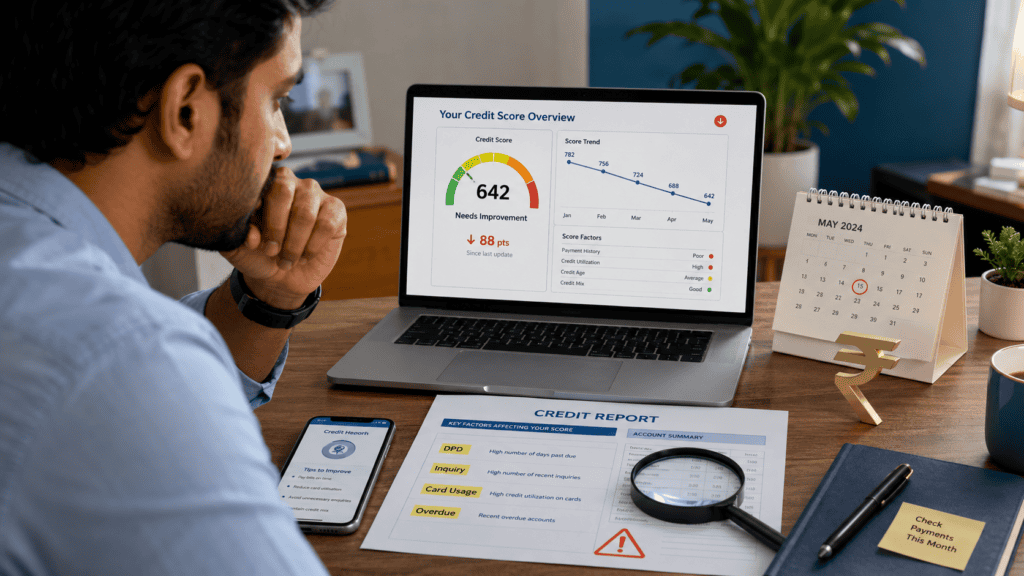
You checked your CIBIL score expecting it to be stable — maybe even a little better since last time — and instead it dropped. Sometimes by a lot, sometimes for no reason you can immediately point to. If you’re about to apply for a personal loan or a new credit card, that drop feels worse than it probably is, because every point suddenly seems to matter.
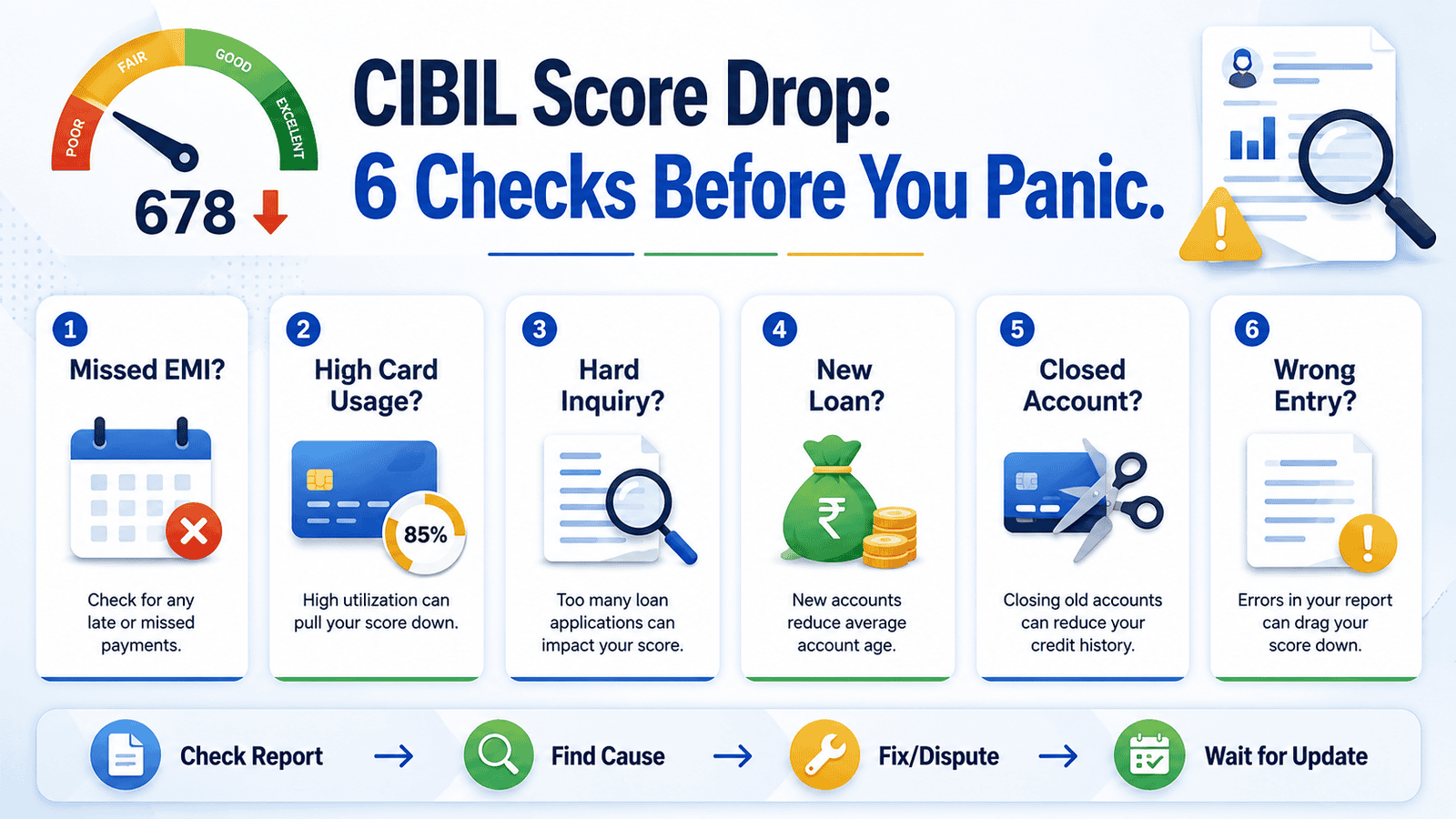
Here’s the reassuring part: a sudden CIBIL score drop almost always has a traceable cause. It usually comes down to one of six things — a missed EMI, high credit card usage, a fresh hard inquiry, a new loan account, a closed account, or an entry your lender reported incorrectly. The score itself doesn’t move randomly; it reacts to what banks, NBFCs, and card issuers report to the bureau.
What you shouldn’t do is panic and start applying to three more lenders hoping one approves you — that usually adds fresh hard inquiries and makes things worse. This guide walks you through exactly where to look in your credit report, what’s normal movement versus what needs action, and what to do next depending on what you find.
Quick Answer: Why Did My CIBIL Score Drop Suddenly?
Why did my CIBIL score drop suddenly? It usually happens because of a missed EMI, high card usage, a hard inquiry, a new loan account, account closure, or wrong lender reporting. Check DPD, overdue amount, credit limit usage, and inquiry sections before applying again or raising a dispute.
Immediate Action Process: What to Do Right Now
Before you do anything else — including applying for a new loan or card — work through this sequence. It takes about 20 minutes and tells you whether you have a genuine repayment issue or a reporting one.
Step 1 — Pull your latest report, not just the score
The score number alone won’t tell you why it moved. You need the full report, which breaks down every account, its status, and any new inquiries.
Step 2 — Check the DPD and overdue columns first
DPD stands for Days Past Due. If any account shows a non-zero DPD or an overdue amount, that’s very likely your answer.
Step 3 — Check your credit card outstanding against your limit
If your reported outstanding is a large share of your limit at the time of reporting, that alone can pull your score down — even with zero late payments.
Step 4 — Check the inquiries section
Multiple loan or credit card applications in a short window show up as hard inquiries, and a cluster of these is a common, often-overlooked cause.
Step 5 — Look for anything that simply looks wrong
An account you closed still showing active, an amount you paid still showing overdue, or a loan you never took — these need a dispute, not a wait-and-watch approach.
Once you’ve identified which of these applies, the rest of this guide tells you exactly what to do.
Key Takeaways
- Checking your own CIBIL score is a soft inquiry and does not lower your score — only lender-initiated hard inquiries after a loan or card application can have an impact.
- An EMI you paid can still show as late in your report if your lender reported it with a delay or made an error — the report reflects what was submitted, not your bank statement.
- Using a large share of your credit card limit can lower your score even if you never miss a due date, because utilisation is reported as of your statement date.
- A wrong entry — overdue after payment, a closed loan shown active, or an account that isn’t yours — should be disputed with proof, not assumed to be a glitch that fixes itself.
- Applying to multiple lenders right after noticing a drop adds fresh hard inquiries on top of whatever caused the original drop, often making your profile look worse, not better.
- A drop after closing an old loan or credit card is common and usually temporary, tied to how your account mix and average account age shift.
Key Facts at a Glance
| Cause of Drop | Where to Check | First Action |
|---|---|---|
| Missed EMI / DPD entry | Account-wise DPD & overdue column | Pay overdue immediately if genuine |
| High card utilisation | Outstanding vs. limit on card account | Pay down balance before next statement date |
| Hard inquiry | Enquiries / inquiries section | Pause new applications for now |
| New loan account | Account summary, recently opened | No action — let it season on the report |
| Closed account | Account status field | Confirm status is “closed,” not “settled” |
| Wrong reporting | Status, overdue amount, or account details | Collect proof and raise a dispute |
Why Did My CIBIL Score Drop Suddenly: The Six Real Reasons
Your CIBIL score is calculated from data that banks, NBFCs, and card issuers send to the bureau — not from what you remember paying. That distinction matters more than almost anything else in this article, because it explains why borrowers who believe they’ve done everything right still see a drop.
1. A missed EMI or a DPD entry
DPD, or Days Past Due, is the field in your report that shows how late a payment was against a specific account — 30, 60, 90 days, and so on. Even one missed or delayed EMI can create a DPD entry, and that single entry is one of the heaviest single-cause drops you’ll see in a credit report.
2. High credit card utilisation
Utilisation is simply how much of your sanctioned credit limit you’re using, expressed as a percentage, calculated as of the date your card issuer reports to the bureau — usually your statement date. Spending heavily in one cycle, even if you intend to pay the full bill on time, can show as high utilisation before your payment is reflected.
3. Multiple hard inquiries
A hard inquiry is created when a lender pulls your credit report because you applied for a loan or card. This is different from soft and hard inquiries you generate by checking your own score, which don’t affect it. Several hard inquiries close together — say, applying to four lenders in two weeks — can signal credit-hungry behaviour to a bureau’s model.
4. A new loan or credit card account
Opening a new account changes your average account age and your overall credit mix, both of which factor into your score. This is usually a small, temporary effect rather than a major drop, but it often coincides with other changes — like a hard inquiry from the same application — making the combined impact feel larger.
5. A recently closed account
Closing a loan or card you’ve held for years can shift your account age and mix in ways that mildly affect your score, even though closing a loan is, financially, a good thing. This is one of the more confusing drops for borrowers because it follows a responsible action.
6. Wrong status reported by a lender
Lenders sometimes report incorrectly — a closed loan still shown as active, a paid EMI still flagged overdue, or an account status marked incorrectly after a dispute or settlement. This is the one cause that genuinely isn’t your fault, and it’s the one where a dispute, not patience, is the right next step. You can check your report free to confirm exactly what’s been reported before assuming anything.
Definitions worth keeping handy: DPD (Days Past Due) tracks lateness on a specific account; utilisation is outstanding-to-limit on revolving credit; a hard inquiry is lender-triggered and visible to other lenders, unlike a soft inquiry; and account status (active, closed, settled, written-off) describes the current state a lender has reported for that account.
Real Example: Rohit’s Sudden Score Drop in Pune
Rohit, 31, works in IT in Pune and earns around ₹65,000 a month. He’s planning to apply for a personal loan to fund a home renovation and pulls his CIBIL report first — standard practice he’s read about. The score has dropped noticeably since he last checked it four months ago, and his first reaction is that something’s gone wrong with his account.
Instead of guessing, he goes through the report section by section. His EMI payments all show zero DPD — no late marks anywhere. But his credit card account tells a different story: he used his card heavily for a family event two months ago, and the outstanding at the time his issuer reported to the bureau was a large share of his sanctioned limit. He’d paid the bill in full before the due date, but the high outstanding had already been reported before his payment cleared.
He also notices two hard inquiries from when he was comparing personal loan offers across apps a few weeks earlier — each application had pulled his report separately.
Rohit’s takeaway: nothing here needed a dispute. His utilisation had been temporarily high at the reporting date, and his inquiries reflected genuine loan shopping. His plan is to keep his card outstanding low for the next billing cycle and hold off on further applications until his next report refresh shows the improvement.
What You’ll Need to Diagnose the Drop
Before you start checking, gather these — it makes the diagnosis faster and gives you a record to refer back to if you need to dispute anything later.
- Your latest CIBIL report (full report, not just the score)
- A previous report or score screenshot, if you have one, for comparison
- A list of your active loan and credit card accounts
- EMI payment receipts or bank statement entries for the past few months
- Your credit card statement showing limit and outstanding
- NOC or loan closure letter, if you’ve recently closed any account
This isn’t a loan eligibility checklist — think of it as what you’d hand a doctor before a diagnosis. The more of this you have ready, the faster you’ll know whether to act or wait.
How Credit Utilisation Can Move Your Score Quickly
Say your credit card has a sanctioned limit of ₹1,00,000 (illustrative figure — check your actual card limit on your statement). For most of the year your outstanding hovers around ₹25,000, a comfortable 25% utilisation. Then one month — a wedding gift, a medical expense, a big purchase — your outstanding climbs to ₹80,000 before your statement date. That’s 80% utilisation, reported to the bureau exactly as it stood that day.
You pay the bill in full a week later, well before your due date, with zero interest charged and zero late marks. But the bureau doesn’t see “paid in full a week later” — it sees the 80% snapshot from your statement date, because that’s what your issuer reported. High utilisation can pull your score down on its own, independent of whether you ever miss a payment.
The fix isn’t complicated: pay down a large purchase before your statement date rather than just before your due date, so a lower outstanding gets reported. The improvement isn’t instant — it shows up only after your issuer reports the next cycle’s lower figure. Understanding your card utilisation ratio in more depth will help you manage this proactively, especially around big-ticket spending months.
Comparison: Normal Score Movement vs Issues That Need Action
| Situation | Likely Meaning | Action Needed |
|---|---|---|
| Self-checked score (soft inquiry) | No real impact | None — this is routine |
| 2–3 hard inquiries from loan shopping | Mild, temporary | Pause further applications for now |
| Genuine missed EMI / real DPD | Serious | Pay overdue, then rebuild patiently |
| Paid EMI still showing overdue | Wrong reporting | Raise a dispute with payment proof |
| Closed loan shown as active | Wrong reporting | Contact lender, then dispute if unresolved |
| Settled or written-off status | Needs careful handling | Understand the difference before acting — see DPD meaning explained |
Safety Checklist Before You Do Anything Else
Before You React to a Score Drop
- Do not apply to multiple lenders right after seeing a drop — each application can add a fresh hard inquiry.
- Do not ignore a genuine overdue amount hoping it disappears on its own — it won’t, and the DPD entry stays on record.
- Do not dispute an entry just because it’s negative — disputes work for incorrect data, not for accurate information you simply dislike.
- Do not pay anyone promising “guaranteed CIBIL repair” or instant score increases for a fee — no third party can alter accurate bureau data for money.
- Do keep every payment receipt, NOC, and closure letter — you’ll need proof if you ever raise a dispute.
How to Decide What’s Right for You
your utilisation was high on the reporting date and all EMIs are current — pay down your outstanding and wait for the next reporting cycle to reflect it.
you see two or more hard inquiries from recent applications — pause new loan or card applications for a few months rather than applying again immediately.
a DPD entry is genuine — clear the overdue amount in full and focus on consistent on-time payments going forward; there’s no shortcut around this.
you find an account status, overdue amount, or personal detail that’s factually wrong — escalate to the lender first, then to the bureau, with documentary proof.
the drop coincides with closing an old loan or card — monitor your next report before applying for new credit, rather than assuming something’s broken.
you can clearly identify the cause from your report — don’t guess or apply for more credit to “test” your score; pull the report again and go through each section methodically first.
Common Mistakes to Avoid
Common Mistakes to Avoid
Applying to multiple lenders right after the drop
Treating a dropped score as a reason to “try your luck” with several applications at once.
Each application can trigger a separate hard inquiry, and a cluster of inquiries in a short window is itself a contributing cause of score drops — you risk compounding the very problem you’re trying to escape, and a rejected application can also create its own visible trail.
Identify the cause first, fix or dispute it, and apply to one well-matched lender only once you understand your current profile.
Assuming every drop is a bureau mistake
Jumping straight to “the bureau got it wrong” without checking the report.
Most drops trace back to genuine causes — utilisation, inquiries, or a real DPD — not bureau error. Disputing accurate information wastes time and delays the real fix, which might be paying down a balance or simply waiting out a reporting cycle.
Go through your report line by line before concluding anything is wrong.
Paying a settlement without understanding the report impact
Agreeing to “settle” a loan for less than owed just to close it quickly, without knowing how that gets reported.
A settled account is typically reported differently from a fully closed one and can weigh on your profile for a longer period — this is a meaningfully different outcome from full repayment, and it’s not always explained clearly at the time of settlement.
Ask the lender exactly how the account will be reported before agreeing to settle, and get it in writing if possible.
Ignoring credit card utilisation entirely
Believing only late payments affect your score, and treating “I pay in full every month” as immunity from any score movement.
As Rohit’s example shows, a high outstanding at the reporting date can lower your score even with perfect payment behaviour — the bureau sees a snapshot, not your full-month intent.
Keep your reported outstanding lower by paying down large purchases before your statement date, not just before the due date.
Not checking account-wise details
Looking only at the headline score number and skipping the account-by-account breakdown.
The score is a summary — the real answer to “why did it drop” almost always sits in one specific account’s DPD, status, or utilisation field, not in the topline number itself.
Always open the full report and review each account individually, not just the score page.
Disputing without proof
Raising a dispute based on memory alone, without payment receipts, NOC, or closure letters attached.
Disputes without documentary backing take longer to resolve and are more likely to be rejected, leaving the incorrect entry in place for longer.
Gather every relevant document — receipts, bank statements, NOC, closure letter — before filing.
Confusing a closed account with a settled one
Treating “closed” and “settled” as the same outcome on a credit report.
They are reported differently and carry different weight — a closed account reflects full repayment, while a settled account reflects partial recovery, and lenders read these very differently on future applications.
Check the exact status field on your report rather than assuming based on what you remember agreeing to.
When This May Not Be the Right Choice
When This May Not Be the Right Choice
Self-diagnosing your score drop using this guide works well for the common causes above. It may not be enough if your situation involves any of the following:
- You suspect identity mix-up or fraud — accounts or inquiries you genuinely never opened or applied for.
- Multiple incorrect entries across different lenders at once, suggesting a deeper data issue rather than a single reporting error.
- A serious default, settlement, or written-off status that’s affecting major financial decisions, like a home loan application.
- You’ve been rejected for credit and have an urgent funding need — a self-diagnosis process takes time you may not have.
- The situation has moved into legal or recovery-agency territory, where the right move is professional or legal guidance, not a DIY report review.
If any of these apply to your situation, it may be worth exploring other options before committing.
Official Rules and Where to Verify
Your CIBIL score is calculated by TransUnion CIBIL using data reported by your lenders — it isn’t something IndiLoan, or any third party, can adjust or guarantee. Because different bureaus can hold slightly different data at any given time, your score may not be identical across all of them.
- TransUnion CIBIL — primary source for your CIBIL score, full report, and dispute process
- Experian India — useful for comparing how your data appears across bureaus
- CRIF High Mark — another bureau where lender-reported data may differ slightly
- Equifax India — relevant if you want to cross-check your profile across all four bureaus
Credit reporting rules, lender assessment methods, and bureau processes can change. Always verify current details from the relevant bureau, lender, or official regulatory source before acting.
Expert Tips
- Keep your reported credit card utilisation comfortably low — well under your full limit — in the months before you plan to apply for a major loan, since that figure is what gets reported on your statement date, not your year-round average.
- Space out loan and credit card applications rather than comparing multiple offers in the same week — each application is a separate hard inquiry, even if you don’t accept the offer.
- Always collect your NOC or closure letter the moment you finish repaying a loan — don’t wait until you need it for a dispute months later.
- Pull a fresh report after any dispute resolution or account closure to confirm the update actually reflects what you expected.
- Treat score-building as a steady habit — consistent on-time payments and low utilisation over several months — rather than a problem to fix with one big action.
- If you’re unsure whether an entry needs a dispute or just patience, check it against your own records first before contacting the lender.
Frequently Asked Questions
Why did my CIBIL score drop suddenly even after paying on time?
Even with on-time EMI payments, high credit card utilisation at your statement date, a recent hard inquiry, or a newly opened or closed account can lower your score. Check your full report — not just the score — to identify which applies to you.
Can checking my own CIBIL score reduce it?
No. Checking your own score is a soft inquiry and does not affect your CIBIL score. Only hard inquiries, triggered when a lender pulls your report after you apply for credit, can have an impact.
How much can my CIBIL score drop after one missed EMI?
The exact point impact varies and depends on your overall profile and the bureau’s scoring model, so it can’t be stated as a fixed number. What’s certain is that a missed EMI creates a DPD entry on that account, which is one of the more significant negative factors a report can carry.
Can high credit card utilisation reduce my CIBIL score?
Yes. If your outstanding balance is a large share of your sanctioned limit on the date your issuer reports to the bureau, it can lower your score — even if you pay your bill in full before the due date with no late fees.
What should I do if my CIBIL report has a wrong loan entry?
First, gather proof — payment receipts, NOC, or a closure letter. Then contact the lender directly to correct it at source. If it isn’t resolved, you can raise a credit dispute with the bureau, attaching your supporting documents.
How long does it take for a CIBIL score to recover?
There’s no fixed timeline — recovery depends on the cause, your ongoing repayment behaviour, and how lenders report future cycles. A utilisation-driven drop can improve as soon as your next reporting cycle reflects a lower balance; a genuine DPD entry typically takes sustained, consistent repayment over time.
Can loan closure reduce my CIBIL score temporarily?
Yes, this can happen. Closing a loan or card changes your account mix and average account age, which can cause a small, usually temporary dip even though repaying and closing a loan is a financially sound decision.
Is a settled loan the same as a closed loan on my CIBIL report?
No. A closed account reflects full repayment, while a settled account reflects partial recovery agreed with the lender. They’re reported differently, and a settled status can carry more weight on future credit applications than a fully closed one.
Should I apply for a new loan right after my score drops?
It’s generally safer to identify the cause first. Applying immediately adds another hard inquiry on top of whatever caused the drop, and if the underlying issue — like high DPD or utilisation — isn’t resolved, the new application is also more likely to face rejection.
Final Verdict
A sudden CIBIL score drop is almost never random — it’s usually traceable to a missed EMI, high card utilisation at the reporting date, a cluster of hard inquiries, a new or closed account, or genuinely wrong lender reporting. The right first move is always the same: pull your full report, not just the score, and check DPD, overdue amounts, utilisation, and inquiries section by section before doing anything else.
If you find a genuine issue — an overdue amount or high utilisation — fix it directly and give your next reporting cycle time to reflect the change. If you find something incorrect, gather your proof and raise it with the lender and bureau rather than assuming it’ll resolve itself. For a longer-term plan once you’ve identified your cause, IndiLoan’s score improvement plan walks through what steady rebuilding looks like over six months.
Always verify your latest credit report, lender requirements, and bureau process before making a credit-related decision.
This article is for educational purposes only and should not be treated as personalised financial, credit, or legal advice. Credit scores, credit reports, lender eligibility criteria, and bureau processes can vary and may change over time. Please verify current details with the relevant credit bureau, lender, official regulatory source, or a qualified professional before making any credit-related decision.

Neha Menon writes simple, borrower-first explainers on CIBIL scores, credit reports, bureau disputes, DPD, loan settlement impact, hard inquiries, and practical credit score recovery. She focuses on helping Indian borrowers understand lender-reported data, avoid credit mistakes, and take safer next steps without false promises.