

You’ve probably heard this warning from a friend or relative: “Don’t keep checking your CIBIL score — it’ll come down.” So you avoid your own credit report for months, even though you’re about to apply for a credit card or a personal loan. That fear is misplaced, and it’s costing you visibility into your own financial health. Checking your own CIBIL score works differently from a bank checking it when you apply for credit — and mixing the two up is where the real damage happens. This article separates the two clearly, shows you when a credit check actually matters, and tells you what to do if your report shows something you don’t recognise.
Quick Answer: Does Checking Your Own CIBIL Score Reduce It?
Does checking CIBIL score reduce it is usually answered no when you check your own score; that is treated as a soft inquiry. A lender check during a loan or credit card application is a hard inquiry and may affect your score, especially if repeated within a short period.
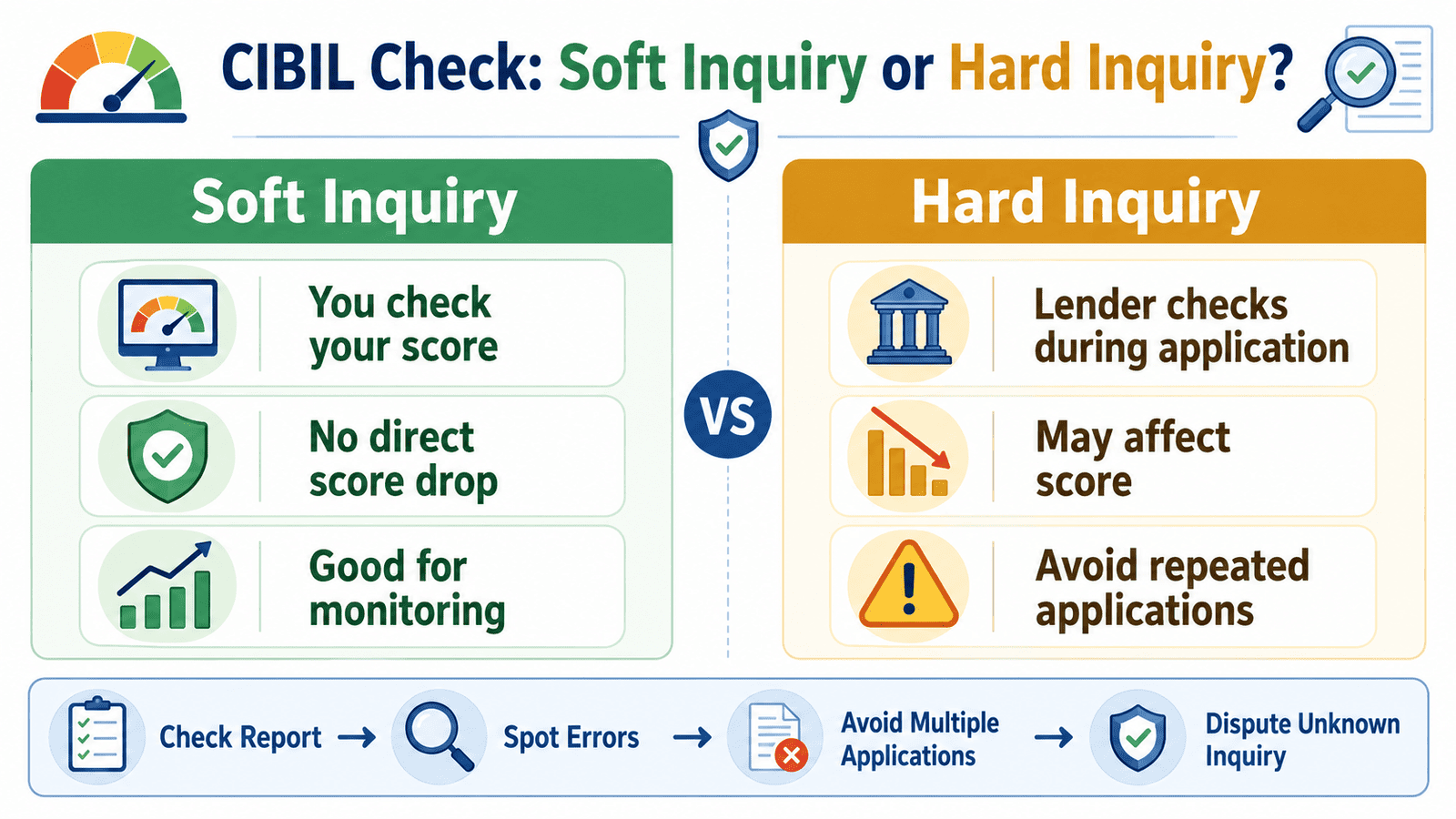
Key Takeaways
- Checking your own CIBIL score is a soft inquiry and is generally not factored into your score the way a lender’s check is.
- A hard inquiry happens when a bank or NBFC checks your credit report because you applied for a loan or credit card.
- If your score drops around the same time you checked it, the real cause is usually a missed EMI, high utilisation, or a fresh lender update — not the act of checking.
- Applying to several lenders in a short window can make your profile look credit-hungry, even if each individual application is routine.
- If you spot an inquiry you don’t recognise, verify it against your recent applications before assuming it’s an error or fraud.
- Regular self-monitoring through an official bureau or trusted platform is one of the few genuinely free tools available to a borrower.
Key Facts at a Glance
| Situation | Inquiry Type | Caution Level |
|---|---|---|
| You check your own score on TransUnion CIBIL or a finance app | Soft inquiry | Low — safe to do regularly |
| You apply for a personal loan | Hard inquiry | Moderate — expected, but avoid repeating it across many lenders |
| You apply for a credit card | Hard inquiry | Moderate — same caution as a loan application |
| You see an inquiry from a lender you don’t remember applying to | Unclear — needs verification | High — check before assuming fraud |
| A bank does a pre-approval check for a marketing offer | Usually a soft inquiry | Low — but confirm with the bank if unsure |
Soft Inquiry vs Hard Inquiry: What Actually Happens When Your Credit Is Checked
Every time someone looks at your credit report — you, a bank, an app — it gets logged as an inquiry. But not all inquiries are treated the same way, and that distinction is the entire answer to whether checking your CIBIL score reduces it.
What a soft inquiry is
A soft inquiry happens when you check your own score, or when a lender does a preliminary check without you formally applying for credit — like a pre-approved offer screening. It’s recorded for your own visibility, but it isn’t treated as a signal that you’re actively seeking new debt. You can check your score for free through an official bureau or a trusted finance platform without it working against you.
What a hard inquiry is
A hard inquiry happens when you formally apply for a loan, credit card, or similar credit product, and the lender pulls your report to assess you. This is logged differently because it signals you’re actively seeking credit right now. One hard inquiry rarely moves the needle much on its own — but several in a short window start to paint a picture lenders read as risk.
Why lenders check inquiries at all
When a bank or NBFC evaluates your application, they’re not just looking at your score — they’re looking at your recent inquiry pattern. Four credit card applications in six weeks tells a different story than one personal loan application after a year of stability. It’s less about the number and more about what the pattern suggests about your need for credit right now. For a deeper look at how this works mechanically, see our explainer on soft and hard inquiries.
Why self-monitoring is still worth doing
Since checking your own score doesn’t carry the same weight as a hard inquiry, there’s little reason to avoid it. Regular monitoring is how you catch a wrongly reported overdue account, an inquiry you didn’t authorise, or a utilisation creep before it becomes a problem at application time — not after you’ve already been rejected.
Real Example: Why Priya’s Score Looked Lower Right After She Checked It
Priya, 31, works as a marketing executive in Pune earning around ₹62,000 a month. She has one credit card and a two-year-old personal loan she’s been paying on time. Three weeks before applying for a top-up loan, she checked her CIBIL score out of habit — something she does roughly every couple of months.
This time, the number was lower than her last check, and her first instinct was to blame the check itself. But looking closer at her report, she found the real reason: her credit card statement from the previous cycle had been reported with a higher outstanding balance than usual, because she’d used the card for a family medical expense and hadn’t paid it down before the billing cycle closed. That utilisation spike — not the score check — is what moved the number.
Priya’s situation is common enough that it has its own explainer: if your number has changed and you’re not sure why, our guide on a sudden score drop walks through how to trace the actual cause from your report instead of guessing. The insight worth taking from her case: the timing of a drop and the cause of a drop are often two different things, and your report — not your memory — tells you which is which.
Before You Check: A Few Things to Keep in Mind
Checking your score responsibly takes almost nothing — but a few habits make the process safer and more useful.
- Most bureaus and finance platforms ask for basic identity verification — typically PAN and a registered mobile number or email — before showing your score. The exact verification steps can vary by platform.
- Stick to the official bureau website or a finance platform you recognise and trust, rather than an unfamiliar link shared over SMS or WhatsApp.
- Download or save a copy of your report when you check it, so you have a reference point the next time you check and want to compare.
- Go through the report properly — not just the headline score. Look at account status, inquiry history, overdue amounts, and your personal details for accuracy.
- Never share an OTP or your full report with anyone who contacts you promising to “improve” your score for a fee.
You can check your score for free through TransUnion CIBIL’s own platform, which is the most direct way to avoid third-party data-handling concerns.
Comparison: Self-Check vs Lender/Application Check
| Factor | Self-Check | Lender/Application Check |
|---|---|---|
| Who initiates it | You | Bank, NBFC, or card issuer |
| When it happens | Any time you check your own report | When you submit a loan or credit card application |
| Linked to a credit application? | No | Yes |
| May affect your score? | Generally no | Possibly, especially if repeated |
| What you should do | Check regularly to monitor your report | Apply only when you’re reasonably confident, and space out applications |
What to Do If You See an Unknown Inquiry on Your Report
Finding an inquiry you don’t recognise is unsettling, but it doesn’t automatically mean fraud — and it’s not something to ignore either. Work through it methodically.
Step 1 — Don’t panic, and don’t ignore it
An unfamiliar entry could be a legitimate inquiry from an application you’ve forgotten about — a marketplace eligibility check, a co-applicant loan, or a card you applied for through a comparison platform that routed it to a lender.
Step 2 — Match it against your recent activity
Think back over the last few months: did you apply through a bank branch, an NBFC, a card issuer, or an aggregator site? Inquiries can sometimes appear under a lender’s formal name rather than the brand you recognise, which is a common source of confusion rather than fraud.
Step 3 — Check the inquiry date and lender name carefully
Your report typically shows the date and the name of the entity that pulled it. Cross-check this against your own records or messages from around that date.
Step 4 — Contact the lender or the bureau directly if it still looks unfamiliar
If you genuinely can’t place the inquiry, reach out to the lender named in the report, or escalate to the bureau. Use official contact channels only — never a number or link from an unsolicited message.
Step 5 — Raise a dispute if the report has incorrect information
If you’ve confirmed an entry is genuinely wrong — not just unfamiliar — you can raise a dispute with the bureau. Our report dispute process guide walks through the steps in detail. Keep in mind that legitimate inquiries you simply forgot about will remain on your report — disputes only correct genuine errors.
Safe CIBIL Monitoring: What to Avoid
Safety Checklist
- Don’t apply to five lenders in a month just to “see who approves you” — each application is a hard inquiry, and the pattern itself can work against you. See our guide on multiple loan applications for how this adds up.
- Don’t enter your PAN, mobile number, or report details on a website you reached through an SMS link or social media ad you don’t recognise.
- Don’t share an OTP with anyone — including someone claiming to be a “credit consultant” who can boost your score quickly.
- Don’t pay anyone who guarantees they can remove a legitimate inquiry or guarantee a specific score increase — no one outside the bureau and the lender controls what’s reported.
- Do check your report before any major application, so you’re applying with full knowledge of where you stand rather than finding out after rejection.
How to Decide What’s Right for You
you’re planning to apply for a loan or credit card in the next few weeks — check your report now so you can fix anything obvious before the lender sees it.
you’ve recently closed a loan or credit card — check your report a few weeks later to confirm it’s reported as closed, not just paid.
you suspect fraud or notice unfamiliar activity — check immediately and follow the unknown inquiry steps above rather than waiting for your usual check-in.
you’re actively working on rebuilding your credit profile — check periodically, every couple of months, to track whether your repayment behaviour is reflecting in your report.
you’ve just been rejected or your report shows an overdue entry — don’t immediately apply elsewhere. Pause, understand why, and fix what you can first.
Common Mistakes to Avoid
Avoiding your score entirely out of fear
Some borrowers stop checking their CIBIL score altogether, believing that not looking keeps it “safe.”
This backfires because it means errors, overdue entries, and fraud-related inquiries can sit unnoticed for months, surfacing only when you’re rejected for the loan you actually needed.
Check periodically through an official source instead of avoiding it.
Applying to multiple lenders to “test” approval
Submitting applications to several banks or NBFCs at once to see who says yes first.
Each application is a hard inquiry, and a cluster of them in a short period can make your profile look credit-hungry to the next lender evaluating you — sometimes leading to rejection where a single, well-timed application might have succeeded.
Research eligibility criteria first, then apply selectively to one or two lenders you’re confident about.
Blaming the check for a score drop that happened anyway
Assuming that because the score was lower right after you checked it, the check itself caused the drop.
This leads borrowers to avoid future checks, missing the real cause — often a missed payment, rising utilisation, or a new hard inquiry that simply got reported around the same time.
Open the full report, not just the score, and trace what actually changed.
Ignoring an unfamiliar inquiry instead of verifying it
Seeing an inquiry you don’t recognise and assuming it’ll sort itself out.
If it’s a genuine error, it can sit on your report and affect how future lenders read your file; if it’s fraud, ignoring it gives it more time to cause damage.
Verify against your recent activity, then escalate to the lender or bureau if it remains unexplained.
Trusting agents who promise quick score repair
Engaging with someone who claims they can raise your score by a fixed number of points within days.
No third party controls bureau scoring — these services often charge a fee for advice you could get free, or worse, ask for sensitive data under false pretences.
Work directly with the bureau or lender, and treat any “guaranteed” score-repair offer as a red flag.
Checking through unverified websites
Using a score-check link from an SMS, WhatsApp forward, or unfamiliar app instead of an official bureau or recognised finance platform.
These sites can harvest your PAN, mobile number, and report data for purposes that have nothing to do with credit monitoring.
Stick to TransUnion CIBIL directly, or a finance platform you already use and trust.
When This May Not Be the Right Choice
When This May Not Be the Right Choice
Checking your CIBIL score is rarely the wrong move — but the way and timing of it sometimes is.
Avoid checking through a website or app you can’t verify, especially one that asks for more personal information than a credit check should reasonably need.
Avoid clicking score-check links sent by agents or unsolicited messages promising free credit “boosts” alongside the check.
Avoid applying for new credit immediately if your report shows an overdue amount or an entry you don’t recognise — resolve that first.
Avoid submitting another application right after a rejection without understanding why you were turned down.
If any of these apply to your situation, it may be worth exploring other options before committing.
Official Rules and Where to Verify
Credit scoring and report access in India are governed by the credit bureaus themselves, working from data reported by your lenders. The main sources for verification are:
- TransUnion CIBIL — for your CIBIL score, credit report, and CIBIL-specific terminology
- Experian India — for comparing how another bureau presents score and report data
- CRIF High Mark — for broader Indian credit bureau context
- Equifax India — for understanding why scores can differ across bureaus
If you find an account that doesn’t belong to you or appears incorrectly reported, the dispute channel runs through the bureau and the lender that reported it, not through any third-party app.
Credit reporting rules, lender assessment methods, and bureau processes can change. Always verify current details from the relevant bureau, lender, or official regulatory source before acting.
Expert Tips
Expert Tips
- Check your report a few weeks before any major application — not the day before — so you have time to act if something’s off.
- Track your score over several checks instead of reacting to a single number; a trend tells you more than one data point.
- Read the inquiry section of your report specifically, not just the score, every time you check.
- If your report shows an overdue or disputed entry, resolve it before applying rather than applying and hoping it’s overlooked.
- Keep your loan closure letter or NOC after paying off any loan — it’s your proof if the report takes time to update.
- If you’re rejected, ask the lender for the reason before applying elsewhere — it tells you what to fix first.
Frequently Asked Questions
Does checking my own CIBIL score reduce it?
No, not directly. Checking your own score is treated as a soft inquiry, which is generally not factored into your score the way a lender’s hard inquiry is.
Is a free CIBIL score check a soft inquiry?
Yes. Whether you check through TransUnion CIBIL’s own site or a finance platform offering free score access, it’s recorded as a self-check, not a lender-initiated application check.
Does a bank checking my CIBIL reduce my score?
It depends on the context. If the bank is checking as part of a formal loan or credit card application you’ve submitted, that’s a hard inquiry and may have some effect, particularly if you have several around the same time. A pre-approval or marketing screening is usually a soft inquiry and works differently.
How many times can I check my CIBIL score?
There’s no fixed limit on how often you can check your own score through self-checks — they’re soft inquiries. How frequently you can access a full report for free, however, can depend on the bureau or platform’s current policy, so it’s worth confirming on the bureau’s website.
Why did my CIBIL score drop after I checked it?
The check itself is unlikely to be the cause. More often, a lender reported updated data — like higher utilisation, a missed payment, or a new hard inquiry — around the same time you happened to check, making it look like the check caused the drop.
Can multiple loan applications affect my CIBIL score?
Yes, potentially. Several applications within a short period generate multiple hard inquiries, which can make your profile appear credit-hungry to lenders evaluating a new application, even if each individual application was reasonable on its own.
What should I do if I see an unknown inquiry in my report?
First, check it against your recent applications — it may be a forgotten or differently-named legitimate inquiry. If you still can’t place it, contact the lender named in the report or the bureau directly, and raise a formal dispute if you confirm it’s incorrect.
Final Verdict
The fear behind “does checking CIBIL score reduce it” is understandable but largely misplaced. Checking your own score is a soft inquiry and a habit worth keeping — it’s one of the few ways you get to see your credit file before a lender does. What actually carries weight is the hard inquiry that comes from formally applying for a loan or credit card, especially when several pile up in a short window. The safest approach: monitor regularly, apply selectively, and investigate anything unfamiliar through the bureau directly rather than guessing or panicking.
Always verify your latest credit report, lender requirements, and bureau process before making a credit-related decision.
This article is for educational purposes only and should not be treated as personalised financial, credit, or legal advice. Credit scores, credit reports, lender eligibility criteria, and bureau processes can vary and may change over time. Please verify current details with the relevant credit bureau, lender, official regulatory source, or a qualified professional before making any credit-related decision.

Neha Menon writes simple, borrower-first explainers on CIBIL scores, credit reports, bureau disputes, DPD, loan settlement impact, hard inquiries, and practical credit score recovery. She focuses on helping Indian borrowers understand lender-reported data, avoid credit mistakes, and take safer next steps without false promises.