
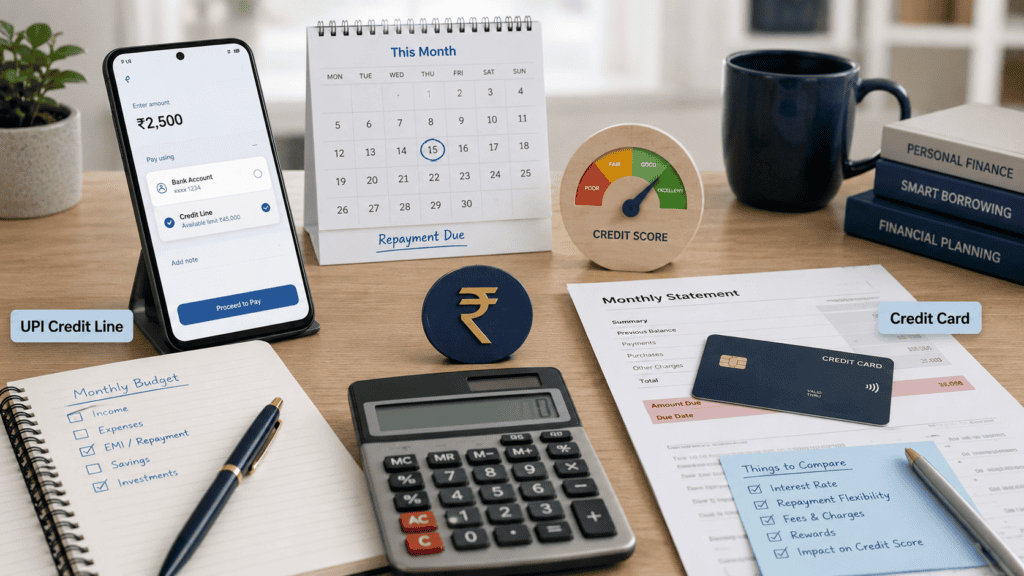
UPI is one of the most trusted payment tools in India — and most users have never once worried about where the money comes from. It comes from your account. That is the whole point. So when a banking or payment app suddenly shows you a “credit line on UPI” option, it is natural to assume it is just another UPI feature — faster, smarter, or maybe even free. It is not. A credit line on UPI lets you make UPI payments using bank-approved borrowed credit, not your own savings balance. That changes everything: the repayment obligation, the possible interest, the late fees, and the credit score impact. This guide explains exactly what a credit line on UPI is, how it works, what it costs, who can get one, and — most importantly — what to check before you ever tap “activate.”
Quick Answer: What Is Credit Line on UPI?
Credit line on UPI is a bank-approved credit facility that lets eligible users make UPI payments from a pre-sanctioned limit instead of savings balance. It needs prior customer consent, bank-set terms, and repayment discipline. Check interest, fees, due date, merchant acceptance, and CIBIL impact before using it.
Key Takeaways
- A credit line on UPI uses borrowed bank-approved credit — not your savings account balance — so every payment creates a repayment obligation you must settle by the due date.
- Approval, credit limit, interest rate, and repayment terms are set by your bank under its board-approved policy; they are not standard across all banks or apps — verify your bank’s current terms before activating.
- Missing the repayment due date may trigger interest charges, late fees, and possible reporting to credit bureaus such as TransUnion CIBIL, Experian, CRIF High Mark, or Equifax — which can affect your credit score.
- Applying for or activating the facility may involve a hard inquiry on your credit report; understand the difference between a hard inquiry score effect before you apply.
- Before using it repeatedly, compare the total cost — interest, APR, processing fee, late fee — with your existing credit card, BNPL options, or a small personal loan.
- This is a credit product, not a payment feature. Treat it exactly as you would treat borrowed money.
Key Facts at a Glance
| Feature | Detail | Borrower Note |
|---|---|---|
| Product type | Pre-sanctioned credit line at a bank, enabled for UPI payments | This is a credit facility, not a UPI wallet feature |
| Regulatory basis | RBI has permitted banks to offer pre-sanctioned credit lines through UPI with prior customer consent (rbi.org.in) | Rules can be updated — verify at rbi.org.in |
| Payment mode | UPI — you pay eligible merchants using a UPI QR or ID | Not all merchants or apps may support this — verify with your bank |
| Source of funds | Bank-approved credit limit — borrowed money, not savings balance | Every transaction creates repayment obligation |
| Repayment | As per bank-set terms: repayment period, interest rate, and billing cycle vary by bank | Check your bank app or Key Fact Statement for current terms |
| Interest / charges | Interest rate, processing fee, late fee, GST — all vary by bank and product | Verify current figures from your bank before using |
| Credit bureau impact | Usage and repayment behaviour may be reported to credit bureaus depending on bank/product structure | Missed repayment may affect your CIBIL or Experian score |
| Customer consent | Required before the credit line is linked to your UPI account, per RBI direction | Do not activate without reading the terms |
What Is Credit Line on UPI?
A credit line on UPI is a pre-sanctioned credit facility offered by a bank that is linked to your UPI account as a funding source. Instead of debiting your savings or current account when you pay by UPI, the payment is drawn from a credit limit the bank has approved for you. You then repay that amount to the bank within the repayment period the bank has set — along with any applicable interest or fees.
The Reserve Bank of India (RBI) permitted Scheduled Commercial Banks to enable pre-sanctioned credit lines at banks through UPI. The key conditions under RBI’s direction include prior customer consent before the facility is activated, and bank-set terms covering the credit limit, repayment period, and rate of interest — all governed by the bank’s board-approved policy. NPCI (npci.org.in), which operates the UPI ecosystem, has built the product-level infrastructure to support this functionality.
In plain borrower language: the bank decides whether you qualify, how much credit limit you get, what interest rate applies, and when you must repay. You consent to these terms. You then use UPI normally — but instead of your savings balance going down, your credit limit is drawn upon. The obligation to repay stays with you.
Step 1 — Bank Approves or Offers a Credit Limit
The bank assesses your eligibility based on its internal policy — which may consider your account history, income, existing obligations, credit profile, and repayment behaviour. Not every bank customer will receive this facility, and the approved limit will vary by customer. “Pre-sanctioned” means the bank has already determined you may qualify — it does not mean approval is guaranteed or that the credit is free.
Step 2 — You Consent and Link the Credit Line in Your UPI App or Bank App
Before the credit line becomes active as a UPI funding source, the bank must obtain your explicit prior consent. This is an RBI requirement. The activation usually happens through your bank’s app, net banking, or a linked UPI app where the bank has integrated the product. Read the terms — interest rate, credit limit, repayment period, fees — before consenting.
Step 3 — You Pay Eligible Merchants Using UPI
Once linked, you can select the credit line as your funding source when making a UPI payment — instead of selecting your savings account. The merchant receives their payment as normal through UPI infrastructure managed by NPCI. Not all merchants, apps, or banks may support this functionality; check your bank’s current list of supported use cases.
Step 4 — You Repay the Bank by the Due Date
The amount drawn from your credit line is now a debt. Your bank will set a repayment period, billing cycle, and due date — similar in concept to a credit card billing cycle. Repay by the due date to avoid interest and late fees. If you miss the due date or pay partially, the bank may charge interest on the outstanding balance, a late payment fee, and GST on those charges. Repeated non-payment may be reported to credit bureaus.
Real Example: Rohan’s Month-End Mistake
Rohan, 29, is a salaried IT professional in Pune earning ₹55,000 per month. He uses UPI for nearly everything — groceries, petrol, food delivery, and small merchant payments. In late March, his savings account shows only ₹2,000 remaining a week before his salary credit. He notices a “credit line on UPI” option in his banking app showing a limit of ₹15,000 — and assumes it is just a UPI overdraft that will auto-adjust when his salary arrives.
He spends ₹5,000 over four days using the credit line — groceries, a pharmacy bill, and one restaurant payment. He does not read the terms. The repayment due date is the 5th of the following month, well before his 10th salary credit. The interest rate and late fee applicable to his credit line vary based on his bank’s current policy — figures he did not check before activating.
If Rohan repays the full ₹5,000 before the due date: the cost may be nil or minimal depending on his bank’s interest-free window — but only if his bank offers one and he confirms this in writing. If he repays after the due date: interest charges and a late fee will apply as per his bank’s current schedule, plus GST. If he misses repayment entirely: the bank may report the overdue amount to credit bureaus, potentially affecting his CIBIL score and future loan eligibility. The key lesson: ₹5,000 spent in four easy UPI taps can quietly become a more expensive obligation if the repayment date passes unnoticed.
Eligibility: Who Can Access a Credit Line on UPI?
Eligibility for a credit line on UPI is determined entirely by the bank offering the product. There is no universal eligibility rule — each bank sets its own criteria under its board-approved policy, as permitted by RBI. Factors that banks may consider include:
- An existing savings, salary, or current account relationship with the bank
- Account vintage and transaction history with the bank
- Internal credit assessment — which may include a check on your credit profile with one or more bureaus
- Income level and employment type — salaried, self-employed, or business account holder
- Existing EMI obligations or loan repayment behaviour on file with the bank
- KYC completion status
- Whether the bank’s UPI app or linked third-party app supports the credit line feature
Applying for or activating this facility may involve the bank pulling your credit report from a bureau — which can count as a hard inquiry and may affect your credit score temporarily. Before applying, read about the hard inquiry score effect so you understand what happens to your credit file.
There is no published minimum credit score or income threshold that applies across all banks — these vary by issuer and can change. If you are shown a “pre-approved” offer inside your banking app, that means the bank’s internal model suggests you may qualify. It still involves a formal consent and may involve a credit check before the limit is confirmed.
How to Calculate the Real Cost of a UPI Credit Line Spend
The total cost of using a credit line on UPI depends on how much you spend, when you repay, and what your bank charges. Here is how to think through it using a ₹5,000 example. All interest rates, fees, and repayment rules in the scenarios below are illustrative placeholders — verify current figures from your bank’s official app, Key Fact Statement, or customer care before using the facility.
Total Cost = Amount Used + Interest (if applicable) + Late Fee (if applicable) + GST on Charges
Where: Interest = Amount Used × Monthly Rate × Months Outstanding | Late Fee = as per bank schedule | GST = 18% on interest and fees (illustrative; verify current rate)
| Scenario | Amount Used | Repayment | Possible Additional Cost |
|---|---|---|---|
| Scenario A: Repaid in full before due date | ₹5,000 | Before bank’s due date | Nil to minimal — confirm whether bank offers an interest-free window for credit line (verify with your bank) |
| Scenario B: Repaid after due date | ₹5,000 | 10–15 days after due date | Interest for overdue days + late fee + GST — all at rates set by your bank (verify before using) |
| Scenario C: EMI conversion (if available) | ₹5,000 | Converted to 3-month EMI | Processing fee + reducing-balance interest for 3 months + GST — if EMI option exists, confirm charges from your bank |
The second scenario — a delayed repayment on a credit line — is where borrowers are most often surprised. A short delay of 10–15 days can add meaningful charges when late fees and interest are both applied. If your bank offers an interest-free repayment window (similar to a credit card’s grace period), confirm this explicitly in writing or in your Key Fact Statement, not from an app notification.
For a ₹10,000 spend used repeatedly over three months without full repayment, the revolving balance grows each month as the outstanding principal remains, interest accrues, and each new spend adds to the total. This is how a small convenience facility can quietly become a significant debt burden — especially if the borrower is using it to bridge a regular monthly cash-flow gap rather than a one-off emergency.
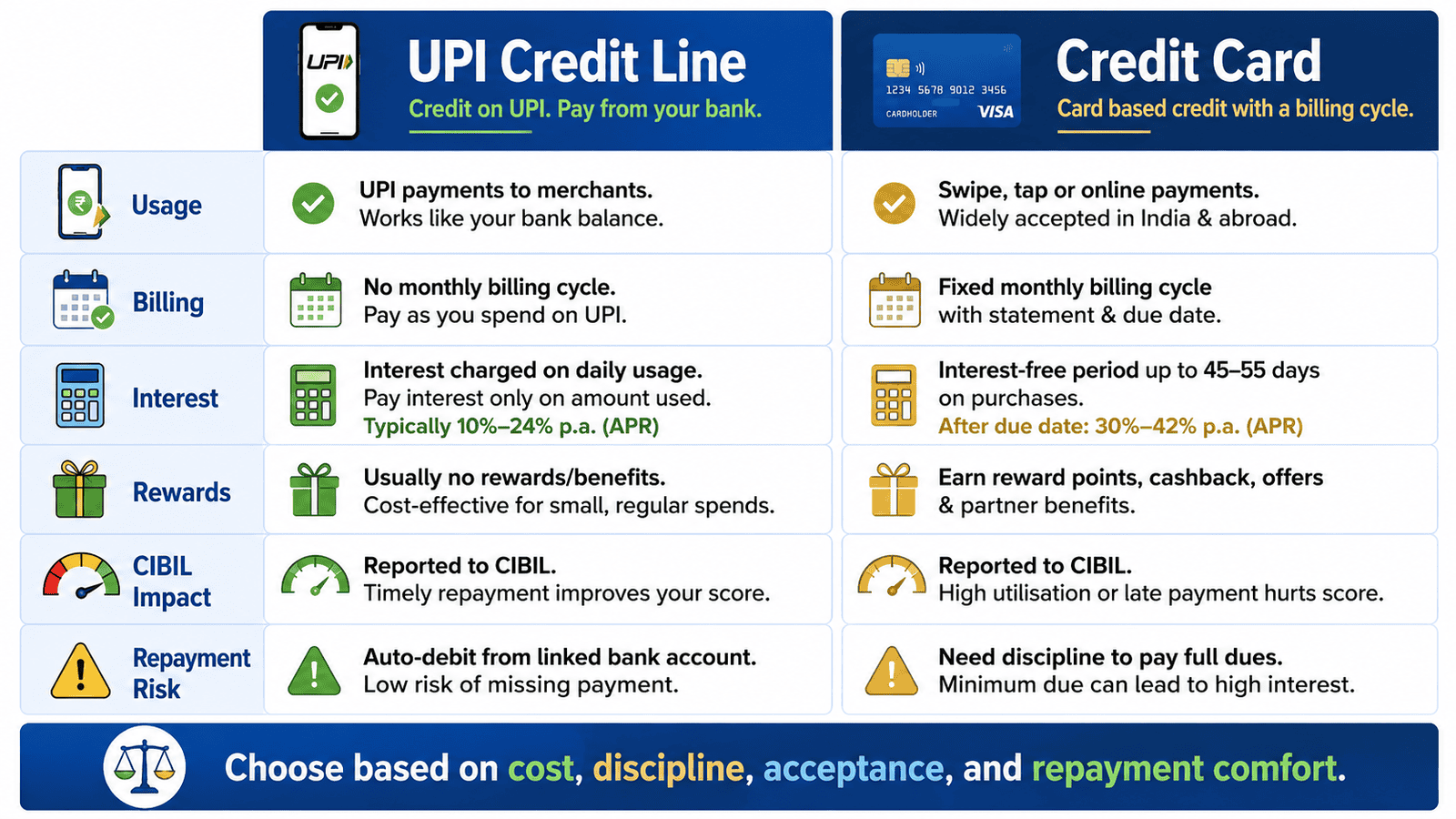
Credit Line on UPI vs Normal UPI vs Credit Card: Key Comparison
Understanding where credit line on UPI sits among your existing payment options is the most important decision check. Here is a direct comparison across the three most common payment modes. For card-based UPI payments, a separate detailed guide covers how linking a credit card to UPI differs from both normal UPI and this credit line facility. For specifics on RuPay card UPI use, including charges and eligibility, see that dedicated guide.
| Feature | Normal UPI (Savings Account) | Credit Line on UPI | Credit Card on UPI (e.g. RuPay) |
|---|---|---|---|
| Source of funds | Your own savings or current account balance | Bank-approved credit limit — borrowed money | Your credit card’s available credit limit |
| Repayment obligation | None — your own money is spent | Yes — must repay bank by due date | Yes — must repay card bill by due date |
| Interest risk | None | Yes — if not repaid on time or per bank terms | Yes — if not repaid in full by due date |
| Late fee risk | None | Yes — as per bank schedule | Yes — as per card issuer schedule |
| Credit bureau impact | None | Possible — depends on bank’s reporting policy | Yes — credit card usage and payment reported to bureaus |
| Rewards / cashback | None (unless linked to a bank offer) | Depends on bank — not guaranteed | Yes — reward points, cashback per card terms |
| Merchant acceptance | All UPI-enabled merchants | May vary — not all merchants or apps support credit line as UPI source | Merchants accepting credit card payments via UPI |
| Product structure | Debit — uses your money | Credit — uses borrowed limit from bank | Credit — uses existing credit card limit |
| Borrower risk | Lowest | Medium — if repayment discipline is weak | Medium — if not repaid in full by due date |
If There Is a Problem: Complaint and Action Steps
Step 1 — Check Transaction Status First
If a credit line payment fails, shows a wrong amount, or does not reflect in your balance: open your bank app or UPI app and check the transaction status. Note the transaction ID, date, amount, and merchant name. Take a screenshot immediately.
Step 2 — Save All Records
Keep a record of: UPI transaction ID, date and time, amount debited from credit line, repayment confirmation screenshots, and any billing statement received. These are your evidence for any dispute or complaint.
Step 3 — Raise a Complaint With Your Bank
Contact your bank’s official customer care — through the app’s complaint section, bank website, or official helpline. Raise the complaint formally in writing, not just on chat. Note the complaint reference number. Most banks have defined timelines for resolution — ask for the timeline in writing when you raise the complaint.
Step 4 — Escalate If Unresolved
If your bank does not resolve the complaint within the stated timeline, you may escalate through official regulatory channels. The RBI Integrated Ombudsman Scheme is available at rbi.org.in for banking complaints. NPCI also has grievance channels at npci.org.in for UPI-related issues. Do not assume the bank will automatically reverse a charge — follow up formally and keep records of every communication.
Borrower Safety Checklist: Before You Activate or Use a UPI Credit Line
- Check the interest rate and APR: Ask your bank for the Annual Percentage Rate — not just the monthly rate. A 2% per month rate is 24% per annum on a reducing balance before fees. Verify from your Key Fact Statement or bank app, not from a marketing message.
- Confirm the repayment due date: Know exactly when you must repay and whether your salary or income arrives before that date. If your salary credit date is after the credit line due date, you risk a late payment every month.
- Check late fee and penalty structure: Ask what happens if you pay one day late. Get this in writing from your bank’s terms and conditions, not from a customer care verbal assurance.
- Understand credit bureau reporting: Ask your bank directly whether credit line usage and repayment will be reported to bureaus such as TransUnion CIBIL (transunioncibil.com) or Experian. If it is, missed payments will affect your credit score.
- Check whether auto-debit or e-mandate applies: Some banks may set up auto-debit from your savings account for the repayment. Ensure your account has sufficient balance on the auto-debit date — a failed auto-debit may trigger additional charges.
- Do not use it for lifestyle overspending: A credit line is a short-term borrowing tool, not a salary supplement. Using it for recurring monthly expenses without a clear repayment source is how debt builds quietly.
- Do not use new credit to pay existing debt: If you are already paying minimum dues on a credit card or carrying a loan EMI, adding a UPI credit line to the same budget creates compounding repayment pressure. Understand the late payment credit impact before combining credit products.
You have a one-off short-term cash need — for example, a medical expense or urgent repair — and your next salary credit is within the bank’s repayment window, and you have checked and confirmed the interest, late fee, and repayment date: a credit line on UPI may be a convenient option.
You already have a credit card with an available limit, you repay your card dues in full every month, and you understand the billing cycle: your existing credit card may be a better option — it already has a structured repayment system and may offer rewards. Compare UPI credit versus card before choosing.
You need ₹15,000 or more for a planned expense and you prefer a fixed monthly EMI over an open credit facility: a small personal loan with a defined EMI and tenure may cost less and be easier to track than a revolving UPI credit line.
You are unsure of the interest rate, have not confirmed your repayment due date, or are planning to use the credit line for regular monthly expenses because your salary is not enough: do not activate. Address the underlying cash-flow gap first — using credit to cover routine shortfalls creates a debt cycle that is harder to exit each month.
You are already carrying a credit card balance and paying only the minimum amount due: adding a UPI credit line increases your total debt burden and creates two repayment dates to track. Fix the existing card balance first before taking on any additional credit product.
When This May Not Be the Right Choice
A credit line on UPI may not suit your situation if any of the following apply:
Your income is irregular or your salary credit date falls after the repayment due date. If you cannot reliably predict when your account will have enough balance to clear the credit line, the risk of a late payment charge and credit bureau impact is real every month.
You are already paying the minimum amount due on one or more credit cards. Adding a UPI credit line to an existing minimum-due habit means two credit products are both compounding interest and fees. This doubles the debt risk without improving your cash position.
You do not fully understand the interest rate, APR, late fee, and repayment date for the specific facility offered by your bank. Activating a credit product without reading the terms is the most common cause of surprise charges.
You intend to use it for discretionary spending — dining out, entertainment, or non-essential shopping. A credit line used for lifestyle expenses with no clear repayment source is a slow debt trap, not a financial tool.
If any of these apply to your situation, it may be worth exploring other options before committing.
Official Rules and Where to Verify
The credit line on UPI product is built on a regulatory framework set by the Reserve Bank of India and the product infrastructure of NPCI. Here is where to verify each layer:
- RBI (rbi.org.in): The RBI has issued directions permitting pre-sanctioned credit lines at banks to be operated through UPI, with prior customer consent as a mandatory condition. Banks must set terms under board-approved policy. Verify the latest RBI circulars and directions at rbi.org.in before relying on any specific rule — regulatory guidance can be updated.
- NPCI (npci.org.in): NPCI operates the UPI platform and has released product-level details on credit line on UPI including supported use cases and ecosystem framework. Check the credit line on UPI section at npci.org.in for current product context.
- Your bank’s official app or website: For current eligibility criteria, credit limit, interest rate, processing fee, late fee, repayment period, auto-debit rules, and grievance process — the only reliable source is your bank’s official app, Key Fact Statement, or customer care. Do not rely on third-party comparison sites or marketing messages for these figures.
- Credit bureaus — for credit score and report impact: TransUnion CIBIL (transunioncibil.com), Experian India (experian.in), CRIF High Mark (crifhighmark.com), and Equifax India (equifax.co.in) are the four licensed credit bureaus. Check your credit report from any of these bureaus to see whether any credit line or inquiry has been recorded after activation.
Credit reporting rules, lender assessment methods, and bureau processes can change. Always verify current details from the relevant bureau, lender, or official regulatory source before acting.
Common Mistakes to Avoid
Treating Credit Line on UPI as a Normal UPI Feature
Normal UPI payments debit your savings account — the transaction is final and there is no repayment. Credit line on UPI draws from borrowed bank credit. Every payment is a debt that must be repaid. Confusing the two is the most common mistake and leads to shock when a repayment notice or interest charge arrives.
Before your first transaction: confirm in writing that you understand the funding source, repayment date, and charge structure.
Ignoring the Repayment Due Date
UPI payments feel instantaneous and consequence-free. Credit line repayments do not. If the due date passes before you repay, interest and late fees apply — and the charge may be a flat fee plus percentage interest on the outstanding amount, plus GST. A ₹3,000 spend that is 20 days overdue can attract charges that are disproportionate to the original spend. Set a calendar reminder three to five days before the due date every month.
Not Checking the Interest Rate Before Activating
Many users activate a credit line from a push notification or app banner without reading the interest rate. Banks are required to disclose the rate, but you must actively check it. A monthly interest rate of 2% sounds small — it is 24% annually on a reducing balance, before fees. Always ask for the APR — Annual Percentage Rate — which reflects the full annualised cost including fees.
Using the Full Limit Because It Is Available
A ₹15,000 credit limit does not mean you should use ₹15,000. Using a high proportion of your available credit limit affects your credit utilisation ratio — a key factor in your credit score across bureaus. Using 80% or more of any credit limit can reduce your credit score, even if you repay in full later. Use only what you can repay comfortably.
Assuming All UPI Apps and All Merchants Support the Feature
Credit line on UPI is not universally available across all UPI apps, all banks, or all merchant categories. Some apps, some QR codes, and some payment types may not support this as a funding source. Assuming the feature works everywhere — and making plans based on that assumption — can leave you without a payment option at a critical moment. Verify the supported use cases from your bank before relying on this for essential payments.
Not Checking Whether Activation Triggers a Hard Inquiry
Applying for a credit line may trigger a hard inquiry on your credit report. If you apply for multiple credit products within a short period — credit cards, personal loans, UPI credit lines — each hard inquiry can reduce your credit score by a few points and the aggregate impact can be significant. Time your applications carefully and understand the hard inquiry score effect before activating any new credit facility.
Expert Tips
- Ask for the Key Fact Statement before activating: Banks are required under RBI’s Fair Practices Code to provide clear disclosure of all charges, rates, and terms. Ask for the KFS for the credit line product specifically and read it in full before consenting.
- Compare the APR with your credit card’s interest rate: If you already carry a credit card, compare the APR on the UPI credit line with your card’s annual interest rate. If the card is cheaper and already in your wallet, the credit line may add complexity without adding benefit.
- Set two reminders: one 5 days before due date and one on due date: Do not rely on the bank’s notification. Bank app notifications can be missed or dismissed. A personal calendar reminder ensures you repay before the due date, not after.
- Keep your UPI credit line usage below 30% of the approved limit: Higher utilisation on any credit product can affect your credit score. Even if you repay in full, a statement-date snapshot showing 80% utilisation may be reported to bureaus — impacting your score temporarily.
- Do not use the credit line for recurring fixed expenses: If you use the credit line for rent, grocery, or EMI payments every month, you are building a structural dependency on borrowed credit. Use it only for non-recurring, manageable, one-off spends where repayment is certain.
- Read the auto-debit mandate carefully if one is set up: Some banks may auto-debit your repayment from your savings account on the due date. If your savings account balance is insufficient on that date, the auto-debit may fail — triggering a penalty. Ensure your savings account always has enough balance on the repayment date.
Frequently Asked Questions
Is credit line on UPI a loan?
It is a credit facility — not a personal loan with a fixed disbursement amount and tenure, but also not free money. You borrow from an approved limit, make UPI payments, and repay by the due date set by your bank. If not repaid on time, interest and fees apply, similar to revolving credit. It is best understood as short-term bank credit accessed through UPI.
Who is eligible for credit line on UPI?
Eligibility depends entirely on your bank’s internal policy — which may consider account history, income, credit profile, existing obligations, and KYC status. There is no universal minimum score or income rule across all banks. Check your specific bank’s eligibility conditions, as they can vary and change over time.
Does credit line on UPI affect my CIBIL score?
It can. Applying for the facility may involve a hard inquiry, which can temporarily reduce your score. Usage may be reported to credit bureaus as utilisation. Missed or delayed repayment may be reported as a negative entry. Confirm your bank’s specific credit bureau reporting policy before activating.
Is a credit line on UPI better than a credit card?
It depends on your usage and repayment habits. A credit card typically offers a structured billing cycle, rewards or cashback, and wider merchant acceptance. A UPI credit line may work for UPI-specific merchant payments. Neither is definitively better — compare charges, APR, repayment rules, and rewards before choosing. Fees, rewards, eligibility, and offers can change, so verify current terms before deciding.
Do I pay interest on every UPI credit line transaction?
Not necessarily. Some banks may offer an interest-free repayment window — if you repay the full amount before the due date, no interest is charged. But this depends on your bank’s current terms for the specific product. Do not assume there is an interest-free period — confirm explicitly with your bank before using the facility.
Can I use a credit line on UPI for all UPI payments?
Not always. Merchant acceptance, app integration, and eligible transaction categories may be restricted depending on your bank’s policy and NPCI’s current product framework. Verify which merchants, apps, and transaction types are supported from your bank’s official documentation before depending on this for essential payments.
What happens if I miss repayment on a UPI credit line?
You will likely incur a late payment fee, interest on the overdue balance, and GST on those charges — at rates set by your bank. If the overdue amount is significant or the delay is extended, your bank may report the default to credit bureaus, affecting your credit score. Contact your bank immediately if you are unable to repay on time — proactively seeking a revised schedule is better than a silent default.
Should first-time borrowers activate a credit line on UPI?
First-time borrowers should approach any credit product with caution. A credit line on UPI can be a manageable entry point into credit — but only if you read the terms, confirm the repayment date fits your income schedule, and use it sparingly for planned expenses. Do not activate it just because the offer appears in your app. Compare it with a basic credit card, which often has a more structured billing process and wider support resources.
Final Verdict
A credit line on UPI is a legitimate, RBI-regulated credit facility — not a wallet feature, not free UPI money, and not a guaranteed approval for everyone. For a borrower like Rohan who has a clear short-term cash need, a confirmed repayment date within the bank’s window, and has read the interest rate and fee terms from the Key Fact Statement: it can be a practical short-term tool. For borrowers with irregular income, existing minimum-due habits, or unclear charges: the risk of silent interest accumulation and credit score damage is real. Before activating, check your bank’s current APR, late fee, repayment period, and credit bureau reporting policy — not from an app banner, but from the official terms. If you are deciding between this and a credit card, compare both products carefully before committing to either. Always verify the latest rates and terms from the lender or official RBI sources before applying for any loan.
This article is for educational purposes only and should not be treated as personalised financial, credit, or legal advice. Credit scores, credit reports, lender eligibility criteria, and bureau processes can vary and may change over time. Please verify current details with the relevant credit bureau, lender, official regulatory source, or a qualified professional before making any credit-related decision.

Meera Nair writes practical credit card guides for Indian users, focusing on eligibility, fees, billing cycles, reward value, UPI credit cards, EMI conversion, CIBIL impact, fraud protection, and safer card usage. She explains card decisions in simple language without pushing readers toward risky borrowing.