

A personal loan in India can solve an urgent problem fast — medical expense, a family event, a home repair, a consolidation of scattered debts. No collateral, paperwork submitted online, and money in an account within days. That convenience is real. But for a first-time borrower, the part that gets skipped too often is the part that matters most: understanding whether you can genuinely afford it, what lenders actually check, how much the loan will cost in total, and what happens if an EMI gets missed. This guide covers all of that — eligibility, CIBIL, FOIR, documents, charges, EMI calculation, and safer application steps — so you can walk into the process with clarity instead of urgency. Rates, eligibility criteria, and charges vary by lender and can change; always verify current details directly from the lender before applying.
Quick Answer: What Is a Personal Loan in India?
A personal loan in India is an unsecured loan where lenders check income, CIBIL, FOIR, documents, and repayment capacity before approval. First-time borrowers should compare EMI, APR, processing fee, tenure, and foreclosure rules before applying.
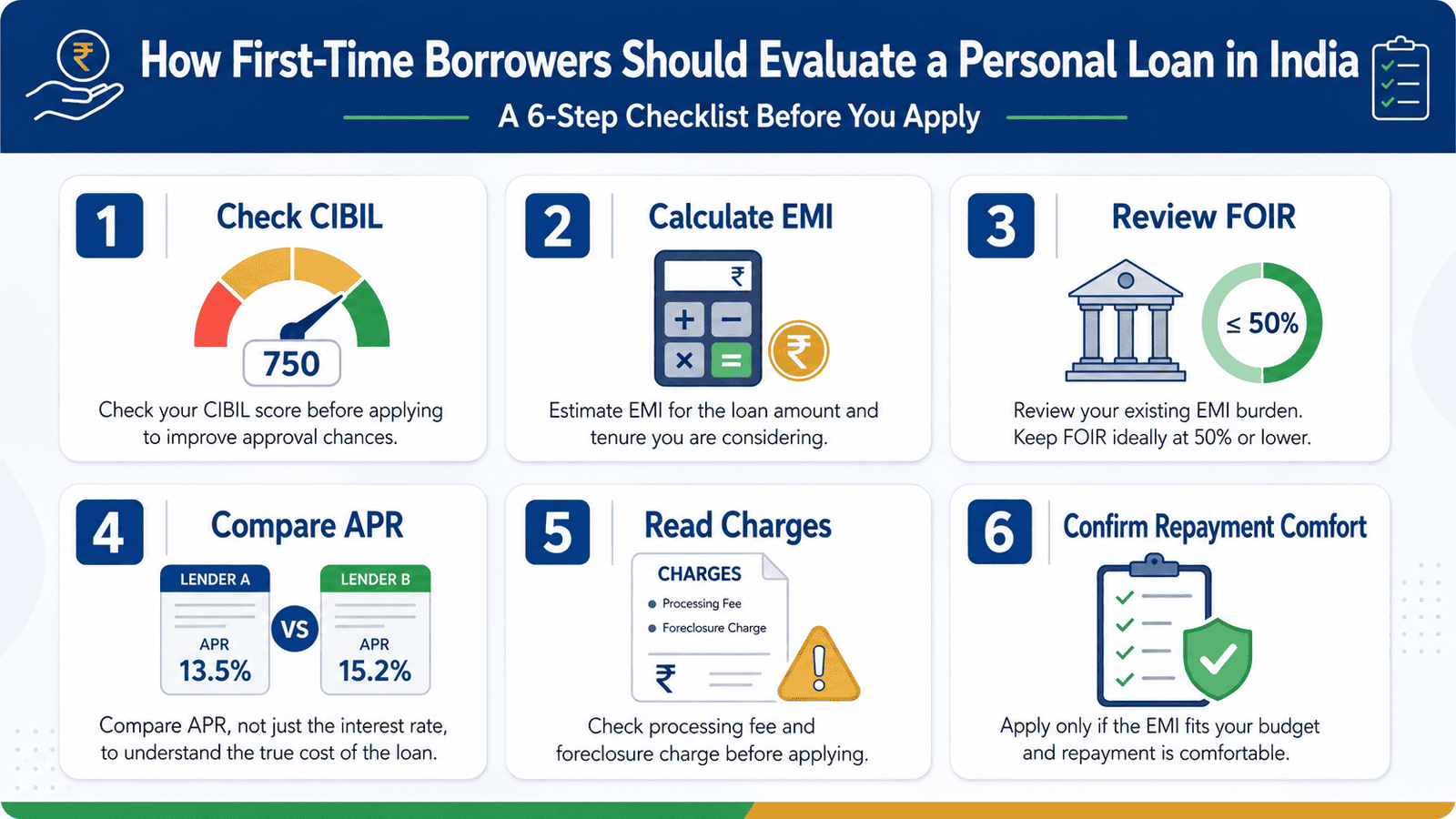
Key Takeaways
- Personal loans in India are usually unsecured — no collateral is needed — but lenders assess income, CIBIL score, existing EMI burden (FOIR), employment stability, and repayment history before approving any amount.
- Your CIBIL score is a key approval signal. A stronger credit history — built through timely EMI and credit card repayments — gives lenders more confidence, though every lender sets its own score threshold. No score guarantees approval.
- FOIR (Fixed Obligation to Income Ratio) limits how much of your monthly income can go toward EMIs. If you already have a home loan, car loan, or credit card EMI, your eligible fresh loan amount may be lower than you expect.
- A lower EMI is not always cheaper. Stretching the same ₹1 lakh loan from 1 year to 3 years reduces your monthly payment but can add thousands in total interest — always compare total repayment cost, not just EMI.
- Charges beyond the interest rate — processing fee, GST on processing fee, foreclosure charge, late payment fee, and EMI bounce fee — add to your real borrowing cost. Ask for the Key Fact Statement (KFS) and the total cost before signing.
- Applying to multiple lenders in a short window may trigger multiple hard inquiries on your credit report, which can temporarily affect your credit score. Shortlist one or two lenders, compare offers, then apply.
Key Facts at a Glance
| Feature | What it means | Why it matters for you |
|---|---|---|
| Loan type | Unsecured — no collateral required in most cases | Easier to apply; but lender takes on more risk, so income and CIBIL checks are stricter |
| Common uses | Medical expense, marriage, home renovation, education support, debt consolidation | Purpose affects how lenders assess the loan risk and whether the EMI fits your income |
| Interest type | Usually reducing-balance interest | Interest is calculated on the outstanding principal each month — more borrower-friendly than flat rate |
| Eligibility checks | Income, CIBIL score, FOIR, employment stability, documents, city of residence | Every lender weighs these differently; no single factor guarantees approval |
| Key charges | Processing fee, GST, foreclosure charge, late payment fee, EMI bounce fee | Charges increase your total borrowing cost beyond the headline interest rate |
| Tenure range | Commonly 1 to 5 years (verify current lender limits before applying) | Longer tenure = lower EMI but higher total interest; shorter = higher EMI but lower total cost |
| Credit impact | Each application may create a hard inquiry; missed EMIs hurt your CIBIL score | Apply selectively; set up repayment reminders before borrowing |
| RBI regulation | Banks and registered NBFCs operate under RBI guidelines (rbi.org.in) | Always verify that your lender or the app behind your loan is RBI-registered before accepting |
How a Personal Loan in India Actually Works
Step 1 — What “unsecured” means for a first-time borrower
A personal loan is called unsecured because you do not pledge any asset — house, vehicle, gold — as security. The lender lends on the strength of your income, creditworthiness, and ability to repay. That sounds easier, but it also means the lender has no fallback if you default. So lenders compensate by checking your profile more carefully, and by pricing the loan at a higher rate than a secured loan like a home loan or gold loan.
It also means that missing EMIs has consequences beyond just debt: late payments and defaults are reported to credit bureaus including TransUnion CIBIL, Experian, and CRIF High Mark. A poor repayment record can affect your ability to borrow for years. Unsecured does not mean consequence-free.
Step 2 — How lenders decide whether to approve your loan
Lenders run a multi-factor assessment. Understanding how banks calculate eligibility helps you prepare in advance rather than guess. The key factors are:
- Income and income stability — Your monthly salary or business income must cross a minimum threshold (which varies by lender and city). Stable employment with a known employer typically improves approval chances.
- CIBIL score and credit history — Lenders check your credit report from bureaus such as TransUnion CIBIL (transunioncibil.com). A history of on-time EMI and credit card payments signals lower risk. A weak score or recent default raises a red flag.
- FOIR (Fixed Obligation to Income Ratio) — This is the share of your monthly income already committed to existing EMIs: home loan, car loan, credit card EMI, or BNPL dues. Most lenders prefer FOIR below a certain level — typically under 50–60% of income — though thresholds differ. Read more about FOIR in loan approval.
- Documents and KYC — Identity proof, address proof, income proof, and bank statements must be complete and consistent.
- Employer or business profile — Working with a listed company, PSU, government body, or reputed private employer often improves approval terms. Self-employed applicants face stricter income verification.
According to RBI guidelines (rbi.org.in), regulated lenders are required to follow Fair Practices Code when assessing and communicating loan decisions. They must provide a Key Fact Statement (KFS) disclosing APR, fees, and repayment terms before disbursement.
Step 3 — Sanction vs disbursement: the two stages of approval
Sanction is when the lender approves your loan in principle — amount, rate, tenure, and conditions are communicated. Disbursement is when the money actually reaches your account. Between sanction and disbursement, verify every charge, EMI figure, and condition in the loan agreement. Do not assume the sanction letter and the final agreement are identical in every detail.
Real Example: Rohit’s First Personal Loan Decision
Rohit, 28, works as a software tester in Pune and earns ₹45,000 per month in hand. His mother needed a medical procedure and the estimated cost was ₹1,50,000. He did not have savings large enough to cover it and started looking at personal loans.
Before applying, Rohit checked his finances. He already had a credit card EMI of ₹6,000 per month. That brought his existing obligation to ₹6,000 out of ₹45,000 — roughly 13% of income already committed. A lender with a 50% FOIR cap would typically consider up to ₹22,500 per month in total EMIs. After subtracting the ₹6,000 already going to the credit card, Rohit’s available EMI capacity was around ₹16,500 per month (illustrative; actual lender thresholds vary — verify directly). Understanding FOIR in loan approval helped Rohit calculate that ₹1,50,000 over 2 years at an assumed rate would generate an EMI of roughly ₹7,200–7,500 — well within his capacity.
He checked his CIBIL report before applying, found no errors, and prepared salary slips, bank statements, and KYC documents. He shortlisted two lenders and compared APR, processing fee, foreclosure rules, and total disbursed amount. The key lesson: Rohit decided his loan amount and lender before applying, not after seeing who approved him first. All figures above are illustrative; verify current rates and lender thresholds before applying.
Personal Loan Eligibility Checklist for First-Time Borrowers
| Requirement | Salaried borrower | Self-employed borrower |
|---|---|---|
| Age | Typically 21–58 years (verify per lender) | Typically 25–65 years (verify per lender) |
| Minimum income | Varies by lender and city; metro cities usually have higher thresholds | Minimum net annual income or profit varies; lenders need ITR evidence |
| Employment / business stability | Minimum service period at current employer (varies by lender) | Minimum years in business (varies; lenders typically ask for 2–3 years of ITR) |
| CIBIL score | Higher scores generally improve approval chances and rate offers | Same principle applies; lenders also check business credit where applicable |
| Existing EMI burden (FOIR) | Existing EMIs should leave room for the new loan EMI within lender’s FOIR limit | Same; business loan EMIs or personal obligations both count |
| Bank account and statements | Active savings account; usually 3–6 months of bank statements required | Business current account statements and personal savings statements often both required |
| KYC documents | PAN card, Aadhaar card or equivalent address proof | PAN card, Aadhaar card, business registration proof where applicable |
Every lender sets its own eligibility rules. The above is a general overview, not a guaranteed approval checklist. For a detailed breakdown of salary, CIBIL, age, and document requirements, see eligibility rules explained. For a full document checklist by borrower type, refer to documents needed for loan.
How to Calculate Your Personal Loan EMI and Total Cost
EMI stands for Equated Monthly Instalment — the fixed amount you repay each month for the duration of the loan. It covers both principal repayment and interest.
EMI = [P × r × (1 + r)^n] ÷ [(1 + r)^n − 1]
Where: P = loan principal | r = monthly interest rate (annual rate ÷ 12 ÷ 100) | n = loan tenure in months
The table below uses an illustrative interest rate of 12% per annum (reducing balance) on a ₹1,00,000 loan. Actual rates vary by lender, income, CIBIL, and other factors — verify current rates before applying.
| Tenure | EMI (illustrative at 12% p.a.) | Total interest paid |
|---|---|---|
| 12 months (1 year) | ₹8,885 | ₹6,620 |
| 24 months (2 years) | ₹4,707 | ₹12,968 |
| 36 months (3 years) | ₹3,321 | ₹19,556 |
Now add the real cost of borrowing. On a ₹1,00,000 loan, a processing fee of 2% would be ₹2,000 (plus GST at 18%, adding approximately ₹360). Total upfront cost: around ₹2,360. Your total repayment cost over 3 years at the illustrative rate is approximately ₹1,21,916 before accounting for the processing fee. Processing fee percentage and GST treatment vary by lender — verify with your lender before accepting the loan offer. For a full breakdown of what lenders charge, see loan charges explained.
The table above shows the core trade-off: at the 1-year tenure you pay ₹8,885 per month but only ₹6,620 in interest. At 3 years, EMI drops to ₹3,321 — but total interest triples. A longer tenure can feel safer month-to-month but costs significantly more over time.
Bank vs NBFC vs Loan App: Which Route Makes Sense?
| Factor | Bank | NBFC | Digital loan app |
|---|---|---|---|
| Approval strictness | Stricter — higher income and CIBIL bar typical | Moderate — may consider newer credit profiles | Varies widely — some are legitimate NBFCs; others may not be |
| Interest rate range | Generally competitive for strong profiles | Often higher than top banks; varies significantly | Can be very high; always check APR, not just flat rate |
| Processing speed | 2–7 days typically; faster for existing customers | Often 1–3 days; many have digital workflows | Can be same-day; speed should not override safety checks |
| Documents required | Standard KYC + income proof + bank statements | Similar; some NBFCs use alternate data | Often minimal upfront; read all permissions the app requests |
| Safety checks | Regulated by RBI; Fair Practices Code applies | Must be RBI-registered; check the RBI NBFC list | Verify the regulated entity behind the app — not all apps disclose clearly |
| Best for | Borrowers with stable income and good credit history | Borrowers needing faster access or slightly more flexible eligibility | Only if the lender is verifiably RBI-registered and terms are clear |
RBI (rbi.org.in) publishes a list of registered banks and NBFCs. Before accepting any loan — especially through a mobile app — verify that the lending entity is on that list. For a deeper comparison, see bank or NBFC loan.
How to Apply for a Personal Loan: Step-by-Step
Step 1 — Check your credit report before anything else
Get your credit report from TransUnion CIBIL (transunioncibil.com), Experian (experian.in), or CRIF High Mark (crifhighmark.com). Review it for errors, old disputes, or unexplained negative marks. A wrong entry can suppress your score and lead to rejection. Dispute errors before applying.
Step 2 — Calculate the EMI you can actually afford
Use the formula above or an online EMI calculator. Factor in your existing EMIs and monthly obligations. The new EMI, combined with existing EMIs, should fit comfortably within your FOIR limit — not just mathematically, but practically, leaving room for routine expenses and emergencies.
Step 3 — Prepare your documents
For salaried borrowers: PAN card, Aadhaar card, last 2–3 months’ salary slips, last 3–6 months’ bank statements, and Form 16 or ITR where required. For self-employed borrowers: PAN card, Aadhaar card, last 2–3 years’ ITR, business registration proof, and bank statements. Keep digital copies ready. Incomplete documents are a common reason for processing delays. For a complete checklist, refer to documents needed for loan.
Step 4 — Compare lender offers — total cost, not just EMI
Request the APR, processing fee, foreclosure conditions, and late payment terms from at least two lenders before deciding. Lenders are required to share a Key Fact Statement (KFS) under RBI guidelines. Read it before signing.
Step 5 — Apply to one or two lenders selectively
Each formal application typically triggers a hard inquiry on your credit report. Multiple hard inquiries within a short period can temporarily reduce your credit score. Shortlist based on your comparison, then apply to one or two — not five or six simultaneously.
Step 6 — Review the loan agreement before disbursement
After sanction, read the agreement for disbursed amount, net amount after deducting fees, EMI date, foreclosure conditions, and penalty clauses. Confirm the amount credited matches the sanction minus disclosed fees.
Personal Loan Safety Checklist Before You Sign
| Check | When it matters | Where to verify |
|---|---|---|
| Lender is RBI-registered | Before applying — especially for app-based loans | RBI registered entity list at rbi.org.in |
| APR disclosed in writing | Before signing; APR includes processing fee and rate | Key Fact Statement (KFS) provided by lender |
| Processing fee and GST amount confirmed | Before disbursement; affects net amount received | Sanction letter and loan agreement |
| Foreclosure / prepayment terms | Before signing; needed if you want to close early | Loan agreement; verify directly with lender |
| Late payment and EMI bounce charges | Before signing; impacts cost if repayment is delayed | Loan agreement |
| Loan insurance is optional, not mandatory | At disbursement; some lenders bundle insurance | RBI guidelines; confirm with lender in writing |
| No “guaranteed approval” claims accepted | At any stage; legitimate lenders do not guarantee approval | RBI Fair Practices Code; lender’s official channel |
How to Decide What’s Right for You
you have a clear, non-deferrable need — medical emergency, essential home repair — and the EMI fits within your FOIR limit while leaving room for daily expenses and an emergency buffer, then a personal loan can be a practical, legitimate tool.
you are borrowing to consolidate high-cost credit card debt — the personal loan rate is meaningfully lower than the credit card interest rate — then a consolidation loan can reduce total interest cost, but only if you do not continue using the credit card heavily after clearing it.
you are a first-time borrower with no credit history, apply for the loan amount you can repay comfortably, not the maximum you may be approved for. Building a strong repayment record on a smaller loan is more valuable long-term than overstretching on the first one.
you want to close the loan early, confirm the foreclosure charge and the minimum lock-in period before accepting the loan offer. Early closure saves interest, but a high foreclosure charge may reduce that saving significantly.
your income is unstable, your existing EMIs already exceed 40–50% of your income, or you have no clear repayment plan — do not borrow out of urgency. Explore family support, a secured loan (gold loan rates can be lower), or delay the expense where possible.
the lender cannot tell you the APR, processing fee, and foreclosure rules in writing — walk away. Legitimate lenders are required to disclose these before disbursement under RBI’s Fair Practices Code.
Common Mistakes to Avoid
Applying to five or six lenders at the same time
Each formal application usually triggers a hard inquiry on your credit report. Multiple hard inquiries within a short window may signal credit-seeking behaviour to future lenders and can temporarily reduce your score.
Compare lenders first using quotes, eligibility checks, or pre-approval tools where available (these may use soft inquiries that do not affect scores). Then apply to one or two.
Deciding based only on the EMI
A longer tenure always produces a lower EMI — but it also means more months of interest. On a ₹1,00,000 loan, the difference between a 1-year and a 3-year term can mean paying nearly three times more in interest (see the table in the EMI section above).
Always calculate total repayment — principal plus total interest plus fees — before accepting any offer.
Ignoring the processing fee and foreclosure terms
A 2–3% processing fee on a ₹5,00,000 loan is ₹10,000–₹15,000 upfront. Add GST. If you plan to repay early, a high foreclosure charge can wipe out the interest saving. Read both before signing.
Ask the lender for the APR and the Key Fact Statement in writing.
Taking a larger loan amount than needed
A lender may sanction more than you asked for. Borrowing more because it was offered adds unnecessary interest cost and EMI pressure. Borrow the amount that solves the specific need, not the maximum approved.
Using a personal loan to clear credit card dues without addressing spending habits
A personal loan can consolidate credit card debt at a lower rate — but only if you stop running up the card again. Borrowers who consolidate and then rebuild card balances end up with both the personal loan EMI and renewed card debt.
If you are using a loan to clear card dues, consider reducing the card limit immediately after clearing it.
Missing EMI payment dates
A missed EMI typically triggers a late payment charge and may be reported to credit bureaus after a grace period. Repeated missed payments push an account into default territory, damaging your CIBIL score significantly. Set a standing instruction or auto-debit on your bank account from day one.
Trusting “guaranteed approval” or “instant loan without CIBIL” claims
No legitimate RBI-registered lender guarantees approval regardless of profile. Claims of “no CIBIL check,” “instant sanction for everyone,” or “loan in 5 minutes without documents” are warning signs of predatory or illegal operations. Verify the lender’s registration at rbi.org.in before sharing documents or paying any upfront fee.
When This May Not Be the Right Choice
Your income is irregular or uncertain. A personal loan commits you to a fixed EMI every month. If your income is seasonal, commission-based, or currently under pressure, a missed EMI triggers charges and credit damage. Build income stability before committing to a fixed monthly obligation.
Your existing EMIs already use a large portion of your income. If existing home loan, car loan, and credit card EMIs already take 40–50% of your salary, adding another personal loan EMI may leave too little for living expenses, emergencies, and savings. A lender may still approve you — but approval does not mean the loan is affordable for you.
You are borrowing for non-essential, deferrable spending. A vacation, a new gadget, or home décor upgrades are legitimate wants — but not urgent enough to justify a high-cost unsecured loan if your repayment comfort is tight.
A personal loan would delay a deeper financial problem. Using a personal loan to avoid dealing with high debt, tax dues, or business losses may feel like a solution but adds to the total burden. Speak to a financial counsellor if debt stress is the underlying driver.
If any of these apply to your situation, it may be worth exploring other options before committing.
Official Rules and Where to Verify
- RBI (rbi.org.in) — Verify that your lender is a registered bank or NBFC. Check borrower rights, Fair Practices Code guidelines, and the Digital Lending Guidelines for app-based loans.
- TransUnion CIBIL (transunioncibil.com) — Access your credit report and credit score, raise disputes on incorrect entries, and check your credit history before applying.
- Experian India (experian.in) — Obtain an alternate credit report and check for discrepancies across bureaus.
- CRIF High Mark (crifhighmark.com) — Access credit report from a third bureau; useful for cross-checking your credit profile.
- Your lender’s official website or branch — Current interest rates, processing fee percentages, tenure options, foreclosure terms, and minimum income requirements must be verified directly with the lender before applying.
Rules, rates, and charges on this topic can change with RBI policy or lender updates. Always verify current figures directly from the official source or the lender before making any borrowing decision.
Expert Tips
- Check your credit report before applying — not after. Errors on a credit report are more common than borrowers realise. A dispute raised after a rejection wastes time. TransUnion CIBIL (transunioncibil.com) allows you to download your report and raise disputes online. Check at least 30 days before you plan to apply.
- Calculate the EMI before you fill in a single form. Use the EMI formula or an online calculator. Enter the actual loan amount you need — not a rounded figure. If the EMI plus existing obligations exceeds 45–50% of your monthly income, reduce the loan amount or extend the tenure before proceeding.
- Compare APR, not just the stated interest rate. If a lender quotes a flat rate, it is not the same as a reducing-balance rate. A “low” 10% flat rate may be equivalent to approximately 18% on a reducing basis. Always ask for the Annual Percentage Rate (APR) which includes the processing fee and reflects the true cost.
- Keep document sets ready before you apply. Incomplete documentation is one of the most common reasons for loan processing delays. Prepare digital copies of PAN, Aadhaar, salary slips, Form 16, and bank statements before comparing lenders. When you apply, the process moves faster.
- Borrow the smallest amount that solves the need. The maximum sanctioned amount is not a suggestion. Every extra rupee borrowed adds interest cost and EMI burden. Decide your loan amount based on your verified need and your repayment capacity, not on what the lender is willing to give.
- Set up auto-debit from day one. Missed EMIs are the fastest way to damage a credit score you spent years building. Set a standing instruction from your salary account for the EMI amount, due two days before the EMI date to allow for weekends or bank holidays.
Frequently Asked Questions
Can a first-time borrower get a personal loan in India?
Yes, but approval depends on the lender’s criteria. Without a credit history, some lenders may offer a smaller amount, shorter tenure, or require a stronger income and employment profile. Some digital lenders and NBFCs cater specifically to new-to-credit borrowers, though rates may be higher. Never trust any lender that guarantees approval without checking your income or documents.
What is the minimum CIBIL score for a personal loan?
Each lender sets its own credit score threshold and does not publicly commit to a single fixed number. A stronger credit score generally improves both approval chances and the interest rate offered. Credit bureaus such as Experian India (experian.in) provide score ranges and guidance on what different score levels may mean for credit applications. Verify current lender thresholds directly with the lender.
How much monthly salary do I need to get a personal loan?
Minimum income requirements vary by lender and city. Metro city borrowers generally face higher thresholds than smaller city applicants. Some lenders set a higher minimum for applicants at smaller or less well-known employers. Verify the specific income requirement directly with each lender you are considering, as published figures may change.
Can I get a personal loan without a salary slip?
Salary slips are a standard income verification document for salaried borrowers. Without them, you may need to provide alternate proof of income such as Form 16, ITR, or bank statements showing regular salary credits. Self-employed borrowers typically submit ITR and business bank statements instead. Some lenders accept bank statement-only verification, but this usually affects the interest rate or loan amount offered.
Does applying for a personal loan affect my CIBIL score?
A formal loan application typically triggers a hard inquiry on your credit report, which may reduce your score by a few points temporarily. Multiple applications in a short period amplify this effect. Checking your own credit report, or using pre-approval or eligibility check tools that run soft inquiries, does not affect your score. Apply selectively after comparing offers.
Should I take a personal loan from a bank, NBFC, or loan app?
Banks usually offer competitive rates for strong profiles but have stricter eligibility. NBFCs can be more flexible but may charge higher rates. App-based loans are convenient but always verify that the lending entity behind the app is registered with RBI. Avoid apps that do not clearly disclose the lender’s name, registration number, or APR. For a detailed comparison, see the Bank vs NBFC section above.
What charges should I check before accepting a personal loan offer?
Check: processing fee (and GST on the processing fee), foreclosure or prepayment charge, late payment fee, EMI bounce charge, and whether any insurance has been bundled. Ask for the APR and the Key Fact Statement (KFS) in writing before signing. The net amount credited to your account after deducting fees may be lower than the sanctioned amount — confirm this before disbursement.
Can I close a personal loan before the tenure ends?
Yes — this is called foreclosure or prepayment. It can save interest, but lenders may charge a foreclosure fee and require a minimum number of EMIs to be paid before early closure is permitted. Verify the foreclosure conditions, the minimum lock-in period, and the charge percentage from the lender before accepting the loan. Floating-rate loans from banks may have different prepayment rules than fixed-rate personal loans from NBFCs.
Final Verdict
A personal loan in India is a practical tool for genuine financial needs — medical emergencies, planned family events, essential home repairs, or consolidating high-cost credit card debt at a lower rate. For a first-time borrower, the difference between a good outcome and a stressful one usually comes down to three things: borrowing an amount whose EMI fits comfortably within your repayment capacity, understanding the total cost including charges — not just the EMI — and applying selectively to lenders after comparing APR, processing fee, and foreclosure terms.
If your income is stable, your FOIR has room for the new EMI, your documents are ready, and you have verified the lender’s RBI registration, a personal loan can serve you well. If any of those conditions are shaky, it is worth slowing down. Always verify the latest rates and terms from the lender or official RBI sources before applying for any loan.
This article is for educational purposes only and should not be treated as personalised financial, credit, or legal advice. Interest rates, processing fees, eligibility criteria, and loan terms vary by lender and can change with RBI policy or lender updates. Please verify current rates and terms directly with the lender or from official RBI sources, or consult a qualified professional, before applying for or accepting any loan.

Rohan writes practical personal loan guides for Indian borrowers, focusing on eligibility, EMI planning, lender charges, CIBIL impact, borrower rights, and safer borrowing choices. His writing helps readers compare options calmly, avoid costly mistakes, and understand loan terms before applying.