
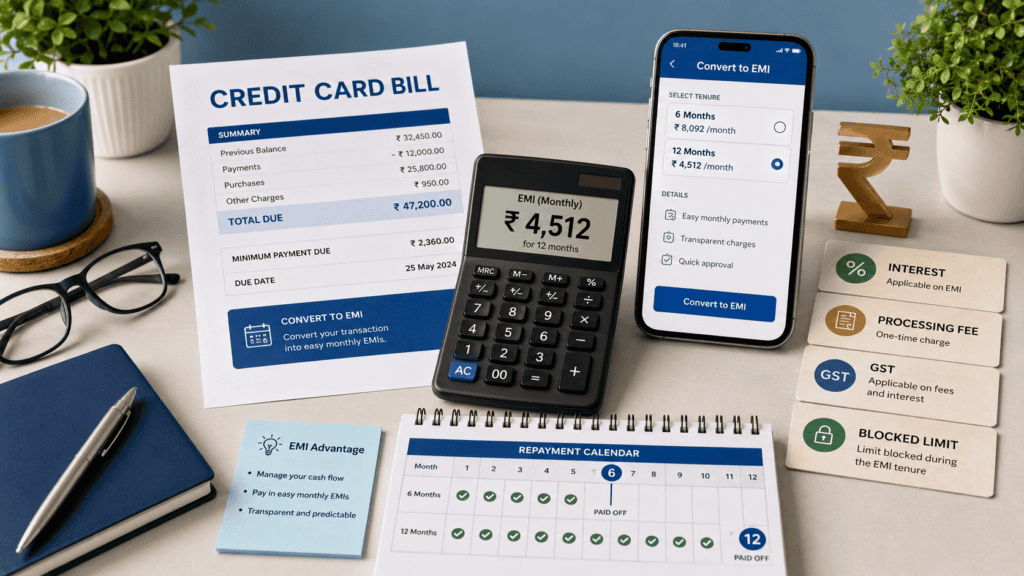
You are at checkout, or inside your card app, and a message appears: “Convert your purchase into easy EMIs.” The monthly amount looks manageable. But that number — the EMI — is only one part of what you will actually pay. Credit card EMI can make a large purchase easier to absorb in your monthly budget, but it is still borrowing against your card limit, and it carries interest, a processing fee, GST on that fee, and sometimes a preclosure charge if you want to close it early. On top of that, converting a purchase into EMI typically blocks part of your available card limit for the entire repayment period — limiting your spending flexibility until you pay it down. This article breaks down exactly how credit card EMI works, what it costs in total, how it affects your credit profile, and when you should think twice before clicking “convert.”
Quick Answer: What Is Credit Card EMI?
Credit card EMI converts a card purchase or outstanding amount into fixed monthly payments over a selected tenure. For a ₹50,000 purchase, compare interest, processing fee, GST, blocked card limit, preclosure charges, and total payable before choosing EMI. The monthly instalment may look small, but the total repayment can be meaningfully higher than the original purchase price once all charges are added up.
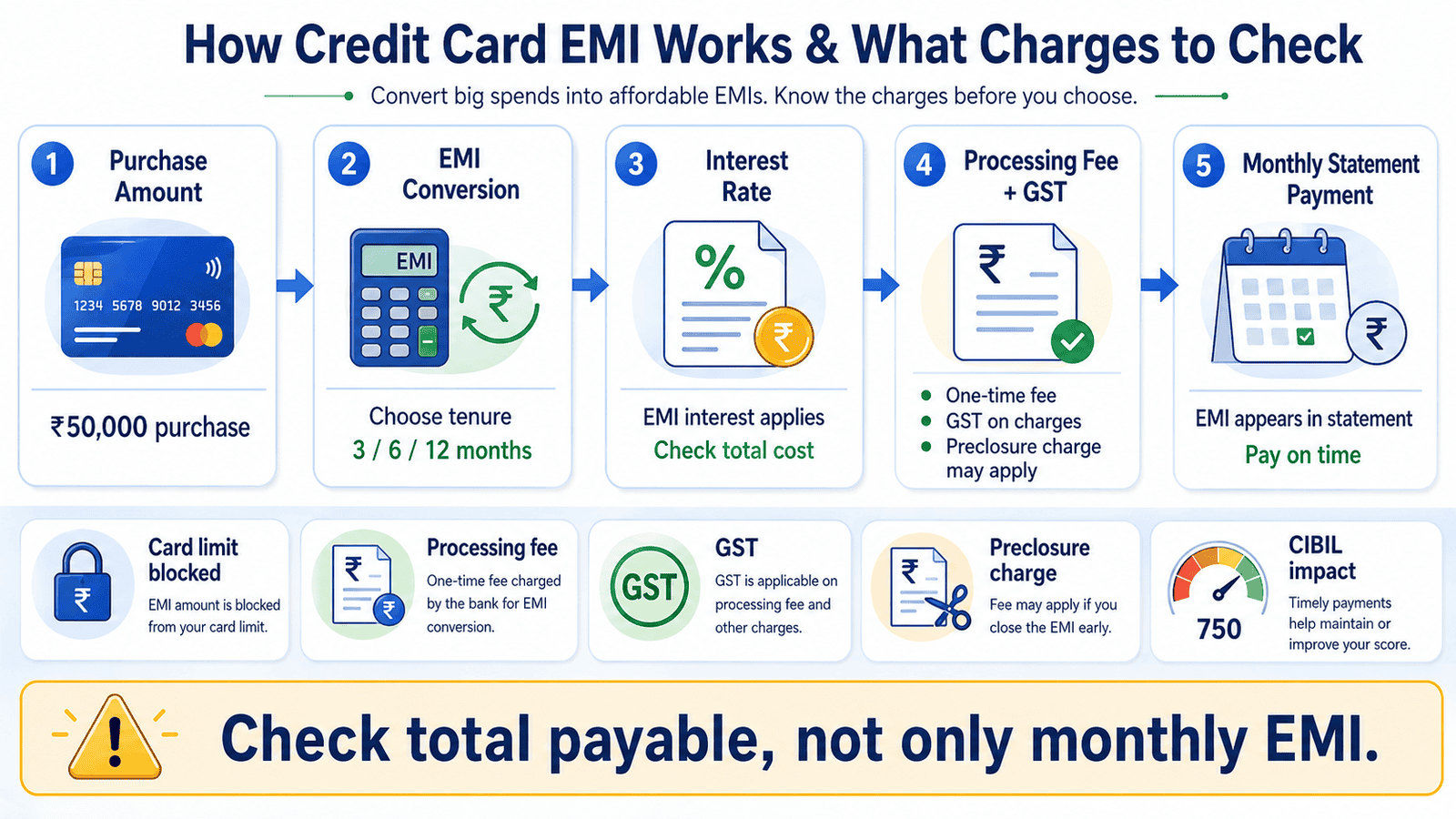
Key Takeaways
- Credit card EMI is a repayment facility — it is not free money. You are borrowing against your card limit and will pay interest, processing fee, and GST on top of the purchase amount.
- Always check total payable, not just the monthly EMI. A ₹50,000 purchase converted into 12-month EMI can cost ₹3,000–₹6,000 or more extra depending on the interest rate and fees (illustrative figures; verify with your issuer).
- Processing fee and GST are charged upfront or added to the EMI — even on many “no-cost EMI” offers, a processing fee plus 18% GST on that fee may apply.
- Missing your monthly card bill payment — even once — can trigger late payment charges and may be reported to credit bureaus, which can damage your credit history.
- Your card limit is typically blocked for the outstanding EMI principal, reducing how much you can spend on other purchases until you repay.
- Before converting, compare the total card EMI cost with simply paying in full or taking a personal loan — especially for larger amounts or longer tenures.
Key Facts at a Glance
| Parameter | What to Know | Where to Verify |
|---|---|---|
| What gets converted | A specific purchase amount or outstanding card balance | Issuer app, card statement, or net banking |
| Typical tenures available | 3, 6, 9, 12, 18, or 24 months — varies by issuer and offer | Issuer MITC / schedule of charges |
| Interest rate | Generally 12%–24% per annum reducing balance — varies by issuer and card type (illustrative; verify current rate with your issuer) | Issuer app, card MITC |
| Processing fee | Flat fee or percentage of transaction — varies by issuer and tenure (illustrative; verify before converting) | Issuer MITC, app at time of conversion |
| GST on charges | 18% GST applicable on processing fee and interest component where applicable | Card statement, issuer app |
| Preclosure charge | A charge may apply if you close the EMI before tenure ends — varies by issuer | Issuer MITC / customer care |
| Limit blocking | Outstanding EMI principal typically blocks part of your credit limit until repaid | Card statement, issuer app |
| CIBIL impact | EMI repayment is reported to bureaus; missed payments can affect your credit score | TransUnion CIBIL — transunioncibil.com |
| Best use case | Planned, essential purchase with stable monthly cash flow and clear repayment capacity | — |
| Avoid if | Already revolving dues, income is unstable, or purchase is impulsive or non-essential | — |
How Credit Card EMI Works in India
Step 1 — The Three Types of Card EMI
There are broadly three ways credit card EMI is offered in India. Purchase EMI is when you choose to pay in instalments at the time of buying — typically shown at checkout on e-commerce platforms or at POS terminals. Post-purchase EMI is when you convert an existing charge on your card statement into EMI after the fact — using your issuer’s app, net banking, or by calling customer care. Merchant EMI is arranged at the merchant level, often through a tie-up between the merchant and a bank or NBFC, and may carry different terms from what your bank offers directly. Understanding merchant EMI difference matters because the interest, processing fee, and cancellation terms can differ significantly from bank-side EMI conversion.
Step 2 — How the Card Limit Gets Blocked
When a purchase is converted into EMI, the outstanding principal — that is, the amount not yet repaid — typically remains blocked against your credit limit. So if your card limit is ₹1,00,000 and you convert a ₹50,000 purchase into a 12-month EMI, up to ₹50,000 of your limit may be blocked at the start. As you repay each monthly instalment, the blocked amount reduces. This means your spending flexibility on the card is reduced until you finish repaying — a point most EMI marketing does not highlight.
Step 3 — How EMI Appears on Your Statement
Each month, the EMI amount — principal portion plus interest for that month — appears as a line item in your credit card statement. You are required to pay at least this amount along with any other card dues. If you pay only the minimum amount due on your statement, and that minimum does not cover the full EMI amount, you risk late payment charges, revolving interest on unpaid dues, and a potential negative mark on your credit report. This is why card EMI is not the same as simply choosing to pay your card bill slowly — to understand how revolving interest works on unpaid dues, see card interest calculation.
Step 4 — The No-Cost EMI Reality Check
“No-cost EMI” means the merchant or brand absorbs the interest component — so you pay only the product’s price in instalments. However, “no-cost” does not automatically mean zero out-of-pocket extra cost. A processing fee — and 18% GST on that fee — may still apply. Some no-cost EMI offers are structured by reducing the product’s effective price (you lose a discount you would have received on upfront payment) rather than the lender absorbing the full cost. Before accepting any no-cost offer, check whether a processing fee applies and whether you could have bought the product cheaper by paying in full. For a detailed breakdown, see no-cost EMI charges.
No-Cost EMI: What May Still Cost You
| Possible Cost | Example | What to Verify |
|---|---|---|
| Processing fee | ₹199–₹499 or more depending on issuer and tenure (illustrative) | Issuer app at time of conversion; card MITC |
| GST on processing fee | 18% of processing fee charged as tax | Card statement or issuer terms |
| Lost instant discount | Product listed at ₹50,000 with a 5% instant cashback on full payment — that cashback is often unavailable on EMI | Merchant checkout terms, card offer page |
| Inflated product price | Some merchants mark up the product price slightly and offer “no-cost EMI” on the marked-up price | Compare MRP and non-EMI price before selecting |
| Cancellation / preclosure condition | Cancelling the EMI midway may trigger a charge and result in the full outstanding being posted back to your card | Issuer MITC / customer care before conversion |
Real Example: Rohit’s ₹50,000 Phone Purchase
Rohit is 31 years old, works as a software tester in Pune, and earns ₹55,000 per month. He wants to buy a smartphone priced at ₹50,000 and his card has a limit of ₹90,000. His issuer offers him three choices: pay in full now, convert into 6-month EMI, or convert into 12-month EMI. He can afford to pay in full, but the 12-month EMI looks very comfortable at around ₹4,600 per month (illustrative figure; actual amount depends on rate and fees).
What Rohit notices after reading the offer details: the 12-month EMI carries an interest rate of approximately 15% per annum reducing balance (illustrative), a processing fee of ₹299 plus 18% GST, and a preclosure charge of 2%–3% of outstanding principal if he closes early (illustrative; verify current terms with issuer). His total payable over 12 months works out to roughly ₹53,500–₹54,500 depending on exact fees — meaning the phone effectively costs him ₹3,500–₹4,500 more than the sticker price. He decides to check whether a short 3-month EMI reduces the total cost significantly — and whether paying in full using savings is even better. The key insight: the comfortable monthly EMI amount is not the total cost. Always check what you actually pay back in total.
Note: All figures above are illustrative only and are not quotes from any lender. Verify current rates and charges with your card issuer before converting.
Eligibility: When Can You Convert to Card EMI?
Not every cardholder or every transaction is automatically eligible for EMI conversion. Issuers like HDFC Bank (hdfcbank.com) apply eligibility conditions that can include:
- An active credit card in good standing with no serious delinquency or account block.
- Sufficient available credit limit to cover the EMI conversion amount — your limit must not already be close to its ceiling.
- A minimum transaction amount for EMI conversion — typically ₹2,000–₹5,000 or more, depending on the issuer (illustrative; verify current minimum with your issuer).
- The transaction type must be eligible — some categories like fuel, rent, or cash advances may not qualify for EMI conversion.
- For pre-approved post-purchase EMI, the offer must be shown by the issuer in the app or net banking at the time you request conversion.
Issuer discretion applies. Being a cardmember does not guarantee that every transaction can be converted. Check your issuer’s app or MITC for the current eligibility conditions before assuming EMI is available.
How to Calculate Credit Card EMI: Total Cost Before You Decide
The monthly EMI number alone will not tell you what you are paying. You need to calculate total payable — principal plus all interest, fees, and taxes — before comparing options.
Monthly EMI = [P × r × (1 + r)^n] ÷ [(1 + r)^n − 1]
Where: P = Principal (purchase amount) | r = Monthly interest rate (annual rate ÷ 12 ÷ 100) | n = Number of monthly instalments (tenure in months)
Then add: Processing Fee + GST on processing fee to get your true total cost.
Illustrative Cost Comparison: ₹50,000 Purchase
| Parameter | 6-Month EMI | 12-Month EMI |
|---|---|---|
| Purchase Amount | ₹50,000 | ₹50,000 |
| Interest Rate (illustrative) | 15% p.a. reducing balance | 15% p.a. reducing balance |
| Monthly EMI (approx.) | ₹8,674 | ₹4,513 |
| Total Interest Paid (approx.) | ₹2,044 | ₹4,156 |
| Processing Fee (illustrative) | ₹299 | ₹499 |
| GST on Processing Fee (18%) | ₹54 | ₹90 |
| Total Payable (approx.) | ₹52,397 | ₹54,745 |
| Extra Cost vs Paying in Full | ₹2,397 | ₹4,745 |
All figures above are illustrative only. Actual interest rate, processing fee, GST treatment, and total payable depend on your card issuer’s current terms. Verify before converting.
If you want to compare your specific numbers before deciding, a credit card EMI calculator can help you estimate monthly EMI and total payable across different tenures.
Credit Card EMI vs Personal Loan vs Paying in Full vs Minimum Due
| Option | Typical Cost Level | Tenure | Limit / Cash Impact | CIBIL Risk | Best For |
|---|---|---|---|---|---|
| Pay in Full | Lowest | None | Limit freed immediately | Lowest | When savings allow; always the cheapest option |
| Credit Card EMI | Medium | 3–24 months | Limit blocked for EMI principal | Low if paid on time; high if missed | Planned essential purchases with stable income |
| No-Cost EMI | Low (check fees) | 3–12 months typically | Limit blocked for EMI principal | Low if paid on time | When processing fee is waived and no discount is lost |
| Personal Loan | Medium | 12–60 months | No card limit impact; own loan limit used | Low if paid on time | Larger amounts, longer tenure, or when card rate is higher than personal loan rate |
| Minimum Amount Due | Highest | Indefinite — revolving | Limit partially freed; revolving balance grows | Highest | Should generally be avoided — read about the minimum due trap |
If Your Credit Card EMI Charges or Billing Look Wrong
Step 1 — Check the statement and the original offer
Before raising a complaint, pull your card statement and compare the EMI line items against the SMS, email confirmation, or in-app offer you accepted. Note the processing fee, interest components, and any other charges shown.
Step 2 — Contact the issuer’s customer support
Call the number on the back of your card or use the issuer’s official app or website chat. State the specific charge that appears incorrect and the reference details of your EMI conversion. Request a written confirmation of the correct EMI amortisation schedule.
Step 3 — Use the issuer’s official grievance channel
If the matter is unresolved within the issuer’s stated resolution timeline, escalate to the dedicated grievance officer through the official process listed on the issuer’s website or in the card MITC.
Step 4 — Escalate to RBI if needed
If the issuer does not resolve the complaint within 30 days, or if the resolution is unsatisfactory, you can file a complaint through the RBI Integrated Ombudsman Scheme at rbi.org.in. The RBI also maintains consumer protection expectations for credit card issuers that cover how charges should be disclosed and applied.
EMI Safety Checklist Before You Convert
- Check total payable — Add principal, total interest across the full tenure, processing fee, and GST. Compare with paying in full.
- Check the processing fee and GST — Even a small processing fee attracts 18% GST. Get the exact figure from the issuer app before accepting.
- Check how much limit will be blocked — Ask yourself whether you need that card limit available for emergencies or regular expenses during the repayment period.
- Check preclosure and cancellation terms — If you plan to repay early, confirm the preclosure charge before committing. Some issuers charge 2%–3% of outstanding principal (illustrative; verify with your issuer).
- Check whether you are already revolving dues — If you are not paying your card bill in full each month, adding an EMI will increase your monthly obligation and financial stress, not reduce it.
- Confirm no-cost EMI is truly no-cost — Check whether you lose an upfront discount, whether a processing fee applies, and whether the product price has been marked up.
How to Decide What’s Right for You
you can comfortably pay the full amount today without touching your emergency fund — pay in full. It is always the cheapest option for a credit card purchase.
the purchase is planned, essential, and you have confirmed your monthly cash flow can absorb the EMI without stress for the entire tenure — a short 3–6 month EMI may make sense.
the amount is large (₹1 lakh or more) and you need 12–24 months — compare with a personal loan. A personal loan may offer a lower interest rate, does not block your card limit, and keeps your card available for emergencies. For a detailed comparison, see card EMI vs loan.
you are offered a no-cost EMI — verify whether a processing fee and GST apply, and whether you are losing an upfront discount. If the net cost after checking is truly zero, and your cash flow is stable, it can be a reasonable option for a short tenure.
you are currently paying only the minimum due on your card, or you already carry a revolving balance — do not add an EMI. First clear your existing dues; adding more EMI obligations will worsen your monthly burden and your credit utilisation. Only convert once your card is at zero outstanding.
the purchase is non-essential or impulsive — do not use EMI to justify an unaffordable purchase. The convenience of a low monthly number can mask a genuinely unaffordable expense. If you cannot pay for it in full within 3 months, consider whether you need it at all.
Common Mistakes to Avoid
Looking Only at the Monthly EMI
The EMI amount is designed to look manageable. A ₹50,000 purchase at ₹4,513 per month looks affordable — but the total payable over 12 months is closer to ₹54,745 (illustrative) once interest, processing fee, and GST are added. Always calculate total payable before accepting.
What to do instead: Ask the issuer for the full amortisation schedule or use a credit card EMI calculator to compare total cost across tenures before deciding.
Ignoring the Processing Fee and GST
A processing fee of ₹499 attracts 18% GST — adding roughly ₹90 to your cost. While individually small, this adds up across multiple EMI conversions and reduces the effective value of any “low rate” offer. Many borrowers overlook this charge entirely because it is listed separately.
What to do instead: Get the exact processing fee and GST amount from the issuer app before accepting, and include it in your total cost calculation.
Missing the Monthly Card Bill Payment
Your EMI amount is billed to your card statement each month. If you miss the payment or pay less than the total due, you may attract a late payment charge — and the unpaid balance may start accruing revolving interest at the card’s full rate, which is often 36%–42% per annum (illustrative; verify with your issuer). This makes the EMI far more expensive than you planned. The impact on your credit history can also be significant — see late payment impact.
What to do instead: Set autopay for at least the total amount due, and ensure your bank account has sufficient balance before the card payment due date each month.
Confusing EMI with Paying the Minimum Amount Due
EMI conversion creates a fixed repayment schedule — you pay a defined amount each month and the debt clears at the end of tenure. Paying only the minimum amount due means the rest of your card balance attracts revolving interest at a high rate and may never fully reduce. These are two very different repayment paths with very different costs.
What to do instead: If you choose EMI, pay the full card bill (not just the minimum) each month so the EMI closes on schedule without any revolving interest accruing on top.
Closing EMI Early Without Checking Preclosure Rules
If you decide to repay the EMI ahead of schedule, some issuers charge a preclosure fee — often 2%–3% of the outstanding principal at the time of closure (illustrative; verify current terms with your issuer before converting). For a ₹40,000 outstanding balance, that could mean a ₹800–₹1,200 preclosure charge.
What to do instead: Always ask the issuer about preclosure charges before converting. If you expect to repay early, factor this cost into your total-cost comparison.
Using EMI to Justify an Unaffordable Purchase
The ease of EMI conversion can lead borrowers to buy things they would not otherwise afford. A ₹1,00,000 appliance does not become affordable just because the monthly EMI is ₹9,000 — especially if that amount, added to other EMIs and expenses, stretches your monthly income to its limit.
What to do instead: Before converting, check your monthly EMI load. As a rough guideline, total EMI obligations across all loans and cards should typically not exceed 40%–50% of your take-home salary (illustrative; your comfort level may vary).
When Credit Card EMI May Not Be the Right Choice
You are already paying only the minimum due on your card. Adding an EMI on top of existing revolving dues increases your monthly liability and can push you deeper into a debt cycle.
Your income is unstable or irregular. A fixed monthly EMI commitment requires consistent cash flow. If your income fluctuates — due to freelance work, commission-based pay, or business seasonality — a missed payment can quickly become expensive.
The purchase is impulsive or avoidable. EMI should support planned expenses, not enable unplanned ones. If you are converting a purchase because the monthly number looks manageable rather than because the purchase is genuinely necessary, reconsider.
A personal loan is cheaper for the same amount. For amounts above ₹50,000–₹75,000 and tenures of 12 months or more, a personal loan from a scheduled bank or NBFC may offer a lower effective interest rate, does not block your card limit, and comes with a clearer amortisation schedule.
You need your card limit available for emergencies. If you have limited credit headroom and may need the card for urgent expenses in the coming months, blocking a large portion of your limit for an EMI can leave you without a financial safety buffer.
If any of these apply to your situation, it may be worth exploring other options before committing.
Official Rules and Where to Verify
Credit card EMI terms, charges, GST treatment, and eligibility conditions are set by individual issuers and can change with RBI policy or internal lender updates. Do not rely on figures quoted verbally or seen in older marketing material.
- RBI (rbi.org.in) — The Reserve Bank of India sets conduct standards for credit card issuers, including rules on charge disclosure, billing, and customer grievance. The RBI’s Master Circular on Credit Card and Debit Card issuance is the primary regulatory reference.
- HDFC Bank (hdfcbank.com) — Verify EasyEMI interest rates, processing fees, GST, cancellation terms, and preclosure rules in the MITC or schedule of charges on the official site.
- SBI Card (sbicard.com) — Verify Flexipay eligibility, charges, applicable tenures, and current issuer conditions in the official MITC.
- ICICI Bank (icicibank.com) — Verify EMI-on-credit-card terms, fees, applicable tax, and repayment rules in the card’s official schedule of charges.
- TransUnion CIBIL (transunioncibil.com) — For understanding how credit card repayment behaviour — including EMI repayment history — is reported and how it can affect your credit profile.
Credit card fees, interest rates, billing rules, eligibility criteria, rewards, and issuer terms can vary and may change over time. Always verify current terms directly with the card issuer, official regulatory source, or a qualified professional before applying for or using any credit card feature.
Expert Tips
- Take a screenshot or PDF of the EMI offer before converting. The exact interest rate, processing fee, and preclosure conditions shown at the time of conversion are your reference. Save this before clicking accept.
- Compare total payable across all tenures, not just the most comfortable EMI. A 6-month EMI almost always costs less in total than a 12-month EMI at the same rate. Choose the shortest tenure your monthly cash flow can genuinely support.
- Avoid long tenures for depreciating purchases. A 24-month EMI on a smartphone or appliance means you may still be paying for a device that has depreciated significantly in value or been replaced by a newer model. Match the tenure to the useful life of the purchase.
- Set autopay or a calendar reminder before the due date. The single most expensive mistake with card EMI is a missed payment. Set autopay for the full amount due, or at minimum, a reminder to pay manually three days before the due date.
- Monitor your credit utilisation ratio. A large EMI blocking your card limit raises your credit utilisation — the proportion of your available limit you are using. High utilisation can affect how lenders view your credit profile. If your EMI is blocking a significant share of your limit, consider whether paying down the balance faster or requesting a limit enhancement might help. Note that utilisation is just one factor; its exact effect on your credit score varies.
- Request the EMI amortisation schedule in writing. Ask your issuer — through the app or customer care — for a month-by-month breakdown showing the principal and interest portions of each instalment. This helps you track what you owe at any point and calculate the accurate preclosure payoff amount.
Frequently Asked Questions
What is EMI on a credit card?
Credit card EMI converts a card purchase or an outstanding amount into fixed monthly instalments over a chosen tenure — typically 3 to 24 months. Instead of paying the full amount at once, you pay a fixed EMI each month, which includes a principal component and an interest component, plus any applicable processing fee and GST.
How is credit card EMI calculated?
The standard EMI formula is: EMI = [P × r × (1 + r)^n] ÷ [(1 + r)^n − 1], where P is the principal amount, r is the monthly interest rate (annual rate divided by 12 divided by 100), and n is the number of months. Add the processing fee and 18% GST on the fee to get the total cost. Use your issuer’s app or an EMI calculator to verify the exact figures for your card and offer.
Is credit card EMI better than paying only the minimum amount due?
Almost always, yes. EMI gives you a fixed repayment schedule with a defined end date and a known total cost. Paying only the minimum amount due means the remaining balance attracts revolving interest at a very high rate — often 36%–42% per annum (illustrative; verify with your issuer) — and your debt may barely reduce each month. EMI is more expensive than paying in full, but far cheaper than revolving on minimum due.
Does credit card EMI affect my CIBIL score?
Yes. Your EMI repayment behaviour is reported to credit bureaus including TransUnion CIBIL. Paying each monthly EMI on time can have a positive effect on your credit history. Missing an EMI payment or paying late can result in a negative mark on your credit report, which may affect future loan or card eligibility. The EMI also affects your credit utilisation ratio while the limit is blocked.
Can I close credit card EMI before the tenure ends?
Yes, most issuers allow preclosure of card EMI. However, a preclosure charge may apply — typically a percentage of the outstanding principal at the time of closure (illustrative; verify the exact charge in your card MITC or with customer care before converting). Ask your issuer for the preclosure amount before deciding to close early.
What charges apply on credit card EMI?
The main charges to check are: interest on the reducing balance, processing fee (flat or percentage of transaction), 18% GST on the processing fee and interest where applicable, and preclosure or cancellation charge if you close the EMI before tenure. For no-cost EMI, also check whether you are losing an upfront discount or paying a processing fee. All figures vary by issuer, card type, and current offer — verify in the card MITC or issuer app at the time of conversion.
Is no-cost EMI on a credit card really free?
Not always. In a true no-cost EMI, the merchant or brand absorbs the interest. However, a processing fee and 18% GST on that fee may still be charged to you. You may also be forfeiting an instant payment discount you would have received on full payment. Always check the full terms before selecting no-cost EMI — the effective cost may not be zero.
What happens if I miss a credit card EMI payment?
If you miss the payment or pay less than the amount due on your card statement, the unpaid amount — including the EMI — may attract a late payment charge and revolving interest at your card’s full interest rate. This can be very expensive and will be reported to credit bureaus. If you are at risk of missing a payment, contact your issuer proactively to discuss options before the due date.
Can I cancel a credit card EMI after conversion?
Some issuers allow cancellation within a short window after conversion; others may charge a cancellation fee or reverse the EMI and post the full outstanding back to your card balance. The conditions vary by issuer and the type of EMI (purchase, post-purchase, or merchant). Always check the cancellation terms before converting, and contact the issuer’s customer care if you want to cancel after the fact.
Final Verdict
Credit card EMI is a useful repayment tool for planned, essential purchases — when you have stable monthly income, a clear repayment plan, and you have compared the total cost across tenures before converting. It is not a shortcut for making unaffordable purchases affordable. The convenience of a low monthly instalment can mask a meaningfully higher total repayment once interest, processing fee, GST, and any preclosure charges are included. Before converting any purchase into credit card EMI, calculate the total payable — not just the EMI — and compare it honestly with paying in full or taking a personal loan for larger amounts. If you are already revolving dues on your card, or your income is unstable, avoid adding EMI obligations until your existing card balance is fully paid. Always verify the latest fees, interest rates, billing rules, and reward terms from the card issuer before applying or using a credit card feature.
This article is for educational purposes only and should not be treated as personalised financial, credit, or legal advice. Credit card fees, interest rates, billing rules, eligibility criteria, rewards, and issuer terms can vary and may change over time. Please verify current terms directly with the card issuer, official regulatory source, or a qualified professional before applying for or using any credit card feature.

Meera Nair writes practical credit card guides for Indian users, focusing on eligibility, fees, billing cycles, reward value, UPI credit cards, EMI conversion, CIBIL impact, fraud protection, and safer card usage. She explains card decisions in simple language without pushing readers toward risky borrowing.