
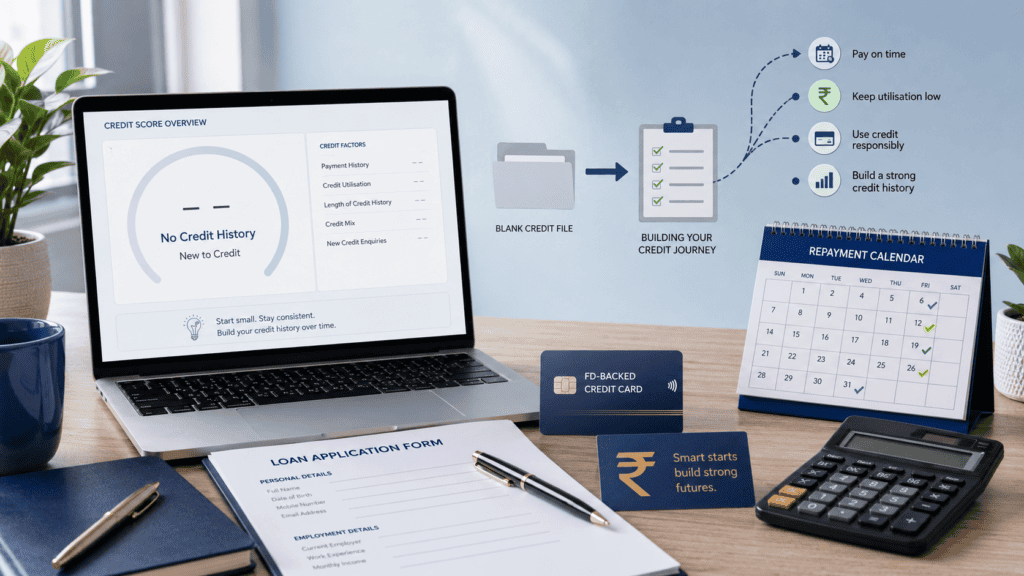
If you have never taken a loan or credit card before, you may have discovered a frustrating loop: every bank asks for your CIBIL score, but your CIBIL score does not exist yet because you have never borrowed. This is one of the most common first-credit problems in India — and it is not your fault. Having no credit history does not mean you have done anything wrong. It simply means credit bureaus do not yet have enough repayment data to generate a score for you. Lenders, who rely on that data to judge risk, find it harder to make a decision. The good news is that this problem is solvable — but only if you take careful, deliberate first steps. Applying randomly to many lenders or trusting “guaranteed approval without CIBIL” loan apps is the fastest way to make things worse before they start. This guide gives you a safe roadmap.
Quick Answer: No Credit History — What It Means and What to Do
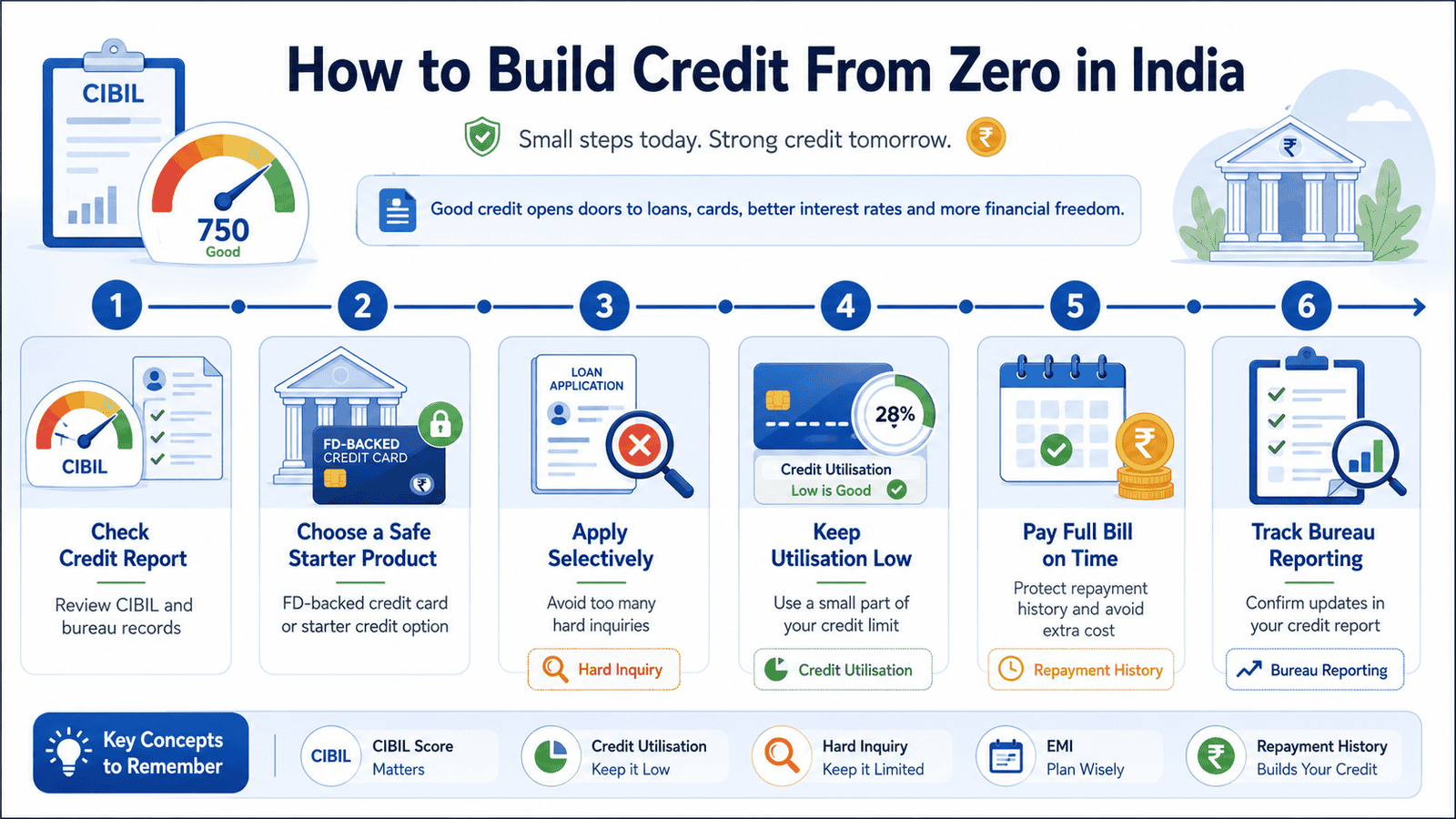
No credit history means lenders do not yet have loan or card repayment data to judge you. Start with a 6-step path: check your credit report, approach your existing bank, compare an FD-backed card or small secured loan, apply selectively, use the product lightly, and repay every bill or EMI on time.
First-Credit Readiness Checklist
Before applying for any loan or credit card, check whether you have everything a lender typically needs to assess a new-to-credit applicant. Missing items in this list can lead to immediate rejection — and a hard inquiry that stays on your report even when you are declined.
| Requirement | Why It Matters | What to Fix First |
|---|---|---|
| PAN card (valid and linked) | Required for KYC and credit bureau lookup | Apply at NSDL/UTI if not yet issued |
| Valid KYC documents (Aadhaar, address proof) | Lenders must verify identity before issuing credit | Ensure Aadhaar address is current |
| Active bank account (salary/current/savings) | Most lenders require bank statement history of 3–6 months | Open an account if you do not have one |
| Income proof (salary slips or ITR for self-employed) | Lenders assess repayment capacity even without credit history | Collect last 3 salary slips or most recent ITR |
| Stable contact details (phone, email, address) | Lenders and bureaus need reachable contact for communication | Ensure your Aadhaar-linked mobile is active |
| Existing salary-bank relationship | Your salary bank already has account behaviour data — easier for them to assess you | Start credit enquiry with your own bank first |
| Savings or FD (if choosing secured card route) | FD-backed cards require a fixed deposit as security — minimum amounts vary by lender | Start a small FD if you plan to go this route |
| Understanding of due dates and repayment | Missing even one payment can hurt a new credit profile significantly | Set reminders or auto-debit before applying |
For more on which credit cards are available to borrowers without a bureau score, read our guide on card without CIBIL score.
Key Takeaways
- No credit history means credit bureaus have no lender-reported repayment data for you — it does not mean you have bad financial behaviour or have defaulted on anything.
- Safer starter options for first-time borrowers in India include FD-backed secured credit cards, entry-level cards offered through your existing salary bank, and small secured loans against deposits or gold.
- Every time you apply to a lender and they pull your credit report, it creates a hard inquiry — too many hard inquiries in a short period can signal credit-seeking desperation and may hurt approval chances once your file starts being built.
- Credit history builds only when your lender reports your account to a credit bureau and you repay on time — a card or loan that is not reported, or one where you pay only the minimum due, does not give you the credit profile you need.
- Taking an expensive high-cost short-term loan just to generate a CIBIL score is not worth it — the interest cost, processing fee, and foreclosure charges will far exceed any benefit to your profile at this early stage.
- Your credit utilisation ratio — how much of your card limit you are using — is one of the first visible signals in a new credit profile. Keeping it low protects you from looking overextended to future lenders.
Key Facts at a Glance
| Concept | What It Means | What to Do |
|---|---|---|
| No credit history | No loan or card account has ever been reported to a credit bureau under your PAN | Start with a safe first product; do not apply randomly |
| CIBIL score not generated | Bureau needs a minimum period of credit activity before it can calculate a score | Check your report first; then follow the 6-step path |
| Low CIBIL score | You have some credit history but repayment has been irregular or utilisation is high | Different problem — needs score repair, not score creation |
| Bad credit history | Past defaults, settlements, or write-offs have been reported against your name | Needs a separate resolution strategy before applying |
| Safer first products | FD-backed credit card, entry-level card via salary bank, small secured loan | Compare these against your income, savings, and repayment readiness |
| What builds credit record | On-time repayment reported by lender to bureau, low utilisation, account longevity | Use the product regularly but lightly; pay full due each month |
| What can hurt a new borrower | Multiple simultaneous applications, minimum-due payments, high utilisation, suspicious apps | Apply to one or two suitable products only |
If you are unsure why your credit score has not appeared yet, the article on CIBIL score not generated explains the most common reasons and what to do about each one.
Why Lenders Hesitate When You Have No Credit History
Step 1 — Understand What a Credit Bureau Actually Does
Credit bureaus — TransUnion CIBIL, Experian India, CRIF High Mark, and Equifax India — collect loan and credit card account data from registered lenders and compile it into a Credit Information Report for each borrower. When a lender needs to assess you, they pull this report and use it to check your repayment track record. If no lender has ever reported an account under your name, the bureau simply has nothing to show. A score is not generated. This is what “new to credit” or “no credit history” means.
Step 2 — Understand Why Salary Alone Is Not Always Enough
Many first-time borrowers assume that a steady salary should be sufficient proof of creditworthiness. Lenders look at income — but they also look at repayment behaviour. A person earning ₹50,000 per month with no credit history tells the lender that they can probably afford the EMI. But the lender does not know whether that person repays on time, how they manage existing obligations, or whether they have borrowed from multiple sources simultaneously. Without a credit record, the lender is working with incomplete information. Some lenders reject new-to-credit applicants entirely; others may offer a lower credit limit or a higher interest rate to compensate for the uncertainty.
Step 3 — Understand the Difference Between No Score, Thin File, and Bad Credit
These three situations are different and need different responses. No credit history means no data at all has been reported. A thin file means there is some credit data — perhaps one account — but not enough for the bureau to generate a confident score. Bad credit history means accounts have been reported, but the repayment record is poor — defaults, DPD (Days Past Due) marks, or settlements. The approach for a first-time borrower is different from someone repairing a damaged score. This article is specifically for the first-time borrower starting from zero. To understand how to actively build a bureau record from scratch, read our guide on build CIBIL from zero.
Step 4 — Know How Your First Product Starts Building History
When you take a credit card or loan and the lender reports your account to the bureau, your credit file opens. Every month that you pay on time, the bureau records a positive repayment entry. Every month that you carry unpaid dues or pay only the minimum, it records a negative signal. Your credit utilisation ratio — that is, how much of your available card limit you are using — also gets recorded. A borrower using ₹5,000 of a ₹25,000 limit looks very different from one using ₹23,000 of the same limit. The first product you choose should be one that is easy to repay in full every month. Affordable and boring is the correct strategy here.
Real Example: Rohit’s First Credit Decision in Pune
Rohit, 24, works as a junior software support executive in Pune earning around ₹32,000 per month (illustrative). He has no previous loan or credit card, and every time he applies for a credit card online, the bank tells him his CIBIL score cannot be found. Frustrated, he considers applying to five or six different card issuers in one week, hoping one will accept him.
Instead, he pauses and checks his credit report directly with TransUnion CIBIL — and finds, as expected, that no score has been generated. He then approaches his salary bank and asks whether any entry-level credit card is available based on his salary account relationship. The bank offers him a basic card with a modest limit. Alternatively, Rohit places a fixed deposit of ₹25,000 (illustrative) and asks the bank about an FD-backed secured credit card, which gives him a credit limit linked to that FD.
He picks the FD-backed card, uses it for utility bills and grocery purchases totalling around ₹5,000 per month (illustrative) — roughly 20% of his ₹25,000 limit — and pays the full bill before the due date every month. After a few months, his lender begins reporting the account to credit bureaus. His credit profile starts to form. The key insight: Rohit built his credit record by being selective, starting small, and repaying fully — not by applying everywhere at once.
How Safe First-Credit Usage Works: A Calculation Example
Understanding two numbers — credit utilisation and the cost of carrying unpaid dues — can protect a new borrower from two of the most common early mistakes.
Example 1 — Credit Utilisation Ratio
Credit Utilisation Ratio = (Amount Used ÷ Total Credit Limit) × 100
Where: Amount Used = current outstanding balance | Total Credit Limit = maximum available limit
| Scenario | Usage (₹) | Limit (₹) | Utilisation % |
|---|---|---|---|
| Safe usage | 10,000 | 30,000 | 33% |
| High usage — risky for a new profile | 25,000 | 30,000 | 83% |
All figures above are illustrative. A lower utilisation ratio signals that you are not dependent on your credit limit to meet basic needs — which is a positive signal for future lenders. A high utilisation ratio on a new credit account can make your profile look stretched even before it has fully formed.
Example 2 — Cost of Carrying Unpaid Dues
If you have a credit card bill of ₹10,000 (illustrative) and choose to pay only the minimum amount due — say, ₹500 — the remaining ₹9,500 carries forward and attracts interest. Many credit cards charge monthly interest rates on unpaid balances that add up significantly over time. Paying the full bill by the due date every month avoids this entirely. For a first-time borrower, paying in full is not just financially sensible — it creates the clean repayment record that builds your credit profile fastest.
Comparison: First Credit Options for Beginners
Choosing the right first product depends on your savings, income stability, urgency, and repayment confidence. Here is a comparison of the most common beginner options. Fees, FD amounts, credit limits, and interest rates vary by lender — verify current figures at the official lender website before applying. For a full breakdown of the FD-backed route, read our guide on the FD-backed card option.
| Option | Best For | Key Caution |
|---|---|---|
| FD-backed secured credit card | Borrowers with some savings who want a controlled credit limit | FD is locked; annual fee and joining fee vary by lender — verify before applying |
| Entry-level unsecured card (via salary bank) | Salaried borrowers with 3–6 months of salary account history | Approval not guaranteed; limit may be low; ask your own bank first |
| Small secured loan (against FD or gold) | Borrowers who need actual cash and have an FD or gold asset | Interest charged on principal; repay on schedule to build record |
| Consumer durable loan (zero-cost EMI) | Borrowers making a planned purchase who can afford the EMI easily | Processing charges and hidden fees exist; check actual cost before signing |
| Personal loan without CIBIL score | Borrowers with strong salary proof and existing lender relationship | Interest rates may be significantly higher for new-to-credit applicants; compare total cost |
If You Find an Error on Your Credit Report
Step 1 — Check Your Report Directly With the Bureau
Before applying for any product, download your Credit Information Report from one or more bureaus — TransUnion CIBIL (transunioncibil.com), Experian India (experian.in), or CRIF High Mark (crifhighmark.com). Under RBI’s credit information reporting directions, registered credit institutions are required to report to credit bureaus. If you see a loan or inquiry you do not recognise, do not ignore it.
Step 2 — Identify the Problem
Look for unknown loan accounts, hard inquiries you never authorised, incorrect personal details such as name spelling or date of birth, or accounts that were closed but still show as active. Any of these can affect how lenders see your profile.
Step 3 — Contact the Lender First
The bureau reports what lenders send them. If an entry is wrong, the correction must begin with the lender who reported it. Contact the lender’s customer service with your account details and a written explanation of the error. Keep a record of all communication — email trail, reference numbers, and screenshots.
Step 4 — Raise a Dispute With the Bureau if Needed
If the lender does not respond or does not resolve the error within a reasonable time, you can raise a dispute directly with the bureau through their official website. Dispute resolution timelines and processes must be verified directly with the relevant bureau before you begin — visit transunioncibil.com or the relevant bureau’s official website for current procedures.
Borrower Safety Checklist — Protect Your Credit Before It Starts
- Do not apply to multiple lenders simultaneously. Each application typically triggers a hard inquiry — a formal credit check that is recorded on your bureau file. Applying to five lenders in one month signals credit-seeking desperation to future lenders, even if all five reject you. Apply to one or at most two products that you have researched and are reasonably eligible for.
- Avoid “guaranteed no CIBIL approval” loan apps. No regulated lender can guarantee approval. Apps or lenders that make this claim are frequently unregistered, charge extremely high fees, use aggressive recovery tactics, or do not report repayment behaviour to credit bureaus at all — meaning they cannot help you build a credit record even if you repay perfectly. Always verify whether a lender is registered with RBI at rbi.org.in before applying.
- Do not borrow just to build a score if you cannot repay comfortably. Taking an expensive short-term loan purely to start a credit record and then struggling to repay will create the exact problem you are trying to avoid — a damaged repayment record on a profile that is just beginning.
- Read fee and charge terms before applying. Annual fees, joining fees, interest rates, processing fees, and foreclosure or closure charges vary widely. A card that seems free may carry a fee after the first year. Verify every cost from the lender’s official website.
- Pay the full credit card bill — not just the minimum amount due. Minimum due payments keep your account technically active but result in interest charges on the unpaid balance and signal to bureaus that you are not clearing your dues fully.
How to Decide What’s Right for You
you have savings that you can lock for 6–12 months without needing them — consider an FD-backed secured credit card. The FD acts as security, the credit limit is capped, and the risk of overspending is naturally controlled.
you have been receiving salary into a bank account for at least 3–6 months — approach that bank first about an entry-level credit card. The bank already has your account behaviour and is better positioned to assess you than a lender who knows nothing about you.
you need actual funds urgently — compare small secured loans against an FD or gold at a registered bank or NBFC. Check the interest rate, total repayment amount, and whether the lender reports to credit bureaus before signing.
you are a student with limited or no income — look carefully at student credit cards or add-on cards linked to a parent’s account. Note that an add-on card may not build a separate credit history for you unless the account is reported under your own PAN.
you are confident about repaying the full bill or EMI each month — do not apply yet. Wait, build your emergency savings, reduce any existing financial pressure, and return to this decision when you can comfortably absorb the repayment without stretching your budget.
the fees, interest rate, and terms are clear from the lender’s official website — do not proceed. Applying for a product whose charges you do not fully understand is how early credit mistakes happen.
Common Mistakes to Avoid
Applying to Too Many Lenders at Once
When you apply for a loan or credit card, the lender pulls your credit bureau report — this is a hard inquiry. Multiple hard inquiries in a short period are visible on your credit file and can signal financial desperation, even if you are simply exploring options. For new borrowers with no existing credit record, this is especially damaging because there is no positive history to balance the signal. The impact of hard inquiries on a new profile is explained in our guide on hard inquiry impact.
Apply only after researching eligibility. Shortlist one or two products. Do not apply as an experiment.
Paying Only the Minimum Amount Due
The minimum amount due is the smallest payment that keeps your account from being marked overdue. But the unpaid balance carries interest at rates that many borrowers underestimate. More importantly, consistently paying only the minimum due sends a signal to future lenders — and to bureau scoring algorithms — that you are managing your credit under stress. Pay the full statement balance by the due date every month.
Maxing Out a New Credit Card
Using close to your full credit limit — say, ₹28,000 of a ₹30,000 limit — creates a very high credit utilisation ratio on a brand-new profile. Lenders reviewing your file later may interpret this as overextension. A new credit card used at 25–30% of the limit, repaid fully every month, sends a far better signal than one used at 90% of the limit even if every payment is on time.
Taking a High-Cost Loan Just to Build a Score
Some borrowers take expensive short-term personal loans from digital lenders specifically to “generate a CIBIL score.” The cost is real — processing fees, high interest, and sometimes foreclosure charges if you try to close early. The benefit to your credit profile from a single short-term loan may not justify this cost, especially when safer, lower-cost options like FD-backed cards are available.
Ignoring Errors on Your Credit Report
Even with no credit history, your bureau report may contain incorrect entries — unknown hard inquiries from lenders you never approached, wrong personal details, or someone else’s account linked to your PAN by clerical error. These errors can affect approval decisions. Check your report before you apply, not after you are rejected.
Not Tracking the Report After Approval
Once your first credit account is open and active, your lender should begin reporting to bureaus. Wait a few months, then check your credit report again to confirm the account is appearing, that repayment records are accurate, and that the information matches your actual usage. Errors in lender-reported data can happen and should be caught early.
When This May Not Be the Right Choice
Getting your first credit product right now may not make sense in the following situations:
Your income is unstable or irregular. If your salary is delayed, seasonal, or project-based, committing to a monthly card bill or loan EMI creates repayment risk. A single missed payment on a new credit profile can do significant damage.
You do not yet have an emergency fund. If an unexpected expense — a medical bill, a vehicle repair, a job gap — would force you to miss a credit card payment or loan EMI, your emergency buffer is not yet ready. Build at least two to three months of basic expenses in a savings account before adding a credit obligation.
You cannot comfortably repay the full credit card bill or EMI each month. Partial repayment leads to interest charges and potentially to a poor repayment record on a file that is just beginning.
The product’s charges are unclear. If you cannot find the annual fee, interest rate, processing fee, or closure terms on the lender’s official website, do not proceed until you can.
You have seen a suspicious “guaranteed no CIBIL” offer. If an app or lender is promising guaranteed approval with no credit check, this is a warning sign. Legitimate regulated lenders do not make this guarantee.
If any of these apply to your situation, it may be worth exploring other options before committing.
Official Rules and Where to Verify
Before applying for any first credit product, verify the following from official sources:
- TransUnion CIBIL (transunioncibil.com): Check your Credit Information Report, understand how your CIBIL Score is calculated, and verify how bureau data is collected and used.
- Experian India (experian.in): Credit scores and reports may vary across bureaus. Check your Experian report separately to see whether data differs.
- CRIF High Mark (crifhighmark.com): India has four active credit bureaus. Lenders may report to one or more bureaus, and data may differ across reports.
- RBI (rbi.org.in): Verify credit information reporting directions, the obligations of registered credit institutions to report to bureaus, and borrower-facing protections under RBI’s credit information framework.
- Your lender’s official website: Verify current fees, interest rates, FD requirements, credit limits, eligibility criteria, and reporting practices before applying.
Credit reporting rules, lender assessment methods, and bureau processes can change. Always verify current details from the relevant bureau, lender, or official regulatory source before acting.
Expert Tips
- Keep your credit utilisation below 30% of your limit. On a card with a ₹25,000 limit, that means keeping your monthly balance below ₹7,500 before payment. If your spending is higher, pay mid-cycle to bring the balance down before the statement is generated. For a detailed explanation, see our guide on credit utilisation basics.
- Pay the full statement balance — not the minimum due, not a partial amount. Full payment avoids interest charges and creates a cleaner repayment record. Even one month of paying less than the full balance carries visible consequences.
- Avoid converting small card purchases to EMIs unnecessarily. EMI conversion on a new card adds a loan-type entry to your file, uses up your credit limit, and typically includes processing charges. Keep your first card simple.
- Do not close your first card too quickly. Account longevity is part of what a credit profile is built on. If the card has no annual fee, or a fee you can justify, keep it open and use it for small, regular expenses.
- Check your credit report from at least two bureaus every 6–12 months. Lenders may report to different bureaus. Checking TransUnion CIBIL, Experian India, and CRIF High Mark periodically ensures you are not surprised by an error when you next apply for credit.
- Use the bureau’s free annual report option. Under RBI directions, credit bureaus are required to provide one free credit report per year to borrowers. Use this entitlement before spending on premium monitoring services.
Frequently Asked Questions
Can I get a loan if I have no credit history?
Some lenders — typically your existing bank or a registered NBFC — may offer a small loan to a new-to-credit borrower if you have a strong salary account relationship, verifiable income, and valid KYC. However, approval is not guaranteed, the interest rate may be higher than for established borrowers, and the loan amount may be limited. Verify eligibility directly with the lender before applying.
Can I get a credit card without a CIBIL score?
Yes, in some cases. FD-backed secured credit cards are specifically designed for borrowers without a credit history — the fixed deposit acts as security and the bank typically does not need a pre-existing CIBIL score to issue the card. Some banks may also offer entry-level cards to their own salary account holders based on internal assessment. The terms, FD amounts, fees, and limits vary by lender.
Is no credit history better than a bad CIBIL score?
These are different situations. No credit history means the bureau has no data on you — some lenders may be willing to work with this. A bad CIBIL score means negative repayment behaviour has been recorded — defaults, late payments, or settlements. Lenders generally treat bad credit more cautiously than no credit. However, neither situation guarantees approval or denial — individual lenders assess both factors differently.
Will an FD-backed credit card build my CIBIL score?
It can — but only if the card issuer reports the account to one or more credit bureaus and you repay on time. Most regulated banks report credit card activity to bureaus. Confirm with your specific lender whether they report FD-backed card accounts, and to which bureaus, before choosing this route purely for credit-building purposes. Note that credit scores are calculated by bureaus using lender-reported data — bureau processes and timelines can vary.
How long does it take to build a credit history in India?
This varies by bureau, by lender reporting frequency, and by the type of credit account. A credit score may begin to appear after a period of regular lender reporting and on-time repayment — but no fixed timeline applies to all borrowers. This article does not promise a specific timeline, and neither should any lender or app. Verify with the relevant bureau about how and when a score is generated after a new account is opened.
Does checking my own CIBIL score reduce it?
No. Checking your own credit score or report is a soft inquiry — it does not affect your credit score. Only hard inquiries — triggered when a lender formally pulls your report for a credit application — are recorded as a credit-seeking event. You can and should check your own credit report before applying for any loan or card.
What is the safest first credit product in India?
There is no single answer for every borrower — the safest product depends on your income, savings, repayment readiness, and existing bank relationship. For many first-time borrowers with some savings, an FD-backed secured credit card from a regulated bank is a controlled starting point because the credit limit is tied to your own deposit. For salaried borrowers with a salary account history, an entry-level card from the same bank may be another option. Compare both carefully before applying.
Final Verdict
If you have no credit history, the most important decision you can make is also the simplest: start small, apply selectively, and repay fully. A first-time borrower who takes one affordable product — whether an FD-backed credit card or a small secured loan — uses it lightly, and pays every bill on time is doing everything correctly. A borrower who applies to ten lenders in one month, takes a high-cost loan to generate a score, or pays only the minimum due is building problems before the profile has even properly started.
The borrowers who benefit most from this approach are those who have income, a bank relationship, and the discipline to repay without pressure. Borrowers who are income-unstable, without an emergency fund, or attracted by “guaranteed no CIBIL” claims should wait and prepare first.
The main decision rule is straightforward: choose the safest, most affordable credit product you qualify for at your existing bank, keep utilisation low, and let on-time repayment do the work. Your next step is to check your credit report directly with a credit bureau, then speak to your salary bank about your options.
Always verify your latest credit report, lender requirements, and bureau process before making a credit-related decision.
This article is for educational purposes only and should not be treated as personalised financial, credit, or legal advice. Credit scores, credit reports, lender eligibility criteria, and bureau processes can vary and may change over time. Please verify current details with the relevant credit bureau, lender, official regulatory source, or a qualified professional before making any credit-related decision.

Neha Menon writes simple, borrower-first explainers on CIBIL scores, credit reports, bureau disputes, DPD, loan settlement impact, hard inquiries, and practical credit score recovery. She focuses on helping Indian borrowers understand lender-reported data, avoid credit mistakes, and take safer next steps without false promises.