
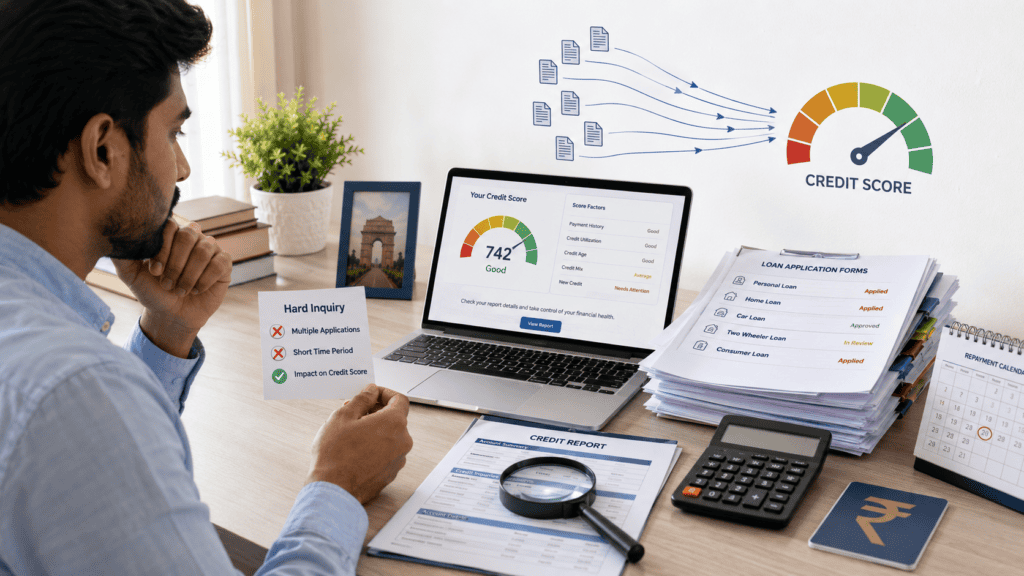
When you need money urgently — or after a lender says no — the natural instinct is to apply to the next bank, then the next NBFC, then a few loan apps. Within a week, you may have applied to five or six places. Then you check your CIBIL report and see a row of fresh enquiries, and the worry sets in: did all those applications just damage my credit score? The multiple loan applications impact on CIBIL score is real — but it is also widely misunderstood. Not every credit check works the same way, and the score drop itself is often less harmful than what those enquiries tell a lender about your behaviour. This article explains what actually happens, what the difference between a hard inquiry and a soft inquiry means for you, and what to do next if you have already applied to several lenders in a short period.
Quick Answer: Do Multiple Loan Applications Affect CIBIL Score?
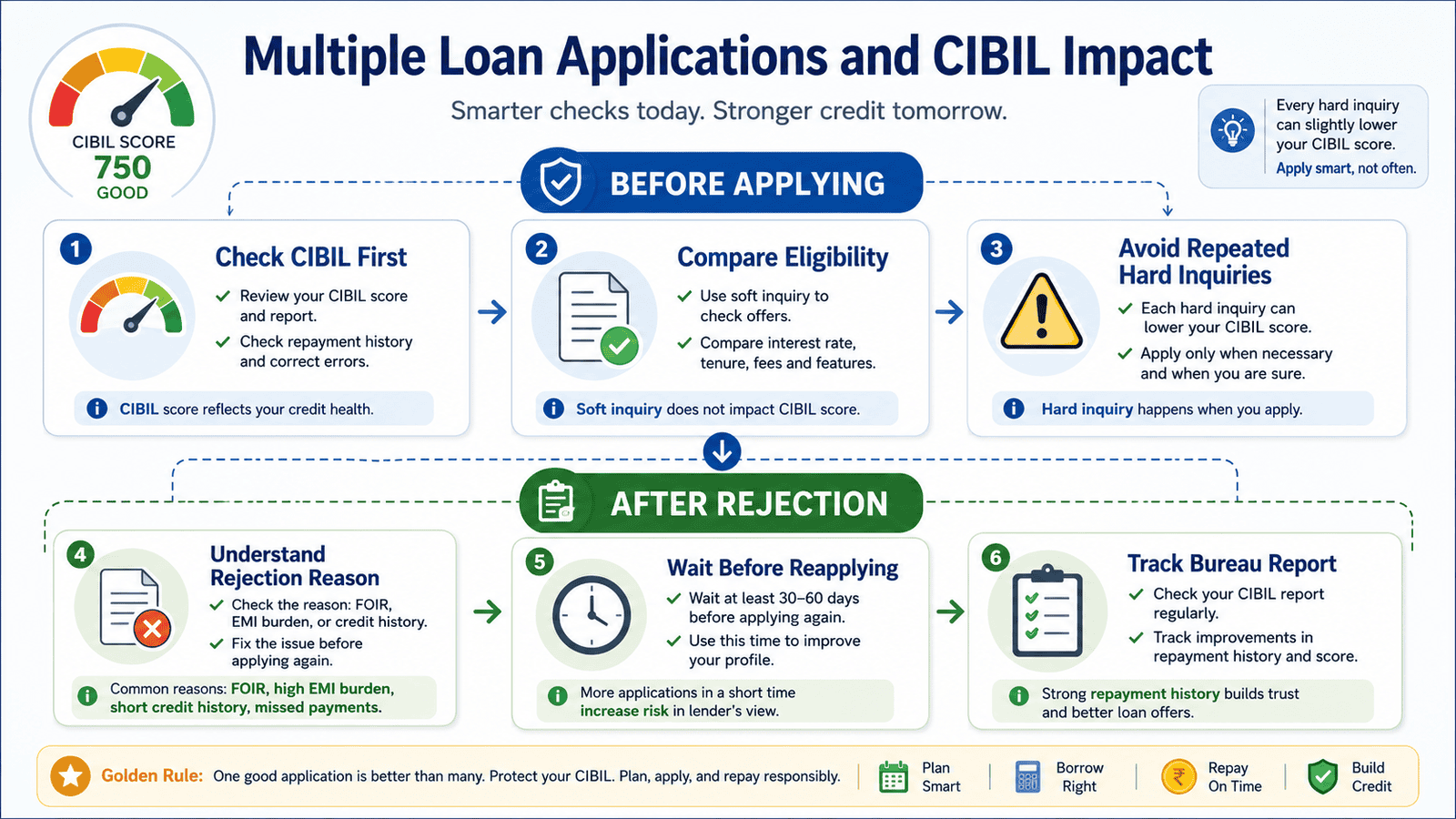
Multiple loan applications impact on CIBIL score when lenders create hard inquiries on your credit report. One or two applications may not matter much, but several applications within a short period can signal credit hunger to lenders. Self-checking your own CIBIL score is a soft inquiry and does not affect your score. Check your report, compare eligibility carefully, and apply selectively rather than to every lender at once.
Key Takeaways
- Every time a lender accesses your credit report as part of a formal loan or credit card application, it creates a hard inquiry — and multiple hard inquiries in a short window can signal credit hunger, which weakens lender confidence even if the score drop itself is modest.
- Checking your own CIBIL score — whether through transunioncibil.com or a bureau-linked partner — is a soft inquiry and does not reduce your credit score.
- Loan rejection is not the event that is directly reported to CIBIL; the hard inquiry from the lender’s access is what appears on your report. However, repeated rejections often lead to more applications and, therefore, more inquiries.
- If you earn ₹42,000 per month with an existing bike EMI and credit card dues, your repayment capacity is already stretched — applying to many lenders signals urgency without improving your eligibility.
- Before applying again, pull your credit report, understand the actual rejection reason — whether it is score, FOIR, documentation, or employer profile — and fix that first.
- Credit scores are calculated by credit bureaus using lender-reported data and may vary across TransUnion CIBIL, Experian India, CRIF High Mark, and Equifax India — verify your report directly from the bureau, not through a third-party estimate.
Key Facts at a Glance
| Term / Situation | What It Means | Borrower Action |
|---|---|---|
| Hard inquiry | Lender accesses your credit report for a formal loan or card application | Minimise; apply selectively |
| Soft inquiry | You check your own score, or a lender runs a pre-approval scan | Safe; do regularly |
| Loan rejection | Not directly reported as a rejection event to bureaus; the hard inquiry is visible | Fix the real cause before reapplying |
| Self-score check | Does not reduce CIBIL score; appears as a consumer enquiry | Check every few months |
| Multiple inquiries | Can signal credit hunger; may affect lender confidence beyond the score number | Pause, review, apply to fewer lenders |
| Bureau variation | Scores and data may differ across CIBIL, Experian, CRIF, and Equifax | Verify from each bureau if lender cites a specific one |
How Multiple Loan Applications Affect Your CIBIL Score
Step 1 — What Actually Happens When You Apply for a Loan
When you submit a formal personal loan application — to a bank, NBFC, or through a lending platform — the lender almost always accesses your full credit report from one or more credit bureaus. This access is recorded in the enquiries section of your credit information report. It is called a hard inquiry (sometimes written as hard enquiry) because it reflects an active credit decision being made. The four bureaus that operate in India — TransUnion CIBIL, Experian India, CRIF High Mark, and Equifax India — each maintain their own report, and a lender may access one or more of these depending on their internal policy.
A hard inquiry stays visible on your credit report for a period that can vary by bureau — verify the current duration directly with TransUnion CIBIL at transunioncibil.com. Each inquiry shows the lender name, date, and product type, so any future lender can see exactly how many places you applied to and when.
To understand the full difference between these two types of checks, read our guide on hard and soft checks.
Step 2 — What a Soft Inquiry Is and Why It Does Not Hurt You
A soft inquiry happens when you or a pre-approved marketing scan accesses your credit data — not as part of a formal application. Checking your own score on the bureau’s website, receiving a pre-approved loan offer by SMS, or using a bureau-linked tool to estimate your eligibility — these are typically soft inquiries. They appear in your report for your own visibility but are not visible to lenders assessing a new application, and they do not affect your credit score. Many borrowers avoid checking their own report precisely because they fear it will reduce the score — this is a myth worth clearing up immediately. For a detailed explanation of why self-checks are safe, see checking your own score.
Step 3 — Why Multiple Hard Inquiries Signal Credit Hunger
The problem with applying to many lenders in a short period is not just the numerical score impact — it is the behavioural signal. Lenders and their underwriting teams look at your credit report holistically. A cluster of hard inquiries from multiple institutions in a short window suggests that you may be urgently seeking credit, may have been rejected elsewhere, or may be planning to take on more debt than your income can support. This pattern is sometimes called credit hunger, and it raises a practical concern for lenders: if you take loans from three or four of them simultaneously, will you be able to repay all of them?
This concern becomes sharper when the lender also sees your existing EMI obligations and credit card dues in the same report. The combination of high FOIR (Fixed Obligations to Income Ratio — the share of your monthly income already committed to existing EMIs and dues) and multiple recent inquiries is a common reason for rejection even when the credit score itself is not very low. Lender underwriting is not based on the score alone; repayment history, credit utilisation, enquiry pattern, and employer profile are assessed together.
Step 4 — Does Loan Rejection Directly Reduce Your CIBIL Score?
No — the rejection decision itself is not typically reported to the bureau as a separate negative event. What is visible on the report is the hard inquiry made at the time of application. However, rejection often triggers a cycle: the borrower applies again to another lender, which creates another hard inquiry. That second lender may then reject partly because of the first inquiry, leading to a third application, and so on. This compounding of inquiries is the real risk, not any single rejection. Keeping that cycle in mind is important for understanding why the right step after rejection is to pause and investigate — not to immediately apply elsewhere. If your score dropped after applications and you want to understand the cause, our guide on why your score dropped suddenly may help.
Real Example: Rohit’s Loan Application Sprint in Pune
Rohit, 29, works as a junior software analyst in Pune and earns ₹42,000 per month. He has an existing two-wheeler EMI of ₹4,800 per month and a credit card outstanding of around ₹12,000. After an unexpected family expense, he needed ₹2,50,000 urgently. He applied through one bank’s website, then two fintech lending platforms, then a loan app, and then tried two more NBFCs — all within 10 days.
When Rohit downloaded his credit report two weeks later, he saw six new enquiries in the enquiry section, all within a 10-day window, all marked as personal loan applications. His CIBIL score had moved downward by a small amount, but the bigger problem was what any new lender would see: six hard inquiries in 10 days, an existing EMI, and a credit card balance — together suggesting that Rohit was under financial stress and actively seeking credit from multiple sources. His FOIR with the new proposed EMI was already tight. One lender he approached after this rejected him citing recent credit behaviour — not the score number itself.
A better path for Rohit would have been: pull his credit report first, estimate his FOIR with the existing EMI and card dues, shortlist two or three lenders whose eligibility criteria matched his salary and score, and apply to those only. That approach would have produced fewer inquiries and a more confident lender assessment. This is an illustrative example — lender underwriting processes vary and are not publicly disclosed in full.
Checklist: Before You Apply to Any Lender
- Download your latest credit report from the official bureau website — not a third-party summary. Check the enquiry section, repayment history, and outstanding balances before you begin any new application.
- Calculate your current FOIR: add all existing monthly EMIs (home loan, two-wheeler, personal loan, credit card minimum due) and divide by your net monthly income. Most lenders prefer FOIR below 40–50% after the new EMI is included.
- Shortlist only two or three lenders whose published eligibility criteria match your salary bracket, employer type, credit score range, and loan amount need.
- Check whether the eligibility check offered by a lender or platform is clearly described as a soft inquiry — if not, treat it as a potential hard inquiry and be cautious.
- Keep all application-related documents ready before you begin — income proof, employment documents, identity proof, address proof — to avoid abandoning a form midway and restarting elsewhere.
- Use the application checklist to confirm you are genuinely ready before submitting to any lender.
How Application Behaviour Affects Affordability Assessment
Beyond the inquiry count, lenders run an affordability check. Here is a simplified illustration using a monthly income of ₹40,000 (illustrative figure — lenders use their own income verification):
FOIR = (Total Fixed Monthly Obligations ÷ Net Monthly Income) × 100
Where: Fixed Monthly Obligations = existing EMIs + minimum credit card due | Net Monthly Income = salary after TDS and deductions
| Scenario | Monthly Obligations | FOIR on ₹40,000 Income |
|---|---|---|
| Existing bike EMI only (₹4,800) | ₹4,800 | 12% — low burden |
| Bike EMI + credit card minimum (₹4,800 + ₹2,400) | ₹7,200 | 18% — manageable |
| Above + new personal loan EMI (₹6,500 illustrative) | ₹13,700 | 34% — approaching lender limits |
| Above + another outstanding EMI (₹3,500) | ₹17,200 | 43% — likely to raise lender concern |
The point of this calculation is not to give you an exact approval threshold — lenders set their own FOIR limits and do not publish them uniformly. The point is that repeated applications without first addressing the affordability picture will keep producing rejections regardless of how many lenders you try. All figures above are illustrative; verify your lender’s actual FOIR requirements directly.
Comparison: Hard Inquiry vs Soft Inquiry vs Unclear Check
| Type of Credit Check | Who Performs It | Appears on Report / Visible to Lenders |
|---|---|---|
| You check your own CIBIL score or report | You (consumer) | No — soft inquiry |
| Pre-approved SMS or marketing offer from a bank | Lender’s marketing team | No — soft inquiry |
| Formal personal loan application to a bank or NBFC | Lender’s credit team | Yes — hard inquiry |
| Credit card application | Card issuer’s credit team | Yes — hard inquiry |
| Loan marketplace “eligibility check” — varies by platform | Platform or lender | Verify — may be hard or soft |
| Employer running a credit background check | Employer via bureau | No — soft inquiry |
According to Experian India (experian.in), the distinction between hard and soft checks is an important part of understanding your credit information report. Note that some lending platforms describe their eligibility tools as “soft checks” — verify this claim directly with the platform before using it, as bureau access practices can vary by lender and platform. See checking your own score for a detailed explanation of consumer-initiated checks.
What to Do If You Find an Inquiry You Did Not Authorise
Step 1 — Review Your Enquiry Section Carefully
Download your full credit report from TransUnion CIBIL at transunioncibil.com and open the enquiries section. This section lists each enquiry by lender name, date, product type (personal loan, credit card, home loan, etc.), and the amount if stated. Go through each entry and match it against applications you actually made.
Step 2 — Identify the Unknown Entry
If you find an enquiry from a lender you did not approach — or a date that does not match any application you submitted — note down the lender name, date, and product type. This could be an error in reporting, a case of mistaken identity, or in rare cases a sign of misuse of your documents.
Step 3 — Contact the Lender First
Write to the lender named in the enquiry and ask them to confirm whether a credit application was submitted using your PAN or other identity, and to provide details of the enquiry. Keep a written record of this communication. Most lenders have a grievance redressal contact listed on their website.
Step 4 — Raise a Dispute With the Bureau
If the lender confirms the enquiry was made in error, or if you cannot reach the lender, raise a formal dispute with TransUnion CIBIL through their online dispute resolution process at transunioncibil.com. The bureau will investigate by contacting the lender. Keep screenshots of your credit report and any correspondence. Note that valid inquiries — from applications you did authorise — typically cannot be removed. For more detail on when removal is and is not possible, read our guide on inquiry removal rules.
Safety Checklist: Protect Yourself From Panic Applications
Borrower Safety: What to Do and Avoid After Rejection
- Do not apply to every loan app just because one bank said no. Each application may create a new hard inquiry. Applying to ten lenders in a panic does not increase your chances — it reduces them.
- Avoid any lender that promises guaranteed approval despite poor credit. Regulated lenders in India do not guarantee loans. Such promises are a warning sign of an unregistered or predatory operator.
- Read the Key Fact Statement (KFS) and APR before accepting any digital loan offer. The RBI’s Digital Lending Guidelines require regulated lenders to provide a KFS — if a lender does not provide one, that is a red flag.
- Do not share Aadhaar, PAN, or bank statements with unknown apps or agents who contact you after you have searched for loans online. Document misuse is a real risk in the digital lending space.
- Pause after a rejection and understand what caused it — was it the score, the FOIR, a documentation gap, your employer’s type, or the loan amount? Fixing the real cause gives your next application a genuine chance.
How to Decide What’s Right for You
Your credit report shows no recent hard inquiries (or just one or two), your FOIR with the new EMI is below 40–45%, and your documents and income proof are complete — apply now to one or two well-matched lenders based on their published eligibility criteria. Use the application checklist before submitting.
You applied to multiple lenders in the last 30 days and were rejected by at least one — wait before applying again. Let the inquiry cluster age and give yourself time to understand the actual rejection reason. Applying immediately after a cluster of rejections will most likely produce another rejection.
Your credit report shows an overdue payment, a Days Past Due (DPD) mark, or a high credit card utilisation — fix these first. No volume of loan applications will resolve an underlying creditworthiness issue; lenders see the full report, not just the score number.
An eligibility or pre-qualification tool is offered by a lender or platform and it is clearly described as a soft check — use it to compare options before making any formal application. This is the safest way to shop without creating hard inquiries.
You do not yet know why your previous application was rejected — do not apply again anywhere until you download your credit report, calculate your FOIR, and identify the actual gap. Applying without understanding the rejection reason is the fastest way to accumulate more inquiries without improving your approval chances.
Common Mistakes to Avoid
Applying to Many Lenders Simultaneously After One Rejection
One rejection does not mean every lender will say no — but applying to five more immediately creates five more hard inquiries, each of which the next lender can see. This pattern looks like desperation rather than credit readiness.
Instead, pause, identify the rejection reason, shortlist two lenders whose criteria match your profile, and apply to those after a gap. To understand what causes rejections, read our guide on loan rejection reasons.
Confusing a Self-Score Check With a Lender Inquiry
Many borrowers avoid checking their own credit report for months because they believe it will lower their score. This fear causes them to apply to lenders without knowing their actual credit position — which increases the chance of rejection and, therefore, more hard inquiries.
Checking your own score is a soft inquiry. Do it regularly, especially before any loan application. It costs nothing and tells you exactly what a lender will see.
Ignoring the Real Rejection Reason and Reapplying Blindly
If a lender rejects due to high FOIR, no amount of applying to other lenders will fix that. If the rejection is due to a documentation error, fixing the document is the only effective step. Continuing to apply without diagnosing the issue wastes time and adds inquiries.
Ask the lender for the specific rejection reason in writing. Many regulated lenders will provide this under RBI’s Fair Practices Code for lenders.
Applying Without Checking or Reducing Existing EMI Burden
If your total EMI obligations already consume more than 40–50% of your income (illustrative; verify actual thresholds with each lender), adding another loan EMI may push you outside the lender’s eligibility window. Paying down the credit card outstanding before applying can improve the affordability picture meaningfully.
Do the FOIR calculation yourself before applying so you are not surprised by another rejection.
Trusting Guaranteed Approval Claims From Loan Apps
If a loan app or agent promises instant sanction regardless of credit score or income, that is not a regulated lender’s normal process. Legitimate banks and NBFCs registered with the RBI assess all applications individually. Guaranteed-approval claims are a common feature of predatory or illegal lending operations.
Verify any lender’s registration with the RBI before sharing documents or accepting terms.
Applying Through Multiple Aggregator Platforms Simultaneously
Some borrowers use three or four loan comparison platforms at the same time, not realising that each platform may submit the application to multiple lenders on the back end. This can result in many more hard inquiries than the borrower intended — sometimes six to eight from one evening of “comparing” options.
Read the platform’s terms before allowing it to submit your application to lenders. A pre-eligibility check is not the same as a formal application submission.
When This May Not Be the Right Choice
Applying for another loan immediately may not be in your best interest if any of these situations apply to you right now:
You have multiple hard inquiries already recorded in the past 30–60 days and have not yet understood why previous applications were rejected.
Your credit report shows overdue payments, a Days Past Due (DPD) entry, or a current settlement or write-off — these are underwriting red flags that will typically override a decent score number.
Your credit card utilisation is very high — some lenders may interpret this as existing financial stress, not just a spending habit.
Your income is unstable, you have recently changed jobs, or you cannot produce the salary documents a lender will require — applying without these ready wastes an inquiry.
Your existing EMI burden is already close to or above the threshold most lenders apply — adding another EMI may make repayment genuinely difficult, not just technically rejected.
If any of these apply to your situation, it may be worth exploring other options before committing.
Official Rules and Where to Verify
Credit report data, enquiry treatment, bureau processes, and lender assessment methods are governed by each credit bureau’s own reporting standards and by RBI regulations on credit information companies. The four credit bureaus operating in India are private entities — they are not government bodies — but they are regulated under the Credit Information Companies (Regulation) Act, 2005.
- TransUnion CIBIL — transunioncibil.com — Access your full credit report, review the enquiry section, and raise disputes for inaccurate entries through their official dispute resolution process.
- Experian India — experian.in — Download your Experian credit report and review enquiry history from the Experian perspective, as different lenders may use different bureaus.
- CRIF High Mark — crifhighmark.com — Access your CRIF High Mark report, relevant particularly for microfinance and NBFC borrowers.
- Equifax India — equifax.co.in — Access your Equifax India report to check whether your enquiry and repayment data differs across bureaus.
For unauthorised inquiries or lender misconduct, the RBI’s Centralised Complaint Management System (CMS) at cms.rbi.org.in is the escalation route after lender-level resolution has been attempted. For disputed entries, use the official bureau dispute process — contact details are on each bureau’s website. Further detail on whether inquiries can be disputed is in our guide on inquiry removal rules.
Credit reporting rules, lender assessment methods, and bureau processes can change. Always verify current details from the relevant bureau, lender, or official regulatory source before acting.
Expert Tips
- Check your credit report before every loan application, not after rejection. Knowing your current score, enquiry history, and FOIR position before applying lets you choose the right lenders — rather than applying everywhere and hoping.
- If a lender quotes you an interest rate that seems unusually low, ask for the APR in writing (Annual Percentage Rate — the true cost of borrowing including fees). A low headline rate with high processing fees may cost more than a straightforward rate from a regulated bank.
- Reduce your credit card outstanding before applying, not after. Even partially paying down a high credit card balance improves your utilisation ratio — one of the factors bureaus use in scoring — and reduces your FOIR, both of which matter to lenders.
- When using a loan marketplace or comparison platform, ask whether the eligibility check is a soft or hard inquiry. Some platforms submit your details to multiple lenders simultaneously — if each lender pulls your report, you may get five inquiries from one form submission.
- Keep a simple log of every loan application you make — lender name, date, product, amount, and outcome. This takes two minutes and helps you track your inquiry count, match it against your credit report, and identify any entries that do not belong to you.
- If you are planning a home loan application in the next 6–12 months, protect your credit report now — avoid unnecessary personal loan or credit card applications in the months before, because home loan underwriting is particularly sensitive to the recent enquiry pattern.
Frequently Asked Questions
Do multiple loan applications reduce CIBIL score?
Multiple loan applications can reduce your CIBIL score because each formal application may result in a hard inquiry from the lender. One or two inquiries may have limited numerical impact, but several hard inquiries within a short window can affect the score and, more importantly, signal credit hunger to future lenders. The exact score impact depends on your overall credit profile and is calculated by the bureau — no fixed drop per inquiry can be stated. Verify your current report from transunioncibil.com.
What is a hard inquiry in a CIBIL report?
A hard inquiry is recorded in your credit report when a lender formally accesses your credit information as part of evaluating a loan or credit card application you have submitted. It appears in the enquiries section of your CIBIL report with the lender’s name, date, and product type. It is visible to other lenders who access your report for future credit decisions.
Does checking my own CIBIL score reduce it?
No. Checking your own credit score or downloading your full credit report is a soft inquiry and does not reduce your CIBIL score. It is visible in your report for your own reference but is not shown to lenders assessing a new application. You can and should check your credit report regularly — ideally before every loan application.
Does loan rejection appear in my CIBIL report?
The rejection decision itself is not typically reported as a separate event to the credit bureau. What appears is the hard inquiry made when the lender accessed your report as part of the application. However, repeated rejections often lead to more applications, which create more hard inquiries — this compounding pattern is what makes the situation worse over time.
How long should I wait before applying for another loan after rejection?
There is no fixed waiting period that applies across all lenders or situations. The more important step is to understand why the previous application was rejected — score, FOIR, documentation, employer type, or something else — and fix that issue before applying again. Applying again immediately without addressing the cause will likely produce another rejection, along with another hard inquiry. Verify lender-specific guidance directly with the lender you plan to approach.
Can I remove loan inquiries from my CIBIL report?
Inquiries that you authorised — from applications you genuinely submitted — typically cannot be removed. They will age off your report over time according to the bureau’s retention policy, which you should verify at transunioncibil.com. If you find an inquiry that you did not authorise, you can raise a dispute with the bureau or contact the lender named in the entry. Valid, authorised inquiries are a factual record of your credit behaviour.
Are pre-approved loan offers soft inquiries or hard inquiries?
Pre-approved offers sent by a lender through SMS or email — where no formal application has been submitted — are typically generated using a soft inquiry or internal lender data. However, once you express interest and submit a formal application in response to a pre-approved offer, the lender will usually conduct a hard inquiry as part of their underwriting process. The pre-approval itself does not guarantee sanction. Verify the process with the specific lender.
Can CIBIL scores vary across bureaus for the same borrower?
Yes. Each credit bureau — TransUnion CIBIL, Experian India, CRIF High Mark, and Equifax India — maintains its own database based on what lenders report to them. Not all lenders report to all bureaus. Different bureaus may also use slightly different scoring models. This means your score and even your reported credit history can vary across bureaus. If a lender cites a low score, ask which bureau they checked and compare it with your own reports from each bureau.
Final Verdict
The multiple loan applications impact on CIBIL score is real but is often less severe than borrowers fear — the bigger risk is what a cluster of hard inquiries communicates to lenders about your credit behaviour. If you have already applied to several lenders in a short period, the right response is not to apply more — it is to pause, download your credit report from transunioncibil.com or another bureau, understand the actual rejection reason, and address it before applying again. Borrowers with strong repayment history, low FOIR, and clean reports should apply selectively to matched lenders. Borrowers with recent DPD entries, high credit card utilisation, or FOIR close to the lender’s limit should fix those issues first — no volume of applications will substitute for genuine credit readiness. If you want to understand whether your report has a disputed entry you can act on, read our guide on inquiry removal rules. Always verify your latest credit report, lender requirements, and bureau process before making a credit-related decision.
This article is for educational purposes only and should not be treated as personalised financial, credit, or legal advice. Credit scores, credit reports, lender eligibility criteria, and bureau processes can vary and may change over time. Please verify current details with the relevant credit bureau, lender, official regulatory source, or a qualified professional before making any credit-related decision.

Neha Menon writes simple, borrower-first explainers on CIBIL scores, credit reports, bureau disputes, DPD, loan settlement impact, hard inquiries, and practical credit score recovery. She focuses on helping Indian borrowers understand lender-reported data, avoid credit mistakes, and take safer next steps without false promises.