
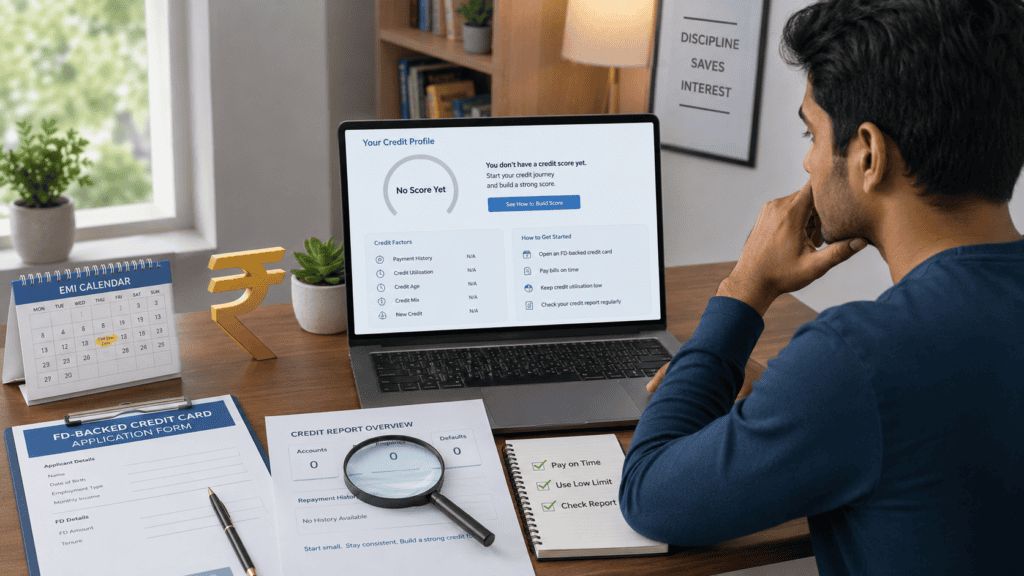
If you’ve never taken a loan or owned a credit card, your CIBIL score is probably not low — it’s simply not there yet. This is one of the most common and most misunderstood problems for students, new employees, and homemakers in India. You check your CIBIL score, and instead of a number, you see “NA” or “NH,” even though you have a salary account, a debit card, and regular UPI payments.
This guide shows you how to build a CIBIL score from zero safely — without falling into the trap of taking a loan you don’t need, or applying for five cards in a week hoping one gets approved. You’ll learn which credit products are realistic starting points, how long the process usually takes, and what mistakes can quietly damage a credit profile before it’s even properly started.
No website, including this one, can guarantee that a specific action will generate your score by a fixed date, or that it will get you approved for a particular loan or card. What this guide can do is show you the safest, most commonly used path that first-time borrowers in India take.
Quick Answer: How to Build CIBIL Score From Zero
How to build CIBIL score from zero starts with opening a small, manageable credit account such as an FD-backed credit card or regulated small EMI product, using it lightly, and paying every bill before the due date. A savings account, debit card, or UPI activity alone usually does not create credit history.
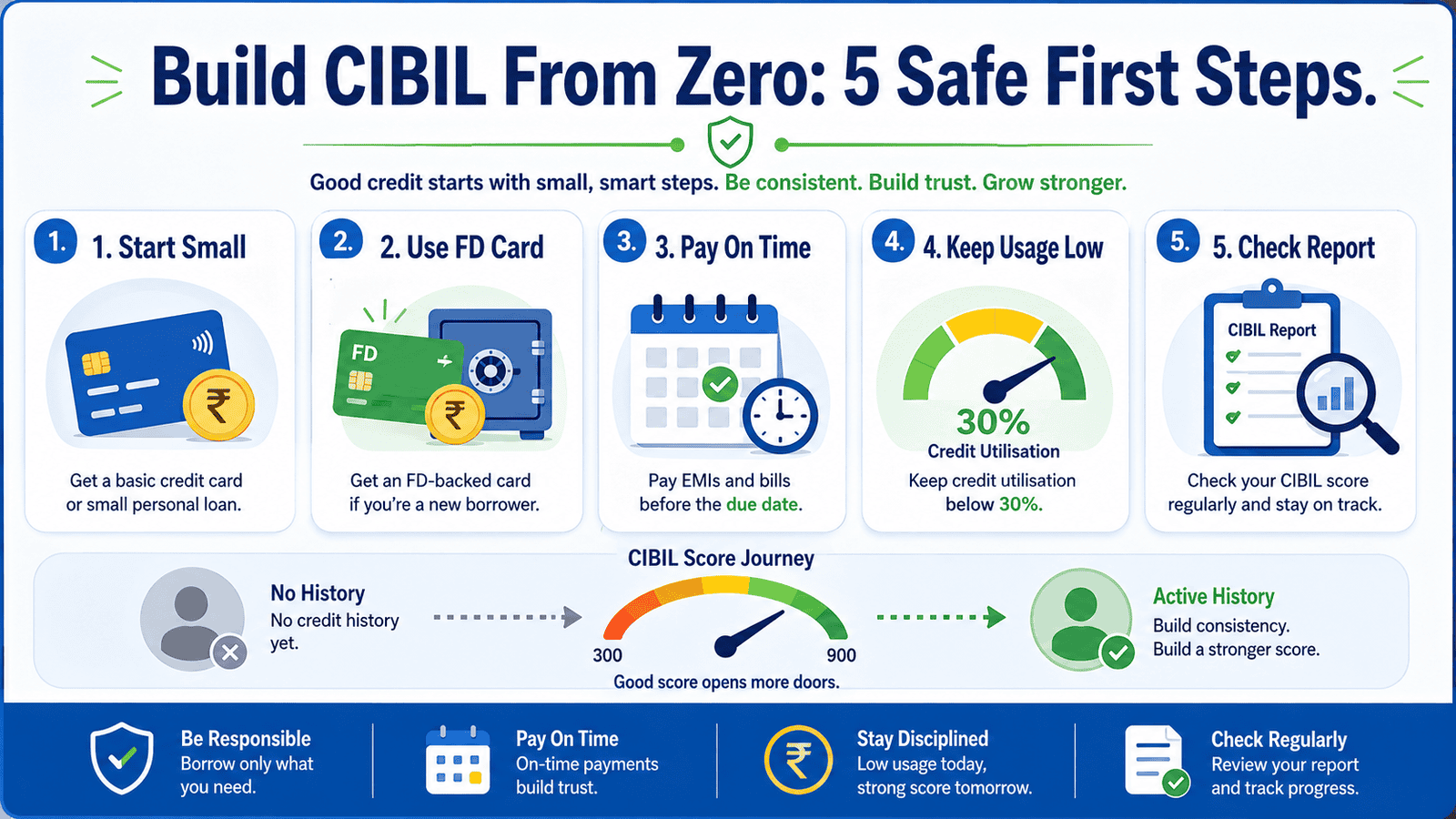
Beginner Credit-Building Checklist
- Choose only a credit product — a card or EMI — that you are fully confident you can repay every month, not the one with the highest limit you can get.
- If a regular credit card application gets rejected for “no credit history,” consider an FD-backed credit card before trying riskier alternatives.
- Keep your usage low relative to your limit — spending a small portion of a ₹20,000 limit looks far steadier to a lender than spending close to all of it.
- Pay the full amount before the due date, every single month — this one habit matters more than any other single factor in this list.
- Avoid applying for multiple cards or loans within a short window — each application can trigger a hard inquiry, and several together can look like credit-hungry behaviour.
Key Takeaways
- Having no CIBIL score usually means there isn’t enough credit account history for the bureau to calculate one — it is not automatically the same as having bad credit.
- Bureaus generally build your credit history from credit accounts that lenders report — a savings account or UPI app does not typically report to TransUnion CIBIL, Experian, CRIF High Mark, or Equifax.
- An FD-backed credit card can be a practical starting point if a regular unsecured card application has been rejected due to no credit history.
- Repaying a small credit account on time, every month, matters more for building a profile than the size of the loan or credit limit you start with.
- Taking an expensive or unfamiliar loan only to “create a score” can backfire — a single missed payment on a fresh credit file can do more damage than having no file at all.
Key Facts at a Glance
| Activity | Helps Build CIBIL History? | Beginner Note |
|---|---|---|
| Savings account, salary credits | Usually no | Banks don’t typically report savings account activity to credit bureaus. |
| Debit card spending | No | Debit cards draw from your own money — there’s no credit being extended or reported. |
| UPI payments | No | UPI is a payment rail, not a credit product, so it carries no bureau footprint. |
| Credit card (regular or FD-backed) | Yes, if used and repaid | The issuer reports your monthly billing and repayment behaviour to bureaus. |
| Loan EMI (any regulated lender) | Yes, if repaid on schedule | Each EMI cycle paid on time builds a positive repayment trail. |
| Missed payments / multiple hard inquiries | Can hurt rather than help | These can show up early and weigh down a thin file disproportionately. |
Before you choose a first product, it helps to understand exactly what a CIBIL score explained means in terms of how bureaus actually calculate it from your accounts.
What “Building a CIBIL Score From Zero” Actually Means
A CIBIL score isn’t generated from your bank balance or your income. TransUnion CIBIL — like Experian, CRIF High Mark, and Equifax — builds your credit report from data that lenders report about credit accounts in your name: credit cards, personal loans, auto loans, EMI purchases, and similar products.
If you’ve never opened any of these, there’s simply no data for a bureau to score. That’s different from having a poor score, where the bureau does have account history, but some of it — late payments, high outstanding balances, defaults — has pulled the number down.
No Credit History vs Low Credit Score
| Situation | Meaning | What To Do Next |
|---|---|---|
| No CIBIL score (“NA”/”NH”) | Bureau has insufficient credit account data to calculate a score | Open one small, regulated credit product and repay it consistently |
| Low CIBIL score | Bureau has account history, but past behaviour has pulled the score down | Review the credit report for the specific cause and correct ongoing behaviour |
Why Your Score May Not Exist Yet
Three situations commonly explain a missing score. You may have no credit card or loan in your own name at all. You may have only savings account, UPI, debit card, or salary account activity, none of which typically gets reported to bureaus. Or you may be an add-on user on a family member’s credit card — in many cases, add-on cards build the primary cardholder’s history, not necessarily your own independent profile, so check this carefully if you’re relying on it.
If you’ve already applied somewhere and were told your score not generated, this is almost always the underlying reason — not an error on your part.
Best Ways to Start Building Credit Safely
The safest beginner routes share one feature: a small, regulated, and manageable credit exposure. An FD-backed credit card, issued against a fixed deposit you hold with a bank, is often easier to get approved for than a regular unsecured card, because the FD itself reduces the lender’s risk. A small consumer durable EMI from a regulated NBFC or bank — financing a phone or appliance, for example — is another common starting point, as long as the EMI fits comfortably into your monthly budget.
A co-applicant or guarantor route, where a family member with an established credit history backs your loan, can also work, but it carries a real responsibility: if you miss payments, it can affect their credit profile too, not just yours. This should be used cautiously and only with full agreement from the other person.
What to avoid: unknown instant-loan apps that promise quick approval with little verification. These are not a reliable way to build a score, and many operate outside RBI’s regulatory framework, which creates real risk around fees, recovery practices, and data misuse.
Real Example: Aarav’s First Year of Credit
Aarav, 23, recently started his first job in Pune, earning around ₹32,000 a month. When he applied for a regular credit card, the bank rejected the application citing insufficient credit history — he had never had a loan or card before. Instead of trying five more issuers, he opened a fixed deposit of ₹25,000 and applied for an FD-backed credit card against it, which got approved within a couple of weeks.
On a ₹20,000 credit limit, Aarav kept his monthly spending to around ₹4,000–₹5,000 — mostly recurring bills and small purchases he had budgeted for anyway. He paid the full statement amount before the due date every month, never just the minimum due. After a few billing cycles, he checked his credit report directly through TransUnion CIBIL and saw that a score had started appearing, reflecting this short repayment history.
This is one illustrative path, not a guaranteed outcome — actual timelines and results depend on the lender’s reporting and the bureau’s own process.
What You May Need to Get Started
Most first credit products will ask for basic KYC: PAN, a registered mobile number, and an active bank account. For an unsecured card or personal loan, lenders typically also want some form of income proof, which can be a hurdle if you’re newly salaried or self-employed without formal documentation. This is exactly where the FD-backed route helps — the fixed deposit itself often substitutes for income proof, since it acts as collateral.
Students and non-salaried beginners are usually better suited to secured options for this reason. If you don’t clearly meet a lender’s stated eligibility criteria, it’s worth holding off rather than applying anyway — each rejected application can still generate a hard inquiry on a profile that has very little else to offset it. For a broader look at realistic starting options, see FD-backed card option before applying.
How Credit Utilisation Works for a New Credit Profile
Credit utilisation is simply how much of your available limit you’re using at a given time. On a ₹20,000 credit card limit, spending around ₹5,000 in a month keeps your utilisation at roughly a quarter of the limit — a usage pattern that generally looks more controlled to a lender reviewing your account than spending ₹18,000–₹20,000 of the same limit, even if you eventually pay it off in full.
| Credit Limit | Monthly Usage | Beginner Note |
|---|---|---|
| ₹20,000 | ₹5,000 | Moderate, controlled usage on a new account |
| ₹20,000 | ₹18,000–₹20,000 | High usage relative to limit, even with full repayment |
The same discipline applies to EMIs. On a ₹3,000 monthly EMI for a consumer durable purchase, missing even one payment can show up as a delinquency on a file that otherwise has almost no other history to balance it out — the impact is proportionally larger on a thin file than on an established one. You can work through your own numbers using the credit usage ratio guide alongside the utilisation calculator linked on this page.
Comparison: First Credit Product Options for Beginners
| Option | Who It May Suit | Risk Level |
|---|---|---|
| FD-backed credit card | Students, new employees, those rejected for regular cards | Lower Risk |
| Regular unsecured credit card | Salaried applicants who meet income eligibility | Moderate Risk |
| Small consumer durable EMI | Anyone with a clear, budgeted monthly repayment capacity | Moderate Risk |
| Co-applicant or guarantor loan | Those with a willing, established-credit family member | Higher Risk |
| BNPL / pay-later apps | Use with caution; not a deliberate score-building tool | Higher Risk |
For a closer look at how each of these compares when you’re starting completely fresh, read first loan or card.
What to Do If Your Score Still Isn’t Generated
If you’ve had a credit product for a few months and still see no score, start by checking your report directly with TransUnion CIBIL rather than relying solely on third-party apps. Confirm with your lender that the account has actually been reported to the bureau — reporting cycles can lag behind your repayment by a few weeks. If your report shows incorrect or missing account details, you can raise a dispute directly with the bureau, and separately follow up with the lender to have the account details corrected at source.
Safety Checklist Before You Apply for Anything
Safe vs Risky Score-Building Routes
Borrowing only to create a score
Taking a loan you don’t otherwise need, purely to generate bureau history, adds real repayment obligation for a benefit that isn’t guaranteed.
A better alternative: choose a small, useful purchase or product you’d need anyway, and let the credit history build as a side effect of normal repayment.
Unknown instant-loan apps
Apps with no clear RBI-regulated lender behind them can carry hidden fees, aggressive recovery practices, and questionable data handling.
Stick to apps and products clearly issued by a bank or RBI-registered NBFC.
Sharing OTP, PAN, or Aadhaar with unverified agents
Sharing these details outside an official app or branch process opens the door to fraud, not credit-building.
Only share KYC details through official, verified channels.
How to Decide What’s Right for You
you’re newly salaried with stable income and meet a card issuer’s eligibility — applying for one regular or FD-backed card and using it lightly is a reasonable starting point.
you’re a student or have no income proof — an FD-backed card is usually a more realistic and safer route than an unsecured product.
you’ve already been rejected once for “no credit history” — wait before reapplying immediately elsewhere, and consider the FD-backed route instead of repeated applications.
a family member with good credit is willing to be a co-applicant and you’re confident in your repayment capacity — this can work, but only with their full understanding of the shared risk.
you have a stable, predictable source of income to repay from — hold off on any new credit product until that changes, regardless of how it might affect your score.
Common Mistakes to Avoid
Applying for several cards or loans in a short period
Submitting multiple applications within days of each other, hoping one gets approved.
Each application can trigger a hard inquiry, and several close together can make a thin file look credit-hungry to lenders reviewing it later.
Apply to one issuer at a time, and space out applications if the first doesn’t succeed.
Using the full credit limit
Spending close to ₹20,000 of a ₹20,000 limit, even if it’s repaid in full each month.
High utilisation relative to your limit can signal financial stress to a lender, even with perfect repayment behaviour.
Keep monthly spending to a modest portion of your available limit.
Paying only the minimum amount due
Paying just the minimum on a credit card statement instead of the full outstanding amount.
The remaining balance accrues interest, often at a high rate, and can grow into a larger obligation than originally intended.
Pay the full statement balance wherever possible, especially on a new account.
Missing an EMI or card payment date
Letting a due date pass, even by a few days, on a fresh account.
A single missed payment on a thin file can have an outsized negative effect, since there’s little other history to offset it.
Set a reminder a few days before every due date without exception.
Closing the only active credit account too early
Shutting down your first card or loan account soon after opening it.
This can interrupt the repayment trail you’ve just started building, right when it would otherwise begin showing consistency.
Keep at least one account open and active unless there’s a specific reason to close it.
Taking a loan purely to “create a score”
Borrowing money you don’t need, with no real purpose beyond generating bureau history.
This adds unnecessary repayment pressure for an outcome that depends on factors outside your control.
Let credit history build naturally through a product you’d use anyway.
When This May Not Be the Right Choice
If your income is unstable or you don’t yet have a reliable source to repay from, it’s worth waiting before opening any new credit account. If your household already carries significant debt pressure, adding a new credit product — even a small one — can add unnecessary strain. If you suspect you’d be tempted to overspend with a new card limit, or if you’re unclear about fees and due dates on a product you’re considering, it’s better to resolve that confusion first.
If any of these apply to your situation, it may be worth exploring other options before committing.
Official Rules and Where to Verify
Credit scores and reports in India are maintained by licensed credit bureaus, not by lenders themselves. The main ones are TransUnion CIBIL, Experian India, CRIF High Mark, and Equifax India.
- TransUnion CIBIL — transunioncibil.com
- Experian India — experian.in
- CRIF High Mark — crifhighmark.com
- Equifax India — equifax.co.in
Your score and report details can differ across these four bureaus, since each may hold slightly different lender-reported data at any given time. You can check your report directly to see exactly what’s on file. Credit reporting rules, lender assessment methods, and bureau processes can change. Always verify current details from the relevant bureau, lender, or official regulatory source before acting.
Expert Tips
- Set an automatic reminder two to three days before every due date — don’t rely on memory alone in the first year of a new account.
- Keep one credit product active and clean rather than juggling several at once while you’re still building history.
- Check your credit report periodically — once every few months is enough; checking daily adds stress without adding insight.
- Avoid “credit shopping” — applying to several issuers just to compare offers adds inquiries without adding real value at this stage.
- Build a small emergency savings buffer alongside your credit history, so a missed paycheck doesn’t turn into a missed EMI.
Frequently Asked Questions
Can I build a CIBIL score without taking a loan?
Yes — a credit card, including an FD-backed one, can build credit history without you taking on a traditional loan, as long as it’s used and repaid regularly.
Does a savings account create a CIBIL score?
No. Savings account activity, including salary credits and balances, is generally not reported to credit bureaus, so it doesn’t contribute to your score.
Does a debit card help build CIBIL score?
No. A debit card draws from your own funds rather than extending credit, so it isn’t reported to bureaus the way credit products are.
Does UPI activity help build a credit score?
No. UPI is a payment method, not a credit product, so regular UPI usage on its own does not create bureau history.
Is an FD-backed credit card good for beginners?
It can be — it’s often easier to get approved for than an unsecured card when you have no credit history, since the fixed deposit reduces the lender’s risk.
How long does it take to build a CIBIL score from zero?
This varies depending on the lender’s reporting frequency and the bureau’s processing, so there’s no fixed timeline. It generally takes a few billing or EMI cycles of reported activity before a score appears.
Can BNPL help build a credit score?
Some BNPL providers do report to bureaus and some don’t — this varies by provider, so it isn’t a reliable, deliberate way to build credit history.
Should I take a small loan only to build my CIBIL score?
It’s safer to choose a credit product tied to something you actually need, rather than borrowing purely to generate a score — the repayment obligation is real either way.
Why is my CIBIL score still not generated?
This usually means there isn’t yet enough lender-reported credit account data on file — check your report directly with the bureau and confirm with your lender that your account has been reported.
Final Verdict
If you’re starting from zero, the safest path to building a CIBIL score is the least dramatic one: open one small, manageable credit product — often an FD-backed card if a regular card isn’t yet within reach — use a modest portion of the limit, and repay it in full before every due date. Avoid the temptation to apply everywhere at once, or to borrow money you don’t need just to manufacture a score. No lender, bureau, or website can guarantee how quickly your score will appear or what it will be once it does. Always verify your latest credit report, lender requirements, and bureau process before making any credit-related decision.
This article is for educational purposes only and should not be treated as personalised financial, credit, or legal advice. Credit scores, credit reports, lender eligibility criteria, and bureau processes can vary and may change over time. Please verify current details with the relevant credit bureau, lender, official regulatory source, or a qualified professional before making any credit-related decision.

Neha Menon writes simple, borrower-first explainers on CIBIL scores, credit reports, bureau disputes, DPD, loan settlement impact, hard inquiries, and practical credit score recovery. She focuses on helping Indian borrowers understand lender-reported data, avoid credit mistakes, and take safer next steps without false promises.