
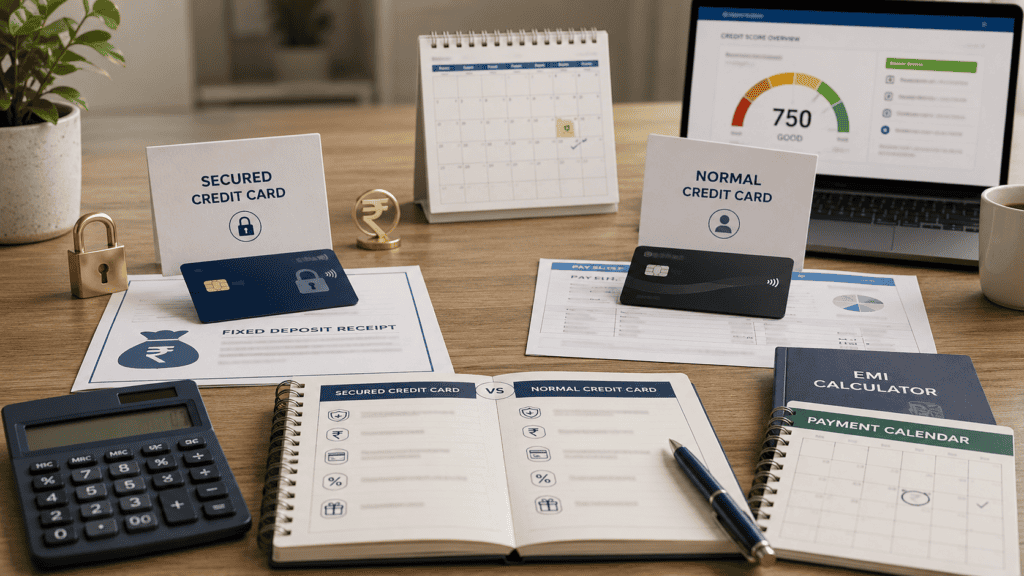
If you have tried to apply for a credit card in India and received a rejection, you are not alone. Banks routinely turn down first-time applicants who have a thin credit file, no CIBIL score, or a salary that does not meet their internal minimum. The result is frustrating: you need a credit card to build credit history, but you need credit history to get a credit card. A secured credit card — issued against a fixed deposit — is often the way out of this loop. But it is not a simple upgrade. You lock real money into an FD, a lien is placed on it, and unpaid dues can still attract high finance charges and push your credit score down just as fast as any other card. This article gives you a plain-language comparison of secured credit card vs normal credit card: how each works in India, which suits your current situation, what the real FD and repayment risks are, and how to decide without guesswork.
Quick Answer: Secured Credit Card vs Normal Credit Card
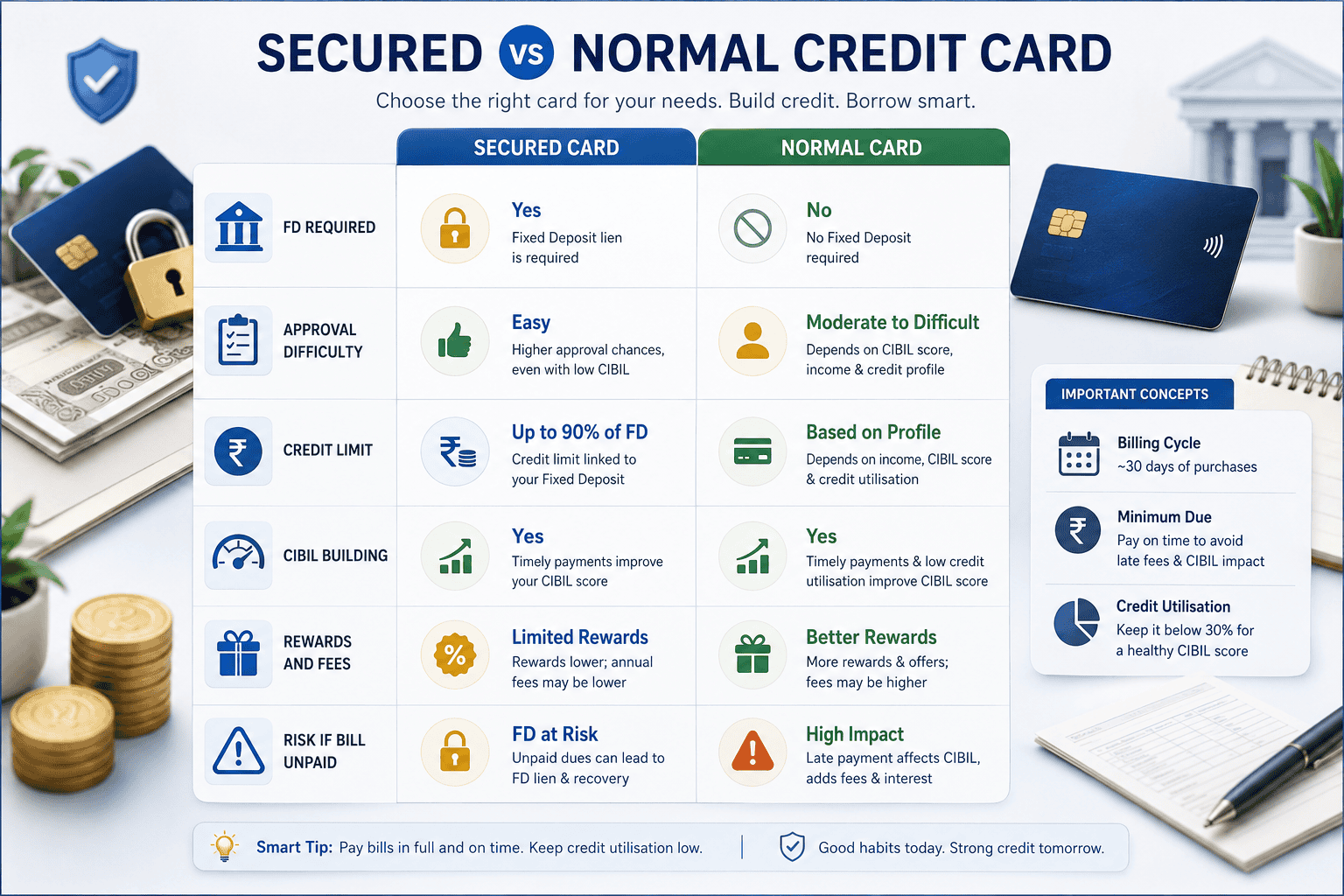
Secured credit card vs normal credit card mainly differs by collateral: a secured card is usually backed by an FD, while a normal card is unsecured and approved using income, credit score, and bank policy. A secured card may suit users with no credit history or a low CIBIL score who can spare FD liquidity. A normal card may suit users with stable income and a stronger credit profile. For a ₹50,000 FD example, the usable card limit depends on the bank’s current rule — verify the exact limit percentage directly from the card issuer before applying.
Key Takeaways
- A secured credit card requires you to pledge a fixed deposit as collateral. The FD is marked under lien by the bank, which means that money is locked and unavailable for withdrawal until the card is closed or the lien is released.
- A normal (unsecured) credit card does not need any collateral, but approval depends on income level, CIBIL score, employer profile, and the bank’s internal eligibility policy — making it harder for beginners to qualify.
- Both secured and normal credit cards can report your repayment behaviour to credit bureaus such as TransUnion CIBIL, Experian, Equifax, and CRIF High Mark. Responsible usage on either card can help build a positive credit history over time — verify whether a specific secured card reports to bureaus before you apply.
- Missing a credit card payment is equally damaging regardless of card type. Finance charges on unpaid balances can range significantly by issuer, and a late or missed payment gets recorded on your credit report and can lower your CIBIL score.
- On a ₹40,000 card limit, spending ₹10,000 gives you a 25% credit utilisation ratio. Keeping utilisation consistently below 30% is generally considered healthier behaviour from a credit profile perspective.
- The secured card is a starter tool for building credit. Once you develop a track record of timely full-bill payments, you may become eligible for a normal unsecured card — but there is no fixed upgrade timeline guaranteed by any bank.
- The right card depends on your current credit history, income stability, and monthly repayment discipline — not on which card looks better on paper.
Secured vs Normal Credit Card: Side-by-Side Comparison
| Feature | Secured Credit Card | Normal Credit Card |
|---|---|---|
| Collateral required | Yes — fixed deposit (FD) pledged as lien | No collateral needed |
| Approval difficulty | Easier for beginners | Stricter eligibility checks |
| CIBIL score required | Often approved with no or low CIBIL score — verify with issuer | Usually requires a minimum credit score — varies by bank |
| Credit limit basis | Linked to FD value — limit percentage varies by bank | Based on income, obligations, and bank policy |
| FD liquidity | FD blocked under lien until card closure | No FD required; funds stay free |
| Rewards and features | Usually basic — varies by issuer | May offer better rewards, cashback, and benefits for stronger profiles |
| Joining and annual fee | Varies by issuer — confirm before applying | Varies by card — some lifetime-free options available |
| CIBIL reporting | Reported if issuer reports — verify with issuer | Reported by all major card issuers |
| Risk if bill is unpaid | Finance charges apply; credit score at risk; FD may be used to recover dues | Finance charges apply; credit score at risk; bank may pursue recovery |
| Upgrade path | May convert to normal card after good repayment history — bank decides | Already unsecured; can apply for limit increase after good record |
Key Facts at a Glance
| Term | What It Means | Why It Matters |
|---|---|---|
| Secured credit card | A credit card issued by a bank against a fixed deposit pledged as security | Helps users with no or low credit history get a card when unsecured approval is denied |
| Normal / unsecured credit card | A credit card issued based on income, credit score, and bank assessment — no collateral required | Offers potentially higher limits and better features but requires an established credit profile |
| FD lien | A legal hold placed by the bank on the fixed deposit pledged for the card | The FD cannot be withdrawn or broken until the card is closed and the lien is released — your money is effectively locked |
| Credit bureau reporting | Monthly update of your card behaviour — payment history, amount due, utilisation — sent to credit bureaus by the card issuer | Timely payments build your credit history; missed payments lower your CIBIL score |
| Credit utilisation ratio | Your outstanding balance as a percentage of your total credit limit | A lower utilisation ratio generally looks healthier from a credit profile perspective |
For a deeper look at how credit cards against fixed deposits work — including pros, cons, and eligibility — see our guide on FD-backed card guide. According to RBI’s Credit Card and Debit Card Issuance and Conduct Directions, card issuers must follow defined rules on billing, consent, grievance redressal, and cardholder protection — these apply equally to secured and normal credit cards.
How Each Card Works in India
Step 1 — How a Secured Credit Card Is Issued
When you apply for a secured credit card, the bank asks you to open or link a fixed deposit of a minimum amount — the exact FD minimum varies by card and issuer and must be verified directly before applying. Once the FD is placed, the bank marks it under lien. This means the FD continues to earn interest at the normal FD rate, but you cannot withdraw it, break it prematurely, or use it for any other purpose while the card is active and the lien holds.
The credit limit assigned to the card is usually a percentage of the FD value — the specific percentage depends on the issuing bank’s current policy and can change. For example, HDFC Bank and ICICI Bank both offer FD-backed credit cards, but the limit ratios, minimum FD amounts, joining fees, and annual fees must be confirmed from their official card pages at hdfc.bank.in and icici.bank.in before you apply, as these figures are subject to change.
Step 2 — How a Normal Credit Card Is Approved
A normal unsecured credit card does not require any fixed deposit. Instead, the bank evaluates your income, employer profile, existing monthly obligations, credit score from a bureau such as TransUnion CIBIL, and its own internal credit policy. If your profile is strong enough, you receive a credit limit based on these factors. First-time applicants, salaried individuals with very short work histories, or those with no credit bureau record often find it harder to get approved for a normal card — which is why secured cards exist as an alternative entry point.
If you are exploring cards despite having no credit history yet, our guide on card without history explains the options available to beginners in India.
Step 3 — How Limits, Charges, and Features Compare
Secured cards often come with basic features and relatively modest credit limits tied to the FD value. Normal cards may offer higher limits, better cashback or reward programmes, lounge access, and waiver conditions — but only for applicants with stronger credit profiles. Finance charges on unpaid balances, late payment fees, joining fees, and annual fees vary significantly between issuers and between card variants. These figures are lender-determined and change — always read the Most Important Terms and Conditions (MITC) document published by the issuer before applying.
What the RBI Expects From Card Issuers
Under RBI’s Credit Card and Debit Card Issuance and Conduct Directions (rbi.org.in), card issuers must clearly disclose all fees, charges, and billing terms. They must obtain explicit cardholder consent for credit limit increases, follow defined grievance redressal timelines, and provide a Key Fact Statement for credit products. These protections apply to both secured and normal credit cards. Knowing these rules helps you hold your bank accountable if you ever face an unjustified charge or a lien release delay.
Real Example: Rohit’s Secured Card Decision
Rohit is 26, works as a junior software tester in Pune, and earns ₹32,000 per month. He applied for a normal credit card at his salary bank branch and received a rejection — the bank cited insufficient credit history. Rohit has no previous credit card, no loan EMIs, and no CIBIL score on record.
After researching his options, Rohit decides to open a ₹50,000 FD at his bank and apply for a secured credit card against it. The bank assigns a credit limit based on its current policy — Rohit verifies this figure directly with the branch before applying. His card is approved. He uses the card only for planned monthly expenses: his internet bill, a grocery top-up, and a subscription, keeping his monthly spending well under the card limit.
He pays the full outstanding amount before the due date every month — not just the minimum due. Over time, the bank reports his positive repayment behaviour to TransUnion CIBIL, and Rohit begins to build a credit file from scratch. According to TransUnion CIBIL (transunioncibil.com), having a consistent record of on-time payments is one of the key factors that contributes to a stronger credit score over time. There is no guaranteed timeline for when Rohit’s score will reach a level where a normal card becomes accessible — but the habit matters more than the deadline.
To understand what CIBIL score threshold banks typically look for before approving a normal card, see our article on minimum score needed.
The key insight: Rohit’s secured card is a credit-building tool, not extra spending money. The FD lien is the price of entry — and the repayment discipline is what actually builds the credit history.
Eligibility and Requirements Before You Apply
For a Secured Credit Card
| Requirement | Typical Condition | Borrower Note |
|---|---|---|
| Fixed deposit amount | Minimum FD amount varies by bank — confirm from official card page before applying | FD will be locked under lien for the full card tenure |
| KYC documents | PAN card, Aadhaar, address proof — as required by the issuer | Standard KYC applies to all Indian bank card applications |
| Existing bank relationship | Some banks require you to hold a savings account or FD with them | Check whether you need to open a new account |
| Minimum age | Usually 18 years or above — confirm with issuer | Add-on card age limits may differ |
| Annual and joining fee | Varies by card and issuer — confirm from MITC document | Some secured cards waive annual fee — verify before applying |
| Credit bureau reporting | Most major banks report to credit bureaus — confirm with issuer | Bureau reporting is what makes the card useful for building credit history |
For a Normal Credit Card
| Requirement | Typical Condition | Borrower Note |
|---|---|---|
| Monthly income | Minimum income threshold varies by card and bank — verify from official card eligibility page | Self-employed applicants may face different income proof requirements |
| CIBIL score | Many banks look for a minimum score — varies by card type and issuer | A score with no credit history is different from a low score — both may face rejection |
| Employer profile | Salary from a listed employer or stable business income may improve approval chances | Some banks have preferred employer lists for premium card variants |
| Existing obligations | High existing EMIs relative to income can reduce approval chances | Bank assesses your debt-to-income position before approving |
| Joining and annual fee | Varies widely — from zero to several thousand rupees per year | Always compare fee waiver conditions before applying |
Credit Utilisation: Why How Much You Spend Matters as Much as How You Pay
Credit Utilisation Ratio = (Amount Used ÷ Total Credit Limit) × 100
Where: Amount Used = total outstanding balance on the card | Total Credit Limit = the credit limit assigned by the issuer
Here is a practical example. Suppose your secured card has a limit of ₹40,000. You spend ₹10,000 this month on groceries and utility bills. Your utilisation ratio for the month is:
| Scenario | Amount Spent | Credit Utilisation |
|---|---|---|
| Low planned usage | ₹10,000 on ₹40,000 limit | 25% — generally considered healthier |
| Medium usage | ₹18,000 on ₹40,000 limit | 45% — approaching a range that may attract attention from bureaus |
| High usage | ₹36,000 on ₹40,000 limit | 90% — this is maxing out the card and may signal credit stress to bureaus |
Consistently high utilisation can work against you on your credit report, even if you pay on time. This applies equally to secured and normal cards. The difference is that a secured card often has a lower credit limit — which means even moderate spending can push utilisation high. Plan spends accordingly.
What happens if you pay only the minimum due instead of the full bill? The unpaid balance rolls over to the next cycle and begins attracting finance charges. These charges vary significantly by card issuer and can compound quickly — the current applicable finance charge rate must be verified from the card’s MITC or the issuer’s schedule of charges before you apply. To understand how utilisation is measured and why it matters, see our detailed guide on credit utilisation ratio.
If There Is a Billing, Lien, or Closure Dispute: What to Do
Step 1 — Contact the Card Issuer First
For any billing error, unauthorised charge, or lien release delay, your first step is to contact the bank’s credit card customer care in writing — email or registered letter — with the details of your dispute, payment proof, and card/FD documents. Keep a copy of everything.
Step 2 — Escalate to the Bank’s Grievance Redressal Officer
If the issuer does not resolve your complaint within the timeline they are required to follow, escalate to the bank’s Nodal Officer or Principal Grievance Redressal Officer. The bank’s official website must list the contact details for grievance escalation.
Step 3 — Check the RBI Complaint Route
If the bank does not resolve the issue within 30 days of your complaint or you are unsatisfied with the resolution, you can file a complaint with the RBI Integrated Ombudsman Scheme through the Centralised Receipt and Processing Centre at rbi.org.in. This route is available only after the required internal bank process is exhausted first.
Safety Checklist Before and After You Apply
- Do not treat your card limit as extra income. A ₹40,000 limit is not ₹40,000 available to spend freely — it is debt that must be repaid in full.
- Pay the full outstanding amount before the due date every month. Paying only the minimum due is one of the most costly habits a credit card user can develop. See our guide on late payment impact for what happens to your CIBIL score when you miss or delay a payment.
- Keep your utilisation low. Aim to use a small planned portion of the limit — not the full amount — each month.
- Track your statement date and due date every billing cycle. Set a phone reminder if needed.
- Understand the FD lien before applying. Know how much FD money you are locking and for how long. Do not pledge an FD that you may need for a near-term expense or emergency.
- Check that your secured card reports to credit bureaus. Not all cards from all issuers report to all four bureaus. Verify with the issuer — bureau reporting is what makes the card useful for credit building.
- Read the Most Important Terms and Conditions (MITC) document from the issuer before signing. The MITC must disclose all fees, charges, and billing rules.
How to Decide What’s Right for You
You have no CIBIL score or a very thin credit file and you can spare a fixed deposit for 12–24 months without needing the funds — a secured credit card is a practical first step toward building a credit history, provided you use it for small planned spends and pay the full bill every month.
You have a low CIBIL score (below a level that most normal cards accept) and your income alone is not strong enough for unsecured approval — a secured card backed by an FD may be your most realistic route to a credit card right now.
You have a stable income, a healthy credit score, and a track record of on-time EMI or previous card repayments — a normal unsecured credit card may be accessible to you and will not require locking any liquidity.
You want a credit card but your monthly spending is unpredictable or you are not confident about paying the full bill before the due date every month — pause on applying for either card until your income and spending habits are more stable.
You already have a secured card and have maintained a clean repayment record for a significant period — check whether your bank offers an upgrade to a normal card or whether you are now eligible to apply for one independently. The timeline varies by issuer and is not guaranteed.
You do not have a spare FD to pledge and your normal card applications keep getting rejected — consider improving your credit profile first through a small secured personal loan with a bank, or check whether your salary account bank offers a pre-approved card or beginner-friendly option. Explore cards for first-time users to compare your options.
| Reader Situation | Better Option | Reason |
|---|---|---|
| No CIBIL score, has spare FD, disciplined spender | Secured credit card | FD provides collateral; responsible usage builds credit history |
| Low CIBIL score, kept missing payments previously | Neither — fix repayment habits first | A card without repayment discipline deepens the problem |
| Stable salary, existing EMIs on time, CIBIL score acceptable to bank | Normal credit card | No FD lock-in needed; better features available for eligible profiles |
| Needs FD money for near-term emergency | Neither — do not pledge the FD | FD lien blocks funds; financial emergencies will leave you stranded |
| Existing secured card user with 12+ months of clean record | Check upgrade eligibility with bank | Good track record may open normal card access — bank decides |
Common Mistakes to Avoid
Treating the Secured Card Limit as Extra Monthly Income
The credit limit on your secured card is not money in your pocket. It is a short-term debt that must be repaid in full before the due date. Spending up to the limit every month and paying only the minimum due will generate compounding finance charges and may push your CIBIL score down rather than up.
Use the card for small, planned, predictable spends — not as a supplement to your salary.
Maxing Out the Card Every Month
Consistently using close to the full credit limit is a signal that can appear unfavourable on your credit report, even if you pay on time. A ₹40,000 limit used for ₹38,000 every month is 95% utilisation — a level that credit bureaus may read as credit stress. Keep monthly usage well below the limit.
Missing the Due Date
A single missed due date triggers a late payment fee and, once reported to credit bureaus, a negative mark on your credit report. With a secured card, you are using the card specifically to build credit — a missed payment defeats the purpose entirely. Set auto-pay for at least the minimum due and top up manually to pay in full.
Closing the FD Before the Card Is Properly Closed
The FD marked under lien cannot be broken or closed independently while the card is active. If you attempt to close the FD first, the bank will decline. The correct sequence is: clear all outstanding dues on the card, submit a card closure request, wait for lien release confirmation, and only then request FD closure or withdrawal. Skipping steps can delay your access to the FD money.
Applying for Multiple Normal Cards After a Rejection
Each credit card application may trigger a hard enquiry on your credit report, depending on the issuer and bureau. Multiple hard enquiries in a short window can lower your CIBIL score temporarily and signal credit hunger to future lenders. According to TransUnion CIBIL (transunioncibil.com), multiple loan or card applications made in a short period can adversely affect a credit score. Space out applications and check your credit profile before applying.
Not Verifying Whether the Secured Card Reports to Credit Bureaus
Some co-branded or smaller issuer secured cards may not report to all four credit bureaus. If the card does not report your repayment behaviour, you will not build any credit history despite paying on time. Confirm bureau reporting in writing before applying — this is the single most important feature of a credit-building card.
Paying Only the Minimum Amount Due
The minimum amount due is the smallest amount that keeps your account from going into default — it is not a repayment strategy. The unpaid portion attracts finance charges, often calculated from the statement date, not the payment date. What appears to be a small leftover balance can grow quickly. Pay the full bill in full every month without exception.
When This May Not Be the Right Choice
Existing debt stress: If you are already struggling to repay an active loan, personal credit, or informal borrowing, adding a credit card — secured or not — adds another repayment obligation and another risk of default.
No stable repayment ability: If your monthly income is irregular, if you are between jobs, or if your expenses already exceed your income most months, a credit card will not solve the underlying problem and may worsen it.
You need emergency cash, not credit card spending power: A credit card — even a secured one — is not a cash instrument in the same way as a liquid FD. If you need ready money for a health emergency or family need, pledging that FD into a lien for a card is not the right move. Keep liquid savings separate.
Your FD is your only financial buffer: If the FD you are considering pledging is also your emergency fund, locking it under lien removes your safety net. Build a separate emergency reserve first.
If any of these apply to your situation, it may be worth exploring other options before committing.
Official Rules and Where to Verify
Before applying for any credit card — secured or normal — verify the following from official sources:
- RBI (rbi.org.in): The Reserve Bank of India’s Credit Card and Debit Card Issuance and Conduct Directions set out cardholder rights, billing rules, consent requirements, and grievance redressal timelines. The RBI Integrated Ombudsman Scheme contact details are also available at rbi.org.in.
- TransUnion CIBIL (transunioncibil.com): For understanding how your credit score is calculated, what a credit report contains, how to check your credit report for free once a year, and what actions affect your score.
- HDFC Bank (hdfc.bank.in): For current FD-backed credit card eligibility, minimum FD requirement, credit limit ratio, joining fee, annual fee, and MITC document.
- ICICI Bank (icici.bank.in): For current credit card against fixed deposit rules, product terms, fees, and lien release process. Check their official card page, not third-party summaries.
Card fees, interest rates, reward rules, and billing terms can change by issuer. Always verify the latest terms from the card issuer and official regulatory sources before applying or converting dues.
Expert Tips
- Start with small, predictable monthly spends. Use the secured card for two or three fixed recurring bills — internet, subscription, or utility — rather than daily variable spending. This keeps utilisation low and makes repayment easy to plan.
- Pay the full outstanding amount, not the minimum due. The minimum due figure printed on your statement is the floor that prevents default — it is not a repayment recommendation. Paying the full amount eliminates finance charges and keeps your credit profile clean.
- Keep utilisation below 30% of your limit consistently. If your card limit is ₹40,000, aim to keep monthly spending under ₹12,000. Lower is better, especially in the first year when you are establishing a credit history.
- Monitor your CIBIL report periodically. Once your card starts reporting to credit bureaus, check your credit report every three to six months to confirm that payments are being recorded correctly. TransUnion CIBIL (transunioncibil.com) provides one free credit report per year.
- Do not apply for a normal card immediately after a secured card rejection. Wait at least six months, use your secured card responsibly in the interim, and then reassess your profile before reapplying. Space out applications to avoid unnecessary hard enquiries.
- Ask your bank about secured card upgrade eligibility only after 12–18 months of clean history. Some issuers convert secured cards to unsecured cards after a sustained repayment record. There is no industry-standard timeline — it depends entirely on the issuer’s current policy. Ask the bank, do not assume.
Secured Card Upgrade Path: A Practical Roadmap
| Stage | Action | What to Monitor |
|---|---|---|
| Getting started (Month 1–3) | Use card for small planned spends only; pay full bill before due date | Statement date, due date, and that payments are posted correctly |
| Building history (Month 4–9) | Continue full payment habit; keep utilisation low; avoid new card applications | CIBIL report — confirm bureau is receiving repayment data from issuer |
| Reviewing progress (Month 10–12) | Check CIBIL score progress; assess whether spending discipline is consistent | Credit report for any missed payment marks or errors |
| Exploring upgrade (Month 12+) | Ask issuer about upgrade eligibility; alternatively, apply for a normal beginner card if CIBIL score now qualifies | Bank’s current upgrade policy — no timeline is guaranteed |
Frequently Asked Questions
Is a secured credit card better than a normal credit card?
Neither is universally better — the right choice depends on your credit profile. A secured card is better for beginners with no credit history or low CIBIL score, because it does not require prior credit approval. A normal card may be better for applicants with a stable income and an acceptable credit score, because it does not lock any FD liquidity. What matters most with either card is full bill payment every month.
Can I get a secured credit card without a CIBIL score?
Many banks accept applications for secured credit cards even from applicants with no credit history or a zero CIBIL score, because the FD provides security. However, the specific eligibility criteria — including minimum FD amount, age, KYC requirements, and bank relationship conditions — vary by issuer and must be verified directly before applying.
Does a secured credit card improve my CIBIL score?
A secured card can help build a credit history if the issuer reports your repayment behaviour to credit bureaus such as TransUnion CIBIL. Consistent on-time full bill payments over time contribute positively to your credit profile. However, no card — secured or otherwise — guarantees a specific score improvement or an improvement by a fixed timeline. The score is determined by multiple factors including repayment history, utilisation, credit age, and enquiries.
What happens to my FD if I do not pay the secured card bill?
If your credit card dues remain unpaid for an extended period, the issuing bank has the right to use the fixed deposit held under lien to recover the outstanding amount, charges, and fees. The FD lien is specifically designed to protect the bank against card defaults. This means you may lose the FD value — or a portion of it — if dues are not cleared. Your credit report will also record the default, damaging your CIBIL score.
Can I close the FD linked to my secured credit card?
Not while the card is active and the lien is in place. You must first clear all outstanding dues on the card, then submit a formal card closure request to the bank, wait for confirmation that the lien has been released, and only then request FD closure, maturity payout, or renewal. Attempting to break or close the FD without following this sequence will be declined by the bank.
Can I convert my secured credit card to a normal credit card?
Some banks offer the option to convert a secured card to an unsecured card after a period of consistent and responsible usage. However, this is at the bank’s discretion, based on your repayment record and internal credit assessment. There is no guaranteed conversion timeline. Ask your card issuer directly after 12 or more months of clean usage history.
Is a normal credit card cheaper than a secured credit card?
Not necessarily. Both card types can carry joining fees, annual fees, and finance charges on unpaid balances. The specific charges depend on the card variant, the issuer, and current promotional terms. Some lifetime-free normal cards exist, as do some fee-based secured cards. Compare the MITC document for any card you are considering — the fee structure is the most reliable basis for comparison.
Does applying for a credit card hurt my CIBIL score?
A credit card application may trigger a hard enquiry on your credit report, depending on the issuer and bureau process. A single enquiry has a relatively minor impact, but multiple applications in a short period can lower your score temporarily and signal credit-seeking behaviour to lenders. Space out your applications and assess your eligibility before applying.
What is the minimum FD amount needed for a secured credit card?
The minimum FD amount required varies by bank and card product. Some issuers have a minimum of ₹10,000 while others require ₹20,000 or more — and these figures can change with product updates. Always verify the current minimum FD requirement directly from the bank’s official credit card page before you apply.
Final Verdict
A secured credit card is a practical first step for Indian borrowers who have no credit history, a low or absent CIBIL score, and access to a fixed deposit they can spare for a period without needing the funds. It is not easier money — it is a structured way to prove repayment discipline to a credit bureau, with your own FD as the safety net for the bank. Used correctly, with small planned spends and full bill payment every month, it can help you build a credit profile that eventually opens the door to a normal unsecured card.
A normal credit card makes more sense for applicants with stable income, a credit score that meets the issuer’s minimum requirement, and existing positive repayment behaviour. It requires no FD lock-in and may offer better rewards and higher limits.
The worst use of either card is treating the credit limit as extra income, paying only the minimum due, or applying repeatedly after rejections without first improving your credit profile. The secured credit card vs normal credit card debate matters less than whether your repayment discipline is strong enough to use one responsibly.
Always verify the latest fees, interest rates, billing rules, and reward terms from the card issuer before applying or using a credit card feature.
This article is for educational purposes only and should not be treated as personalised financial, credit, or legal advice. Credit card fees, interest rates, billing rules, eligibility criteria, rewards, and issuer terms can vary and may change over time. Please verify current terms directly with the card issuer, official regulatory source, or a qualified professional before applying for or using any credit card feature.

Meera Nair writes practical credit card guides for Indian users, focusing on eligibility, fees, billing cycles, reward value, UPI credit cards, EMI conversion, CIBIL impact, fraud protection, and safer card usage. She explains card decisions in simple language without pushing readers toward risky borrowing.