
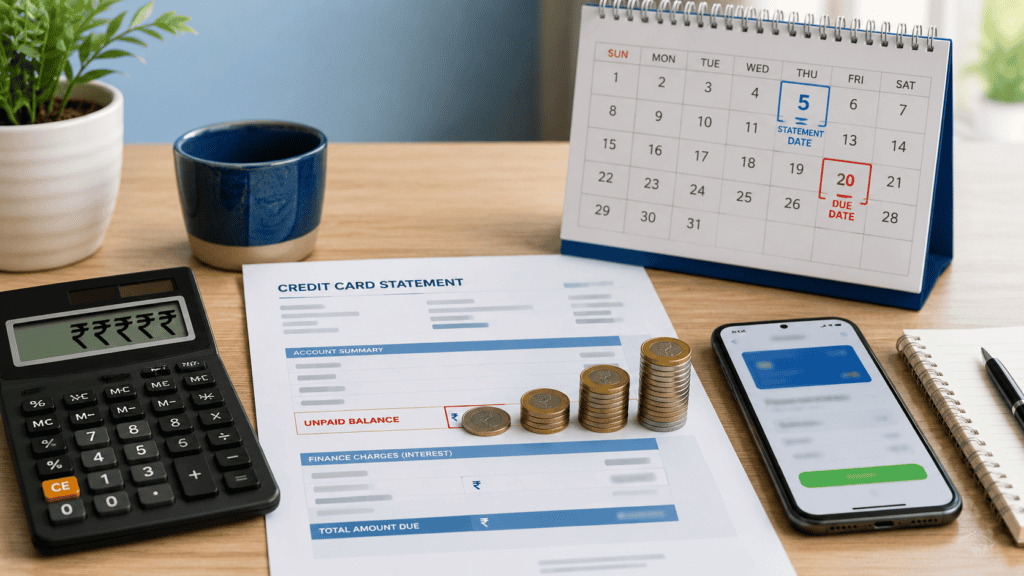
Your credit card bill arrives, you pay the minimum amount due, and assume the rest can wait until next month. Then the next statement lands — and there’s a finance charge you didn’t expect. This is one of the most common and costly credit card misunderstandings in India. Many card users believe that paying the minimum due protects them from interest. It does not. Understanding how credit card interest is calculated in India — and how quickly an unpaid balance can become expensive — can save you thousands of rupees and prevent unnecessary credit score damage. This article explains the formula, the billing cycle, the minimum due trap, and what your card issuer actually charges, using real ₹ examples. Rates, charges, and issuer rules vary by card and can change — always verify current figures from your card’s Most Important Terms and Conditions (MITC) document or your bank’s official website.
Quick Answer: How Credit Card Interest Works
How credit card interest is calculated in India depends on the unpaid balance, daily interest rate, and number of days the amount remains unpaid. For example, if ₹45,000 is carried forward after paying the minimum due, finance charges may apply daily until repayment, based on issuer rules. Paying only the minimum amount due does not make the remaining balance interest-free — finance charges typically continue until the full outstanding is cleared.
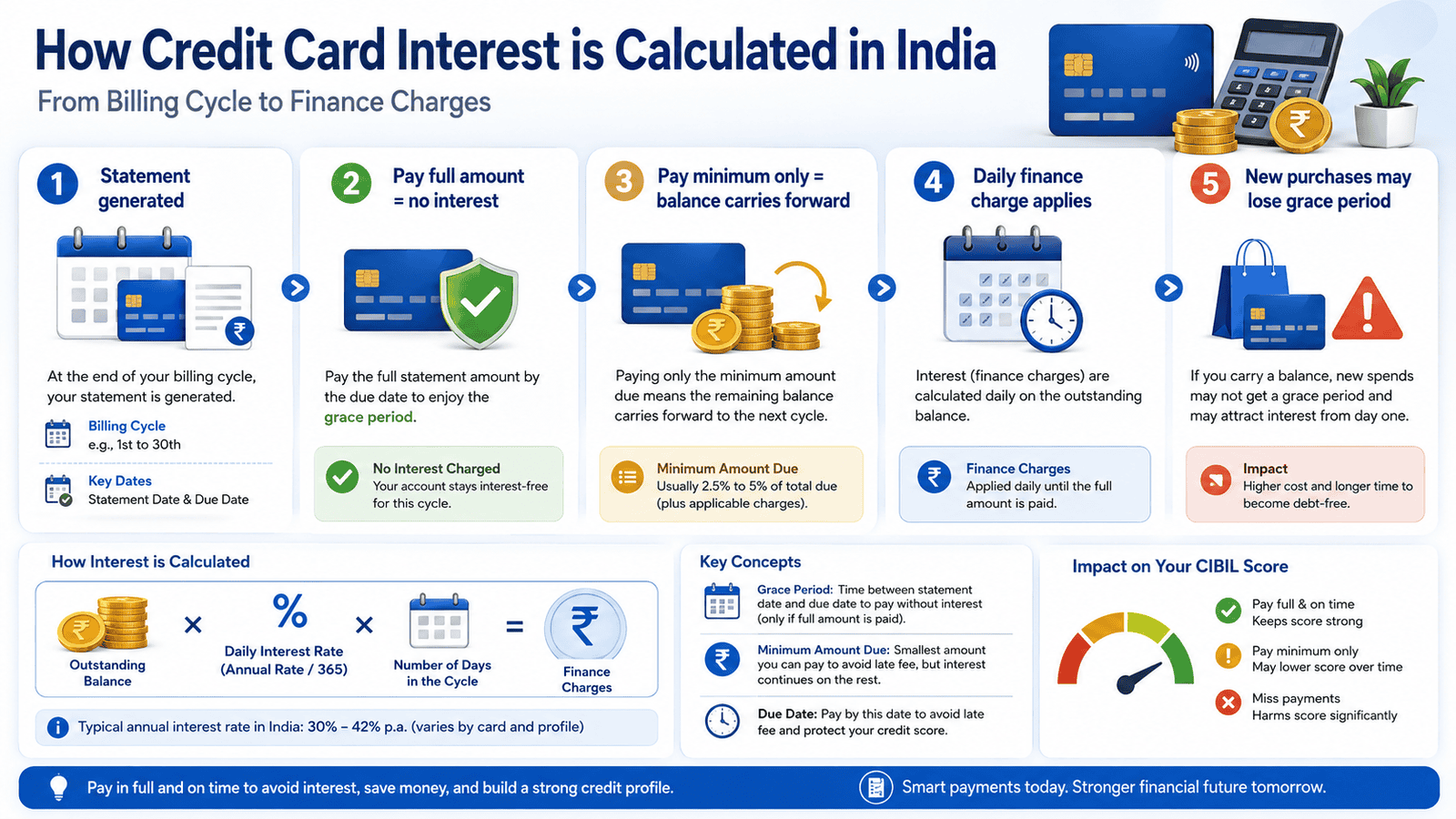
How to Calculate Credit Card Interest: The Formula
Credit card interest in India is typically calculated on the daily outstanding balance — not just the amount unpaid at month-end. Banks call these charges finance charges. Here is how the approximate calculation works.
Estimated Finance Charge = Outstanding Balance × Daily Interest Rate × Number of Days Unpaid
Where: Daily Interest Rate = Monthly Interest Rate ÷ 30 | Number of Days = Days from transaction date or statement date until repayment (varies by issuer)
To convert a monthly rate to a daily rate: if a card charges a sample monthly rate of 3.5% (illustrative — verify your card’s MITC for the actual rate), the approximate daily rate is 3.5% ÷ 30 = 0.1167% per day.
Now apply this to a real example. Suppose your statement shows ₹50,000 due and you pay only the minimum due of ₹5,000, leaving ₹45,000 unpaid.
| Item | Amount / Rate | Estimated Impact |
|---|---|---|
| Outstanding balance carried forward | ₹45,000 | Balance on which finance charges apply |
| Sample monthly interest rate (illustrative) | 3.5% per month | Verify from your card MITC — rates vary |
| Approximate daily rate | ~0.1167% per day | 3.5% ÷ 30 |
| Estimated finance charge for 30 days | ₹45,000 × 3.5% | ~₹1,575 for one month (illustrative) |
| GST on finance charges | 18% on interest (verify with issuer) | Adds ~₹284 (illustrative) on ₹1,575 |
These figures are illustrative only. Actual finance charges depend on your card’s specific monthly rate, the exact days of non-payment, how your bank calculates the daily balance, and whether GST applies as shown. Actual bank calculations may differ. Check your card statement or MITC for the precise method. If you want to estimate your own charges, use the credit card interest calculator.
One detail that surprises many users: when you carry unpaid dues, finance charges may apply not just on the carried-forward balance but also on new purchases made during the current billing cycle — from the transaction date itself. This is why the minimum due trap is so costly. Always check your issuer’s MITC to understand exactly how they calculate daily balances.
Key Takeaways
- Paying the total amount due before the due date typically lets you avoid finance charges on purchases — this is your interest-free period working as intended.
- Paying only the minimum amount due does not make the remaining ₹45,000 interest-free. Finance charges apply on the unpaid balance, often from the transaction date or statement date — not just the due date.
- Credit card interest is usually calculated on the daily outstanding balance, so every day the amount stays unpaid, the charge grows.
- Cash withdrawals on a credit card typically attract an immediate cash advance fee plus finance charges from the transaction date — with no interest-free period at all.
- A late payment fee and a finance charge are two separate things — both can appear on the same statement if payment is missed or insufficient.
- Missing or underpaying credit card dues can affect your CIBIL score and credit report if the payment delay is reported by the issuer.
- Know the billing cycle basics — the billing cycle, statement date, and due date all determine how interest is counted and when it starts.
Key Facts at a Glance
| Term | Meaning | Why It Matters |
|---|---|---|
| Billing Cycle | The period (usually ~30 days) during which purchases are grouped into one statement | Determines which transactions appear on the next bill |
| Statement Date | The date the bank closes your billing cycle and generates your bill | All purchases before this date appear on the current statement; learn more about statement and due date differences |
| Payment Due Date | The deadline by which payment must reach your bank to avoid late fees | Missing this date can trigger late charges and CIBIL reporting risk |
| Total Amount Due | The full outstanding balance on your statement | Paying this in full typically avoids all finance charges on purchases |
| Minimum Amount Due | The smallest payment accepted to keep account active — usually 5% of outstanding or a fixed floor, whichever is higher (verify with issuer) | Paying only this does NOT stop interest on the remaining balance |
| Finance Charges | The interest applied by the card issuer on unpaid or revolved balances | Usually the highest cost element of an unpaid card bill |
| Interest-Free Period | The window (commonly up to 45–51 days) during which purchases attract no interest if total dues are cleared | Carrying forward unpaid dues can remove this benefit for new purchases depending on issuer rules — verify your MITC |
How Credit Card Interest Actually Works in India
Most credit cards in India operate on a billing cycle — a fixed period, typically around 30 days, during which your purchases are recorded. At the end of the cycle, the bank generates a statement showing the total amount due, minimum amount due, and payment due date.
Step 1 — Purchases Enter the Billing Cycle
Every time you swipe or tap your card, the transaction is added to your running balance for that billing period. Purchases made before the statement date appear on the current bill. Those made after the statement date fall into the next cycle. Understanding your credit card grace period and when it begins and ends is essential before you can understand when interest kicks in.
Step 2 — Statement Is Generated
On the statement date, the bank closes the cycle and produces your bill. This shows every transaction during the period, the total amount due, the minimum amount due, and the payment due date — typically 18 to 25 days after the statement date, depending on the issuer (verify your card agreement).
Step 3 — You Pay the Full Amount Due
If you pay the total amount due before or by the due date, no finance charges apply to those purchases. This is the interest-free period in action — and it is the only way to use a credit card at zero borrowing cost. Some banks also offer an interest-free window on new purchases only if there is no previous unpaid balance.
Step 4 — You Pay Less Than the Total Amount Due
This is where finance charges begin. If you pay even ₹1 less than the total amount due — including if you pay only the minimum amount due — the unpaid balance typically starts attracting finance charges. Depending on your issuer’s calculation method, these charges may apply from the original transaction date, not from the due date. This means you could owe interest on a purchase that was technically “within the free period” because you did not clear it completely.
Step 5 — New Purchases May Lose the Interest-Free Benefit
Many issuers in India apply a rule: if there is an unpaid balance from the previous statement, new purchases in the current cycle may not get the interest-free treatment. Finance charges may begin from the transaction date of new purchases too — until the old dues are fully cleared. This is sometimes called “loss of grace period.” The exact rule differs by issuer, so check your MITC carefully. ICICI Bank, HDFC Bank, SBI Card, and other major issuers publish these terms on their official websites and in their card offer documents.
Real Example: Rohit’s Credit Card Bill in Bengaluru
Rohit, 29, works in Bengaluru and earns ₹55,000 per month. He uses his credit card for groceries, fuel, and online shopping. His statement this month shows a total amount due of ₹50,000 with a minimum amount due of ₹2,500 and a payment due date of the 15th.
Scenario A — Rohit pays ₹50,000 in full by the 15th: No finance charges apply. Rohit gets the full interest-free benefit. His next billing cycle starts fresh with no outstanding balance.
Scenario B — Rohit pays only the ₹2,500 minimum due: The remaining ₹47,500 carries forward. Finance charges begin applying — potentially from the original transaction dates. Using a sample monthly rate of 3.5% (illustrative — verify your card rate), the approximate finance charge on ₹47,500 for 30 days is around ₹1,663, plus GST. On top of this, any new purchases Rohit makes during the next cycle may also attract charges from transaction date because he has unpaid dues. By month two, Rohit owes ₹47,500 + ₹1,663 + GST + new purchases — and the interest keeps compounding.
Scenario C — Rohit pays ₹20,000 and spends ₹15,000 more: The unpaid balance is ₹30,000 from the old statement. Finance charges apply on ₹30,000 plus potentially on the new ₹15,000 if the issuer applies charges from transaction date when old dues exist. Within two cycles, Rohit may find himself in a position where the finance charges are nearly as large as his monthly grocery bill.
The key insight: even one month of unpaid dues can cost Rohit more than using a personal loan for the same amount — at a fraction of the interest rate. Credit card revolving debt is among the costliest forms of borrowing available to Indian consumers.
What You Need Before Calculating Interest
Before you can estimate your credit card finance charges, gather these details from your card statement or bank app:
- Statement date: The date your billing cycle closed and the bill was generated.
- Payment due date: The last date by which payment must be made to avoid late fees.
- Total amount due: The full balance you owe for the cycle.
- Minimum amount due: The smallest payment the issuer accepts — but paying only this does not stop interest.
- Monthly finance charge rate: Usually shown in your MITC or on the bank’s credit card product page. Different cards from the same issuer may carry different rates.
- Cash advance charge: If you have withdrawn cash on the card, this is a separate fee typically charged as a percentage of the withdrawal amount — in addition to daily finance charges from the transaction date.
- Number of days unpaid: Count from the transaction date or statement date, depending on your issuer’s rule — check the MITC for clarity.
SBI Card, HDFC Bank, ICICI Bank, and other major issuers publish their MITC documents on their official websites. These are the authoritative source for your specific card’s rates and calculation rules.
Comparing Payment Choices: Cost and Risk
| Payment Action | Interest / Charge Risk | CIBIL Risk |
|---|---|---|
| Pay total amount due in full by due date | No finance charges on purchases | No risk |
| Pay partial amount (more than minimum) | Finance charges on unpaid balance; new purchases may also attract charges | Low if on time |
| Pay minimum amount due only | Finance charges on full remaining balance; revolving debt risk | Low if paid on time, but check your late payment CIBIL impact |
| Miss payment entirely | Finance charges + late payment fee + possible penalty interest | High — missed payment may be reported to bureaus |
| Cash withdrawal on card | Cash advance fee + finance charges from transaction date; no grace period | Medium — high utilisation visible on report |
| Convert to EMI | Processing fee + EMI interest — total cost varies; compare before converting | Generally stable if EMIs are paid on time |
All fee and charge figures in this table are indicative. Verify exact amounts — including cash withdrawal charges — from your card’s MITC or official bank website before making a payment decision.
Safety Checklist: Avoid the Revolving Debt Trap
- Do not use minimum due as a repayment plan. Paying the minimum each month can keep your balance growing even if you make no new purchases. Finance charges compound month after month.
- Avoid cash withdrawal on a credit card unless truly unavoidable. The cash advance fee plus daily interest from the transaction date makes this one of the costliest ways to access money in India. RBI consumer protection principles require issuers to disclose these charges clearly — check rbi.org.in for the latest credit card directions framework.
- Stop new spending if old dues are still unpaid. New purchases made while carrying forward unpaid dues may not get the interest-free window at all — you effectively start paying interest on everything you buy.
- Check the finance charges line on every statement. Even a small finance charge amount can indicate a revolving balance pattern that will grow if unchecked.
- Contact your issuer early if repayment is difficult. Most major banks have hardship or restructuring options. Approaching them before a missed payment is better for your credit profile than acting after the fact.
- Compare the total cost before switching to EMI or a personal loan — these may be cheaper than revolving credit card interest, but only after you include processing fees, tenure, and total interest outgo.
How to Decide What’s Right for You
you can pay the total amount due in full by the due date — always do so. This is the only way to use a credit card at zero interest cost and preserve the interest-free period for future purchases.
you cannot pay in full but can pay more than the minimum — pay as much as possible. The higher your payment, the lower the balance on which finance charges apply next month.
you are consistently paying only the minimum due every month — calculate how much you are paying in finance charges per statement. If it is substantial, consider converting the balance to a card EMI or a personal loan only after comparing total cost including all fees.
you have a large one-time purchase that you cannot pay at once — compare the cost of a card EMI conversion versus a personal loan. Card EMIs often have a processing fee plus interest; a personal loan from a bank or NBFC at a lower reducing-balance rate may cost less total. Always run the numbers before converting.
your card dues are growing faster than you can repay — stop using the card for new purchases immediately. Contact your issuer about repayment assistance before a payment is missed, not after.
you are unable to verify the monthly rate, cash advance fee, or calculation method from your MITC — do not assume the rate from a general article or comparison site. Different cards, even from the same bank, can carry different rates. Fetch your MITC from the bank’s official website or ask for it in writing.
Common Mistakes to Avoid
Thinking the minimum amount due means no interest
This is the single most costly credit card misunderstanding in India. Paying the minimum due keeps your account in good standing with the issuer, but the remaining balance attracts full finance charges — often from the transaction date, not just the due date. On a ₹45,000 unpaid balance at a sample rate of 3.5% per month, you could be paying over ₹1,500 in finance charges every 30 days on top of continuing to use the card.
Pay as close to the total amount due as possible, every statement.
Ignoring the statement date and focusing only on the due date
Many users track only the payment due date. But the statement date determines which purchases fall into your current bill and when your interest-free window actually starts. Making a large purchase one day after the statement date gives you almost a full extra billing cycle before it is due — making a large purchase one day before it means the payment is due in roughly 18–25 days. Timing large spends around your statement date can extend your interest-free window meaningfully.
Using cash withdrawal on the card casually
Cash withdrawals on a credit card do not have an interest-free period. Most issuers charge a cash advance fee — typically a percentage of the amount withdrawn — plus daily finance charges that begin from the transaction date. On a ₹10,000 cash withdrawal, you could owe a cash advance fee plus interest for every day until repayment. This is among the most expensive ways to borrow money short-term.
Continuing to spend while old dues are unpaid
When you carry forward an unpaid balance, new purchases in the current cycle may no longer get the interest-free window. Every new transaction could attract finance charges from the purchase date. This can rapidly increase your total outstanding and the monthly finance charge load.
Looking only at the EMI amount without checking total charges
When a bank offers to convert a balance into card EMIs, the monthly amount looks manageable. But the total cost — processing fee plus interest over the tenure — can be significant. Always calculate total outgo before accepting an EMI conversion offer, and compare it with a personal loan rate from a bank or NBFC.
Missing payment and assuming one month will not matter
A missed credit card payment triggers a late payment fee, continued finance charges, and may be reported to CIBIL and other bureaus. Even one reported missed payment can affect your credit score for months. If repayment is genuinely difficult, contact your issuer before the due date — most banks have structured options for customers who reach out proactively.
When Revolving Credit Card Dues May Not Be the Right Choice
Carrying forward unpaid credit card dues may be especially risky in these situations:
If your income is unstable or irregular: Without a predictable monthly inflow, managing growing finance charges and a revolving balance becomes significantly harder each month.
If your monthly card bill is already close to your monthly salary: A ₹50,000 card bill on a ₹55,000 salary leaves almost no room for regular expenses once dues and charges are accounted for.
If your existing EMIs are already high: Adding revolving card interest to existing loan obligations can push your debt-to-income ratio into an uncomfortable zone and make future credit harder to access.
If paying only the minimum due is the maximum you can afford: A minimum-due-only repayment pattern on a large balance can mean years of slow repayment while interest accumulates — the balance may barely reduce even after months of payments.
If the card is already being used for cash withdrawals regularly: Regular cash advances compound the problem — cash advance fees plus daily interest with no grace period can make an already difficult situation significantly worse.
If any of these apply to your situation, it may be worth exploring other options before committing.
Official Rules and Where to Verify
Credit card interest rates, finance charges, late payment fees, cash advance charges, GST treatment, and billing rules are set by individual card issuers and may change. No general article — including this one — can substitute for your card’s official documents.
- Reserve Bank of India (rbi.org.in): The primary regulator for credit card issuance and consumer protection. RBI’s Master Directions on Credit Cards and Debit Cards set the regulatory framework that issuers must follow, including fair practices and disclosure requirements.
- Your card’s MITC (Most Important Terms and Conditions): This is the single most important document for your specific card. It contains the exact monthly finance charge rate, cash advance fee, late payment fee, minimum payment calculation, and billing rules applicable to your account. Download it from your bank’s official website or request it from the issuer.
- Your monthly card statement: Finance charges, cash advance fees, and late payment fees applied in that cycle appear here. Reviewing this carefully each month is the simplest way to catch revolving interest early.
- Issuer official websites: HDFC Bank (hdfcbank.com), ICICI Bank (icicibank.com), SBI Card (sbicard.com), and other major issuers publish current rates and MITC documents for each card product on their official sites. Do not rely on third-party aggregators for live rate figures.
Card fees, interest rates, reward rules, and billing terms can change by issuer. Always verify the latest terms from the card issuer and official regulatory sources before applying or converting dues.
Expert Tips
- Set autopay for the total amount due, not the minimum due. Most banks allow you to set autopay at the total outstanding level. This ensures you never accidentally pay only the minimum and trigger finance charges through inattention.
- Track your statement date, not just your due date. If you are planning a large purchase, making it one day after your statement date gives you the maximum interest-free window — close to a full billing cycle plus the grace period days. Timing matters more than most users realise.
- Keep card utilisation below a reasonable level. High utilisation — using a large fraction of your card limit regularly — is visible on your credit report and can affect your credit score over time. There is no universal safe threshold, but consistently high utilisation is generally considered a risk signal by lenders.
- Do not use a credit card as emergency cash. The cash advance fee plus daily interest from transaction date makes this one of the highest-cost borrowing options available. A personal overdraft facility, salary advance, or even a small personal loan from a registered NBFC is usually cheaper for genuine emergencies.
- Use the calculator before deciding how much to pay. If you cannot pay the full amount, estimate how much the unpaid balance will cost you in finance charges next month before deciding. Even paying ₹10,000 more than the minimum due can reduce your monthly interest outgo meaningfully.
- Review your last three statements for finance charge patterns. If finance charges appear on consecutive statements, you are in a revolving balance situation. Address it actively — either by increasing monthly payments or by comparing a structured repayment option before the balance grows further.
Frequently Asked Questions
How is credit card interest calculated in India?
Credit card interest in India is typically calculated on the daily outstanding balance — the unpaid amount is multiplied by the daily interest rate (monthly rate divided by 30) and then by the number of days the balance remains unpaid. Finance charges usually apply until the full outstanding is cleared. The exact calculation method depends on your card issuer — check your MITC for details.
Is credit card interest charged daily or monthly in India?
Most Indian card issuers calculate interest on a daily basis — using the daily outstanding balance and a daily rate derived from the monthly rate. The charges then appear on your statement as a single finance charge line at the end of the billing cycle. However, the underlying accumulation is typically daily, which is why unpaid balances grow faster than many users expect.
Do I have to pay interest if I pay the minimum amount due?
Yes. Paying only the minimum amount due does not exempt the remaining balance from finance charges. Interest continues to apply on the full unpaid amount — often from the original transaction date, not just from the due date. Minimum due is the smallest payment that keeps your account in good standing with the issuer, but it does not stop interest from accumulating on the rest.
When does the credit card interest-free period end?
The interest-free period typically ends if you do not pay the total amount due by the payment due date. When you carry forward any unpaid balance, the interest-free window for that amount is effectively lost, and finance charges begin. The exact trigger depends on your card’s MITC — verify with your issuer how they define the start of finance charge calculation.
Is interest charged on new purchases after I carry forward a balance?
Many Indian card issuers apply finance charges to new purchases from the transaction date if there is an existing unpaid balance from the previous statement. This means that even a fresh purchase made on day one of your new billing cycle may attract daily interest — not an interest-free window — until your old dues are fully cleared. This rule varies by issuer, so check your MITC before assuming new purchases are interest-free.
How is credit card cash withdrawal interest calculated?
Cash withdrawals on a credit card attract two separate charges: a cash advance fee (usually a percentage of the withdrawn amount, subject to a minimum — verify with your issuer) and finance charges that begin from the transaction date itself, with no interest-free period. So a ₹10,000 cash withdrawal immediately costs you the advance fee plus daily interest for every day until you repay the amount in full. This is why cash withdrawal is typically one of the most expensive short-term borrowing methods available through a credit card.
Can credit card interest affect my CIBIL score?
Finance charges themselves do not directly appear on your CIBIL report, but their consequences can. If unpaid finance charges push your total outstanding higher and you are unable to make even the minimum payment, a missed or delayed payment will be reported by the issuer to credit bureaus including TransUnion CIBIL, Experian, Equifax, and CRIF High Mark. Even one reported missed payment can reduce your credit score and remain on your report for an extended period. High credit utilisation resulting from revolving balances is also visible to lenders reviewing your report.
Is GST charged on credit card interest in India?
Yes, GST is typically applied on finance charges (interest) and certain other credit card fees such as the cash advance fee and late payment fee. The applicable GST rate on financial services is 18% as of the time of writing — verify with your card issuer for the exact treatment on your specific card and whether it has changed.
Final Verdict
Understanding how credit card interest is calculated in India comes down to one core rule: any unpaid balance after the due date — including amounts above the minimum due — attracts finance charges, often from the original transaction date, not just from when the payment was missed. These charges are calculated daily, apply to the full outstanding, and can grow quickly if the minimum-due pattern continues month after month. Cash withdrawals are even more expensive, with no grace period at all. The safest approach is to pay the total amount due before the due date every statement, track your billing cycle and statement date, and check your MITC for the exact rates that apply to your card. If you are already in a revolving balance situation, calculate the total cost before choosing between card EMI, personal loan, or a step-up repayment plan. Use the credit card interest calculator as a starting point — but always verify actual charges against your card statement and issuer terms. Always verify the latest fees, interest rates, billing rules, and reward terms from the card issuer before applying or using any credit card feature.
This article is for educational purposes only and should not be treated as personalised financial, credit, or legal advice. Credit card fees, interest rates, billing rules, eligibility criteria, rewards, and issuer terms can vary and may change over time. Please verify current terms directly with the card issuer, official regulatory source, or a qualified professional before applying for or using any credit card feature.

Meera Nair writes practical credit card guides for Indian users, focusing on eligibility, fees, billing cycles, reward value, UPI credit cards, EMI conversion, CIBIL impact, fraud protection, and safer card usage. She explains card decisions in simple language without pushing readers toward risky borrowing.