
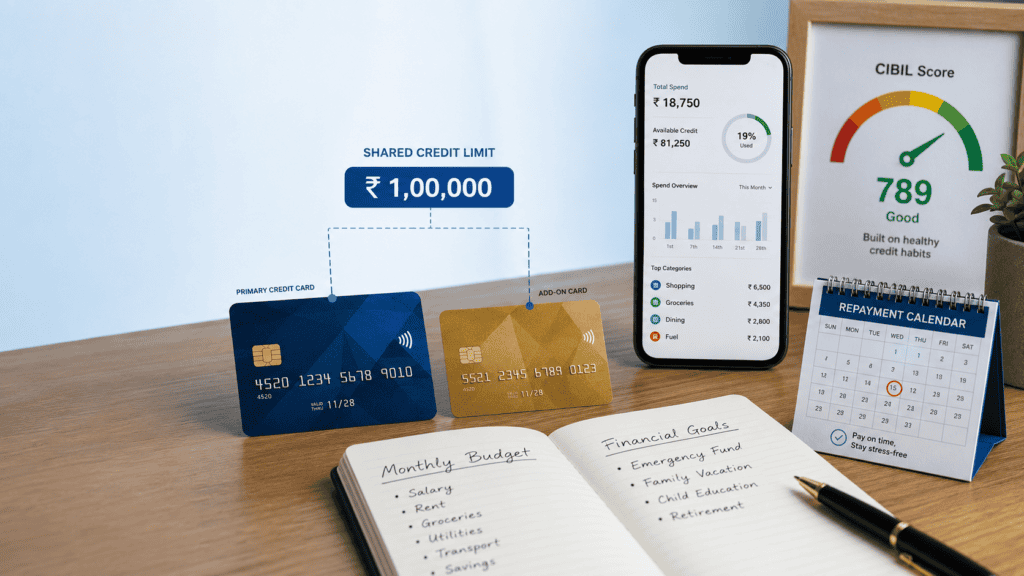
An add-on credit card sounds like a simple convenience — one card for your spouse, one for a parent, and a single bill at the end of the month. Many Indian families use them exactly like this. But there is a side of add-on cards that most people only discover after the statement arrives: the spends, the repayment, and the credit utilisation all sit under the primary cardholder’s account. If that account is not managed carefully, one month of untracked family spending can push your credit utilisation ratio above a threshold that concerns lenders. This article explains what an add-on credit card is, who bears the responsibility, how it can affect your CIBIL profile, and how to use one safely — or decide not to at all.
Quick Answer: What Is an Add-On Credit Card?
An add-on credit card is a supplementary card linked to the primary cardholder’s account, usually sharing one credit limit and one bill. If a ₹1,00,000 limit has ₹70,000 total family spends, utilisation becomes 70%, so repayment delay or high usage can hurt the primary holder’s CIBIL profile.
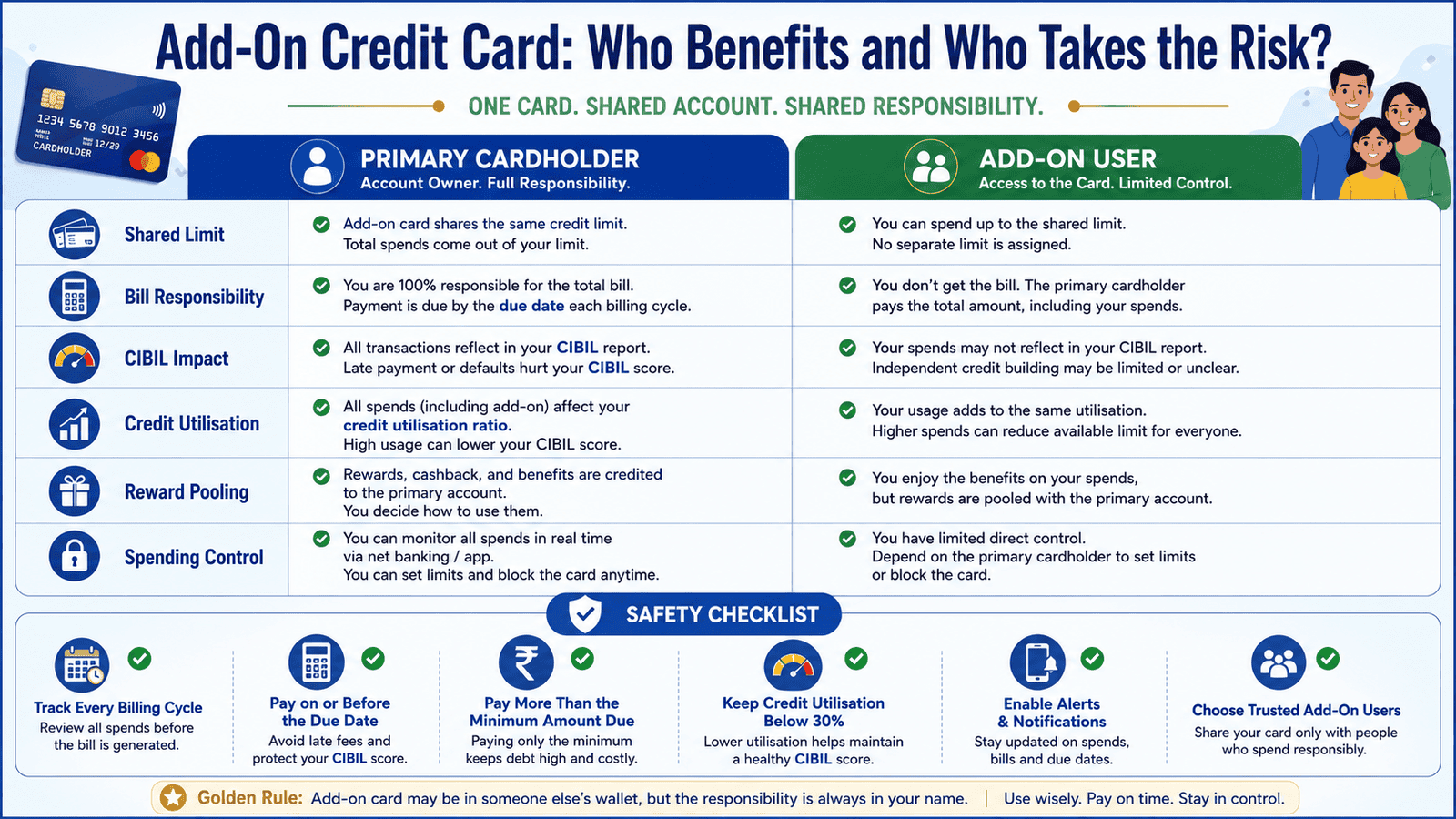
Key Takeaways
- An add-on credit card is linked to your primary card account and usually shares the same credit limit — your spouse spending ₹40,000 and you spending ₹30,000 on a ₹1,00,000 limit creates 70% utilisation, which can affect how lenders view your profile.
- Repayment responsibility typically sits with the primary cardholder — even if the add-on user made the spend, the bill arrives in your name and any missed payment affects your credit record.
- Add-on cards may not help the secondary user build independent credit history — bureau reporting practices vary by issuer, so verify this directly with your card issuer and the relevant credit bureau before assuming the add-on holder is building a separate profile.
- Most issuers allow you to set a monthly spend cap or transaction alerts on the add-on card — use these before handing the card over, not after a surprise statement arrives.
- Bank-specific rules on eligibility, age criteria, number of add-on cards allowed, annual fees, and relationship requirements vary — verify these from the official issuer terms before applying.
- If the family member’s real need is to build their own credit history, a secured credit card backed by a fixed deposit may serve that goal better than an add-on card.
Key Facts at a Glance
| Question | Practical Answer | What to Verify |
|---|---|---|
| What is an add-on credit card? | A supplementary card linked to the primary card account, usually sharing one credit limit and one monthly bill | Confirm whether any separate sub-limit is available with your issuer |
| Who can usually get one? | Spouse, parents, siblings, or adult children — depending on bank rules; relationship criteria vary by issuer | Check eligible relationships and minimum age at your card issuer’s website |
| Is the credit limit shared? | Yes, in most cases — add-on and primary spends are counted together against one total limit | Confirm whether a separate sub-limit can be set for the add-on card |
| Who pays the bill? | The primary cardholder — the statement arrives in their name and payment is their responsibility | Check liability terms in the Most Important Terms and Conditions (MITC) document |
| Do reward points pool together? | In many cases, add-on card spends earn points or cashback that are credited to the primary card account — but this varies by issuer | Check reward terms for add-on cards with your issuer before issuing |
| Does it affect CIBIL score? | Yes — through the primary cardholder’s utilisation ratio and repayment history; the add-on holder may not build a separate credit record | Confirm how your issuer reports add-on card usage to credit bureaus |
| Is there an annual fee? | Some issuers charge a fee for add-on cards; others offer the first one or two free — terms vary | Check the fee schedule in your card’s MITC or at the issuer’s website |
| When does family spending appear? | Add-on spends usually appear in the same billing cycle as primary card spends — see billing cycle rules | Check the statement date and due date for your card to plan repayment |
How Add-On Credit Cards Work in India
When you apply for an add-on credit card, your bank issues a second physical or virtual card linked to your existing primary credit card account. The add-on card is not a new account — it is an extension of the same account, with a separate card number but the same billing structure. Spends made on the add-on card appear on your monthly statement alongside your own transactions.
Shared Credit Limit and Consolidated Statement
The most important thing to understand is that add-on and primary card spends typically draw from the same total credit limit. If your limit is ₹1,00,000 and your spouse spends ₹40,000 on the add-on card while you spend ₹30,000, your combined outstanding is ₹70,000. That is 70% of your total credit limit — and that figure is what your card issuer reports to credit bureaus like TransUnion CIBIL as your credit utilisation on that account.
Credit utilisation ratio — the percentage of your total available credit that you are currently using — is one of the factors that can influence your credit score. Keeping this ratio consistently high, whether through your own spends or a family member’s add-on usage, can affect how lenders and credit bureaus assess your credit profile. For a deeper explanation of how this works, see credit utilisation basics.
Primary Cardholder Visibility and Controls
Most card issuers allow the primary cardholder to see add-on card transactions through their net banking or mobile app. Some issuers allow you to set a monthly spending limit specifically for the add-on card, or to enable transaction alerts so you are notified every time the add-on user makes a purchase. Whether these controls are available depends entirely on your card issuer — check the issuer’s app or website before issuing the card.
The Credit-Building Confusion
Many people assume that giving a family member an add-on card will help that person build their own credit history. This is not reliably true. Because the add-on card is part of the primary account, bureau reporting typically reflects the primary cardholder’s account — not a separate account for the add-on user. The add-on holder may not be building an independent credit record that will help them get their own loan or card in the future. Verify this directly with your card issuer and the relevant credit bureau before making this assumption.
| Feature | Primary Cardholder | Add-On Cardholder |
|---|---|---|
| Account ownership | Yes — the account is in their name | No — the add-on card is an extension of the primary account |
| Bill responsibility | Full responsibility for all spends, including add-on spends | None directly — payment is the primary holder’s obligation |
| Credit limit control | Yes — sees and manages the total limit | Shares the primary limit; sub-limit may or may not be available |
| CIBIL impact | Directly affected by utilisation, repayment history, and missed payments | May not build independent credit history — verify with issuer and bureau |
| Reward points | Typically credited to primary account | Add-on spends may earn points pooled under primary account — varies by issuer |
| Transaction visibility | Can usually see all add-on transactions | Spends visible on the primary statement |
Real Example: Rohit’s Add-On Card Surprise
Rohit, 34, is a salaried IT professional in Pune earning ₹85,000 per month. He gives his wife Priya an add-on card on his primary credit card, which has a total limit of ₹1,00,000. In October, Rohit uses his primary card for ₹30,000 worth of online purchases and flight tickets. Priya uses the add-on card for ₹40,000 across grocery runs, school fees, and a medical expense that came up unexpectedly.
By the end of the billing cycle, the combined outstanding on Rohit’s account is ₹70,000 — a credit utilisation of 70% on that card. Rohit had been planning to apply for a home loan the following month. When the lender checks his credit profile, they see a recent month of 70% utilisation on his primary credit card account. This is not a catastrophe, but it is a data point that lenders notice, especially when combined with other factors.
Rohit pays the full ₹70,000 bill on time, which is the right move — but had he paid only the minimum amount due, the revolving unpaid balance would have attracted high interest, and the utilisation would have carried over into the next billing cycle, compounding the problem.
Key insight: The add-on card did not cause a crisis here, but it did create a situation Rohit had not planned for. The fix is simple: set a monthly spend cap for Priya’s card and track the combined statement before the due date. These are illustrative figures — all rupee values are for explanation only.
Eligibility: What Issuers Usually Check
Before issuing an add-on card, your bank will typically verify certain criteria. These vary by issuer, so confirm the specifics from your card’s official terms before applying.
- Your primary card must be active and in good standing — issuers generally do not offer add-on cards on accounts with overdue balances or suspended status.
- Relationship eligibility — most issuers allow add-on cards for spouse, parents, siblings, and adult children. Some may allow other dependents. The exact list of eligible relationships varies by issuer and must be confirmed directly.
- Age criteria — the add-on cardholder must meet the issuer’s minimum age requirement. This varies — some issuers set a minimum age of 18, others may differ. Verify with your card issuer before applying for someone who is close to the threshold.
- KYC and identity documents — the add-on applicant may need to provide PAN, Aadhaar, or other identity documents depending on the issuer’s KYC requirements. Confirm what is needed from your bank’s official channel.
- Number of add-on cards allowed — most issuers cap the number of add-on cards per primary account. The limit varies. Check this before assuming you can issue multiple cards to different family members.
How Add-On Spending Affects Your Utilisation: Two Calculations
The numbers below are illustrative examples to show how shared family spending can push credit utilisation upward. Actual card limits, fees, and interest rates vary by issuer.
Credit Utilisation Ratio = (Total Outstanding ÷ Total Credit Limit) × 100
Where: Total Outstanding = primary card spends + add-on card spends + any unpaid balance carried over
| Scenario | Card Limit | Combined Spends | Utilisation |
|---|---|---|---|
| Example 1: Moderate family spending | ₹1,00,000 (illustrative) | Primary ₹30,000 + Add-on ₹40,000 = ₹70,000 | 70% — on the higher side |
| Example 2: Higher limit but heavy add-on use | ₹2,00,000 (illustrative) | Primary ₹40,000 + Add-on ₹90,000 = ₹1,30,000 | 65% — still elevated |
| Example 3: Controlled family spending | ₹1,00,000 (illustrative) | Primary ₹20,000 + Add-on ₹10,000 = ₹30,000 | 30% — comfortable range |
In Examples 1 and 2, the utilisation is above 60–70%. Even if you pay the full bill on time each month, consistently high utilisation on a single card is a pattern that credit bureaus can record. The concern is not one month — it is a recurring pattern of high family spending that the primary cardholder did not plan for.
If the primary cardholder pays only the minimum amount due on a month with high family spends, the unpaid balance rolls over and attracts interest — often at a significant monthly rate. That creates a revolving debt cycle. Read more about why paying only the minimum is a costly habit: minimum due trap.
Add-On Card vs Separate Primary Card vs Secured Credit Card
| Option | Add-On Credit Card | Separate Primary Card | Secured Credit Card (FD-backed) |
|---|---|---|---|
| Best for | Trusted family member who needs spending convenience, not independent credit | Adult earning member who qualifies independently and needs their own credit profile | New-to-credit adult who wants to build independent credit history safely |
| Credit limit | Shared with primary account | Separate limit based on own income and credit profile | Linked to the FD amount placed as collateral |
| Bill responsibility | Primary cardholder pays for all spends | Add-on card user is now the primary — owns their own bill | New cardholder owns and pays their own bill |
| CIBIL / credit building | Typically reflects in primary holder’s account — may not build add-on user’s profile independently | Builds independent credit history | Builds independent credit history |
| Risk to primary holder | Shared repayment and utilisation risk | No risk to primary holder’s credit | No risk to primary holder’s credit |
| Better when | Family spending is predictable and controlled; no credit-building goal | Person has stable income and credit eligibility | Person is new to credit, student, or homemaker — see secured card alternative |
Managing an Add-On Card: A Step-by-Step Process
Step 1 — Check Official Issuer Terms Before Applying
Visit your card issuer’s official website or call the customer service number. Read the Most Important Terms and Conditions (MITC) document for the add-on card — it covers eligibility, fees, liability, spending controls, and what happens if the add-on user defaults or if you want to cancel.
Step 2 — Set a Monthly Spend Cap If Available
Many issuers allow the primary cardholder to set a monthly spending limit for the add-on card. If your issuer offers this, set a cap that keeps combined family utilisation under a manageable level — for example, 30–40% of your total limit. Confirm whether this feature is available and how to enable it, since this varies by issuer.
Step 3 — Enable Transaction Alerts for Both Cards
Set SMS or app notifications so you receive an alert every time the add-on card is used. This allows you to track spending in real time rather than waiting for the statement. Whether per-transaction alerts are available for add-on cards depends on your issuer — verify this before handing over the card.
Step 4 — Review the Combined Statement Every Month
When the statement arrives, check each add-on transaction against what you know of family spending that month. If any transaction is unfamiliar or looks incorrect, raise it with your issuer before the due date.
Step 5 — Block or Cancel the Add-On Card If Needed
If add-on spending becomes uncontrolled or the family arrangement changes, you can usually block or cancel the add-on card without closing your primary account. Contact your issuer’s customer service or use the app to initiate this. Confirm the process and any notice period with your issuer.
Safety Checklist Before Giving an Add-On Card
- Only give it to someone whose spending you genuinely trust — the convenience is real, but so is the repayment responsibility.
- Set a monthly family spend rule before the card is used — agree on a rupee cap for the add-on user, not after the first statement arrives.
- Check your current utilisation before adding family spends — if you are already using 40–50% of your limit on your own spends, adding an add-on user can push utilisation into uncomfortable territory.
- Enable transaction alerts immediately — so you know about every add-on spend as it happens.
- Avoid using the add-on card for cash withdrawals — credit card cash advances typically attract fees and interest from the transaction date, with no grace period, and can create repayment pressure.
- Do not let add-on spending push you into minimum-due payment — paying only the minimum due when the bill is large creates interest accumulation and potential CIBIL harm.
- Review the statement line items together — treat the monthly card review as a shared family habit, not a solo task.
How to Decide What’s Right for You
your family member needs household spending convenience and you trust their spending habits — an add-on card on your account can work well, provided you set a monthly cap, track alerts, and always pay the full bill.
your current credit utilisation is already above 40% of your card limit — do not issue an add-on card yet. Combined family spending will push utilisation higher, which can become a pattern that affects your credit profile over time.
the family member’s real goal is to build their own independent credit history — an add-on card is unlikely to achieve that. A secured credit card backed by a fixed deposit is a more direct path to an independent credit record.
the family member has stable income and meets credit eligibility criteria — a separate primary card in their own name gives them full ownership of their credit profile and removes repayment risk from your account. Check secured card alternative for a comparison of entry-level card options.
you are currently using minimum-due payment as a regular habit — resolve your existing repayment discipline first. Adding an add-on user before clearing that pattern will compound both the interest and the utilisation problem.
you are confident you can track combined family spends, set clear usage rules, and pay the full bill every month — do not issue an add-on card. The convenience is not worth the repayment and CIBIL risk if the household spending discipline is not already in place.
Common Mistakes to Avoid
Giving the Card Without Discussing a Monthly Limit
Handing over an add-on card without agreeing on a spending cap is the most common mistake. The add-on user may not understand that their spends directly affect your credit utilisation and repayment burden. Agree on a rupee figure — even a rough monthly ceiling — before the card is first used.
Ignoring the Combined Statement
When two people use one account, the monthly statement has twice as many line items. Primary cardholders who scan only the total amount due — without checking add-on transactions — can miss billing errors, unfamiliar charges, or spending that has drifted beyond the agreed limit. Review every line item when the statement arrives.
Assuming the Add-On User Pays Separately
There is no separate bill for the add-on cardholder. The full amount — primary and add-on spends combined — is billed to the primary cardholder. If there is a family arrangement to split costs, that is a private agreement between household members; the bank will collect from the primary cardholder regardless. One late payment from a miscommunication about “who pays this month” can result in a late payment impact on your credit record.
Paying Only the Minimum Due After a Big Family Spend Month
After a month of combined primary and add-on spends — perhaps during a school admission, a festival, or a medical emergency — the bill can be significantly larger than usual. Paying only the minimum due that month creates a revolving unpaid balance that attracts high interest from the next billing cycle onward. This also keeps your utilisation elevated into the next month, compounding the credit profile impact.
Valuing Rewards Over Repayment Discipline
Some families give add-on cards specifically to pool reward points faster. Rewards are a genuine benefit, but they have no financial value if the resulting bill is not paid in full. Interest on unpaid balances will cost far more than any reward points or cashback earned. Repayment first, rewards second — always.
Not Checking Whether the Add-On User’s Credit Is Actually Being Built
If the add-on user’s stated goal is to establish their own credit record, confirm with your card issuer and TransUnion CIBIL whether the add-on card activity is reported separately to the bureau in the add-on user’s name. Do not assume it is happening — verify it.
Keeping the Add-On Card Active After the Need Has Passed
If the original reason for the add-on card — a temporary family need, a period of travel, a dependent’s school expenses — no longer applies, cancel or block the card. An unused add-on card is an unnecessary credit risk sitting in someone’s wallet.
When This May Not Be the Right Choice
An add-on card may not be the right choice in these situations:
Your current card utilisation is already high. If you are regularly using 50% or more of your credit limit on your own spends, adding a family member’s usage will push that figure further — and a pattern of high utilisation can affect how lenders assess your credit profile when you apply for a loan or a new card.
The family member has uncontrolled or unpredictable spending habits. If there is a history of impulse purchases, subscription sign-ups, or spending beyond a budget, adding that behaviour to your credit account creates direct financial and credit risk for you.
You are currently managing your card on minimum-due payments. If the monthly bill is already stretching your repayment capacity, adding an add-on user will make that harder — not easier. Note that increasing your credit limit is not a solution to poor repayment discipline: credit limit increase only changes the denominator of your utilisation, not your ability to pay what you owe.
The primary purpose is to build the add-on user’s independent credit history. Add-on cards are not a reliable credit-building tool for the secondary user. A secured card or a separate primary card achieves that goal more directly and without putting your own credit account at risk.
The household does not review card statements monthly. If tracking spending is not already a household habit, adding an extra card user into the mix will make it harder to catch errors, dispute charges, or stay within budget before the due date arrives.
If any of these apply to your situation, it may be worth exploring other options before committing.
Official Rules and Where to Verify
Add-on credit card rules — including eligibility, fees, credit limit handling, reward treatment, liability terms, and bureau reporting — are set by individual card issuers, not by a single national standard. Before issuing or applying for an add-on card, verify the following from the sources listed below.
- Your card issuer’s official website — for add-on card eligibility, relationship criteria, age requirements, fee structure, number of cards allowed, spending controls, and cancellation process. For HDFC Bank cards, check hdfc.bank.in. For other issuers, use their official domain.
- Most Important Terms and Conditions (MITC) — your card issuer is required to provide this document. It details liability, fees, billing, grievance contact, and all key terms. Read the section on add-on cards specifically.
- TransUnion CIBIL (transunioncibil.com) — to understand how credit utilisation, repayment history, and credit account reporting work, and to check how your card account currently appears on your credit report. If you want to confirm whether add-on card activity is reported in the add-on holder’s name, contact TransUnion CIBIL or the relevant bureau directly.
- RBI (rbi.org.in) — for broad credit card regulatory framework, responsible lending norms, cardholder grievance rights, and guidance on dispute resolution with card issuers. The RBI’s grievance portal and Banking Ombudsman are available if issuer-level resolution fails.
Card fees, interest rates, billing rules, eligibility criteria, rewards, and issuer terms can vary and may change over time. Always verify the latest terms from the card issuer, official regulatory source, or a qualified professional before applying for or using any credit card feature.
Expert Tips
- Start with a low monthly spend cap, not a high one. When giving an add-on card for the first time, set the combined family spend target at 25–30% of your total card limit for the first two or three months. This gives you time to observe how the shared spending behaves before expanding it.
- Keep transaction alerts active for both cards if your issuer supports it. Real-time alerts are more useful than end-of-month statements for catching spending that drifts beyond the agreed limit. Confirm whether your issuer allows per-transaction SMS or app alerts for add-on cards — this varies.
- Review the card bill within two to three days of statement generation, not on the due date. Leaving the review to the last moment reduces time to dispute errors or unexpected charges. Treat statement arrival as a calendar event — check it immediately.
- Avoid enrolling the add-on card in recurring subscriptions without a clear cancellation plan. Streaming services, gym memberships, or app subscriptions auto-renew every month. If the add-on user sets these up and then stops using the service, the charges continue until someone actively cancels. These can accumulate quietly before the primary cardholder notices.
- Verify whether reward points actually apply to add-on card spends before factoring rewards into your decision. Not all issuers pool add-on card rewards identically to primary card rewards. Some cap the earning rate, exclude certain categories, or apply different cashback rules. Check the reward programme terms specifically for add-on cards before assuming the benefit applies fully.
- If the add-on card is not being used, block it proactively. An inactive add-on card is an open liability. Most issuers allow temporary blocking through the app. If the card is permanently no longer needed, cancel it and get written confirmation from the issuer.
Frequently Asked Questions
Does an add-on credit card affect the primary cardholder’s CIBIL score?
Yes, it can — through two routes. First, add-on spends increase the total outstanding on the primary card account, raising the credit utilisation ratio. Consistently high utilisation can affect how your credit profile is assessed by lenders and bureaus. Second, if the combined bill — including add-on spends — is not paid in full or on time, the late or missed payment is recorded against the primary cardholder’s credit report. The add-on card itself does not create a separate entry for the add-on user in most cases — verify this with your card issuer and TransUnion CIBIL.
Does an add-on card help the add-on cardholder build their own credit history?
Not reliably. Because the add-on card is part of the primary account, bureau reporting typically reflects the primary cardholder’s account. The add-on user may not be building an independent credit record that shows up in their own name at the credit bureau. If building independent credit history is the goal, a secured credit card or a separate primary card in the person’s own name is a more direct and reliable path. Verify the reporting practice with your specific card issuer and TransUnion CIBIL before assuming add-on usage is building a separate profile.
Who pays the credit card bill when an add-on card is used?
The primary cardholder pays the full bill — there is no separate statement or payment obligation for the add-on user. The monthly statement will show all primary and add-on transactions in one combined bill, due in the primary cardholder’s name. Any family arrangement to split costs is a private agreement between household members; it does not change the bank’s billing structure.
Can I set a spending limit on an add-on credit card?
Some issuers allow the primary cardholder to set a monthly spend cap or sub-limit for the add-on card — but this is not universally available. Whether this feature exists, and how to enable it, depends entirely on your card issuer. Check the issuer’s app, website, or customer service before assuming this control is available.
Is an add-on card a good option for my spouse or adult child?
It depends on your household’s repayment discipline, current utilisation, and the family member’s credit-building goals. For a spouse managing household expenses in a family that tracks spending and pays the full bill monthly, an add-on card can work well. For an adult child who needs to build their own independent credit profile, a secured credit card or a separate primary card is usually more appropriate. Assess the purpose clearly before issuing.
Can an add-on card be cancelled without closing the primary card?
Yes — in most cases, you can cancel or block the add-on card independently without affecting your primary card account. Contact your issuer’s customer service, use the issuer’s mobile app, or submit a written request. Confirm the process and any notice period directly with your issuer, as procedures vary.
Is a secured credit card better than an add-on card for a family member new to credit?
For the purpose of building an independent credit history, yes — a secured credit card backed by a fixed deposit is generally a better option. The new cardholder owns their own account, manages their own bill, and builds their own credit record at the bureau. An add-on card does not typically achieve this because usage is reported under the primary account. For a detailed comparison, see secured card alternative.
What happens to the add-on card if I close my primary credit card?
If you close the primary credit card, the add-on card linked to it will also be cancelled — it cannot exist independently of the primary account. Before closing a primary card, confirm this with your issuer and make sure any recurring charges linked to the add-on card are transferred to another payment method.
Final Verdict
An add-on credit card is a practical household spending tool — not a credit-building shortcut and not a risk-free extra card. When used with clear spending rules, active alerts, and consistent full-bill repayment, it can simplify family finances. The primary cardholder who tracks combined utilisation, sets a monthly spend cap, and pays the full statement amount every month will rarely have a problem.
The risk sits with primary cardholders who issue an add-on card without discussing limits, ignore the combined statement, or fall into minimum-due payment after family spends push the bill higher than expected. If you are in that situation, resolve repayment discipline on your primary card first — and consider whether a secured credit card for the family member achieves the underlying goal more safely.
Before you issue an add-on card, check your current add-on credit card utilisation level, agree on a family monthly spending rule, and read the Most Important Terms and Conditions from your card issuer. For family members who genuinely need their own credit record, the path starts with a card in their own name.
Always verify the latest fees, interest rates, billing rules, and reward terms from the card issuer before applying or using a credit card feature.
This article is for educational purposes only and should not be treated as personalised financial, credit, or legal advice. Credit card fees, interest rates, billing rules, eligibility criteria, rewards, and issuer terms can vary and may change over time. Please verify current terms directly with the card issuer, official regulatory source, or a qualified professional before applying for or using any credit card feature.

Meera Nair writes practical credit card guides for Indian users, focusing on eligibility, fees, billing cycles, reward value, UPI credit cards, EMI conversion, CIBIL impact, fraud protection, and safer card usage. She explains card decisions in simple language without pushing readers toward risky borrowing.