

Every month, your salary lands in your account — and within days, rent, groceries, EMIs, UPI spends, credit card bills, and family expenses have already claimed most of it. If you are left wondering where the money went before you could save anything, you are not alone. Most salaried people in India want to save and invest, but nobody taught them a starting rule for how to divide their salary.
The 50-30-20 rule is one of the most practical budgeting frameworks for salaried earners. It is simple enough to use on day one and flexible enough to adapt to Indian realities — rent-heavy cities, EMI burdens, single-income families, and credit card debt. This article explains the rule using real take-home salary examples, tells you what needs adjustment for Indian households, and warns you when the standard split will not work without modification. This is a practical framework, not personalised financial advice.
Quick Answer: What Is the 50-30-20 Rule for Indian Salaried People?
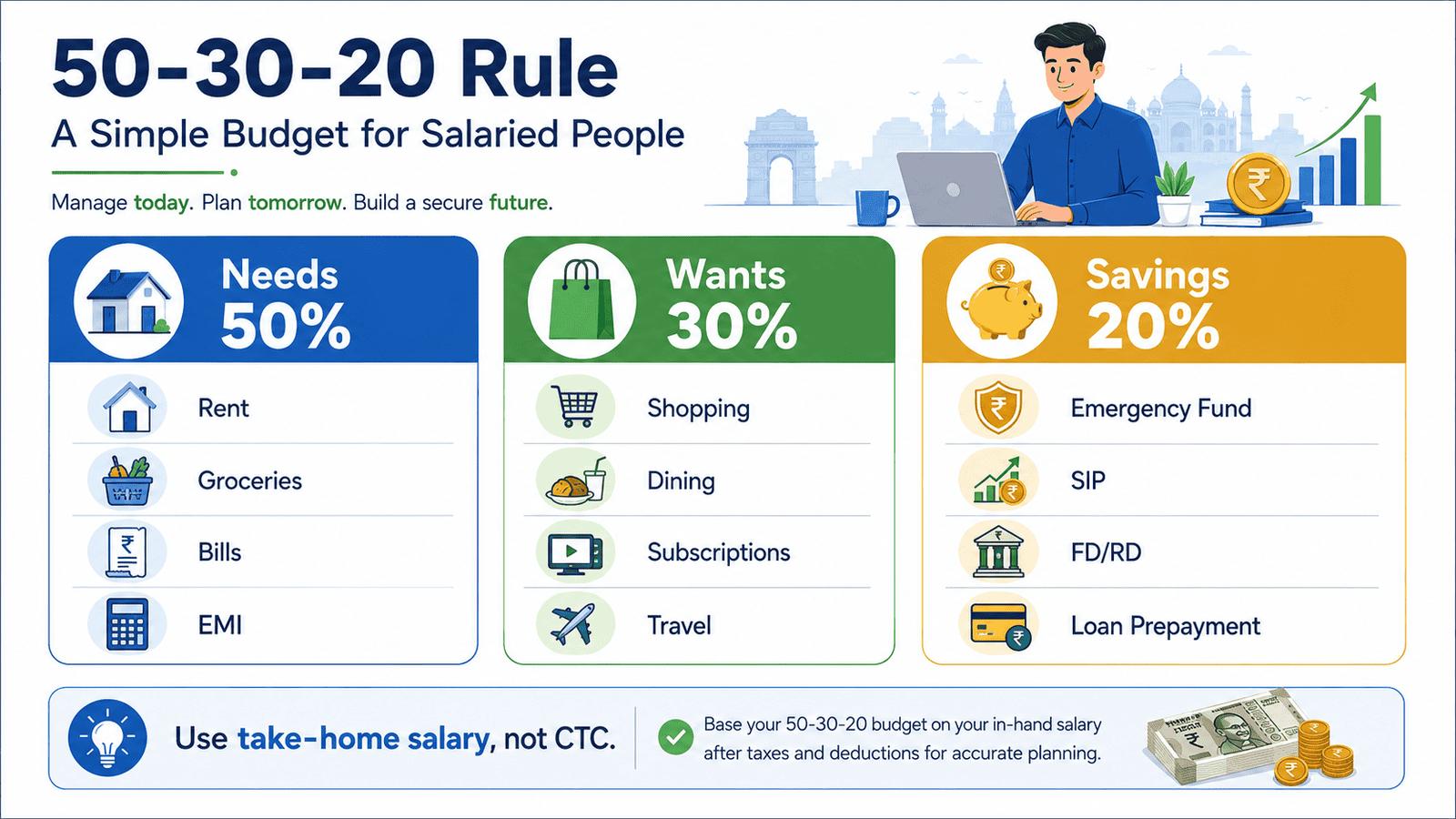
The 50-30-20 rule for Indian salaried people means using monthly take-home salary, not CTC, and dividing it into 50% needs, 30% wants, and 20% savings or debt repayment. For a ₹50,000 salary, that means ₹25,000 for essentials, ₹15,000 for lifestyle, and ₹10,000 for savings.
Key Takeaways
- Always apply the 50-30-20 rule to your in-hand monthly salary — not your CTC. A ₹7.2 lakh CTC may translate to only ₹50,000–₹52,000 per month after PF, tax, and professional tax deductions.
- The 50% needs bucket covers rent, groceries, utilities, transport, school fees, minimum EMI payments, and basic insurance — anything you cannot skip without a real consequence.
- The 30% wants bucket covers dining out, OTT subscriptions, shopping, travel, and lifestyle upgrades — important for wellbeing, but the first place to reduce when money is tight.
- The 20% savings and debt repayment bucket should prioritise emergency fund first, then high-interest debt, then SIP or long-term investments — in that order if your debt burden is already high.
- If your EMIs or rent already push past 50% of take-home salary, shift to a modified split such as 60-20-20 or 70-20-10 rather than forcing the standard rule onto a budget that does not fit.
- Credit card minimum due payment is not responsible repayment — it is a debt trap. The full outstanding amount belongs in your needs or debt repayment bucket, not a fraction of it.
- The 50-30-20 rule is a strong starting framework for Indian salaried beginners, but it requires honest categorisation of needs versus wants, and periodic review after every salary change.
Key Facts at a Glance
| Budget Bucket | Percentage | Indian Examples |
|---|---|---|
| Needs | 50% | Rent, groceries, electricity, water, transport, school fees, basic insurance premiums, minimum EMI payments |
| Wants | 30% | Dining out, OTT subscriptions, shopping, weekend trips, gym membership, gadget upgrades, cab rides beyond commute |
| Savings and Debt Repayment | 20% | Emergency fund, SIP contributions, FD or RD, EPF voluntary top-up, loan prepayment, credit card full outstanding payment |
How the 50-30-20 Rule Works in Indian Salary Life
The 50-30-20 rule was originally made popular by American personal finance thinking, but its core logic works well for Indian salaried earners once you apply it to the right number and understand what belongs in each bucket.
Step 1 — Start with Take-Home Salary, Not CTC
Your CTC — cost to company — is not your budget. Every month, your employer deducts Provident Fund contributions, income tax (TDS), professional tax, and sometimes health insurance premiums before the salary reaches your bank account. The amount that actually lands in your account is your in-hand or take-home salary, and that is the only number that should drive your budget.
For example: a ₹7.2 lakh annual CTC may leave you with approximately ₹50,000–₹52,000 per month in-hand, depending on your tax slab, PF contribution, and deductions. Running a 50-30-20 split on the CTC figure would leave you short every month and frustrated with the framework itself — when the problem was simply the starting number.
Step 2 — Understand What Belongs in Needs
Needs are expenses you face a real consequence for skipping — eviction, hunger, disconnected utilities, a loan default, or a lapsed insurance policy. In Indian household terms, this usually means rent or home loan EMI, monthly groceries, electricity and cooking gas, transport to work, school fees for children, term insurance or health insurance premiums, and the minimum payment due on any existing loans.
Notice that the minimum EMI on existing loans belongs in needs — because missing it triggers a default. However, paying only the minimum on a credit card is not a responsible needs expense; it is a debt warning sign covered later in this article.
Step 3 — Be Honest About Wants
Wants are everything that improves comfort or lifestyle but is not essential. Food delivery and restaurant meals, OTT subscriptions, weekend shopping, travel, new gadgets, premium gym memberships, and salon visits are all wants — even when they feel normal and expected. This is not a reason to eliminate them; the 30% bucket exists precisely so you do not live like a monk. But it is the first place to temporarily reduce if rent or EMIs are already under pressure.
Step 4 — Build the Savings Bucket Intelligently
The 20% savings and debt repayment bucket is where most salaried Indians underinvest — not because they earn too little, but because they spend 30% on wants before setting this aside. A more effective approach is to treat savings as a fixed expense: allocate the 20% the moment your salary credits, before discretionary spending begins.
Within that 20%, the priority order for most Indian salaried borrowers should be: emergency fund first (build it to three to six months of essential expenses before aggressive investing), then high-interest debt repayment (credit card outstanding or personal loan), then SIP or long-term investment contributions. If your employer already deducts EPF, that amount is part of your savings even before take-home salary — factor it in when assessing your total savings rate.
For a full monthly budgeting framework beyond the 50-30-20 rule, see our guide to monthly salary budget planning for Indian employees.
Why Indian Realities Require Adjustment
The standard 50-30-20 split assumes a relatively uncomplicated expense structure. Indian salaried life is rarely that clean. Rent in Mumbai, Bengaluru, Delhi NCR, or Pune can easily consume 30–40% of take-home salary on its own. Many salaried employees also support parents, contribute to a spouse’s household expenses, or carry school fees for two children. These are all needs — and stacking them can push the needs bucket to 60–70% before a single rupee of lifestyle spending enters the picture.
This is not a budgeting failure; it is an Indian household reality. The solution is to use a modified split that reflects your actual income and obligation structure, which is covered in the Comparison Table section below.
Real Example: Priya’s Budget in Pune
Priya, 31, works as a marketing executive in Pune and earns a monthly take-home salary of ₹50,000. She pays ₹12,000 in rent for a 1BHK, has a bike EMI of ₹4,200 per month, and sends ₹3,000 home to her parents every month. Her husband contributes a separate income to the household, but Priya manages her own salary independently.
Here is what her 50-30-20 split looks like in practice:
Needs — 50% (₹25,000 target): Rent ₹12,000 + parental support ₹3,000 + bike EMI ₹4,200 + groceries ₹4,500 + electricity and gas ₹1,200 + term insurance premium ₹800 = ₹25,700. Already slightly over the 50% ceiling, but not dangerously so.
Wants — 30% (₹15,000 target): Food delivery and dining ₹3,500 + OTT subscriptions ₹500 + shopping ₹4,000 + weekend outings ₹2,500 + miscellaneous ₹2,000 = ₹12,500. Under budget — which creates room for savings.
Savings and Debt Repayment — 20% (₹10,000 target): SIP ₹3,000 + emergency fund RD ₹4,000 + credit card full payment ₹2,500 = ₹9,500. Just under the target.
Priya’s budget is not perfect — her needs bucket slightly exceeds 50% because of parental support. But she is not borrowing to fund wants, she is building an emergency fund, and she is paying her credit card in full each month. The key insight: real budgets rarely fit a textbook split perfectly. The goal is direction, not precision.
Before You Apply the Rule: Budget Checklist
Before you try to implement 50-30-20, you need four pieces of information about your own finances. Without them, any split you calculate will be a guess.
- Know your exact take-home salary. Check your salary slip for in-hand amount after all deductions — not the CTC in your offer letter.
- List all fixed monthly expenses. Rent or home loan EMI, vehicle EMI, any personal loan EMI, school fees, insurance premiums — amounts that do not change month to month.
- Separate your variable needs from your wants. Groceries are a need. Food delivery is a want. Basic mobile recharge is a need. Upgrading to a premium plan is a want. Be honest — most Indian households misclassify ₹3,000–₹6,000 per month in this step.
- Add up all EMIs and credit card dues. If your total monthly EMI obligation already exceeds 40% of take-home salary, your needs bucket is structurally under pressure regardless of the rule you follow.
- Decide your emergency fund target. Three months of essential expenses is a minimum starting goal. Six months is more secure, especially for single-income households.
Salary-Wise 50-30-20 Examples
The numbers below are illustrative examples only. Your actual split will depend on your city, family size, existing EMIs, and spending habits. These examples show the rule in rupee terms so you can see how the buckets scale with income.
| Monthly Take-Home Salary | Needs 50% | Wants 30% | Savings/Debt 20% |
|---|---|---|---|
| ₹30,000 | ₹15,000 | ₹9,000 | ₹6,000 |
| ₹50,000 | ₹25,000 | ₹15,000 | ₹10,000 |
| ₹75,000 | ₹37,500 | ₹22,500 | ₹15,000 |
| ₹1,00,000 | ₹50,000 | ₹30,000 | ₹20,000 |
For the ₹75,000 example with a ₹15,000 existing EMI: that EMI alone consumes 20% of take-home salary. After rent of ₹14,000 and groceries and utilities of ₹7,000, the needs bucket is already at ₹36,000 — close to the 50% ceiling. In this case, the wants bucket should be trimmed to ₹15,000–₹18,000, and the savings bucket held steady at ₹15,000. This requires a ₹7,500–₹10,000 cut in wants, not a cut in savings.
For the ₹1 lakh salary example, the ₹20,000 savings bucket could reasonably include: emergency fund contribution ₹5,000 (until three to six months of expenses is built), SIP contribution ₹8,000, term and health insurance premiums ₹3,500, and loan prepayment or credit card full payment ₹3,500. The split between these depends on your existing debt load. To understand whether emergency fund or loan prepayment should come first for your situation, see our guide on emergency fund first.
Comparison: Budget Splits for Indian Salaried People
| Budget Rule | Best For | Caution |
|---|---|---|
| 50-30-20 (Standard) | Stable salaried earners with moderate rent, low EMI burden, and no credit card stress | Balanced — but only works if needs genuinely fit inside 50% |
| 60-20-20 (High-Rent) | Salaried employees in Mumbai, Bengaluru, or Delhi NCR where rent alone is 35–40% of salary | Watch Wants — cutting wants to 20% requires discipline; do not cut savings |
| 70-20-10 (Low Income or High Dependents) | Salaries below ₹30,000 or households with elderly parents, multiple children, or medical obligations | Savings Risk — 10% savings is low; increase as income rises; avoid new debt |
| 50-20-30 (Debt-First) | Salaried earners with high-interest personal loan or credit card outstanding who want to clear debt aggressively | Temporary — reduce wants to 20% only until high-interest debt is cleared, then revert |
Safety Checklist for Debt-Stressed Salaried Borrowers
| Warning Sign | What It Means | What To Do Next |
|---|---|---|
| EMIs exceed 40% of take-home salary | Your fixed debt obligation is crowding out both savings and lifestyle spending | Shift to a 60-20-20 or 70-20-10 split temporarily; avoid new loans until existing EMIs reduce |
| You are paying only credit card minimum due each month | Remaining outstanding balance attracts interest at 36–42% per year — one of the highest rates in retail lending | Move the full outstanding amount into your needs or debt repayment bucket immediately; stop new card spending until balance is cleared |
| You have no emergency fund at all | A single job loss, medical expense, or family emergency can force you into high-cost emergency borrowing | Start a recurring deposit for ₹2,000–₹5,000 per month in a separate account; treat it as a non-negotiable savings line |
| You borrow to fund lifestyle spending | Using personal loans or credit card limits to fund the wants bucket worsens long-term cash flow | Reduce wants immediately; the wants bucket should only be funded from the current month’s salary, never from borrowed money |
| Your wants spending increases after every salary hike | This is lifestyle inflation — income rises but savings rate stays the same or falls | After any salary increase, increase savings percentage before increasing wants spending |
Missing EMIs or paying only the minimum due on a credit card can reduce your credit score with bureaus such as TransUnion CIBIL and affect your ability to get a loan at a good rate in the future. See our guide to repay debt faster if your current EMI load is already uncomfortable.
How to Decide What’s Right for You
your take-home salary is stable, your rent is below 30% of salary, and you have no credit card outstanding — use the standard 50-30-20 split and automate the 20% savings on salary day.
you live in a high-rent city and rent alone is 35–40% of salary — shift to 60-20-20. Protect the 20% savings bucket by cutting wants, not savings.
your total EMI burden (home loan + vehicle + personal loan) exceeds 40% of take-home salary — acknowledge that your needs bucket is structurally above 50%. Do not borrow further. Reduce wants to 10–15% until one loan closes and EMI burden falls.
you have credit card outstanding or a high-interest personal loan — temporarily shift to a debt-first 50-20-30 split, using the extra 10% from wants to aggressively repay debt. Revert to standard once the high-interest debt is cleared.
your income rises — increase savings percentage first before increasing lifestyle spending. A ₹10,000 salary hike should add ₹3,000–₹4,000 to savings before adding anything to wants.
you are unsure whether to use extra surplus for a SIP or to prepay an existing loan — compare the loan interest rate with expected investment returns. See our guide on the loan or SIP decision before committing either way.
you have built even one month of emergency fund — do not start a SIP before you have at least ₹20,000–₹30,000 in a liquid savings account. Market investments cannot be accessed immediately in a crisis; emergency funds can.
Common Mistakes to Avoid
Budgeting from CTC Instead of Take-Home Salary
Many salaried employees calculate 50% of their annual CTC and are confused when the number does not match monthly expenses. CTC includes employer PF contribution, gratuity provision, and other non-cash benefits that never reach your bank account.
A ₹9 lakh CTC sounds like ₹75,000 per month, but after PF, TDS, and professional tax, in-hand salary may be closer to ₹58,000–₹63,000. Budgeting from the higher number means you will always fall short.
Always check your monthly payslip and use the credited amount as your budgeting base.
Calling Wants “Needs” Because They Feel Normal
Food delivery three times a week feels normal. A ₹999 OTT bundle feels small. A ₹3,500 monthly shopping habit feels unremarkable. But labelling these as needs because they are habitual is the most common way the wants bucket quietly expands to 40–50%.
A want is not defined by how accustomed you are to it. It is defined by what happens if you skip it: nothing urgent, nothing irreversible. Rent unpaid is an emergency; skipping a Swiggy order is an inconvenience.
Review each regular expense and ask honestly: what is the real consequence of skipping this for one month?
Saving Whatever is Left After Spending
If your savings strategy is “save what remains at month-end,” the savings bucket will receive ₹0 in many months. Unexpected expenses, impulse purchases, and social obligations reliably consume whatever buffer exists.
The correct sequence is: salary credited → transfer savings immediately → pay needs → spend wants from what is left. Automate the savings transfer on salary day if possible.
Paying Only the Credit Card Minimum Due
The minimum amount due on a credit card statement is typically 5% of the outstanding balance. Paying only this amount means the remaining 95% continues to attract interest — often at 36–42% per annum. Over six months, a ₹20,000 outstanding balance can grow to ₹26,000–₹28,000 even without new spending.
The minimum due trap is one of the most expensive habits in retail personal finance. Always pay the full outstanding, or at minimum, the statement balance. According to TransUnion CIBIL, consistently paying only the minimum due is a negative signal that can affect your credit profile over time.
Lifestyle Inflation After Every Salary Hike
A 15% salary increase feels significant. But if the entire increment goes into an upgraded apartment, a new car EMI, more frequent dining, and subscription upgrades, your savings rate does not improve — even though your income did.
After any salary hike, increase savings percentage first. If your savings rate was 15%, aim for 20–22% before adding a single rupee to wants.
Treating Parental Support or Family Contributions as Optional
For many Indian salaried earners, monthly money sent to parents or contributed to a joint family expense is a fixed obligation — emotionally and practically. It belongs in the needs bucket, not wants. Misclassifying it as wants leads to unrealistic budgets where you think you have ₹15,000 for lifestyle spending but actually have ₹9,000.
Be honest about all fixed obligations when setting up the needs bucket.
Ignoring EPF When Calculating Total Savings Rate
Your employer deducts Provident Fund contributions before crediting your take-home salary. This is a form of forced savings — typically 12% of basic salary on the employee side. Many salaried people forget to include EPF when assessing their total savings rate, then feel they are not saving enough when they actually are. Factor EPF into your full savings picture before deciding how much additional SIP or FD contribution is needed.
When This May Not Be the Right Choice
The 50-30-20 rule is a useful starting framework, but there are specific situations where applying it without adjustment can create stress rather than relief.
Very low salary with high essential expenses. On a ₹22,000–₹28,000 monthly take-home salary in a city with ₹8,000–₹10,000 rent, the needs bucket may legitimately consume 65–70% of salary. A 50% needs ceiling is not realistic. A 70-20-10 split or even a 75-15-10 split may be a more honest starting point.
High existing EMI burden. If existing EMIs (home loan, vehicle, or personal loan) already consume 35–45% of take-home salary, there is structurally limited room for wants and savings. Forcing a standard 50-30-20 split onto this situation will fail within the first month. Adjust the rule to reflect your actual fixed obligations. See how your existing EMI load may affect future loan eligibility impact as well.
Active credit card debt or personal loan stress. If you are carrying credit card outstanding at high interest or struggling to make a personal loan EMI each month, the 50-30-20 rule is not the priority — debt resolution is. Shift temporarily to a debt-first split until the high-cost obligation is eliminated.
Single-income household with multiple dependents. A salaried employee supporting a spouse, two children, and one or two elderly parents from a single income has a structurally different needs bucket than a two-income household. The standard 50% ceiling may be unworkable without meaningful lifestyle reduction.
Emergency medical or job-loss situation. During a period of income disruption or emergency expenditure, normal budgeting rules take a back seat. Build the emergency fund first so that this situation does not force you into high-cost borrowing.
If any of these apply to your situation, it may be worth exploring other options before committing.
Official Rules and Where to Verify
The 50-30-20 rule is a personal finance framework — not a government directive, an RBI regulation, or a statutory requirement. No law requires you to split your salary this way, and no official body endorses this specific ratio over alternatives.
When this article references budgeting concepts that touch regulated products or official rules, the relevant authoritative sources are:
- Reserve Bank of India (rbi.org.in) — for information on borrower rights, regulated lending institutions, fair practices in loan recovery, and banking-related consumer guidance.
- SEBI (sebi.gov.in) — for information on regulated investment products including mutual funds and SIPs. SEBI regulates asset management companies and provides investor education. Returns on market-linked investments are not guaranteed and should not be assumed at a fixed rate.
- IRDAI (irdai.gov.in) — for information on regulated insurance products, policyholder rights, and insurer terms. Insurance premiums and policy terms vary by insurer and product.
- TransUnion CIBIL (transunioncibil.com) — for checking your credit report, understanding how repayment behaviour affects your credit score, and disputing inaccurate entries on your credit profile.
Rules, rates, charges, and eligibility conditions can change. Always verify current details from the official source, lender, or relevant regulator before making a financial decision.
Expert Tips
- Automate your savings transfer on salary day. Set up a standing instruction to move the savings amount to a separate account or RD the moment your salary credits. This removes the temptation to spend it and removes the decision fatigue of deciding whether to save each month.
- Keep a dedicated account for fixed bill payments. If you can maintain a second savings account, route rent, insurance premiums, and EMIs from it. This prevents you from accidentally spending money that is already committed to fixed obligations.
- Review your budget once a month, not daily. Daily tracking creates anxiety and decision fatigue. A 15-minute end-of-month review — comparing actual spend by bucket against the plan — is more sustainable and gives you clear data for the next month’s adjustments.
- After any salary increase, lock in a higher savings rate before lifestyle spending rises. Even increasing savings from 20% to 22% or 25% after a hike compounds significantly over a decade. The lifestyle upgrade can wait one budget cycle.
- Treat high-interest debt as a budget emergency, not a line item. A personal loan at 18% or credit card outstanding at 36% is costing you money every single day. Temporarily cutting wants by ₹3,000–₹5,000 per month and redirecting it to debt repayment can save you tens of thousands in interest over the loan tenure.
- Do not ignore small recurring wants. Five subscriptions at ₹200 each plus three at ₹500 each is ₹2,500 per month — ₹30,000 per year — going to services you may not use. Audit subscriptions once a quarter and cancel what does not justify the cost.
- Use your EPF balance as a long-term savings asset, not an accessible fund. Many salaried employees withdraw EPF during job transitions. Keeping it invested means compounding at a relatively stable government-notified rate over decades. Treat it as your retirement anchor, not a salary extension.
Frequently Asked Questions
Is the 50-30-20 rule good for Indian salaried people?
Yes, as a starting framework — but it needs adaptation. The standard split works well for salaried earners with moderate rent, low EMI burden, and stable income. For those with high rent, family obligations, active debt, or low salaries, a modified version such as 60-20-20 or 70-20-10 will fit better. The underlying logic — separate needs, wants, and savings — applies universally. The specific percentages are a guideline, not a law.
Should I use gross salary or take-home salary for the 50-30-20 rule?
Always use take-home (in-hand) salary — the amount that credits in your bank account each month after PF, TDS, professional tax, and other deductions. Your gross salary or CTC is not money you can spend or save; it is an accounting figure that includes employer contributions and deferred components.
What if my rent and EMIs are already more than 50% of my salary?
Then the standard 50-30-20 split does not fit your situation. Acknowledge that your fixed obligations are above 50% and shift to a modified split — 60-20-20 is a practical starting point. The priority is to protect your 20% savings/debt bucket even as needs exceed 50%. Cut wants first, not savings. If needs plus minimum EMIs already exceed 70%, focus on increasing income or reducing fixed obligations over time.
Does SIP come under savings in the 50-30-20 rule?
Yes. SIP (Systematic Investment Plan) contributions to mutual funds are a form of savings and belong in the 20% savings and debt repayment bucket. However, if you do not yet have an emergency fund of at least three months of essential expenses, prioritise building that in a liquid savings account or short-term FD before directing the full 20% into market-linked investments. SIPs carry market risk — emergency funds do not.
Should I repay debt or save first?
It depends on the type of debt and interest rate. High-interest debt — credit card outstanding at 36–42% per year or personal loan at 18–24% — should typically be repaid aggressively before directing significant funds to market investments. Low-interest debt such as a home loan at 8–9% can coexist with SIP contributions because long-term investment returns may reasonably be expected to exceed the interest cost. The emergency fund, however, should be built regardless — even if it delays other financial goals by a few months.
Can the 50-30-20 rule work for a ₹30,000 salary?
It can, but with tight discipline. At ₹30,000 take-home, the needs bucket is ₹15,000 — which may be difficult to stay within in Tier-1 cities if rent alone is ₹8,000–₹10,000. In Tier-2 cities or shared accommodation, ₹15,000 for needs is more manageable. The savings target of ₹6,000 per month at this salary level remains achievable — especially if wants are kept honest and debt is avoided. Starting with even ₹3,000–₹4,000 per month in savings is better than waiting for a higher salary.
How should I adjust the 50-30-20 rule after a salary increase?
The disciplined approach is to direct the first 40–50% of any salary increment into the savings bucket before upgrading lifestyle. If your salary rises from ₹50,000 to ₹60,000, that is ₹10,000 extra. Ideally, ₹4,000–₹5,000 of that goes to increased savings or faster debt repayment, and the rest can expand wants. Avoid immediately committing the entire increment to a new EMI — that converts a raise into a fixed obligation rather than a savings opportunity.
How do I categorise family support payments — needs or wants?
If you regularly send money to parents or contribute to a joint household, treat it as a need — it is a fixed monthly obligation you cannot skip. Include it in your 50% needs bucket when planning. If the amount is variable and discretionary, you can treat the minimum committed amount as a need and any top-up as a want.
Final Verdict
The 50-30-20 rule is one of the most practical starting frameworks for Indian salaried people who want to move from spending blindly to budgeting deliberately. It does not require a financial degree, an accountant, or a complex spreadsheet — just an honest list of what you spend, a clear take-home salary number, and a decision to automate savings before discretionary spending begins.
For most salaried earners in the ₹30,000–₹1 lakh take-home range, the standard 50-30-20 split is a reasonable target. For those carrying high EMIs, living in expensive rental cities, supporting dependents, or managing active credit card debt, a modified split — 60-20-20, 70-20-10, or a temporary debt-first 50-20-30 — will be more honest and more sustainable. The 50-30-20 rule for Indian salaried people works best when the percentages adapt to your real cash flow obligations rather than the other way around.
Start by tracking your current spending for one month. Do not change anything yet — just record. Then categorise every expense as need, want, or savings. The gap between where you are and where 50-30-20 suggests you should be will tell you exactly what needs to change. Build your emergency fund first. Then address high-cost debt. Then invest for the long term. And if you need to see where your full monthly budget is going in more detail, the guide to monthly salary budget planning covers the next level of detail.
Always verify the latest rules, charges, and terms from the relevant official source or provider before making a financial decision.
This article is for educational purposes only and should not be treated as personalised financial, credit, tax, or legal advice. Rules, rates, charges, eligibility criteria, and product terms can vary by provider and may change over time. Please verify current details from official sources, the relevant provider, or a qualified professional before making any financial decision.

Priya Raman writes simple, borrower-first guides on UPI issues, banking problems, savings habits, debt repayment, emergency funds, borrower insurance, and everyday money decisions. Her writing helps Indian readers understand practical next steps, avoid avoidable charges, and make safer financial choices without jargon or pressure.