

A WhatsApp message from a loan app can go from a payment reminder to something much more disturbing — threats about calling your employer, messages warning that your contacts will be reached, or warnings that your photos will be misused. If this is happening to you right now, you are not alone, and you do not have to figure this out under pressure.
Loan app threats on WhatsApp are one of the most distressing situations a borrower can face. The fear of embarrassment — at work, at home, with family — can push people into panic-paying amounts they cannot verify, sharing more documents than they should, or deleting evidence they will later need. This article explains what to do instead.
One thing to be clear about from the start: if you genuinely owe money on a digital loan, that obligation does not disappear. But genuine repayment responsibility and illegal harassment are two separate things. You can handle both — and this article shows you how. It covers safe evidence collection, how to verify the lender, and which official complaint routes exist in India for WhatsApp threats, blackmail, and abusive recovery communication.
Quick Answer: What to Do If a Loan App Threatens You on WhatsApp
Loan app threats on WhatsApp should be handled by saving evidence first, not by panic-paying. Take screenshots, note the sender number, preserve voice notes, stop sharing data, verify the lender or RBI-regulated entity, and use cybercrime, police, lender grievance, or RBI complaint channels depending on the threat.
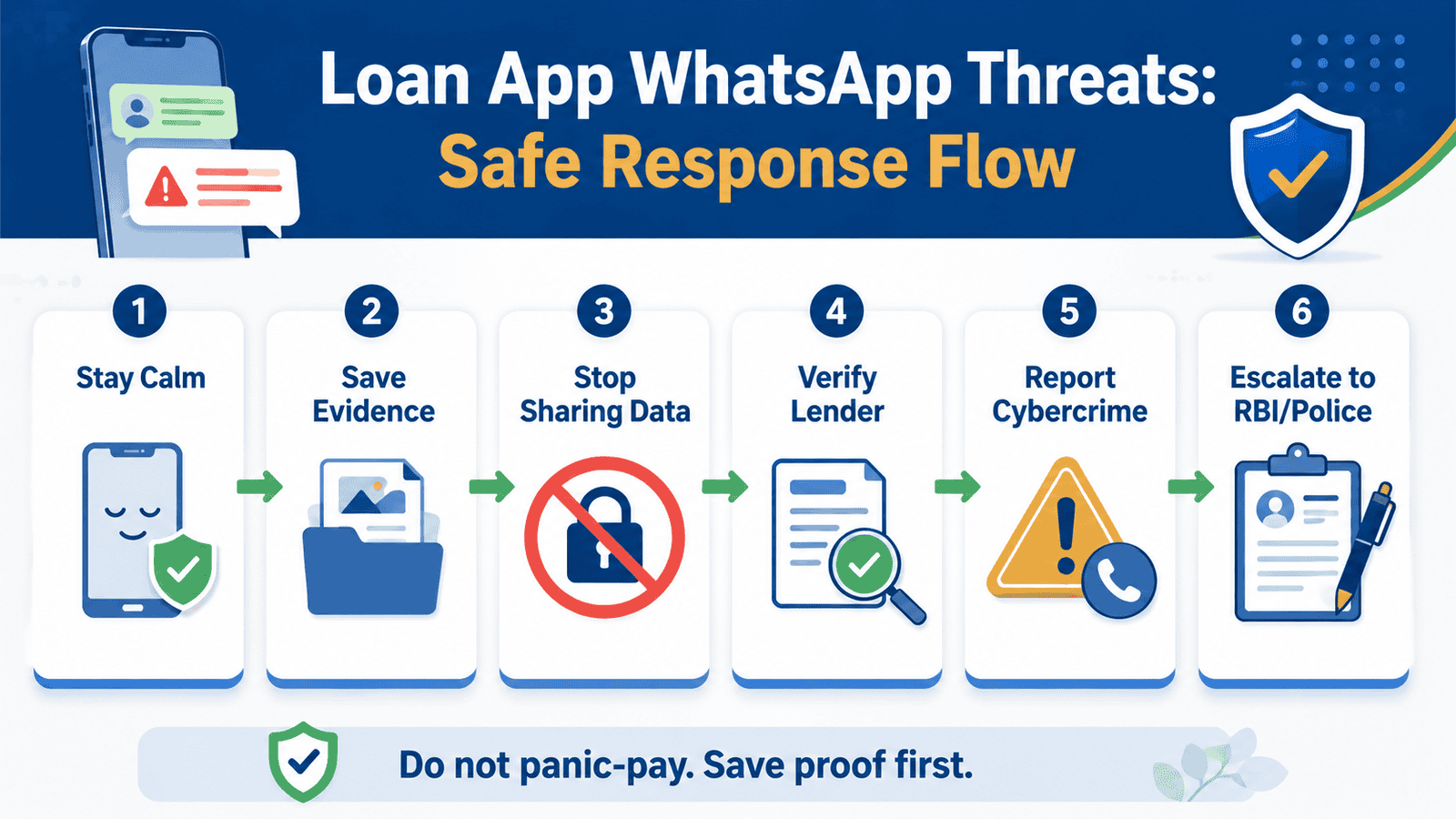
Complaint and Action Process: Step by Step
Step 1 — Save Evidence Before You Block or Delete
This is the single most important step. Before you block the number, before you delete the chat, before you do anything else — take screenshots. Make sure the screenshots show the sender’s phone number, the date, the time, and the full message text. WhatsApp also has an export chat function: tap the chat, go to More Options, then Export Chat. Save this file to your email or cloud storage immediately.
If you received a voice note or a recorded call, save those too. Do not rely on memory. The strength of your complaint depends entirely on what you can show.
Step 2 — Stop Sharing Any New Data
Do not respond to requests for a new selfie, a fresh Aadhaar scan, an OTP, your bank account number, or screen-sharing access. If you have already shared documents, note what was shared and when. Do not provide anything further. Some loan apps or fake lenders use threat sequences to extract more personal data, which they then use as additional leverage.
Step 3 — Ask for Written Dues and Lender Details
Send a written request — by WhatsApp message, email, or both — asking for the lender’s registered name, their NBFC or bank licence details, a copy of the Key Fact Statement (KFS), and a written outstanding balance statement. A legitimate lender operating under RBI’s Digital Lending Guidelines is required to provide these. If the sender cannot or will not provide a lender name, a grievance officer contact, and a written dues statement, that is itself a significant red flag.
Step 4 — Report Cyber Harassment Through Official Channels
If the messages include blackmail, threats to misuse your photos, threats to contact your family or employer, or fake police or legal warnings, these may qualify as cyber offences. You can report them at the National Cyber Crime Reporting Portal (cybercrime.gov.in). Your local police cyber cell is also an option, particularly for urgent or repeated intimidation. See our cybercrime reporting guide for the evidence and steps required before filing.
Step 5 — Escalate to the Lender’s Grievance Channel and RBI CMS
If the lender or NBFC behind the loan app is identifiable, you can raise a formal grievance through their registered grievance redressal officer. If that fails, and the lender is an RBI-regulated entity, you can escalate to the RBI Complaint Management System at cms.rbi.org.in. Keep records of every complaint you raise — reference number, date, and response. For a full walkthrough of the escalation path, see our guide on harassment complaint steps.
Safety Checklist: What to Do and What to Avoid Under Pressure
- Do not panic-pay. If a threat demands immediate transfer to a random UPI ID, stop. Verify who you are paying before sending any money. Panic payments are very difficult to recover.
- Do not share OTPs, Aadhaar scans, PAN scans, or selfies under pressure from a threatening sender. Once shared, these cannot be unsent.
- Do not grant screen-sharing access to anyone claiming to be a recovery agent or lender representative.
- Save screenshots and export your WhatsApp chat before blocking or deleting the conversation. The export file acts as a timestamped record.
- Revoke unnecessary app permissions — go to your phone Settings, find the loan app, and check what permissions it still holds. Revoke access to contacts, camera, microphone, and storage if you no longer need the app.
- Warn close contacts if the threatening message says their names or numbers will be called. A brief heads-up gives them context so they are not panicked by unexpected calls.
- Use official complaint channels for blackmail or threats — cybercrime portal, police cyber cell, lender grievance officer, or RBI CMS depending on what the threat involves.
Key Takeaways
- Save screenshots and export your WhatsApp chat before blocking or deleting — this evidence forms the basis of any complaint you file later.
- Threats to contact your family, employer, or phone contacts are a recognised form of digital harassment in India and can be reported at cybercrime.gov.in or to your local cyber cell.
- Any UPI payment demand from an unverified sender should be paused — ask for the lender’s name, NBFC or bank licence, KFS, and written outstanding balance before sending money.
- Genuine loan dues should be handled through written communication with the actual lender, not through panic payments to a phone number sending threats on WhatsApp.
- Threats involving morphed images, sexual blackmail, or extortion involving large sums should be escalated urgently to the police or cyber cell rather than handled through self-help steps alone.
- Under RBI’s Digital Lending Guidelines, regulated lenders must provide a Key Fact Statement, a grievance officer contact, and proper loan documentation — if these are absent, that is a red flag worth investigating.
Key Facts at a Glance
| Threat Type | First Safe Action | Possible Complaint Route |
|---|---|---|
| Abusive repayment message on WhatsApp | Screenshot and save; do not reply emotionally | Lender grievance officer, RBI CMS if lender is regulated |
| Threat to call your contacts or employer | Save evidence, warn affected contacts, revoke app contact access | Cybercrime portal (cybercrime.gov.in), cyber police cell |
| Fake legal notice or fake police warning | Do not panic; note sender number; save screenshot | Cybercrime portal, local police |
| Morphed photo or sexual blackmail threat | Do not pay; save evidence; act quickly | Local police cyber cell immediately; cybercrime portal |
| Random UPI demand for payment | Do not pay; ask for KFS, lender name, written dues statement | Lender grievance, cybercrime portal if fraud is involved |
| Repeated intimidation after repayment | Save proof of repayment; send written dispute to lender | RBI CMS, lender grievance officer, cybercrime portal |
Understanding Loan App Threats on WhatsApp
Not every message from a loan app contact is illegal. A reminder that your EMI is overdue, a note asking you to contact customer care, or a request to arrange repayment — these are part of normal collection communication. What crosses the line is a different matter.
Loan app threats on WhatsApp typically follow patterns that are designed to create fear and urgency. Common forms include abusive language, warnings that a borrower’s phone contacts will be called or messaged, threats that photos will be edited and shared, messages mimicking official legal notices or police summons, and extreme interest or fee demands with very short deadlines. Some borrowers also receive threats from multiple numbers — often a sign of coordinated pressure tactics.
It helps to understand how the digital lending chain works. Most loan apps are not lenders themselves. The real lender is usually a bank or NBFC — the Regulated Entity — that has engaged the app as a Loan Service Provider (LSP). The LSP handles the customer interface, loan processing, and often recovery. The Key Fact Statement (KFS) is a one-page document that regulated lenders are required to share — it lists the loan amount, APR, fees, tenure, and grievance officer details in plain language. If you never received a KFS, the lender may not be operating within RBI’s Digital Lending Guidelines.
When a loan app cannot name a regulated lender, refuses to provide a KFS, has no grievance officer contact, and instead sends threats — that profile raises serious questions about whether it is operating legally at all. This does not automatically mean your dues are zero, but it does mean the repayment process needs to be handled very carefully, in writing, with everything documented.
If the threat involves your phone contacts — warning that saved numbers will be called, or that messages will be sent to people on your contact list — this is a form of contact-shaming. Under RBI’s guidelines, regulated lenders and their service providers are not permitted to contact third parties for recovery without their prior consent. If the loan app has already accessed your contacts, see our guide on contacts misuse response for the specific steps to take.
Real Example: Ravi’s Response to WhatsApp Threats
Ravi, 29, works at a private company in Bengaluru and earns around ₹38,000 per month. During a cash shortfall, he borrowed ₹5,000 through a digital loan app. The app deducted ₹800 as a processing fee at disbursal, so he received ₹4,200 in hand. He missed one repayment date by ten days due to a salary delay.
Two days after the due date, he began receiving WhatsApp messages from an unknown number claiming to represent the app’s “legal recovery team.” The messages threatened to send voice notes to everyone in his contact list and warned that a “cybercrime case” had been filed. He was asked to pay ₹9,500 immediately to a personal UPI ID — nearly double what he understood was owed.
Instead of transferring money immediately, Ravi exported the WhatsApp chat, took screenshots of every message with the sender’s number visible, and noted the UPI ID mentioned in the threat. He checked the loan app’s terms and found a customer grievance email address. He sent a written email requesting the lender’s NBFC registration name, a copy of his KFS, a detailed dues statement showing principal, fees, and interest, and the name and contact details of the grievance redressal officer.
He also revoked the app’s contact list permission through his phone settings. He did not pay the ₹9,500 to the unknown UPI ID. Instead, once he received a written dues statement from the actual lender, he paid the legitimate outstanding amount through the app’s official payment channel and kept the bank transaction reference as proof. The threats stopped after his complaint was registered at the lender grievance level.
This example is illustrative only. Outcomes depend on individual facts, lender behaviour, and applicable rules at the time. It is not legal or financial advice.
Before You Complain: Details to Collect
Filing a complaint without supporting evidence is harder and less effective than filing one with a clear evidence file. Before escalating — whether to the lender, the cybercrime portal, or the police — collect the following:
Evidence Readiness Checklist
App and Lender Details
- Full name of the loan app (as listed on the Play Store or App Store)
- Registered lender or NBFC name (check the app, KFS, or loan agreement for this)
- Grievance officer name and email, if available
Loan Documents
- Key Fact Statement (KFS) — if you received one
- Loan agreement or sanction letter
- Written outstanding dues statement from the lender, if available
Threat Evidence
- Screenshots of threatening WhatsApp messages, with sender number, date, and time visible
- WhatsApp exported chat file (email yourself a copy)
- Voice notes or call recordings, where saving these is practically possible
- The UPI ID or account number to which payment was demanded
Repayment Proof
- Bank statement entry or UPI payment receipt for any amounts already paid
- Date, amount, and reference number for each payment made
To verify whether the loan app or its lender is connected to a regulated entity, see our guide on RBI app safety check.
How to Verify Your Real Dues Before Paying
A threatening demand for payment does not automatically tell you what you actually owe. Before transferring any money, it is worth working out the real numbers — and asking for written confirmation from the lender.
What you actually owe = Net amount disbursed + Agreed interest + Agreed fees − Amount already repaid
Where: Net disbursed = loan amount minus processing fee deducted upfront | Agreed interest = as per your loan agreement or KFS | Agreed fees = charges listed in the KFS | Amount repaid = verified from bank statement or UPI receipt
| Item | Illustrative Example | Where to Verify |
|---|---|---|
| Loan amount sanctioned | ₹5,000 | Loan agreement / KFS |
| Processing fee deducted upfront | ₹800 | KFS / bank statement |
| Net amount received in hand | ₹4,200 | Bank credit entry |
| Agreed repayment amount or EMI | ₹5,400 (principal + interest) | KFS / loan agreement |
| Amount already repaid | ₹2,000 | UPI receipt / bank statement |
| Amount legitimately outstanding (illustrative) | ₹3,400 | Written statement from lender |
| Amount demanded by threatening sender | ₹9,000 | Ask: where is the KFS/APR breakup? |
If ₹4,200 was disbursed and ₹9,000 is demanded within a few days, that gap warrants a written explanation from the lender — specifically the APR, all charges listed in the KFS, and a line-by-line outstanding statement. Do not pay a demand you cannot verify in writing. Under RBI’s Digital Lending Guidelines, the Annual Percentage Rate (APR) must be disclosed before the loan is issued. If the lender cannot show you how ₹9,000 is calculated from ₹5,000 sanctioned, ask them to do so in writing before you pay.
Normal Reminder vs Harassment: What to Watch For
| Communication Type | What It Looks Like | Risk Level | What to Do |
|---|---|---|---|
| Normal repayment reminder | Message stating overdue amount, due date, payment link, customer care number | Low | Verify amount, use official payment channel, keep receipt |
| Firm recovery follow-up | Multiple messages per day, persistent but not threatening, no abusive language | Moderate | Respond in writing; request dues statement; raise grievance if excessive |
| Abusive or intimidating language | Insults, threats of reputational damage, aggressive urgency with short deadlines | Red flag | Save evidence; raise formal grievance with lender; consider cybercrime report |
| Contact or employer threat | “We will call your boss,” “your contacts will receive messages” | Red flag | Save evidence; report to cybercrime portal; warn affected contacts |
| Fake police or legal warning | Message claiming FIR registered, court summons issued, arrest warrant pending | Red flag | Do not panic; a real notice will come through official channels, not WhatsApp |
| Morphed photo or blackmail threat | Warning that edited photos will be shared publicly or sent to contacts | Urgent | Do not pay; save evidence; contact police cyber cell immediately |
the loan is genuine and repayment is overdue — communicate in writing with the actual lender, ask for a written dues statement, and arrange repayment through the official app or bank channel.
the recovery message is abusive, threatening, or uses intimidation — save evidence first, then raise a formal grievance with the lender’s grievance officer before taking any further action.
the sender cannot name a regulated lender, provide a KFS, or give a written dues statement — do not pay the demanded amount to an unverified UPI ID until you know who you are actually paying.
threats include contacting your employer or family members — revoke the app’s contact list permission, warn the people mentioned, and report to the cybercrime portal.
you have already repaid but threats continue — gather all payment receipts, send a written repayment confirmation to the lender by email, and escalate to lender grievance or RBI CMS.
the threat involves blackmail, morphed images, or physical harm — self-help steps are not enough. Contact your local police cyber cell without delay and seek qualified legal guidance.
Common Mistakes to Avoid
Deleting Chats Before Saving Evidence
Many borrowers block the threatening number and delete the chat in one move. This removes the evidence you need to file any complaint. Always export the WhatsApp chat and take screenshots before blocking.
What to do instead: export chat, screenshot the conversation, save to email or cloud storage, then block the number.
Panic-Paying a Random UPI ID
A common tactic is to demand urgent payment to a personal UPI ID or mobile number, claiming the official payment channel is unavailable. Sending money to an unverified ID is very difficult to reverse and may not even reach the actual lender. In some cases, it only invites more demands.
What to do instead: ask for a written outstanding statement and the lender’s official payment link. Pay only after verifying who you are paying.
Sharing More Documents Under Pressure
If a threatening message asks for a fresh KYC selfie, a new Aadhaar scan, or your bank login to “verify your identity,” do not comply. Sharing additional documents under pressure gives the sender more leverage, not less.
What to do instead: stop sharing any new data; note what has already been shared.
Responding Abusively or Threatening Back
Responding with abuse, counter-threats, or aggressive language can weaken your complaint position and may create new problems. It also does not stop the threats.
What to do instead: if you reply at all, keep the message factual and calm — request the lender’s name, KFS, and dues statement in writing. Then stop responding and escalate through official channels.
Ignoring Genuine Loan Records
If the loan is genuine and money was disbursed to your account, ignoring the entire situation — including the repayment obligation — will not make the problem smaller. Overdue amounts can result in credit report entries and continued collection contact.
What to do instead: separate the repayment obligation from the harassment. Handle each through the right channel.
Waiting Too Long When Blackmail Is Involved
If the threat involves your photos, a morphed image, or a threat to contact your workplace, delays can allow the situation to escalate. Evidence may also become harder to preserve as time passes.
What to do instead: save evidence immediately and contact the police cyber cell or cybercrime portal without unnecessary delay.
When This May Not Be the Right Choice
The self-help steps in this article work well for most borrowers dealing with WhatsApp threats, abusive messages, and unverified payment demands. However, they are not sufficient in every situation.
If the threats include physical harm to you or your family, seek police help immediately — not just a cybercrime portal report.
If morphed images or sexual blackmail are involved, contact your local police cyber cell urgently. This goes beyond lender grievance channels.
If contact-shaming has already started — messages or calls have already reached your employer, colleagues, or family members — document the impact and seek guidance from a qualified legal professional alongside your official complaint.
If you have received a document that looks like a real court notice or legal summons, do not assume it is fake. Verify it through an advocate or through the relevant court’s official process before dismissing it.
If any of these apply to your situation, it may be worth exploring other options before committing.
Official Rules and Where to Verify
The complaint channels and digital lending rules in India are governed by official bodies whose guidance should be checked before acting. The following sources are relevant to loan app threats on WhatsApp:
- Reserve Bank of India (rbi.org.in) — governs Digital Lending Guidelines, the regulated entity framework, Key Fact Statement requirements, consent norms, data access rules, and borrower grievance channels for banks and NBFCs.
- National Cyber Crime Reporting Portal (cybercrime.gov.in) — the primary portal for reporting online harassment, blackmail, impersonation, morphed images, and digital threats in India.
- RBI Complaint Management System (cms.rbi.org.in) — used when the complaint involves an RBI-regulated bank or NBFC. Supports escalation when the lender’s internal grievance process has not resolved the issue within the prescribed period.
- Local police cyber cell — relevant for urgent threats, extortion, repeated intimidation, and cases involving safety risks. Contact your state police website or the nearest cyber crime police station.
These portals, categories, and escalation timelines can change. Verify current procedures directly from official sources before filing a complaint. For a full explanation of the borrower protections that apply in digital lending, see our article on digital borrower rights and the detailed explainer on digital lending rules.
Credit reporting rules, lender assessment methods, and bureau processes can change. Always verify current details from the relevant bureau, lender, or official regulatory source before acting.
Expert Tips
- Create a single evidence folder. On your phone or computer, create one folder labelled with the app name and date. Put every screenshot, exported chat file, payment receipt, and lender email in this folder. This makes it easier to file a complaint and follow up.
- Keep all repayment communication in writing. If you speak to a recovery agent on the phone, follow up with a WhatsApp or email message summarising what was said — date, amount discussed, reference number. This creates a paper trail.
- Ask for KFS and lender name before paying any disputed amount. Under RBI’s Digital Lending Guidelines, a regulated lender must provide a Key Fact Statement with the APR, fees, and grievance officer details. If the sender cannot provide these, pause the payment until they do.
- If you reply at all, reply once and calmly. Something like: “Please share the lender’s registered name, NBFC/bank licence number, KFS, and written outstanding balance. I will arrange payment through the official channel after verifying these details.” Then stop engaging and escalate if needed.
- Inform trusted contacts if threats mention them. A brief, factual heads-up — “I am dealing with a loan recovery matter and some contacts may be called; ignore those calls” — prevents them from being alarmed and reduces the threat’s effectiveness.
- Do not install new APKs or grant fresh screen access. Some recovery tactics involve sending links to install updated loan app versions or customer-service tools that request screen-sharing permissions. These can give senders access to your device and data.
- File your complaint early, not as a last resort. Official complaint channels work better when evidence is fresh, details are clear, and the borrower has not already made several unverified payments. Do not wait until the situation becomes overwhelming.
Frequently Asked Questions
What should I do first if a loan app threatens me on WhatsApp?
Save the evidence before doing anything else. Take screenshots showing the sender’s number, the date, and the message content. Use WhatsApp’s Export Chat option and send the file to your email. Do not block the number or delete the chat before saving proof. Once you have the evidence, stop sharing any new data, ask for a written dues statement from the lender, and decide on the complaint route based on the type of threat.
Should I block the threatening loan app number?
Block the number only after you have saved all evidence — screenshots, exported chat, voice notes, and UPI IDs. Blocking does not prevent future contact from new numbers, but it can reduce immediate distress. After blocking, report the number through the cybercrime portal or local cyber cell if the messages qualify as harassment or blackmail.
Can a loan app recovery agent legally message my contacts?
Under RBI’s Digital Lending Guidelines, regulated lenders and their Loan Service Providers are not permitted to contact third parties — including family members, employers, or phone contacts — without their prior consent. If the loan app has already accessed your contact list without proper consent disclosure, or if agents have already contacted people in your list, this may be a violation worth reporting. See also what steps are available if a loan app has already accessed your contacts.
Where can I file a complaint against loan app WhatsApp harassment?
The main options are: the National Cyber Crime Reporting Portal at cybercrime.gov.in for online harassment, blackmail, and digital threats; your local police cyber cell for urgent or serious intimidation; the lender’s registered grievance redressal officer for recovery process violations; and the RBI Complaint Management System at cms.rbi.org.in if the lender is an RBI-regulated bank or NBFC and the grievance process has not resolved the issue. Check each portal for current procedures before filing.
What evidence should I save before complaining?
At minimum: screenshots of the threatening messages showing the sender’s number, date, and time; an exported WhatsApp chat file; the UPI ID or payment account to which money was demanded; any voice notes received; bank receipts or UPI references for any payments already made; a copy of the KFS or loan agreement if you have one; and the app name and registered lender name.
Can a fake loan app misuse my photos or contacts?
Some unregulated or fraudulent loan apps request access to the device’s camera and contacts during installation. If this access was granted, the app may have copies of photos or contact lists stored on its servers. If you receive a threat that mentions your photos specifically — particularly morphed or edited versions — treat this as urgent. Contact the police cyber cell without delay. Do not pay ransom demands, as payment does not guarantee the threat will stop.
What if I have already repaid but they still threaten me?
Gather all repayment proof — UPI receipts, bank statements, transaction reference numbers, and the date and amount of each payment. Send a written repayment confirmation to the lender by email, listing every payment with proof attached. If threats continue after documented repayment, escalate to the lender’s grievance officer and, if the lender is regulated, to the RBI Complaint Management System at cms.rbi.org.in. Keep copies of every complaint you file.
What if the loan is genuine and I do owe money?
A genuine outstanding balance does not mean you have to accept abusive recovery tactics. Arrange repayment through the official app or bank channel, using the payment method listed in the KFS or loan agreement. Pay only after verifying the amount in writing. Keep the repayment receipt. If recovery messages remain abusive even after you are making payments, raise a formal grievance through the lender’s grievance officer. Illegal recovery methods are a separate issue from the underlying loan obligation.
Final Verdict
Loan app threats on WhatsApp are designed to overwhelm you with fear and urgency. The most effective response is the calmest one: save your evidence first, pause before making any unverified payment, and verify who you are actually dealing with before doing anything else.
If the loan is genuine, handle the repayment obligation in writing, through the official channel, with receipts kept for every payment. If the recovery communication involves abuse, blackmail, contact-shaming, fake legal notices, or morphed image threats — those are separate issues that belong in front of a grievance officer, a cybercrime portal, or a police cyber cell, depending on severity.
You do not have to choose between protecting yourself and being responsible. Both are possible — with the right steps, in the right order. For a full explanation of the protections available to you under India’s digital lending framework, read our guide on digital borrower rights.
Always verify the latest rules, charges, and terms from the relevant official source or provider before making a financial decision.
This article is for educational purposes only and should not be treated as personalised financial, credit, tax, or legal advice. Rules, rates, charges, eligibility criteria, and product terms can vary by provider and may change over time. Please verify current details from official sources, the relevant provider, or a qualified professional before making any financial decision.

Arjun writes clear borrower-safety guides on digital loan apps, RBI digital lending rules, KFS, APR, LSPs, loan app harassment, cybercrime complaints, CIBIL impact, and safer borrowing choices. He focuses on helping Indian borrowers understand risks, protect their data, compare lenders carefully, and use official complaint channels when needed.