

Your salary lands on the 1st, and by the 20th it’s gone — rent, groceries, the EMI, money home to your parents, a few UPI payments you don’t even remember making. The 50-30-20 rule for Indian salaried people is a simple way to stop that disappearing act: split your monthly take-home salary into 50% needs, 30% wants, and 20% savings or debt repayment, so every rupee has a job before the month begins.
This article gives you the Indian version of that rule — with real salary examples at ₹30,000, ₹50,000, ₹75,000, and ₹1 lakh take-home, and what to do when rent, EMIs, or family support push your numbers off the textbook split.
One thing to be clear about upfront: this is a starting framework, not a compulsory formula. Your city, your dependents, your existing debt, and your income stability all change what a healthy split looks like for you.
Quick Answer: What Is the 50-30-20 Rule for Indian Salaried People?
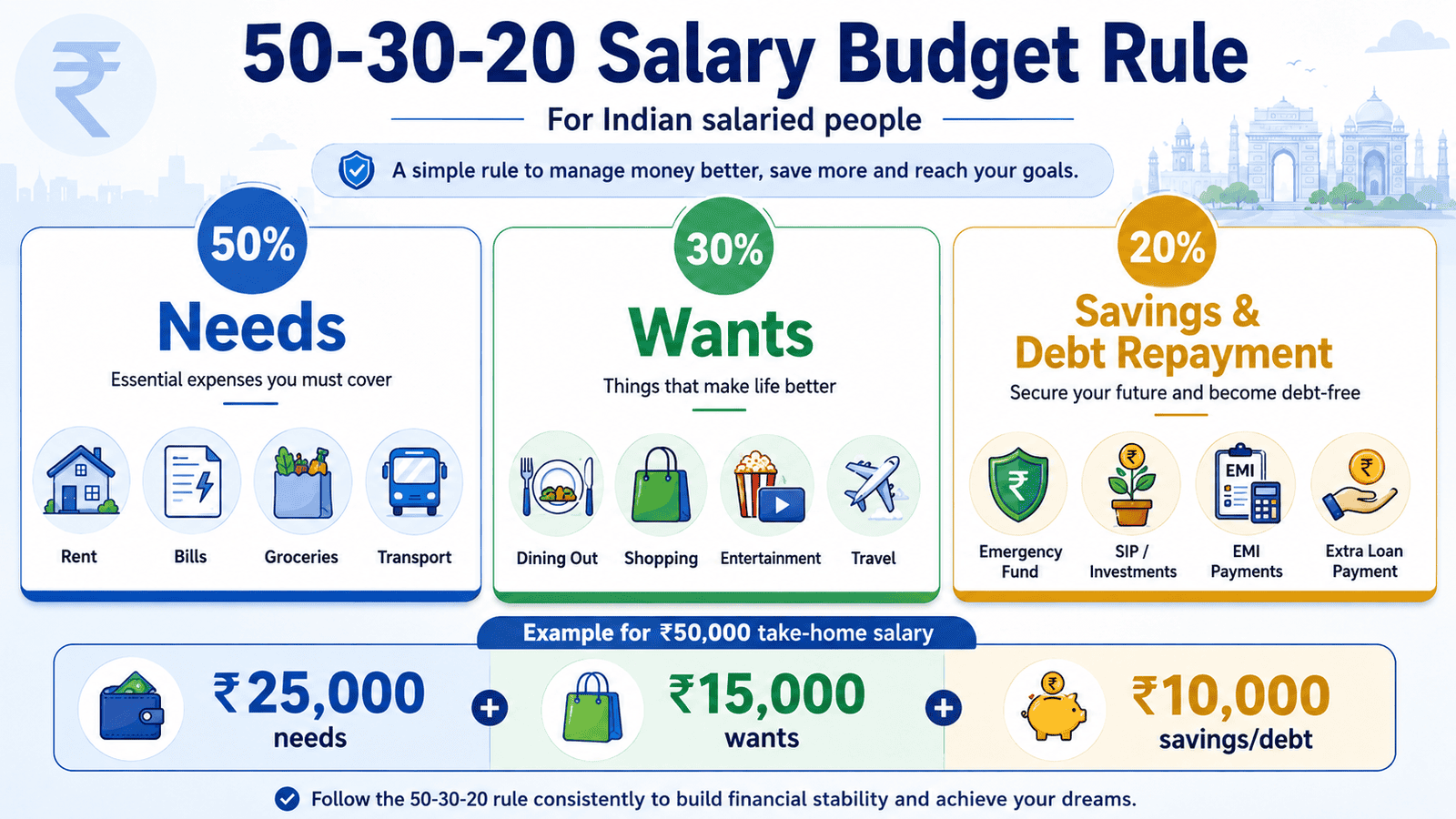
The 50-30-20 rule for Indian salaried people means dividing monthly take-home salary into 50% needs, 30% wants and 20% savings or debt repayment. For a ₹50,000 salary, that becomes ₹25,000 needs, ₹15,000 wants and ₹10,000 savings, adjusted for EMIs, rent and emergency fund needs.
Key Takeaways
- Apply the 50-30-20 rule to your monthly in-hand salary — not your CTC, which includes deductions you never actually receive.
- Needs cover rent, groceries, utilities, commute, insurance premiums, school fees, and EMIs — the spending you cannot skip without real consequences.
- When money is tight, your wants bucket should shrink first — not your EMI payments, insurance, or emergency fund.
- In high-rent cities like Mumbai or Bengaluru, needs can easily cross 50% of salary, and that’s a sign to adjust the ratio, not panic.
- Even if you can only manage 5–10% savings right now, that’s a real starting point — the rule is a direction, not a pass-or-fail test.
- SIPs, FD/RD contributions, EPF top-ups, and loan prepayment all sit in the savings/debt-repayment bucket — credit card minimum dues do not count as “wants.”
Key Facts at a Glance
| Bucket | Percentage | Indian Examples |
|---|---|---|
| Needs | 50% | Rent, groceries, electricity, commute, school fees, insurance premiums, loan EMIs |
| Wants | 30% | Eating out, shopping, OTT subscriptions, travel, gadgets, lifestyle upgrades |
| Savings / Debt Repayment | 20% | Emergency fund, SIPs, FD/RD, EPF voluntary contribution, loan prepayment, credit card dues beyond minimum |
How the 50-30-20 Rule Works for Indian Salaried People
Start with take-home salary, not CTC
This is where most people get the rule wrong from day one. Your CTC (Cost to Company) includes employer EPF contribution, gratuity, and other components you never see in your bank account. Apply 50-30-20 to your monthly in-hand salary — what actually hits your account after income tax, employee EPF, and professional tax are deducted.
If your CTC is ₹8 lakh a year but your monthly take-home is ₹55,000, your budget math should start at ₹55,000. Anyone calculating a “20% savings target” off CTC is setting a goal they can never actually hit.
What counts as a “need” for an Indian salaried household
Needs are the spending you cannot skip without a real, immediate consequence — a missed rent payment, a defaulted EMI, a lapsed health insurance policy. For most Indian households this includes rent or home loan EMI, groceries, electricity and water bills, commute costs, school or tuition fees, insurance premiums, and any existing loan EMI. monthly salary budget planning works best when this list is written down explicitly, not estimated from memory.
What counts as a “want”
Wants are spending that improves your life but isn’t essential to keep it running — eating out, weekend shopping, OTT and music subscriptions, the latest phone upgrade, vacations, and lifestyle spending generally. The test is simple: if you stopped this expense tomorrow, would anything actually break? If the answer is no, it’s a want.
What counts as savings and debt repayment
This bucket includes your emergency fund contribution, SIP investments, FD or RD deposits, voluntary EPF top-ups, and any extra loan prepayment beyond your scheduled EMI. Credit card dues deserve a special note here: your minimum due is a need (missing it triggers interest and a credit score hit), but paying down the full outstanding balance — beyond the minimum — belongs in this savings/debt bucket, because that’s effectively debt repayment.
Real Example: Priya’s Hyderabad Budget
Priya, 31, works as a marketing executive in Hyderabad with a monthly take-home salary of ₹65,000. She pays ₹18,000 rent for a 1BHK, sends ₹8,000 home to her parents every month, and has a personal loan EMI of ₹9,000 from a medical expense two years ago. She also started a ₹4,000 SIP six months ago.
Her needs — rent, groceries, commute, family support, EMI, and insurance — already total around ₹38,000, close to 58% of her salary. Her wants, mostly weekend outings and subscriptions, run about ₹14,000. That leaves roughly ₹13,000 for savings, including her SIP.
Priya’s situation shows why a rigid 50-30-20 split doesn’t always fit: her needs bucket is naturally larger because of the EMI and family support. Rather than cutting her SIP to “balance the ratio,” the sustainable move is trimming discretionary spending first — and building a small emergency fund planning habit before considering any extra loan prepayment.
The key insight: the percentages are a guide for where to look, not a rule to force at any cost.
Before You Use the 50-30-20 Rule, Check These Numbers
- Your exact monthly take-home salary, after all deductions — not an estimated or rounded figure.
- All fixed EMIs and minimum credit card dues you’re currently paying.
- Rent and any recurring family support amount you send out monthly.
- Annual expenses — insurance premiums, school admission fees, travel, repairs — divided by 12 to get a monthly equivalent.
- Your current emergency fund status — zero, partial, or fully funded.
Writing these five numbers down before you start is what makes the 50-30-20 split useful instead of theoretical.
How to Calculate Your 50-30-20 Split
Needs = Take-home salary × 50% | Wants = Take-home salary × 30% | Savings/Debt = Take-home salary × 20%
Where: Take-home salary = monthly in-hand salary after tax, EPF, and other deductions
| Take-Home Salary | Needs (50%) | Wants (30%) | Savings/Debt (20%) |
|---|---|---|---|
| ₹30,000 | ₹15,000 | ₹9,000 | ₹6,000 |
| ₹50,000 | ₹25,000 | ₹15,000 | ₹10,000 |
| ₹75,000 | ₹37,500 | ₹22,500 | ₹15,000 |
| ₹1,00,000 | ₹50,000 | ₹30,000 | ₹20,000 |
EMI-heavy example: ₹60,000 salary with ₹18,000 EMI
Here’s where the textbook ratio breaks down in practice. On a ₹60,000 take-home salary, a standard split gives ₹30,000 needs, ₹18,000 wants, and ₹12,000 savings. But if you’re already paying an ₹18,000 EMI, plus ₹15,000 rent and ₹6,000 groceries, your real needs total ₹39,000 — already 65% of salary, before you’ve spent a rupee on wants.
The fix isn’t to skip the EMI or stop saving entirely. It’s to shrink the wants bucket — from a theoretical ₹18,000 down to maybe ₹8,000–₹10,000 — so you can still protect a minimum savings contribution of ₹10,000–₹12,000. Wants flex. EMIs, rent, and a baseline emergency fund don’t. You can read a full plan in repay debt faster if your EMI load feels unmanageable long-term.
Comparison: Standard vs Modified Budget Rules
| Rule | May Suit | Caution |
|---|---|---|
| 50-30-20 (standard) Balanced | Stable income, moderate rent, no heavy debt | Doesn’t account for high-rent cities or existing EMIs |
| 60-20-20 (high-cost city) Needs-heavy | Mumbai, Bengaluru, Delhi NCR renters | Wants get squeezed — track spending closely so it doesn’t creep back up |
| 50-20-30 (debt-priority) Debt-focused | Readers actively clearing high-interest debt | Don’t sacrifice your starter emergency fund entirely while doing this |
| Needs-first, minimum-dues-second Crisis mode | Unstable income or income shock months | Treat as temporary — return to a savings-inclusive split once income stabilises |
Monthly Budget Safety Checklist
- Do not skip or reduce an EMI payment just to hit your savings percentage — a missed EMI affects your credit score directly.
- Do not pay only the minimum on a credit card while telling yourself the rest counts as “savings” — interest accrues on the full outstanding balance.
- Do not cut health insurance premiums or essential family expenses to force the ratio to look clean on paper.
- Do not lean on credit cards to protect your wants spending when your needs bucket is already full — that converts a wants problem into a debt problem. Understand the credit card debt trap before it starts.
- Build at least a small starter emergency fund — even ₹5,000–₹10,000 — before redirecting savings into aggressive investing.
How to Decide What’s Right for You
your salary is on the lower end and rent alone crosses 35–40% of it — your needs bucket will naturally exceed 50%, and that’s expected, not a failure.
you’re carrying one or more EMIs that push needs past 50% — trim the wants bucket first, and keep at least a token savings contribution rather than cutting it to zero.
your emergency fund is currently at zero — redirect most of your 20% bucket there first, before SIPs or extra loan prepayment.
you’re planning to apply for a loan in the next 6–12 months — keep your needs-plus-EMI ratio in check now, since a high EMI burden ratio can affect how lenders assess your application later.
your income is stable month to month — don’t lock yourself into a fixed savings percentage; budget around your lowest expected month instead.
you’ve accounted for annual expenses like insurance renewal or school admission fees — don’t assume your monthly numbers are accurate until you have.
Common Mistakes to Avoid
Calculating the split on CTC instead of take-home salary
This is the single most common error.
If your CTC is ₹9 lakh annually but EPF, gratuity, and tax bring your monthly in-hand down to ₹58,000, budgeting against the CTC figure means you’re planning around money you’ll never actually receive — leading to a budget that fails by design.
Always pull your actual monthly credit amount from your salary slip or bank statement, not your offer letter.
Treating credit card limit as available income
A ₹2 lakh credit limit is not ₹2 lakh of spending power.
Spending against the limit and paying only the minimum due each month means the gap compounds at high card interest rates — often 36–48% annually — turning a small shortfall into a growing balance within a few months.
Track card spending against your wants budget in real time, not against the limit.
Saving only after all spending is done
Waiting until month-end to see “what’s left” for savings.
This almost always leaves nothing, because spending naturally expands to fill available money — a well-documented behavioural pattern, not a personal failing.
Move your savings amount out on salary day, automatically, before you start spending.
Ignoring annual and irregular expenses
Forgetting insurance renewals, school admission fees, festival travel, or appliance repairs because they don’t happen every month.
These costs don’t disappear — they just arrive as a surprise that wrecks a single month’s budget, often pushing readers toward a credit card or short-term loan they didn’t plan for.
Divide your known annual expenses by 12 and set that amount aside monthly inside your needs bucket.
Copying someone else’s exact ratio
Applying a colleague’s or influencer’s budget percentages directly to your own salary.
Their rent, dependents, EMI load, and city cost of living are different from yours — a 50-30-20 split that works for a single person in a tier-2 city won’t work the same way for someone supporting parents in Mumbai.
Use the standard rule as a starting point, then adjust based on your own fixed obligations.
Cutting EMIs or insurance to “fix” the ratio
Reducing or skipping an EMI payment, or lapsing an insurance policy, purely to make the needs bucket look smaller on paper.
A missed EMI triggers late fees and a negative mark on your credit report; a lapsed health policy leaves you exposed to costs that could be far larger than the premium you saved.
If needs genuinely exceed 50%, accept that and reduce wants instead — don’t manufacture a clean ratio by cutting essentials.
When This May Not Be the Right Choice
If you’re already behind on EMI or credit card payments, the priority is stabilising those dues first — a percentage-based budget can wait until the immediate pressure eases.
If you’re facing irregular or unstable income — freelance work, commission-based pay, or a recent job change — a fixed-percentage rule may not fit month to month; a needs-first, flexible approach works better until income settles.
If you’re the sole earner supporting dependents with significant medical or care expenses, your needs bucket may legitimately need to exceed 50% on an ongoing basis, not just occasionally.
If you live in a very high-rent city where housing alone takes 35–40% of your salary, a strict 50-30-20 split will feel impossible without a modified version like 60-20-20.
If any of these apply to your situation, it may be worth exploring other options before committing.
Official Rules and Where to Verify
The 50-30-20 rule itself is a budgeting framework, not a government regulation — there’s no official body that mandates it. But several related areas connect to official sources worth knowing:
- RBI (rbi.org.in) — for general financial education and borrower-awareness resources.
- Income Tax Department (incometax.gov.in) — for understanding salary tax deductions and how they affect your take-home figure.
- EPFO (epfindia.gov.in) — for EPF deduction rules and voluntary contribution options.
- IRDAI (irdai.gov.in) — for insurance premium and coverage standards if you’re reviewing your protection needs.
Rules, rates, charges, and eligibility conditions can change. Always verify current details from the official source, lender, or relevant regulator before making any financial decision.
Expert Tips
- Set up an automatic transfer to a separate savings account on the day your salary is credited — before you have a chance to spend it.
- Open a small “annual expenses” sinking fund and contribute monthly, so insurance renewals and school fees stop feeling like emergencies.
- Review your UPI and credit card spending weekly, not monthly — small daily payments are the easiest place for the wants bucket to silently expand.
- When you get a salary hike, increase your savings percentage before your lifestyle spending rises to match the new number.
- Recalculate your split every time your rent, EMI, or family support amount changes — don’t keep running last year’s numbers.
- Use a salary budget calculator monthly rather than estimating in your head — actual numbers catch drift that mental math misses.
Frequently Asked Questions
Is the 50-30-20 rule suitable for Indian salaried people?
Yes, as a starting framework — but it usually needs adjustment for Indian realities like high urban rent, family financial support, and existing EMIs, which can push the needs bucket above 50% for many readers.
Should I calculate the 50-30-20 rule on CTC or take-home salary?
Always use take-home (in-hand) salary — the amount that actually reaches your bank account after tax, EPF, and other deductions. Budgeting against CTC sets targets you can’t realistically meet.
Where do EMIs fit in the 50-30-20 rule?
Loan EMIs belong in the needs bucket, since missing one has direct consequences for your credit score and finances. If EMIs push your needs past 50%, reduce the wants bucket rather than the EMI itself.
What if my rent and household expenses are more than 50% of my salary?
This is common in high-rent cities. Consider a modified split like 60-20-20, where needs take a larger share and wants shrink accordingly, while still protecting a minimum savings contribution.
Should SIPs come under savings in the 50-30-20 rule?
Yes. SIP contributions sit in the 20% savings/debt-repayment bucket, alongside emergency fund contributions, FD/RD deposits, and any extra loan prepayment.
Is credit card bill payment a need, want, or debt repayment?
Your minimum due is effectively a need — missing it triggers interest and credit score damage. Any amount you pay beyond the minimum, to clear the balance faster, counts as debt repayment under the savings bucket.
How can I follow the 50-30-20 rule on a ₹30,000 salary?
On ₹30,000, the standard split is roughly ₹15,000 needs, ₹9,000 wants, and ₹6,000 savings. If rent and essentials already exceed ₹15,000, reduce the wants bucket first and treat even a small, consistent savings amount — like ₹2,000–₹3,000 — as a reasonable starting point.
What happens if I can’t save 20% every month?
That’s common, especially in the early months of tracking a budget. Start with whatever percentage you can manage consistently and increase it gradually as EMIs are paid off or income rises — consistency matters more than hitting 20% immediately.
Final Verdict
The 50-30-20 rule for Indian salaried people works best as a starting framework, not a fixed formula. If your income is stable, your rent is reasonable, and you have no major EMIs, the standard split is a solid place to begin. If you’re carrying debt, living in a high-rent city, or supporting family, expect your needs bucket to run higher — and adjust by trimming wants, not by skipping EMIs, insurance, or your emergency fund. The safest next step is simple: pull your actual take-home salary and last month’s spending, sort it into needs, wants, and savings, and see where your real numbers land before changing anything.
Always verify the latest rules, charges, and terms from the relevant official source or provider before making a financial decision.
This article is for educational purposes only and should not be treated as personalised financial, credit, tax, or legal advice. Rules, rates, charges, eligibility criteria, and product terms can vary by provider and may change over time. Please verify current details from official sources, the relevant provider, or a qualified professional before making any financial decision.

Priya Raman writes simple, borrower-first guides on UPI issues, banking problems, savings habits, debt repayment, emergency funds, borrower insurance, and everyday money decisions. Her writing helps Indian readers understand practical next steps, avoid avoidable charges, and make safer financial choices without jargon or pressure.