
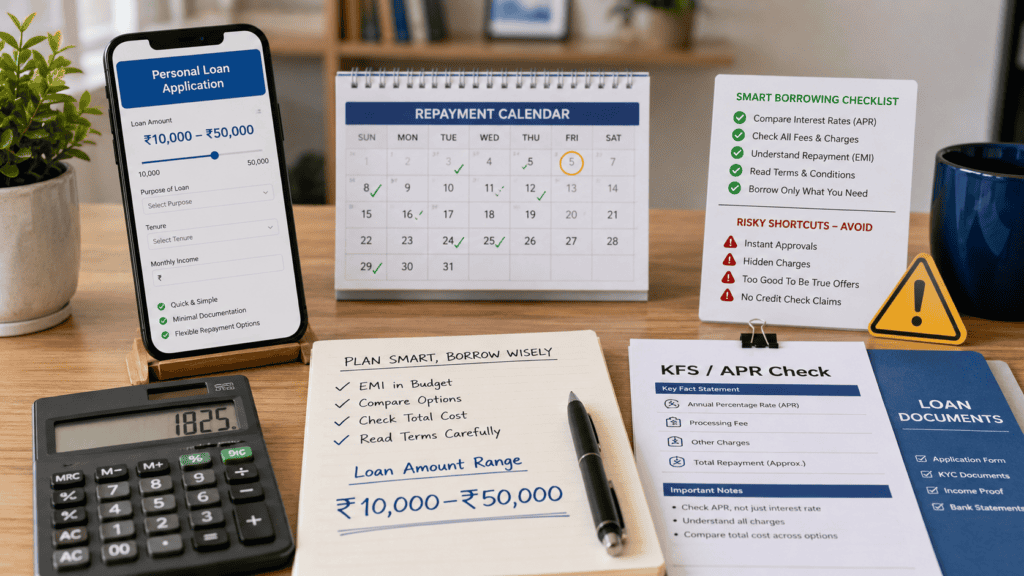
A sudden medical bill. Rent due before salary arrives. A repair that cannot wait. These are the moments when ordinary Indians need ₹10,000 to ₹50,000 quickly — not months from now, not after a mountain of paperwork, but soon. The problem is that “quickly” has become a trap. Dozens of apps promise instant approval, but small loans can carry high charges, short tenures, CIBIL consequences, and hidden fees that turn a manageable gap into a bigger problem. Before you apply anywhere, you need to compare your real options — bank, NBFC, digital lender, credit card loan, or salary advance — and understand the full cost, not just the monthly EMI. This guide does exactly that.
Quick Answer: Small Personal Loan Options from ₹10,000 to ₹50,000
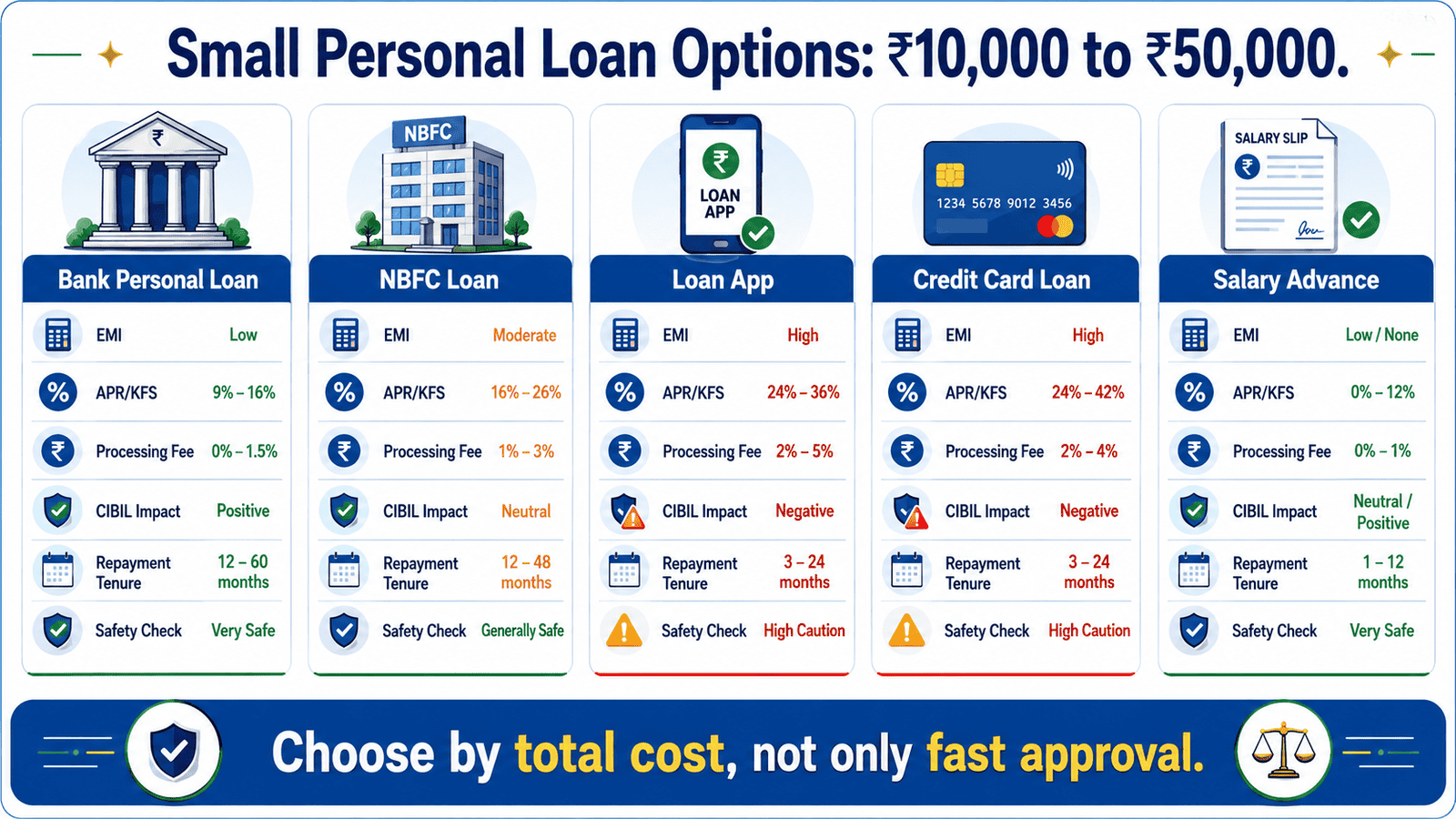
A small personal loan is usually an unsecured loan of around ₹10,000 to ₹50,000 used for short-term needs. Before applying, compare EMI, total interest, processing fee, APR, KFS, repayment tenure, CIBIL impact, and lender safety instead of choosing only the fastest approval option.
Key Takeaways
- A ₹50,000 loan at a sample 18% annual interest for 12 months means an EMI of roughly ₹4,584 (illustrative) — but after processing fees and GST, your total outgo can be noticeably higher. Always check total payable, not just EMI.
- Banks and regulated NBFCs are generally safer options than unknown instant-loan apps. Regulated lenders must follow RBI’s Fair Practices Code and provide a Key Facts Statement (KFS) for digital loans.
- Even a small personal loan triggers a hard inquiry on your credit report. Multiple applications within a short period can lower your CIBIL score, so apply to one lender at a time after comparing properly.
- A missed EMI — even on a ₹10,000 loan — gets reported to credit bureaus and can affect your score. Loan size does not reduce the credit impact of a default or late payment.
- Before accepting any digital loan, ask for the KFS, check the lender’s name, verify their APR, and confirm the grievance officer’s contact details. If any of these are missing, do not proceed.
- If your existing EMIs already take up more than 40–50% of your monthly take-home pay, taking another small loan may push you into a difficult repayment situation.
Small Loan Options Compared: Bank vs NBFC vs Loan App vs Credit Card vs Salary Advance
There is no single “best” option for a ₹10,000 to ₹50,000 loan. The right choice depends on your income, credit score, repayment capacity, urgency, and how transparent the lender is. Use this table to understand what each option typically involves — then verify current terms directly with the lender before applying. For a deeper comparison of bank and NBFC loan structures, see bank or NBFC loan.
| Option | Suitable For | Key Things to Check |
|---|---|---|
| Bank personal loan | Salaried employees with established bank relationship, decent CIBIL score | Processing fee, reducing-balance rate, prepayment terms — verify at bank’s official site [CONFIRM] |
| NBFC personal loan | Borrowers who may not qualify at banks; can be faster | APR is often higher than banks — compare total cost carefully [CONFIRM] |
| Digital loan app (regulated lender) | Urgent need, verified RBI-registered lender behind the app | Must show KFS, lender name, APR, grievance officer; avoid apps that ask for upfront fee |
| Credit card loan / card EMI | Existing credit card holder needing short-term funds | Interest on cash advance is very high; EMI conversion may carry processing fee [CONFIRM] |
| Salary advance (employer or platform) | Salaried employees with employer tie-up or salary account | Often interest-free or low-cost but limited to earned salary; check deduction timing |
| FD-backed / overdraft | Borrowers with fixed deposits who want low-cost secured borrowing | Rate typically lower than unsecured personal loan; FD stays locked [CONFIRM] |
Key Facts at a Glance
| Factor | What to Know | Where to Verify |
|---|---|---|
| Loan amount range | ₹10,000 to ₹50,000 (varies by lender and borrower profile) [CONFIRM] | Lender’s official product page |
| Loan type | Unsecured personal loan — no collateral required in most cases | Lender’s official product page |
| Typical applicants | Salaried employees, self-employed individuals with income proof | Lender eligibility page |
| Documents commonly needed | PAN, Aadhaar-based KYC, bank statement, salary slip or income proof | Lender’s document checklist |
| Main cost components | Interest (reducing-balance), processing fee, GST on fee, late/bounce charges | KFS, lender official site [CONFIRM] |
| CIBIL impact | Hard inquiry on application; missed EMI reported to bureaus | transunioncibil.com |
| Safer verification step | Check RBI’s regulated entity list and KFS before accepting any digital loan | rbi.org.in |
What Is a Small Personal Loan and How Does It Work in India?
A small personal loan is an unsecured short-term loan — meaning no gold, property, or fixed deposit is pledged as security. You borrow a fixed amount, repay it in equated monthly instalments (EMIs) over an agreed tenure, and pay interest on the outstanding balance. Most personal loans in India use the reducing-balance method: your interest is calculated on the remaining principal each month, not the original loan amount. This makes the reducing-balance rate lower in effective cost than a flat interest rate quoted on the full principal.
The APR (Annual Percentage Rate) captures a broader cost picture — it includes the interest rate plus processing fees, GST, and other mandatory charges spread across the loan tenure. According to RBI’s digital lending guidelines (rbi.org.in), regulated lenders offering loans digitally must provide a Key Facts Statement (KFS) before disbursal. The KFS shows the loan amount, APR, repayment schedule, total charges, and the grievance officer’s details — all in one standardised document. If a lender skips the KFS, that is a regulatory compliance issue and a warning sign.
A hard inquiry is placed on your credit report every time a lender pulls your CIBIL score or credit bureau report during loan processing. Too many hard inquiries in a short period signal credit hunger to future lenders and can nudge your score downward. This matters even for small loans.
Lenders assess your loan application against several factors: monthly income, bank statement cash flows, existing EMI obligations (captured in the FOIR — Fixed Obligation to Income Ratio), CIBIL score, employer stability, and in some cases, the nature of your credit history. A lender may deny or restrict a ₹50,000 loan if your FOIR with the new EMI would exceed their internal cap — even if your salary looks adequate.
There is an important difference between a lender product, a loan marketplace, and a digital loan app. A bank or NBFC is a regulated lender. A marketplace (like a financial aggregator website) helps you compare and apply across lenders — your loan still comes from the underlying lender. A digital loan app may be a regulated NBFC itself, or it may be a Lending Service Provider (LSP) working with a regulated lender. According to RBI’s digital lending framework, the loan agreement and KFS must come from the regulated entity, not just the app interface. Always identify who the actual lender is before accepting.
Real Example: Priya’s ₹25,000 Small Loan Decision in Bengaluru
Priya, 31, works as an accounts executive in Bengaluru earning ₹29,000 per month. Her father’s hospitalisation left her with a ₹25,000 bill to settle in the next ten days, and her savings account has only ₹4,000. She has a CIBIL score of around 710 and no existing EMI obligations. She has three realistic options.
Option one: her salary account bank has a pre-approved personal loan offer at a published rate, with a processing fee. She can accept it through netbanking and get disbursement in one to two working days. She checks the KFS, confirms the APR includes the processing fee, and calculates that her EMI for ₹25,000 over 12 months comes to roughly ₹2,300–₹2,500 per month depending on the final rate (illustrative — verify with your lender). Her FOIR with this EMI stays comfortably below 50% of her salary. This is the option she short-lists. For a detailed checklist of what lenders look at before approval, see personal loan eligibility.
Option two: a loan app offering “instant ₹25,000 in 10 minutes.” The app’s interface does not clearly show the lender’s name. When Priya reads the fine print, the APR is above 40% annualised, the tenure is only 90 days, and the app requests access to her contacts and photos. She closes it.
Option three: using her credit card’s cash advance limit for ₹25,000. Cash advance interest on most cards starts from the withdrawal date with no grace period and is typically charged at a much higher monthly rate than a personal loan. She decides this is more expensive than her bank’s personal loan offer.
Priya’s key insight: repayment capacity mattered more than approval speed. She needed documents — PAN, Aadhaar, last three months’ salary slips, and six months’ bank statements — ready before she applied, which reduced back-and-forth delays. She applied to one lender only, protecting her CIBIL score from multiple hard inquiries.
Eligibility and Documents: What You Need Before You Apply
Most small personal loan applications in India require the following. Exact requirements vary by lender — verify the current checklist at the lender’s official website before applying.
| Requirement | Typical Expectation | Notes |
|---|---|---|
| Age | 21–58 years (varies by lender) [CONFIRM] | Upper limit may be lower for self-employed |
| Monthly income | Minimum income threshold varies by lender [CONFIRM] | Salaried and self-employed norms differ |
| CIBIL score | Many lenders prefer 700+ but some NBFCs consider lower scores [CONFIRM] | Lower score may mean higher rate or rejection |
| PAN card | Mandatory | Required for KYC and credit bureau check |
| Aadhaar-based KYC | Commonly used for digital KYC verification | Video KYC may be offered by digital lenders |
| Salary slips | Last 2–3 months for salaried applicants [CONFIRM] | Some digital lenders may rely on bank statement instead |
| Bank statement | Last 3–6 months [CONFIRM] | Used to verify cash flow, EMI debits, and income regularity |
| Existing EMI burden (FOIR) | Existing EMIs typically should not exceed 40–50% of income [CONFIRM] | A new EMI is added to this calculation |
For a complete breakdown of what documents lenders typically ask for and how to prepare them, see documents for personal loan.
EMI and Total Repayment Examples for ₹10,000, ₹25,000 and ₹50,000
The EMI formula for a personal loan is: EMI = [P × r × (1+r)^n] ÷ [(1+r)^n − 1], where P is the principal, r is the monthly interest rate (annual rate ÷ 12), and n is the number of months.
EMI = [P × r × (1+r)^n] ÷ [(1+r)^n − 1]
Where: P = Loan principal | r = Monthly interest rate (annual rate ÷ 12) | n = Loan tenure in months
The tables below use a sample annual interest rate of 18% for illustration only. Actual rates vary by lender, income, credit profile, and tenure. These are not offers from any lender — verify current rates at the lender’s official website before applying. For a detailed ₹50,000 loan calculation including tenure variations, see ₹50,000 EMI examples.
| Loan Amount | Tenure | Sample EMI (18% p.a.) [CONFIRM] |
|---|---|---|
| ₹10,000 | 3 months | ~₹3,481 |
| ₹10,000 | 6 months | ~₹1,789 |
| ₹10,000 | 12 months | ~₹917 |
| ₹25,000 | 6 months | ~₹4,473 |
| ₹25,000 | 12 months | ~₹2,292 |
| ₹50,000 | 6 months | ~₹8,946 |
| ₹50,000 | 12 months | ~₹4,584 |
| ₹50,000 | 24 months | ~₹2,498 |
A lower EMI from a longer tenure means you pay more total interest. On a ₹50,000 loan at 18% for 12 months, total interest is roughly ₹5,008 (illustrative). Stretch that to 24 months and total interest rises to around ₹9,952 (illustrative) — almost double. Add a processing fee of, say, 2% (₹1,000) plus 18% GST (₹180) and your total borrowing cost climbs further. Always calculate total payable, not just monthly EMI.
If a Lender or App Treats You Unfairly: What to Do
Even with a small personal loan, you have rights. If a lender, NBFC, or digital loan app treats you unfairly — hidden charges not in the KFS, recovery calls outside permitted hours, incorrect deductions, or refusal to share loan documents — here is what to do.
- Save all documents from day one: the loan agreement, KFS, repayment schedule, EMI receipts, payment screenshots, and any messages from the lender or recovery agent.
- Contact the lender’s grievance officer first. Their name and contact details must be in the KFS and the app/website per RBI’s guidelines (rbi.org.in).
- If the lender does not resolve your complaint within 30 days, you can escalate to the RBI Integrated Ombudsman Scheme through the RBI portal.
- Do not stop EMI payments unilaterally to protest a dispute — this creates a default on your credit report even if your complaint is valid. Pay what is due and raise the dispute in parallel.
- If you experience harassment, abusive language, or threats from a recovery agent, document it (screenshots, recordings if permitted) and report it to the lender’s grievance officer and the RBI.
Small Loan Safety Checklist: Before You Accept Any Digital Loan
Unsafe instant-loan apps and unregulated lenders are an active risk for small borrowers in India. This checklist helps you verify a lender before accepting any offer. For a deeper guide, see fake loan app signs.
| Check | Safe Sign | Warning Sign |
|---|---|---|
| Lender identity | RBI-registered bank or NBFC clearly named in app and agreement | Lender name missing, vague, or only a brand name with no registration detail |
| Key Facts Statement (KFS) | KFS provided before disbursal with APR, charges, and repayment schedule | No KFS, or KFS provided only after you accept |
| APR disclosure | APR clearly shown, inclusive of all charges | Only monthly rate shown, no APR, or APR buried in fine print |
| App permissions | Only permissions needed for KYC, bank statement, and communication | Requests access to contacts, photos, gallery, or microphone unnecessarily |
| Upfront fee | No fee demanded before loan is disbursed | Asked to pay “processing fee,” “insurance,” or “registration” before receiving funds |
| Grievance officer | Named contact, email, and escalation path clearly stated | No grievance officer mentioned, or only a generic email with no response |
| Recovery behaviour | Recovery only through permitted channels, no threats or public shaming | Threats, abusive calls, contact to family/employer without consent |
How to Decide What’s Right for You
your need is urgent, your repayment capacity is clear, and your CIBIL score is healthy — check your existing bank’s pre-approved offer first. It is often the fastest and lowest-cost route for a salaried borrower.
your employer offers a salary advance or early salary product — use it for amounts within your earned salary. This typically carries zero or very low interest and no CIBIL inquiry.
you need to use a digital lending app — verify the lender name, check the KFS, confirm the APR, and only proceed if all safety checks pass. Never pay an upfront fee.
your CIBIL score is below 650 or you have recent missed payments — approach a regulated NBFC with caution and compare total cost carefully, since rates for weaker profiles can be significantly higher [CONFIRM].
the loan is for a non-essential or deferrable expense — consider postponing the purchase, using existing savings, or asking a family member for a short-term interest-free loan instead.
your existing monthly EMI obligations leave you less than ₹3,000–₹5,000 of breathing room after essential expenses — do not add another loan. A new EMI on a tight income increases the risk of a missed payment, which damages your CIBIL score and compounds the problem.
the lender cannot show you their KFS, APR, lender name, or grievance officer contact before disbursal — walk away. A legitimate lender will never withhold this information.
Which Option Fits Your Situation?
| Borrower Situation | Safer Option to Check | Be Careful About |
|---|---|---|
| Salaried with good CIBIL, existing bank account | Pre-approved personal loan from salary account bank | Processing fee and prepayment charges [CONFIRM] |
| Urgent need, verified digital lender | RBI-registered NBFC digital loan with full KFS | APR may be higher; check total cost before accepting |
| CIBIL below 650 or no credit history | Salary advance, family support, or FD-backed loan if FD exists | High-rate NBFC or unknown app loans can worsen CIBIL |
| Repayment uncertain or income irregular | Postpone if possible; explore employer advance | Any EMI-based loan adds default risk on unstable income |
| Existing credit card holder | Card EMI conversion (if processing fee is low) rather than cash advance | Cash advance interest is typically very high and starts immediately [CONFIRM] |
Common Mistakes to Avoid
Applying to Multiple Lenders Simultaneously
Every application triggers a hard inquiry on your credit bureau report. If you apply to five lenders in one week, each one sees the previous inquiries. According to TransUnion CIBIL (transunioncibil.com), multiple hard inquiries within a short period can lower your credit score and signal financial stress to lenders. Compare first. Apply to one.
Judging the Loan Only by Monthly EMI
A ₹50,000 loan with a 24-month tenure has a lower EMI than a 12-month loan — but you pay nearly twice the total interest. The EMI is just one number. What matters more is total interest paid plus fees. Always calculate total payable before accepting.
Ignoring the Processing Fee and APR
A 2% processing fee on a ₹50,000 loan is ₹1,000, plus 18% GST is another ₹180 — deducted from what you receive. If you needed ₹50,000 net, you may need to apply for slightly more. An advertised interest rate is not the same as the APR, which captures total annualised cost. Always ask for the APR and check the KFS.
Borrowing from an App Without Verifying the Lender
An app interface is not a lender. The actual lender — a bank or NBFC — must be named in the loan agreement and KFS. If the app does not show you who the regulated lender is, or asks for contact-list access and an upfront fee, close it. Unsafe loan apps have caused documented financial and personal harm to borrowers.
Missing EMI Because the Amount Seems Small
A ₹917 EMI on a ₹10,000 loan feels manageable, but missing it still gets reported to all four credit bureaus. A single 30-day delinquency can lower a CIBIL score by a meaningful number of points and stay on your report for years. Set an auto-debit or standing instruction from day one.
Using a New Loan to Cover Avoidable Spending
A ₹25,000 loan for a medical emergency is a legitimate use. A ₹25,000 loan to fund a holiday or gadget upgrade when you already have EMI obligations is a debt decision worth pausing on. Interest paid on a small loan for non-essential spending is money lost permanently. If the expense can wait, wait. For readers who already have a low score and are exploring their options, see low CIBIL options.
Accepting Loan Terms Without Reading the KFS
The KFS is a standardised one-page document mandated by RBI for digital loans. It shows your loan amount, APR, monthly payment schedule, total charges, and the grievance officer’s contact. Skipping it means you may not know your actual repayment obligation until after disbursement. Read the KFS before clicking accept.
When This May Not Be the Right Choice
A small personal loan is not automatically a safe or low-risk option just because the amount is small. Consider the following situations where borrowing may make your financial position worse.
If your income is irregular or contract-based, a fixed monthly EMI adds repayment pressure during slow months, increasing the risk of a missed payment.
If your existing EMIs already consume more than 40–50% of your monthly take-home, adding a new EMI — even a small one — may push your FOIR beyond what most lenders or your own budget can comfortably support.
If you are already missing credit card dues, delaying existing EMIs, or overdrawing your account, a new loan adds to the burden without solving the underlying cash-flow problem.
If the lender’s charges are unclear, the APR is not disclosed, or you cannot identify who the regulated lender is — the terms of the loan are not transparent enough to make an informed decision.
If the purpose is discretionary spending that can be postponed — a new appliance, a travel plan, a celebration — the total interest and fee paid on a small personal loan for this purpose is a real cost that reduces your future cash flow.
If any of these apply to your situation, it may be worth exploring other options before committing.
Official Rules and Where to Verify
Before applying for any small personal loan, verify the following from official sources. Do not rely on the app interface or a third-party aggregator for regulatory facts.
- RBI (rbi.org.in): Verify whether a lender is a registered bank or NBFC. The RBI website has a list of regulated entities. For digital lending, RBI’s Digital Lending Guidelines require lenders to provide a KFS, disclose the APR, and name a grievance officer. Use the RBI portal for escalated complaints.
- Lender’s official website: Current interest rates, processing fees, eligibility criteria, minimum loan amounts, and prepayment/foreclosure charges must be verified directly at the lender’s site before applying. These figures change with lender policy and RBI guidance [CONFIRM].
- TransUnion CIBIL (transunioncibil.com): Check your own credit score and report before applying. A hard inquiry from a loan application shows up on your report, so know your starting position. You are entitled to one free credit report per year from each bureau under RBI guidelines.
- KFS from the lender: For any digital or app-based loan, ask for the KFS before accepting. It is a mandatory document under RBI’s digital lending framework and must be provided in your preferred language.
For a checklist of documents to prepare before submitting any loan application, see documents for personal loan.
Rules, rates, and charges on this topic can change with RBI policy or lender updates. Always verify current figures directly from the official source or the lender before making any borrowing decision.
Expert Tips
- Borrow only the amount you actually need — not the maximum you are offered. A ₹10,000 loan costs less in total interest and fees than a ₹25,000 loan, even if both are “approved.” Size your loan to the gap you need to fill, not the ceiling the lender sets.
- If a lender quotes an interest rate without specifying whether it is flat or reducing-balance, ask directly. A flat rate on the original principal is a higher effective cost than a reducing-balance rate of the same number. Most Indian personal loans use reducing balance — confirm before comparing.
- Compare APR, not just the advertised interest rate. The APR (Annual Percentage Rate) includes processing fees and other charges spread across the tenure. Two loans with the same stated rate can have different APRs if their processing fees differ.
- Set up an auto-debit or standing instruction for your EMI on the day you accept the loan. A single missed EMI — even on a ₹10,000 loan — gets reported to all four credit bureaus and can stay on your credit record for years.
- After you close any loan, get a No-Objection Certificate (NOC) or loan closure letter from the lender in writing. Keep it. If a bureau error later shows the loan as still open or overdue, this document is your proof of repayment.
- Do not share your OTP, bank password, or UPI PIN with anyone claiming to be from a lender or loan app. Legitimate lenders never ask for these during the approval or disbursement process.
- If you are repaying a loan early and the lender charges a prepayment fee, calculate whether the interest saved exceeds the prepayment cost. For short-tenure small loans, the saving window may be narrow [CONFIRM prepayment fee terms with your lender].
Frequently Asked Questions
Can I get a small personal loan of ₹10,000 in India?
Yes, several banks, NBFCs, and regulated digital lenders offer personal loans starting from ₹10,000 or lower. Eligibility depends on your income, credit score, employer profile, and the lender’s minimum loan amount policy. Verify current minimums directly at the lender’s official website [CONFIRM].
What is the EMI for a ₹50,000 personal loan?
At a sample rate of 18% per annum (illustrative only), a ₹50,000 loan over 12 months has an EMI of approximately ₹4,584 and over 24 months approximately ₹2,498. Actual EMI depends on your lender’s rate, processing fee structure, and tenure. Verify at the lender’s official site and use a loan EMI calculator before applying [CONFIRM].
Which is better for a small loan: bank, NBFC, or loan app?
It depends on your credit profile, urgency, and the transparency of the offer. Banks often have lower rates for existing customers with good CIBIL scores. NBFCs may approve faster or with less stringent CIBIL requirements but often at higher rates. A loan app is a delivery channel — the actual lender behind the app must be an RBI-regulated entity. Always check the KFS, APR, and grievance officer before accepting from any source.
Can I get a small personal loan without a salary slip?
Some lenders accept bank statement-based income verification for salaried borrowers and alternative income proofs for self-employed applicants. However, eligibility conditions and rates may differ. Some digital lenders use bank account analysis in place of salary slips — verify what the specific lender requires before applying [CONFIRM].
Does taking a small personal loan affect my CIBIL score?
Yes. Every loan application triggers a hard inquiry on your credit report, which can cause a small short-term dip in your CIBIL score. If you repay on time, the loan adds positive repayment history. If you miss even one EMI, it is reported to all four credit bureaus and can lower your score meaningfully. Loan size does not reduce the credit impact of late or missed payments.
Are instant small loan apps safe?
Some are, most are not. Instant loan apps backed by an RBI-registered bank or NBFC with a visible KFS, APR, lender name, and grievance officer contact are safer options. Apps that demand upfront fees, request unnecessary phone permissions (contacts, photos, gallery), or promise “guaranteed approval” should be avoided. Always verify the regulated entity before accepting a loan from any app.
What charges should I check before taking a small personal loan?
Check the processing fee (and whether it is deducted from the disbursed amount), GST on the processing fee (currently 18% [CONFIRM]), late payment charge, bounce charge for failed EMI debits, prepayment or foreclosure fee, and the APR — which combines interest and mandatory charges into one annualised cost. All of these must appear in the KFS for digital loans.
Should I take a small loan for non-urgent expenses?
Generally, no. Interest and fees on a personal loan are a real and permanent cost. If the expense can be postponed, or covered from savings, an employer advance, or family support at zero interest, that is a cheaper option. A small loan makes sense for a genuine emergency where you have a clear repayment plan. It is harder to justify for discretionary spending when your existing EMI burden is already high.
Final Verdict
A small personal loan of ₹10,000 to ₹50,000 can be a reasonable solution for a genuine short-term need — a medical bill, an urgent repair, a rent gap — when you have stable income, a manageable EMI burden, and a transparent lender. The keyword is transparent: you should know the APR, the processing fee, the repayment schedule, and the grievance officer before you click accept, not after. Banks and regulated NBFCs with clear KFS disclosures are the safer starting point. Unknown instant-loan apps that skip these basics are not a shortcut — they are a risk.
For first-time borrowers, the most important habit is comparing total repayment cost, not just monthly EMI. A longer tenure lowers your EMI but raises your total interest bill. Multiple applications lower your CIBIL score. And a missed EMI — even on a ₹10,000 loan — stays on your credit record. Borrow the smallest amount you actually need, from the most transparent lender you can find, and set up auto-debit before your first EMI due date.
Always verify the latest rates and terms from the lender or official RBI sources before applying for any loan.
This article is for educational purposes only and should not be treated as personalised financial, credit, or legal advice. Interest rates, processing fees, eligibility criteria, and loan terms vary by lender and can change with RBI policy or lender updates. Please verify current rates and terms directly with the lender or from official RBI sources, or consult a qualified professional, before applying for or accepting any loan.

Rohan writes practical personal loan guides for Indian borrowers, focusing on eligibility, EMI planning, lender charges, CIBIL impact, borrower rights, and safer borrowing choices. His writing helps readers compare options calmly, avoid costly mistakes, and understand loan terms before applying.