

You already have a personal loan running. Then one day your lender sends a message: “Congratulations — you are eligible for a top-up loan.” It looks simple. Less paperwork, same lender, quick disbursal. Maybe you have a medical bill due, or a credit card outstanding that has been quietly charging you 36–42% a year. The top-up feels like a clean solution.
It can be. But a personal loan top up is still additional debt — not a reward for good repayment. The revised EMI may look manageable while the total interest you end up paying is quietly higher. The processing fee, insurance add-on, tenure extension, and hard inquiry on your CIBIL report all matter. This article will compare the real cost of a top-up against a fresh personal loan, a balance transfer, and credit card EMI — and give you a clear framework to decide.
Quick Answer: What Is a Personal Loan Top Up?
A personal loan top up is extra borrowing offered on an existing personal loan, usually after clean repayment history and lender approval. It can help during genuine cash needs, but compare the revised EMI, tenure, processing fee, and total interest before accepting the offer. The processing fee and other charges vary by lender and should be verified directly with the lender before accepting.
Key Takeaways
- A personal loan top up adds a fresh loan amount on top of your existing outstanding — your revised EMI and total interest both change, even if the new monthly amount looks smaller.
- A top-up may be disbursed faster than a fresh personal loan, but faster does not automatically mean cheaper — the interest rate, tenure, and processing fee decide total cost.
- On a ₹2,00,000 outstanding balance with a ₹1,00,000 top-up at 14% over 48 months, your illustrative revised EMI may settle around ₹6,900–₹7,500 — but total interest paid over the extended period can exceed ₹50,000 on the combined amount (illustrative; verify with your lender).
- Your CIBIL score, existing EMI burden (FOIR — Fixed Obligation to Income Ratio), income stability, and repayment track record all affect whether your lender approves a top-up and at what rate.
- Avoid accepting a top-up simply because it is pre-approved or the EMI looks affordable — if your monthly obligations already consume more than 40–50% of your income, additional borrowing increases financial stress.
- Always ask for the total repayment amount, not just the monthly EMI, before signing the top-up sanction letter.
Personal Loan Top Up vs Fresh Personal Loan vs Balance Transfer vs Credit Card EMI
| Option | Best For | Key Risk |
|---|---|---|
| Personal Loan Top Up | Existing borrowers with clean repayment, urgent need, same-lender convenience | Tenure extension can increase total interest; processing fee adds cost |
| Fresh Personal Loan | Borrowers who can qualify with another lender at a materially better rate | Full documentation again; new hard inquiry; may not help if credit profile has weakened |
| Balance Transfer | Existing loan with a high interest rate — moving to a lower-rate lender | Processing fee at new lender; foreclosure charge at old lender; resets tenure; hard inquiry |
| Credit Card EMI | Small, known purchase amounts if converted at low or zero-cost promotional rate | Effective annual rate can be 24–42% if not repaid in full or if conversion charges apply; blocks credit limit |
For borrowers carrying expensive existing credit card debt, a personal loan top up — or a fresh personal loan — often carries a meaningfully lower interest rate than a revolving card balance. The key is to check whether the savings on interest actually exceed the processing fee and other charges on the new borrowing.
Key Facts at a Glance
| Factor | What to Know | Verify Before Acting |
|---|---|---|
| Who can apply | Existing personal loan borrowers with active loan and satisfactory repayment record | Lender’s official website or branch |
| Minimum EMI history required | Many lenders require 6–12 months of clean EMI payments before offering a top-up | Verify exact number with your lender — this varies |
| Interest rate | May be same as, higher than, or lower than your existing loan rate — depends on lender, credit profile, and offer type | Ask for the reducing-balance APR in writing — do not accept a flat-rate quote without converting it |
| Processing fee | Typically charged as a percentage of the top-up amount; some lenders waive it for existing customers | Verify the exact fee and GST with your lender before accepting |
| CIBIL impact | A hard inquiry is usually made; the new loan amount increases your total debt and affects your credit utilisation and FOIR | TransUnion CIBIL — transunioncibil.com |
| Documents needed | Often fewer than a fresh loan — lender may use existing KYC; income proof or salary slip may still be required | Confirm with your lender |
| Tenure | May be capped at the original loan tenure or extended — both affect your EMI and total interest differently | Ask for the revised repayment schedule in writing |
| Interest calculation method | Should be on a reducing balance interest basis — confirm this explicitly | Lender’s sanction letter and KFS (Key Fact Statement) |
What Is a Personal Loan Top Up — In Plain Language
A personal loan top up is an additional loan amount offered by your existing lender on top of your current outstanding personal loan balance. Think of it as borrowing more from someone who already knows your repayment behaviour — the lender has seen your payment history and decides you are a relatively lower-risk borrower.
Unlike a fresh personal loan, a top-up typically involves less documentation because your KYC, employment verification, and basic income assessment may already be on record. Many lenders also disburse top-up amounts faster — sometimes within a few working days — compared to a new loan application from scratch.
But here is what often trips borrowers up: a top-up changes your EMI, your remaining tenure, or both. Lenders may structure it in two ways. First, the top-up amount is merged into your existing outstanding balance — creating a single revised loan with a new EMI and a new repayment schedule. Second, the top-up is treated as a separate loan running alongside your original loan — meaning two EMIs, two schedules, and two sets of charges.
The first structure usually gives you one clean EMI, which can feel simpler. But if the tenure is extended to keep that EMI manageable, your total interest paid over the loan lifetime can be significantly higher. That gap between “comfortable monthly EMI” and “expensive long-term total cost” is the most common trap in top-up borrowing.
Always ask your lender: What is the revised repayment schedule? What is the total amount I will repay over the full tenure? What are the charges? Are there foreclosure conditions on the revised loan? A lender regulated by RBI (rbi.org.in) is required under its Fair Practices Code to give you clear, written terms before you accept — do not sign without reading them.
Real Example: Rohit’s Top-Up Decision in Pune
Rohit, 32, is a senior executive assistant at a logistics firm in Pune earning ₹55,000 per month. He has been paying a personal loan EMI of approximately ₹5,200 per month for the last 14 months. His outstanding balance is around ₹2,00,000 with roughly 38 months remaining at an illustrative 13% reducing-balance interest rate.
His lender sends him a pre-approved top-up offer for ₹1,00,000. The revised loan would be ₹3,00,000 at 14% (slightly higher rate on the top-up component), with a revised tenure of 48 months. The lender shows him a new EMI of approximately ₹6,960 (illustrative — verify with lender). That is only ₹1,760 more per month than he currently pays, for ₹1,00,000 more in his account. It feels easy.
But Rohit does the total-cost check. On his original loan, he would have paid approximately ₹1,97,600 total over 38 remaining months (illustrative). The new combined loan over 48 months at 14% would cost him approximately ₹3,34,080 in total repayment — meaning total interest on the revised loan alone is roughly ₹34,080, plus a processing fee that his lender quotes at 1.5% of the top-up amount (₹1,500 + GST). The fresh 48-month commitment also means he is extending his debt cycle by 10 months beyond what he had remaining (all figures illustrative — verify current rates and charges with your lender before accepting any offer).
The key insight: Rohit’s EMI increase looks small, but the tenure extension means he pays more total interest than if he had taken a smaller, shorter top-up or explored a fresh loan from another lender at a competitive rate. He should compare at least one fresh personal loan quote before accepting.
Eligibility Check — Will You Qualify for a Top Up?
Lenders do not automatically offer a top-up to every existing borrower. Most use a combination of factors before approving one. Understanding these helps you estimate whether your application is likely to succeed — and whether it is worth applying at all.
The main factors most lenders consider include: an active personal loan with no defaults or serious delinquencies; a minimum number of on-time EMI payments (many lenders require 6 to 12 consecutive clean payments before you become eligible — verify this exact threshold with your lender); a stable income or employment profile; a CIBIL score that meets the lender’s current minimum threshold; and an existing EMI burden (FOIR) that stays within the lender’s permitted range after adding the new top-up EMI.
FOIR — Fixed Obligation to Income Ratio — is the percentage of your monthly income already committed to EMIs and fixed obligations. Most lenders are cautious if your FOIR exceeds 40–50% after adding the new loan commitment. If your existing EMIs, rent, and other fixed outgoings already consume 60% or more of your take-home salary, a lender may decline the top-up even if your repayment record is clean.
Review your full personal loan eligibility rules before applying — the same criteria that governed your original loan largely apply here, with additional weight given to your actual repayment behaviour since the original disbursement.
Your minimum CIBIL score requirement for a top-up typically mirrors the lender’s standard personal loan threshold, though some lenders may apply their own internal criteria — check with your lender directly. According to TransUnion CIBIL (transunioncibil.com), your credit report reflects every enquiry, outstanding balance, and payment record — all of which lenders review before approving additional credit.
How to Calculate Whether a Top Up Saves Money
The single most important number is not your new EMI. It is the total amount you will repay over the entire revised tenure — principal plus interest plus all charges. Here is how to build that comparison yourself.
EMI = [P × r × (1+r)^n] ÷ [(1+r)^n − 1]
Where: P = principal (outstanding balance + top-up amount) | r = monthly interest rate (annual rate ÷ 12 ÷ 100) | n = revised tenure in months
Apply this to Rohit’s illustrative case — and use it for your own numbers before accepting any offer:
| Item | Without Top-Up | With Top-Up (Illustrative) |
|---|---|---|
| Outstanding / Loan Amount | ₹2,00,000 | ₹3,00,000 |
| Interest Rate (reducing balance) | 13% p.a. | 14% p.a. |
| Remaining / Revised Tenure | 38 months | 48 months |
| EMI | ~₹5,200 | ~₹6,960 |
| Total Repayment | ~₹1,97,600 | ~₹3,34,080 |
| Processing Fee + GST (illustrative) | — | ~₹1,500–₹3,000+ |
| Extra Months of Debt | — | +10 months |
All figures above are illustrative only and are not a lender quote. Actual EMI, interest rate, processing fee, and total repayment will vary by lender, loan amount, credit profile, and tenure. Verify current figures with your lender and check the personal loan processing fee before accepting the offer.
The table shows a common trap: the EMI increase looks modest (about ₹1,760), but the total repayment jumps by over ₹1,36,000 — and that is before processing fees. The borrower is also locked into debt for 10 additional months. If a fresh loan from another lender offered 12% over 36 months for ₹1,00,000, the total cost could be materially lower despite the documentation effort.
If the Offer Terms Are Unclear — What to Do
Lenders regulated by RBI are required to provide a Key Fact Statement (KFS) with every loan offer. The KFS must disclose the Annual Percentage Rate (APR), processing fee, GST, insurance charges (if any), repayment schedule, and foreclosure/prepayment conditions. If the offer you received does not include these, ask for them in writing before you proceed.
If the charges applied at disbursal differ from what was communicated in the sanction letter or KFS, raise the discrepancy in writing with the lender’s customer support team first. Keep a record of the communication. If the lender does not resolve it satisfactorily, you can escalate through the lender’s official grievance redressal channel — most regulated lenders are required to have one per RBI guidelines (rbi.org.in). For systemic or unresolved issues, the RBI’s Integrated Ombudsman Scheme provides an escalation route. Do not accept the disbursal without confirming the final charges match the documents you were given.
Safety Checklist Before Accepting a Top-Up Offer
- Why do I actually need this money? A medical emergency or one-time education expense is different from casual spending. Clarity on purpose helps you decide the right loan amount and tenure.
- Can I genuinely afford the revised EMI? Add the new EMI to rent, existing obligations, school fees, insurance, and groceries. If the total exceeds 50–55% of your take-home salary, the burden is high.
- What is the total interest I will pay over the revised tenure? Ask for the full repayment schedule — not just the EMI figure.
- What is the exact processing fee, GST, and any insurance add-on? These upfront costs reduce the effective money you receive and add to your total borrowing cost.
- What are the foreclosure and prepayment charges? If you plan to close the loan early, check the foreclosure and prepayment charges on the revised loan — some lenders charge a percentage of outstanding on early closure.
- Am I borrowing to repay another debt? If you are taking a top-up to clear a credit card outstanding, calculate whether the interest saving actually exceeds the processing fee and any other charges on the top-up.
- Have I compared at least one alternative? A quick rate check from one other lender for a fresh personal loan takes 15–20 minutes and can save thousands.
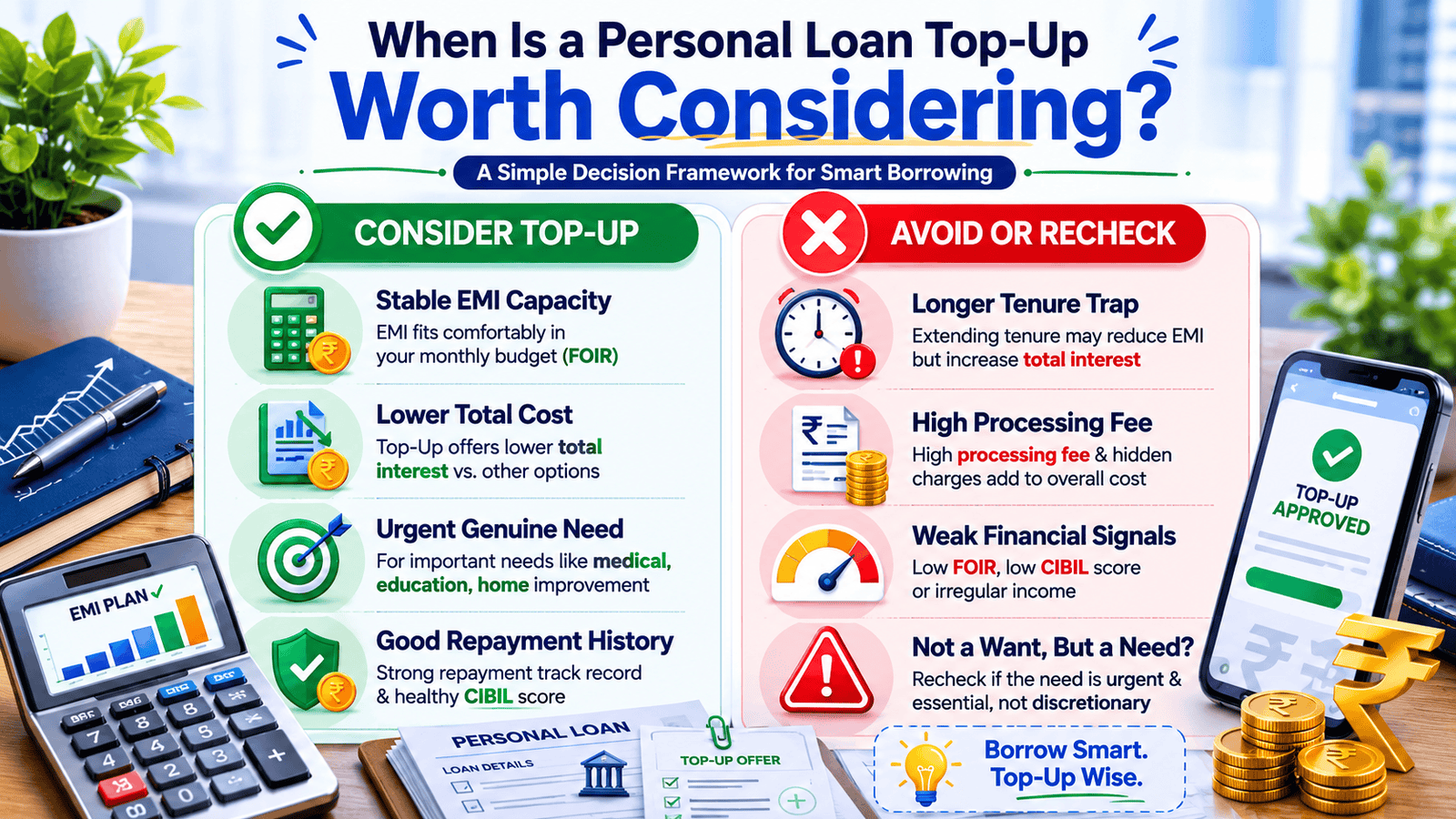
Your existing EMI is manageable, the need is genuine (medical, urgent repair, education fee), the revised total interest is lower than or comparable to alternatives, and the processing fee is minimal — a top-up can make practical sense.
Another lender can offer you a fresh personal loan at a materially lower interest rate and you have a clean credit profile — compare both options before accepting the top-up. The documentation effort may be worth the savings.
Your existing loan rate is high and you can find a lender offering a significantly lower rate — a balance transfer may reduce your overall interest burden more effectively than a top-up from the same lender.
You carry credit card debt at 36–42% interest and a top-up or fresh personal loan comes at 13–16%, the interest saving is real — but only if you close the card balance immediately and do not rebuild it.
Your FOIR is already above 45–50%, or your income has recently become unstable, or the need is discretionary — avoid additional borrowing until your repayment capacity improves. A pre-approved offer does not mean it is the right time to borrow.
You have already taken one or two top-ups without a clear repayment plan — each cycle of additional borrowing extends your debt timeline and increases the total interest you pay. Pause and review your overall debt position before adding more.
Common Mistakes to Avoid with a Personal Loan Top Up
Deciding based on the revised EMI alone
The monthly EMI is only one number. If the tenure has been extended to keep the EMI low, the total interest you pay over the loan period can be significantly higher than a shorter, higher-EMI alternative.
Always ask your lender for the full repayment schedule and total repayment amount before signing.
Ignoring the tenure extension trap
A top-up merged into your existing loan at a longer tenure means you are paying interest on a larger amount for more months. Even a small rate difference of 1–2% compounded over an additional 12–24 months can add ₹10,000–₹30,000 or more to your total repayment (illustrative — verify for your own loan).
If you can repay the top-up within the original remaining tenure, the total cost impact is usually lower.
Missing the processing fee and insurance add-on
Processing fees, GST on fees, and bundled insurance products (credit shield, life cover, or job loss cover linked to the loan) are sometimes added to the disbursed top-up amount or charged upfront. These are real costs that reduce your effective borrowing and increase your total obligation.
Ask specifically: Is any insurance being bundled? Is it mandatory? What is the premium? What does it cover?
Using a top-up for lifestyle expenses or non-essential spending
A vacation, a new gadget, or home décor upgrades are not emergencies. Borrowing at 13–16% reducing-balance interest for discretionary spending means you pay a premium for items that lose value quickly.
Limit top-up borrowing to genuine, time-sensitive needs with a clear repayment plan.
Applying with multiple lenders simultaneously to compare top-up offers
Every formal application triggers a hard enquiry on your CIBIL report. According to TransUnion CIBIL (transunioncibil.com), multiple hard enquiries in a short period can reduce your credit score temporarily and signal credit-hungry behaviour to lenders.
Check pre-approved offers — which use soft enquiries — before submitting formal applications at multiple places.
Treating a pre-approved top-up as urgency-free money
Pre-approved means the lender believes you are likely to qualify — it does not mean the terms are locked, the rate is the best available, or that borrowing is the right decision for your current situation.
Pre-approved offers have expiry windows and the final rate/terms are confirmed only at disbursement. Read the full offer letter before acting.
When This May Not Be the Right Choice
A personal loan top up is not right for every borrower, even if the lender approves it. Consider carefully if any of the following describe your situation.
Your existing EMI is already stretching your monthly budget — adding ₹1,000–₹3,000 more per month may not look large in isolation, but over 36–48 months it creates sustained financial pressure, especially if income is variable or expenses are rising.
You have missed one or more EMIs in the recent past. Most lenders will decline a top-up in this case — but if a lender does offer one despite a recent missed payment, review the terms very carefully. The rate may be unfavourable and the urgency of the offer may not be in your interest.
Your income has recently changed — a job switch with a probation period, a business downturn, or loss of a secondary income source all reduce your effective repayment capacity even if last month’s salary slip looks fine.
The money is for discretionary spending — travel, celebrations, or consumer goods — where the borrowing cost is higher than the value delivered.
You have already consolidated credit card debt through a top-up once, but the credit card balance has built up again. This pattern suggests the root cause is spending behaviour, not a one-time shortfall — a second top-up for the same purpose does not fix the underlying issue.
If any of these apply to your situation, it may be worth exploring other options before committing.
Official Rules and Where to Verify
Before accepting any personal loan top-up offer, verify the following from primary sources — not from third-party comparison websites or the lender’s marketing material.
- RBI (rbi.org.in): For regulated lending norms, the Fair Practices Code for lenders, digital lending guidelines, Key Fact Statement requirements, and the Integrated Ombudsman Scheme for complaint escalation. RBI does not set individual loan rates or approve specific loan products — it regulates the institutions behind them.
- TransUnion CIBIL (transunioncibil.com): For your current credit score, full credit report, hard enquiry log, and outstanding loan balances. You are entitled to one free credit report per year from each bureau. Checking your own report is a soft enquiry — it does not affect your score.
- Your lender’s official website or branch: For current interest rates, processing fee structure, minimum EMI history required, tenure options, foreclosure and prepayment charges, and required documents. Use HDFC Bank (hdfc.bank.in), SBI (sbi.co.in), ICICI Bank (icicibank.com), Axis Bank (axisbank.com), Bajaj Finance (bajajfinserv.in), or whichever is your lender — only the official site, not a screenshot or third-party listing.
- Sanction letter and KFS: Before disbursement, your lender must provide a sanction letter and Key Fact Statement. Read both. The KFS must state the APR, total amount payable, all charges, and the repayment schedule. If it is missing or vague, ask for it before signing anything. Check the minimum CIBIL score requirements from your lender directly, as these thresholds are not published uniformly and can change.
Rules, rates, and charges on this topic can change with RBI policy or lender updates. Always verify current figures directly from the official source or the lender before making any borrowing decision.
Expert Tips
- Ask for the total repayment figure, not the EMI: When the lender presents the top-up offer, ask them to show you the full repayment schedule and total amount payable. A ₹1,00,000 top-up at 14% over 48 months costs meaningfully more in total interest than the same amount over 24 months — the EMI is higher in the shorter option, but the total outflow is lower.
- Compare at least one fresh personal loan rate before saying yes: Check a competing lender’s current personal loan rate — even a 1.5–2% difference on ₹1,00,000 over 36 months can mean ₹3,000–₹5,000 in total savings. The documentation is more work, but the savings can be real.
- Decline bundled insurance unless you genuinely need it: Credit shield or loan protection insurance bundled into a top-up may not provide meaningful coverage for your actual risk profile. If you want life or disability cover, evaluate it separately rather than accepting a lender-linked product automatically.
- Keep your emergency fund separate from your borrowing plan: A top-up can solve a short-term cash need, but it does not replace an emergency fund. If you are borrowing repeatedly to manage cash flow gaps, building 2–3 months of expenses in a liquid fund is a more sustainable approach.
- Check foreclosure charges before you plan to prepay: If your plan is to close the top-up loan early once a cash flow improves, confirm the prepayment or foreclosure charge first. Some lenders charge 2–4% of the outstanding principal on early closure within the first 12–24 months. A high foreclosure charge reduces the benefit of prepaying early.
- Request a soft credit check first: Some lenders allow a pre-qualification or eligibility check that uses a soft enquiry — this does not affect your CIBIL score. Use this where available before committing to a full application that triggers a hard enquiry.
Frequently Asked Questions
What is a personal loan top up?
A personal loan top up is an additional loan amount offered by your existing personal loan lender, on top of your current outstanding balance. It is available to borrowers with a satisfactory repayment record and is typically processed with less documentation than a fresh loan application.
When should I take a personal loan top up?
A top-up can make sense when you have a genuine, time-sensitive financial need — such as a medical expense, urgent home repair, or consolidating expensive credit card debt — and when the revised total interest and charges are lower than or comparable to alternatives like a fresh personal loan. Avoid it for discretionary or lifestyle spending.
Is a personal loan top up better than a new personal loan?
Not always. A top-up is faster and needs less documentation. But if a competing lender offers a materially lower interest rate on a fresh loan, the total cost of the fresh loan may be lower even after accounting for documentation and processing time. Compare the total repayment amount — not just the EMI — before deciding.
Does a personal loan top up affect my CIBIL score?
Yes. Most lenders run a hard enquiry on your credit report when you apply for a top-up. This can temporarily reduce your CIBIL score by a few points. The additional loan amount also increases your total outstanding debt, which affects your credit profile. According to TransUnion CIBIL (transunioncibil.com), consistent on-time repayments after the top-up disbursement help rebuild your score over time.
Can I get a top up loan if I have missed EMIs recently?
Most lenders require a clean repayment record before approving a top-up. A recent missed EMI or delinquency typically disqualifies you, or results in a higher interest rate on the top-up offer. The exact policy varies by lender — verify directly with yours.
What charges apply on a personal loan top up?
Common charges include a processing fee (usually a percentage of the top-up amount), GST on the processing fee, and in some cases an insurance premium if the lender bundles a credit protection product. Some lenders also charge a documentation fee or stamp duty. Verify all charges in the sanction letter and KFS before accepting the offer.
Can I use a personal loan top up to pay off credit card debt?
Yes, and in many cases it makes financial sense — a personal loan top-up or fresh personal loan typically carries a lower interest rate than a revolving credit card balance (which can be 36–42% annually). However, confirm that the total interest saved on the card debt genuinely exceeds the processing fee and other charges on the top-up. Also, closing the card balance and then rebuilding it again defeats the purpose.
After how many EMIs am I eligible for a personal loan top up?
This varies by lender. Many lenders require a minimum of 6 to 12 consecutive on-time EMI payments on your existing personal loan before you become eligible. Some lenders have stricter internal criteria. Verify the exact requirement with your lender — do not assume eligibility based on a pre-approved message alone.
Can I use a personal loan top up for a medical emergency?
Yes — a genuine medical emergency is one of the clearest legitimate uses of a top-up loan, especially when the expense is unexpected and time-sensitive. Check the disbursal timeline with your lender if the need is urgent. If the lender cannot disburse within the required window, also check whether a medical loan or emergency credit option from another lender is faster.
Final Verdict
A personal loan top up can be a practical option for existing borrowers who have a genuine, one-time financial need — a medical emergency, an urgent repair, or consolidating genuinely expensive debt — and whose revised EMI stays within a comfortable FOIR range. The speed and lower documentation requirement are real advantages over a fresh application.
But the core trap is clear: a lower monthly EMI does not mean a lower total cost. If the lender extends your tenure to reduce the EMI, your total interest payment over the revised loan period can be substantially higher. Always compare the total repayment amount across your top-up offer, a fresh personal loan, and where relevant, a balance transfer.
Do not accept a personal loan top up simply because it is pre-approved or because the offer expires soon. Pre-approval means the lender thinks you are likely to qualify — it does not mean the terms are optimal for your situation. Check the revised EMI against your actual monthly budget, read the KFS and sanction letter, and compare at least one alternative before signing.
Always verify the latest rates and terms from the lender or official RBI sources before applying for any loan.
This article is for educational purposes only and should not be treated as personalised financial, credit, or legal advice. Interest rates, processing fees, eligibility criteria, and loan terms vary by lender and can change with RBI policy or lender updates. Please verify current rates and terms directly with the lender or from official RBI sources, or consult a qualified professional, before applying for or accepting any loan.

Rohan writes practical personal loan guides for Indian borrowers, focusing on eligibility, EMI planning, lender charges, CIBIL impact, borrower rights, and safer borrowing choices. His writing helps readers compare options calmly, avoid costly mistakes, and understand loan terms before applying.