

Wanting to close a credit card is completely reasonable — annual fees on a card you barely use, or the temptation to overspend on a second card, are real problems. But the moment most people decide to close a card, a new worry sets in: will this damage my CIBIL score? The fear is valid, but it is usually misunderstood. Closing a credit card is not a negative mark on your CIBIL report. The real risks come from three specific places: unpaid dues that attract interest or late charges, a jump in your credit utilisation ratio once the card’s limit is removed, and wrong reporting by the issuer after closure. This article gives you a step-by-step checklist to close a card correctly, avoid those three risks, and verify your CIBIL report afterward.
Quick Answer: How to Close a Credit Card Without Hurting CIBIL
How to close a credit card without hurting CIBIL starts with a six-step checklist: clear full dues, cancel EMIs and autopay, redeem rewards, check credit utilisation ratio, submit closure through the issuer’s official channel, and verify the card status in your CIBIL report later. Avoid settlement, overdue balance, or unclear closure confirmation.
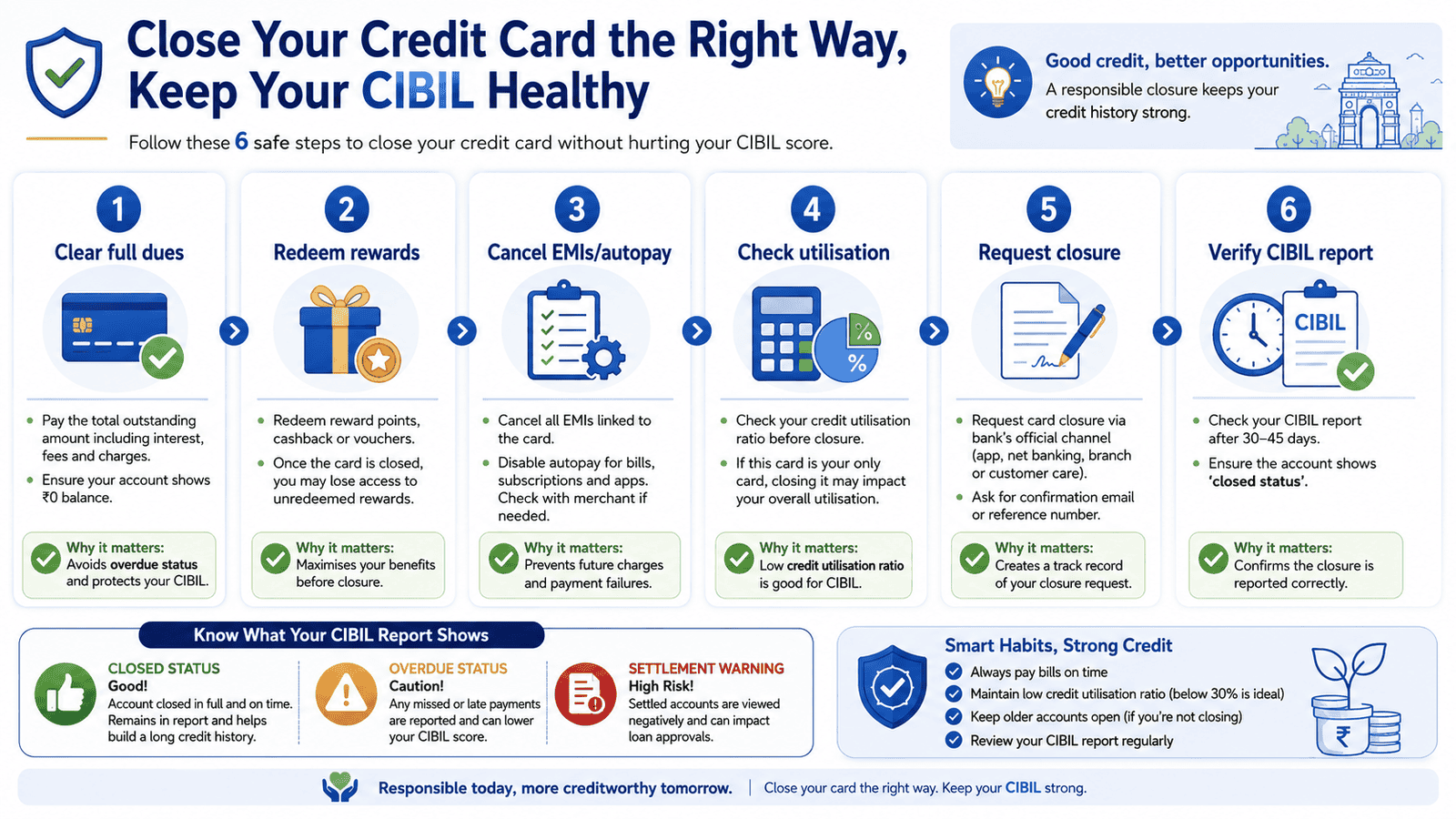
Before Closing: The Pre-Closure Checklist
- Clear the total outstanding balance — not just the minimum amount due. Any unpaid amount after closure can be reported as overdue and will damage your credit score. Check your statement for interest accrued, late charges, and any unbilled EMIs.
- Confirm there are no active credit card EMIs on this account. If you converted a purchase to a card EMI, it must be foreclosed or fully paid before closure. An active EMI on a closed card can create billing confusion and overdue reporting. Learn about billing cycle basics to understand when new charges can appear after your request.
- Cancel or transfer all autopay and subscription links. Streaming services, utility bills, insurance premiums — any auto-debit mapped to this card will fail after closure. Merchants may report failed payments independently. Move every recurring instruction at least one full billing cycle before requesting closure.
- Check and redeem your reward points. Most issuers cancel unredeemed points at closure. Redeem for statement credit, vouchers, or cashback before submitting the request. Verify the current redemption policy directly with your card issuer, as reward expiry rules vary.
- Wait for any pending refunds, chargebacks, or disputes to resolve. A refund processed after account closure can sometimes get stuck, requiring manual follow-up with the issuer. If a dispute is open, close the card only after it is resolved.
- Plan to get written confirmation of closure. A verbal “your request has been raised” is not proof of closure. Ask for a closure reference number, and follow up for a written acknowledgement or No Objection Certificate (NOC). This is your evidence if the card is ever wrongly reported as active.
Key Takeaways
- Closing a credit card is not the same as settling it. Settlement — where you pay less than the full amount due — creates a “Settled” remark on your CIBIL report that harms your score for years. Normal closure after paying all dues shows as “Closed” and is not a negative mark.
- Your oldest credit card and your highest-limit card need extra caution. Closing either can shorten your credit history or raise your credit utilisation ratio significantly, both of which can affect your score.
- Credit utilisation — how much of your total available credit you use — can jump sharply if you close a high-limit card. On ₹30,000 monthly spending, removing a ₹2,00,000-limit card from a ₹3,00,000 total can push utilisation from 10% to 30% (illustrative example).
- Your CIBIL report may take one issuer reporting cycle — often 30–45 days — to reflect the closed status. Check after that window, not the next morning.
- Written confirmation from the issuer is non-negotiable. If the card later appears as active or overdue in your CIBIL report, this document is your first line of evidence.
Key Facts at a Glance
| Factor | Why It Matters for CIBIL | Risk Level |
|---|---|---|
| Unpaid dues at closure | Can be reported as overdue — damages score directly | High |
| Credit utilisation ratio after closure | Removing a high limit can raise utilisation on remaining cards | Medium |
| Age of credit history | Closing your oldest account may shorten average credit age | Medium |
| Wrong reporting after closure | Card may show as “Active”, “Overdue”, or “Settled” incorrectly | High |
| Settlement vs closure | Settlement creates a harmful remark; full-payment closure does not | High |
| Active card EMIs at closure | Unconverted or running EMIs can generate unexpected dues | Medium |
Understanding your credit utilisation ratio before you close any card is one of the most practical steps you can take. It takes five minutes and tells you immediately whether closure will push your utilisation into a zone that lenders may view less favourably, as reported by TransUnion CIBIL (transunioncibil.com).
Does Closing a Credit Card Actually Hurt Your CIBIL Score?
The short answer: closing a card is not itself a negative event. TransUnion CIBIL does not treat “card closed after full payment” as a mark against you. The closed account continues to appear on your report — often for several years — and the repayment history associated with it remains visible. That history keeps working in your favour.
The indirect effects are where the real risk lives. When a card is closed, its credit limit disappears from your total available credit. If your monthly spending stays the same but your total limit drops, your credit utilisation ratio rises — and a higher utilisation ratio is one of the factors credit bureaus consider when calculating scores. Keep that number as low as possible, and ideally well below 30% of your total available credit limit.
The second indirect effect is account age. Credit bureaus weigh the age of your credit history — how long your accounts have been open, and the average age of all your accounts. An old card with a clean repayment record contributes positively to that calculation. Closing it removes that account from your active credit mix over time, which can reduce the average age of your credit history. This matters most when the card being closed is your oldest active account.
The third risk — and often the most damaging — is wrong reporting. Some issuers take time to report the closed status to bureaus, or the report may show an incorrect status such as “Active”, “Overdue”, or “Settled.” These are very different terms with very different credit implications. A “Closed” status is neutral. “Settled” is a warning sign to lenders that you paid less than the full amount owed.
Real Example: Priya’s Fee Card Decision
Priya, 34, works as a marketing manager in Bengaluru earning ₹72,000 per month. She holds two credit cards: Card A from her primary bank with a ₹1,00,000 limit and Card B from another issuer with a ₹2,00,000 limit. She spends about ₹30,000 per month across both cards combined.
Card B charges a ₹1,499 annual fee and Priya rarely uses it. She wants to close it before applying for a home loan in about eight months. Her current utilisation: ₹30,000 spent out of ₹3,00,000 total limit — that is 10%, which is considered healthy.
If Priya closes Card B now, her available limit drops to ₹1,00,000. Her same ₹30,000 monthly spending would now represent 30% utilisation — three times higher than before. For someone planning a home loan application, that shift matters. Rather than closing the card immediately, Priya could request a downgrade to a no-fee variant, reducing her annual cost while keeping the limit intact. Or she could wait until after the loan is sanctioned before closing Card B. Both options protect her credit position better than an immediate closure.
All figures above are illustrative. Your actual utilisation impact depends on your total available limit and spending pattern.
How to Calculate Your Utilisation Before and After Closure
Credit Utilisation Ratio = (Total Outstanding Balance ÷ Total Credit Limit) × 100
Where: Outstanding Balance = total amount spent and unpaid across all cards | Credit Limit = sum of all active card limits
Before and After Closure — Illustrative Example
| Scenario | Total Limit | Monthly Spend | Utilisation |
|---|---|---|---|
| Before closure (two cards) | ₹3,00,000 | ₹30,000 | 10% |
| After closing ₹2,00,000 limit card | ₹1,00,000 | ₹30,000 | 30% |
| After closing ₹1,00,000 limit card instead | ₹2,00,000 | ₹30,000 | 15% |
These figures are illustrative examples only — not thresholds set by any bureau or regulator. The credit bureau reporting cycle and individual score impact will vary.
Close, Keep, or Downgrade — Which Option Suits You?
| Option | Best Suited For | CIBIL Risk |
|---|---|---|
| Close the card | Cards with annual fees, low limit, and multiple other active cards keeping utilisation low | Medium — check utilisation first |
| Keep with zero balance | Oldest card, highest-limit card, or any card where closure would push utilisation above 30% | Low — history and limit preserved |
| Downgrade to no-fee card | Annual fee is the only problem — issuer offers a free or lower-tier variant | Low — limit and history continue |
| Increase limit on another card first | Before closing a high-limit card, offsetting the limit loss on a remaining card | Lower — buffer built before closure |
One important warning: if the issuer ever suggests “settling” the account — meaning you pay a negotiated lower amount instead of the full outstanding — do not accept this to avoid dues. A settled vs closed status on your CIBIL report are not the same thing. Settlement marks your account as one where the lender accepted less than owed, and that remark stays visible to every future lender you approach.
What to Do If the Card Is Not Closed Properly or CIBIL Shows Wrong Status
Step 1 — Contact the issuer’s grievance channel
If the card is still showing as active weeks after your closure request, start with the issuer’s official customer care or grievance officer. Provide your closure request number and any acknowledgement you received. Ask for a written confirmation of the closure date and the date the status will be reported to credit bureaus.
Step 2 — Check the final statement
Request or download the final statement issued after closure. Confirm the outstanding balance is zero and that no new charges, interest, or EMIs have appeared. This statement is your primary document if a dispute arises.
Step 3 — Read your CIBIL report carefully
After one full bureau reporting cycle (allow approximately 30–45 days — verify the current timeline with TransUnion CIBIL at transunioncibil.com, as reporting timelines can change), pull your credit report. Find the account and check the status field. The correct status is “Closed.” Any other status — “Active”, “Overdue”, “Written-Off”, or “Settled” — is incorrect and needs correction.
| Status Shown | What It Means | Action Needed |
|---|---|---|
| Closed | Account fully paid and correctly reported as closed | No action needed |
| Active | Account still showing as open — issuer may not have reported closure yet | Wait one more cycle; then raise dispute with bureau |
| Overdue | Bureau shows an unpaid amount — may be a reporting error or genuinely missed dues | Verify with issuer immediately; clear any balance; raise dispute |
| Settled | Issuer reported that less than full amount was accepted — harmful remark | Dispute with bureau and issuer urgently; provide full-payment proof |
| Written-Off | Issuer has classified the account as a loss — very damaging to score | Contact issuer to resolve outstanding amount; dispute bureau entry with payment proof |
Step 4 — Raise a dispute with the credit bureau
If the status is wrong, raise a formal dispute through TransUnion CIBIL’s dispute portal at transunioncibil.com. Submit your closure acknowledgement, final zero-balance statement, and any NOC from the issuer as supporting documents. If you need guidance on the process, the article on wrong CIBIL entry correction explains the full dispute route.
If the Bank Does Not Close the Card
| Problem | First Step | Next Escalation |
|---|---|---|
| No closure confirmation after request | Call/write to official customer care with request reference number | Escalate to issuer’s Grievance Redressal Officer |
| Annual fee charged after closure request | Request reversal in writing with closure date proof | Escalate to Grievance Officer; then RBI Banking Ombudsman (rbi.org.in) |
| Card still “Active” in CIBIL 60 days after closure | Obtain NOC from issuer; then raise bureau dispute | Follow up directly with TransUnion CIBIL dispute portal |
Safety Checklist: What Not to Do Before or During Closure
Do not close the card with any unpaid balance remaining
Even a small outstanding amount — interest charges, a late fee, or an unbilled transaction — can be reported as overdue after closure. This is the most common cause of a CIBIL score drop after card cancellation. Always request a current outstanding amount before submitting the closure request, and pay in full. Read about late payment CIBIL impact to understand exactly what happens when dues are missed.
Do not ignore the final statement
Issuers often generate one more billing cycle after the closure request is raised. This final statement can include interest accrued up to the closure date, annual fee pro-ration, or unbilled EMI tranches. Ignoring it leaves you with a balance you did not know existed — and which can become overdue silently.
Do not treat a verbal confirmation as closure
A call-centre agent telling you “your card has been cancelled” is not legal proof. The account is only formally closed when the issuer sends a written confirmation or NOC. Keep this document indefinitely — you may need it to dispute a wrong CIBIL entry years later.
Do not close your oldest card without checking alternatives first
If the card you want to close is your oldest active credit account, check whether the issuer offers a downgrade to a no-fee variant. Keeping the account open — even at zero balance — preserves your credit history length. Closing it permanently removes that record from your active profile over time.
Do not confuse settlement with closure
If you are struggling to pay the full outstanding amount and an issuer representative offers to accept a lower amount to close the account, understand that this is settlement, not closure. The CIBIL report will show “Settled” — a signal to future lenders that the account was not paid in full. This remark can affect your loan and credit card applications for years.
How to Decide What’s Right for You
Your card has a significant annual fee, you rarely use it, and closing it will not push your utilisation above 30% — closing is sensible and unlikely to cause meaningful CIBIL impact.
The annual fee is the only problem and the issuer offers a lifetime-free or lower-tier variant — downgrade first. You keep the limit and the account history without paying a fee.
Closing this card would raise your utilisation significantly — consider increasing the limit on your remaining card before closing. An increase card limit on an existing card can offset the credit limit reduction, keeping your utilisation stable. Check with the card issuer whether a limit increase request would require a hard credit enquiry before applying.
You are planning a home loan, personal loan, or new credit card application within six months — delay closure until after the application is processed. A sudden rise in utilisation or a reduction in credit history strength can affect the lender’s assessment at exactly the wrong time.
This is your only active credit card — do not close it without first establishing at least one other credit account. Having no active credit card removes an important element from your credit mix.
Your utilisation is already above 20–25% and you have pending EMIs, disputes, or a refund in progress — do not initiate closure now. Resolve those items first, reduce your utilisation, and then proceed with a clean account.
Common Mistakes to Avoid
Paying Only the Minimum Amount Due
The minimum amount due is not the same as the full outstanding balance. If you pay only the minimum and request closure, the remaining balance continues to accumulate interest. The issuer may report the difference as overdue after the account is nominally closed.
Before submitting a closure request, call the issuer and ask for the exact “full outstanding amount as of today” — this number will be slightly different from what your last statement showed.
Forgetting Subscriptions and Autopay Instructions
Even one active subscription on the closed card — a streaming service, an annual insurance renewal, a utility autopay — will result in a failed payment after closure. The merchant may flag this, and the issuer may reopen or keep the account active to process the charge.
Audit every service linked to this card, update the payment method at least one full billing cycle before closure, and verify each subscription has confirmed the new card details.
Losing Reward Points at Closure
Many issuers cancel unredeemed reward points at the time of account closure. Points accumulated over months or years can disappear with no compensation. Check your reward balance, and redeem for statement credit or vouchers before submitting the closure request. Reward policies vary by issuer — verify before acting.
Closing a Card Before a Pending Refund Has Settled
If you returned a purchase or raised a dispute, the associated refund credit may still be in transit. Closing the account before the refund posts can delay the credit indefinitely and require manual follow-up. Wait until the refund appears in your statement, then proceed with closure.
Not Checking the CIBIL Report After Closure
Most people close the card and never look at the CIBIL report to confirm the status. Incorrect reporting — “Active” or “Overdue” instead of “Closed” — can sit unnoticed for months, affecting loan applications without warning. Pull your report from TransUnion CIBIL (transunioncibil.com) after one issuer reporting cycle and verify the account status.
When This May Not Be the Right Choice
It is your only credit card. Without any active card, your credit mix becomes thinner and future lenders have less repayment history to assess. Establish a second account before closing your only card.
It is your oldest active credit account. Closing a card that has been open for eight or ten years removes your longest-standing credit record from your active profile. The impact on credit history length can be meaningful, particularly for younger borrowers with shorter overall histories.
It carries your highest credit limit. If this card represents more than half your total available credit, closure will substantially raise your utilisation on whatever cards remain — even without changing your spending at all.
You have a major loan application planned within six months. Any volatility in your score — even a temporary rise in utilisation — is best avoided when a lender is about to pull your credit report.
You have a pending EMI, dispute, chargeback, or refund on this account. Closing the account before these resolve creates billing and reporting complications that require time-consuming follow-up.
If any of these apply to your situation, it may be worth exploring other options before committing.
Official Rules and Where to Verify
- Card issuer’s official website — verify the exact closure process, authentication steps, forms required, charges (if any), and the confirmed timeline for written acknowledgement. Every issuer handles closure slightly differently, and processes can change.
- TransUnion CIBIL — transunioncibil.com — to check your credit report, verify account status after closure, understand how long a closed account remains on your report, and raise a dispute if the reported status is incorrect.
- Credit bureau dispute portal — each bureau (TransUnion CIBIL, Experian, Equifax, CRIF High Mark) has its own dispute submission process. Verify the current dispute steps directly from the bureau’s official site before raising a complaint.
- RBI — rbi.org.in — for banking grievance escalation if the issuer fails to close the account or resolve a complaint within their internal process. The RBI Banking Ombudsman handles complaints against scheduled banks.
Card fees, interest rates, billing rules, and issuer closure timelines can change by issuer. Always verify the latest terms from the card issuer and official regulatory sources before applying or converting dues.
Expert Tips
- Take a screenshot of every step. Screenshot your closure request confirmation, your zero-balance statement, and the closed status in your CIBIL report. Store these in a folder you will not accidentally delete — they may be needed years later if a wrong entry appears.
- Download 6–12 months of statements before closure. Once the account is closed, statement access via the issuer app may be restricted or removed. Download your statements as a general record-keeping measure before the account is deactivated. This is a suggested practice, not a regulatory requirement.
- If the annual fee is the only problem, try downgrading first. Call the issuer and ask whether a no-fee or lower-fee variant of your card is available. A downgrade converts your existing account to the new variant — preserving the account age and credit limit — without closing anything.
- Keep a card with zero balance if it costs you nothing. If an existing card has no annual fee and you are not using it, leaving it open at zero balance is often better for your utilisation ratio than closing it. A card that costs nothing and is never misused is a passive credit score tool.
- Check your report after the next issuer reporting cycle — not the next day. Issuers report to credit bureaus on a cycle, typically monthly. The closed status will not appear instantly. Give it a full cycle — approximately 30–45 days — before you assess the impact. Verify the current reporting cycle with TransUnion CIBIL, as these timelines can change.
Frequently Asked Questions
Does closing a credit card reduce my CIBIL score?
Closure itself is not a negative event. Your score may be affected indirectly if your credit utilisation ratio rises because the card’s limit has been removed, or if your credit history shortens because you closed an old account. The impact depends on your overall credit profile — how many other active accounts you have, your total remaining limit, and your monthly spending pattern.
Should I close my oldest credit card?
Approach this with caution. Your oldest card contributes to your credit history length and credit mix. If it has no annual fee, keeping it open at zero balance is usually the safer choice. If it does carry a fee, ask the issuer about downgrading to a no-fee variant before choosing full closure.
Is it better to close an unused credit card or keep it?
If the card has no annual fee, keeping it open typically helps more than closing it — it supports your total available limit and credit history without costing you anything. If the card charges a fee that is not justified by any benefit to you, and closing it will not significantly raise your utilisation, closure is reasonable after completing the pre-closure checklist.
Can I close a credit card with an EMI pending?
You should not. An active card EMI — from a purchase you converted to monthly instalments — is a running obligation on that account. Before closure, either foreclose the EMI by paying the outstanding principal (check if a foreclosure charge applies) or ensure all instalments are cleared. Attempting closure with an active EMI can create billing disputes and incorrect overdue reporting. Verify the current foreclosure terms directly with your card issuer.
What happens to reward points after credit card closure?
Most issuers cancel unredeemed reward points at the time of account closure. A few may allow a short window for redemption after the request is raised, but this varies by issuer and programme. Check your reward balance and redeem before submitting the closure request. Verify the current reward expiry policy with your card issuer before acting.
How long does it take for a closed card to reflect in my CIBIL report?
Issuers report to credit bureaus on a cycle — typically monthly. After the issuer confirms closure, the updated status may appear in your CIBIL report within approximately 30–45 days. Verify the current reporting cycle directly with TransUnion CIBIL at transunioncibil.com, as timelines can vary.
What should I do if CIBIL shows my closed card as still active?
First, confirm the closure date and request a written NOC from the issuer. Then raise a dispute through the TransUnion CIBIL dispute portal with your closure acknowledgement and zero-balance statement as supporting documents. If the issuer disputes the correction, escalate through their internal grievance process. For the full dispute process, the guide on wrong CIBIL entry correction walks through each step.
Is settlement the same as closure?
No — these are two very different outcomes with different credit implications. Closure after full payment shows as “Closed” in your CIBIL report, which is neutral. Settlement — where the issuer agrees to accept less than the full amount owed — shows as “Settled,” which signals to future lenders that the debt was not fully honoured. Settlement can affect your ability to get loans and new credit cards for years. Never agree to settlement as a way to avoid dues if you can pay in full.
Final Verdict
Knowing how to close a credit card without hurting CIBIL comes down to three things: clearing every rupee owed before the request, checking your credit utilisation ratio before and after, and getting written confirmation that the account is closed. Closing is genuinely safe if the card has no remaining dues, your other cards keep utilisation low, and the issuer correctly reports the closed status. The most common source of avoidable harm — a “Settled” or “Overdue” entry on your CIBIL report — is almost always preventable with a little groundwork.
If this card is your oldest account or your highest-limit card, spend five minutes checking whether a downgrade is available before choosing full closure. And once the card is closed, pull your CIBIL report after one reporting cycle to confirm the status field reads “Closed.”
Always verify the latest fees, interest rates, billing rules, and reward terms from the card issuer before applying or using a credit card feature.
This article is for educational purposes only and should not be treated as personalised financial, credit, or legal advice. Credit card fees, interest rates, billing rules, eligibility criteria, rewards, and issuer terms can vary and may change over time. Please verify current terms directly with the card issuer, official regulatory source, or a qualified professional before applying for or using any credit card feature.

Meera Nair writes practical credit card guides for Indian users, focusing on eligibility, fees, billing cycles, reward value, UPI credit cards, EMI conversion, CIBIL impact, fraud protection, and safer card usage. She explains card decisions in simple language without pushing readers toward risky borrowing.