

Every time you apply for a personal loan, home loan, or credit card in India, the lender’s first move is almost always the same: they check your CIBIL score. Banks, NBFCs, and credit card issuers use this number as an early filter before they look at anything else. Yet most first-time borrowers have heard the term without really understanding what it means, what the number says about them, or what happens when it is low. If you have ever been told “your CIBIL score needs to be better” without anyone explaining why — or what a good score even looks like — this article is for you. It explains CIBIL score meaning, the 300–900 range, how lenders use it, and what it cannot tell you. One thing to be clear about upfront: a CIBIL score is important, but it does not guarantee loan approval on its own.
Quick Answer: CIBIL Score Explained
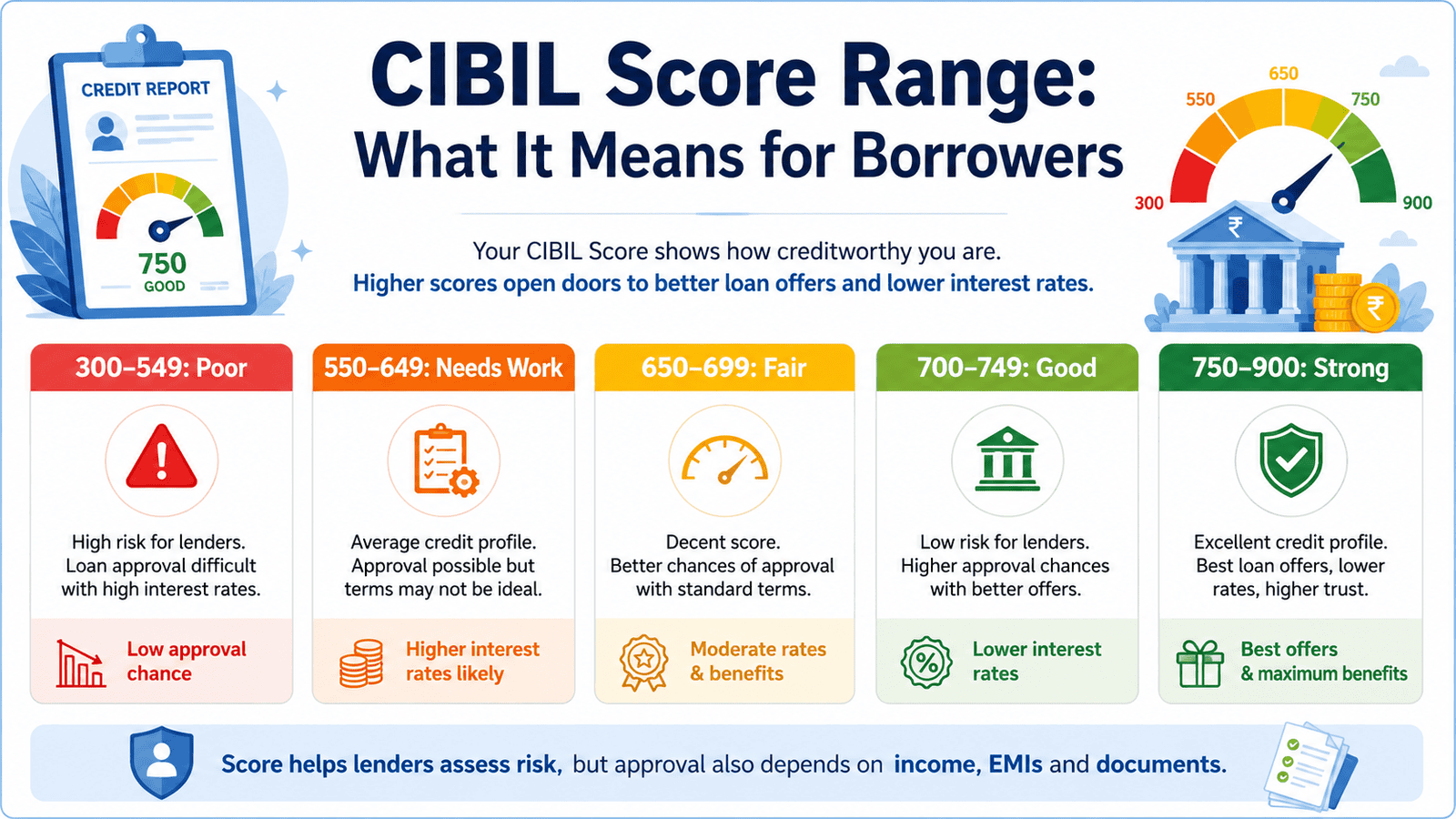
CIBIL score explained simply: it is a 3-digit credit score, usually shown in the 300–900 range, that helps lenders judge how responsibly you have handled loans and credit cards. A higher score may improve your loan-readiness, but approval also depends on income, existing EMIs, documents, and lender policy.
Key Takeaways
- Your CIBIL score is a 3-digit number between 300 and 900, calculated by TransUnion CIBIL using lender-reported data on how you have repaid loans and credit cards — it is not based on your income or bank balance.
- The score reflects your repayment history, credit utilisation ratio, loan and card mix, length of credit history, and the number of recent hard inquiries made by lenders on your profile.
- A higher score may improve your chances of approval and may help you qualify for better interest rate offers, but no score guarantees a loan — lenders also check income, FOIR, documents, employer profile, and internal credit policy.
- The CIBIL score is just a summary number; the CIBIL report behind it contains your full credit history, including DPD records, settled accounts, written-off entries, and active/closed loan details — both need to be reviewed before applying.
- Applying to multiple lenders at once without checking your score first can create multiple hard inquiries on your report, which may make you look credit-hungry and could affect future approval chances.
Key Facts at a Glance
| Item | Detail | Borrower Note |
|---|---|---|
| What it is | A 3-digit credit score calculated by TransUnion CIBIL | Based on lender-reported credit behaviour, not income |
| Score range | 300 to 900 | Higher is generally better; lender cutoffs vary |
| Who calculates it | TransUnion CIBIL (transunioncibil.com) | Three other bureaus — Experian, CRIF High Mark, Equifax — also generate scores |
| Who checks it | Banks, NBFCs, credit card issuers | Each lender may weigh it differently alongside other factors |
| What it does not prove | Income, net worth, or guaranteed loan eligibility | A strong score is a good signal, not an approval certificate |
| Update frequency | Usually updated monthly as lenders report to the bureau | Changes in repayment behaviour take time to reflect |
To understand what score band you fall into and what lenders generally look for, see our guide on good score for loans.
CIBIL Score Range: 300 to 900 Explained
| Score Range | General Meaning | What to Check | Approval Caution |
|---|---|---|---|
| 300–549 | Poor — reflects significant repayment problems | Missed EMIs, defaults, settled or written-off accounts, DPD records | Most lenders will be very cautious; high-cost options carry risk |
| 550–649 | Below average — may indicate past stress or early credit history | Overdue status, high credit utilisation, multiple hard inquiries | Approval less likely at mainstream banks; terms may be less favourable |
| 650–699 | Fair — improving but still room to grow | Repayment consistency, card utilisation, age of credit accounts | Some lenders may approve with additional conditions or higher rates |
| 700–749 | Good — generally considered a reasonable starting point | Income, existing EMIs, and documents matter at this stage | Many lenders open; terms depend on full profile, not score alone |
| 750–900 | Strong — reflects disciplined credit behaviour over time | Keep utilisation low, avoid unnecessary hard inquiries | Better offers possible, but income, FOIR, and profile still matter |
These are general interpretations. Lender cutoffs are not published and can change based on loan type, product policy, and internal risk models. A score in one band does not guarantee the same outcome with every lender.
What Is a CIBIL Score and How Is It Calculated?
TransUnion CIBIL is one of four credit bureaus licensed by the Reserve Bank of India to collect and maintain credit information on individuals and businesses in India. The CIBIL score — formally called the CIBIL TransUnion Score — is a 3-digit number that summarises your credit behaviour based on information reported to the bureau by lenders such as banks and NBFCs.
The score is not connected to your income, savings account balance, or how much money you have in the bank. It reflects only one thing: how responsibly you have managed credit — loans and credit cards — that has been reported to TransUnion CIBIL.
What goes into the score
While TransUnion CIBIL does not publish the exact formula, the broad factors that influence the score include:
- Repayment history: Whether you have paid EMIs and credit card bills on time, or missed them. This is the most significant factor. A single missed payment can cause a visible drop, and DPD — Days Past Due — is the measure lenders look at most closely in your credit report.
- Credit utilisation ratio: This is the percentage of your total available credit limit that you are currently using. For example, if your credit card limit is ₹1,00,000 and you typically carry a balance of ₹70,000–₹80,000, you are using 70–80% of your available credit. High utilisation can signal financial stress even if you are not missing payments. Learn more in our detailed guide on credit utilisation ratio.
- Length of credit history: Longer credit history gives lenders more data to assess your behaviour. A borrower with five years of clean repayment history is typically seen as more predictable than someone with six months of data.
- Credit mix: Having a mix of secured credit (home loan, car loan) and unsecured credit (personal loan, credit card) can signal that you have managed different types of credit responsibly.
- Recent hard inquiries: Every time a lender checks your credit score as part of a loan or card application — a hard inquiry — it is recorded on your report. Too many hard inquiries in a short period can make you look credit-hungry.
- Errors or adverse entries: Settled accounts, written-off accounts, and errors in lender-reported data can negatively affect your score even if your actual behaviour has improved.
What Affects Your CIBIL Score
| Factor | Example | Borrower Risk | What to Do |
|---|---|---|---|
| Repayment history | Missing an EMI by 30+ days | High — DPD entries stay on report | Pay before due date every month without exception |
| Credit utilisation ratio | Using ₹85,000 of a ₹1,00,000 limit | Medium — looks like financial stress to lenders | Try to keep card usage well below the full limit where possible |
| Length of credit history | Closing your oldest credit card | Low to medium — shortens average account age | Keep older accounts open and active where suitable |
| Hard inquiries | Applying to five lenders in one week | Medium — multiple hard pulls can look risky | Check eligibility before applying; apply selectively |
| Adverse entries | A settled account from a past loan | High — settlement is not the same as full closure | Avoid settlement where possible; verify report accuracy |
Real Example: Same Salary, Very Different Lender Perception
Consider two borrowers — Rohit and Priya — both earning ₹42,000 per month and both working in private sector jobs in Pune. They both apply for a ₹3 lakh personal loan from the same bank in the same month. Their applications are processed almost identically on paper. But their credit profiles tell a different story.
Rohit has one credit card with a ₹50,000 limit. He uses about ₹12,000–₹15,000 each month and pays the full amount before the due date every billing cycle. He took a small consumer loan two years ago and repaid it on time. His CIBIL score, as a result, sits in a healthy range. He has no DPD entries, no settled accounts, and no excessive hard inquiries.
Priya earns the same ₹42,000. But she has been carrying a high balance on her credit card — around ₹45,000 on a ₹50,000 limit — for several months, and has paid only the minimum amount due twice in the past six months. She applied to four lenders last month after an earlier rejection. Each of those applications triggered a hard inquiry. Her credit report now shows high utilisation, missed full-payment behaviour, and multiple recent inquiries.
The bank’s credit officer sees two very different profiles despite identical salaries. Rohit’s repayment behaviour reduces perceived risk. Priya’s profile raises questions that the bank will need to weigh carefully. These are illustrative examples only — lender decisions depend on income, existing EMI burden, documents, employer category, and internal credit policy, not just the score. Outcomes are not guaranteed either way.
What Lenders May Check Along with CIBIL Score
A lender’s decision is almost never based on CIBIL score alone. Think of the score as a screening tool — it helps lenders decide whether to look further. Once your application passes that initial screen, the full credit profile and other eligibility factors come into play.
- CIBIL score and full CIBIL report: Not just the number — the report details matter. DPD entries, settled accounts, open loan count, and written-off entries are all visible to the lender.
- Income and employment stability: Salaried borrowers from listed or recognised companies may be viewed more favourably than those in unorganised employment. Self-employed applicants may face additional income-proof requirements.
- FOIR — Fixed Obligation to Income Ratio: FOIR measures what percentage of your monthly income is already committed to existing EMIs. A borrower earning ₹42,000 with existing EMIs of ₹25,000 has very limited room for a new loan, regardless of credit score. Most lenders want FOIR to remain below a threshold — often around 40–50% — though this varies by lender and product.
- Documents: PAN card, address proof, income proof (salary slips or ITR), and recent bank statements are typically required. Gaps or inconsistencies in documents can cause rejections that have nothing to do with CIBIL score.
- Lender-specific policy: Each bank and NBFC runs its own credit models. A score that qualifies for one lender may not qualify for another. Lender appetite for risk can also shift with market conditions.
Understanding Credit Utilisation: A Practical Example
Credit utilisation ratio is the percentage of your total credit card limit that you are currently using. It is one of the factors that can influence your CIBIL score and how lenders read your profile.
Credit Utilisation Ratio = (Total Outstanding Balance ÷ Total Credit Limit) × 100
Where: Total Outstanding Balance = current amount owed across all credit cards | Total Credit Limit = sum of all credit card limits
Illustrative example: If your credit card has a limit of ₹1,00,000 and your outstanding balance is ₹80,000, your utilisation ratio is 80%. Even if you have not missed a payment, this high utilisation can signal to lenders that you are heavily reliant on available credit. Many credit professionals suggest keeping utilisation well below your full limit — though the exact impact on scores varies and no fixed number can be guaranteed to improve or worsen your score by a specific amount. This is illustrative only; actual credit score impact depends on your full credit profile and bureau methodology.
CIBIL Score vs CIBIL Report: Key Comparisons
India has four credit bureaus licensed by RBI — TransUnion CIBIL, Experian India, CRIF High Mark, and Equifax India. Each generates its own credit score for borrowers, so your score may differ slightly across bureaus depending on the data each has received. For a closer look at this difference, see our guide on score versus credit score.
| Item | What It Shows | Why It Matters | Borrower Action |
|---|---|---|---|
| CIBIL Score | A single 3-digit summary number between 300 and 900 | Used as a quick screening tool by lenders | Check where you stand before applying for credit |
| CIBIL Report | Full account-by-account history: loans, cards, DPD, settled status, inquiries | Contains the detail behind the score — errors here affect your score | Review the full report, not just the number, for accuracy |
| Score from other bureaus | Experian, CRIF High Mark, Equifax scores based on their own data | Different lenders may check different bureaus; scores can vary | Be aware your profile may look slightly different across bureaus |
| Hard inquiry on report | A lender’s formal credit check triggered by a loan or card application | Multiple hard inquiries in a short window can affect perception | Apply selectively; do not apply to many lenders simultaneously |
What to Do After Checking Your Score: A Practical Flow
Step 1 — Check your score and full credit report
Do not just check the number. Access your full credit report from TransUnion CIBIL at transunioncibil.com or from one of the other bureaus. RBI rules allow you to access your credit report once a year for free from each bureau.
Step 2 — Review every section of the report carefully
Look at active loans, closed loans, DPD (Days Past Due) entries, overdue accounts, any accounts marked “settled” or “written off,” and recent hard inquiries. Each of these tells a lender something specific about your credit behaviour.
Step 3 — Raise a dispute if you find an error
If a loan you have already repaid is showing as overdue, or if a hard inquiry appears that you did not authorise, raise a dispute with TransUnion CIBIL directly at transunioncibil.com. Lenders are obligated to correct verified errors. This process takes time, so start early before applying.
Step 4 — Compare eligibility before submitting applications
Once you understand your score and report, compare your profile against lender eligibility criteria before submitting formal applications. Many lenders now offer soft eligibility checks that do not trigger hard inquiries. Applying only where you realistically fit reduces the risk of hard-inquiry accumulation.
CIBIL Score Safety Checklist: Before You Apply
- Do not apply to multiple lenders at once. Each formal application triggers a hard inquiry. A cluster of hard inquiries in a short window is visible to lenders and may raise concerns about your financial situation.
- Do not ignore errors in your credit report. An incorrect DPD entry or an account wrongly marked as overdue can hurt your score even if your actual repayment behaviour has been clean. Check the report — not just the score.
- Do not believe services that promise guaranteed score improvement in a fixed time. Credit scores are calculated by bureaus from lender-reported data; no third-party service can directly increase your score through a shortcut. Improvement comes from behaviour, not payment to a fix service.
- Do not confuse checking your own score with a lender checking it. When you check your own score — a soft inquiry — it does not affect your score or appear as a negative entry. Only hard inquiries by lenders do.
- Do not take on new debt purely to build a score if you cannot confidently repay it. New debt that goes into default will damage your profile far more than having a thin credit history.
How to Decide What’s Right for You
Your CIBIL score is a starting point — not a final verdict. What you do with that information depends on where you stand right now.
your score is in the strong range (750–900) — check your full credit report, verify that there are no errors, and review your FOIR before applying. A strong score improves your loan-readiness but does not guarantee the offer you expect.
your score is in the fair-to-good range (650–749) — focus on repayment consistency for the next few months before applying aggressively. Paying card bills in full and avoiding unnecessary hard inquiries during this period may help stabilise your profile.
your score is below 650 — prioritise checking your credit report for errors or adverse entries. Avoid applying to multiple lenders in a short period. Address any DPD entries or overdue amounts first, and consider safer credit-building options rather than high-cost emergency borrowing.
you have no CIBIL score yet (NH or NA on the report) — this means no credit history has been reported to the bureau. Consider a secured credit option such as a credit card against a fixed deposit. Repay on time every month to start building a credit profile.
sure where your score stands — do not guess or apply blindly. Check your score free first from one of the authorised bureau websites, then decide your next step based on actual information rather than assumptions.
Common Mistakes to Avoid
Applying to multiple lenders after a single rejection
One rejection stings, and the natural instinct is to keep trying. But each new application triggers a hard inquiry on your credit report. A pattern of multiple hard inquiries within a short window signals to lenders that you are in urgent need of credit — which can actually make subsequent approvals harder, not easier.
Instead, find out why the first application was rejected, fix the underlying issue, and apply selectively to lenders where your profile realistically fits. See our guide on hard and soft inquiries for more.
Paying only the minimum amount due on credit cards
The minimum due is the smallest amount you can pay to avoid a late payment fee — it is not a substitute for full repayment. If you carry forward the remaining balance, interest charges accumulate quickly at rates that are typically far higher than personal loan rates. Over time, consistently paying only the minimum keeps your utilisation high and your interest costs elevated.
Pay the full statement amount wherever possible. If that is not feasible in a given month, pay as much above the minimum as you can.
Ignoring the closed loan section of your credit report
A loan you repaid three years ago may still show incorrect data on your report — such as a small overdue amount that was never reconciled with the lender. Many borrowers assume that once a loan is closed, it disappears from the report. It does not. Errors in closed loan records can still affect your score.
Check the full report including closed accounts, and raise a dispute if any entry looks inaccurate.
Assuming that a good salary is enough for approval
Income matters — but it is not the only factor. A borrower earning ₹80,000 per month with existing EMIs of ₹55,000 may have very little room for additional debt. The FOIR calculation can disqualify an application even when the salary seems comfortable.
Before applying, calculate your approximate existing EMI load and check whether the new EMI you are planning to add keeps you within a manageable FOIR range.
Believing instant credit score fix services
Some third-party services advertise guaranteed score improvement within days or weeks. Credit scores are calculated by bureaus using lender-reported data — no outside service can manipulate this process legally. The only way to improve a score is to change repayment behaviour over time and correct genuine errors through the formal dispute process.
Be wary of anyone who asks for payment in exchange for a score guarantee.
Settling a loan instead of fully closing it
A loan “settled” means the lender agreed to accept a lower amount than what you owed — and this distinction is recorded on your credit report. Settlement is not the same as full repayment. Lenders can see this entry and may view it as a sign that you did not honour your full obligation, which can affect future applications.
If possible, repay the full outstanding amount. If circumstances force a settlement, understand that this entry may remain on your report for years.
When CIBIL Score Alone Is Not Enough
Focusing only on your CIBIL score can give you a false sense of security — or unnecessary worry — in these situations:
When your income is unstable or your documents are weak. A strong score does not override an income verification problem. If your salary slips, bank statements, or ITR do not support the loan amount you are applying for, the application may still be declined.
When your existing EMI burden is already high. A borrower with a 780 score but an EMI load of 60% of monthly income may find that lenders are unwilling to add more debt regardless of credit history.
When there are unresolved errors on your credit report. Your score may look acceptable at a summary level while the detailed report contains DPD entries, incorrect overdue flags, or adverse account statuses that lenders will see when they pull the full report.
When you are using new debt to service old debt without a clear repayment plan. This pattern is identifiable through report data and raises serious concerns for lenders regardless of current score.
If any of these apply to your situation, it may be worth exploring other options before committing.
Official Rules and Where to Verify
Credit scores in India are generated by four credit bureaus licensed by the Reserve Bank of India. Each bureau maintains its own credit data based on information reported by lenders and produces its own score. These bureaus are the authoritative sources for your credit score and credit report.
- TransUnion CIBIL (transunioncibil.com): The most widely referenced bureau in India for personal credit scores. Check here for your CIBIL TransUnion Score and full CIBIL report.
- Experian India (experian.in): Another RBI-licensed bureau with its own credit score and report. Some lenders use Experian data in their assessment process.
- CRIF High Mark (crifhighmark.com): Active across retail and microfinance lending. Relevant for borrowers who have had microfinance loans or NBFC credit.
- Equifax India (equifax.co.in): The fourth bureau, also used by certain lenders in their credit assessment process.
Your score may differ slightly across these four bureaus depending on the data each has received from lenders. Check directly from official bureau websites rather than relying on third-party apps or aggregators for figures you plan to act on. Credit reporting rules, lender assessment methods, and bureau processes can change. Always verify current details from the relevant bureau, lender, or official regulatory source before acting.
Expert Tips
- Pay every EMI and credit card bill before the due date — not just the minimum. Repayment history is the single biggest factor in your credit score. A single missed EMI that crosses 30 days overdue creates a DPD entry on your report that lenders will see for years. Set up auto-debit or calendar reminders for every due date without exception.
- Keep your credit card balance well below the full limit. Even if you pay on time, consistently using 80–90% of your credit card limit signals financial stress to bureaus and lenders. A reasonable utilisation level is generally considered healthier for your credit profile, though the exact impact on scores varies — there is no single magic number that works for everyone.
- Avoid applying to multiple lenders in quick succession. Before submitting a formal loan or card application, check whether the lender offers a soft eligibility check. If not, research the eligibility criteria carefully and apply only where you realistically qualify. This limits hard inquiry accumulation on your report. See our guide to improve from 650 for a practical roadmap.
- Check your credit report periodically — not just before applying. Lenders can and do report incorrect data. An error caught early is easier to dispute than one discovered the day before you need a loan. Access your report from each bureau at least once a year.
- Keep older credit accounts active where suitable. Closing your oldest credit card can shorten your average credit account age, which may affect how your credit history is read. If an older card carries no annual fee and you are not using it irresponsibly, keeping it open and occasionally active can help maintain your history length.
- Understand the difference between settled and closed — and avoid settlement where possible. If you are having repayment difficulty, speak to your lender about restructuring options before agreeing to a settlement. A settled account stays on your report and is treated as a negative entry by most lenders.
Frequently Asked Questions
What is a CIBIL score in simple words?
A CIBIL score is a 3-digit number between 300 and 900 that summarises how well you have managed credit — loans and credit cards — based on data reported to TransUnion CIBIL by your lenders. It is used by banks and NBFCs as an early signal of your creditworthiness before they assess the rest of your loan application.
What is the CIBIL score range in India?
The CIBIL TransUnion Score ranges from 300 to 900. A score closer to 900 generally reflects stronger credit behaviour. Scores below 300 are typically assigned when there is insufficient credit history — these may show as NH (No History) or NA (Not Applicable) rather than a numeric score. Lender-specific cutoffs are not published and can vary by product and policy.
Is 750 a good CIBIL score?
A score of 750 is generally considered good and often falls within the range that many mainstream lenders find acceptable. However, whether it leads to approval — and at what interest rate — depends on your full profile: income, existing EMIs, FOIR, documents, employment type, and the specific lender’s internal criteria. A 750 score improves your loan-readiness; it does not guarantee a particular outcome.
Can I get a loan with a low CIBIL score?
It becomes more difficult, though not always impossible. Some NBFCs and certain loan products have more flexible criteria. However, borrowers with low scores often face higher interest rates, lower loan amounts, or stricter conditions. More importantly, if the reason for a low score is unresolved — such as an active DPD entry or a settled account — applying to many lenders simultaneously is unlikely to help and may add more hard inquiries to an already stressed profile.
Is CIBIL score the same as credit score?
CIBIL score refers specifically to the score generated by TransUnion CIBIL. “Credit score” is a broader term — it can refer to a score from any of the four RBI-licensed credit bureaus in India: TransUnion CIBIL, Experian India, CRIF High Mark, or Equifax India. Your score may differ across these bureaus. When a lender says they check your “credit score,” they are pulling data from one or more of these bureaus.
Does checking my own CIBIL score reduce it?
No. When you check your own score, it is recorded as a soft inquiry and has no effect on your credit score. Only hard inquiries — triggered by lenders when you formally apply for a loan or credit card — are visible to other lenders and are considered in your credit profile. Self-checking your score as often as you find useful is encouraged, not harmful.
Why do banks check CIBIL before giving a loan?
Your CIBIL report gives a lender a summary of how you have managed credit with other institutions — before they take on any risk themselves. It tells them whether you have a history of paying on time, whether you are already carrying significant debt, and whether there are any red flags such as defaults or settled accounts. It is one of the fastest ways for a lender to form an initial view of your repayment behaviour without knowing you personally.
Can a lender approve my loan even if my CIBIL score is average?
Some lenders do assess applicants with average scores if the income is strong, the FOIR is comfortable, the employment profile is stable, and the reason for a lower score is explainable — for example, a thin credit history rather than defaults. Lender criteria are not uniform. However, loan terms may differ, and it is worth comparing options carefully rather than applying broadly and accumulating hard inquiries.
Final Verdict
Your CIBIL score is one of the most important signals lenders look at before offering a loan or credit card in India. Understanding what the CIBIL score explained in this article means — the 300–900 range, what drives it up or down, and what it cannot tell you — is genuinely useful for any borrower preparing to apply for credit. A score in the stronger range opens more lender options and may lead to better offers. But no score number, on its own, guarantees approval. Income, FOIR, documents, employment profile, and lender-specific policy all matter too. The most responsible approach is to check both the score and the full credit report, fix any errors before applying, and apply selectively to lenders where your complete profile makes sense — not just where the score seems sufficient. Always verify your latest credit report, lender requirements, and bureau process before making a credit-related decision.
This article is for educational purposes only and should not be treated as personalised financial, credit, or legal advice. Credit scores, credit reports, lender eligibility criteria, and bureau processes can vary and may change over time. Please verify current details with the relevant credit bureau, lender, official regulatory source, or a qualified professional before making any credit-related decision.

Neha Menon writes simple, borrower-first explainers on CIBIL scores, credit reports, bureau disputes, DPD, loan settlement impact, hard inquiries, and practical credit score recovery. She focuses on helping Indian borrowers understand lender-reported data, avoid credit mistakes, and take safer next steps without false promises.