

Every time you apply for a personal loan or a credit card in India, the lender checks your credit report. And every time a friend tells you to “be careful, checking your CIBIL score will reduce it,” confusion creeps in. The truth is that not every credit check is the same — and mixing up the two types can lead you to either avoid useful self-checks out of fear or apply to five lenders in a week and quietly damage your approval chances. This article explains the difference between a hard inquiry and a soft inquiry, how each shows up on your CIBIL report, and what you should do before you apply for your next loan or credit card.
Quick Answer: Hard Inquiry vs Soft Inquiry
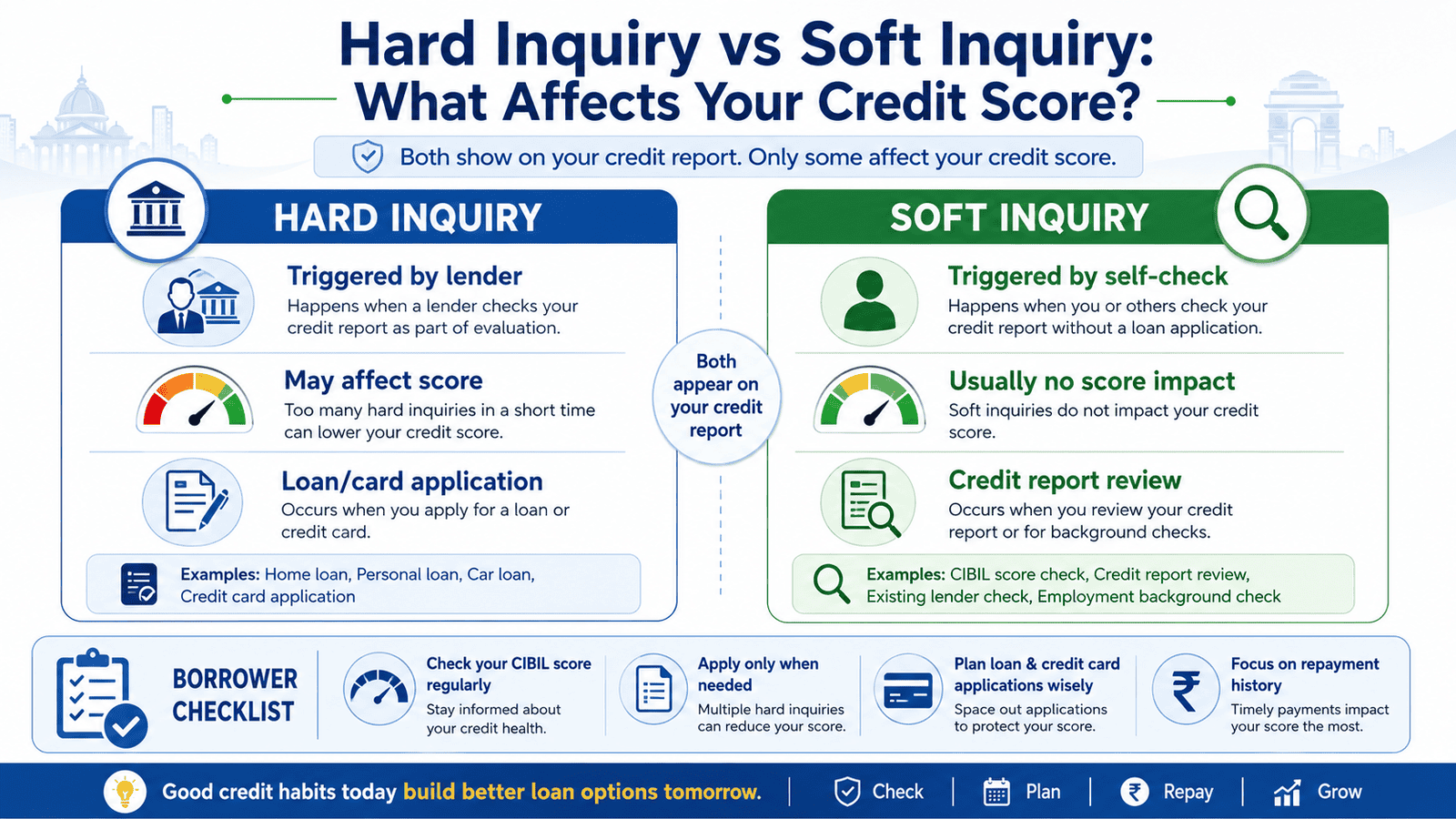
Hard inquiry vs soft inquiry means the difference between a lender checking your credit report for a loan or credit card application and you checking your own score. A hard inquiry may affect your CIBIL score, while a soft inquiry usually does not. Avoid multiple applications within a short period.
Key Takeaways
- Checking your own credit score directly through a credit bureau or trusted platform is generally a soft inquiry — it does not affect your credit score.
- When you apply for a personal loan or a credit card, the lender typically initiates a hard inquiry by pulling your full credit report from a bureau such as TransUnion CIBIL, Experian, CRIF High Mark, or Equifax India.
- Multiple hard inquiries in a short period — such as applying to four or five lenders within a month — can make you appear credit-hungry to future lenders, even if none of those applications were approved.
- Hard inquiry impact on your CIBIL score is not a fixed guaranteed number: the effect depends on your full credit profile, repayment history, existing EMI burden, and the number of recent applications.
- Checking your CIBIL report before applying gives you time to spot incorrect entries, including any inquiry you did not authorise, and raise a dispute with the bureau before the damage compounds.
- Credit score is only one factor in lender approval — income, repayment behaviour, credit utilisation, employer profile, and debt-to-income ratio all play a role alongside any inquiry count.
Hard Inquiry vs Soft Inquiry: Main Differences
| Feature | Hard Inquiry | Soft Inquiry |
|---|---|---|
| Who initiates it | Lender or financial institution | You (the borrower), or a platform with your consent for informational purposes |
| Typical Indian examples | Personal loan application, credit card application, home loan underwriting, two-wheeler loan application | Checking own CIBIL score, pre-approved offer screening, educational credit check |
| May affect credit score | Yes — possible impact | Generally no impact |
| Visible to other lenders | Usually visible in enquiry section | Generally not visible to lenders |
| Borrower consent required | Required at point of loan or card application | Consent given to check own report; not used for credit decision by others |
| Recommended borrower action | Apply selectively and only after matching eligibility | Check freely and regularly before major applications |
Key Facts at a Glance
| Borrower Action | Likely Inquiry Type | What to Know |
|---|---|---|
| Checking own CIBIL score on bureau website | Soft — checking your score this way generally does not affect your credit score | Do this regularly before applying for any loan or card |
| Applying for a personal loan | Hard — lender requests full credit report for underwriting | May be recorded in the enquiry section of your CIBIL report |
| Applying for a credit card | Hard — card issuer initiates a bureau check as part of the application | Multiple card applications in a short period can create several hard inquiries |
| Receiving a pre-approved loan or card offer | Soft — lender screens existing customers or purchased data without formal application | Receiving an offer does not mean a hard inquiry has been created |
| Using an eligibility calculator on a lender website | Varies — some are soft checks; a formal application submission is usually hard | Read the platform’s terms before submitting your PAN or consent |
What Is a Credit Inquiry in a CIBIL Report?
Your CIBIL report — and the report from any of India’s other three credit bureaus — has an enquiry section that records when a lender or other authorised entity requested your credit data. Every time you apply for a loan or credit card, your consent typically allows the lender to pull your full credit report from one or more bureaus. That pull is logged as an enquiry. Future lenders who review your report can see these entries: who asked for your data, when they asked, and for what type of product.
According to TransUnion CIBIL (transunioncibil.com), your credit report is a record of your credit history compiled from information that lenders and financial institutions report to the bureau. The enquiry section is one part of this report — it does not define your score on its own, but it contributes to how a lender reads your recent credit behaviour. A single planned application looks very different from ten lender enquiries in two months.
What Is a Hard Inquiry?
A hard inquiry — also called a hard pull or a lender-initiated credit check — happens when a financial institution formally checks your credit report as part of evaluating a credit application. In India, hard inquiries are most commonly created by:
- Personal loan applications submitted to a bank or NBFC
- Credit card applications to a bank or card issuer
- Home loan or loan against property processing
- Two-wheeler or car loan underwriting
- Business loan or gold loan applications at some institutions
A hard inquiry is recorded in the enquiry section of your credit report and may be visible to other lenders who check your report later. It reflects that you were actively seeking credit at a particular point. One well-timed hard inquiry from a planned loan application is normal. The risk rises when several hard inquiries appear in a compressed timeframe — a pattern that lenders may interpret as financial stress or credit-seeking behaviour.
What Is a Soft Inquiry?
A soft inquiry — also called a soft pull or self-check — is a credit report access that does not arise from a formal credit application. Common examples in India include:
- You checking your own credit score on a bureau website such as TransUnion CIBIL (transunioncibil.com) or Experian India (experian.in)
- A lender reviewing existing customers for pre-approved offer eligibility
- An educational or informational credit check on a personal finance platform
- Background checks that do not involve a credit decision
Soft inquiries generally do not affect your credit score and are typically not visible to other lenders in the enquiry section the way hard inquiries are. This is why borrowers are encouraged to review their own credit report regularly — it gives you a clear picture of your credit health without creating any bureau-reported risk.
How Hard Inquiries Can Affect Your Credit Score and Lender Perception
The most common question borrowers ask is: how many points will my CIBIL score drop after a loan application? The honest answer is that no bureau, including TransUnion CIBIL, publishes a fixed guaranteed score-drop figure for a single hard inquiry. Credit scores are calculated using multiple factors — repayment history, credit utilisation, credit mix, age of accounts, and recent enquiry behaviour among them. A single planned hard inquiry from one loan application may cause a small, temporary movement in your score or may cause no noticeable movement at all, depending on the strength of your overall credit profile.
What matters more in practice is the pattern. If you submit several loan applications across multiple lenders in a short span, each application can trigger its own hard inquiry. A lender who then pulls your report sees a cluster of enquiries within a short window. This may be interpreted as a sign that you are struggling to get approved or are taking on more credit than your income comfortably supports — even if you were simply comparing options. This lender perception can affect approval decisions independently of your actual credit score number.
According to information published by credit bureaus including Experian India (experian.in), the enquiry section is one input in a lender’s underwriting decision. It sits alongside repayment history, existing EMI burden, credit utilisation, and income — all of which typically carry more weight than the inquiry count alone. But a high concentration of recent enquiries can tip the balance unfavourably, especially if other parts of the profile are borderline.
Does Checking Your Own CIBIL Score Reduce It?
No. Checking your own credit score — whether directly through TransUnion CIBIL’s official website, Experian India, CRIF High Mark, or Equifax India — is generally treated as a soft inquiry and does not affect your credit score. This is one of the most persistent myths among Indian borrowers, and it leads to a harmful outcome: borrowers avoid checking their own report and then apply for loans without knowing their credit position.
You are entitled to review your credit report. In fact, doing so regularly is one of the most practical things you can do before any major loan or credit card application. Reviewing your own report helps you spot errors, unauthorised entries, or outdated negative records before a lender sees them. The credit bureaus provide official channels for borrowers to access their own reports, and bureau-direct self-checks fall within the soft inquiry category.
The confusion often arises because some third-party platforms may handle data differently or may submit a consent form that inadvertently triggers a hard check. Always read the terms before granting PAN-level consent to any platform that is not an official bureau site.
Real Example: Two Borrowers, Two Very Different Outcomes
Priya, 31, is a school teacher in Pune earning ₹42,000 per month. She wants a personal loan of ₹3 lakh to renovate her kitchen. Before applying, she logs into the TransUnion CIBIL website, pulls her own credit report as a self-check, and finds her score is 731 — a healthy starting point. She reviews the enquiry section and sees only two entries from the past two years: one from when she opened her salary account and one from a credit card she took three years ago. She shortlists two lenders whose personal loan eligibility criteria she matches, applies to one first, and waits for a response before deciding whether to try the second. Her enquiry section shows one new hard inquiry from the lender she applied to. The lender approves the loan.
Rohit, 28, is a software developer in Bengaluru earning ₹55,000 per month. He also wants a personal loan and applies to five lenders in the same week through three different aggregator platforms, thinking more applications means more chances. Within ten days, his credit report shows five new hard inquiries. Two of the lenders reject his application, noting a high number of recent credit enquiries alongside his existing two-wheeler loan EMI. The remaining approvals come with higher interest rates than Priya received. The key lesson: the number of applications did not improve Rohit’s chances — it signalled credit-hungry behaviour to underwriters who then priced the risk accordingly.
Before You Apply: Reducing Unnecessary Hard Inquiries
| Step | Why It Matters |
|---|---|
| Check your own credit report first through an official bureau website | Identifies your current score, existing enquiries, and any errors — without creating a hard inquiry |
| Review your existing EMI burden and credit utilisation | Lenders assess your debt-to-income ratio; knowing your own position helps you apply realistically |
| Shortlist one or two lenders whose stated eligibility criteria you match | Reduces the chance of multiple hard inquiries from scattered applications |
| Confirm whether a step is an eligibility estimate or a formal application | Eligibility calculators on lender websites may or may not trigger bureau pulls — read the consent language |
| Do not apply to a second lender until you know the outcome of the first | Spacing applications protects you from a cluster of hard inquiries appearing in the same window |
Application Count and Lender Perception: A Practical Illustration
Consider three scenarios involving Rohit and his ₹55,000 monthly salary in Bengaluru:
Scenario 1 — One planned application: Rohit checks his credit report, confirms a score of 720, and applies to one bank whose personal loan criteria he matches. One hard inquiry appears in his report. The lender reviews his profile holistically and approves the loan. Score impact, if any, is minimal and temporary.
Scenario 2 — Five applications in one month: Rohit applies to five lenders in three weeks. Five hard inquiries cluster in his report. Even if his score was 720 at the start, the pattern itself raises a flag during underwriting. Two lenders decline on policy grounds. The three who approve offer rates that are higher than what Scenario 1 lender offered, because the bureau data now shows recent credit-seeking behaviour layered on top of his existing two-wheeler loan.
Scenario 3 — Checking own score monthly: Rohit checks his own CIBIL score on the bureau website in January, February, and March before applying. Three self-checks. Zero hard inquiries. Zero score impact. When he finally applies in April to one shortlisted lender, only one hard inquiry appears in his report. This is the correct approach.
The point is not that any individual hard inquiry is catastrophic — it is that the pattern matters, and self-checks do not contribute to that pattern at all.
If You See an Inquiry You Did Not Authorise
Pull your credit report from the bureau and go to the enquiry section. For each entry, you should see the lender’s name, the date of the enquiry, and the product type. Work through this checklist:
| What to Check | What to Do |
|---|---|
| Do you recognise the lender name? | If yes, match it to a loan or card application you made around that date |
| Does the date match any application you submitted? | If yes, the entry is likely a legitimate hard inquiry from your own application |
| Is the product type correct? | If you applied for a personal loan but the entry says home loan, raise a query with the lender |
| Do you not recognise the lender at all? | This may be an unauthorised or erroneous inquiry — raise a dispute with the bureau |
According to TransUnion CIBIL (transunioncibil.com), borrowers can raise disputes through the bureau’s official online dispute process. Note that a genuine hard inquiry created by a lender — one you authorised at the time of application — may not be removed simply because the loan was rejected. The inquiry reflects that a check occurred, not that a loan was disbursed. If the entry is incorrect or unauthorised, the dispute process is the right route. For a full walkthrough, see the guide on raising a wrong inquiry entry in your credit report.
Borrower Safety: What to Watch Before Applying
- Do not apply to several lenders at the same time just to compare approval chances — use eligibility tools first.
- Do not submit a formal application just to “test” whether you will be approved — each submission can create a hard inquiry.
- Be cautious of platforms or apps that promise “check eligibility” but require PAN consent and submit an inquiry to a bureau without you realising it.
- Keep a record of every loan or card application you submit: the lender name, date, and product. This helps you match bureau entries later.
- Review your credit report directly from an official bureau website at least once before any major loan or card application.
- Do not respond to “guaranteed approval” claims — legitimate lenders always check your credit before approving any loan.
your credit score is healthy, you have checked your own report and found no concerning entries, and you match the stated eligibility criteria of a lender — apply to that lender. One well-timed hard inquiry from a planned application is normal credit behaviour.
you have several existing EMIs and your debt-to-income ratio is already stretched — resolve this before applying. A hard inquiry from a rejected loan adds no value and may make future applications harder.
you have applied to three or more lenders in the past 30 to 60 days — pause. Wait for responses from those applications before creating additional hard inquiries. A cluster of recent enquiries can affect lender perception even if your score number looks acceptable.
you are unsure whether an eligibility estimate will trigger a bureau check — read the consent language on the lender’s platform before entering your PAN. A soft eligibility screen and a formal application are different steps.
you have not yet checked your own credit report — do not apply for any loan or credit card yet. A self-check costs nothing, creates no hard inquiry, and may reveal errors or enquiry entries you should resolve before a lender sees your report.
Common Mistakes to Avoid
Confusing a self-check with a lender hard inquiry
Many borrowers avoid checking their own CIBIL score because they believe it will reduce their credit score. This is incorrect. Checking your own score through an official bureau is a soft inquiry and does not affect your score.
What you should do instead: review your own report on the TransUnion CIBIL or Experian India website before every major loan or card application — it gives you critical information with no downside.
Applying to many lenders simultaneously to improve approval odds
Each formal loan or credit card application can trigger a separate hard inquiry. Applying to five lenders in one week does not improve your chances — it creates five enquiry entries that lenders can see. This pattern can signal financial stress during underwriting, even if your score is otherwise healthy.
Apply to one well-matched lender at a time. If rejected, understand the reason before applying elsewhere.
Ignoring the enquiry section in your credit report
Many borrowers only look at their credit score number and skip the enquiry section of their report. An unexpected score drop can sometimes be traced to lender enquiries you did not notice or authorise. The enquiry section tells you exactly which institutions have accessed your credit data and when.
Review the enquiry section each time you pull your report and match every entry to an application you remember submitting.
Assuming a rejected loan does not create a hard inquiry
A hard inquiry is created when the lender requests your credit report — not when the loan is approved. A rejected application can still leave an enquiry in your report. Applying to several lenders and getting rejected repeatedly can create multiple hard inquiries with no benefit.
Check eligibility criteria carefully before applying and avoid applying speculatively.
Not tracking your own applications
If you apply through multiple aggregator platforms, you may not always know exactly which lenders have pulled your credit data. When you later review your bureau report, you may not be able to match entries to applications — which can make it hard to spot genuine errors.
Keep a simple log of every application: lender name, platform used, date submitted, and product type. This takes five minutes and saves significant confusion later.
Assuming a hard inquiry alone causes loan rejection
Hard inquiries are one input in lender underwriting — not the only one. Income, repayment history, existing EMI burden, credit utilisation, employer profile, and bureau-reported behaviour all matter. A borrower with an otherwise excellent profile is unlikely to be rejected solely because of one recent hard inquiry.
Address the full picture: check score, check EMI load, check repayment behaviour, then apply selectively.
When Applying for a Loan or Card May Not Be the Right Move Right Now
You may want to pause before submitting a new application if any of the following apply:
- You have already applied to three or more lenders in the past 30 to 60 days and are waiting for responses — adding more applications now increases your hard inquiry count without improving your odds.
- Your existing EMIs already consume a large portion of your monthly income — lenders calculate a fixed obligation-to-income ratio, and a high existing burden often outweighs a decent credit score.
- You have recent missed payments or a high credit card utilisation — these are read more negatively by underwriters than inquiry count alone. See the guide on loan rejection reasons for a full breakdown of what lenders flag.
- You have not yet reviewed your own credit report — you may be applying without knowing whether there are errors, outdated entries, or unauthorised inquiries in your record.
- You are planning to borrow to repay existing unaffordable debt — this can worsen your debt-to-income position and may not address the underlying repayment difficulty.
If any of these apply to your situation, it may be worth exploring other options before committing.
Official Rules and Where to Verify
Credit score calculation methods, report formats, and enquiry display rules are maintained by India’s licensed credit information companies. These are private bureaus, not government bodies, but they operate under the Credit Information Companies (Regulation) Act, 2005 and are regulated by the Reserve Bank of India. For any question about your credit report, credit score, enquiry section, or dispute process, use only official bureau sources:
- TransUnion CIBIL — transunioncibil.com — For your CIBIL score, full credit report, enquiry section, and the official dispute process. This is India’s most widely referenced bureau.
- Experian India — experian.in — For your Experian credit report and score, and for cross-checking inquiry and account information.
- CRIF High Mark — crifhighmark.com — For CRIF credit report and score data, often used by some NBFCs and microfinance lenders.
- Equifax India — equifax.co.in — For Equifax credit report and score, used by some banks and financial institutions alongside other bureaus.
To access your own report without creating a hard inquiry, go directly to the bureau’s official website. You can also get a free CIBIL report through the official bureau route. Credit reporting rules, lender assessment methods, and bureau processes can change. Always verify current details from the relevant bureau, lender, or official regulatory source before acting.
Expert Tips
- Pull your credit report before any major application — not after. Reviewing your report a few weeks before applying gives you time to raise a dispute for any incorrect entry and avoid a lender seeing an avoidable problem.
- Ask the platform or lender directly: “Will submitting this form trigger a bureau inquiry?” Many online eligibility checks are soft, but some aggregator platforms submit a formal bureau pull at the eligibility step — especially if they require your PAN and full consent upfront. Confirm before clicking submit.
- If you have been rejected once, wait and investigate before reapplying. Multiple rejections within a short period leave a visible trail of hard inquiries with no approvals attached — a combination that underwriters notice. Understand the specific rejection reason first.
- Do not assume all four bureaus show identical information. Some lenders report to only one or two bureaus. Your CIBIL score and your Experian score may differ. If a lender uses a bureau you have not checked, review that bureau’s report before applying to that lender.
- Keep credit utilisation below 30% before applying. High credit card utilisation is often read alongside inquiry count during underwriting. A borrower with a 70% utilisation and three recent hard inquiries is in a riskier position than one with 20% utilisation and one recent inquiry — even if both have similar credit scores.
- Space applications by at least 30 to 60 days where possible. This gives the first lender time to respond and keeps your recent enquiry count from clustering. There is no bureau-mandated waiting period, but lenders typically look at the enquiry pattern over the past three to twelve months.
Frequently Asked Questions
What is the difference between a hard inquiry and a soft inquiry?
A hard inquiry is a credit report check initiated by a lender or financial institution when you apply for a loan or credit card. It may affect your credit score and is typically visible to other lenders in the enquiry section of your credit report. A soft inquiry is a credit check you initiate yourself — such as checking your own CIBIL score — or a check done for informational or pre-screening purposes. A soft inquiry generally does not affect your credit score.
Does checking my own CIBIL score reduce my credit score?
No. Checking your own credit score directly through an official bureau website such as TransUnion CIBIL (transunioncibil.com) or Experian India (experian.in) is generally a soft inquiry and does not affect your credit score. You should check your report regularly — especially before applying for a major loan or credit card — so you know your credit position and can spot any errors.
Does a personal loan application create a hard inquiry?
Yes, in most cases. When you submit a formal personal loan application to a bank or NBFC, the lender typically requests your full credit report from one or more credit bureaus. This creates a hard inquiry that is recorded in your credit report’s enquiry section. Using an eligibility calculator before applying may or may not trigger a bureau check — always read the consent terms on the lender’s platform.
Does a credit card application create a hard inquiry?
Yes. Most credit card issuers in India initiate a bureau pull as part of their underwriting process when you submit a card application. Each application to a different card issuer can create a separate hard inquiry. Applying to multiple card issuers in a short period can result in several hard inquiries appearing in your report within the same window.
Can multiple hard inquiries reduce my loan approval chances?
Yes, they can — not simply because of score movement but because of lender perception. A cluster of several hard inquiries within a short period may signal to a lender that you have been actively seeking credit from multiple sources, which can be interpreted as financial stress. Lenders look at the full pattern: score, repayment history, existing EMI burden, and enquiry behaviour all together. Applying selectively and spacing applications reduces this risk.
How long does a hard inquiry stay on a credit report?
Hard inquiries may remain visible in the enquiry section of your credit report for a period of time after they are created. The exact display period can vary by bureau and their reporting practices. For the current display period applicable to your bureau, verify directly with the relevant bureau — TransUnion CIBIL (transunioncibil.com), Experian India (experian.in), CRIF High Mark (crifhighmark.com), or Equifax India (equifax.co.in).
Can I remove a hard inquiry from my CIBIL report?
A genuine hard inquiry — one created from a loan or credit card application you actually submitted — may not be removable simply because the application was rejected. The inquiry reflects that a check occurred. However, if an inquiry appears in your report for a lender you never applied to, or for a date and product type that does not match your records, that entry may be incorrect. In that case, you can raise a dispute through the bureau’s official dispute process. The bureau will contact the reporting institution to verify the entry.
Is a pre-approved loan offer a hard inquiry?
Generally, no. Pre-approved loan or credit card offers are typically based on soft screening — the lender reviews existing customer data or purchased lists without formally pulling your full credit report for an underwriting decision. However, once you accept the offer and formally apply, the lender may then initiate a hard inquiry as part of the disbursement process. Check the terms of any pre-approved offer before proceeding.
Final Verdict
Hard inquiry vs soft inquiry is a distinction that directly affects both your credit score and your loan approval chances. Checking your own CIBIL score is generally a soft inquiry — do it freely and regularly, especially before applying for any loan or credit card. A lender-initiated check when you submit a formal loan or credit card application is a hard inquiry — it may affect your score and is visible to other lenders, so apply selectively and only after confirming you match the stated eligibility criteria. Multiple hard inquiries in a short window can look risky to underwriters even if your credit score number is healthy. The safest path is simple: review your own report first, shortlist well-matched lenders, apply to one at a time, and space applications where possible. If you find an inquiry you do not recognise, use the bureau’s official dispute process. Always verify your latest credit report, lender requirements, and bureau process before making a credit-related decision.
This article is for educational purposes only and should not be treated as personalised financial, credit, or legal advice. Credit scores, credit reports, lender eligibility criteria, and bureau processes can vary and may change over time. Please verify current details with the relevant credit bureau, lender, official regulatory source, or a qualified professional before making any credit-related decision.

Neha Menon writes simple, borrower-first explainers on CIBIL scores, credit reports, bureau disputes, DPD, loan settlement impact, hard inquiries, and practical credit score recovery. She focuses on helping Indian borrowers understand lender-reported data, avoid credit mistakes, and take safer next steps without false promises.