
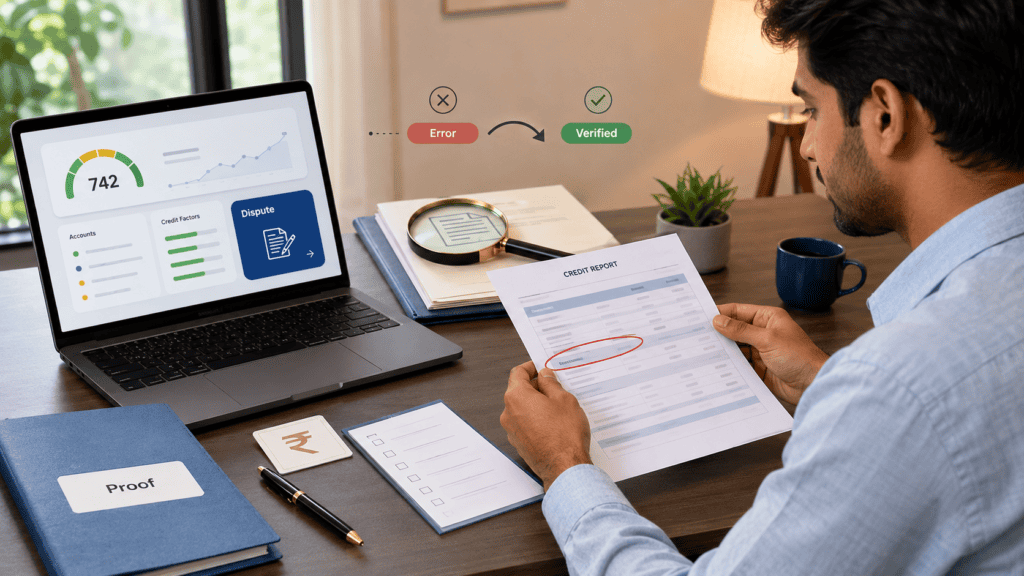
A wrong entry in your credit report can quietly damage your chances of getting a loan or credit card approved — even if you have never missed a payment in your life. Lenders reviewing your application may see an incorrect overdue amount, a DPD marker you never earned, or a loan account you never opened. The credit report dispute process in India exists specifically to fix these errors. But correction is not automatic, and the bureau cannot always act without the lender’s input. This article walks you through exactly how to identify an error, collect the right proof, raise a dispute with the correct bureau, follow up with your lender, and escalate the issue if it is not fixed — step by step, without false promises.
Quick Answer: Credit Report Dispute Process in India
The credit report dispute process in India starts with downloading your latest report, identifying the exact wrong entry, collecting proof, raising a dispute with the relevant bureau, and following up with the lender if needed. A wrong ₹5,000 overdue or DPD entry can affect loan review, but correction is not guaranteed.
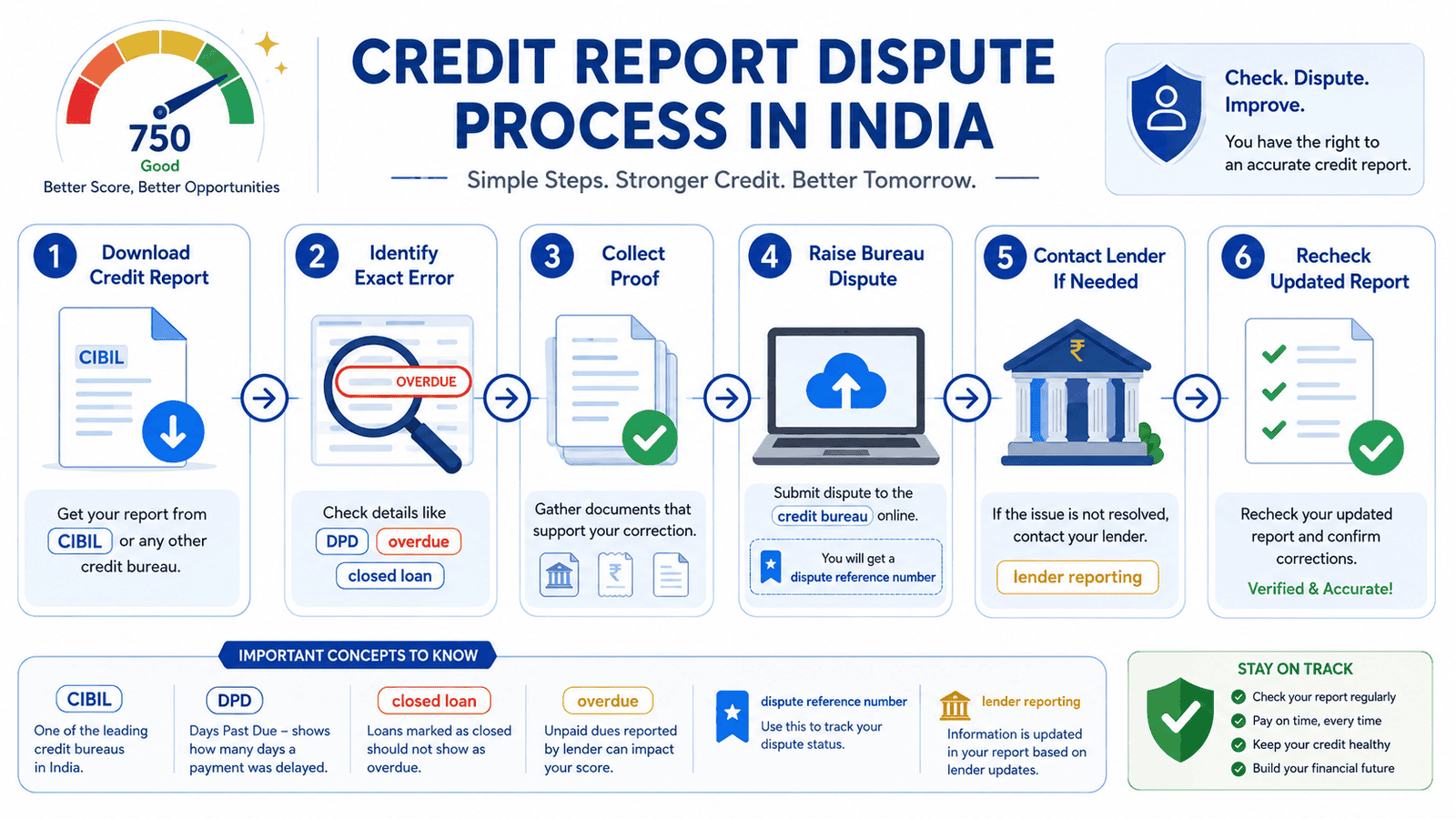
Do This First: Immediate Action Steps
Step 1 — Save your current credit report immediately
Before you do anything else, download a PDF or take a dated screenshot of the report showing the exact wrong entry. This is your evidence baseline. If the report changes later — even after correction — you will want a record of what it showed before you disputed it. You can check your CIBIL score and download your full credit report from the bureau’s official site.
Step 2 — Note the exact details of the error
Write down: the bureau name where the error appears (CIBIL, Experian, CRIF High Mark, or Equifax), the lender’s name, the loan or credit card account number, and what exactly is wrong — overdue amount, wrong DPD, closed loan showing active, wrong inquiry, or incorrect personal detail. Vague disputes take longer and are harder to resolve.
Step 3 — Collect your proof before raising any dispute
A dispute without supporting documents is easy to close without correction. Gather what you have: NOC, loan closure letter, repayment proof, bank statement, lender email, or loan account statement. The stronger your proof at the time of submission, the better your position when the bureau contacts the lender.
Step 4 — Avoid paid “CIBIL repair” agents
No agent can guarantee deletion of a reported entry, whether wrong or valid. Anyone charging a fee to “fix your CIBIL score” or “remove negative entries” is using your concern against you. Use only the official bureau dispute channels and your lender’s grievance process.
Key Takeaways
- A credit report dispute is for inaccurate, duplicate, outdated, or unverifiable information — not for removing valid late payments or genuine defaults simply because they hurt your score.
- Credit bureaus in India — CIBIL, Experian, CRIF High Mark, and Equifax — typically verify disputed data by contacting the lender or data furnisher before updating any record. The bureau cannot simply delete a lender-reported entry on your request alone.
- Different bureaus may show different records for the same loan. If you find an error in one bureau’s report, check all four before applying for any major loan or credit card.
- Keep your dispute reference number, all submitted documents, and every written communication. These become critical if you need to escalate to the lender’s grievance team or the RBI.
- A closed loan still reported active, a wrong DPD marker, or a wrong ₹5,000 overdue entry can trigger extra lender scrutiny during loan review — even if your score looks reasonable on the surface.
- Valid negative repayment history — a genuine missed EMI, a real settlement, or an actual default — cannot be removed through a dispute. These remain in your report for the prescribed retention period.
Key Facts at a Glance
| Error Type | First Contact | Proof Needed |
|---|---|---|
| Wrong loan account you never took | Bureau + lender both | ID proof, no lender relation confirmation |
| Closed loan showing active or overdue | Bureau dispute + lender to update | NOC, closure letter, bank statement |
| Paid EMI showing overdue or DPD | Bureau dispute + lender confirmation | Bank statement, payment receipt, lender email |
| Wrong DPD figure in report | Bureau dispute first | Repayment schedule, payment history |
| Unauthorized hard inquiry | Bureau dispute first | No application proof, written confirmation |
| Wrong personal detail (name, address, PAN) | Bureau dispute first | PAN card, Aadhaar, official ID |
| Wrong settlement or written-off status | Lender first, then bureau | Full payment proof, NOC, bank statement |
If a wrong loan entry is appearing in your report — an account you never opened — treat this as a high-priority dispute and contact both the bureau and the lender immediately.
What Is a Credit Report Dispute — and How the Bureau-Lender System Works
A credit report dispute is a formal request to a Credit Information Company (CIC) to investigate and correct data you believe is inaccurate in your credit report. In India, the four licensed credit bureaus — TransUnion CIBIL, Experian India, CRIF High Mark, and Equifax India — collect and store credit data reported by banks, NBFCs, credit card issuers, and other lenders. These reporting entities are called data furnishers.
Here is the key point most borrowers miss: the bureau does not own your loan data. The lender reports it. When you raise a dispute, the bureau’s role is to pass your query to the reporting lender and wait for a response. If the lender confirms the data is correct — even if you believe it is wrong — the bureau typically will not update the record unilaterally. This is why lender follow-up is often the most important part of the dispute process.
Bureau Role vs Lender Role
| Issue | Bureau Role | Lender Role |
|---|---|---|
| Wrong loan account in report | Forwards dispute to lender | Confirms or corrects reported data |
| Closed loan showing active | Flags for lender verification | Updates closure status in next reporting |
| Wrong DPD or overdue | Queries lender for corrected figure | Resubmits corrected payment record |
| Wrong personal detail | Can correct from your submitted ID proof | May or may not be involved |
| Unauthorized inquiry | Investigates origin of inquiry | Confirms whether inquiry was raised |
A closed loan showing active in your report is one of the most common disputes and almost always requires the lender to push a correction through their reporting system — raising a bureau dispute alone may not be enough.
What is a CIBIL control number?
Your CIBIL report includes a unique CIBIL control number — a nine-digit reference number that identifies your specific report. When raising a dispute with TransUnion CIBIL, quoting this number helps the bureau locate your record precisely. Other bureaus use similar internal reference identifiers in their dispute forms.
Wrong data vs valid negative data — the difference matters
A dispute applies to data that is factually wrong: a loan you did not take, a payment you did make but it still shows overdue, or an inquiry you never triggered. It does not apply to genuine late payments, real settlements, or actual defaults. Even if a valid negative entry significantly reduces your score, it cannot be disputed out — it stays in your report for the retention period set under the Credit Information Companies (Regulation) Act, 2005.
Real Example: Rohit’s Closed Loan Still Showing Overdue
Rohit, 31, is a software professional in Pune earning ₹55,000 per month. He paid off and closed a personal loan of ₹1.2 lakh in full and collected a No Objection Certificate from his lender. Six months later, while preparing to apply for a home loan, he downloads his CIBIL report and finds the same loan still marked active — with an outstanding overdue of ₹5,000 (illustrative figure).
This is an illustrative scenario — the ₹5,000 figure is used only to show how even a small reported overdue can raise a flag. Rohit’s lender’s processing team had not updated the closure status in their reporting to CIBIL.
Rohit gathers his NOC, bank account statement showing the final payment, and an email from the lender confirming closure. He raises a dispute on the CIBIL portal with the loan account number and attaches his proof where the form allows. He simultaneously emails the lender’s customer service with his NOC and requests a written confirmation that they will update the status with the bureau in their next reporting cycle. Once the lender updates the data, Rohit rechecks his CIBIL report in the following month’s reporting cycle. The entry then reflects correctly. See the related guide on overdue after payment for a full walkthrough of this scenario.
Documents and Details You Need Before Raising a Dispute
A well-prepared dispute is far more likely to be resolved quickly. Before you log into any bureau’s dispute portal, make sure you have the following:
- Your latest credit report — download this from the bureau website first. Note the bureau name, report date, and the exact entry you are disputing.
- Loan or credit card account number — this appears in your credit report alongside the lender name. For CIBIL disputes, the CIBIL control number may also be useful.
- Lender name — the data furnisher who reported the wrong entry.
- Description of the specific error — be precise: is the overdue wrong? Is the account status wrong? Is it a loan you never took? Is the DPD figure incorrect?
- Supporting proof — depending on the error type: NOC, loan closure letter, bank statement showing repayment, repayment schedule, payment receipt, lender email confirmation, or credit card closure letter.
For DPD-related disputes, understanding exactly what DPD means before raising your complaint will help you explain the error precisely. Review what DPD meaning in report covers before contacting the bureau. Experian India’s consumer dispute page (experian.in) also lists bureau-specific documentation guidance you should check directly before submitting.
Why a Wrong ₹5,000 Overdue Still Matters to a Lender
You might assume a small wrong overdue of ₹5,000 — illustrative figure — is too minor to matter. In practice, lenders reviewing a loan application do not just look at your credit score. They review your full repayment history, including any overdue amounts, DPD markers, or active flags on existing accounts.
A wrong overdue entry may prompt a lender’s credit assessment team to ask for an explanation letter, additional proof, or a longer processing time. In competitive lending decisions — particularly for home loans where multiple applicants are assessed — any unexplained negative marker can affect outcomes. This is not a guaranteed score impact or approval refusal, but it is a real-world friction point that is worth resolving before you apply, rather than during the process.
Do not expect a precise credit score improvement figure from any source. Credit scores are calculated by each bureau using their own models and lender-reported data. No one outside the bureau can tell you exactly how many points a specific correction will add.
Can You Dispute This? A Quick Reference
| Situation | Can You Dispute? | Better Next Step |
|---|---|---|
| Loan account you never took | Yes — dispute immediately | Bureau dispute + lender complaint |
| Closed loan still showing active | Yes — dispute and follow lender | Bureau dispute + lender update request |
| Paid EMI still showing overdue | Yes — with payment proof | Bureau dispute + lender correction email |
| Genuine missed EMI 2 years ago | No — valid negative data | Repay and maintain clean record going forward |
| Real settlement or written-off status | No — unless lender error | Verify with lender; get NOC if fully paid |
| Inquiry from your own loan application | No — valid inquiry | Limit future unnecessary applications |
| Unauthorized hard inquiry you never triggered | Yes — dispute with bureau | Bureau dispute + written complaint to lender |
| Wrong name or PAN in report | Yes — personal detail error | Bureau dispute with ID proof |
Step-by-Step Credit Report Dispute and Escalation Process
Step 1 — Identify which bureau’s report contains the error
India has four credit bureaus: TransUnion CIBIL (transunioncibil.com), Experian India (experian.in), CRIF High Mark (crifhighmark.com), and Equifax India (equifax.co.in). The same lender may report slightly different data to each bureau, or may not report to all four. Download your report from the bureau where you saw the error first. You may need to raise separate disputes with each bureau where the wrong entry appears.
Step 2 — Raise the dispute through the bureau’s official consumer dispute portal
Each bureau has a consumer dispute resolution section on their website. Log in using your registered credentials, locate the dispute or correction section, and identify the specific account or entry you are challenging. Do not use third-party websites or mobile apps that claim to “submit disputes on your behalf.” Always go directly to the bureau’s official domain.
Step 3 — Provide exact account details and a clear description of the error
In the dispute form, enter the lender name, account or loan number, the specific field that is wrong (status, overdue amount, DPD, inquiry), and what the correct information should be. Write this clearly and specifically. “My report is wrong” will not help the bureau contact your lender with a useful query.
Step 4 — Upload or preserve supporting documents
Where the bureau’s dispute portal allows document uploads, attach your proof. Where it does not, preserve all documents and reference them in the description field. Note the document types you are prepared to provide if the bureau contacts you for further information.
Step 5 — Note your dispute reference number
After submitting, the bureau will provide a dispute reference number or ticket ID. Save this immediately — screenshot it, write it down, and keep the confirmation email. This number is essential for tracking the status of your dispute and for escalating later if needed.
Step 6 — Track the dispute status
Log back into the bureau’s dispute portal to check the status of your complaint. Dispute resolution timelines vary by bureau and depend on how quickly the lender responds. Verify current processing timelines directly on the bureau’s official website before acting, as these can change. CRIF High Mark’s consumer dispute page (crifhighmark.com) publishes its consumer resolution process, which you should verify directly for current timelines.
Step 7 — Contact the lender if the dispute is closed without correction
If the bureau closes your dispute after the lender reconfirms the wrong data, your next step is to go directly to the lender’s customer service or grievance team. Send a written complaint — email is preferable — with your bureau dispute reference number, the account details, your proof, and a clear request for them to correct their reporting to the credit bureau.
Step 8 — Escalate through the lender’s nodal officer if needed
If the lender’s customer service does not resolve the matter within a reasonable time, escalate to their Nodal Officer or Principal Nodal Officer — details are usually available on the lender’s official website under the grievance redressal section. Regulated banks and NBFCs are required under RBI’s Fair Practices Code to have a functioning grievance mechanism.
Step 9 — Use the RBI complaint route where applicable
If the lender is an RBI-regulated entity — a bank or NBFC — and you have completed the internal grievance process without resolution, you may file a complaint through the RBI Integrated Ombudsman Scheme. The RBI’s complaint management portal is accessible at rbi.org.in. This route is available after exhausting the lender’s internal grievance process first.
Dispute Process Timeline: What to Expect
- Day 1: Download report, identify error, gather proof, submit bureau dispute.
- Days 1–7 (approximate): Bureau acknowledges dispute and contacts lender or data furnisher. Verify actual acknowledgment timeline on the bureau’s official site.
- Days 7–30 (approximate): Lender reviews and responds. Bureau updates report if lender confirms correction. Actual timelines vary — verify at the relevant bureau before relying on any figure.
- After closure: Recheck your report in the following month’s reporting cycle. Score may take an additional cycle to reflect the updated lender data.
- If not resolved: Contact lender grievance team with your dispute reference number and proof. Escalate if needed.
Borrower Safety: Protect Yourself During the Dispute Process
Do not pay agents promising guaranteed credit record deletion
Paid “CIBIL repair” agents cannot delete valid reported entries, negotiate with bureaus on your behalf in any official capacity, or guarantee score improvement. Any agent claiming otherwise is misleading you. Use only the official bureau portals and lender grievance channels.
Do not share your bureau login, OTP, PAN, or full documents with third parties
Your credit report and personal details are sensitive. Sharing them with an unofficial agent increases your risk of identity fraud and unauthorised applications. If an agent needs to “log into your CIBIL account to check your dispute,” refuse and report them.
Do not raise a dispute using false or exaggerated claims
A dispute is for inaccurate data, not for disputing valid debts you actually owe. Filing false disputes can complicate your credit profile and may not produce the result you expect. If a debt is valid but disputed for other reasons, seek legal or financial guidance separately.
Keep copies of everything you submit
Save every form submission, email, reference number, and document you send. This evidence chain is critical if you need to escalate to the lender’s Nodal Officer or the RBI. As RBI guidelines for regulated entities require a functioning grievance mechanism, your documented evidence strengthens your complaint at every level.
How to Decide: Bureau, Lender, or Both?
the error is a wrong personal detail (name, address, PAN) — raise a dispute directly with the bureau and attach your ID proof. Lender involvement is usually not required for this type of correction.
the error is a closed loan still showing active or a wrong overdue amount — raise a bureau dispute AND simultaneously contact the lender in writing. The lender needs to push a correction through their reporting; the bureau alone cannot fix this.
a loan account appears that you never took out — contact both the bureau and the lender immediately. This is a high-priority case and may also require you to notify the lender’s fraud team.
the bureau closes your dispute but the wrong entry remains — escalate directly to the lender’s grievance team using your bureau dispute reference number, your proof documents, and a clear written complaint requesting correction of their bureau reporting.
the same wrong entry appears across multiple bureaus — raise separate disputes with each bureau where the error appears. Each bureau has its own dispute process, and one correction does not automatically carry across to others.
the entry is simply a valid negative record you dislike — a genuine late payment, a real settlement, or an actual DPD from a missed EMI — a dispute will not remove it. Focus instead on building clean repayment history going forward and verify score update timelines from Equifax India (equifax.co.in) and other bureaus you are checking.
Common Mistakes to Avoid
Raising a vague dispute without account details
A dispute that says “my credit report is wrong” without specifying the lender, account number, field in error, and what the correct data should be is likely to be closed without action. Be specific: include the exact loan account number, the wrong field, and what you believe the correct value to be.
Not downloading your latest report first
Many borrowers raise a dispute based on a report they pulled three months ago. The latest report may show the lender has already corrected the data. Always download the current report from the bureau’s official site before submitting a new dispute. Paying for a recent copy is worth it if it saves you a redundant dispute cycle.
Contacting only the bureau when the lender’s data is the root problem
The bureau reflects what the lender reports. If the lender’s internal records still show the wrong status, contacting only the bureau will not fix it permanently. The lender must correct their reporting. Contact both the bureau and the lender in writing, especially for closed loan, overdue, and DPD disputes.
Expecting an instant score improvement after the dispute is raised
Even after a lender confirms a correction, the bureau needs to update its records, and your credit score is then recalculated in the next bureau scoring cycle. This is not instant. Do not apply for a loan immediately after raising a dispute and expect a different outcome — give the process time to complete and verify the updated report first.
Ignoring other bureau reports
If one bureau shows an error, the other three may show the same wrong data — or different data entirely. If you are preparing for a major loan application, pull reports from all four bureaus before applying. A lender may access any of the four, and an uncorrected error in one bureau can still affect your application.
Giving up after the first bureau response
If a bureau closes your dispute because the lender “confirmed” the wrong data, this is not the end. Write directly to the lender’s grievance team with your proof and the bureau reference number. If that fails, escalate to the Nodal Officer. The escalation path exists precisely for situations where the initial dispute channel does not resolve a genuine error.
When This May Not Be the Right Choice
Raising a credit report dispute will not help — and may waste your time — in these situations:
You have a genuine late payment history. If you did miss EMIs and those DPD entries are accurately reported, a dispute will not remove them. The only path forward is consistent on-time repayment from here, which will carry weight over time. Check score update timing to understand when new repayment data gets reflected.
Your loan was genuinely settled or written off. If the lender marked a loan as settled or written off because you paid less than the full dues, that status is accurately reported. A dispute is not the tool to change it — you would need to clear the full outstanding amount and obtain a fresh NOC showing proper closure.
An inquiry was raised by a lender after you applied. If you applied for a loan or credit card and a hard inquiry appears for that lender, that inquiry is valid. Disputing a legitimate inquiry will not succeed.
Your score is low but your report has no actual errors. A low score due to high credit utilisation, short credit history, or recent hard inquiries is not a report error. Improving these factors takes time and repayment discipline — a dispute cannot fix a score problem that comes from valid data.
If any of these apply to your situation, it may be worth exploring other options before committing.
Official Rules and Where to Verify
The credit report dispute process in India is governed by the Credit Information Companies (Regulation) Act, 2005, which mandates how data is collected, stored, and corrected. Each bureau has its own consumer dispute process that you must verify directly from their official website before submitting a complaint, as login flows, forms, and timelines can change.
- TransUnion CIBIL — transunioncibil.com — Official dispute process, CIBIL control number reference, and consumer resolution guidance.
- Experian India — experian.in — Bureau-specific dispute process and consumer credit report correction route.
- CRIF High Mark — crifhighmark.com — Consumer dispute resolution process and credit report correction guidance.
- Equifax India — equifax.co.in — Consumer dispute process and data correction guidance.
- Reserve Bank of India — rbi.org.in — RBI Integrated Ombudsman Scheme for regulated-entity complaints after exhausting the lender’s internal grievance process. RBI’s Fair Practices Code for NBFCs and banks sets out the baseline grievance standards you can expect from regulated lenders.
Credit reporting rules, lender assessment methods, and bureau processes can change. Always verify current details from the relevant bureau, lender, or official regulatory source before acting.
Expert Tips
- Write one dispute per clear, separate error. If your report has a wrong overdue on one account and a wrong personal address, raise them as separate dispute items where possible. This makes each dispute easier to track and harder for the bureau or lender to conflate or dismiss together.
- Use exact dates, amounts, account numbers, and lender names in every submission. A dispute that says “my loan was closed in March 2024 and the closure amount was ₹1,21,500 as per my NOC dated 14 March 2024” is far stronger than “I already closed my loan.” Specificity reduces back-and-forth.
- Organise your proof in chronological order before uploading or referencing it. Start with the loan sanction or account open document, then payment records, then the closure or NOC document. A clean evidence chain is easier for the lender’s reporting team to verify and act on.
- Follow up with your lender in writing, not only by phone. Phone calls leave no audit trail. Send your complaint and supporting documents by email to the lender’s official customer service or grievance address. If you need to escalate later, you want a documented trail of dates, responses, and your own submissions.
- Recheck all four bureaus before applying for any major loan. A home loan, business loan, or large personal loan application may trigger bureau checks across more than one credit bureau. Correct errors at all four bureaus before you submit the application — not after a rejection.
- Do not apply for new loans while a major dispute is unresolved. A pending dispute does not pause lender assessments. If a wrong entry is still appearing in your report, a new loan application will still be evaluated against that entry. Wait for the correction to reflect before applying where possible.
Frequently Asked Questions
How do I raise a dispute in my CIBIL report?
Log in to the TransUnion CIBIL website at transunioncibil.com using your registered credentials. Navigate to the dispute or credit report correction section, enter the details of the wrong entry — account number, lender name, error type, and what the correct information should be — and submit. Save the dispute reference number you receive. Verify the exact steps on the CIBIL site before proceeding, as login flows and dispute form layouts can change.
Can I dispute a wrong loan account that appears in my credit report?
Yes. A loan account that you never opened and that appears in your report is a high-priority dispute. Raise a dispute with the bureau where it appears, provide your identity proof confirming you have no relationship with the reporting lender, and simultaneously contact the lender’s customer service or fraud team in writing. This type of error can take longer to resolve because the lender needs to investigate the source of the wrong reporting.
How long does it take to correct a credit report error in India?
Dispute resolution timelines vary by bureau and depend on how quickly the lender responds. Verify the current processing timeline from the bureau’s official website before relying on any fixed figure, as these timelines can be updated. After the bureau updates the record, your credit score may take an additional reporting cycle to reflect the correction.
Should I contact the credit bureau or the lender first?
For most errors — especially wrong overdue amounts, DPD errors, and closed loan status — contact both simultaneously or in quick succession. The bureau can flag the dispute, but the lender must push the corrected data. For personal detail errors like a wrong name or PAN, the bureau can often correct from your ID proof directly. For a loan account you never opened, contact both the bureau and the lender immediately.
Will my CIBIL score increase after a dispute is resolved?
If the wrong entry was affecting your score, correcting it may result in a score update in the following bureau scoring cycle. However, no one can promise a specific score increase or tell you exactly how many points the correction will add. Credit scores are calculated by each bureau using proprietary models. Do not expect a precise or immediate score jump — and verify your updated report before applying for any loan.
Can a closed loan still show active in CIBIL after I repay and collect the NOC?
Yes. This happens when the lender does not update the loan status in their next bureau reporting cycle after closure. The bureau reflects lender-submitted data — so if the lender’s internal system still shows the account as active, CIBIL will too. Raising a bureau dispute is the starting point, but you will typically need the lender to push a correction through their reporting before the status changes.
What should I do if the lender confirms wrong information after my bureau dispute?
If the bureau closes your dispute because the lender reconfirmed the wrong data, escalate directly to the lender’s customer service or grievance team with your documentary proof and your bureau dispute reference number. If the lender’s grievance process does not resolve the issue, escalate to the lender’s Nodal Officer or Principal Nodal Officer. For RBI-regulated entities, you may then use the RBI Integrated Ombudsman Scheme after exhausting internal lender escalation.
Do I need to raise a separate dispute with each credit bureau?
Yes. Each bureau maintains its own database and dispute process. A correction at CIBIL does not automatically carry over to Experian, CRIF High Mark, or Equifax. If the same lender has reported wrong data to multiple bureaus, raise a separate dispute with each bureau where the error appears. This is especially important before a major loan application, where the lender may check any of the four bureaus.
Can I remove a genuine late payment from my credit report through a dispute?
No. A genuine late payment that was accurately reported by your lender is not a dispute candidate. It is valid historical data and is retained in your credit report for the prescribed period under the Credit Information Companies (Regulation) Act, 2005. Disputing accurate negative information is not likely to produce a correction. Focus on maintaining a clean repayment record going forward.
Is there a fee to raise a credit report dispute?
The dispute process on official bureau portals is generally available to consumers without a charge for corrections to existing accounts. However, fees for downloading additional credit reports or premium monitoring services may apply depending on the bureau and the plan you access. Verify the current terms on each bureau’s official website before proceeding.
Final Verdict
The credit report dispute process in India is not complicated — but it requires the right evidence, the right contact, and realistic expectations. If your credit report shows a wrong loan, a wrong overdue, an incorrect DPD, or a closed account still showing active, raise a dispute with the bureau where the error appears and simultaneously write to your lender in documented form. Do not wait for a loan rejection to fix an error you can address now.
Keep every reference number, email, and document copy. If the bureau closes your dispute without correction because the lender reconfirmed wrong data, escalate through the lender’s grievance route — that is where the real data correction authority lies. And if you are close to a major loan application, check all four bureaus before applying, not just CIBIL.
This guide is educational. The specific steps, forms, and timelines on each bureau’s portal can change — always verify the current process directly at the bureau’s official site or the lender’s grievance page before submitting. Always verify your latest credit report, lender requirements, and bureau process before making a credit-related decision.
This article is for educational purposes only and should not be treated as personalised financial, credit, or legal advice. Credit scores, credit reports, lender eligibility criteria, and bureau processes can vary and may change over time. Please verify current details with the relevant credit bureau, lender, official regulatory source, or a qualified professional before making any credit-related decision.

Neha Menon writes simple, borrower-first explainers on CIBIL scores, credit reports, bureau disputes, DPD, loan settlement impact, hard inquiries, and practical credit score recovery. She focuses on helping Indian borrowers understand lender-reported data, avoid credit mistakes, and take safer next steps without false promises.