
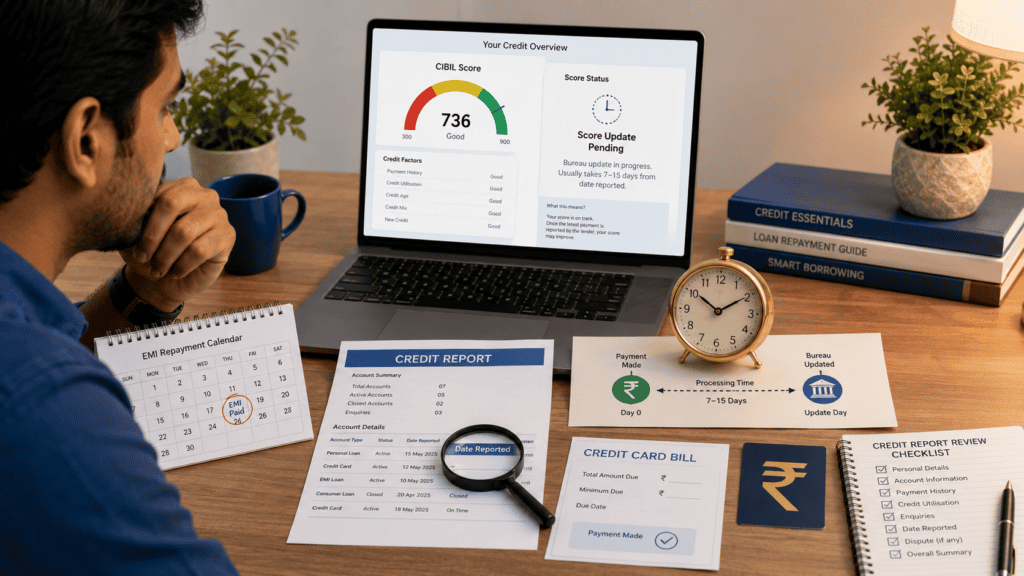
You paid your EMI on the 5th. Your credit card bill is cleared. You even closed a personal loan and got the NOC. But you check your CIBIL score a week later — and nothing has changed. The overdue amount still shows. The closed loan still looks active. The credit utilisation is still high. This is one of the most common and most stressful situations for Indian borrowers, especially when a home loan or top-up application is sitting on the table. The good news: in most cases, this is normal reporting lag — not a mistake, and not a black mark against you. The important thing is knowing the difference between a delay and an actual error, what fields to check in your credit report, and when to act rather than wait. This article explains exactly that — calmly and step by step.
Quick Answer: How Often Is CIBIL Score Updated?
How often is CIBIL score updated depends on lender reporting to credit bureaus, not on when you make an EMI or credit card payment. In India, reporting frequency is moving toward weekly reference-date reporting from July 1, 2026, but delays can still occur before your report and score reflect changes. Always check your full credit report — not just the score — before concluding that data is wrong.
Key Takeaways
- Your CIBIL score is derived from credit report data — it does not update the moment you make a payment. The lender must first post and then report the data to the bureau before the report or score can change.
- EMI payments and credit card bill payments may take time to appear in your CIBIL report, depending on when your lender submits data to the credit bureau and when the bureau processes it.
- Loan closure and overdue correction can take additional time — lenders must report the updated account status (closed, settled, or nil overdue) before the bureau can update your report.
- A CIBIL score update that has not yet appeared is often a timing issue. A credit report that shows wrong data — such as an incorrect days past due (DPD) figure, an active status after confirmed closure, or an account you never opened — is a different problem requiring action.
- Checking your own CIBIL report is a soft inquiry and does not reduce your score. Applying for a new loan or card before the report is corrected can add hard inquiries that do affect your score.
- No third party can guarantee a score increase for a fee. Credit data correction requires the lender to verify and update the reported information — nothing else can change it.
Key Facts at a Glance
| Question | Answer | Note |
|---|---|---|
| Who actually updates your CIBIL data? | Your lender (bank, NBFC, card issuer) | TransUnion CIBIL processes data after lenders report it |
| Is CIBIL score updated instantly after payment? | No | There is always a lender reporting lag followed by bureau processing |
| How often do lenders report data to bureaus? | Moving toward weekly reporting (verify current frequency with RBI / lender) | Stale data risk — confirm at rbi.org.in before publishing |
| What fields to check in your report? | Account status, current balance, overdue, DPD, credit limit, date reported | Score alone is not enough — read the full report |
| When to contact your lender? | When the lender’s own records are wrong or NOC was not issued | Lender must correct and re-report data to the bureau |
| When to raise a CIBIL dispute? | When the credit report shows data different from what the lender confirms | Dispute through transunioncibil.com — lender verification required |
Who Actually Updates Your CIBIL Score?
Many borrowers believe that CIBIL updates the score when a payment is made. This is not how it works. Your CIBIL score is not a live bank balance — it is a calculated output derived from the data sitting in your credit report.
The data in your credit report comes entirely from Credit Institutions — the banks, NBFCs, credit card issuers, and other regulated lenders you borrow from. These institutions are required under RBI directions to report credit data to Credit Information Companies (CICs) — which include TransUnion CIBIL, Experian India, CRIF High Mark, and Equifax India.
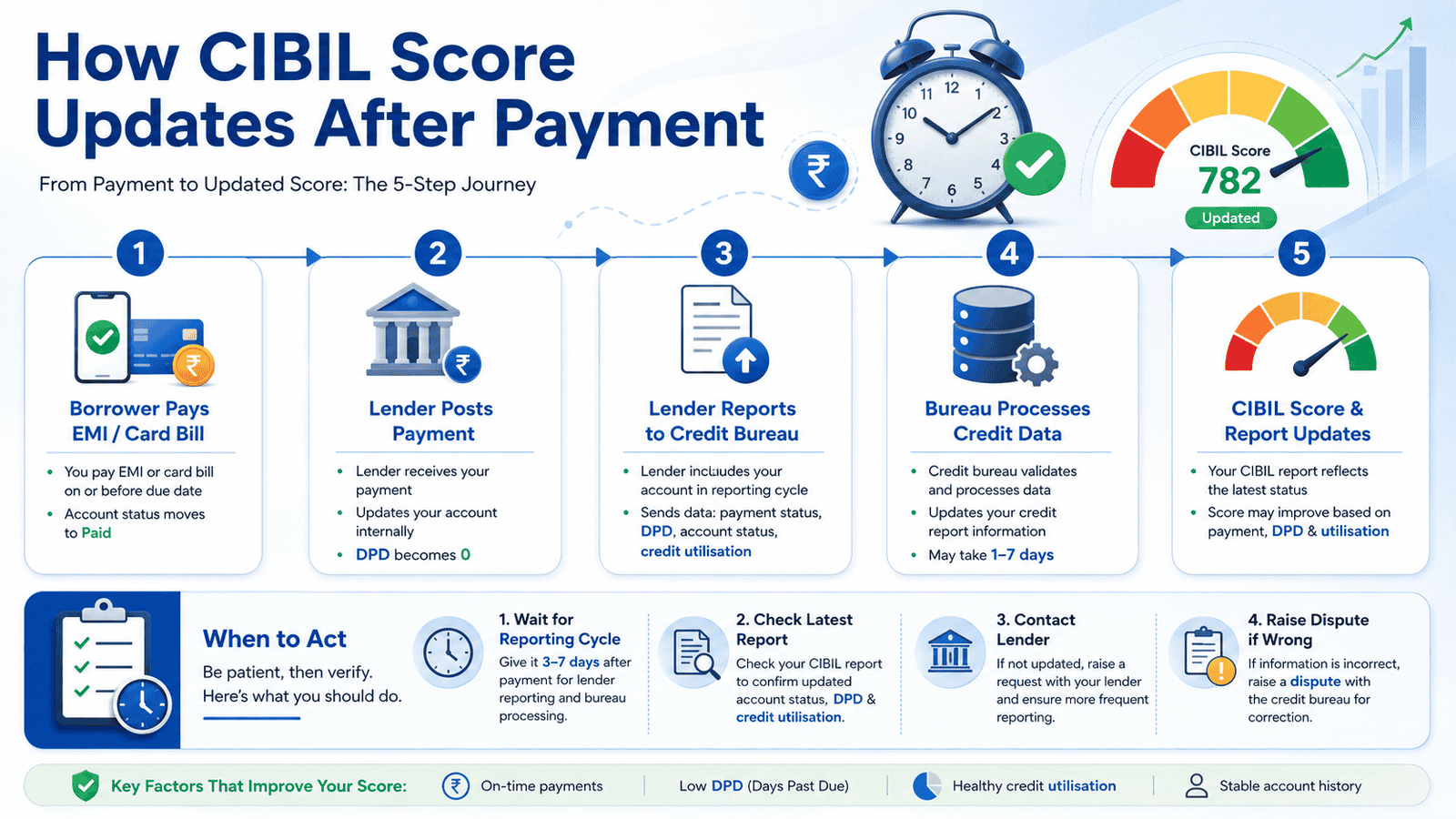
The reporting chain looks like this:
| Step | Who Acts | What Happens |
|---|---|---|
| 1. Borrower pays EMI or card bill | You | Payment is made to the lender |
| 2. Lender posts payment | Your bank or NBFC | Payment is recorded in the lender’s internal system |
| 3. Lender reports to bureau | Your bank or NBFC | Updated account data is sent to TransUnion CIBIL and other bureaus on the lender’s reporting schedule |
| 4. Bureau processes data | TransUnion CIBIL (or other bureau) | Reported data is validated and updated in your credit report |
| 5. Score recalculates | TransUnion CIBIL (or other bureau) | Your credit score is recalculated based on the updated report data |
At no point does TransUnion CIBIL independently decide to change your score. It can only work with what lenders report to it. If your lender has not yet submitted updated data, your report — and therefore your score — will not change, no matter how recently you paid. If you want to understand score basics and see how report fields connect to the final score, that foundation helps make sense of everything in this article.
Why Your EMI or Credit Card Payment May Not Reflect Immediately
Borrowers often confuse payment date with reporting date. These are two separate events, and the gap between them is where most of the frustration lives.
Step 1 — You Make the Payment
Your EMI is debited or your credit card bill is paid. This is the payment date. This event is visible to you on your bank statement. But it is not yet visible to TransUnion CIBIL.
Step 2 — The Lender Posts the Payment Internally
The lender updates its own records — marking the EMI as received, reducing the outstanding balance, and updating the days past due (DPD) to zero if the payment was on time. This usually happens within a day or two, but the borrower cannot see this step directly.
Step 3 — The Lender Sends a Data File to the Bureau
On the lender’s next reporting cycle — which depends on the lender and on RBI reporting directions — the updated account data is sent to credit bureaus including TransUnion CIBIL. RBI has been moving lenders toward more frequent, reference-date based reporting. Verify the current reporting frequency at rbi.org.in before publishing this article, as this figure is subject to change.
Step 4 — The Bureau Processes and Updates the Report
TransUnion CIBIL validates the incoming data and updates the relevant fields in your credit report — account status, current balance, overdue amount, DPD, date reported, and credit limit. After the report updates, the credit score recalculates based on the new information.
The key insight is that every step takes time — and you are waiting for all of them to complete before seeing any change.
Real Example: Priya’s Credit Card Payment and the CIBIL Lag
Priya, 34, is a salaried marketing manager in Bengaluru earning ₹62,000 per month. She has one credit card with a credit limit of ₹80,000 (illustrative). Before her billing cycle closed, her outstanding balance was ₹60,000 — a credit utilisation ratio of 75%, which is considered high.
Priya made a payment of ₹50,000, bringing her outstanding balance down to ₹10,000. Her utilisation ratio dropped from 75% to 12.5% — a significant improvement. She expected her CIBIL score to jump within days.
But when she checked her score ten days later, it had not moved. The reason: her card issuer had not yet submitted the updated balance to the bureau. The report still reflected the ₹60,000 outstanding from the previous reporting cycle.
Two weeks after the card issuer’s next reporting submission, Priya’s CIBIL report updated to show ₹10,000 outstanding. Her score improved in the following report refresh. Understanding how credit utilisation ratio works — and when it is reported — would have saved Priya a week of unnecessary worry.
The key insight: paying the bill reduces your utilisation — but the score only moves after the card issuer reports the new balance to the bureau.
Documents and Details to Keep Ready
Before you call your lender or raise a CIBIL dispute, make sure you have the following. This is not a loan eligibility checklist — it is what you need to verify any CIBIL update issue properly.
- Your latest CIBIL report — not just the score. Download the full report from transunioncibil.com so you can read account status, DPD, overdue, date reported, and current balance for every account. You can check your report for free once a year through the official bureau website.
- Loan or credit card statement — showing the payment you made, the payment date, and the updated outstanding balance from the lender’s records.
- Payment receipt or bank transaction record — proof that the payment was debited from your account on a specific date.
- Loan closure letter or NOC — if you have closed a loan, the No Objection Certificate from the lender is the key document confirming closure. Without it, you cannot establish that the lender itself acknowledges the closure.
- Screenshot or printout of the incorrect report field — if you are raising a dispute, document exactly what the report says versus what you believe it should say.
How to Read a Timeline Example: EMI Paid on the 5th
Here is a practical timeline example — not an EMI cost calculation, but a sequence of events:
Payment Date → Lender Internal Posting → Lender Reporting to Bureau → Bureau Processing → Report Update → Score Recalculation
Where: Each step adds time | Lender reporting schedule is set by RBI directions and lender practice | Bureau processing adds additional time | Score recalculation happens after report update
Suppose Rohit pays his personal loan EMI on the 5th of the month. The lender posts the payment within one to two days. The lender’s reporting cycle — which depends on RBI directions in force at the time — determines when the updated data reaches TransUnion CIBIL. The bureau then processes the submission. By the time Rohit checks his score on the 15th, the report may or may not have updated, depending entirely on when the lender’s reporting submission fell. According to RBI’s credit information reporting directions, lenders are required to report credit data to Credit Information Companies within specified timeframes — verify the current requirement at rbi.org.in before publishing, as reporting frequency is evolving.
The practical rule: if the “date reported” field in your CIBIL report has not changed since your last payment, the lender has simply not yet submitted updated data. This is not an error — it is the normal cycle.
Common Situations and Whether Your Delay Is Normal
| Situation | Likely Normal Delay? | What to Check | Next Step |
|---|---|---|---|
| EMI paid but balance not updated in report | Yes — if lender reporting cycle has not completed | Date reported field in credit report vs payment date | Wait for lender’s next reporting cycle |
| Credit card payment made but utilisation still high in report | Yes — card issuer reports on its own schedule | Statement balance at billing date, date reported in report | Wait for card issuer to submit updated data |
| Loan closed but still showing active in report | Possible — if closure was recent and lender has not yet reported | Date of closure, lender internal records, NOC received or not | Wait one full reporting cycle; if not updated, contact lender with NOC |
| Overdue amount still showing after full payment | Possible — if lender has not yet reported the cleared status | Lender statement showing nil overdue vs report overdue field | Wait; then contact lender if mismatch persists |
| Wrong loan account visible in report | No — this is not a timing issue | Account number, lender name, dates — check if account belongs to you | Raise CIBIL dispute immediately; check for identity fraud |
| DPD showing non-zero after on-time payment | No — DPD should reflect on-time payment after lender reports | Payment date vs due date on lender statement | Contact lender to verify DPD; raise dispute if lender confirms payment was on time |
What to Do If Your CIBIL Report Is Not Updated or Shows Wrong Data
Step 1 — Download Your Full Credit Report
Go to transunioncibil.com and download your complete credit report, not just the score summary. Look at every account listed. For each account in question, check: account status (active, closed, written-off, settled), current balance, overdue amount, days past due (DPD) for the last 36 months, credit limit, and most importantly — the date reported field. This date tells you when the lender last sent data to TransUnion CIBIL.
Step 2 — Compare the Report With Your Lender Records
Match what the CIBIL report shows against your lender statement, payment receipt, and any closure letter or NOC. If the lender’s own records match what the report says — for example, the lender also shows an overdue — the problem is at the lender level, not the bureau. If the lender’s records contradict what the report says — for example, the lender confirms full payment but the report still shows overdue — this points to a reporting error.
Step 3 — Contact Your Lender First
If the lender-side data is wrong, the lender must correct it and re-report it to the bureau. Send a written request (email is preferable for a paper trail) with your payment proof, statement, and the specific field that is incorrect. Ask the lender to confirm in writing whether the data they reported to credit bureaus is accurate. If you have an issue with an overdue after payment, the lender is always the first point of contact — not the bureau.
Step 4 — Raise a CIBIL Dispute If the Bureau Data Is Inaccurate
If the lender confirms their records are correct but the bureau report still shows different data, raise a formal dispute through transunioncibil.com. The dispute process involves TransUnion CIBIL contacting the lender to verify the data. If the lender confirms the correction, the bureau updates the report. If the lender does not respond or disputes the claim, the outcome depends on what the lender verifies. TransUnion CIBIL cannot change data without lender confirmation.
Step 5 — Escalate if Unresolved
If the dispute is not resolved within a reasonable period, you can escalate through the RBI’s complaint management channels. Verify the current grievance escalation path and timelines at rbi.org.in before publishing, as these processes are subject to regulatory updates.
Safety Checklist: Protect Your Credit While Waiting for Updates
- Do not apply for multiple new loans or credit cards while waiting. Each application adds a hard inquiry to your credit report. Multiple hard inquiries in a short period can reduce your score and signal credit hunger to lenders.
- Do not ignore current EMIs while disputing a past entry. Missing a current payment creates a fresh negative entry in your report — which is a real problem, not a timing issue.
- Do not rely on the score number alone. The score is a summary. The report fields — account status, DPD, overdue, date reported — tell you what is actually happening and what a lender’s credit team will see.
- Do not pay agents or “CIBIL fixers” who promise a guaranteed score increase for a fee. No third party can change your credit data without lender verification. These are often scams. If you suspect a wrong loan entry or fraud, use the official dispute process only.
- Keep proof of every payment and every lender communication — especially when a dispute or correction is underway. Written records are your strongest tool in a lender escalation.
How to Decide What’s Right for You
you made a payment recently and the “date reported” in your CIBIL report is older than your payment date — wait for the lender’s next reporting cycle before concluding that anything is wrong.
your lender’s statement confirms full payment but the CIBIL report still shows overdue or a non-zero balance after more than one full reporting cycle — contact the lender in writing and ask them to verify what data they submitted to the bureau.
your loan is closed, you have the NOC, but the CIBIL report still shows the loan as active after the lender’s reporting cycle has passed — this is a closed loan still active problem that requires a lender escalation and formal dispute.
you are planning to apply for a home loan or a large personal loan — delay the application until the updated report reflects your corrected repayment, closure, or nil overdue status. Applying before the update risks a rejection based on stale data.
your report shows an account you never opened, or your DPD figures are wrong and the lender confirms the error — do not wait. Raise a CIBIL dispute immediately and contact the lender in parallel.
Common Mistakes to Avoid
Checking Only the Score and Ignoring the Full Report
The score is a single number derived from dozens of data points. If you check only the score and see no change, you learn nothing about why. Pull the full credit report and look at account status, DPD, overdue amount, date reported, and credit limit for every account. That is where the actual update — or the actual error — will be visible.
Assuming CIBIL Manually Updates or Controls Your Score
TransUnion CIBIL does not independently decide to change your score. It calculates your score based only on the data lenders report to it. If lenders have not yet reported the correct data, CIBIL cannot update the report — regardless of how recently you paid or how many times you check.
Raising a Dispute Before Checking Whether the Delay Is Normal
Disputes require the bureau to contact the lender for verification. If the delay is simply a normal reporting lag and the lender’s data is correct, a dispute wastes time and resolves nothing. First check the “date reported” field. If the report has not refreshed since your payment, wait for the next cycle before filing.
Applying for Multiple Loans While Waiting for the Report to Update
Each loan or card application creates a hard inquiry on your credit report. Hard inquiries are visible to all lenders and can signal financial stress. Applying to five banks in the hope that one approves you before your report updates can actively worsen the very profile you are trying to improve.
Trusting Paid “CIBIL Score Repair” Services
No agent, app, or consultant can change your credit data without lender verification. Any service claiming to “remove” accurate negative entries or “fix” your score for a fee is either misleading you or engaging in fraud. The only legitimate path is through the official CIBIL dispute process and direct lender communication.
Ignoring All Your Other Active Accounts While Fixing One Entry
While disputing one entry or waiting for a report update, borrowers sometimes miss EMIs on other accounts. A fresh missed payment creates a new DPD entry that can be more damaging than the original delayed update. Keep all current obligations on time throughout the correction process.
When Waiting Is Not Enough: Act Immediately in These Cases
Most CIBIL update delays are normal reporting lag and resolve after the lender’s next reporting cycle. But there are situations where waiting is the wrong choice:
Your account is marked overdue when the lender’s own statement confirms full payment — and multiple reporting cycles have passed without correction. Your loan is confirmed closed by the lender and you have the NOC, but the report still shows it as active after more than one reporting cycle. Your DPD entry shows missed payments on dates when your bank statement confirms payments were made on time. An account you have never opened, a lender you have never borrowed from, or a loan amount that does not match any facility you took appears on your report — this may indicate identity fraud or a reporting error. The lender acknowledges the incorrect data but has not corrected or re-reported it despite your written request. In all of these cases, raise a formal dispute through transunioncibil.com and simultaneously escalate with the lender in writing. According to TransUnion CIBIL’s dispute process, the bureau contacts the lender to verify the data — resolution depends on the lender’s response. If any of these apply to your situation, it may be worth exploring other options before committing.
Official Rules and Where to Verify
The credit information reporting framework in India is set by the Reserve Bank of India (rbi.org.in). RBI issues directions to Credit Institutions on how and how often they must report credit data to Credit Information Companies. These directions have been evolving — reporting frequency requirements are changing, and you should verify the current requirements at rbi.org.in before relying on any specific figure.
For the dispute process, the authoritative source is TransUnion CIBIL (transunioncibil.com). The bureau’s consumer dispute section explains how to raise, track, and escalate a dispute. Credit bureaus are private entities, not government bodies — cite them by name and domain only.
The other licensed Credit Information Companies in India — Experian India (experian.in), CRIF High Mark (crifhighmark.com), and Equifax India (equifax.co.in) — operate independently. Each may show a different score for the same borrower because the data submitted by lenders, the timing of submissions, and the scoring models used can all differ. No single bureau is always “correct.” If a lender pulls your report from Experian and CIBIL shows a different score, both can be accurate — they reflect different data snapshots.
The grievance escalation path for unresolved credit disputes — including timelines and the role of the RBI Ombudsman — should be verified at rbi.org.in before this article is published, as regulatory processes are subject to update.
Rules, credit reporting rules, lender assessment methods, and bureau processes can change. Always verify current details from the relevant bureau, lender, official regulatory source before acting.
Expert Tips
- Download your full credit report at least one month before applying for any major loan. This gives you time to identify delays or errors and resolve them before a lender’s credit team does.
- Pay your credit card bill before the statement generation date, not just before the due date. The balance on the statement date is usually what gets reported to the bureau. Paying before the statement date reduces the reported utilisation — paying after the due date avoids interest, but does not reduce the reported balance for that cycle.
- Collect your loan closure letter or NOC the same week you make the final payment. Many borrowers chase the NOC months later, by which time the lender’s records are harder to access and disputes take longer.
- Save every payment receipt, bank statement, and lender communication in a dedicated folder. If a dispute arises six months later, your payment date proof is the critical document.
- Review your full credit report — not just the score — every six months. Check active accounts, overdue amounts, DPD entries, credit enquiries, and account status. Small errors that go uncorrected for many months can affect major borrowing decisions later.
- If you are an authorised user on someone else’s credit card, their utilisation and payment behaviour can affect your report. Check that all accounts listed on your report are ones you actually hold or are legitimately associated with.
Frequently Asked Questions
How often is CIBIL score updated in India?
Your CIBIL score updates when TransUnion CIBIL receives and processes new data from your lenders. Lenders report credit data to bureaus according to schedules set by RBI directions. In India, reporting frequency is moving toward more regular, reference-date based submissions — verify the current frequency requirement at rbi.org.in, as this figure is subject to change. After the lender reports, the bureau processes the data and the score recalculates. This means updates are not instant and the timing depends on both lender and bureau processing.
Does my CIBIL score update immediately after I pay an EMI?
No. Making an EMI payment does not trigger an immediate CIBIL update. The lender must first post the payment internally, then send updated account data to the bureau on its reporting schedule. Only after the bureau processes that data does your report — and therefore your score — change. The gap between payment date and report update can range from several days to a few weeks, depending on the lender’s reporting cycle.
How long after loan closure does CIBIL update?
After you close a loan and the lender updates its records, the closure status should appear in your CIBIL report after the lender’s next reporting submission and bureau processing. If the lender is reporting on a regular cycle, the update typically appears within a few weeks of closure — but verify timing with your specific lender and confirm the current reporting requirement at rbi.org.in. If the loan is still showing active after one or two full reporting cycles, contact the lender with your NOC and request a re-report to the bureau.
Why is my credit card payment not reflected in CIBIL?
Credit card balances are typically reported based on the statement balance at the billing cycle date, not at the time you make the payment. If you paid after the statement was generated, the reported balance for that cycle may still be the pre-payment figure. The reduced balance will appear after the card issuer submits the next reporting data and the bureau updates your report. This is a timing issue, not an error — unless the balance remains wrong across multiple billing cycles.
Who is responsible for correcting wrong CIBIL data — me, the lender, or CIBIL?
The lender is primarily responsible, because lenders are the source of all credit data in your report. If a figure is wrong, the lender must correct it and re-report it to the bureau. TransUnion CIBIL can facilitate a dispute by contacting the lender on your behalf, but CIBIL cannot change data without lender confirmation. You initiate the process — by contacting the lender directly, or by raising a dispute through transunioncibil.com.
Can I raise a CIBIL dispute if my report has not updated after a payment?
Yes, but first check whether the delay is normal reporting lag. Look at the “date reported” field in your CIBIL report. If the report has not refreshed since your payment, the lender may not have submitted updated data yet — a dispute at this stage will not speed things up. If the “date reported” is recent and the balance is still wrong, or if multiple reporting cycles have passed without correction, a dispute is the right step. Contact the lender first; then raise a formal dispute through transunioncibil.com if the lender’s own records are correct but the report remains wrong.
Does checking my CIBIL score repeatedly reduce it?
No. Checking your own credit score or report is a soft inquiry. Soft inquiries do not affect your CIBIL score at all. Hard inquiries — which happen when a lender checks your credit report as part of a loan or card application — do affect the score and remain on the report. So checking your own report as many times as you need is safe. Applying to multiple lenders in quick succession is what creates hard inquiry accumulation.
Can CIBIL, Experian, CRIF High Mark, and Equifax show different scores for the same person?
Yes — and this is normal. Each bureau receives data from lenders on its own reporting schedule, uses its own proprietary scoring model, and may have received slightly different data from the same lender at different points in time. A lender who checks your Experian report may see a different score than one who checks your CIBIL report. This does not mean one bureau is wrong. It means each bureau reflects its own data snapshot. If a specific lender pulls a specific bureau, focus on verifying your report with that bureau before applying.
Final Verdict
Understanding how often is CIBIL score updated comes down to one key fact: your score moves only after your lender reports data to the bureau and the bureau processes it. Paying an EMI, clearing a credit card bill, or closing a loan does not trigger an instant CIBIL refresh. The reporting chain has multiple steps, each with its own timeline.
For most borrowers, a delayed score update is simply reporting lag — not an error, and not cause for alarm. The right response is to download your full credit report, check the “date reported” field, and compare it with your payment records. If the data is wrong after multiple reporting cycles — wrong DPD, incorrect overdue, a loan still showing active despite a closure NOC — that is when to contact the lender in writing and, if needed, raise a formal CIBIL dispute.
Do not apply for a new loan until the report reflects your corrected credit position. Rushing in with a hard inquiry while stale data is still visible can lead to rejection — or approval at a worse rate. Verify your latest credit report, lender requirements, and bureau process before making a credit-related decision. Always verify your latest credit report, lender requirements, and bureau process before making a credit-related decision.
This article is for educational purposes only and should not be treated as personalised financial, credit, or legal advice. Credit scores, credit reports, lender eligibility criteria, and bureau processes can vary and may change over time. Please verify current details with the relevant credit bureau, lender, official regulatory source, or a qualified professional before making any credit-related decision.

Neha Menon writes simple, borrower-first explainers on CIBIL scores, credit reports, bureau disputes, DPD, loan settlement impact, hard inquiries, and practical credit score recovery. She focuses on helping Indian borrowers understand lender-reported data, avoid credit mistakes, and take safer next steps without false promises.