
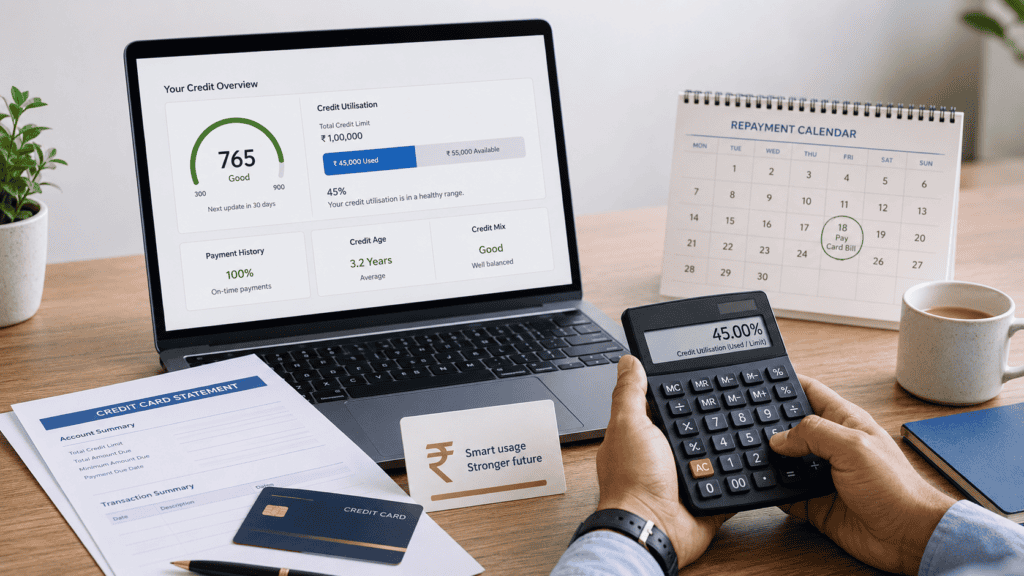
Many credit card users in India pay their bills on time every month — and then check their CIBIL score only to find it lower than expected. The most common reason is not a missed payment. It is the credit utilisation ratio: a measure of how much of your available card limit you are using at any given point. If you have been spending close to your credit limit, that pattern can show up on your credit report even before you pay the bill — and credit bureaus and lenders take notice. This article explains what credit utilisation ratio means, how to calculate it across one or multiple cards, why the statement date matters more than many people realise, and how to keep your usage under control without falling into a debt trap. No fixed score increase can be promised here, because credit scores depend on bureau models and lender-reported data — but understanding this concept clearly is one of the most practical steps any card user can take.
Quick Answer: What Is Credit Utilisation Ratio?
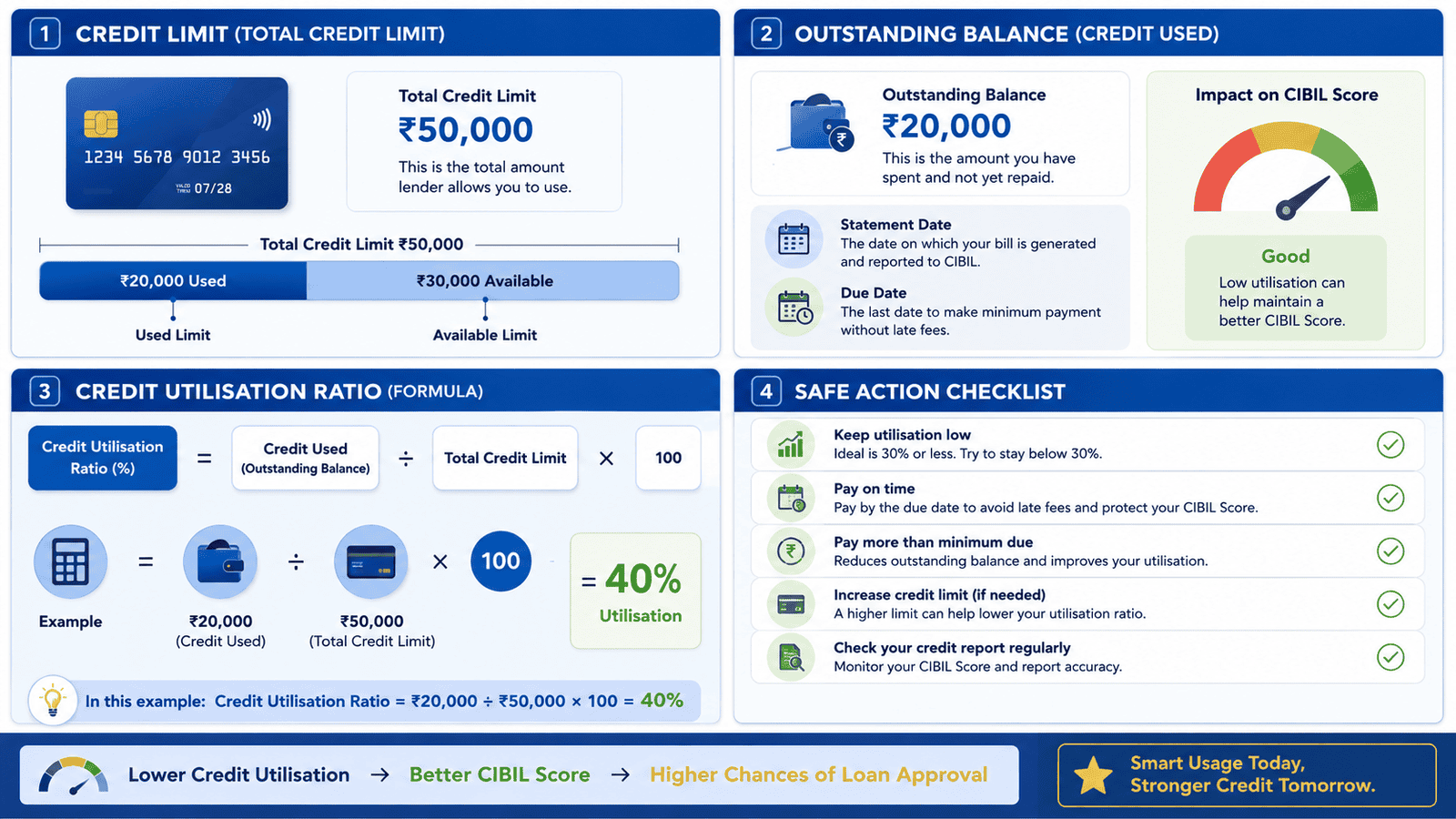
Credit utilisation ratio is the percentage of your available credit card limit that you are currently using. For example, if your card limit is ₹50,000 and your outstanding balance is ₹20,000, your utilisation is 40%. Lower, controlled usage generally looks healthier than regularly maxing out your card.
Key Takeaways
- Credit utilisation ratio equals your outstanding balance divided by your total available credit limit, multiplied by 100 — if you have spent ₹45,000 across cards with a combined ₹1,50,000 limit, your ratio is 30%.
- High usage can signal credit dependence to lenders, even if you pay the full bill on time every month — because the statement balance may already be reported before your payment clears.
- The statement generation date, not the payment due date, is often when the card issuer reports your outstanding balance to credit bureaus — paying only after the statement is generated may not lower the reported utilisation for that cycle.
- Paying the full bill on time remains essential — utilisation and payment history are two different credit factors, and both contribute to your credit profile.
- Reducing spending or paying part of your balance before the statement date is safer than taking a personal loan or opening unnecessary new cards just to bring down the ratio.
- Credit scores are calculated independently by each bureau — TransUnion CIBIL, Experian, CRIF High Mark, and Equifax — and may vary based on lender-reported data, so always check the actual bureau report if something looks wrong.
Key Facts at a Glance
| Term | What It Means | Why It Matters |
|---|---|---|
| Credit Limit | The maximum amount your card issuer allows you to spend on a credit card | Forms the denominator of the utilisation formula |
| Outstanding Balance | The total unpaid amount on your card at any given moment | Forms the numerator — higher balance means higher utilisation |
| Statement Balance | The balance recorded when the billing cycle closes and the statement is generated | This is often the figure reported to credit bureaus — not what you pay later |
| Due Date | The deadline by which you must pay the statement balance to avoid interest charges | Paying by due date avoids interest but may not change the already-reported utilisation |
| Overall Utilisation | Total outstanding across all cards divided by total credit limit across all cards | Gives a combined credit-usage picture across your full credit profile |
| Card-Wise Utilisation | Outstanding on one card divided by that card’s individual limit | A single maxed-out card can look risky even if overall utilisation is moderate |
What Is Credit Utilisation Ratio and Why Does It Matter?
Credit utilisation ratio — sometimes called credit limit usage percentage or card utilisation — measures how much of your revolving credit you are using at a given time. Revolving credit means credit that resets each billing cycle, such as a credit card, as opposed to a fixed instalment loan like a home or car loan. Because credit cards allow ongoing borrowing up to a set limit, bureaus and lenders track how close to that limit you are running.
The formula is straightforward:
Credit Utilisation Ratio = (Outstanding Balance ÷ Total Credit Limit) × 100
Where: Outstanding Balance = total unpaid amount currently owed on the card | Total Credit Limit = the maximum sanctioned limit on the card | Result = percentage of limit currently in use
For a single card with a ₹50,000 limit and ₹20,000 outstanding, the ratio is (₹20,000 ÷ ₹50,000) × 100 = 40%.
This matters because credit bureaus — including TransUnion CIBIL, Experian India, CRIF High Mark, and Equifax India — factor credit utilisation into their scoring models. Lenders who see a consistently high ratio on your credit report may interpret it as a sign that you are heavily reliant on credit to meet everyday expenses. This can affect loan and card approvals even when your repayment history is clean. For a deeper grounding in how your overall credit profile is scored, see CIBIL score basics.
Utilisation and Payment History Are Two Separate Factors
A common misunderstanding is that paying the full bill on time automatically means utilisation is not an issue. It is not that simple. Payment history and credit utilisation are two distinct components of your credit profile. Payment history captures whether you paid on time. Utilisation captures how much of your available credit you were using when the data was reported. A card user who spends ₹48,000 on a ₹50,000 limit every month and pays it fully on time still has a high utilisation ratio on record — because the statement may have been generated showing ₹48,000 outstanding before the payment was made.
Why Credit Bureau Reporting Creates the Timing Gap
Card issuers report data to credit bureaus periodically — typically at or around the statement generation date. This is not the same as the payment due date, which usually comes 15–20 days later. So the bureau may receive data showing a high balance before your payment is even due. This does not mean the system is unfair — it simply means that the snapshot used for reporting may capture your peak monthly spending, not your cleared balance.
Real Example: Priya’s Festival Month and the Statement Surprise
Priya, 31, is a marketing executive in Bengaluru earning ₹62,000 per month. She uses one credit card with a ₹50,000 limit for groceries, shopping, and travel bookings. In October, during the festival season, she spends ₹40,000 on the card — mainly on gifts, clothes, and a short trip. She pays the full ₹40,000 before the due date and does not carry any balance into the next month.
What Priya does not realise is that her card statement was generated a week before the due date, at which point it showed ₹40,000 outstanding. The card issuer reported that balance to the bureau. Her utilisation for that cycle was 80% — not because she defaulted, but because she spent heavily and the timing of reporting captured the peak balance.
One unusual month is unlikely to permanently damage a credit profile if the rest of her history is clean. But if Priya consistently spends ₹40,000–₹45,000 every month on a ₹50,000 limit, the bureau report will show persistently high utilisation across multiple cycles. Over time, this pattern tells a different story than one festive splurge. If Priya had wondered why her score dipped after a high-spending month, she could read more on the topic of score dropped suddenly to understand the full picture.
The key insight: paying on time protects your payment history. Managing your statement balance protects your utilisation ratio. Both matter.
Credit Utilisation Self-Checklist
Are You Managing Your Credit Utilisation Well?
- Do you know the credit limit on each of your cards and your combined total limit across all cards?
- Do you track your outstanding balance before the statement generation date — not just before the due date?
- Have you checked your credit report from at least one bureau — TransUnion CIBIL, Experian, CRIF High Mark, or Equifax — in the last six months?
- Do any of your individual cards regularly show usage above half their limit?
- Are you paying only the minimum amount due each month, or are you paying the full statement balance?
- If you have multiple cards, do you know your combined outstanding as a percentage of your combined limit?
How to Calculate Your Credit Utilisation Ratio
The calculation is the same whether you have one card or five. The difference is in whether you calculate card-by-card or across all cards combined.
One-Card Example
Utilisation = (₹20,000 outstanding ÷ ₹50,000 limit) × 100 = 40%
Where: Outstanding = ₹20,000 | Credit Limit = ₹50,000 | Ratio = 40%
Multi-Card Example
| Card | Credit Limit | Outstanding Balance | Card-Wise Utilisation |
|---|---|---|---|
| Card A | ₹75,000 | ₹30,000 | 40% |
| Card B | ₹50,000 | ₹10,000 | 20% |
| Card C | ₹25,000 | ₹5,000 | 20% |
| Total | ₹1,50,000 | ₹45,000 | Overall: 30% |
In this illustrative example, the overall utilisation is (₹45,000 ÷ ₹1,50,000) × 100 = 30%. But Card A alone is at 40%, which may still attract attention depending on how a lender interprets individual card usage. Keeping each card’s ratio under control matters — not just the overall picture.
Before-and-After Payment Example
Suppose Rohit has ₹35,000 outstanding on a ₹50,000 limit card. His statement date is the 10th of the month. If he pays ₹15,000 before the 10th, the statement is generated showing only ₹20,000 outstanding — a utilisation of 40% instead of 70%. That is the reported figure for that cycle. The full payment does not need to happen before statement generation — even a partial early payment can reduce what gets reported.
For more on how the billing cycle and reporting dates interact, see card billing cycle.
A Note on Credit Card EMI Conversion
When you convert a large credit card purchase into monthly instalments (EMI), the amount may or may not be treated as part of your outstanding balance depending on the card issuer and how they report to bureaus. Converting purchases to EMI reduces your monthly payment pressure but does not eliminate the underlying borrowing. It is not a reliable method for reducing reported utilisation, and it adds interest cost. Understand the full terms from your card issuer before converting.
Utilisation Range Interpretation
| Usage Range | What It May Indicate to Lenders | Suggested Action |
|---|---|---|
| 0% (no usage) | No recent revolving credit activity — limited recent repayment data | Occasional controlled use with full repayment is generally healthier than no use at all |
| 1–10% | Very low usage — strong signal of credit discipline | Maintain if sustainable; no need to force more spending |
| 11–30% | Generally controlled usage — considered a reasonable range by many lenders | Continue paying full bills on time and monitoring before statement date |
| 31–50% | Moderate-to-elevated usage — worth monitoring more carefully | Try to reduce spending or make a partial payment before statement generation |
| 51–80% | High usage — may appear credit-dependent to lenders reviewing the profile | Reduce spending or request limit review if income and repayment support it |
| 81–100% | Very high or maxed-out — significant risk signal in most credit profiles | Prioritise paying down the balance; avoid this pattern across multiple cycles |
These ranges are practical guidance based on commonly observed lender behaviour and bureau frameworks, including guidance from Experian India. They are not fixed rules, and exact scoring thresholds vary across bureaus and individual credit profiles. Do not rely on hitting a specific percentage to guarantee a score outcome.
Safety Checklist: Reducing Utilisation Without Creating a Debt Trap
The goal is a lower ratio through better spending habits — not by creating new financial risk. Here is how to approach it safely. Understanding when your balance gets reported is the starting point — read more on due date difference to get this right.
| Action | Safer or Risky? | Why It Matters |
|---|---|---|
| Pay part of the outstanding balance before the statement generation date if usage is unusually high | Safer | Reduces the balance reported to bureaus for that cycle without any additional cost |
| Spend less on the card this month to bring down usage | Safer | Directly solves the root cause — lower spending means lower outstanding |
| Pay the full statement bill on time every month | Safer | Protects payment history and prevents interest from accumulating |
| Request a credit limit increase only when income genuinely supports it | Safer | A higher limit reduces the ratio mathematically — but only if spending stays the same |
| Pay only the minimum amount due to “manage cash flow” | Risky | Does not reduce outstanding meaningfully and triggers high interest — often 36–42% per annum — on the remaining balance |
| Take a personal loan specifically to repay card dues and show lower card utilisation | Use Caution | Shifts credit card debt to instalment debt — may or may not help the overall profile; only consider if the personal loan interest is genuinely lower and you will not re-spend on the card |
| Open multiple new cards only to raise total credit limit | Risky | Each new application triggers a hard enquiry on your credit report and adds complexity to managing multiple outstanding balances |
How to Decide What’s Right for You
you pay the full card bill on time but your statement is generated when your balance is high — try making a partial payment before the statement date to reduce the reported outstanding for that cycle.
you regularly revolve credit card dues — meaning you carry a balance month to month and pay only the minimum — stop. The interest cost at typical credit card rates of 36–42% per annum makes this financially harmful; reducing utilisation by spending less or paying more aggressively is the right path.
you want a credit limit increase to reduce your ratio mathematically — consider it only if your income has genuinely increased and you are confident your spending will not rise to fill the new limit. Read about limit increase impact before requesting one.
you are planning to apply for a home loan, car loan, or personal loan in the next three to six months — try to reduce your credit card outstanding to a lower percentage of your limit before applying, since lenders will review your credit report as part of the assessment process.
you have multiple cards with different usage levels — calculate total utilisation across all cards combined, and also check individual card utilisation; a single card running consistently above 70–80% of its own limit may draw attention even if overall utilisation looks moderate.
you do not have income stability or an emergency fund, do not take additional credit — whether a new card or a personal loan — solely to manage your utilisation ratio. Address repayment discipline and spending habits first.
Common Mistakes to Avoid
Paying Only the Minimum Amount Due
Many card users pay the minimum amount due — typically 5% of the outstanding balance or ₹100–₹250, whichever is higher — believing they have “cleared” the bill.
This leaves 95% of the balance attracting credit card interest, often at 36–42% per annum. Over several months, the outstanding can snowball even as you keep making payments. Your utilisation remains high, and the interest burden grows. This is one of the most common and costly credit card mistakes. Learn why this matters so deeply at minimum due trap.
Always pay the full statement balance if you can. If you genuinely cannot, pay as much above the minimum as possible and work on reducing the shortfall each month.
Maxing Out a Card Every Month
Consistently spending close to or above 80–90% of your credit limit — even while paying the full bill — means your statement will regularly show very high utilisation.
If the issuer reports the balance before your payment, multiple consecutive cycles of 80%+ utilisation create a pattern that can affect how lenders assess your credit profile.
If your spending genuinely needs to be at that level, consider spreading it across two cards with sufficient combined limits, or request a limit increase if income supports it.
Closing an Old Card Without Checking the Impact
Closing a credit card removes that card’s limit from your total available credit. If you have balances on other cards, your overall utilisation ratio immediately increases even though your spending has not changed.
For example, if you have ₹30,000 outstanding and ₹1,50,000 total limit and you close a card with ₹50,000 limit and zero balance, your total limit drops to ₹1,00,000 — pushing utilisation from 20% to 30%. Think carefully before closing cards, especially older ones.
Assuming One Percentage Is the Universal Answer
You may have read that keeping utilisation “below 30%” guarantees credit score improvement. There is no such guarantee. Credit scores are calculated by multiple bureaus using different models, and each bureau receives lender-reported data that may vary. A ratio of 28% on one profile may behave very differently from 28% on another, depending on account age, payment history, number of accounts, and recent enquiries.
Focus on the behaviour — controlled spending, full on-time payments, awareness of statement timing — rather than chasing a single magic number.
Taking a New Loan or Credit Card Just for Utilisation Management
Adding new credit generates hard enquiries on your credit report and can temporarily reduce your score. If you are doing this only to expand your available limit without genuine income growth or need, it may create more credit complexity than benefit.
Evaluate whether the actual reduction in utilisation justifies the new obligation and the short-term impact of the enquiry.
Thinking EMI Conversion Solves Utilisation
Converting a large purchase to credit card EMI spreads the repayment, but the underlying principal is still a form of borrowed money. Some issuers may reduce the card’s available limit by the EMI amount during the repayment period. Check with your issuer exactly how EMI conversion is reflected in your outstanding and reported limit — it is not a clean solution to a utilisation problem.
Ignoring Individual Card Utilisation
Even if your overall utilisation across all cards looks acceptable, a single card running at 90% of its own limit may attract scrutiny. Lenders reviewing your credit report can see individual card-level data. Monitor each card separately, not just the combined total.
When This May Not Be the Right Focus
Controlling credit utilisation is a useful long-term credit habit — but it is not the only factor in your credit profile, and it is not the right focus in every situation.
If you have a history of missed or late payments, that is a more urgent issue than utilisation. Payment history is a significant component of credit scoring, and no amount of utilisation management will offset multiple defaults or delays in your record.
If you have a settled or written-off account — where the lender accepted less than the full amount owed — that requires separate attention. A settlement mark on your credit report is a serious negative entry that reducing utilisation will not address. According to TransUnion CIBIL, settled accounts remain on the credit report and are reviewed separately from utilisation-based factors.
If your credit report has incorrect entries — a wrong outstanding amount, a card you did not open, or payments recorded as missed when you have proof of payment — you need to raise a dispute directly with the relevant bureau. Reducing utilisation on other cards will not fix an error in the data.
If you have too many recent hard enquiries from multiple loan or card applications, that is another factor affecting your profile independently of utilisation.
If your primary concern is debt stress — where monthly obligations are genuinely unmanageable — focus on a realistic repayment plan rather than cosmetic score management through ratio adjustments alone.
If any of these apply to your situation, it may be worth exploring other options before committing.
Official Rules and Where to Verify
Credit utilisation is part of how credit bureaus calculate credit scores, and the underlying data comes from lenders who report to these bureaus. Here is where to verify your credit profile data directly:
- TransUnion CIBIL (transunioncibil.com) — India’s most widely referenced credit bureau; provides your CIBIL score and credit report including card-wise outstanding and limit data as reported by lenders.
- Experian India (experian.in) — Another RBI-licensed credit information company; offers credit reports and scores that may differ from CIBIL depending on lender reporting.
- CRIF High Mark (crifhighmark.com) — RBI-licensed bureau that reports credit repayment behaviour and may be used by certain lenders as part of their assessment process.
- Equifax India (equifax.co.in) — Also an RBI-licensed credit information company; relevant for a complete view of your credit profile across all four bureaus.
- Reserve Bank of India (rbi.org.in) — The regulatory authority for credit information companies in India; its guidelines govern how lenders must report credit data to bureaus and what information bureaus can collect and share.
If the outstanding balance or credit limit shown in your credit report does not match your card records, contact the card issuer first to confirm what was reported. If the issuer’s records are correct but the bureau entry is wrong, raise a dispute directly with the bureau through their official dispute portal.
Credit reporting rules, lender assessment methods, and bureau processes can change. Always verify current details from the relevant bureau, lender, or official regulatory source before acting.
Expert Tips
- Find out your card’s statement generation date — not just the due date — and note it in your phone calendar. This is the date that matters most for what gets reported to bureaus that month.
- Set spending alerts at 30%, 50%, and 80% of your card limit through your bank’s mobile app or net banking. Most Indian card issuers offer SMS or push notification alerts for these thresholds — activate them.
- If you have a large planned expense — home renovation, medical bill, travel booking — consider whether it makes sense to make a partial payment before the statement date to keep the reported balance lower for that cycle.
- Keep emergency expenses separate from routine card spending where possible. Mixing the two makes it harder to track whether you are creeping toward a high utilisation cycle.
- Never pay only the minimum amount due two months in a row. Even once is a risk signal — twice starts to create a revolving balance pattern that compounds interest rapidly.
- Review your full credit report from at least one bureau every three to four months — not just the score. The report shows card-wise outstanding, payment history, enquiries, and any incorrect entries. Checking the score alone does not give you this detail.
- If you are planning a major loan application, check your credit report at least 60–90 days in advance. This gives you time to pay down balances, spot report errors, and dispute anything incorrect through proper channels before the lender pulls your report.
Frequently Asked Questions
What is credit utilisation ratio in simple words?
It is the percentage of your credit card limit you are currently using. If your card has a ₹1,00,000 limit and you have spent ₹40,000, your utilisation is 40%. It is calculated separately for each card and also as a combined figure across all your cards.
How do I calculate my credit utilisation ratio?
Divide your outstanding balance by your credit limit and multiply by 100. For one card: ₹20,000 ÷ ₹50,000 × 100 = 40%. For multiple cards, add up all outstanding balances and divide by the sum of all credit limits — for example, ₹45,000 ÷ ₹1,50,000 × 100 = 30%.
Is 30% credit utilisation good for CIBIL?
Keeping usage below 30% is commonly cited as a reasonable range for credit health. However, credit scores are calculated by each bureau independently using their own models, and there is no guarantee that any specific percentage produces a guaranteed score outcome. Focus on consistent low usage and full on-time payments rather than targeting one fixed number.
Does high utilisation hurt my CIBIL score if I pay the full bill?
It can. Card issuers typically report your outstanding balance around the statement generation date — before your payment is even due. So if your statement shows ₹45,000 on a ₹50,000 card, the bureau may record 90% utilisation for that cycle even though you pay the full amount a week later. Paying on time protects your payment history, but the utilisation snapshot is taken earlier.
Is utilisation calculated on each card or all cards together?
Both. Bureaus and lenders may look at individual card utilisation — so a single card at 90% of its own limit can stand out — as well as your total utilisation across all cards combined. Managing both levels matters, not just the overall figure.
Can increasing my credit card limit improve utilisation?
Mathematically, yes — a higher limit with the same outstanding reduces the ratio. For example, ₹30,000 outstanding on a ₹50,000 limit is 60%, but on a ₹1,00,000 limit it becomes 30%. However, this only works if your spending does not increase to fill the new limit. A limit increase also triggers a review by the card issuer and may involve a hard enquiry depending on the issuer’s process.
Is zero credit utilisation good or bad?
Not using a card at all means there is no recent revolving credit activity to show on your report. Some bureaus and lenders prefer to see controlled, repayable usage rather than zero activity — because it demonstrates current repayment behaviour. Using a small amount each month and paying the full bill is generally healthier than keeping a card entirely inactive.
Does converting credit card spending to EMI reduce utilisation?
Not always — and not in a straightforward way. When you convert a purchase to card EMI, some issuers reduce the card’s available limit by the outstanding EMI principal during the repayment period. How the issuer reports this to the bureau varies. EMI conversion does not erase the underlying borrowing and adds interest cost. Confirm with your specific issuer how EMI balances are reflected in your credit limit and reported outstanding before using this as a utilisation strategy.
Final Verdict
Credit utilisation ratio is not a hidden technical metric — it is a direct reflection of how much of your available credit you are using at the time lenders review your profile. For most Indian card users, the practical message is simple: spend within a comfortable range of your limit, pay the full bill on time, and be aware that the statement generation date — not the due date — is when your balance snapshot is often taken. If you have two cards, manage the ratio on each individually and track the combined picture. If you are applying for a loan, reducing outstanding on your cards a couple of months before the application can help present a healthier credit profile. Do not take new loans, open unnecessary cards, or pay only the minimum due just to chase a ratio. Control the behaviour, and the ratio will follow. If your credit report shows unexpected data, verify it directly with the relevant bureau. Always verify your latest credit report, lender requirements, and bureau process before making a credit-related decision.
This article is for educational purposes only and should not be treated as personalised financial, credit, or legal advice. Credit scores, credit reports, lender eligibility criteria, and bureau processes can vary and may change over time. Please verify current details with the relevant credit bureau, lender, official regulatory source, or a qualified professional before making any credit-related decision.

Neha Menon writes simple, borrower-first explainers on CIBIL scores, credit reports, bureau disputes, DPD, loan settlement impact, hard inquiries, and practical credit score recovery. She focuses on helping Indian borrowers understand lender-reported data, avoid credit mistakes, and take safer next steps without false promises.