
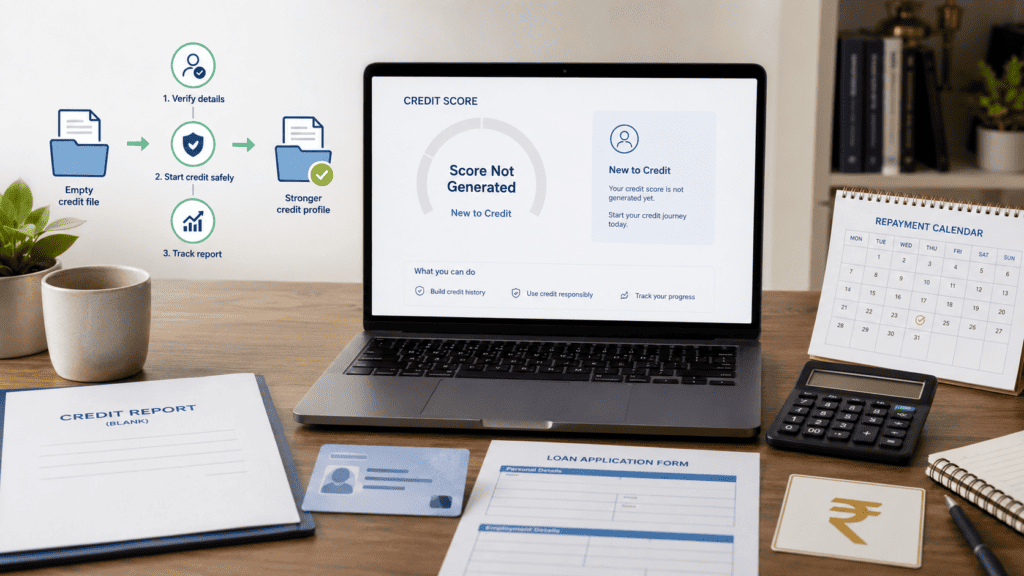
You check your CIBIL score before applying for a credit card or personal loan — and instead of a number, you see “score not generated,” “NH,” “NA,” or a completely blank report. It stops you in your tracks. Does this mean bad credit? Will every lender reject you? Should you apply anyway and hope for the best?
The short answer: probably not bad credit. “CIBIL score not generated” is one of the most common things Indian first-time borrowers and people with limited credit history encounter — and in most cases it simply means the credit bureau does not have enough matching credit data yet to calculate a score. It is a very different situation from having a low score due to missed payments or defaults.
This guide explains exactly why your CIBIL score may not be generated, what NH and NA mean, how to diagnose whether you are truly new to credit or facing a lender reporting gap or identity mismatch, and what safe next steps look like. No article can guarantee loan approval or a fixed score-generation timeline — but this one will help you understand where you stand and what to do next.
Quick Answer: Why Is Your CIBIL Score Not Generated?
CIBIL score not generated usually means the bureau does not have enough matching credit data to calculate your score, not that you have bad credit. Start with a 6-point check: credit history, PAN/name match, lender reporting, account age, inactive accounts, and dispute need. Avoid random loan applications while checking this.
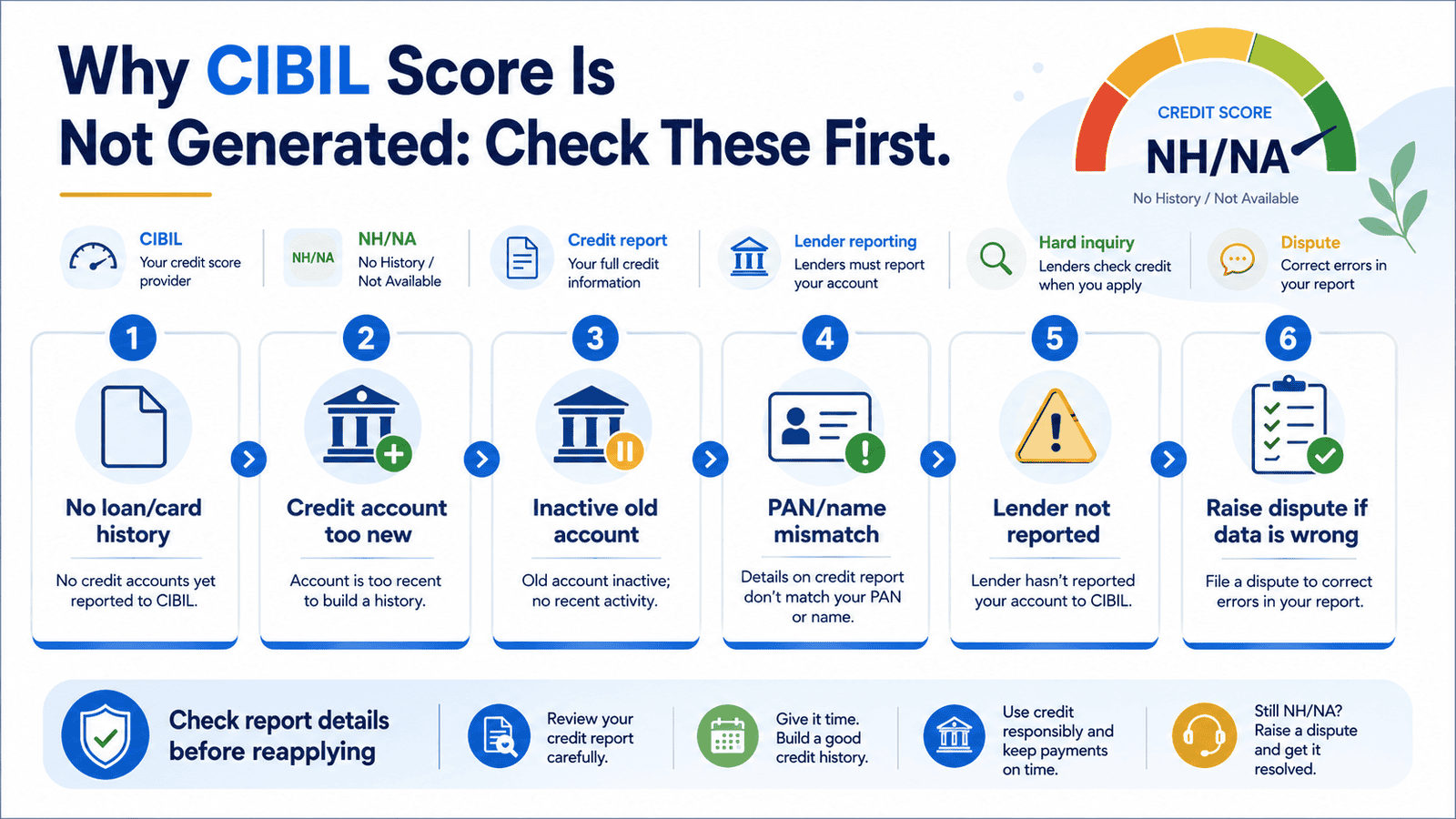
Immediate Action Steps
- Step 1 — Check whether you have ever used a credit product: A loan, credit card, BNPL facility, or consumer durable EMI — these create credit history. A salary account, UPI transactions, or debit card use do not.
- Step 2 — Verify your personal details: Confirm that your PAN, full name, date of birth, mobile number, and address are consistent across your lender records and your bureau report.
- Step 3 — If credit exists but the score is missing: Check whether your lender reports data to credit bureaus, and whether the account details on the report match your own records.
- Step 4 — Do not apply to multiple lenders right now: Each hard inquiry from a lender can be recorded on your credit report. Applying randomly while your data situation is unclear can add unnecessary inquiries without benefit.
Key Takeaways
- “CIBIL score not generated” is not the same as a bad or low credit score — it typically means insufficient matching credit data exists at the bureau, often because you have never used a credit product or your account is very recently opened.
- NH (No History) and NA (Not Applicable) are official status labels used when credit repayment data is absent or insufficient — they do not indicate default, missed payment, or financial irresponsibility.
- Your savings account, salary credits, UPI payments, and debit card transactions do not create credit history with CIBIL or any other bureau — only credit products reported by regulated lenders count.
- A lender reporting delay, a PAN or name mismatch, or an add-on card situation (where the primary cardholder holds the credit record) can cause a “score not generated” result even if you believe you have credit history.
- Raising a credit bureau dispute is the correct path if your credit account exists but does not appear correctly on your report — bureau data correction is a formal, documented process, not a quick phone call fix.
- Safe credit-building options for new-to-credit borrowers include secured credit cards backed by a fixed deposit, salary-linked entry-level cards from your own bank, and small regulated credit products — not high-interest loan apps or informal lenders.
Key Facts at a Glance
| Situation | What it likely means | Suggested next step |
|---|---|---|
| No loan, card, or EMI ever taken | No score may be completely normal — insufficient credit data | Consider a safe credit-building option if you need credit access |
| Credit account opened recently | Lender may not yet have reported data to the bureau — verify current lender reporting frequency from the official source | Wait, then verify report again; contact lender if account does not appear |
| Wrong PAN, name, or date of birth | Data mismatch may prevent bureau from matching your records | Check bureau report details against official ID; contact lender and bureau if wrong |
| Score missing despite existing loan or card | Lender may not report to bureaus, or account may be mismatched | Contact lender; raise a formal bureau dispute if data is incorrect |
| Add-on credit card user only | Credit record belongs to primary cardholder, not add-on user | Apply for your own primary card or credit product to build independent history |
| Repeated loan applications while score is missing | May create multiple hard inquiry records without benefit | Pause applications; diagnose the root cause first |
What “CIBIL Score Not Generated” Actually Means
A CIBIL score — or any credit bureau score in India — is calculated using credit repayment data that lenders report to credit information companies. According to the credit reporting framework overseen by the Reserve Bank of India (rbi.org.in), regulated lenders including banks and NBFCs are required to report credit data to licensed credit information companies. TransUnion CIBIL (transunioncibil.com) is one of four RBI-licensed credit bureaus operating in India, alongside Experian India, CRIF High Mark, and Equifax India.
When a bureau does not have enough data — or cannot match the data it has to your identity — it cannot generate a score. That is the core reason behind “CIBIL score not generated.” It is a data-availability or data-matching issue, not a judgment about whether you are a good or bad borrower.
What NH and NA Mean in a Credit Report
NH (No History) typically indicates that the bureau has no credit history on record for you — either because you have never taken a credit product, or because your accounts are extremely limited or very old and inactive. NA (Not Applicable) is a related status that indicates the score cannot be calculated based on the current data available. Neither NH nor NA means you have defaulted, missed a payment, or done anything wrong financially. They mean: insufficient data to generate a number.
Understanding your CIBIL score basics — how the score range works and what factors feed into it — helps you understand why repayment history needs to exist before a score can be calculated at all.
Why Savings Accounts and UPI Do Not Create a CIBIL Score
This is a very common misunderstanding. Many people assume that because they have a bank account, use UPI regularly, receive salary credits, or use a debit card, they must have a credit record somewhere. They do not. Credit bureaus collect data on credit behaviour — how you repay loans, credit cards, EMIs, and other credit facilities. Your savings account activity, UPI payments, and debit card use are not reported to credit bureaus and do not create any credit history whatsoever.
The Difference Between a Credit Report and a Credit Score
It is also worth separating two things that often get confused. A credit report is the full record of your credit accounts, repayment history, inquiries, and personal details held at a bureau. A credit score is a number — generated from that report data — that summarises your creditworthiness. You can have a credit report with limited data (one old closed account, for example) and still not have a generated score because there is not enough active, recent repayment data to calculate one. “Score not generated” does not necessarily mean your report is completely empty — it may mean the data present is insufficient to produce a number.
Real Example: Three Borrowers, One Message
Three different borrowers in India might all see “CIBIL score not generated” — but for entirely different reasons, with entirely different next steps.
Rohan, 26, Pune — Salaried IT support executive, ₹38,000/month: Rohan has never taken a loan or applied for a credit card. He has had a salary account for three years and uses UPI daily. When he checks his CIBIL report before applying for his first personal loan, he sees “score not generated.” In his case, this is completely normal — he has no credit product history for CIBIL to work with. His next step is to understand his first-credit options and choose one that suits his repayment comfort level, not to apply for ten loans hoping one approves.
Priya, 29, Bengaluru — Marketing associate, ₹52,000/month: Priya got a credit card three months ago from a private bank. She has used it lightly and paid the full bill twice. When she checks her CIBIL report, she still sees no score. In her case, the lender may not have yet reported enough data to the bureau, or the reporting may be recent. Her next step is to wait, check again after some time, and confirm that her lender does report to CIBIL. If the account still does not appear after a reasonable period, she should contact the lender.
Vikram, 34, Hyderabad — Self-employed, ₹70,000/month: Vikram has had a home loan for six years, but when he applies for a top-up, the lender says his CIBIL report shows no score. On checking his report, Vikram finds his name is recorded differently from his PAN card — a spelling variation from when the loan was originally processed. This mismatch means the bureau has data but cannot fully match it to his identity. His next step is to contact his lender to correct the name on their records and follow up with the bureau if the report still does not update.
The key insight: the same three words — “score not generated” — can mean three completely different problems with three different solutions. Diagnosing which applies to you is the first job.
Eligibility Checklist: Are You New-to-Credit or Facing a Data Issue?
Run through this self-check before deciding your next step. It is not a lender eligibility test — it is a diagnostic tool to help you understand your situation.
| Check | Your answer | What it suggests |
|---|---|---|
| Have you ever taken a loan, credit card, BNPL, EMI card, or consumer durable loan? | No | Likely new-to-credit — no score may be normal |
| Are you the primary account holder, not just an add-on cardholder? | Add-on only | Credit history may belong to primary cardholder, not you |
| Do your PAN, full name, date of birth, mobile number, and address match your lender records exactly? | Unsure or No | Possible identity mismatch — check and correct before applying |
| Is your credit account active, recently closed, or very old? | Old and inactive | Inactive or very old accounts may contribute little to score generation |
| Does your lender confirm they report to credit bureaus? | Unknown or No | Not all lenders report to all bureaus — verify directly with the lender |
| Did you open your credit account very recently? | Yes, within last few months | Reporting may not yet have occurred — verify current lender reporting frequency from official sources before acting |
If you are genuinely new to credit and comfortable with the repayment commitment, a secured credit card against a fixed deposit is one of the lower-risk entry points. Read the full guide on the FD-backed card option — including the eligibility conditions and risks — before deciding.
No Score vs Low Score vs NH/NA vs Data Mismatch: What Is the Difference?
| Status | What it means | Does it indicate bad credit? | What to do next |
|---|---|---|---|
| Score not generated / No score | Bureau does not have enough credit repayment data to calculate a number | No — data absent, not negative | Diagnose whether new-to-credit, reporting gap, or mismatch; use safe credit-building options if needed |
| NH (No History) | No credit history on file — no repayment records found | No — absence of history, not negative history | Consider a first credit product if eligible and repayment is comfortable |
| NA (Not Applicable) | Score cannot be calculated from available data — often for very limited or very old accounts | No — insufficient data, not bad data | Check account status and lender reporting; add active credit history if suitable |
| Low score (e.g. below 650) | Score was calculated but reflects poor repayment behaviour, high utilisation, or defaults | Yes — negative repayment history exists | Improve repayment behaviour; check report for errors; reduce utilisation; allow time for improvement |
| Report not found / No hit | Bureau could not match the details provided to any existing credit record | Unclear — may be new-to-credit or identity mismatch | Verify PAN, name, date of birth; check with lender; raise dispute if record should exist |
Note: CIBIL score range thresholds and the exact interpretation of NH/NA labels may vary. Verify current official definitions from TransUnion CIBIL (transunioncibil.com) before publishing or acting on specific score range figures.
What to Do If You Have Credit but Your Score Is Still Not Showing
If you know you have taken a loan or credit card — but your bureau report either shows nothing or shows incorrect information — a lender reporting error or personal data mismatch is the most likely cause. Here is how to approach it step by step.
Step 1 — Download Your Official Credit Report
Access your credit report directly from the official bureau source — TransUnion CIBIL (transunioncibil.com or cibil.com), Experian India (experian.in), CRIF High Mark (crifhighmark.com), or Equifax India (equifax.co.in). Under RBI regulations, you are entitled to one free credit report per year from each licensed bureau. Review the report carefully: check personal details, account listings, account status, and payment history.
Step 2 — Compare Personal Details Across Sources
Check whether the name, PAN, date of birth, mobile number, and address in the bureau report exactly match the details your lender holds. Even minor differences — a middle name missing, a date of birth digit wrong, or a PAN character error — can prevent data from matching correctly.
Step 3 — Contact Your Lender First
If a credit account you hold is not appearing in the report, contact the lender directly. Ask them to confirm: whether they report data to credit bureaus, which bureaus they report to, and whether your account details in their records match your official ID documents. If there is an error on the lender’s side, request a correction in writing and keep the reference number.
Step 4 — Raise a Formal Bureau Dispute If Needed
If the data on the bureau report is wrong — an account listed incorrectly, a wrong status, missing closure record, or personal detail error — you can raise a formal dispute. The credit report dispute process in India involves filing a dispute directly with the bureau, which then contacts the lender for verification. Keep your dispute reference number and follow up if there is no response within a reasonable period. Verify current dispute processing timelines from the official bureau source before expecting a specific resolution date.
Step 5 — Document Everything
Whether you are contacting the lender or the bureau, keep written records: emails, reference numbers, acknowledgement letters, and screenshots. These matter if you need to escalate to the RBI Integrated Ombudsman Scheme (rbi.org.in) if the issue is not resolved through normal channels.
Safety Checklist: What Not to Do When Your Score Is Not Generated
Do not apply to multiple lenders or loan apps in a short period
When a lender runs a credit check on you, it may be recorded as a hard inquiry on your credit report. Applying to many lenders at the same time while your data situation is unclear can leave a trail of hard inquiries without resulting in credit. This can work against you when your score does eventually generate.
Do not believe “guaranteed CIBIL score generation” claims
No app, agent, or service can guarantee that your CIBIL score will appear within a fixed number of days. Score generation depends on lender reporting and credit activity — it is not a service anyone can sell you. If someone is charging money for “guaranteed CIBIL score fixing,” it is a scam signal.
Do not share your PAN, OTP, or bank credentials with unknown agents
Fraudsters sometimes target people worried about credit rejection by offering “credit repair” help that requires OTP or PAN details. No legitimate credit bureau or lender requires your OTP to check or correct your credit information.
Do not take high-interest or unregulated loan products just to create a credit score
Taking a loan from an unregulated app or informal lender at very high interest rates simply to “start” a credit history is financially dangerous. If you cannot comfortably repay the loan, any missed payment will create a negative record — the opposite of what you need.
Stick to regulated lenders and official bureau verification
RBI-registered banks and NBFCs are the safe lane. Check the RBI’s list of registered NBFCs and the bureau’s official website for any credit-building product you are considering. According to RBI (rbi.org.in), only licensed credit information companies are authorised to maintain credit records in India.
How to Decide What’s Right for You
You have never used any credit product — then you are genuinely new to credit, and no score is completely expected. Build credit safely starting with a manageable product you can repay fully and on time, such as a secured credit card against your FD or an entry-level card from your salary bank.
You opened a credit account recently — then the lender may not have yet reported data to the bureau. Wait and verify the report again after some time. Confirm with your lender whether and when they report to credit bureaus. Do not apply elsewhere while waiting.
Your personal details are inconsistent across lender records and your bureau report — then correct the mismatch before doing anything else. Contact the lender first, then the bureau if the data on file is still wrong. A mismatch will not resolve itself.
You have existing credit that is not appearing on your report — then contact the lender to verify their reporting status, and raise a formal bureau dispute if data is missing or incorrect. See the first loan options guide only after resolving reporting issues.
You need credit urgently and your score is not yet generated — then compare regulated lender options carefully, including secured loans, FD-backed products, or employer-tied credit, and assess the full cost before committing. Urgency is not a reason to use unsafe or unlicensed lenders.
You are not sure which situation applies to you — then do not apply anywhere yet. Work through the eligibility checklist above, download your official credit report, and identify the root cause before making any credit application decision.
Common Mistakes to Avoid
Applying to many lenders the moment you see “score not generated”
The instinct is to “test” whether some lender will approve you. But multiple applications in a short period can create hard inquiry records on your report. When your score does eventually generate, those inquiries are visible and can signal credit-seeking behaviour to future lenders. Pause, diagnose first.
Assuming debit card and UPI activity creates CIBIL history
This is one of the most widespread misunderstandings. A salary account in active use for years, hundreds of UPI transactions, and regular debit card payments contribute absolutely nothing to your CIBIL score or credit report. Only credit products — loans, credit cards, EMI facilities — reported by regulated lenders count.
Ignoring PAN or name mismatches
A two-character name spelling difference between your lender’s record and your PAN card can be enough to prevent your credit data from matching at the bureau. Many borrowers overlook this because they assume the bank “got it right.” Check carefully — the mismatch can leave your credit history invisible even after years of responsible repayment.
Taking any available loan just to “start” a CIBIL score
Some borrowers take high-interest short-term loans from digital apps specifically to create a credit record. If repayment is missed even once, the resulting negative record is far more damaging than no record at all. Never borrow to build credit unless you are completely certain you can repay on time, every time. Read about first loan options before deciding.
Paying a “credit repair” agency that promises fast CIBIL score fixes
Legitimate credit record corrections happen through the formal bureau dispute process, which involves the lender verifying data directly with the bureau. No third-party agent can speed this up, guarantee a result, or remove accurate negative records. Agencies charging fees for “guaranteed CIBIL improvement” are taking your money for something you can do yourself for free through official channels.
Checking the bureau report only from third-party apps
Many third-party apps provide credit score data as a service. While they can be convenient, they may not always reflect the exact data or status shown in the official bureau report. If your score shows as “not generated,” verify directly from the official bureau source to confirm what the actual record holds — especially before raising a dispute.
Forgetting to check all four bureaus
India has four RBI-licensed credit bureaus: TransUnion CIBIL, Experian India, CRIF High Mark, and Equifax India. Lenders choose which bureaus they report to. Your score may be generated at one bureau but not another, depending on which bureau your lender uses. If one shows no score, check others before concluding you have no credit record anywhere.
When This May Not Be the Right Choice
Trying to generate a CIBIL score by taking a new credit product may not be right for you in the following situations:
Your income or employment is currently unstable: Taking a loan or credit card when income is uncertain adds repayment risk. A missed payment will create a negative record — the opposite of your goal.
You cannot comfortably repay the full credit card bill each month: If you may carry an unpaid balance, the interest cost and the risk of a missed payment outweigh the credit-building benefit.
You are considering high-interest loan apps as a credit-building tool: Very high borrowing costs combined with strict collection practices make app-based high-interest products a risky way to start a credit history.
Your actual problem is a data mismatch or lender reporting error: Taking new credit does not fix a mismatch. If your existing credit history is invisible due to wrong PAN details or a lender not reporting, adding new credit before fixing the underlying problem achieves nothing useful.
If any of these apply to your situation, it may be worth exploring other options before committing.
Official Rules and Where to Verify
The credit information framework in India is regulated by the Reserve Bank of India under the Credit Information Companies (Regulation) Act. RBI (rbi.org.in) is the authoritative source for understanding how lenders are required to report credit data, what rights borrowers have, and how grievance processes work at the regulatory level.
For your credit report, score, dispute process, and personal data correction, the official sources are:
- TransUnion CIBIL — transunioncibil.com and cibil.com — for score access, report download, consumer dispute filing, and support
- Experian India — experian.in — for report access and dispute filing if your lender reports to Experian
- CRIF High Mark — crifhighmark.com — for report access if your lender reports to CRIF
- Equifax India — equifax.co.in — for report access if your lender reports to Equifax
- RBI Integrated Ombudsman — rbi.org.in — for escalation if a lender or bureau does not resolve your complaint through normal channels
You can also check your score safely through official and verified routes before relying on third-party app data. Credit reporting rules, lender assessment methods, and bureau processes can change. Always verify current details from the relevant bureau, lender, or official regulatory source before acting.
Expert Tips
- Start with one manageable credit product, not several: If you decide to begin building credit history, one product used responsibly creates a clean, positive record. Multiple new accounts opened at once can appear as credit-seeking behaviour and may complicate your profile.
- Pay the full outstanding amount — not just the minimum due — by the due date: Paying only the minimum due on a credit card means interest accrues on the remaining balance and your utilisation stays high. Full payment is the single most important credit behaviour habit to build from day one.
- Keep your credit card usage modest relative to the limit: High credit utilisation — using a large proportion of your card limit — can affect how lenders view your profile even before a score is generated. Using a small fraction of the available limit and paying it in full keeps your utilisation low. Verify current recommended utilisation thresholds from TransUnion CIBIL (transunioncibil.com) as these may change.
- Check your credit report periodically through official sources, not obsessively: Checking your own credit report through official bureau portals is a soft inquiry and does not affect your score or profile. Doing this a few times a year is healthy; doing it daily adds no value.
- Keep your NOC and account closure documents: When a loan is fully repaid and closed, obtain the No Objection Certificate (NOC) or closure letter from the lender and preserve it. If the bureau later shows the account as active or overdue, this document is your proof for the dispute process.
- Correct personal details proactively: If you change your mobile number, address, or have a name correction on official documents, update these with your lender promptly. Stale or inconsistent details are a common cause of data mismatch problems later.
Frequently Asked Questions
Why is my CIBIL score not generated?
The most common reasons are: you have never used a credit product (no loan, credit card, or EMI facility), your credit account was opened too recently for lender-reported data to appear, your personal details such as PAN or name do not match across lender and bureau records, or your credit account is very old and inactive. In all these cases, the bureau cannot calculate a score because it either has no data or cannot match existing data to your identity.
Is no CIBIL score the same as a bad CIBIL score?
No — these are meaningfully different situations. A bad or low score means the bureau has credit repayment data for you and that data reflects poor behaviour such as missed payments, defaults, or very high utilisation. “Score not generated” means there is insufficient matching credit data to calculate any score at all. No score is a starting point; a bad score is a record of past problems. Lenders may treat them differently — some may be willing to assess a no-score borrower on income and documents, while a borrower with a very low score may face stricter scrutiny.
What does NH mean in a CIBIL report?
NH stands for No History. It indicates that the bureau has no credit repayment history on record for you — usually because you have never taken a loan, credit card, or similar credit product that was reported to the bureau. It does not mean you have bad credit or have defaulted on anything. It simply means there is no credit data to work with.
Can I get a personal loan without a generated CIBIL score?
Some lenders — particularly banks where you hold a salary account, or NBFCs that assess new-to-credit borrowers — may consider loan applications from borrowers with no generated score, using income documents, employment stability, and other factors. However, terms, interest rates, and eligibility vary significantly by lender. There is no guarantee of approval, and lender criteria can change. Verify directly with the lender about their assessment process for no-score applicants.
Can a secured credit card help generate a CIBIL score?
A secured credit card — backed by a fixed deposit — is one of the lower-risk routes for new-to-credit borrowers because approval typically does not require an existing credit history. If the issuing bank reports card activity to credit bureaus, and if you use the card and pay the full bill on time consistently, credit repayment data can gradually accumulate. This may eventually result in a score being generated. No timeline can be guaranteed — it depends on when and how the lender reports, and how much activity exists on the account.
What should I do if I already have a loan but my CIBIL score is still not showing?
First, download your official credit report directly from the bureau and check whether the loan account appears. If it does not appear, contact the lender to confirm whether they report to that bureau and whether your personal details in their records match your official documents. If the account appears but with wrong information, raise a formal dispute with the bureau. Keep reference numbers for all correspondence.
Does checking my CIBIL score reduce it?
No. Checking your own credit score or report — through the official bureau website or authorised channels — is recorded as a soft inquiry and does not affect your credit score or profile. Only hard inquiries, triggered when a lender formally checks your credit as part of a loan or card application, are recorded in a way that may be visible to other lenders. Soft inquiries from your own checks are not visible to lenders and have no impact on any score calculation.
How often should I check my credit report if my score is not generated?
Checking once every three to four months is generally reasonable — enough to track whether new credit data has appeared or whether any mismatch has been corrected, without becoming an anxious daily exercise. You are entitled to at least one free credit report per year from each RBI-licensed bureau. Verify current free-access terms directly from the bureau’s official website, as these may be updated over time.
Final Verdict
“CIBIL score not generated” is almost always a data availability or data matching issue — not proof of bad credit or guaranteed loan rejection. The first step is always to diagnose correctly: are you truly new to credit, are you waiting for a recently opened account to appear, or is there a PAN or name mismatch that is making existing data invisible?
First-time borrowers who have no credit product history can consider a low-risk credit-building route — but only if repayment is comfortable and the lender is regulated. Borrowers who suspect a lender reporting gap or personal data mismatch should prioritise correction through the formal bureau dispute process before applying anywhere new.
Above all, avoid random applications, unverified “credit repair” agents, and high-interest informal lenders. The official path — bureau report, lender verification, formal dispute if needed — is slower but far safer. Always verify your latest credit report, lender requirements, and bureau process before making a credit-related decision.
This article is for educational purposes only and should not be treated as personalised financial, credit, or legal advice. Credit scores, credit reports, lender eligibility criteria, and bureau processes can vary and may change over time. Please verify current details with the relevant credit bureau, lender, official regulatory source, or a qualified professional before making any credit-related decision.

Neha Menon writes simple, borrower-first explainers on CIBIL scores, credit reports, bureau disputes, DPD, loan settlement impact, hard inquiries, and practical credit score recovery. She focuses on helping Indian borrowers understand lender-reported data, avoid credit mistakes, and take safer next steps without false promises.