
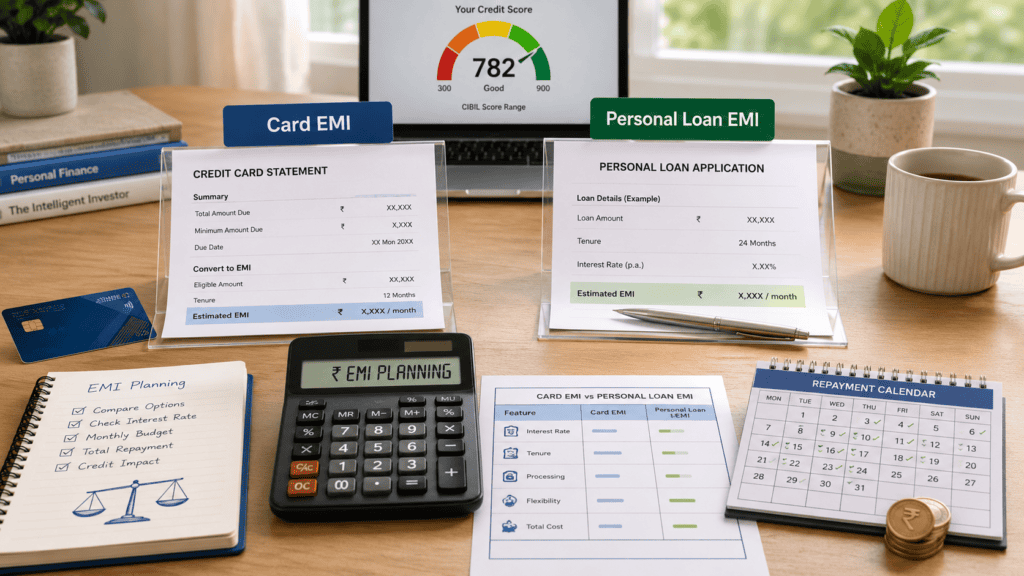
You are looking at a ₹1 lakh purchase — a smartphone, a laptop, a medical bill, or a home appliance — and you have two options sitting in front of you. Your credit card app is offering to convert the amount into monthly instalments. Your bank is offering a personal loan with a similar EMI. Both look manageable on paper. But the monthly payment is not the full story. The total interest, the processing fee, the GST, the impact on your credit card limit, and what happens if you miss a payment — all of these decide which option actually costs you less and puts you at less financial risk. This article gives you a practical, cost-first comparison of credit card EMI vs personal loan in India so you can make a decision based on total repayment, not just the number that appears in the EMI column. All interest rates, charges, and lender-specific terms used here are illustrative — verify current figures from the card issuer, lender, or official sources before acting.
Quick Answer: Credit Card EMI vs Personal Loan — Which Is Better?
Credit card EMI vs personal loan depends on amount, tenure, charges and repayment comfort. For a ₹1 lakh purchase, compare EMI, total interest, processing fee, GST, credit-limit blockage and prepayment rules before choosing. Card EMI suits short merchant purchases; personal loan may suit larger planned borrowing.
Key Takeaways
- A lower EMI does not mean lower total cost — a personal loan at a lower interest rate over the same tenure will almost always result in a smaller total repayment than a credit card EMI at a higher rate, even if the monthly difference looks small.
- Credit card EMI typically blocks a portion of your available credit limit equal to the outstanding EMI principal — so a ₹1 lakh card EMI on a ₹1.5 lakh limit leaves you with very little buffer for other card spends until the EMI is repaid.
- Processing fees and GST on those fees can add ₹1,000–₹3,000 or more to your actual borrowing cost on a ₹1 lakh amount — both card EMI and personal loans may carry these charges, and they need to be compared, not ignored.
- According to TransUnion CIBIL (transunioncibil.com), both credit card EMI and personal loan EMI missed payments are reported to credit bureaus and can damage your credit score — missing even one EMI before the due date can affect your CIBIL score for months.
- No-cost EMI advertised by merchants is rarely free — the discount you would have received on direct purchase is often adjusted against the zero-interest claim, and a processing fee plus GST on that fee still applies in many cases.
- Prepayment rules differ: personal loan foreclosure charges and credit card EMI cancellation fees vary by lender and must be checked before committing, especially if you expect to close the borrowing early.
- If your existing EMI burden already exceeds 40–50% of your monthly take-home income, adding either card EMI or a personal loan may put your monthly cash flow under stress — repayment comfort matters as much as the rate.
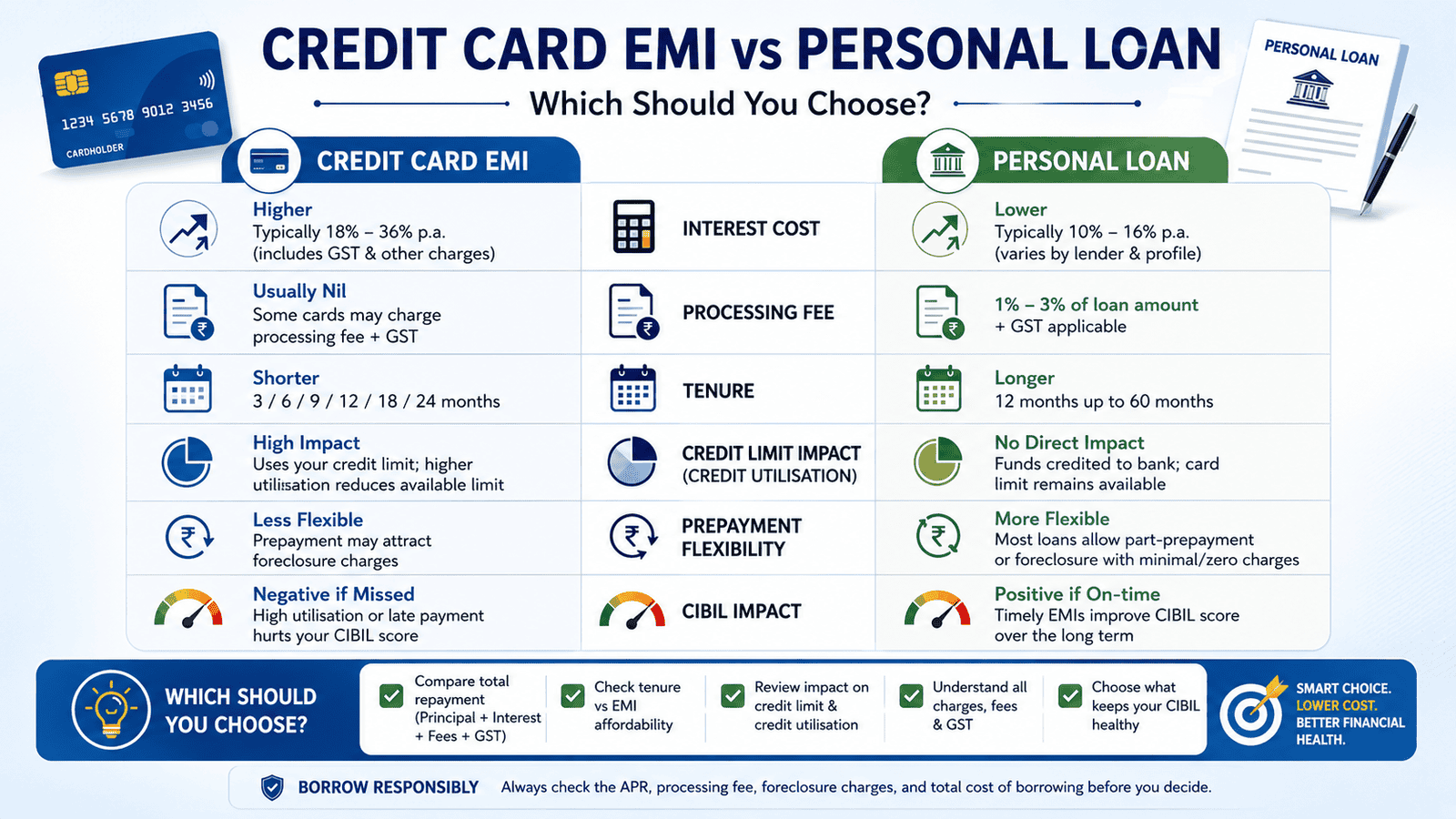
Credit Card EMI vs Personal Loan: Side-by-Side Comparison
| Factor | Credit Card EMI | Personal Loan |
|---|---|---|
| What it is | Converts a card purchase or outstanding balance into fixed monthly instalments | A separate unsecured loan disbursed to your bank account |
| Best suited for | Smaller merchant purchases, short tenure, existing card users | Larger planned expenses, longer tenure, need cash in hand |
| Typical tenure range | 3 to 24 months (verify with card issuer) | 12 to 60 months (verify with lender) |
| Interest rate style | Reducing balance; rates can be higher than personal loan rates | Reducing balance; may be lower than card EMI rate |
| Processing fee | Flat fee or percentage; may apply even on no-cost EMI | Typically 1–3% of loan amount (verify with lender) |
| GST on charges | 18% GST applies on processing fee and interest charges | 18% GST applies on processing fee |
| Credit limit impact | Blocks card limit by outstanding EMI principal — Limit Reduced | No impact on card limit — Limit Unaffected |
| Documentation needed | None — uses existing card account | KYC, income proof, bank statements, employer details |
| Disbursement speed | Instant to same day | Same day to 3–5 working days |
| Prepayment / foreclosure | EMI cancellation may carry a fee; check card MITC | Foreclosure charges apply; RBI-regulated for floating-rate loans |
| CIBIL / credit score impact | Missed EMI hurts score; affects credit utilisation ratio | Missed EMI hurts score; adds to credit mix |
| Borrower risk | Medium — card limit risk | Medium — fixed obligation |
Key Facts at a Glance
| Parameter | Credit Card EMI | Personal Loan |
|---|---|---|
| Minimum amount | Typically ₹2,500–₹5,000 (verify with card issuer) | Typically ₹25,000–₹50,000 (verify with lender) |
| Tenure | 3–24 months (verify with card issuer) | 12–60 months (verify with lender) |
| Charges to confirm | Processing fee, GST on fee, foreclosure/cancellation fee | Processing fee, GST on fee, foreclosure charge, prepayment fee |
| Credit score impact | Missed EMI reported to all four credit bureaus | Missed EMI reported to all four credit bureaus |
| No-cost EMI hidden cost | Processing fee, GST on fee, possible loss of merchant discount | Not applicable |
How Credit Card EMI and Personal Loan Actually Work
Step 1 — What is credit card EMI?
Credit card EMI is a facility offered by your card issuer that converts a large purchase — or an existing outstanding balance — into fixed monthly payments spread over a chosen tenure. There are broadly three types. Merchant EMI (sometimes called no-cost EMI) is offered at the point of purchase, typically at an electronics or appliance store. Card EMI conversion lets you convert a transaction already posted on your card statement into instalments, usually through the card app or net banking. A credit card loan (or insta loan) is a pre-approved loan from your card issuer that credits money to your bank account without a new application. To understand how card EMI works at the mechanics level — including how interest is calculated and what fees apply — that guide covers it step by step.
Step 2 — What is a personal loan?
A personal loan is a separate, unsecured loan from a bank or NBFC that gets credited directly to your bank account. You repay it through fixed monthly EMIs over 12 to 60 months, typically at a reducing-balance interest rate. The loan appears as a separate account in your credit report and is governed by the lender’s schedule of charges and RBI’s Fair Practices Code. Unlike card EMI, a personal loan does not touch your credit card limit at all — the two products sit in entirely separate accounts.
Step 3 — The key difference: card limit vs. bank account
This is the practical difference most borrowers miss. Credit card EMI uses your existing card limit — and in most cases, the outstanding principal of the EMI continues to block your available limit until repayment. If your card has a ₹1.5 lakh limit and you convert a ₹1 lakh purchase to EMI, only ₹50,000 of your limit remains usable for other expenses. A personal loan, on the other hand, lands in your bank account and keeps your card limit fully intact. For borrowers who rely on their card for day-to-day spending, this credit-limit blockage can be a real cash-flow constraint.
Step 4 — Why total repayment matters more than EMI
A lower EMI can come from a longer tenure, a lower rate, or a combination of both. But a longer tenure almost always means more total interest. Suppose card EMI on ₹1 lakh over 12 months costs ₹9,500 in total interest, while a personal loan over 24 months costs ₹12,000 in total interest at a lower monthly EMI. The personal loan EMI is smaller, but the total repayment is higher. The only number that tells you which option actually costs you less is the total repayment amount — EMI multiplied by the number of months, plus all fees charged upfront. Always compare that number, not just the monthly instalment. You can use the personal loan EMI calculator to run these numbers before you commit.
Real Example: Rohit’s ₹1 Lakh Decision in Pune
Rohit is 31, works as a software analyst in Pune, and takes home around ₹65,000 per month. He needs to buy a laptop for ₹1,00,000 — partly for work and partly for a course he has enrolled in. His credit card has a ₹1.5 lakh limit and is offering a 12-month card EMI. His bank has also sent him a pre-approved personal loan offer for ₹1 lakh at a lower interest rate over 12 or 24 months.
On the card EMI side, Rohit is quoted a sample processing fee plus 18% GST on that fee and an interest rate on reducing balance. His total EMI for 12 months works out to approximately ₹9,200–₹9,500 per month at an illustrative rate (exact rate to be verified from card issuer before publishing). His card limit will be blocked by ₹1 lakh at the start, leaving only ₹50,000 for other expenses.
On the personal loan side, the bank is offering a lower reducing-balance rate, with a processing fee of around 1–2% plus GST. His EMI works out slightly lower, total repayment is lower, and his card limit remains untouched. He will need to submit basic income documents, but approval is expected within one working day given it is pre-approved.
Rohit’s insight: the card EMI is faster and needs zero paperwork, but the personal loan costs less in total interest and keeps his card available for monthly expenses. Since ₹1 lakh is a meaningful amount and he has the documents ready, the personal loan may suit him better — but he should verify the exact rate, fee, and foreclosure terms from the lender before accepting.
What You Need to Be Eligible
For credit card EMI, the core requirement is simple — you need an active credit card with a limit high enough to cover the purchase amount, and your account must be in good standing with no overdue balance. Most card issuers will also check whether your card account has a history of on-time payments before offering EMI conversion. If your card is already near its limit or has any outstanding dues, the EMI option may not be available.
For a personal loan, eligibility typically depends on your monthly income, credit score, employer profile, and your existing EMI obligations. Lenders generally prefer a credit score of 700 or above, though the exact cut-off varies by lender and product. Your total monthly EMI obligations — including the proposed loan — should ideally remain within a comfortable percentage of your take-home income. KYC documents, the last three to six months of bank statements, and salary slips are commonly required. According to TransUnion CIBIL (transunioncibil.com), your credit report is checked as a hard inquiry when you apply for a personal loan, which can have a small short-term impact on your credit score.
The practical difference in eligibility: card EMI requires no new application or documentation if you already hold the card, while a personal loan requires a fresh application, income verification, and a credit check. For borrowers with a thin credit file or recent credit issues, card EMI may be more accessible — but at potentially higher cost.
How to Calculate and Compare Total Cost
The only honest comparison is total repayment — not just the monthly EMI. Here is how to calculate it for both options on a ₹1,00,000 purchase over 12 months using illustrative sample figures. Verify all rates, fees, and GST treatment with the actual lender or card issuer before making a decision.
EMI = [P × r × (1+r)^n] ÷ [(1+r)^n − 1]
Where: P = Principal (₹1,00,000) | r = Monthly interest rate (annual rate ÷ 12 ÷ 100) | n = Number of months (12)
Illustrative Cost Comparison — ₹1 Lakh Over 12 Months
| Cost Head | Credit Card EMI (Sample) | Personal Loan (Sample) |
|---|---|---|
| Loan / purchase amount | ₹1,00,000 | ₹1,00,000 |
| Illustrative annual interest rate | 15% p.a. (reducing balance — verify) | 11% p.a. (reducing balance — verify) |
| Approximate monthly EMI | ₹9,026 | ₹8,838 |
| Total EMI paid over 12 months | ₹1,08,312 | ₹1,06,056 |
| Total interest | ₹8,312 | ₹6,056 |
| Processing fee (illustrative) | ₹500–₹1,500 (verify with card issuer) | ₹1,000–₹2,000 (1–2% — verify with lender) |
| GST on processing fee at 18% | ₹90–₹270 (verify) | ₹180–₹360 (verify) |
| Estimated total cost | ₹1,09,000–₹1,10,000 (approx — verify) | ₹1,07,000–₹1,08,500 (approx — verify) |
These are illustrative figures using sample rates. At a lower rate, the personal loan saves around ₹1,500–₹3,000 over the same 12-month tenure — a meaningful difference on a ₹1 lakh amount. For larger amounts or longer tenures, the saving grows proportionally. Always ask for the reducing-balance rate and the full schedule of charges before accepting any offer. For a detailed breakdown of what banks charge on personal loans, see personal loan charges.
The break-even rule: if a personal loan charges a higher processing fee but a lower interest rate, calculate at which month the interest saving exceeds the fee difference. For most ₹1 lakh scenarios at comparable tenures, a 3–4% rate gap is enough for the personal loan to cost less even after accounting for a higher processing fee.
Safety Checklist Before You Commit to EMI
- Check your monthly repayment comfort first. Add the proposed EMI to all your existing monthly EMI obligations. If the total exceeds 40–50% of your take-home income, the borrowing may strain your cash flow — no matter how low the rate appears.
- Never rely on the minimum-due option. Credit card EMI and revolving credit are different. If you start paying only the minimum due while an EMI is running, you may be charged interest on the remaining statement balance at your card’s standard purchase rate — which is typically much higher. Understand card interest calculation before assuming your EMI is ring-fenced from the rest of your card bill.
- Do not roll existing unpaid dues into a new EMI without a clear repayment plan. Using card EMI to defer a balance you cannot repay is not a solution — it adds fees and extends the cost. According to TransUnion CIBIL (transunioncibil.com), repeated rollovers combined with high utilisation can push your credit score down over time.
- Keep credit utilisation in mind. If the card EMI blocks your limit and pushes your credit utilisation ratio above 30%, your CIBIL score may take a short-term hit. A personal loan does not affect your card utilisation at all.
- Pay every EMI before the due date — without exception. A single missed or delayed EMI payment is reported to all four credit bureaus and can lower your CIBIL score in the same billing cycle. Set a standing instruction or auto-debit from the day you activate the EMI.
How to Decide What’s Right for You
Your purchase is under ₹50,000, the tenure is 3–6 months, and the card EMI rate is genuinely competitive after including the processing fee and GST — card EMI may be a convenient and low-friction option.
Your purchase is ₹75,000 or more and you have a personal loan offer at a clearly lower reducing-balance rate with a comparable or lower total cost — a personal loan is likely to cost you less over the same tenure.
You are looking at a no-cost EMI offer from a merchant — verify whether the “zero interest” comes with a processing fee, GST on that fee, or forfeiture of a cash discount that would have applied otherwise. If the total still works out cheaper than alternatives, it may be worth considering.
You need money in your bank account rather than a merchant purchase — for example, medical expenses paid in cash or bank transfer — a personal loan is the correct instrument since card EMI is tied to a card transaction and cannot give you liquid funds.
Your card limit is already near its ceiling or you depend on the card for regular monthly expenses — card EMI will block your limit further and may disrupt your day-to-day spending. A personal loan keeps your card limit intact.
You are not confident you can pay the EMI every month without fail, or your existing monthly obligations already feel tight — do not accept either option until you have reviewed your monthly budget and confirmed there is genuine room for the new EMI commitment.
You have not compared the total repayment (EMI × tenure + all fees) for both options side by side — do not choose based on which EMI amount looks more comfortable. The smaller monthly number can still be the more expensive option.
Choose This If / Avoid This If
| Situation | Better Option | Why |
|---|---|---|
| Small purchase under ₹50,000, 6-month tenure | Card EMI | Instant, no paperwork, total interest is manageable |
| Large purchase over ₹1 lakh, 12+ months | Personal loan | Lower rate may reduce total interest significantly |
| Need cash in bank account | Personal loan | Card EMI is linked to a card transaction, not a cash transfer |
| Card limit is already heavily used | Personal loan | Card EMI will block limit further; loan does not affect card |
| No-cost EMI offer at merchant | Card EMI — after checking hidden costs | May be cheaper if processing fee is low and no discount is lost |
| Consolidating multiple card dues | Personal loan | One fixed EMI at a lower rate replaces multiple high-interest card charges |
| Already stretched on monthly obligations | Neither — until cash flow improves | Missed EMI on either option will damage credit score and add late fees |
Common Mistakes to Avoid
Choosing the option with the lower monthly EMI without checking total repayment
A 24-month personal loan EMI is always smaller than a 12-month card EMI on the same amount — but the total interest paid over 24 months will be higher. Always multiply EMI by the number of months and add all fees to get the true cost comparison.
Ignoring the processing fee and GST on that fee
A processing fee of 2% on ₹1 lakh is ₹2,000 upfront. Add 18% GST on that and the fee becomes ₹2,360 — paid before you receive or spend a single rupee of the loan. Both personal loans and card EMI may carry this charge, and it must be factored into the total cost. Verify the exact fee from the lender’s schedule of charges before accepting.
Assuming no-cost EMI is completely free
Merchants offering no-cost EMI sometimes adjust the product price by removing a cash discount that would have applied to a direct purchase. A processing fee plus 18% GST on that fee may still be charged by the card issuer even when the interest component is zero. Read the full terms before choosing no-cost EMI. Our guide on hidden EMI charges explains the exact costs to watch for.
Not checking the foreclosure or cancellation fee before committing
If you receive a bonus or windfall during the EMI tenure and want to close early, a foreclosure charge on a personal loan or an EMI cancellation fee on a card EMI can reduce your saving significantly. These charges vary by lender — check them before you sign or confirm, not after.
Ignoring the credit card limit blockage
If you convert ₹1 lakh to card EMI on a ₹1.5 lakh limit, you have only ₹50,000 available for other expenses for the duration of the EMI. If an unexpected expense arises, you may find your card useless. A personal loan does not have this drawback.
Selecting the longest tenure to minimise the EMI amount
A 48-month personal loan EMI on ₹1 lakh may look very affordable at around ₹2,500–₹2,800 per month — but at a 12–14% rate, total interest can exceed ₹25,000–₹30,000. Over 12 months at the same rate, total interest would be around ₹6,000–₹7,500. Longer tenure means more interest, every time.
Starting EMI while existing card dues are unpaid
If you have an unpaid balance on your credit card and you add a new EMI on top of it, the card issuer may charge interest on both the outstanding balance and apply the EMI separately. The resulting interest can stack up quickly. Clear any existing unpaid dues before converting a new purchase to EMI.
When This May Not Be the Right Choice
You are currently paying only the minimum amount due on your credit card. If you are already in minimum-due behaviour, adding an EMI on top of it may worsen your debt position, not improve it. Address the existing revolving balance first.
Your existing EMI obligations — home loan, vehicle loan, or other personal loans — are already high. If your total fixed monthly obligations exceed 40–50% of your take-home income, taking on another card EMI or personal loan may push your debt-to-income ratio into an uncomfortable zone and increase your risk of missing payments.
Your income is irregular or uncertain. EMI commitments are fixed monthly obligations. If your income varies significantly month to month — freelance, commission-heavy, or seasonal work — a fixed EMI commitment carries higher default risk. Missing a single payment will be reported to all four credit bureaus.
You are borrowing for discretionary lifestyle spending without a clear repayment plan. Using card EMI or a personal loan to fund a holiday, fashion purchases, or upgrades you could delay is a high-risk move if repayment depends on future income that is not yet confirmed. Borrow only when the expense is necessary and repayment is genuinely comfortable. If you are already caught in this pattern, the guide on the credit card debt trap explains how to find a way out.
If any of these apply to your situation, it may be worth exploring other options before committing.
Official Rules and Where to Verify
Before accepting any credit card EMI or personal loan offer, verify the following from their official sources — do not rely on marketing communications or verbal assurances:
- RBI (rbi.org.in) — The Reserve Bank of India’s Fair Practices Code and Digital Lending Guidelines set minimum standards for transparency, charges disclosure, and customer protection that all regulated banks and NBFCs must follow. If a lender is charging fees not disclosed upfront or is not sharing a Key Fact Statement, that is a Fair Practices Code issue.
- TransUnion CIBIL (transunioncibil.com) — Check your credit report before applying for a personal loan to understand your current score, existing enquiries, and credit utilisation. A score above 700 typically improves your personal loan eligibility and rate.
- Card MITC (Most Important Terms and Conditions) — Every credit card issuer must publish the MITC, which covers interest rates, fee structure, EMI charges, foreclosure rules, and minimum due treatment. Download and read the MITC from your card issuer’s official website before converting any purchase to EMI.
- Personal loan sanction letter and schedule of charges — Before disbursement, ask for the full loan agreement and the lender’s schedule of charges. Verify the reducing-balance rate, processing fee, GST, foreclosure charge, and prepayment conditions in the document, not just the offer communication.
Rules, rates, and charges on this topic can change with RBI policy or lender updates. Always verify current figures directly from the official source or the lender before making any borrowing decision.
Expert Tips
- Ask for the reducing-balance APR — not the headline rate. Some card EMI options are quoted as a monthly interest rate (for example, 1.5% per month) that looks small but equals 18% per annum on a reducing basis. A personal loan quoted at 12% reducing balance is substantially cheaper. Always convert both rates to the same annual basis before comparing.
- Run the full cost comparison before accepting pre-approved offers. Pre-approved personal loans and card EMI conversion offers are designed to be accepted in seconds. Slow down. Plug the amount, rate, tenure, processing fee, and GST into an EMI calculator and compare total repayment for both options at the same tenure before accepting.
- Do not extend tenure just to bring the EMI down to a “comfortable” number. If the 12-month EMI feels slightly high, the temptation is to move to 24 months. That reduces the monthly number but nearly doubles the interest paid. Instead, evaluate whether the purchase amount itself should be smaller.
- Check the foreclosure or cancellation terms before you commit — not when you want to exit. If there is any chance you will receive additional income (annual bonus, incentive payout, freelance project) within the EMI tenure, confirm the cost of early closure upfront. For personal loans, check the guide on early loan closure charges before deciding.
- Save a screenshot or PDF of the final offer terms at acceptance. Interest rates, processing fees, and foreclosure rules are sometimes different in the final loan agreement from the offer communication. Download and save the full agreement, sanction letter, or confirmed EMI schedule the day you accept — before the offer expires or the terms change in the system.
- Set up a standing instruction or auto-debit for every EMI from day one. Manual payments create the risk of forgetting a due date. A missed EMI — even by one day in some lenders’ systems — can trigger a late fee and may be reported as a default to the credit bureaus. Auto-debit removes this risk entirely.
Frequently Asked Questions
Is credit card EMI cheaper than a personal loan?
Not always. Credit card EMI rates are often higher than personal loan rates from banks and NBFCs, especially for borrowers with a strong credit profile. The total cost — including interest, processing fee, and GST — must be compared for the same amount and tenure before deciding which is cheaper. At the same tenure, a personal loan at a lower rate will usually result in a lower total repayment than card EMI at a higher rate.
Which is better for a ₹1 lakh purchase: card EMI or personal loan?
For ₹1 lakh over 12 months, a personal loan at a lower rate may save ₹1,500–₹3,000 in total interest compared to card EMI, depending on the rate difference. Card EMI may still make sense if the rate is competitive, the processing fee is low, and you value the convenience of instant activation without documentation. Compare total repayment — not EMI alone — for both options using your actual rate quotes.
Does credit card EMI affect my CIBIL score?
Yes. Credit card EMI repayments are tracked and reported to credit bureaus including TransUnion CIBIL. Paying every EMI on time can support a positive credit history. Missing or delaying an EMI will be reported as a default or late payment and can reduce your CIBIL score. Additionally, if the card EMI blocks a large portion of your credit card limit, it may increase your credit utilisation ratio, which can also affect your score.
Does a personal loan show up on my credit report?
Yes. A personal loan is a separate credit account that appears in your credit report with its own EMI schedule. Lenders check this when assessing future loan or card applications. Timely repayment strengthens your credit mix, while missed payments cause the same damage as any other default.
Is no-cost EMI actually free?
Not necessarily. No-cost EMI means the merchant or issuer absorbs the interest component, but a processing fee and 18% GST on that fee may still apply. In some merchant EMI deals, the “zero interest” is funded by removing a cash or bank transfer discount that would have applied on a direct purchase. Always check the actual amount you are paying versus the direct-purchase price, and confirm whether a processing fee applies.
Can I prepay or cancel my credit card EMI early?
Most card issuers allow EMI cancellation, but a foreclosure or cancellation fee may apply — typically a flat amount or a percentage of the outstanding principal. The fee varies by issuer and is disclosed in the card MITC. Check this before cancelling; in some cases the cancellation fee may negate the interest saving from early closure.
Should I take a personal loan to pay my credit card bill?
This can make sense if your credit card outstanding balance is attracting a high revolving interest rate (often 36–42% per annum) and you can get a personal loan at a significantly lower rate. The saving on interest over 12–24 months can be material. However, this only works if you also stop using the card for new spends you cannot repay in full — otherwise you will end up with both a personal loan EMI and new card dues simultaneously.
Does applying for a personal loan affect my credit score?
Yes. Every personal loan application triggers a hard inquiry on your credit report, which may cause a small short-term dip in your CIBIL score. Multiple applications within a short period amplify this effect. Apply only to lenders where you are reasonably confident of eligibility, and avoid submitting multiple applications simultaneously just to compare offers.
How does credit card EMI affect my available credit limit?
In most cases, the outstanding principal of your credit card EMI blocks a corresponding portion of your credit card limit. For example, if you have a ₹2 lakh limit and convert ₹1 lakh to a 12-month EMI, only ₹1 lakh of your limit is usable for other purchases until the EMI principal is paid down. As each monthly EMI is paid, the blocked limit is gradually released. A personal loan does not affect your credit card limit at all.
Can I use credit card EMI for debt consolidation?
Credit card EMI conversion works on card transactions or outstanding balances, not on debts from other lenders or cards. For consolidating debt across multiple credit cards or loans, a personal loan from a bank or NBFC is the more appropriate instrument — it provides a lump sum that can clear multiple dues at once, leaving one fixed personal loan EMI to manage.
Final Verdict
Credit card EMI vs personal loan is not a question with a single answer — it depends on the amount, the tenure, the rates available to you, and your monthly cash flow. For smaller purchases of under ₹50,000 on short 3–6 month tenures, card EMI offers genuine convenience and competitive total cost when the processing fee is low. For larger amounts of ₹75,000 and above on longer tenures, a personal loan at a lower reducing-balance rate is likely to result in less total interest paid and keeps your card limit available for other needs. No-cost EMI deserves careful scrutiny — check whether a processing fee applies, whether a merchant discount has been removed, and what the foreclosure terms say. In every case, calculate total repayment for both options at the same tenure before accepting any offer. If monthly obligations are already stretching your budget, neither option is the right move until cash flow is more comfortable. Always verify the latest fees, interest rates, billing rules, and reward terms from the card issuer before applying or using a credit card feature.
This article is for educational purposes only and should not be treated as personalised financial, credit, or legal advice. Credit card fees, interest rates, billing rules, eligibility criteria, rewards, and issuer terms can vary and may change over time. Please verify current terms directly with the card issuer, official regulatory source, or a qualified professional before applying for or using any credit card feature.

Meera Nair writes practical credit card guides for Indian users, focusing on eligibility, fees, billing cycles, reward value, UPI credit cards, EMI conversion, CIBIL impact, fraud protection, and safer card usage. She explains card decisions in simple language without pushing readers toward risky borrowing.