

You received a sanction letter. You planned around the loan amount — maybe you had a payment deadline, a purchase lined up, or a debt you were ready to clear. Then the lender came back and said the loan could not be disbursed. No money hit your account. Now you are left wondering what just happened, whether your CIBIL score is damaged, whether you lost the processing fee, and what to do next.
A sanction letter is not the same as having the money in your bank account. Many borrowers only discover this at the worst possible moment. The good news: a loan rejected after sanction is not the end of your borrowing options — but your next few steps matter more than you think. This article walks you through exactly what happened, why it happened, how your credit report is affected, and what to do before you apply anywhere else.
Quick Answer: What Should You Do First?
Loan rejected after sanction means the lender approved the loan conditionally but stopped it before final disbursement. Common reasons include failed verification, document mismatch, credit report change, high FOIR, or bank account issues. Ask for the rejection reason in writing, check fees and CIBIL inquiry, and avoid multiple fresh applications.
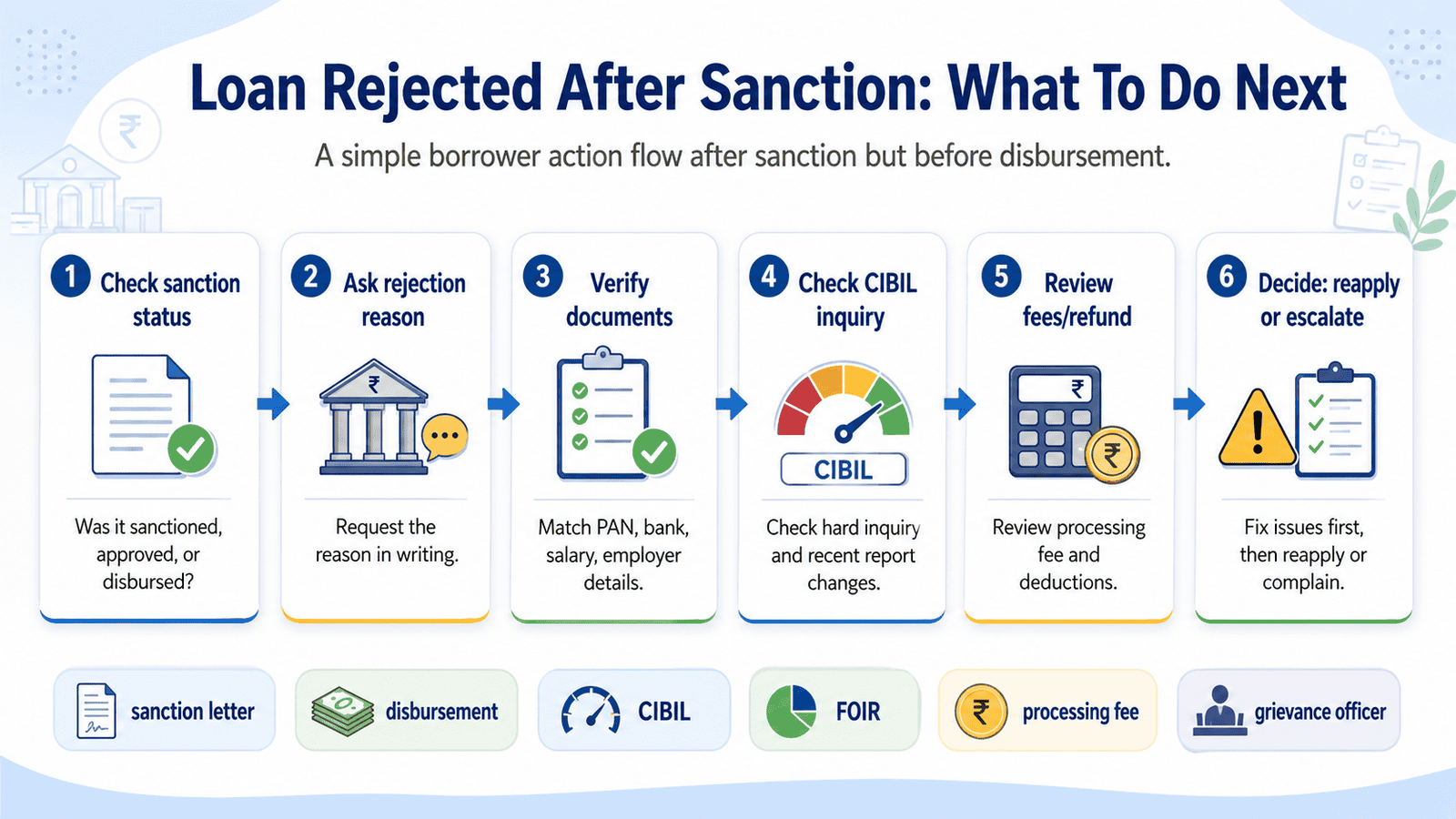
Immediate Steps to Take Right Now
The first 24 to 72 hours after a sanction rejection are important. Do not panic, and do not rush to apply elsewhere. Here is what to do, in order.
Step 1 — Save every document you have
Collect your sanction letter, application ID, all SMS and email messages from the lender, any fee payment receipts, and a copy of the loan agreement if you already signed one. You will need these for any written complaint or reapplication. Do not delete any lender messages.
Step 2 — Ask for the rejection reason in writing
Call customer care or visit the branch and ask specifically for a written confirmation of why disbursement was stopped. A phone explanation is not enough. An email or letter naming the exact reason — document mismatch, employer verification failure, credit bureau change, or other — will tell you what to fix before your next application. If the lender does not respond or gives a vague reason, that itself becomes the basis for a written complaint later. Verify the lender’s specific process for requesting this from their official website or grievance page.
Step 3 — Confirm what stage your loan actually reached
There is an important difference between a loan that was only sanctioned, one that received final approval, and one where a loan account was actually created but the amount was not credited. Your next steps depend on which stage was reached. Check your lender app, net banking, or branch statement carefully.
Step 4 — Check whether any charge was deducted
Before anything else, check your bank account and your lender account statement for any deduction — processing fee, insurance premium, stamp duty, or documentation charge. Note the exact amount and date. Whether these are refundable depends on the lender’s sanction letter terms and loan agreement. Do not ignore deductions — they need to be verified and, if wrongly charged, disputed in writing.
Step 5 — Do not apply to multiple lenders yet
Every new loan application triggers a hard inquiry on your credit report. If you apply to five lenders in one week, your credit report will show five enquiries. This can reduce your chances of approval with each subsequent lender. Wait until you understand the exact rejection reason before applying again.
Key Takeaways
- A sanction letter is conditional approval — the lender can still stop disbursement after final verification of your documents, employer, bank account, and credit report.
- On a ₹5 lakh personal loan at 14% for 4 years, the illustrative EMI is approximately ₹13,672 per month — planning your budget around this before actual disbursement is one of the most common mistakes borrowers make.
- Rejection after sanction usually shows on your credit report as a hard inquiry from the application, not as a loan default — but multiple applications will add multiple enquiries that can hurt your approval chances.
- Processing fee refundability depends entirely on the lender’s sanction letter and loan agreement terms — some lenders retain the fee even if disbursement does not happen; verify this from your agreement.
- The single most important step is to get the rejection reason in writing before you take any other action — it determines whether you should fix a document, reduce your loan amount, correct a bureau error, or complain.
- Your eligibility, interest rate, and loan amount after sanction can still depend on the lender’s assessment during final checks — sanction does not freeze these permanently.
Key Facts at a Glance
| Stage | What It Means | Borrower Action |
|---|---|---|
| Sanction Letter Issued | Conditional approval based on initial checks — not final | Do not plan payments until money is credited |
| Final Verification | Lender re-checks employer, income, address, bank account, and credit report | Respond to all lender requests promptly |
| EMI Start | EMI should start only after a loan account is active and amount is credited — verify with lender | Confirm active loan account before setting up auto-debit |
| CIBIL Impact | Hard inquiry appears for the application; rejection itself does not add a default entry | Check your credit report after applying |
| Processing Fee | May or may not be refundable depending on lender terms — verify before applying | Check sanction letter and loan agreement for refund clause |
| Reapplication | Possible at same or different lender after fixing the root cause | Get rejection reason in writing first; see approved not disbursed guide |
Why a Loan Can Be Rejected After Sanction: The Full Explanation
Most borrowers expect the sanction letter to be the finish line. It is not. A sanction letter is the lender’s in-principle decision, made after a first-level review of your credit score, income, and basic documents. But before the money reaches your account, lenders typically run a second, more detailed round of checks. This is where rejections happen.
What a sanction letter actually covers
A personal loan sanction letter confirms the loan amount, interest rate, tenure, EMI, processing fee, and basic eligibility the lender has agreed to offer you — subject to conditions. The phrase “subject to conditions” is critical. Most sanction letters explicitly state that final disbursement depends on satisfactory completion of verification, document submission, and the lender’s internal policies at the time of disbursal.
What happens during final verification
After sanction, lenders verify your employer by calling the HR or payroll department. They check whether your salary is still being credited to the bank account you declared. They match your name, address, and PAN across all documents. They may pull a fresh credit report. If anything has changed since your application — a new EMI, a credit card overdue, a job change, or even an address discrepancy — the lender’s risk engine may flag the application for review or cancellation.
This is also why personal loan rejection reasons after sanction are often different from reasons at the initial application stage. The initial rejection is usually about eligibility. The post-sanction rejection is usually about verification or a change in risk factors.
Common reasons disbursement is stopped
Your Fixed Obligations to Income Ratio — or FOIR — is the percentage of your monthly income already committed to EMIs and loan repayments. If the proposed loan’s EMI pushes your FOIR above the lender’s threshold, disbursement may be refused. Most lenders have internal FOIR limits, though these vary by institution and are not publicly standardised.
Other common reasons include: a bank account that does not match the declared account; employer details that could not be verified; a salary slip that does not match bank statement credits; a mismatch between your PAN and Aadhaar-linked address; a new hard inquiry or credit event that appeared on your bureau report after the initial sanction; or the lender’s own internal policy change between sanction and disbursement date.
A loan can also be stopped if your loan was approved but funds were not credited due to a technical issue in the lender’s system — though this is usually resolved faster than a full rejection.
Real Example: Rohit’s Sanctioned ₹5 Lakh Loan That Was Not Disbursed
Rohit, 31, works as a software support analyst in Pune and earns ₹55,000 per month. He applied for a ₹5 lakh personal loan to consolidate two smaller debts. The lender issued a sanction letter within three days. Rohit immediately informed one of his creditors that the payment was coming.
Ten days later, the lender’s verification team called his employer. The HR team confirmed Rohit’s employment but gave a slightly different designation than what Rohit had written on the application — he had listed “Software Analyst” while his official title was “Support Specialist.” The lender flagged this as a designation mismatch. Separately, Rohit’s bank statement showed a credit of ₹48,000 for one month — a month he had taken leave without pay — not the ₹55,000 he had declared.
The lender paused disbursement and sent Rohit an SMS asking for clarification. Rohit did not notice the SMS for two days. By the time he responded, the lender had already closed the case as “verification incomplete.” The loan was not disbursed. The processing fee of ₹3,500 (illustrative — verify refundability from lender’s terms) had already been deducted.
Rohit’s correct next step: request a written rejection reason, check his credit report for the hard inquiry, clarify the designation and income discrepancy with supporting documents, and then re-approach the lender — or a different one — with corrected paperwork. He should review the full personal loan verification process before reapplying. His CIBIL score was not reduced by the rejection itself; only one hard inquiry appeared from the original application.
Eligibility and Document Checklist Before Reapplying
Before you apply again — at the same lender or a different one — check these items carefully. A mismatch in any of these is one of the most common reasons disbursement is stopped after sanction.
| Document / Detail | What to Verify | Common Mismatch Found |
|---|---|---|
| PAN Card | Name must exactly match salary slips, bank account, and Aadhaar | Name spelling differs across documents |
| Aadhaar / Address Proof | Current residential address must match lender’s records | Old address on Aadhaar; new address on salary slip |
| Salary Slips | Last 3 months; net salary must match bank credits in the same period | LOP month, arrears, or variable pay causes mismatch |
| Bank Statement | Account must be in borrower’s name; salary credits must be consistent | Borrower uses a joint account or informal salary deposit |
| Employer Details | Company name, designation, and contact number must match lender’s verification call | Designation on slip differs from title used in application |
| FOIR | Total EMIs (existing + proposed) should not exceed lender’s threshold — check with lender | New loan EMI on credit report not declared at application |
| Credit Report | No new overdue, recent default, or unexplained hard inquiry since sanction date | Borrower applied elsewhere after sanction, adding new enquiries |
Lender-specific eligibility criteria — including minimum credit score thresholds, FOIR limits, and employer categories — vary and should be confirmed from the lender’s official website or branch before reapplying.
EMI Planning When a Sanctioned Loan Is Not Disbursed
One of the most practical problems borrowers face is having built their payment plans around a loan that was never credited. Here is what the numbers look like in a realistic illustrative scenario.
EMI = [P × r × (1+r)^n] ÷ [(1+r)^n − 1]
Where: P = Principal loan amount | r = Monthly interest rate (annual rate ÷ 12) | n = Loan tenure in months
| Scenario | Illustrative Figures | Borrower Impact |
|---|---|---|
| Planned: ₹5 lakh loan at 14% for 4 years (illustrative) | EMI ≈ ₹13,672/month | Total interest ≈ ₹1,56,256 | Processing fee ≈ ₹3,000–₹10,000 (varies by lender) | Borrower planned ₹13,672/month outflow and one large incoming credit |
| Actual: Loan not disbursed | Zero credit to bank account | Processing fee may have been deducted | No EMI starts | Urgent payment deadline missed; deducted fee may or may not be refunded |
| Reapply after 30–60 days (illustrative wait) | Same or revised loan amount at potentially different rate depending on credit and lender | New hard inquiry on credit report; rate may differ from original sanction |
All figures above are illustrative only. Actual EMI, interest rate, processing fee, and tenure depend on your lender’s assessment at the time of your application. Verify every figure from your sanction letter and loan agreement before planning payments. EMI should be set up only after the loan account is active and the amount is confirmed as credited.
Comparison: Five Post-Sanction Situations and What Each Means
| Situation | What It Means | Recommended Next Step |
|---|---|---|
| Sanctioned, pending final verification | Loan still in process; disbursement has not been confirmed or denied | Respond to verification — provide requested documents immediately |
| Sanctioned, disbursement delayed | No rejection; lender processing is slow or a technical issue is present | Follow up in writing — request status and expected credit date from lender |
| Sanction cancelled before disbursement | Lender stopped the loan after sanction — this is the subject of this article | Get written reason — check fees, check CIBIL, fix issue before reapplying |
| Loan account created, amount not credited | A loan account number exists but no fund transfer has happened — different from cancellation | Contact lender immediately — confirm if account is active and whether EMI liability has started |
| Amount credited, borrower wants to cancel | Disbursement happened; borrower now wants to return the loan | Check foreclosure terms — prepayment charges and interest accrual may apply from credit date |
Each of these situations carries different fee implications, CIBIL effects, and complaint rights. Knowing which situation you are in is the most important first step. Verify which stage your loan reached from the lender’s official app, net banking, or written communication.
How to Complain If the Lender Does Not Respond or Deducted Fees Unfairly
Step 1 — Start with lender customer care
Contact the lender’s customer care helpline or the branch where you applied. State the application ID, sanction letter reference, and your specific concern — either the rejection reason was not given in writing, or a fee was deducted and you want to understand the refund position. Put this in writing — email is best. Keep the complaint reference number.
Step 2 — Escalate to the lender’s grievance officer
If customer care does not resolve within the lender’s stated timeline (check their website for the specific number of days), escalate to the lender’s Grievance Redressal Officer or Nodal Officer. Banks and NBFCs regulated by RBI are required to have this escalation path. The lender’s official website lists the nodal officer’s contact details. Your escalation email should include: your application ID, sanction letter copy, fee receipt, rejection communication, and your previous complaint reference.
Step 3 — Approach RBI Complaint Management System
If the lender does not respond satisfactorily after you have completed lender-level escalation, you may file a complaint through the RBI Complaint Management System at cms.rbi.org.in. This is available for borrowers who have already raised the issue with the lender and have not received a satisfactory resolution within a reasonable period. See the full RBI complaint guide for the step-by-step escalation process. Complaint timelines, eligibility conditions, and outcomes depend on the specific facts of your case — verify the process from rbi.org.in before filing.
| Escalation Step | Who to Contact | What Proof to Keep |
|---|---|---|
| Step 1: Customer Care | Lender helpline or branch | Complaint reference number, email sent, date of contact |
| Step 2: Grievance / Nodal Officer | Lender’s official grievance contact (check lender website) | Escalation email, previous complaint reference, sanction letter, fee receipt |
| Step 3: RBI CMS | cms.rbi.org.in | All previous complaint correspondence, application ID, sanction letter, identity proof |
Safety Checklist: What Not to Do After Sanction Rejection
Before You Apply Anywhere Else — Read This First
Your credit report already carries a hard inquiry from your rejected application. Every new application adds another enquiry. Here is what to avoid before your next step.
- Do not apply to multiple lenders in one week. Each application creates a separate hard inquiry. Lenders can see all recent enquiries on your bureau report. Multiple enquiries in a short period signal financial stress and can reduce your chances of approval. Check how CIBIL score is affected by rejection and enquiries before applying again.
- Do not pay any agent or broker who promises “guaranteed approval.” No third party can guarantee a lender’s credit decision. These are almost always fee-extraction schemes. Approach lenders directly.
- Do not ignore any fee or insurance amount that was deducted. Check your statement and raise a written query with the lender if a charge appears that you did not authorise or that you believe should be refunded.
- Do not accept a revised loan offer without checking the full cost. If the lender comes back with a lower amount at a higher rate, calculate the total repayment — principal + total interest + all charges — before accepting. Verify from TransUnion CIBIL at transunioncibil.com that your credit report is accurate before deciding.
- Do not assume the rejection will permanently affect your credit score. The inquiry will appear, but a sanctioned-and-cancelled loan does not create a default entry. Your credit behaviour going forward matters more than one hard enquiry.
How to Decide What’s Right for You
the rejection was due to a document mismatch or employer verification issue — correct the specific document or detail, confirm with the lender that it is now resolved, and reapply with accurate information. Do not apply to a different lender until the error is fixed, or the same issue will repeat.
the rejection was due to high FOIR or too many existing EMIs — consider requesting a lower loan amount that keeps your total EMI burden within the lender’s acceptable ratio, or prepay an existing loan first to reduce your fixed obligations. Check how long to wait after rejection before applying again.
the rejection was due to a credit report change — pull your credit report from a bureau such as TransUnion CIBIL, check for any new overdue or incorrect entry, dispute errors through the bureau’s official process, and wait for the report to update before applying again.
the rejection was due to the lender’s internal policy change and no specific fault was found in your documents — approach a different lender after a gap of at least 30 days, and apply for a realistic amount based on your current income and EMI burden.
a fee was deducted and the lender has not confirmed whether it will be refunded — raise a written query first. Do not apply to the same lender again while the fee dispute is unresolved.
you do not yet have the rejection reason in writing — do not take any of the steps above. Your first action is always to get the specific reason confirmed in writing from the lender. Every next step depends on knowing exactly what caused the disbursement to stop.
Common Mistakes to Avoid
Assuming sanction means guaranteed money
A sanction letter is a conditional offer, not a transfer confirmation. Many borrowers make commitments — informing creditors, booking purchases, stopping other applications — the moment they receive a sanction SMS. This leaves them exposed if disbursement is stopped. Do not make financial commitments based on a sanction letter alone. Wait for the amount to appear in your bank account.
Applying to multiple lenders immediately after rejection
Each application creates a hard inquiry on your bureau report. If you apply to four lenders in the same week, all four enquiries appear on your CIBIL report within days. Subsequent lenders see these enquiries and may interpret them as a sign of financial distress or desperation. This can reduce your approval chances and may result in a higher rate offer even if you are approved. Fix the root cause first, then apply to one lender at a time.
Not saving written proof of the rejection and fee deduction
If you need to escalate to the lender’s grievance officer or the RBI later, you need the sanction letter, the rejection communication, and the fee receipt as evidence. Borrowers who only have a verbal explanation from a phone call have almost no escalation support. Always request and keep written confirmation of every lender communication.
Ignoring credit report errors that may have caused the rejection
If a bureau error — such as an incorrectly reported overdue or a loan that was closed but still showing as active — contributed to your rejection, reapplying without fixing it will result in the same outcome. Pull your credit report, check it carefully, and raise a dispute through the bureau’s official portal if you find an error. This typically takes 30 days to resolve.
Accepting a revised loan offer without checking total cost
After a post-sanction issue, lenders sometimes come back with a revised offer at a lower amount or a higher rate. Do not accept it based on EMI alone. Calculate the total repayment: principal + total interest + processing fee + any insurance charged. A seemingly small rate increase on ₹5 lakh over 4 years can cost you ₹15,000–₹25,000 more in total interest (illustrative — verify with your actual figures). Check the full cost before signing.
Ignoring the FOIR problem and reapplying for the same amount
If your disbursement was stopped because the proposed EMI exceeded the lender’s FOIR threshold, applying for the same amount at the same tenure will face the same problem. Either reduce the loan amount, extend the tenure (which reduces EMI but increases total interest), or prepay an existing EMI-bearing loan before reapplying.
When This May Not Be the Right Choice
Reapplying for a personal loan quickly after a post-sanction rejection may not be the best decision in every situation. Consider waiting and fixing the underlying problem first if any of the following apply.
If your income has recently decreased or your employment has become unstable — whether due to a job change, notice period, or salary restructuring — a new application is likely to face the same employer and income verification issues. Lenders verify salary continuity, and a gap or reduction will affect eligibility.
If your credit report currently shows a recently reported overdue account, a loan settlement, or a default — even one you dispute — most lenders will not disburse until the report is clean. Reapplying before the report is updated wastes an inquiry and adds more enquiries to your record.
If your total existing EMI burden is already above 40–50% of your net monthly income (illustrative — verify the threshold from your specific lender), a new personal loan EMI will push your FOIR further and is likely to be rejected again.
If the urgent need that drove this loan can be met through a smaller amount, a secured loan, or a salary advance — explore those options before taking on a high-cost personal loan under pressure. Borrowing urgently without checking terms often leads to a higher rate than you would have received with a planned application. If any of these apply to your situation, it may be worth exploring other options before committing.
Official Rules and Where to Verify
The rules, timelines, and refund policies around loan sanction, disbursement, and cancellation are set by individual lenders within the broad framework of RBI regulations. There is no single published rule that specifies how many days a lender must take to disburse after sanction, or whether a processing fee must be refunded — these are lender-specific terms. Always verify the following from official sources before taking any action.
- RBI (rbi.org.in): Relevant for understanding the regulated framework for banks and NBFCs, Fair Practices Code requirements, and borrower rights under RBI’s directions for lenders.
- RBI Complaint Management System (cms.rbi.org.in): Use only after completing lender-level grievance escalation. The portal explains eligibility, process, and what complaints can be filed against regulated entities.
- TransUnion CIBIL (transunioncibil.com): Pull your credit report to check which enquiries appear, whether any accounts are incorrectly reported, and how to raise a dispute if you find an error. Other bureaus — Experian, Equifax, CRIF High Mark — also provide reports; use any one or all four.
- Your lender’s official website or branch: The sanction letter, loan agreement, and lender’s grievance redressal page are the definitive sources for refund terms, disbursement timelines, verification requirements, and escalation contacts specific to your loan.
Rules, rates, and charges on this topic can change with RBI policy or lender updates. Always verify current figures directly from the official source or the lender before making any borrowing decision.
Expert Tips
- Always ask for the rejection reason by email, not just over a phone call. A customer care agent’s verbal explanation is not binding and cannot be used in a complaint. An email from the lender naming the specific reason — document mismatch, employer verification failure, FOIR breach — gives you a clear action point and an evidence trail.
- Cross-check your name, PAN, bank account holder name, and employer name across every document before reapplying. Even a single character difference between your name on a salary slip and your PAN card can cause a lender’s automated system to flag your application. Fix mismatches at source before submitting.
- Review your FOIR before applying again. Add up all your current EMIs — including credit card minimum dues — and divide by your net monthly income. If the result is above 0.50 (50%), most lenders will be cautious. Consider whether you can prepay one loan or reduce the requested amount before applying.
- Apply for a realistic amount, not the maximum you are eligible for. Borrowers who apply for the highest amount the eligibility calculator shows are more vulnerable to FOIR rejections, especially if their income varies month to month. A slightly lower amount at a comfortable EMI is more likely to be disbursed cleanly.
- Compare APR and total repayment cost — not just the EMI — before accepting any revised offer. A lender who reduces your loan amount and increases the rate may actually cost you more over the tenure. Use an EMI calculator to compare total repayment across options before signing the loan agreement.
- If any charge was deducted before disbursement, ask for an itemised fee statement in writing. This helps you understand what was charged, at which stage, and whether the lender’s own sanction letter supports a refund claim. Do not assume charges are non-refundable without checking the terms.
Frequently Asked Questions
Can a loan be rejected after sanction?
Yes. A sanction letter is a conditional approval. The lender can stop disbursement if final verification of your income, employer, documents, bank account, or credit report reveals a mismatch or a change in risk since the initial application. This is more common than most borrowers expect.
Is a sanction letter a legal guarantee of loan disbursement?
No. A sanction letter is an in-principle offer, subject to the conditions stated in the letter. Most sanction letters explicitly say disbursement is conditional on satisfactory verification and the lender’s prevailing policies. The lender has the right to withdraw the offer if verification fails. Verify the specific terms of your sanction letter before treating it as confirmed funds.
Why was my loan approved but not disbursed?
The most common reasons are: document mismatch between application and verification, employer could not be verified or contact details were wrong, bank account is not in the borrower’s name or salary credits are inconsistent, your credit report showed a new overdue or hard inquiry after sanction, your FOIR exceeded the lender’s threshold when calculated again at disbursement stage, or the lender’s internal policy changed between sanction and disbursement. Ask for the specific reason in writing from your lender.
Will loan rejection after sanction reduce my CIBIL score?
The rejection itself does not create a default or a negative repayment entry on your credit report. What does appear is the hard inquiry created when you applied. A single hard inquiry has a minor impact and typically fades in significance within a few months of normal credit behaviour. However, if you apply to multiple lenders in quick succession, multiple hard inquiries will appear — and this pattern can hurt your approval chances with subsequent lenders.
Can I get a processing fee refund if the loan is not disbursed after sanction?
Whether the processing fee is refundable depends entirely on the lender’s sanction letter and loan agreement terms. Some lenders refund the full fee if disbursement does not happen due to their own failure; others retain part or all of the fee once processing has started. Check the refund clause in your sanction letter and loan agreement first. If the fee was wrongly deducted or the terms are unclear, raise a written query with the lender. If not resolved, escalate through the lender’s grievance channel.
Should I apply for another loan immediately after sanction rejection?
Not immediately. First, get the rejection reason in writing. Then check your credit report for the hard inquiry and whether any other entry has changed. If the rejection was due to a fixable issue — document error, designation mismatch, a CIBIL report error — fix it before applying anywhere else. Applying immediately without understanding the cause adds more hard inquiries to your report and is likely to result in rejection again for the same reason.
Can I complain to RBI if a bank cancels my sanctioned loan?
You can approach the RBI Complaint Management System at cms.rbi.org.in, but only after completing the lender’s own grievance escalation process first. The RBI’s complaint route is available for regulated banks and NBFCs that have not resolved your complaint satisfactorily at their own level. The complaint eligibility, process, and timelines should be verified from cms.rbi.org.in before filing. Not all grievances will result in the outcome the borrower expects — the RBI examines complaints against regulated practices, not lending decisions as such.
What is the difference between a loan sanction letter and final approval?
A sanction letter is the lender’s conditional offer after initial processing. Final approval — or disbursement approval — is the lender’s decision after completing all verification checks. Some lenders use different terminology, but the key distinction is whether a fund transfer instruction has been issued and whether a loan account has been created and activated. Do not treat any communication as final approval until the money appears in your bank account and you have confirmed the loan account is active.
Final Verdict
A loan rejected after sanction is stressful — but it is a recoverable situation. The key is not to act in panic. The borrower who gets the rejection reason in writing, checks their credit report, verifies what was deducted, and fixes the specific cause before reapplying is in a far better position than the borrower who immediately fires off five new applications out of urgency.
If the issue was a document mismatch or employer verification failure, it is usually fixable within days. If the issue was FOIR or a credit report change, it takes longer but is still resolvable. In either case, applying again without addressing the root cause will produce the same result. Complain only if a fee was wrongly deducted or the lender failed to respond — do not treat the complaint process as a path to forcing disbursement.
Borrowers who are most vulnerable after this situation are those who had urgent payment plans tied to the loan. If you are in that position, assess whether a smaller, shorter-tenure loan — or a different secured borrowing option — can meet the immediate need while you resolve the personal loan issue properly. Always verify the latest rates and terms from the lender or official RBI sources before applying for any loan.
This article is for educational purposes only and should not be treated as personalised financial, credit, or legal advice. Interest rates, processing fees, eligibility criteria, and loan terms vary by lender and can change with RBI policy or lender updates. Please verify current rates and terms directly with the lender or from official RBI sources, or consult a qualified professional, before applying for or accepting any loan.

Rohan writes practical personal loan guides for Indian borrowers, focusing on eligibility, EMI planning, lender charges, CIBIL impact, borrower rights, and safer borrowing choices. His writing helps readers compare options calmly, avoid costly mistakes, and understand loan terms before applying.