
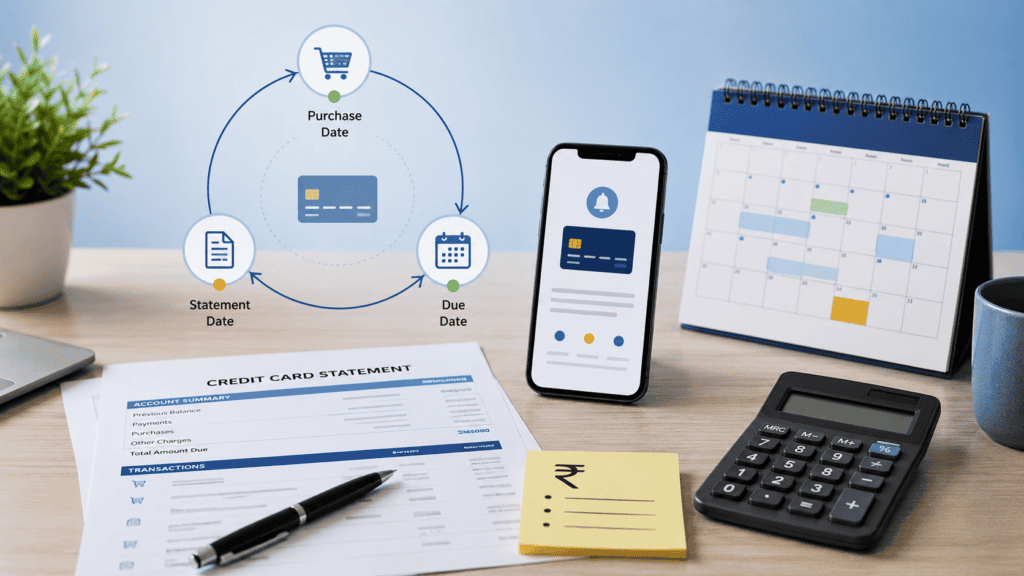
Your first credit card statement arrives and suddenly there are two dates on it — a statement date and a due date — and you are not sure which one actually matters. Then a charge appears for a purchase you thought you made last month. Then you see “minimum amount due” and wonder if that is all you need to pay to stay safe. If any of this sounds familiar, you are not alone. Most first-time credit card users in India get confused at exactly this point. The billing cycle, statement date, due date, grace period, and minimum amount due are five different things — and mixing them up can quietly cost you interest charges, late fees, and even a dip in your credit score. This article explains the full cycle as a simple monthly timeline, using Indian examples, so you know exactly when to pay, how much to pay, and what happens if you do not. Exact dates, interest-free periods, and charges vary by card issuer — always check your statement and cardholder terms before acting.
Quick Answer: Credit Card Billing Cycle Explained
Credit card billing cycle explained means understanding the period in which your card purchases are collected into one statement, followed by a due date and possible grace period. For example, a ₹10,000 purchase just after statement generation may get more days to pay if previous dues are cleared.
Key Takeaways
- Your billing cycle is the fixed period — typically around 30 days — during which all card transactions are collected into a single monthly statement. The length of this cycle can vary by issuer and card type.
- The statement date is when your bill is generated, not when it is due. Confusing these two dates is one of the most common and costly credit card mistakes in India.
- The due date is the final deadline for payment. Missing it can attract late payment charges and, if the delay is reported, may affect your credit report with bureaus like TransUnion CIBIL.
- The interest-free period — the window between purchase and due date — only works in your favour when your previous month’s dues are fully paid. Carry any unpaid balance forward and new purchases may attract finance charges from the transaction date itself.
- Paying only the minimum amount due is not a safe option. The unpaid portion typically attracts finance charges, and if this becomes a habit, it can push you into a revolving credit trap where the outstanding balance grows month after month.
- Purchasing just after your statement date generally gives you more days to pay before the next due date compared to purchasing just before the statement is generated.
- Always verify your specific billing cycle dates, grace period length, finance charge rate, and late payment fee from your card statement or the MITC (Most Important Terms and Conditions) document provided by your issuer.
Key Facts at a Glance
| Term | Simple Meaning | What You Should Do |
|---|---|---|
| Billing Cycle | The period during which your card transactions are recorded before being compiled into one statement | Know when your cycle starts and ends — check your statement or issuer app |
| Statement Date | The date your monthly bill is generated — not the payment deadline | Download or review your statement as soon as it is generated |
| Payment Due Date | The last date to pay your credit card bill without attracting late payment charges | Set a calendar or auto-debit reminder at least 3–4 days before this date |
| Grace Period / Interest-Free Period | The number of days between statement generation and the due date during which no interest accrues — but only if previous dues are fully cleared | Pay the total amount due in full every month to maximise this benefit; the length of this period varies by issuer |
| Total Amount Due | The full outstanding balance shown on your statement — the safest amount to pay | Pay this in full before or on the due date whenever possible |
| Minimum Amount Due | A small fraction of your total dues — paying only this avoids immediate default treatment in many cases, but does not settle your bill | Treat this as an emergency-only floor, not a routine payment habit; unpaid balance typically attracts finance charges |
For a detailed comparison of statement date and due date and how they differ in practice, see our dedicated guide.
How a Credit Card Billing Cycle Works
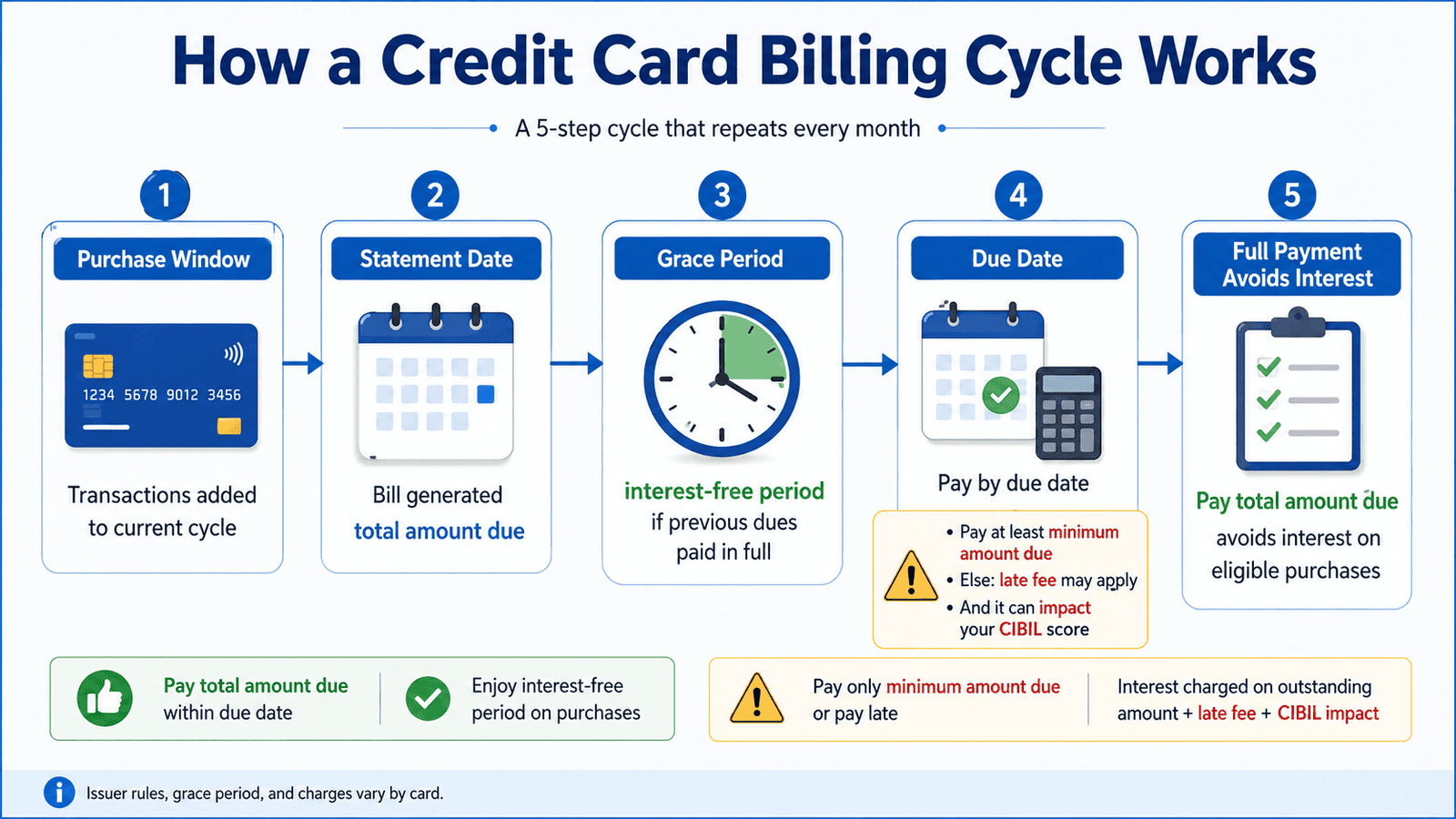
The billing cycle is the backbone of how your credit card works every month. Think of it as a recording window — every transaction you make with your card during this window gets collected into a single monthly statement. When the window closes, your issuer generates that statement and gives you a deadline to pay. Understanding this sequence — cycle opens, transactions accumulate, cycle closes, statement generated, due date arrives — is the most important thing you can do as a new cardholder.
Step 1 — The Billing Cycle Opens
Your billing cycle starts on a fixed date each month — often the day after your previous statement was generated, though this varies by issuer. From this day onwards, every purchase, refund, EMI debit, cash advance, and fee charge is recorded against your card account for that cycle.
Step 2 — Transactions Accumulate During the Cycle
Throughout the billing cycle, your card records all activity. A purchase on the first day of the cycle and a purchase on the last day both appear on the same statement — but as you will see in the example section below, the day you purchase within the cycle affects how many days you have before you must pay. This is the most practical insight most first-time users miss entirely.
Step 3 — The Statement Date Arrives
On the statement date — sometimes called the bill generation date — your issuer compiles all transactions from the billing cycle into your monthly statement. This statement shows your total amount due, minimum amount due, and due date. The statement date is not your payment deadline. Many new cardholders confuse the statement date with the due date and either panic or pay immediately without checking the full bill. Read the statement carefully first.
Your card statement contains the key numbers you need: total amount due, minimum amount due, and the payment due date. Understanding your credit card grace period — and when it actually applies — is essential reading alongside this article.
Step 4 — The Due Date and the Grace Period
After the statement date, your issuer gives you a window — the grace period — to pay the bill before finance charges or late fees apply. This period runs from the statement date to the payment due date. The length of this window varies by issuer and card type, so check your MITC or statement for your card’s specific terms. If you pay the total amount due in full before or on the due date, and your previous month’s dues were also cleared in full, most issuers do not charge interest on purchases made during that cycle. This is the interest-free period benefit — but it is conditional, not automatic.
Step 5 — What Happens If You Do Not Pay in Full
If you pay only the minimum amount due — or miss the due date entirely — the benefit of the interest-free period is typically lost. Most issuers apply finance charges on the unpaid balance, and in many cases on new purchases as well, from the transaction date rather than from the due date. This is why the minimum amount due can quietly become a debt trap: you are paying just enough to avoid immediate default treatment, but the unpaid balance keeps accumulating charges. According to RBI’s guidelines on credit card operations, issuers are required to clearly disclose interest rates, fees, and billing terms to cardholders — but it remains your responsibility to read and act on this information.
Real Example: Rohit’s First Credit Card Statement
Rohit, 29, is a software analyst in Pune earning ₹55,000 per month. He received his first credit card in March and used it for groceries, fuel, and one online purchase. His billing cycle runs from the 5th of each month to the 4th of the following month — illustrative dates used here for explanation only; your cycle dates will differ.
His statement is generated on 4 April and shows a total amount due of ₹18,500. The payment due date printed on the statement is 24 April — giving him approximately 20 days to arrange payment. These figures are illustrative only.
Purchase just after statement date: Rohit makes a ₹10,000 purchase on 6 April — two days after the statement date. This purchase falls into the next billing cycle (5 April to 4 May). It will appear on his May statement, generated on 4 May, with a due date around 24 May. That means Rohit may have close to 48 days from the purchase date to the next due date — assuming he pays his April bill in full.
Purchase just before statement date: Now imagine Rohit had made the same ₹10,000 purchase on 3 April — one day before the statement date. This purchase appears on the April statement, generated the very next day on 4 April, and is due on 24 April. That gives him only around 21 days from purchase to due date — a much shorter window than the first example.
The key insight: the same ₹10,000 purchase can give you very different payment timelines depending purely on when in the billing cycle you make it. This only works, however, if you pay the previous month’s total amount due in full. If Rohit carries even ₹1 of unpaid balance into April, the interest-free benefit on new purchases may not apply.
Your Monthly Statement Checklist
What to Check Every Time Your Statement Arrives
- Statement date: Note the date your bill was generated so you know when the next cycle begins.
- Payment due date: Mark this in your phone or calendar immediately. Do not rely on memory.
- Total amount due: This is what you should aim to pay in full to avoid finance charges.
- Minimum amount due: Read this figure but treat it as a last resort — not a target.
- Finance charges and late payment fees: Scroll past the due date section and check if any carry-forward interest or fees from previous months appear. If they do, your full amount due includes those charges too.
- Auto-debit or payment status: If you have set up an auto-debit mandate, confirm it is active and set to debit the total amount due — not just the minimum. Check your bank account has sufficient balance at least 2–3 days before the due date.
- Refunds and failed transactions: Confirm any refunds due have been credited. If a refund is pending and pushes close to the due date, still pay the net amount due — do not wait for the refund to arrive before paying.
How Purchase Timing and Minimum Due Affect Your Cost
Two calculations matter most for everyday card users: how purchase timing affects your available payment window, and what paying only the minimum amount due actually costs you.
Purchase Timing — Days Available to Pay
| Purchase Timing | Approximate Days to Due Date | Key Condition |
|---|---|---|
| Just after statement date (e.g. 1–3 days after) | Potentially the maximum for that card — could be around 45–50 days depending on issuer grace period; verify with issuer | Previous month’s total amount due must be fully paid; exact days vary by card |
| Mid-cycle (around 15 days before statement date) | Roughly 30–35 days, depending on grace period length; verify with issuer | Previous dues must be cleared; no guaranteed fixed number |
| Just before statement date (e.g. 1–3 days before) | Only the grace period days — could be around 15–20 days; verify with issuer | Purchase appears on current statement due very soon |
These ranges are illustrative. Your actual interest-free days depend on your specific card’s billing cycle and grace period — both of which are stated in your MITC and monthly statement. For a deeper look at how this is calculated, read our guide on credit card interest calculation.
Minimum Due on a ₹30,000 Bill — An Illustrative Example
Suppose Rohit’s May statement shows a total amount due of ₹30,000. His issuer calculates a minimum amount due — often a small percentage of the outstanding balance plus any interest or fees, or a fixed floor amount, whichever is higher. The exact formula varies by issuer and must be checked in the MITC.
Finance Charge Risk = Unpaid Balance × Monthly Finance Charge Rate × Months Unpaid
Where: Unpaid Balance = Total Amount Due − Amount Paid | Monthly Finance Charge Rate = varies by issuer (check MITC) | This is a simplified illustration — actual calculation methods differ by card
If Rohit pays only the minimum due and carries ₹25,000 forward, his issuer may apply finance charges on that ₹25,000 — and in many card schemes, also on new purchases made after the due date, from the date of those purchases. Over two or three months, this unpaid balance compounds. The actual charge rate varies significantly by issuer and must be verified from the card statement or MITC. Do not assume a universal rate applies to your card.
| Payment Choice | Short-Term Effect | Finance Charge Risk |
|---|---|---|
| Full payment before due date | Bill cleared, no carry-forward balance | None — interest-free period applies on new purchases (if previous dues also cleared) |
| Partial payment above minimum due | Unpaid portion carries forward | Finance charges apply on unpaid balance; check issuer rate in MITC |
| Minimum amount due only | Immediate late fee avoided in many cases, but balance grows | High — finance charges on full unpaid balance; interest-free period may be lost for new purchases |
| Missed due date entirely | Late payment charge applied; possible finance charges on full outstanding | Very high — may also affect credit report if delay is reported; check issuer and CIBIL reporting norms |
For a full comparison of payment options and their long-term debt risk, see our article on minimum amount due and the debt trap.
Monthly Credit Card Safety Routine
- Step 1 — Check statement immediately: As soon as your statement is generated, open it. Note the statement date, total amount due, minimum amount due, and payment due date. Do not leave it for later.
- Step 2 — Pay total amount due before the due date: Transfer the full outstanding to your card account at least 2–3 banking days before the due date to account for processing time. UPI card payments may reflect the same day, but give yourself a buffer.
- Step 3 — Do not rely on minimum due as routine: Use the minimum due figure only in a genuine cash-flow emergency. Paying it habitually builds a balance that quietly becomes expensive over months.
- Step 4 — Set two reminders: One reminder for your statement date (so you review the bill) and a second reminder 5–7 days before your due date (so you have time to arrange funds and confirm the payment is processed).
- Step 5 — Avoid cash withdrawal on the card unless unavoidable: Cash advances on credit cards typically attract interest from the withdrawal date itself — no interest-free period applies. Check your MITC for the specific charge.
- Step 6 — Track refunds and failed payments: If a merchant refund is pending or a UPI card payment fails close to the due date, do not wait for the refund before paying. Pay the net due amount and claim the refund separately. A failed payment that goes unnoticed until after the due date will attract charges.
your salary credit date falls well before your card due date — this is the ideal cash-flow match. Pay the full amount due as soon as salary is credited and your card account stays clean each month.
your card due date arrives before your salary credit date — consider checking with your issuer whether the billing cycle can be adjusted so the due date falls after your salary arrives. This is subject to issuer policy and is not guaranteed.
you want to maximise interest-free days on a large planned purchase — make the purchase just after your statement date, not before. This pushes the transaction to the next billing cycle and gives you the longest possible window to pay. Only do this if your previous dues are fully cleared.
you are considering spending on the card because “payment is a month away” — pause. Delaying payment is not the same as having funds available. Only use the card for purchases you can repay in full on the due date.
your issuer allows billing cycle changes — check via the official app, customer care, or written request. RBI’s credit card directions require issuers to offer transparency on cardholder terms; verify any cycle-change process and effective date directly with the issuer before assuming it will apply to your next statement.
you are confident you can repay the full amount due by the due date — do not use the card for that purchase. A credit card purchase you cannot repay in full is a short-term borrowing decision, not a free payment window.
Common Mistakes to Avoid
Confusing the Statement Date with the Due Date
The statement date is when your bill is generated. The due date is when you must pay. These two dates are different — often separated by 15 to 20 days or more depending on the issuer. Treating the statement date as the payment deadline causes unnecessary panic, while treating the due date as the statement date leads to missed payments.
When your statement arrives, locate both dates clearly and mark the due date — not the statement date — in your calendar.
Paying Only the Minimum Amount Due as a Habit
Paying the minimum due avoids an immediate late fee in many cases, but the unpaid balance typically attracts finance charges. Over three or four months, even a ₹20,000 unpaid balance can grow significantly depending on your issuer’s monthly finance charge rate. What starts as a small shortfall becomes a recurring debt.
Always aim to pay the total amount due. If that is not possible in a given month, pay as much above the minimum as you can and clear the balance fully the next month.
Assuming Every Purchase Gets the Maximum Interest-Free Days
The interest-free period only works fully when previous dues are cleared. If you carry forward even a small unpaid balance, many issuers apply finance charges on new purchases from the transaction date — not from the due date. You may assume your new purchases are interest-free when they are not.
Check your statement each month to confirm no carry-forward balance exists before assuming the interest-free window applies.
Missing the Due Date Because of a Weekend or Public Holiday
If your due date falls on a Sunday or a bank holiday, the safe practice is to pay at least one working day before. Some issuers may accept the next working day as the effective due date, but this varies — do not rely on it. A missed due date can attract late payment charges and, if the delay is reported to credit bureaus, may affect your credit report.
Set your payment reminder for 3–4 days before the printed due date, not on the due date itself.
Ignoring Finance Charges Already on the Statement
If your statement shows finance charges from a previous month’s unpaid balance, those charges form part of your total amount due this month. Many cardholders pay what they think is the full bill — the current month’s purchases — and unknowingly leave the carry-forward charges unpaid. This creates a cycle of compounding interest.
Always check the full statement, not just the new purchases section, before initiating payment.
Using a Credit Card Cash Withdrawal Casually
Cash withdrawals on a credit card typically attract interest from the withdrawal date itself — there is usually no interest-free period. Many issuers also charge a separate cash advance fee. The cost of a ₹5,000 cash withdrawal can be significantly higher than the same amount borrowed via a personal loan or UPI overdraft. Check your MITC for the actual rates before using this facility.
Treat credit card cash withdrawal as a last resort, not a convenient ATM alternative.
Missing the CIBIL Impact of Delayed Payments
According to TransUnion CIBIL, credit card payment history is one of the key inputs into your credit score calculation. Delayed payments that are reported by the issuer can appear on your credit report and reduce your score. Not every one-day delay is guaranteed to appear — reporting timelines and methods vary by issuer — but habitual late payments or significant defaults typically do. Protecting your credit report starts with paying your card bill on time, every month.
Read our guide on late payment CIBIL impact for a detailed explanation of how and when delayed card payments are reported.
When This May Not Be the Right Choice
Understanding your billing cycle is useful — but trying to “use the cycle strategically” can backfire in several situations:
If you already carry unpaid dues from a previous month: The interest-free period benefit does not apply when you have a carry-forward balance. Timing purchases for more days is irrelevant when finance charges are already running on the unpaid amount.
If you are using the card to cover an expense you cannot actually repay: A longer payment window is not the same as having money available. If repayment is uncertain, using the card extends financial stress — it does not resolve it.
If spending has increased because payment feels further away: The billing cycle is not a spending buffer. Increased spending driven by a “pay later” mindset can result in a bill that exceeds your monthly repayment capacity.
If your salary date and card due date do not align: If your salary is credited after your due date every month, the risk of a missed or late payment is structurally high. Consider requesting a billing cycle change from your issuer, or managing spending carefully until the two dates align.
If paying the minimum due has become a monthly habit: Once the minimum due is treated as the normal monthly payment, the outstanding balance grows. This is the beginning of a revolving credit situation that becomes harder to exit each month. Read our article on credit card debt recovery if you are already in this situation.
If any of these apply to your situation, it may be worth exploring other options before committing.
Official Rules and Where to Verify
Credit card billing rules, interest-free period lengths, late payment charges, and minimum due formulas are set by individual issuers within the regulatory framework established by the Reserve Bank of India. They can and do change. Always verify current terms from these sources before acting on any figure:
- Your monthly card statement: The most reliable source for your specific billing cycle dates, total amount due, minimum amount due, due date, and any finance charges already applied.
- MITC (Most Important Terms and Conditions): Provided at the time of card issuance and available on your issuer’s website or app. This document contains your card’s specific interest rate, grace period, late payment charge, cash advance fee, and billing cycle terms.
- Official card issuer app or website: SBI Card (sbicard.com) and HDFC Bank (hdfcbank.com) provide billing and statement FAQs and account management tools. For your specific issuer, always go to the official domain.
- Reserve Bank of India — rbi.org.in: RBI’s Master Direction on Credit Cards and Debit Cards sets the regulatory framework for credit card billing, customer rights, dispute resolution, and issuer obligations. Refer here for your rights as a cardholder, including rules around billing cycle changes and disclosure standards.
- TransUnion CIBIL — transunioncibil.com: For understanding how credit card payment history may appear on your credit report, and how to check and dispute report entries.
Card fees, interest rates, billing rules, and reward terms can change by issuer. Always verify the latest terms from the card issuer and official regulatory sources before applying or converting dues.
Expert Tips
- Set two calendar alerts every month — not one: The first for your statement date (to review the bill as soon as it generates) and the second for five days before the due date (to confirm payment has been initiated and will land in time).
- Never pay the minimum due out of convenience — only out of genuine necessity: The minimum due figure exists to protect you from an immediate default-style treatment in an emergency. It was not designed to be your monthly payment strategy. Treat it as a floor, not a ceiling.
- If you want to time a large purchase, make it one or two days after the statement date: This pushes the purchase into the next billing cycle and gives you the longest possible interest-free window — but only if you pay the current month’s bill in full first. Confirm the interest-free period length on your specific card before planning this.
- Keep your credit utilisation reasonable month to month: Your credit utilisation ratio — total outstanding as a percentage of your credit limit — is a factor in your credit score calculation. Keeping this consistently low across all your cards is better for your credit report than clearing a high balance once every few months.
- Always confirm a UPI or NEFT card payment has been credited before the due date: UPI payments to credit card accounts are usually fast, but delays can occur. Do not initiate payment on the due date itself — give yourself at least one to two banking days of buffer.
- Download and file your monthly statements: Your statements serve as a financial record and are useful if you ever need to raise a dispute, verify a refund, or understand your spending patterns across months. Most issuers retain 12–24 months of e-statements online, but local copies are safer.
Frequently Asked Questions
What is a credit card billing cycle in simple words?
A credit card billing cycle is the period during which your card transactions are recorded before being compiled into one monthly statement. It typically spans around 30 days, though the exact length varies by issuer. At the end of this period, your issuer generates your statement and gives you a deadline — the due date — to pay the bill.
Is the billing date the same as the due date?
No — these are two different dates. The billing date (also called the statement date or statement generation date) is when your monthly bill is created. The due date is the final deadline to pay that bill without attracting late fees or finance charges. The gap between these two dates — which is your grace period — varies by card issuer and is stated in your MITC and statement.
How many days do I get to pay my credit card bill?
This depends on your specific card’s billing cycle and grace period. Many issuers provide a gap of around 15 to 20 days between statement date and due date, and some offer longer windows. The maximum interest-free period from purchase to due date depends on when in the cycle you made the purchase. Check your statement or MITC for the exact figures on your card — there is no single universal answer.
What is the best date to buy using a credit card?
Purchases made just after your statement date generally get the most days before the next due date, because they fall into the next billing cycle. Purchases made just before the statement date appear on the current statement and are due sooner. However, this strategy only benefits you if your previous month’s dues are fully paid. If you have a carry-forward balance, the interest-free period may not apply at all.
Will I pay interest if I pay the full bill before the due date?
In most cases, no — if you pay the total amount due in full before or on the due date, and your previous month’s dues were also cleared in full, most issuers do not charge interest on purchases during that cycle. However, cash advances are usually excluded — they typically attract interest from the withdrawal date regardless of when you repay. Always confirm the exact terms in your card’s MITC.
What happens if I pay only the minimum amount due?
Paying the minimum amount due usually prevents an immediate late payment charge, but the unpaid balance carries forward and typically attracts finance charges from the issuer. Many issuers also apply interest on new purchases from the transaction date when a previous balance is unpaid — meaning new purchases may not be interest-free. Over months, this can grow into a significant outstanding amount.
Does missing the credit card due date affect my CIBIL score?
It can. Credit card issuers report payment behaviour to credit bureaus including TransUnion CIBIL. Late payments or defaults that are reported can negatively affect your credit score. Not every minor delay results in a report entry — this depends on issuer reporting timelines and practices — but regular late payments or significant missed dues are likely to appear on your credit report and reduce your score over time.
Can I change my credit card billing cycle?
Some card issuers do allow cardholders to request a billing cycle change, subject to policy. This is useful if your current due date falls before your salary is credited. To request this, contact your issuer through the official app, customer care line, or written request. Check with your issuer directly — not all issuers offer this option, and where it is available, the process, conditions, and effective date vary.
What happens to refunds after the statement has been generated?
If a merchant refund is processed after your statement date, it will typically appear as a credit on your next statement — not on the current one. This means your current statement may show the full purchase amount as part of the total amount due. Do not wait for a pending refund before paying your bill. Pay the total amount shown on your current statement and the refund credit will adjust your next statement balance.
Final Verdict
The credit card billing cycle is one of the most practical concepts a new cardholder can understand — and one of the most misunderstood. Your billing cycle collects transactions, your statement date generates the bill, and your due date is the actual payment deadline. These three events are distinct and the gaps between them matter. Buying just after the statement date gives you more time to pay; buying just before gives you less. Neither strategy is useful if previous dues are unpaid.
Full payment before the due date is the safest and most cost-effective habit. The minimum amount due is a floor for emergencies — not a routine payment. Treating it as a normal monthly option is one of the fastest ways to fall into revolving credit debt. If you are already carrying a balance, read our guide on credit card debt recovery for practical steps to exit the cycle.
For new cardholders — understand your statement date and due date, set two payment reminders every month, and always pay the total amount due. That single habit will protect your cash flow, avoid unnecessary charges, and keep your credit report clean.
Always verify the latest fees, interest rates, billing rules, and reward terms from the card issuer before applying or using a credit card feature.
This article is for educational purposes only and should not be treated as personalised financial, credit, or legal advice. Credit card fees, interest rates, billing rules, eligibility criteria, rewards, and issuer terms can vary and may change over time. Please verify current terms directly with the card issuer, official regulatory source, or a qualified professional before applying for or using any credit card feature.

Meera Nair writes practical credit card guides for Indian users, focusing on eligibility, fees, billing cycles, reward value, UPI credit cards, EMI conversion, CIBIL impact, fraud protection, and safer card usage. She explains card decisions in simple language without pushing readers toward risky borrowing.