

You are about to enter your card details on a website you have never used before. Your first instinct is the right one: something feels risky. A virtual credit card exists exactly for this moment — it gives you a set of digital payment credentials to use instead of your main card number, so even if a merchant’s database gets compromised, your original card details stay protected. But a virtual card is not a safety guarantee. It is one tool in a larger approach to safer online payments. Issuer features vary widely, and some risks — fake websites, OTP fraud, and unpaid bills — remain just as real whether you pay with a virtual card or a physical one. This guide explains what a virtual credit card is, how it works in India, where it genuinely helps, and what you still need to watch out for.
Quick Answer: What Is a Virtual Credit Card?
A virtual credit card is a digital version of card details used mainly for online payments. It may have a separate number, expiry, CVV, limit, or validity depending on the issuer. It can reduce exposure of your main card details, but the spending still needs safe repayment.
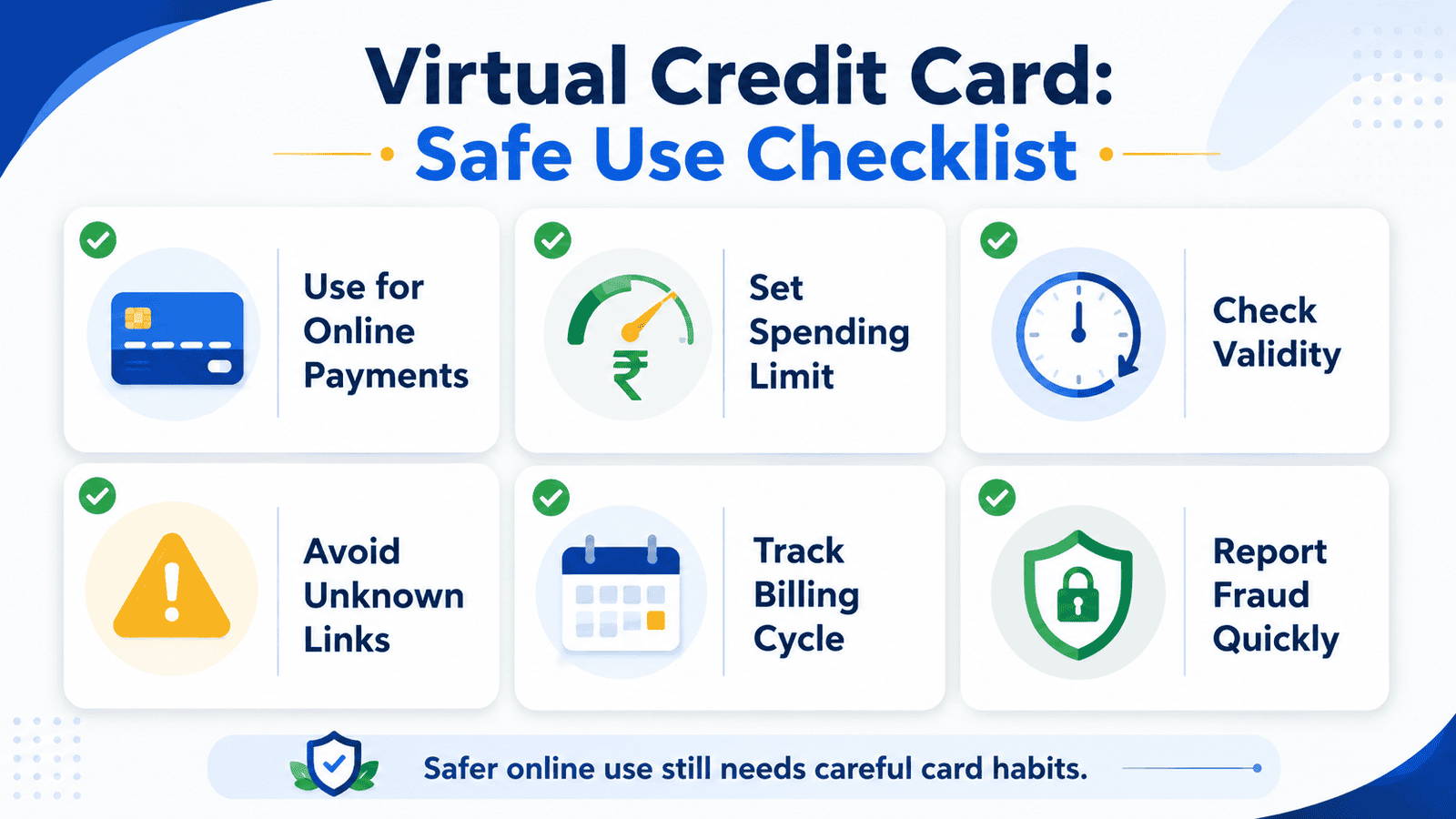
Safety Checklist: Before You Use a Virtual Credit Card Online
- Create the virtual card only through your bank’s official app or netbanking portal — not through any third-party website or link received via SMS or email.
- Set the lowest limit that covers your purchase where your issuer allows limit controls — this caps potential exposure if card details are misused.
- Check the merchant before entering any card details — look for HTTPS in the address bar, a clear return policy, and a verifiable business name.
- Never share your OTP, CVV, card PIN, or app login credentials with anyone — not even someone claiming to be from the bank.
- Do not save virtual card details on unfamiliar merchant websites — save them only on platforms you trust and regularly use.
- Turn on transaction alerts for your credit card so you are notified of every charge immediately.
- Check your credit card statement after every online payment — confirm the virtual card charge appears correctly and matches what you spent.
- Report any suspicious or unrecognised charge immediately — contact your card issuer through the official number on the back of your card or the bank’s official app. See: card fraud complaint.
Key Takeaways
- A virtual credit card gives you a separate set of digital card credentials — typically a card number, expiry date, and CVV — for online payments, so your original card number is not exposed to merchants.
- Virtual card transactions may still appear in your regular credit card bill if the virtual card is linked to your main card account — unpaid dues attract interest just like any other card transaction.
- Some issuers allow you to set a custom spending limit on the virtual card, such as ₹5,000 for a specific purchase — this is one of the most practical safety features available, but it is not available with every issuer or card type.
- A virtual card reduces the risk of your main card number being stolen, but it does not protect you from OTP fraud, phishing websites, malware on your device, or careless approval of recurring subscription charges.
- Refund and chargeback processes for virtual card transactions can vary by issuer and merchant — a refund may be credited back to the underlying card account even if the virtual card has expired.
- Availability of virtual card features, limit controls, validity periods, and international payment access differs across banks and card issuers in India — always check with your specific issuer before relying on these features.
- Missing the credit card due date after a virtual card purchase — even for a small amount — can attract interest charges and, if unpaid for long, affect your credit score across all four bureaus: TransUnion CIBIL, Experian, Equifax, and CRIF High Mark.
Key Facts at a Glance
| Feature | What It Means | What to Check |
|---|---|---|
| Virtual card number | A separate card number generated for online use — different from your physical card number | Whether your issuer generates a unique number or uses a masked version of the original |
| Expiry date and CVV | Digital credentials assigned to the virtual card — may differ from your physical card | Validity period: some virtual cards expire after one transaction or a set time frame |
| Spending limit | Some issuers allow you to set a custom limit lower than your full credit limit | Whether limit control is available with your card and how to set it |
| Billing and repayment | Charges usually appear in your regular credit card statement and must be paid by due date | Whether virtual card transactions are billed separately or as part of the main card bill |
| Offline and ATM use | Virtual cards are generally not usable at physical POS terminals or ATMs | Your issuer’s confirmation on whether offline use is supported |
| Safety benefit | Reduces exposure of your main card number to merchants and third-party websites | What the card does not protect against — phishing, OTP fraud, fake merchants |
| Issuer availability | Not all Indian banks and card issuers offer virtual card features | Whether your specific card and account is eligible — check with your issuer directly |
How a Virtual Credit Card Works in India
A virtual credit card is a set of payment credentials — a card number, an expiry date, and a CVV — that exists only in digital form. There is no physical plastic involved. You use these credentials exactly the way you would use a physical card on any online checkout page: enter the number, expiry, and CVV, complete the two-factor authentication with an OTP, and the payment goes through.
The key difference is what happens to those credentials after the transaction. Your physical credit card number is a permanent identifier. Every time you use it online, a merchant’s payment system, database, or third-party processor records it. If any of those systems is breached, your card number can be misused. A virtual card number, by contrast, may be temporary, single-use, or limited to a specific amount — which means even if it is captured in a data breach, it is either invalid or useless beyond the amount you set.
How the virtual card connects to your main account
In most Indian implementations, a virtual credit card is not a separate credit account. It draws from the same credit limit as your existing physical credit card. When you spend ₹4,499 on a virtual card, that amount is deducted from your available credit limit — and it appears in your regular monthly credit card statement. Repayment works the same way as any other card transaction: pay by the due date to avoid interest charges.
Understanding your billing cycle basics is important here — virtual card purchases made in one billing period will appear in that period’s statement and must be cleared by the payment due date. Treating a virtual card as “separate spending” from the main card is a common and costly mistake.
What “card tokenisation” means here
Some virtual card implementations work through card tokenisation — a process where the actual card number is replaced with a unique token for each merchant or transaction. According to the Reserve Bank of India (rbi.org.in), card-on-file tokenisation allows merchants to store a token instead of the actual card number, reducing the risk of card data theft from merchant databases. This is a different but related concept: both virtual cards and tokenisation aim to prevent your original card number from being widely exposed, though they work differently at the technical level.
What varies by issuer
Not all Indian card issuers offer virtual credit card features, and those that do may implement them differently. Some banks offer virtual cards through their mobile banking app or internet banking portal. Some allow you to set a custom spending limit. Some generate a one-time card number valid for a single transaction; others generate a card valid for a set period. The availability of controls for merchant category restrictions, validity, and international payments differs by issuer. Always check with your specific bank or card provider before relying on any of these features.
Real Example: Rohit’s ₹4,499 Online Purchase
Rohit, 31, is a software analyst in Pune earning ₹55,000 per month. He uses his credit card for online shopping, OTT subscriptions, and travel bookings. One evening, he spots a ₹4,499 keyboard on a website he has not purchased from before. He is unsure how trustworthy the merchant is.
Rohit logs into his bank’s official mobile app, generates a virtual card, and sets a transaction limit of ₹5,000 — just enough to cover the purchase with a small buffer. He uses this virtual card number on the unfamiliar website, completes the OTP verification, and gets the order confirmation. He does not save the card on the merchant website.
Two days later, Rohit checks his credit card statement and confirms the ₹4,499 charge appears correctly. He makes a note of the due date and plans to pay the full outstanding amount before then.
Now consider what happens if Rohit forgets. He pays only the minimum amount due — say, ₹250 — thinking the virtual card was “separate.” The remaining balance of ₹4,249 is carried forward to the next billing cycle and immediately starts attracting interest at the rate his issuer charges on unpaid balances. Over a few months, this can cost him significantly more than the original purchase. His credit score is not affected yet if he continues making minimum payments, but a missed payment altogether — even a small one — can be reported to the credit bureaus and affect his score. This is why understanding late payment impact matters just as much as the virtual card itself.
The key insight: a virtual card protects your card number at the point of purchase — it does not make the spending responsibility disappear.
Before You Create a Virtual Card: What to Check
- Does your issuer offer virtual card functionality? Not all Indian banks and card providers offer this feature. Log in to your bank’s official app or website and look for a virtual card option, or call the official customer care number to confirm availability.
- Do you need an existing credit card? In most cases, yes — a virtual card is linked to an existing credit card account. You typically cannot apply for a standalone virtual card without an underlying card relationship with the issuer.
- Can you set a custom spending limit? Some issuers allow cardholders to define a limit for the virtual card below the full credit limit. If your issuer offers this, use it — set the limit to just enough to cover your intended purchase.
- What is the validity period? Some virtual cards expire after one transaction. Others are valid for a few days or weeks. If you are using the virtual card for a recurring subscription, check whether the virtual card number will still be active when the next renewal charge is attempted.
- Is international payment enabled? If you are shopping on an international website or an app billed in foreign currency, confirm whether your virtual card supports international transactions and what foreign currency markup your issuer charges. Details on this are covered in foreign transaction charges.
- Is the official app or netbanking the only channel? Always generate your virtual card only through the official bank app or official internet banking portal. Do not use any third-party app, SMS link, or WhatsApp message that claims to offer virtual card generation — these are fraud vectors.
How Virtual Card Spending Affects Your Credit Card Bill
A virtual card transaction is not separate from your credit card — it is part of it. Here is what a typical billing impact looks like using an illustrative example:
Outstanding bill = Previous balance + New virtual card charge − Payments made
Where: Previous balance = any amount carried from last billing cycle | New virtual card charge = the merchant transaction amount | Payments made = amount paid before or by due date
| Scenario | Action Taken | Result |
|---|---|---|
| ₹4,499 purchase, full bill paid by due date | Pay total outstanding by due date | No interest carried forward — subject to issuer’s interest-free period policy |
| ₹4,499 purchase, only minimum amount paid | Pay minimum amount due only | Remaining balance attracts interest at the issuer’s applicable rate — verify with your issuer |
| ₹4,499 purchase, payment missed entirely | No payment made by due date | Late payment charge applies; continued non-payment is reported to credit bureaus and can reduce credit score |
The interest rate on unpaid credit card balances and the late payment fee structure vary by issuer and card type. These figures should be verified directly with your card provider before making any payment decisions.
Virtual Credit Card vs Physical Credit Card
| Point | Virtual Credit Card | Physical Credit Card |
|---|---|---|
| Form | Digital credentials only — no physical card | Plastic card with embossed or printed number, expiry, and CVV |
| Online payments | Suitable — designed for online use | Suitable — widely accepted online |
| Offline POS / retail | Generally not supported | Fully supported — tap, swipe, or chip |
| ATM cash advance | Generally not available | Available — though cash advance charges apply |
| Main card number exposure | Reduced — a separate number is used | Higher exposure — same number shared across merchants |
| Spending limit control | Possible with some issuers — check availability | Fixed credit limit set by issuer — no per-transaction limit control |
| International payments | Depends on issuer and international usage setting | Available if international usage is enabled — foreign transaction charges apply |
| Billing impact | Same as physical card — appears in regular statement | Appears in regular statement — same repayment rules apply |
| Replacement on misuse | Can often be disabled or regenerated without replacing the physical card | Requires physical card block and replacement — takes a few working days |
For international transactions using either card type, check what your issuer charges as a foreign currency markup. These charges can add meaningfully to your total bill when shopping on international websites or apps billed in US dollars or other currencies.
What to Do If a Virtual Card Transaction Looks Suspicious
Step 1 — Act immediately
If you see an unrecognised charge on your credit card statement that appears to relate to a virtual card transaction, do not wait. Log in to your bank’s official app and check whether you can disable or block the virtual card. Some issuers allow cardholders to disable the virtual card instantly without blocking the physical card — this can prevent further charges while you investigate.
Step 2 — Contact the card issuer through official channels
Call the customer care number printed on the back of your physical card, or use the official bank app’s chat or complaint function. Do not call numbers found in search engine results or WhatsApp messages — these can be impersonation fraud. Report the suspicious charge and ask for a temporary block on the card if you are uncertain about further transactions.
Step 3 — Report the unauthorised transaction in writing
Raise a formal complaint with the card issuer. According to the Reserve Bank of India (rbi.org.in), cardholders have defined rights regarding unauthorised electronic transactions, including a liability framework that depends on where the negligence occurred — the bank’s end or the cardholder’s end. Prompt reporting strengthens your position. See: unauthorised card transaction.
Step 4 — Preserve all evidence
Save the transaction SMS or email notification, a screenshot of the charge in the app or statement, any merchant confirmation email, and the date and time of your complaint. You will need these if you escalate the matter.
Step 5 — Raise a dispute or chargeback if relevant
If the issue is a merchant dispute — for example, you paid for a product that was not delivered, or you were charged twice — you may be eligible to raise a chargeback through your card issuer. The outcome depends on the investigation. Do not assume a chargeback guarantees a refund. Keep communicating with the issuer and escalate to the bank’s grievance redressal officer if the complaint is not resolved within the timeframe they commit to.
| Scenario | First Step | Who to Contact |
|---|---|---|
| Unrecognised charge on statement | Block or disable virtual card via official app | Card issuer customer care — official number only |
| Payment deducted, no order confirmation from merchant | Contact merchant first with transaction reference | Merchant → then card issuer if no response |
| Product not delivered after full payment | Contact merchant and preserve all proof | Raise chargeback with card issuer after merchant fails to respond |
| OTP was shared with a fraudster | Report to card issuer immediately and block card | Card issuer + cybercrime.gov.in for formal fraud report |
You are buying from an unfamiliar or first-time online merchant — use a virtual card with the lowest limit that covers the purchase. This limits exposure if the merchant’s systems are compromised.
You are setting up a recurring subscription — check whether your issuer’s virtual card remains active across billing cycles. A virtual card that expires after one transaction will cause the subscription to fail and may lead to service interruption or auto-renewal confusion.
You are shopping on an international website — confirm that your issuer supports international payments on the virtual card and check what foreign currency markup applies before completing the purchase.
You need to pay at a physical store, withdraw cash, or the merchant requires card-present verification — a virtual card will not work. Use your physical credit card or a UPI-linked option instead.
You are already carrying unpaid credit card debt from previous billing cycles — using a virtual card adds to that balance. Consider clearing existing dues before making new purchases, regardless of whether you use a virtual or physical card.
Your issuer does not offer virtual card controls like limit-setting or one-time number generation — the safety benefit is limited. In this case, evaluate whether tokenisation through your bank’s official app or UPI with a linked credit card offers equivalent protection for your specific transaction type, per NPCI (npci.org.in) guidelines on digital payment safety.
Common Mistakes to Avoid
Treating a virtual card as completely fraud-proof
A virtual card reduces the exposure of your main card number — it does not eliminate fraud. Fake websites, phishing links, OTP-sharing scams, and malware on your device can still result in financial loss even when you use a virtual card number.
Always verify the merchant independently before entering any card details, virtual or otherwise.
Sharing your OTP with anyone after a virtual card payment
No legitimate bank, merchant, or payment app will ask you to share the OTP you receive on your phone. If someone calls you claiming to be a bank representative and asks for your OTP to “verify” a virtual card transaction, disconnect immediately. This is a known fraud pattern and sharing the OTP authorises the transaction from your end — affecting your liability under RBI’s customer protection framework.
Ignoring the credit card bill after virtual card use
Virtual card transactions appear in your regular credit card statement. If you miss the due date — even by one day — late payment charges apply. Prolonged non-payment is reported to the credit bureaus and can reduce your credit score. Check the statement and pay the full outstanding amount before the due date.
Using a virtual card on a website that looks suspicious
A virtual card reduces the damage if a legitimate merchant’s database is breached. It offers no protection if you enter your credentials on a fake website designed to capture card details in real time. Look for HTTPS, a clear merchant name, verifiable contact details, and a return/refund policy before completing any payment.
Forgetting recurring subscriptions set up on a virtual card
If you used a virtual card to sign up for a subscription trial, and the virtual card has a limit of ₹500, the renewal charge may fail when the subscription auto-renews at full price. This can lead to service disruption, failed payment records, or — if the subscription switches to a backup card saved on the platform — an unexpected charge you did not plan for.
Assuming all issuers offer the same controls
Virtual card features are not standardised across Indian banks. One issuer may offer one-time card numbers with custom limits; another may offer a masked version of the original card without limit controls. Do not assume a feature is available until you confirm it with your specific issuer.
Creating virtual cards through unofficial apps or links
There are fake apps and phishing pages that claim to generate virtual cards or offer “instant virtual card services.” These are fraud vectors. Always generate virtual cards only through your bank’s official mobile app or official internet banking portal — no exceptions.
When This May Not Be the Right Choice
Merchant requires physical card verification. Some merchants — particularly offline retailers, government portals requiring in-person KYC, or certain foreign websites with additional identity checks — require the physical card to be present or verified. A virtual card number alone will not work in these situations.
Refunds may be complex if the virtual card has expired. When you request a refund from a merchant, the refund is typically processed back to the original payment source. If the virtual card number has expired or been disabled by the time the refund is processed, the crediting path depends on your issuer’s process — which can take additional time or require follow-up. Verify your issuer’s refund-to-expired-virtual-card process before making purchases where returns are likely.
You are already struggling to control credit card spending. If unpaid credit card balances are already a concern, adding virtual card transactions to the same account creates more complexity without solving the underlying problem. Reducing outstanding dues and building a repayment habit should come first.
You need to use your card offline, at an ATM, or at a physical POS terminal. Virtual cards are designed for online use. For in-store purchases, transit, or cash withdrawals, your physical card is the only option.
If any of these apply to your situation, it may be worth exploring other options before committing.
Official Rules and Where to Verify
Virtual credit card rules, features, fees, and dispute processes are not standardised — they are governed by the individual issuer within the broader framework set by the Reserve Bank of India. Here is where to verify the information that matters most:
- RBI — rbi.org.in: For customer protection rules on unauthorised electronic transactions, card safety guidelines, digital lending regulations, and the framework for reporting fraud to your bank. RBI’s guidelines on limiting customer liability in unauthorised card transactions are particularly relevant if you face disputed charges.
- NPCI — npci.org.in: For guidance on digital payment safety, UPI-linked card usage, and payment system standards that apply where virtual card payments interact with NPCI payment rails.
- Your card issuer’s official website or app: Check HDFC Bank (hdfcbank.com), ICICI Bank (icicibank.com), Axis Bank (axisbank.com), SBI Card (sbicard.com), or your specific issuer for virtual card availability, feature details, limit controls, validity, fees, international payment settings, and the dispute or chargeback process.
- Card terms and most important terms and conditions (MITC): Every credit card comes with a Key Fact Statement (KFS) and MITC. Read the section on fees, interest rates on unpaid balances, and chargeback or dispute timelines. These figures can change with issuer updates.
For understanding the chargeback and dispute process in more detail, see: chargeback process India.
Credit reporting rules, lender assessment methods, and bureau processes can change. Always verify current details from the relevant bureau, lender, or official regulatory source before acting.
Expert Tips
- Set the virtual card limit as close to your purchase amount as possible — if you are buying a ₹3,200 item, a ₹3,500 limit gives a small buffer without leaving room for additional unauthorised charges. Where your issuer offers this control, use it every time.
- Keep international usage disabled by default and enable it only when needed — most Indian card issuers allow you to toggle international transactions on or off through the official app. Leaving it on when you do not shop internationally widens your exposure unnecessarily.
- Review your credit card statement at the end of every billing cycle, not just before the due date — catching an unfamiliar charge early gives you more time to investigate and raise a dispute before the cycle closes.
- Enable transaction alerts for every rupee — set SMS or app push notifications for every card transaction, including virtual card charges. This is the fastest way to spot fraud in real time.
- Watch your credit utilisation ratio — your virtual card charges reduce the available credit on your card. If you carry a balance forward month after month, your utilisation rises, which can affect your credit score across all four bureaus: TransUnion CIBIL, Experian, Equifax, and CRIF High Mark. Keeping utilisation below 30% of your credit limit is a broadly followed guideline.
- Do not use a virtual card — or any credit card — to fund spending you cannot repay fully within the billing cycle — the interest rate on unpaid credit card balances is among the highest of any consumer financial product in India. If you cannot pay the full amount by due date, consider whether the purchase is necessary right now.
- If your issuer allows it, generate a new virtual card for each risky merchant rather than reusing the same virtual card number — this limits each merchant’s access to a credential that cannot be reused elsewhere.
Frequently Asked Questions
What is a virtual credit card in India?
A virtual credit card is a set of digital payment credentials — a card number, expiry date, and CVV — that you can use for online transactions without exposing your main physical credit card number. It is typically linked to your existing credit card account. Features like spending limits, validity periods, and one-time card numbers vary by issuer, so check with your bank or card provider for what is available on your account.
Is a virtual credit card safer than a normal credit card for online use?
It can reduce one specific risk: the exposure of your main card number to merchants and third-party payment systems. If a merchant’s database is breached, a virtual card number is less useful to a fraudster — especially if it is a one-time or limited-amount credential. However, virtual cards do not protect you from phishing websites, OTP-sharing fraud, malware on your device, or fake merchant pages. You must still exercise the same caution you would with a physical card.
Does a virtual credit card affect my CIBIL score?
Yes — indirectly. The transactions made through a virtual card are part of your credit card account and appear in your credit card statement. If you miss the payment due date or carry a high unpaid balance, this will be reported to the credit bureaus — TransUnion CIBIL, Experian, Equifax, and CRIF High Mark — and can reduce your credit score. The virtual card itself does not create a separate credit inquiry or new account entry; it operates within your existing card account.
Can I use a virtual credit card for subscriptions?
Potentially, yes — but with caution. If the virtual card has a fixed validity period or a low spending limit, it may not work when the subscription auto-renews at full price in the next cycle. Check whether your issuer’s virtual card supports recurring mandates, how long it remains valid, and whether the renewal amount stays within the limit you have set. If the virtual card expires before the renewal, the subscription charge may fail.
Can I get a refund on a virtual credit card payment?
In most cases, the refund is credited back to the underlying credit card account — either the virtual card account or the main card account, depending on how your issuer processes it. If the virtual card has been disabled or expired by the time the refund is processed, check with your issuer on how the credit will be applied. Refund timelines also depend on the merchant’s own process. Do not assume a refund request means immediate credit to your account.
Can a virtual credit card be used offline or at an ATM?
Generally, no. Virtual credit cards are designed for online use only — entering card details on a digital checkout page. They are not compatible with physical POS terminals, contactless tap-to-pay, or ATM cash withdrawals. If you need to pay in person or withdraw cash, you will need your physical credit card.
What should I do if a virtual card transaction is unauthorised?
Act immediately. Log in to your bank’s official app and block or disable the virtual card if that option is available. Then contact the card issuer through the official customer care number or app and report the unauthorised transaction formally. Preserve the transaction SMS, email, and any merchant details. According to the Reserve Bank of India (rbi.org.in), customer liability for unauthorised electronic transactions depends on where the negligence lies — prompt reporting is essential to protect your rights. Do not share any OTP or credentials with anyone claiming to investigate the fraud on your behalf.
Are virtual credit cards available on all Indian credit cards?
No. Virtual card features are offered by select banks and card issuers in India, and availability varies by card type and product. Some major issuers — including HDFC Bank, ICICI Bank, and Axis Bank — have offered virtual card functionality on some of their products. However, features, controls, and availability are not uniform. Check with your specific issuer to confirm whether your card is eligible and what features are available.
Can I set a spending limit on a virtual credit card?
Some issuers allow cardholders to set a custom transaction limit on the virtual card — for example, limiting it to ₹5,000 for a specific purchase. This is one of the most useful safety controls available. However, this feature is not offered by every issuer. Check your issuer’s app or netbanking to see whether limit control is an option for your card.
Is there any additional charge for using a virtual credit card?
Most issuers do not charge a separate fee for generating or using a virtual credit card. However, the standard charges on your credit card account — interest on unpaid balances, late payment fees, foreign transaction markups, and any applicable annual or joining fees — continue to apply to virtual card transactions as they would to any other card charge. Verify the specific fee structure with your issuer.
Final Verdict
A virtual credit card is a practical tool for reducing the exposure of your main card number when shopping online — particularly on unfamiliar websites, during subscription trials, or when you want to limit how much a merchant can charge to a single credential. If your issuer offers limit controls and one-time card numbers, those features add a meaningful layer of protection to your online payments.
That said, a virtual credit card is not a fraud shield. It does not protect you from fake websites, OTP fraud, phishing, malware, or careless subscription approvals. And because virtual card transactions almost always appear in your regular credit card statement, your repayment responsibility is identical to that of any other card charge. Missing the due date after a virtual card purchase can attract interest and, if the pattern continues, reduce your credit score just as a missed physical card payment would.
Use a virtual card when you are shopping online from a new or unfamiliar merchant and your issuer’s controls give you genuine confidence. Verify features, limits, and international payment settings with your issuer before relying on them. For dispute or refund situations, act promptly and use official channels only.
Always verify the latest fees, interest rates, billing rules, and reward terms from the card issuer and official regulatory sources before applying or using a credit card feature.
This article is for educational purposes only and should not be treated as personalised financial, credit, or legal advice. Credit card fees, interest rates, billing rules, eligibility criteria, rewards, and issuer terms can vary and may change over time. Please verify current terms directly with the card issuer, official regulatory source, or a qualified professional before applying for or using any credit card feature.

Neha Menon writes simple, borrower-first explainers on CIBIL scores, credit reports, bureau disputes, DPD, loan settlement impact, hard inquiries, and practical credit score recovery. She focuses on helping Indian borrowers understand lender-reported data, avoid credit mistakes, and take safer next steps without false promises.