

You pull up your CIBIL report before applying for a loan, and there it is — a loan you never took, a personal loan you closed two years ago still marked “active,” or an overdue amount on an account you paid off in full. Your stomach drops. A wrong loan entry in CIBIL report data can quietly sink a loan application, and most borrowers don’t know whether to call CIBIL, call the lender, or panic.
Here’s the calm version: some of this can be fixed. Some of it can’t — not because the system is broken, but because CIBIL only displays what your lenders report to it. This article walks you through how to tell a genuine error from a loan you simply forgot about, what proof to gather, how to raise a bureau dispute, when to go straight to the lender, and what to do if nobody fixes it. What it won’t do is promise you a score bump or a fixed number of days — nobody can promise that, and anyone who does is trying to sell you something.
Quick Answer: Can You Remove a Wrong Loan Entry from Your CIBIL Report?
Yes — but only if the entry is actually incorrect. You can dispute it directly with TransUnion CIBIL, but because the data comes from your lender, the lender usually has to verify or correct it before your report updates. Collect proof — an NOC, payment receipts, or bank statements — before you raise the dispute, and always save your reference number.
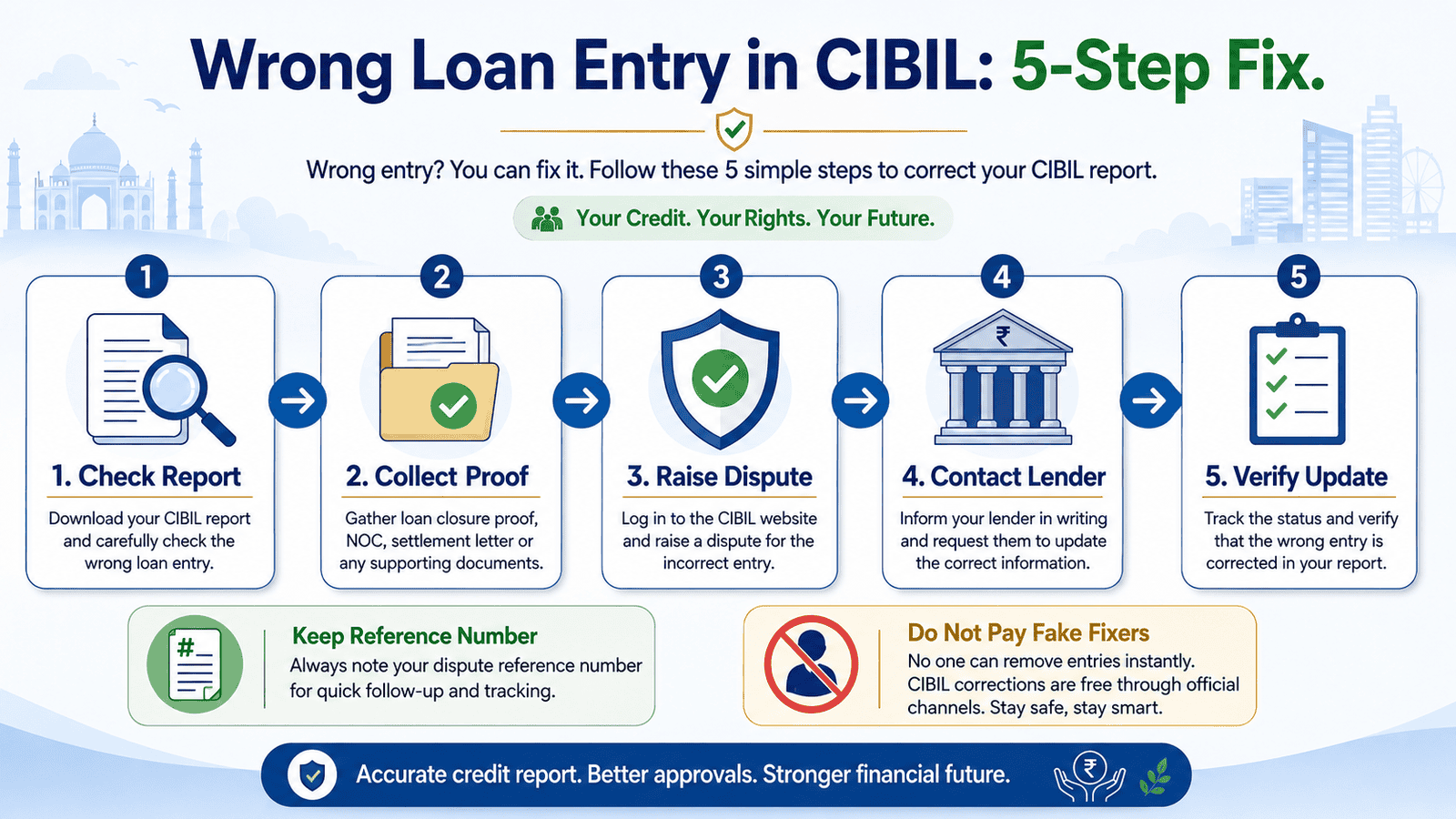
Do This First: Immediate Steps for a Wrong Loan Entry
Before you file anything, work through these steps in order. They take under an hour and they decide whether your dispute gets fixed quickly or gets stuck.
Step 1 — Pull your latest report and note the control number
Get your current CIBIL report, not an old download. Every report carries a control number — you’ll need it for any dispute you raise.
Step 2 — Pinpoint exactly what’s wrong
Don’t dispute “this loan” broadly. Identify the precise wrong field: lender name, account status, outstanding amount, Days Past Due (DPD), ownership type, or closure date.
Step 3 — Gather proof before you file
A closure letter, a “No Objection Certificate” (NOC), a bank statement showing the final payment, or lender emails — whatever supports your claim.
Step 4 — Raise the dispute with the bureau, and separately with the lender
File the correction request through TransUnion CIBIL’s dispute process, and send the same proof to the lender’s grievance or customer service channel. Save every reference number you receive.
Key Takeaways
- CIBIL cannot delete an account simply because it’s inconvenient — it can only correct data that is actually inaccurate, based on what the lender confirms.
- A wrong loan entry — one you never took, a closed loan shown as active, or a wrong DPD meaning in report — should be disputed with documented proof, not a vague complaint.
- In most cases, the lender has to confirm or correct the data before your bureau report changes, so contacting the lender directly is rarely optional.
- Paid “CIBIL repair” agents cannot bypass the official dispute-and-verification process — anyone promising instant deletion is a red flag.
- If a dispute is rejected or the same wrong data reappears, escalation goes through the lender’s grievance officer, and then the RBI Ombudsman for regulated lenders.
- Keep every reference number, email, and screenshot in one place — you will likely need to quote them more than once during follow-up.
Key Facts at a Glance
| Error Type | Proof to Collect | Who to Contact First |
|---|---|---|
| Loan you never took | ID proof, address history, police complaint if fraud is suspected | Lender (for identity verification) and bureau |
| Closed loan shown as active | NOC or closure letter, final payment receipt | Lender first, then bureau if unresolved |
| Wrong overdue amount or DPD | Bank statement, payment confirmation, EMI receipts | Lender first, then bureau |
| Duplicate account or wrong ownership | Loan agreement showing correct applicant/co-applicant status | Lender and bureau together |
Why Wrong Loan Entries Happen — and Why the Lender Matters
A credit information report is not something CIBIL, Experian, CRIF High Mark, or Equifax India generates on their own. Banks and NBFCs report account-level data to the bureaus every reporting cycle — balances, repayment history, DPD, and status. The bureau’s job is to display and process that lender-reported data, not to independently investigate every loan.
That’s why errors creep in. A lender’s system might miss updating an account to “closed” after you pay it off. A processing delay can leave a recently paid EMI showing as overdue — a common trigger for readers searching overdue after payment. Identity mismatches, duplicate data entry, or in rarer cases fraud using your PAN can also plant an entry you never created.
Not every unrecognised entry is actually wrong
Before you assume fraud or error, rule out the ordinary explanations. A credit card EMI conversion, a Buy-Now-Pay-Later account, a consumer durable loan taken at a store checkout, or a loan where you were a co-applicant or guarantor can all show up looking unfamiliar months later. If the account is genuine but you simply don’t recognise the lender’s trade name, that’s not something a dispute will “remove” — it’s something you need to verify first.
A closed loan sitting as closed loan still active is one of the most common and most fixable versions of this problem, precisely because you usually already hold the proof of closure.
Real Example: Rohit’s Unfamiliar Loan Entry
Rohit, 32, works in Pune and earns around ₹55,000 a month. Planning to apply for a personal loan for a home renovation, he pulled his CIBIL report and found a ₹40,000 consumer durable loan he didn’t remember taking, showing a small overdue balance.
Instead of panicking, he checked the lender’s name, the loan date, and the address linked to the account — and matched it against his bank statements from that period. It turned out to be a store-financed purchase from 18 months earlier that he’d genuinely forgotten, already fully paid, but never marked closed in the lender’s system. He gathered his payment proof, raised a dispute with CIBIL, and separately emailed the lender’s grievance desk asking them to confirm closure.
The insight for Rohit — and for most readers in this position — is that identifying exactly what’s wrong before disputing saves weeks of back-and-forth.
Documents You Should Collect Before Raising a Dispute
Have These Ready
- Your latest credit report with the control number visible
- Loan closure letter or NOC, if the loan has been repaid
- Bank statements showing EMI debits or the final settlement payment
- Any lender emails, SMS, app screenshots, sanction letter, or rejection communication related to the account
- A note of the exact account number and lender name as shown in the report
How a False Entry Can Affect a Loan Application
Say Rohit applies for his renovation loan while that false overdue is still live on his report. A lender assessing his application typically weighs his existing EMI obligations, repayment history, and overdue status alongside his income — so an incorrect overdue entry can make his profile look riskier than it actually is, even though the underlying loan was paid.
This isn’t a guaranteed rejection, and it isn’t a fixed number of points off a score — credit scoring models vary by bureau and change over time, and no article can honestly calculate an exact score impact for you. What matters practically is this: an unresolved wrong entry adds unnecessary risk to how a lender reads your file, which is reason enough to get it corrected before you apply, not after.
Comparison: CIBIL’s Role vs the Lender’s Role
| Task | CIBIL’s Role | Lender’s Role |
|---|---|---|
| Displaying account data | Displays reported data | Sends the original data |
| Investigating a dispute | Logs and forwards the dispute | Verifies and confirms correction |
| Correcting the record | Updates once lender confirms | Must approve the correction |
| Unresolved regulated-lender complaint | Not the escalation route | RBI Ombudsman may apply |
This is the single most important thing to understand: raising a dispute only with CIBIL, and never contacting the lender, is one of the most common reasons corrections stall.
Step-by-Step: The Full Correction Process
Once you’ve confirmed the entry is genuinely wrong and gathered your proof, here’s the fuller credit report dispute process to follow.
Step 1 — Review your report and mark the exact wrong fields
List each incorrect field separately — status, amount, ownership, dates.
Step 2 — Assemble your proof file
NOC, receipts, statements, and lender communication, organised by account.
Step 3 — Raise the official bureau dispute
Use TransUnion CIBIL’s consumer dispute route, select the specific account and the correct dispute reason, and attach supporting proof where the form allows it. Note your dispute reference number immediately.
Step 4 — Send a written complaint to the lender
Email or write to the lender’s grievance or nodal officer with the same proof, and ask for written confirmation once the correction is made.
Step 5 — Recheck your report after the review cycle
Pull a fresh report once the bureau’s review period has passed and confirm the field has actually changed — don’t assume it has.
Protect Yourself While You Dispute
Never share your credentials
Do not share your PAN, Aadhaar, OTP, credit report login, or payment details with anyone contacting you and claiming they can fix your CIBIL entry.
Don’t pay for “instant” removal
No legitimate service can bypass lender verification or delete accurate data for a fee — this is the core promise fake “CIBIL repair” agents make, and it’s false.
Never submit fabricated documents
Submitting a fake NOC or altered statement to support a dispute can create a bigger legal problem than the original error.
Keep everything in writing
Emails and reference numbers protect you if a dispute needs to be escalated later.
How to Decide What’s Right for You
you don’t recognise a loan and have no memory of applying for it — treat it as a possible reporting error or identity issue and raise a dispute with proof of your identity and address history.
a loan you fully repaid still shows as active — gather your NOC and closure proof and contact the lender before disputing with the bureau.
the overdue amount is wrong but the loan itself is genuine — send your payment proof and bank statement directly, since this is usually a lender data-entry delay.
the account looks unfamiliar but turns out to be a BNPL, EMI conversion, or guarantor-linked loan you genuinely hold — a dispute won’t remove it, since the data is accurate.
you can’t produce any proof for your claim — dispute anyway, but expect the lender’s verification step to take longer without documentation to point to.
the negative entry is accurate and simply reflects a missed payment — don’t dispute it hoping it will be removed; focus on repayment and future conduct instead.
Common Mistakes to Avoid
Filing a vague dispute
Writing “this is wrong” without specifying the field or attaching proof.
Vague disputes are harder for the lender to verify quickly and are more likely to come back unresolved, forcing you to refile and lose weeks.
Name the exact field — amount, status, date, ownership — and attach evidence for each.
Only contacting CIBIL, never the lender
Assuming the bureau alone can fix lender-reported data.
Since the lender owns the underlying data, a bureau-only complaint often sits waiting for lender confirmation that never comes.
Send the same complaint, in writing, to the lender’s grievance channel at the same time.
Ignoring lender follow-up requests
Not responding when the lender asks for additional proof or clarification.
An unanswered verification request can cause the dispute to be closed as unresolved by default.
Respond promptly and keep a copy of every exchange.
Assuming CIBIL can delete verified genuine data
Believing a dispute will remove an accurate but inconvenient negative record.
This misunderstanding wastes time on disputes that were never going to succeed and delays focusing on what actually helps — like clearing dues.
Reserve disputes for data you can show is factually incorrect.
Confusing written-off, settled, closed, and overdue statuses
Treating all negative-sounding labels as the same kind of error.
A written-off loan status, a settled account, a closed account, and an overdue account all mean different things and need different proof to dispute.
Check the exact status label before deciding what to contest.
Paying a “credit repair” agent
Hiring someone who promises fast, guaranteed removal for a fee.
Beyond the money lost, sharing your credit report login or ID documents with such agents risks identity misuse.
Use only the bureau’s official dispute channel and the lender’s grievance desk.
When This May Not Be the Right Choice
A dispute won’t help — and may not be the right move — if:
The loan is genuine and the reported data is already accurate, even if the outcome is unwelcome. The entry reflects a co-applicant or guarantor obligation you did agree to, even if you weren’t the primary borrower. The negative status is correct but simply uncomfortable to see, such as a missed payment that did happen. Or the error you’re seeing actually belongs to a different bureau’s report — CIBIL correction won’t touch Experian, CRIF High Mark, or Equifax India data separately.
If any of these apply to your situation, it may be worth exploring other options before committing.
Official Rules and Where to Verify
Verify current dispute steps, forms, and complaint routes directly from these sources rather than relying on secondhand summaries:
- TransUnion CIBIL — transunioncibil.com — for the bureau dispute process and report access
- Experian India — experian.in — if the same error appears on an Experian report
- CRIF High Mark — crifhighmark.com — if the error appears on a CRIF report
- Equifax India — equifax.co.in — if the error appears on an Equifax report
- Your lender’s grievance or nodal officer — for lender-side verification and correction
- RBI — rbi.org.in — for the RBI Ombudsman complaint process, if a regulated lender does not resolve your complaint
Credit reporting rules, lender assessment methods, and bureau processes can change. Always verify current details from the relevant bureau, lender, or official regulatory source before acting.
Expert Tips
- Keep a single folder — digital or physical — with your report copy, proof documents, emails, and every reference number, from day one.
- Use identical facts and dates when describing the error to both the bureau and the lender — inconsistent details slow down verification.
- If you’re planning a major loan application, check your report with more than one bureau, since data can differ between them.
- Avoid submitting multiple fresh loan applications while a serious error is still under dispute — each hard inquiry adds its own footprint.
- Ask the lender for written confirmation once they’ve corrected their records, not just a verbal assurance.
- Re-verify your report a few weeks after the lender confirms correction — don’t assume the bureau update happened automatically.
Frequently Asked Questions
Can I remove a wrong loan entry from my CIBIL report?
Yes, if the entry is genuinely incorrect. You dispute it with the bureau, but the lender typically has to verify or confirm the correction before your report updates.
How do I dispute a loan I never took?
Raise a dispute with TransUnion CIBIL citing identity or reporting error, and separately alert the lender in writing, since they may need to investigate for potential misuse of your identity.
Should I contact CIBIL or the lender first?
Doing both together works best. CIBIL logs the dispute, but the lender usually has to confirm the correction, so contacting only one side often stalls the process.
Is there a fixed order that guarantees a faster fix? No — it depends on the type of error and how quickly the lender responds.
What documents are needed to remove a wrong loan entry?
An NOC or closure letter for closed loans, bank statements or payment receipts for overdue disputes, and any lender communication relevant to the account.
How long does CIBIL take to correct a wrong loan entry?
Timelines depend on the bureau’s current process and how quickly the lender verifies the data — check the bureau’s website for the current review period rather than relying on a fixed number.
What if my closed loan is still showing as active in CIBIL?
Send your NOC and final payment proof to the lender directly and ask them to update the closure status, then raise a bureau dispute if it isn’t reflected afterward.
Can a paid agent remove a loan from CIBIL faster?
No legitimate agent can bypass lender verification or delete accurate data for a fee. Anyone promising instant, guaranteed removal is not using the official process.
What happens if the lender confirms the wrong data again?
You can escalate to the lender’s grievance or nodal officer in writing, and if the lender is RBI-regulated and still doesn’t resolve it, you can approach the RBI Ombudsman.
Final Verdict
A wrong loan entry in CIBIL report data is fixable when it’s genuinely wrong — a closed loan marked active, an incorrect overdue amount, or an account you never opened. It is not fixable, and shouldn’t be disputed, when it’s simply an accurate record you’d rather not see. The safest next step is the boring one: verify the exact error, collect your proof, raise the dispute with the bureau, and put the same complaint in writing to the lender. If it isn’t resolved, escalate through the lender’s grievance officer and, where applicable, the RBI Ombudsman — never through a paid “fixer.” Always verify your latest credit report, lender requirements, and bureau process before making a credit-related decision.
This article is for educational purposes only and should not be treated as personalised financial, credit, or legal advice. Credit scores, credit reports, lender eligibility criteria, and bureau processes can vary and may change over time. Please verify current details with the relevant credit bureau, lender, official regulatory source, or a qualified professional before making any credit-related decision.

Neha Menon writes simple, borrower-first explainers on CIBIL scores, credit reports, bureau disputes, DPD, loan settlement impact, hard inquiries, and practical credit score recovery. She focuses on helping Indian borrowers understand lender-reported data, avoid credit mistakes, and take safer next steps without false promises.