
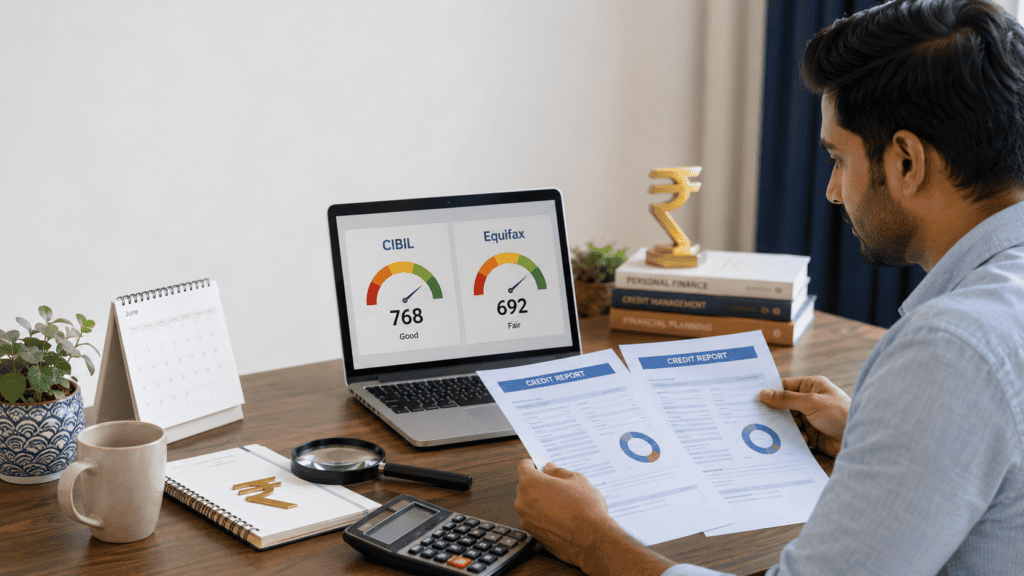
You checked your credit score before applying for a personal loan and saw CIBIL 760. Then you pulled your Equifax report and saw 735. Same person, same loans, different number — and now you are wondering which one the bank will check, whether the lower score will get your application rejected, and whether something is wrong with your credit history. This confusion is more common than most borrowers realise, and it usually has a straightforward explanation. Both CIBIL and Equifax are credit information companies registered with the Reserve Bank of India. They collect the same type of lender-reported data, but they process it independently — so scores can differ. This article explains exactly why, which report to check before applying, what a mismatch actually means, and what to do if either report shows a wrong entry.
Quick Answer: Equifax vs CIBIL
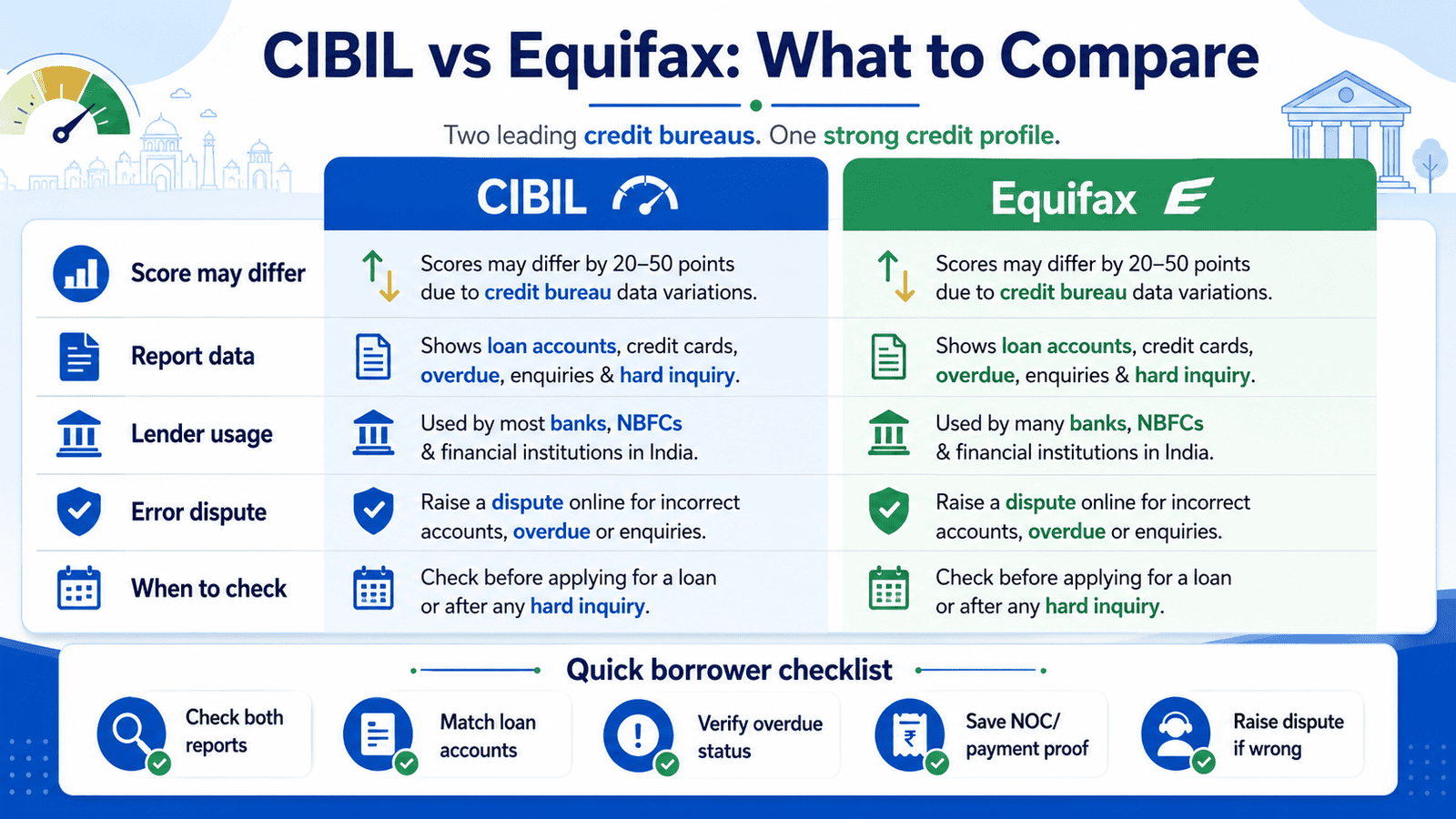
Equifax vs CIBIL compares two of India’s RBI-registered credit information companies that prepare credit reports from lender-reported data. CIBIL is more widely recognised by Indian borrowers, but Equifax can also matter if a lender uses it. Scores may differ because reporting timelines, account matching, and scoring models vary across bureaus. Borrowers should check report accuracy — not just the number — before applying for a loan or credit card.
Key Takeaways
- CIBIL and Equifax are separate credit bureaus — each builds your credit report independently from lender-reported data, so scores can and do differ.
- A score mismatch of 10–30 points across bureaus is common and is not automatically a sign of fraud or a reporting error — update timing and scoring models differ.
- Lenders may use CIBIL, Equifax, Experian, CRIF High Mark, or a combination depending on their internal credit policy — you cannot assume only one bureau is checked.
- A wrong overdue, an active-but-closed loan, or a settled account in either bureau report can affect approval comfort or loan terms, regardless of your score number.
- Check your actual account list — not just the score — in both reports before applying for a home loan, large personal loan, or credit card upgrade.
- No credit score from any bureau guarantees loan approval. Lenders also assess income, Fixed Obligation to Income Ratio (FOIR), repayment history, employer stability, and existing EMI burden.
- Disputes raised with the bureau and the lender can correct wrong entries — but give yourself time before a major application, as correction may take several weeks.
Equifax vs CIBIL: Key Comparison
| Factor | TransUnion CIBIL | Equifax India |
|---|---|---|
| Full name | TransUnion CIBIL Limited | Equifax Credit Information Services Pvt Ltd |
| RBI registration | Registered CIC | Registered CIC |
| Score range (typical) | 300–900 | 1–999 (verify current range at equifax.co.in) |
| Borrower recognition in India | Very widely known | Less widely known by borrowers |
| Lender usage | Widely used across banks and NBFCs | Used by a number of lenders; varies by institution |
| Free annual report access | One free report per year (verify at cibil.com) | One free report per year (verify at equifax.co.in) |
| Dispute route | Online dispute at cibil.com; lender must confirm correction | Online dispute at equifax.co.in; lender must confirm correction |
| Best use for borrowers | First check for general loan readiness; most lenders reference it | Check if lender uses Equifax, after rejection, or when score mismatch is unexplained |
Key Terms at a Glance
| Term | What It Means | Why It Matters |
|---|---|---|
| Credit Information Company (CIC) | An RBI-registered company that collects credit data from lenders and prepares credit reports | CIBIL and Equifax are both CICs — they are the source of your credit report, not the lender |
| Credit score | A three-digit number generated by the bureau from your credit history data | Used by lenders as one input in credit decisions — not the only input |
| Credit information report (CIR) | The full record of your loans, credit cards, repayment history, overdue amounts, and enquiries | The score comes from the CIR — a good score with a wrong entry in the CIR can still hurt approval |
| Hard inquiry | A credit check triggered when you apply for a loan or credit card; recorded in your CIR | Multiple hard inquiries in a short period can reduce lender comfort even if the score looks decent |
| Dispute | A formal request to the bureau to correct wrong information in your credit report | Both CIBIL and Equifax have dispute processes — correction usually requires the lender to confirm |
| FOIR (Fixed Obligation to Income Ratio) | The share of your monthly income already committed to existing loan EMIs | Lenders use FOIR alongside bureau data — high FOIR can affect approval even with a good score |
For a full explanation of how credit scores are built and what range lenders typically look for, read our guide on CIBIL score basics. And if you are confused about the difference between the bureau name and the score number, our article on the credit score vs CIBIL difference covers that clearly.
What CIBIL and Equifax Actually Do
Step 1 — TransUnion CIBIL: India’s Most Recognised Credit Bureau
TransUnion CIBIL Limited — commonly called CIBIL — is one of four RBI-registered credit information companies in India. It collects repayment data from banks, NBFCs, credit card issuers, microfinance institutions, and other registered lenders. From that data, it prepares each borrower’s Credit Information Report (CIR) and generates a CIBIL score, typically on a scale of 300 to 900. The higher the score, the lower the perceived credit risk.
CIBIL was established in 2000 and is the bureau most Indian borrowers encounter first — largely because many lenders defaulted to referencing it by name when explaining credit checks. The brand recognition created a widespread (and incorrect) assumption that CIBIL is the only bureau that matters. According to RBI’s credit information regulations at rbi.org.in, all four registered CICs operate under the same regulatory framework and lenders are not restricted to using only one.
Step 2 — Equifax India: A Fully Registered Credit Bureau
Equifax Credit Information Services Private Limited is also an RBI-registered credit information company operating in India under the Credit Information Companies (Regulation) Act. It collects the same type of lender-reported data — loans, credit cards, repayment behaviour, overdue accounts, and enquiry history — and uses it to generate its own credit report and credit score for borrowers.
Equifax India is part of the global Equifax group but operates as a separate entity in India. A number of lenders, fintech platforms, and NBFC partners use Equifax reports as part of their credit assessment process. For many borrowers, the first time they encounter Equifax is when a lender mentions a bureau check or when they pull their own report and see a score different from CIBIL.
Step 3 — How Lender-Reported Data Becomes a Credit Report
Both bureaus work the same way. Your bank, NBFC, or credit card issuer reports your account details — loan amount, outstanding balance, payment status, overdue days (Days Past Due, or DPD), and enquiries — to the bureaus it is registered with. Lenders report this data monthly, but not all lenders report to all four bureaus, and not always on the same day.
Each bureau then applies its own scoring model to your reported data and generates a score. Because the underlying data may differ slightly — based on which lender reported to which bureau and when — your Equifax score and CIBIL score can both be accurate while still showing different numbers.
Real Example: Priya’s Two Bureau Scores
Priya, 34, is a software engineer in Bengaluru earning ₹72,000 per month. She recently closed a personal loan of ₹3 lakh after 24 EMIs. She checked her CIBIL score and saw 763. Then she checked her Equifax report and saw a score of 738 — a difference of 25 points. Her immediate reaction was that something was wrong.
When she looked at the account section of both reports, the picture became clearer. Her CIBIL report had already updated the personal loan status to “Closed.” Her Equifax report still showed the same loan as “Active” with an outstanding balance — because her lender had not yet reported the closure to Equifax at the time she pulled the report. There was no fraud, no error in repayment history, and no overdue on either report. The difference was entirely due to update timing.
Additionally, a recent credit card inquiry she made appeared on her CIBIL report but had not yet reflected on her Equifax report. Priya’s correct action was to wait for Equifax to update after her lender reported the loan closure — and to keep her loan closure letter and NOC ready in case the update did not come through. To check your own CIBIL report before your next application, see our guide on how to check your CIBIL score free.
Note: The scores above are illustrative examples. Your actual scores will depend on your own credit history, and a 25-point difference is not always explained by timing alone — check the account section of both reports carefully.
Why Your CIBIL and Equifax Scores May Be Different
| Reason | What Happens | What to Check |
|---|---|---|
| Update timing | Lender reports to CIBIL before reporting to Equifax (or vice versa) — a loan closure or payment may show on one bureau first | Compare account status in both CIRs; allow 30–45 days for lender updates to reflect |
| Lender reporting gap | Some lenders report only to certain bureaus — an account may appear on one report but not the other | Check if all your known loan and card accounts appear on both reports |
| Different scoring models | Each bureau uses its own algorithm to weight payment history, utilisation, enquiries, and account age | No action needed — a model difference alone does not mean an error |
| Account matching issues | Name spelling, PAN mismatch, or address variation can cause an account to map incorrectly or not appear in one report | Check personal details and account list for mismatches; raise a dispute if a valid account is missing or wrongly mapped |
| Wrong or old entry | A closed loan still shown as active, or an overdue from years ago that was cleared but not updated | This needs a formal dispute — see the Complaint / Action Process section below |
| Hard inquiry timing | A recent loan application that was checked by one lender may reflect on one bureau but not yet on the other | Compare the enquiry section on both reports — multiple recent inquiries on one report will affect that bureau’s score more |
Which Bureau Do Lenders Check in India?
There is no single answer. Banks, NBFCs, and fintech lenders each set their own credit assessment policy. Some large public-sector and private banks may use CIBIL as their primary bureau. Others may cross-check with Equifax, Experian, or CRIF High Mark — or use a combination.
Lenders are not required to disclose which specific bureau they check, though some state it in their loan application terms. CIBIL’s long-established presence in the Indian market means it is widely used. But a lender that primarily onboards borrowers through digital-first underwriting may use Equifax or Experian report data because of their bureau integration or product partnership arrangements.
The practical implication: do not assume only CIBIL is checked. If your CIBIL score is strong but your Equifax report has a wrong overdue or an active-but-closed loan, a lender using Equifax data may see a risk flag you did not expect.
Report Readiness Checklist Before Applying
| Checkpoint | Why It Matters |
|---|---|
| Personal details match on both reports (name, PAN, date of birth, address) | Mismatches can cause account mapping errors or delay dispute resolution |
| All active loan accounts shown are actually active | A loan you closed may still show as active — this affects perceived EMI burden and FOIR |
| All closed loan accounts are marked “Closed” — not “Active” or “Written Off” | A closed loan shown as active inflates your outstanding liability in the lender’s risk calculation |
| No overdue, settled, or written-off accounts you were not aware of | These are hard flags in any bureau report; one settled account can reduce lender comfort significantly |
| DPD (Days Past Due) column shows “000” or “STD” for all recent entries | Even a single 30-day late payment in the last 12 months can affect assessment |
| Recent hard inquiries count is low (ideally 0–2 in the last 6 months) | Multiple hard inquiries suggest financial stress and reduce lender confidence even with a good score |
| NOC, loan closure letter, and payment receipts saved for all closed loans | These are your evidence if a dispute needs to be raised with the bureau or lender |
How Bureau Report Quality Can Affect Your Loan
The direct connection between a score number and an interest rate is not a fixed formula — lenders set rates based on their internal risk model, your income, FOIR, employer profile, and bureau data together. What bureau reports can affect is approval comfort and the loan amount a lender offers you.
Consider this scenario: Arjun, 38, a self-employed professional in Chennai with a monthly income around ₹85,000, has a CIBIL score of 748. His CIBIL report looks clean. But his Equifax report still shows a personal loan he repaid in full two years ago as “Active” with an outstanding balance of ₹1,12,000 — because the lender never reported the closure to Equifax.
A lender using Equifax data would see Arjun’s FOIR as higher than it actually is. They might offer him a lower loan amount than he expected, or flag the application for manual review. The score number on CIBIL alone would not solve this problem. Arjun needs to raise a dispute with Equifax and the original lender to get the account updated. Understanding what counts as a loan-ready score is one part of preparation — read our guide on what qualifies as a good loan-ready CIBIL score. But report accuracy matters just as much as the number.
How to Correct a Wrong Entry in CIBIL or Equifax
Step 1 — Identify the Specific Error
Pull the full credit information report from the relevant bureau — not just the score dashboard. Look at the account section and identify: the account name, the reported status (Active / Closed / Overdue / Settled / Written Off), the outstanding amount, and the DPD (Days Past Due) column. Write down the exact account number and the discrepancy.
Step 2 — Collect Your Proof
Gather documents before raising the dispute:
- Loan closure letter or NOC from the lender
- Final EMI payment receipt or bank statement showing the last payment
- Written confirmation from the lender that the account is closed (email or letter)
- For overdue disputes: payment proof for the specific EMI being shown as overdue
Step 3 — Raise a Dispute With the Bureau
Both TransUnion CIBIL (cibil.com) and Equifax India (equifax.co.in) have online dispute portals where you can submit the incorrect entry, attach supporting documents, and receive a complaint reference number. Keep this number for all follow-ups. Verify the current dispute process, required formats, and timelines directly from the official bureau website before submitting, as these details can change.
Step 4 — Contact the Lender Directly
Bureaus cannot change your report unilaterally. They raise the dispute with the lender that reported the data. If the lender confirms the correction, the bureau updates the report. If the lender does not respond in time, the bureau may update the entry based on the evidence you provided — but lender confirmation is the most reliable route. Submit a formal written complaint to the lender’s customer service or nodal officer, referencing the bureau dispute number.
Step 5 — Follow Up and Escalate if Needed
If the correction is not reflected after the bureau’s stated resolution window (verify current timeline at cibil.com or equifax.co.in), escalate to the lender’s grievance officer. If still unresolved, you can escalate to the RBI Integrated Ombudsman Scheme at rbi.org.in. For a full step-by-step guide to this process, read our article on the credit report dispute process in India.
Borrower Safety: What Not to Do
Do Not Apply Repeatedly After One Rejection
Each loan application triggers a hard inquiry on the bureau report used by that lender. Multiple hard inquiries in 30–60 days signal financial distress and reduce lender confidence, regardless of your score. If rejected, check your bureau reports first, identify the reason, and apply again only after addressing the specific issue.
Do Not Ignore a Score Mismatch Without Checking the Account Section
A 25-point difference might be update timing. A 60–80 point difference often signals a wrong entry, a missing account, or a status error. Do not assume a mismatch is harmless without opening both reports and comparing the account list line by line.
Do Not Pay Anyone Promising Guaranteed Score Improvement
No third party can guarantee a credit score increase or speed up legitimate dispute resolution. Anyone charging upfront fees to “fix” your CIBIL or Equifax score is almost certainly running a scam. Both bureaus have free dispute processes.
Do Not Assume CIBIL Is the Only Bureau That Matters
Lenders vary in their bureau usage. Assuming only CIBIL is checked and ignoring a wrong entry on your Equifax report can result in a surprising rejection. Check both reports, especially before applying for a home loan or a large personal loan.
Do Not Upload Personal Documents to Unofficial Credit-Check Links
PAN, Aadhaar, and address proof should only be shared on official bureau websites or with registered lenders. Fake credit-check links that harvest personal documents are a documented fraud vector. Always verify the URL and use official bureau portals directly.
How to Decide Which Bureau Report to Check
you are doing routine credit monitoring — start with CIBIL. It is the most widely referenced bureau among Indian borrowers and many mainstream lenders.
you are planning a major loan (home loan, large personal loan, business loan) — check both CIBIL and Equifax, and ideally Experian or CRIF High Mark as well. A wrong entry in any one report can affect approval at lenders who use that bureau.
your loan application was rejected unexpectedly despite a good CIBIL score — pull your Equifax report immediately and compare the account section. The lender may have used Equifax and found a flag that does not appear on your CIBIL report.
your CIBIL and Equifax scores differ by more than 30–40 points — do not dismiss it as just a model difference. Compare the account list, overdue entries, and inquiry section across both reports to find the discrepancy.
you have verified the account section (not just the score) on both reports before your next major application — do not assume the loan process will go smoothly. The score is the headline; the account detail is where problems hide.
Common Mistakes to Avoid
Assuming CIBIL and Equifax Should Always Show the Same Score
They rarely do. Different scoring models, different update cycles, and different lender reporting mean a gap is normal. Expecting identical scores is a misunderstanding of how credit bureaus work. The concern is not whether the numbers match — it is whether the account-level data is accurate in each report.
Ignoring Account-Level Errors Because the Score Looks Good
A CIBIL score of 750 with a closed loan shown as active on your Equifax report is a problem. The score looks fine but the report contains a flag that a lender using Equifax data will see. Check the full report — not just the score summary.
Applying to Multiple Lenders Simultaneously After a Rejection
Each application triggers a hard inquiry. Five applications in a week puts five hard inquiries on bureau reports. Lenders seeing multiple recent inquiries interpret this as financial distress, which can result in further rejections or unfavourable terms even when the underlying credit profile is reasonable.
Trusting Paid Third-Party Services to “Improve” Your Score Fast
Legitimate dispute resolution is free through the official bureau portals. There is no shortcut. A service that charges ₹5,000–₹15,000 to “remove negative entries” cannot do anything you cannot do yourself through the bureau’s dispute process — and some are outright fraudulent. Use only official channels. If you have a specific wrong entry to fix, read our article on how to remove a wrong loan entry from your CIBIL report.
Treating the Credit Score as the Only Approval Factor
Lenders look at FOIR, income stability, employer type, existing EMI burden, and repayment history in full — not just a three-digit score. A borrower with CIBIL 780 but a FOIR above 55% may get a lower loan amount or a conditional offer. Preparing only the score and ignoring the broader financial picture is a common pre-application mistake.
Not Keeping Loan Closure Documents
NOC, closure letter, and final payment receipt are your evidence in any dispute. If a lender fails to report a loan closure to the bureau, without documentation you have limited recourse. Keep these permanently — not just for the duration of the loan.
When This May Not Be the Right Choice
Comparing Equifax and CIBIL scores alone is not sufficient in certain situations — the borrower needs deeper action first:
If a settled or written-off account appears on either report — a score comparison cannot fix this. Settlement and write-off entries persist on bureau records and are a significant negative flag for lenders. The borrower needs to either dispute an incorrect settlement status or accept that the entry will affect applications for several years.
If a closed loan is still shown as active — score comparison is irrelevant until the status is corrected. An active-but-closed loan inflates perceived liability and FOIR. Dispute the entry and wait for the correction before applying.
If an overdue entry appears after a payment was made — this is a reporting error that will affect any bureau’s report of that account. Raise a dispute with proof of payment before approaching any lender.
If you are planning a home loan in the next 3–6 months — a quick score comparison is not enough preparation. Pull the full CIR from all major bureaus, resolve every discrepancy, and verify with the lender which bureaus they check.
If any of these apply to your situation, it may be worth exploring other options before committing.
Official Rules and Where to Verify
Credit bureau regulations in India are governed by the Credit Information Companies (Regulation) Act and the RBI’s reporting directions. RBI (rbi.org.in) is the official regulator for credit information companies in India — its website lists registered CICs and publishes the applicable Master Directions.
- RBI — rbi.org.in: For current list of RBI-registered credit information companies, reporting obligations on lenders, and grievance escalation under the Integrated Ombudsman Scheme
- TransUnion CIBIL — cibil.com / transunioncibil.com: For your CIBIL credit information report, score access, free annual report entitlement, and the online dispute process
- Equifax India — equifax.co.in: For your Equifax credit report, score access, free annual report, and online dispute submission
- Experian India — experian.in: A third RBI-registered bureau; some lenders use Experian reports
- CRIF High Mark — crifhighmark.com: A fourth RBI-registered bureau with significant presence in microfinance and rural lending
Credit reporting rules, lender assessment methods, and bureau processes can change. Always verify current details from the relevant bureau, lender, or official regulatory source before acting.
Expert Tips
- Pull the full CIR, not just the score. Free score apps often show only a number. Before any major loan application, download the complete credit information report from the bureau’s official website — the account status, DPD column, and inquiry section carry the real information.
- Close old credit cards properly, not just by stopping use. An unused credit card that remains open can affect your credit utilisation ratio. If you want it closed, formally request closure in writing and verify the “Closed” status appears on your bureau reports.
- Raise disputes at least 60–90 days before a major loan application. Bureau corrections require lender confirmation, which takes time. Starting the dispute process close to your application date is a common and avoidable mistake.
- Keep a single file with all loan closure documents permanently. NOC, closure letter, final EMI payment proof — keep these even for loans repaid years ago. Bureau reporting errors on old accounts do happen, and your documentation is the fastest resolution path.
- If a lender rejects your application, ask specifically what bureau data flag was identified. You may not always get a detailed answer, but asking focuses the investigation. Some lenders will indicate whether it was a score issue, an overdue, or an FOIR calculation.
- Check your report after every loan closure, not just before an application. If the lender has not updated your bureau record within 30–45 days of closure, contact them first — do not wait until you need the loan.
Frequently Asked Questions
Is Equifax the same as CIBIL?
No. Both are separate RBI-registered credit information companies that independently collect lender-reported data and prepare credit reports. They use different scoring models and may have slightly different account data depending on which lenders report to each bureau and when. A borrower has a CIBIL credit information report and an Equifax credit report — they are not the same document.
Which is better — Equifax or CIBIL?
Neither is universally “better.” CIBIL is more widely recognised by Indian borrowers and is used by many mainstream lenders. Equifax is equally valid and is used by a number of lenders and fintech platforms. What matters is whether the data in each report is accurate — not which bureau has a higher number for you.
Why is my Equifax score different from my CIBIL score?
Score differences arise from update timing (a loan closure may appear on one bureau before the other), different scoring models, lender reporting gaps (some lenders report to certain bureaus first), and account matching variations. A difference of 10–25 points is often due to timing. A larger gap should prompt you to compare the account section on both reports to identify the specific discrepancy.
Do Indian banks check Equifax or CIBIL?
Banks and NBFCs set their own bureau usage policy — many use CIBIL, but a number also use Equifax, Experian, or CRIF High Mark data, either independently or in combination. Lenders are not required to disclose which bureau they pull, though some mention it in their terms. Do not assume only CIBIL is checked.
Can I get a loan if my CIBIL score is good but my Equifax score is lower?
It depends on which bureau the lender uses and what is causing the Equifax score to be lower. If the lower Equifax score is due to a wrong overdue entry or an active-but-closed loan, that entry will affect the lender’s risk assessment regardless of your CIBIL score. Correct any factual errors in both reports before applying.
How do I correct an error in my Equifax or CIBIL report?
Raise an online dispute at the relevant bureau’s official website — cibil.com for CIBIL, equifax.co.in for Equifax. Attach your proof (NOC, closure letter, payment receipts). The bureau contacts the lender to confirm the correction. Keep your complaint reference number. If the lender does not respond within the bureau’s resolution window, escalate to the lender’s grievance officer and, if still unresolved, to the RBI Integrated Ombudsman at rbi.org.in.
Does checking my Equifax or CIBIL score reduce it?
No. When you check your own credit score or report, it is recorded as a soft inquiry — this does not affect your score. Only hard inquiries (triggered when you apply for a loan or credit card with a lender) can affect your score. You can check your own report as often as you need without any negative impact.
How long does a dispute take to resolve?
Resolution timelines vary and are subject to the bureau’s current processes and the lender’s response time. Verify the current expected timeline at cibil.com or equifax.co.in before submitting your dispute. Start well in advance of any major loan application — allow at least 60–90 days for the correction to reflect.
Final Verdict
Both Equifax and CIBIL are valid, RBI-registered credit bureaus. CIBIL may be the name most Indian borrowers recognise, but Equifax reports are used by real lenders making real credit decisions. If your scores differ across the two bureaus, the number alone rarely tells the full story — open the account section on both reports and compare loan status, overdue flags, and recent inquiries. A score difference caused by update timing is manageable. A wrong overdue or an active-but-closed loan in either report is a problem that needs to be corrected before your next major application. Borrowers applying for a home loan, large personal loan, or credit card upgrade should treat multi-bureau report review as a standard pre-application step, not an optional extra. No score from any bureau guarantees approval — lenders also assess income, FOIR, repayment pattern, employer profile, and existing EMI burden. Fix what you can find, document what you have closed, and apply when your report is clean — not just when your number looks good. Always verify your latest credit report, lender requirements, and bureau process before making a credit-related decision.
This article is for educational purposes only and should not be treated as personalised financial, credit, or legal advice. Credit scores, credit reports, lender eligibility criteria, and bureau processes can vary and may change over time. Please verify current details with the relevant credit bureau, lender, official regulatory source, or a qualified professional before making any credit-related decision.

Neha Menon writes simple, borrower-first explainers on CIBIL scores, credit reports, bureau disputes, DPD, loan settlement impact, hard inquiries, and practical credit score recovery. She focuses on helping Indian borrowers understand lender-reported data, avoid credit mistakes, and take safer next steps without false promises.