
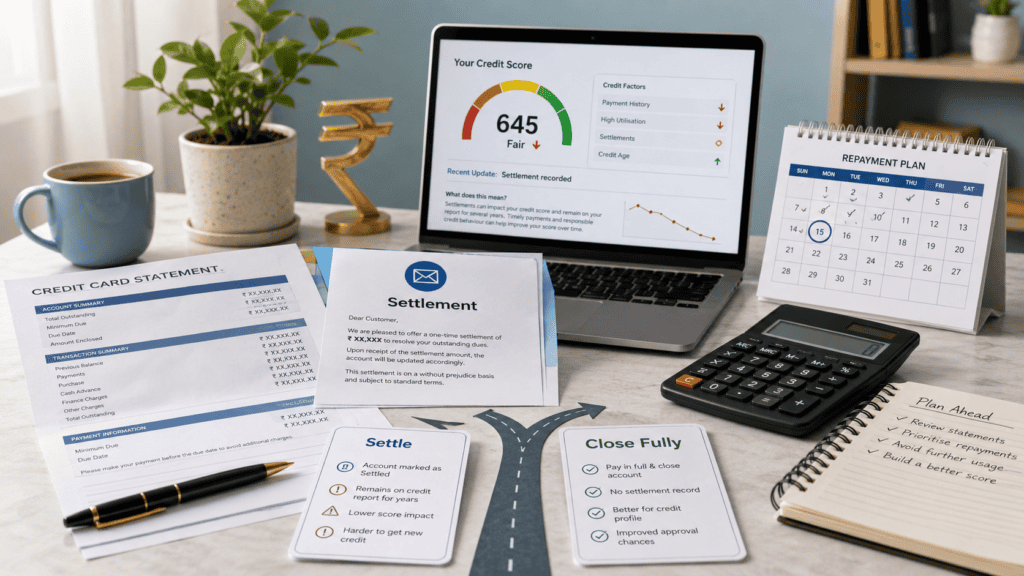
When credit card dues pile up — through missed payments, minimum-due traps, or sudden income loss — settlement can start to look like a way out. The bank calls. A recovery agent visits. They offer to close your account if you pay a lower amount. It feels like relief. But credit card settlement impact on CIBIL score is a separate problem that begins the moment the lender marks your account in their system — and that mark follows you for years, not weeks.
Settlement is not the same as closing your credit card account fully. When you settle, the bank accepts less than what you actually owe and forgives the rest. That sounds reasonable under financial stress, but lenders and credit bureaus treat the unpaid portion as a signal that you did not fully honour your repayment commitment. This article explains exactly what that means for your CIBIL report, how future lenders read a settled account, what documents you need to protect yourself, and what your realistic options are for rebuilding credit after settlement — without false promises.
Quick Answer: Credit Card Settlement Impact on CIBIL Score
Credit card settlement impact on CIBIL score can be serious because the lender may report the account as “settled” instead of “closed.” For example, if ₹1,00,000 dues are settled for ₹60,000, the unpaid waiver may still signal repayment risk to future lenders. A settled status is not the same as a closed account and can affect future credit card or loan approvals.
Immediate Action Steps
If you are already in discussions with your bank about settlement — or have recently accepted one — these steps matter most right now. According to RBI’s Fair Practices Code at rbi.org.in, lenders are required to communicate loan and credit terms clearly. That protection extends to settlement discussions.
- Do not agree verbally only. Any settlement discussion that happens over phone or in-person without written confirmation gives you no protection. Ask for the settlement offer in writing on the bank’s official letterhead before agreeing.
- Ask directly how the account will be reported to credit bureaus. Ask whether the account will be marked “settled,” “closed,” “written-off,” or something else. Get this in writing. It affects every future credit decision you make.
- Check whether full payment is still possible. Even paying in two or three instalments — if the bank agrees — may result in a cleaner “closed” status. Ask about a structured repayment arrangement before accepting settlement.
- Collect all payment proof and correspondence. Keep your payment receipt, the settlement letter, any bank email or SMS, and the no-dues certificate (NOC) once issued. Do not rely on the bank’s records alone.
- Pull a fresh credit report after settlement. After the lender’s reporting cycle updates, check your CIBIL report directly from TransUnion CIBIL (transunioncibil.com) to confirm what status has been reflected. Reporting cycle timelines can vary — verify current timelines with your bureau directly.
Key Takeaways
- A credit card settlement means the lender accepted less than the full outstanding amount — your CIBIL report may show “settled” instead of “closed,” which signals to future lenders that the full due was not honoured.
- Missed payments before settlement — tracked as Days Past Due (DPD) in your credit report — also damage your payment history, even before the final settlement is recorded.
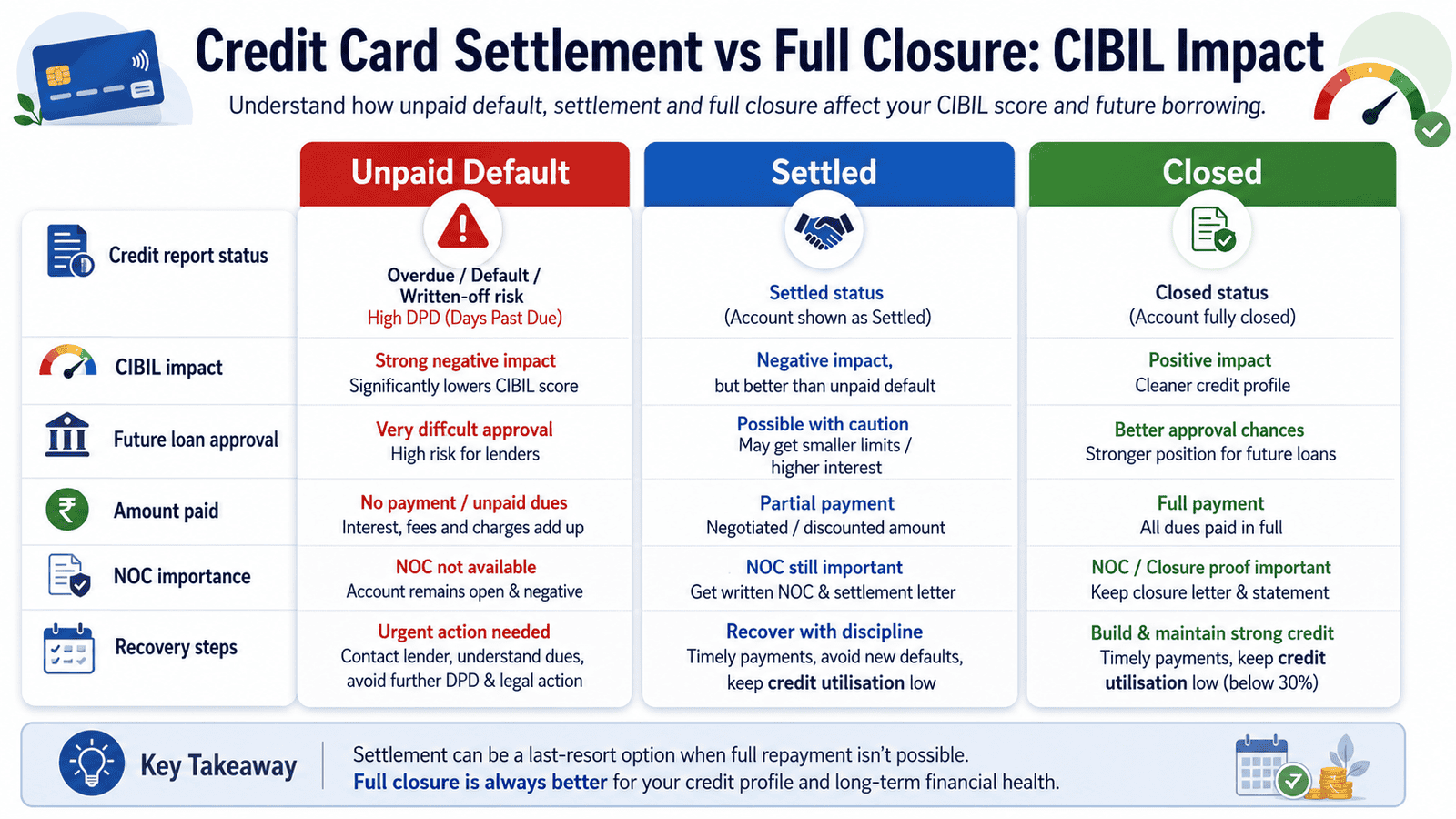
- A “closed” account means all dues were paid fully. A “settled” account means a portion was waived. Most lenders view settled accounts with more caution than closed ones when reviewing future credit applications.
- Credit recovery after settlement depends on your future repayment behaviour — keeping credit utilisation low, paying all future EMIs and bills on time, and avoiding multiple loan applications at once.
- Always collect the settlement letter, payment receipt, and NOC from the bank. If your CIBIL report does not reflect the correct status after reporting, you have the right to raise a dispute through the bureau’s official dispute process.
- There is no fixed score drop number guaranteed for settlement — impact varies by bureau, lender reporting, and your existing credit history. Anyone promising a specific recovery timeline is overstating what they can know.
Key Facts at a Glance
| Settlement Fact | What It Means | Borrower Action |
|---|---|---|
| Settlement definition | Bank accepts less than full outstanding; remaining dues are waived | Get settlement terms in writing before paying |
| CIBIL report status | Account may appear as “Settled” — not “Closed” | Confirm with bank what will be reported to bureaus |
| Full account closure? | No — settlement closes the dues, not the obligation history | Ask for a no-dues certificate (NOC) after payment |
| Future loan or card approval | May be harder — lenders can view settled accounts as higher repayment risk | Plan future credit applications carefully after settlement |
| Documents to collect | Settlement letter, payment receipt, NOC, bank email/SMS trail | Store safely — needed for disputes if status is not updated |
| Credit bureau reporting | Lender reports status to CIBIL, Experian, CRIF High Mark — not the borrower | Pull credit report after the lender reporting cycle completes |
For a detailed look at why settled versus closed account status matters differently to lenders, see our dedicated comparison guide.
What Is Credit Card Settlement and How Does It Affect Your CIBIL Score?
A credit card settlement — also called a one-time settlement (OTS) — is an arrangement where the bank agrees to accept a lower amount than the total outstanding dues and treats the account as resolved. This typically happens after a borrower has already missed multiple payments and the account has gone into default or is close to being written off.
Banks may offer settlement because recovering even a partial amount can be more practical for them than pursuing full dues through legal channels. But from your perspective as a borrower, the key difference is what happens to the amount the bank waived. That waived amount is not simply forgiven in the eyes of future lenders — it is recorded.
What Settlement Does to Your Payment History
Your credit card payment history — including missed payments, Days Past Due (DPD) entries, and final account status — is the most heavily weighted factor in how credit bureaus calculate your credit score. By the time most borrowers reach a settlement discussion, they have already accumulated several months of late payment records. Each of those months is reported individually to bureaus.
Understanding credit card late payment impact helps explain why the damage often begins well before the settlement itself is even offered. The DPD entries for three, six, or nine months of missed payments each carry weight in your credit history, independent of the final settlement status.
According to RBI’s directions at rbi.org.in, lenders are required to follow Fair Practices Code in all credit-related dealings, which includes transparency in reporting to credit information companies. This means the bank is expected to report your account status accurately — including whether it is settled or closed. The bureau, in turn, reflects what the lender reports. CIBIL does not independently determine whether your account is settled; it records what the bank has submitted.
Why Lenders Look at Settled Accounts Differently
When a future lender reviews your credit report, they are not just looking at a number. They are looking at your repayment pattern. A settled account tells them: this borrower made a commitment, ran into difficulty, and the bank had to accept less than the full amount. That is a repayment red flag — not because you are a bad person, but because it represents a higher statistical risk for the next lender extending you credit.
This concern affects not just credit cards but personal loans, home loans, car loans, and any future credit facility you apply for. Some lenders may decline applications with settled accounts outright. Others may approve but at higher interest rates or lower loan amounts. There is no fixed rule — it depends on the lender, how long ago the settlement was, and what your overall credit history looks like since then.
Real Example: Rohit’s Credit Card Settlement in Pune
Rohit, 32, works in IT in Pune and earns ₹55,000 per month. During a period of job instability, he relied on his credit card heavily for household expenses and medical costs. Over fourteen months, he paid only the minimum amount due — ₹2,500 to ₹3,000 each month — while interest continued compounding. His outstanding reached ₹1,20,000.
The bank contacted Rohit with a one-time settlement offer: pay ₹72,000 and the account would be considered resolved. The ₹48,000 difference would be waived. Rohit was relieved — he could arrange ₹72,000 from family support. He paid, and the bank sent him an SMS confirming receipt. He assumed the matter was closed.
Three months later, Rohit applied for a personal loan. The lender pulled his credit report and found: fourteen months of DPD entries, an account marked “Settled,” and a credit score that had dropped significantly from where it was before the defaults began. His personal loan was declined.
What would have been different had Rohit paid the full ₹1,20,000? His account would have been marked “Closed” — a clean status. The DPD entries would still exist, but the final outcome of the account would have told a different story to lenders. Additionally, Rohit’s bigger mistake was not collecting a formal settlement letter or NOC from the bank — only an SMS, which did not specify how the account would be reported to bureaus. Note: This is an illustrative example. Outstanding amounts, settlement ratios, and outcomes vary by card issuer, repayment history, and individual case.
Eligibility / Requirement Checklist Before Accepting Settlement
| Checklist Item | Why It Matters | Proof to Collect |
|---|---|---|
| Written settlement offer on bank letterhead | Verbal offers give you no legal protection if terms are disputed later | Physical or emailed letter confirming settlement amount and date |
| Confirm exact amount to be paid | Verbal amounts can differ from what is formally accepted | Bank statement or email showing final payable figure |
| Ask what will be reported to credit bureaus | “Settled” and “Closed” have different outcomes for future credit | Written bank confirmation of reporting status |
| Ask about NOC / no-dues certificate timeline | NOC is your proof that the bank has no further claim on the account | Bank’s written commitment on when NOC will be issued |
| Check whether full payment or restructuring is possible | Full closure avoids settled status entirely | Bank confirmation of alternate repayment terms in writing |
| Do not pay into unverified accounts | Scammers sometimes impersonate bank recovery agents | Pay only to the bank’s official account — verify via the bank’s official website or branch |
Full Payment vs Settlement vs Unpaid Default: Comparing Your Options
Key comparison: total cash outflow vs credit report outcome vs future borrowing risk
Full payment = all dues paid → closed status | Settlement = partial dues paid → settled status | Unpaid default = no payment → written-off or overdue status, continuing damage
| Option | Immediate Cash Outflow | CIBIL Report Status | Future Borrowing Risk |
|---|---|---|---|
| Full payment of ₹1,00,000 outstanding (illustrative) | ₹1,00,000 (plus any applicable charges — verify with card issuer) | Closed — cleanest outcome | Lower — account shows as fully honoured |
| Settlement at ₹60,000 (illustrative ratio — varies by issuer) | ₹60,000 | Settled — negative marker | Higher — future lenders can view this as repayment risk |
| Unpaid default — no payment made | ₹0 now, but continuing interest and penalties (verify current rates with card issuer) | Written-Off / Overdue — most damaging | Highest — active negative reporting, lender collection action possible |
Note: All figures above are illustrative. Actual outstanding amounts, settlement ratios, charges, and interest rates vary by card issuer, tenure of default, and individual account history. Verify all current figures directly with your bank before making any decision.
Comparison: Settled vs Closed vs Written-Off Credit Card Status
| Status | What It Means | Future Lender Concern |
|---|---|---|
| Closed | All dues paid in full as originally agreed. Account closed cleanly. | Lowest — best status for future credit applications |
| Settled | Bank accepted less than full dues. Remaining amount waived. | Moderate to High — signals partial repayment only |
| Written-Off | Bank has written the outstanding off their books as a loss, usually after prolonged default. Dues may still be recoverable. | High — very serious negative marker; dues technically still outstanding |
| Overdue / DPD | Payment is late — shown as Days Past Due (30, 60, 90+ days). Active negative entry. | High while active — reduces with time if payments resume |
For borrowers who find a written-off loan entry in their CIBIL report alongside or instead of a settled status, the steps to address it differ. A written-off account means the bank has categorised the outstanding as a loss — but it does not mean the dues disappear. You may still be contacted for recovery, and the entry is reported to bureaus. According to TransUnion CIBIL (transunioncibil.com), the credit report reflects data as submitted by member lenders, not as assessed independently by the bureau.
What to Do If Settlement Is Wrongly Reported or Not Updated
After you have settled and paid, the bank must update their records with the credit bureau. If they do not, or if the wrong status appears in your credit report, you have a formal process to raise a dispute.
Step 1 — Collect Your Documents First
| Document | Who Issues It | Why It Matters |
|---|---|---|
| Settlement letter | Bank / card issuer | Proof of agreed settlement amount and terms |
| Payment receipt | Bank (official receipt or bank statement) | Confirms the settlement amount was paid and received |
| No-dues certificate (NOC) / closure letter | Bank | Confirms the bank has no further claim on your account |
| Bank email or SMS trail | Bank communications | Timestamped record of key settlement communications |
Step 2 — Contact the Card Issuer
Raise the reporting discrepancy directly with the bank’s customer care or grievance officer first. The bank has the authority to update what they reported to the bureau — the bureau itself cannot change the data without the lender’s instruction.
Step 3 — Pull Your Credit Report and File a Dispute
Access your credit report directly from TransUnion CIBIL (transunioncibil.com). If the lender-reported data is incorrect — for example, if the account shows “written-off” instead of “settled” or the account is not updated at all — you can raise a formal dispute through the bureau’s dispute process.
For a detailed step-by-step guide to raising a credit report dispute, including timelines and escalation options, see our complete process walkthrough. Do not expect dispute outcomes to be guaranteed — the bureau will investigate and ask the lender to verify. If the lender confirms the original data, the bureau may not change it.
Step 4 — Escalate If Needed
If the bank does not resolve your grievance within a reasonable timeframe, you may use RBI’s official grievance channels (rbi.org.in). Escalation timelines and the specific process can vary — verify current procedures directly at the RBI website before filing.
Credit Card Settlement Safety Checklist
- Never agree to settlement only on a call. Any verbal settlement offer must be followed by a written confirmation from an official bank email ID or on bank letterhead before you pay a single rupee.
- Confirm the exact settlement amount in writing — including whether the figure is inclusive or exclusive of any current interest or charges accruing up to the payment date.
- Ask the bank directly, in writing, what status will be reported to credit bureaus. Get confirmation of whether the account will be marked “settled” or “closed” before you make the payment.
- Keep all payment proof. Bank payment receipts, net banking screenshots, and official SMS receipts are all valid. Store digital copies and one physical backup.
- Request your NOC in writing — with a timeline. If the bank promises a no-dues certificate within 30 days, get that commitment in writing.
- Do not pay into any account not verified through the bank’s official website or branch. Collection agents sometimes operate with unverified payment instructions. Always confirm the payment account directly with the bank.
- Do not let collection pressure push a rushed decision. You have the right to verify, document, and take a day to confirm terms — no legitimate bank can legally force same-day settlement without written terms.
How to Decide What’s Right for You
You can arrange the full outstanding amount — even in two or three instalments over 60–90 days — then full closure is almost always the better choice. Ask the bank if they will agree to a short-term structured repayment that results in a “closed” status rather than “settled.”
You have a home loan, car loan, or major credit facility planned in the next one to two years, then settlement may seriously affect your approval. Lenders reviewing credit reports for large-ticket loans are more likely to decline or rate-adjust for a settled credit card account. Consider delaying settlement if full payment is possible, or restructuring the card debt instead.
Your financial hardship is genuine and temporary — and you have no realistic way to pay full dues even in instalments — settlement may be unavoidable. In that case, focus on getting everything in writing, collecting the NOC, and starting credit recovery immediately after settlement.
The bank is offering restructuring — a revised repayment plan with lower EMIs — before pushing settlement, that option is worth exploring first. Restructuring that results in eventual full payment produces a cleaner credit history than settlement.
Do not take a new high-interest personal loan or borrow from an unregistered lending app just to avoid credit card settlement. Replacing one credit problem with a higher-cost debt obligation — especially from a lender with aggressive recovery practices — can create a worse financial situation than the settlement itself. If you are considering borrowing to repay, read our guide on recover after default to understand safer steps first.
Do not ignore a written-off account thinking it has expired. Written-off dues can still be pursued by the bank, and the account continues to appear negatively in your credit report. Inaction is not a strategy.
Common Mistakes to Avoid
Assuming settlement means the account is fully closed
Settlement closes the bank’s immediate recovery effort — it does not close the account cleanly in credit bureau records. Your CIBIL report may continue to show “Settled” as the final status, which is different from “Closed.”
Always confirm with the bank in writing how the account will appear in bureau reports after settlement. Do not assume “resolved with the bank” means “clean on CIBIL.”
Not collecting a written settlement letter before paying
Many borrowers pay the settlement amount on the strength of a phone call or a WhatsApp message from a collection agent. If the terms are later disputed — the amount, the status, or whether an NOC will be issued — you have no recourse without a formal written document.
Insist on an official letter or email from the bank before transferring any settlement payment.
Paying into an unverified account
Collection agents and, in some cases, fraudsters posing as bank representatives have directed borrowers to pay settlement amounts into personal or unofficial accounts. This is a serious risk — your money leaves, but the bank has no record of a settlement, and your credit account remains outstanding.
Always verify the payment account number directly through the bank’s official website, app, or branch before transferring funds. Never pay based on a number provided only over a phone call.
Ignoring the credit report after settlement
Borrowers often assume the bureau update happens automatically and correctly. In practice, there can be delays or errors in how the lender updates the bureau. Pull your credit report directly from TransUnion CIBIL or another bureau after the lender’s reporting cycle to check the status reflects what was agreed.
If it does not, raise a formal dispute immediately — do not wait until you need a loan.
Applying for multiple loans or credit cards immediately after settlement
Every time you apply for credit, the lender makes a hard enquiry on your credit report. Multiple hard enquiries in a short period signal credit-seeking behaviour and can further reduce your score at a time when it is already recovering.
Allow time before applying for new credit. When you do apply, target one considered application rather than multiple simultaneous enquiries.
Thinking settlement removes the DPD history
Days Past Due entries for every month you missed payment before the settlement are not removed when you settle. They remain in your credit history as a record of your repayment behaviour during that period. Settlement affects the final account status — it does not erase the months of missed payment before it.
Not asking about the NOC
A no-dues certificate (NOC) is your written proof from the bank that they have no outstanding claim on your account. Without it, a future dispute about whether the dues are truly resolved has no simple answer. Always ask for the NOC timeline in writing before and after settlement.
When This May Not Be the Right Choice
You can arrange full payment within a short, realistic period. If you can raise the full outstanding amount within 60–90 days by tapping savings, family support, or a salary advance, full closure protects your credit history far better than settlement.
You are planning a major loan application in the near future. A home loan, car loan, or education loan application reviewed against a credit report showing “Settled” may face rejection or higher interest rates. If a major credit decision is coming up, the timing of settlement matters.
Settlement terms are not clear or not in writing. If the bank representative cannot confirm terms on letterhead, or if only a collection agent is involved with no official bank communication, do not proceed. Ambiguous settlement terms create disputes that are difficult to resolve later.
The bank refuses to clarify how the account will be reported. Before settling, you have the right to know whether the account will be marked “settled” or “closed.” If the bank will not clarify this in writing, you do not have the full picture yet.
Collection pressure is forcing a rushed decision. Pressure tactics do not change your right to verify terms, take time to decide, and document everything. A one-day ultimatum on a settlement offer is not a normal or acceptable banking practice. Contact the bank’s official grievance officer or RBI channels (rbi.org.in) if you feel you are being pressured without adequate documentation.
If any of these apply to your situation, it may be worth exploring other options before committing.
Official Rules and Where to Verify
Credit reporting rules, lender assessment methods, and bureau processes can change. Always verify current details from the relevant bureau, lender, or official regulatory source before acting.
- TransUnion CIBIL (transunioncibil.com) — Check your credit report, understand your credit score, and raise disputes against incorrectly reported account statuses. CIBIL is a private credit bureau, not a government body.
- Experian India (experian.in) — Cross-check your credit report from a second bureau. Lenders may report to multiple bureaus, and reports can sometimes differ.
- CRIF High Mark (crifhighmark.com) — A third credit bureau where lenders may also report account data. Useful for cross-verification if a lender reports to multiple bureaus.
- RBI (rbi.org.in) — Relevant for understanding Fair Practices Code, Digital Lending Guidelines, and your rights in dealing with lenders and collection agents. The RBI also provides a portal for escalating unresolved banking grievances — verify current grievance contact details and processes directly at the official website.
- Your card issuer’s official grievance officer — The first escalation point for reporting disputes, settlement documentation problems, or incorrect bureau reporting. The grievance officer’s contact details must be available on the bank’s official website per RBI directions.
Expert Tips
- Start credit recovery the month after settlement. Pay every remaining credit obligation — personal loan EMI, other card bills, utility payments where reported — on time from that month forward. Every on-time payment after settlement begins rebuilding your repayment history, which is the largest factor in credit scoring. Follow a structured six-month CIBIL plan to stay on track without chasing shortcuts.
- Keep your credit utilisation low. If you still hold a credit card, aim to use no more than 30% of the available credit limit — and ideally less. High utilisation on a revolving card worsens your credit profile even after settlement. Pay balances in full each month where possible.
- Avoid applying for multiple loans or cards in the months immediately following settlement. Each hard enquiry reduces your score slightly and signals financial pressure to lenders. Wait until your repayment behaviour has had a few months to reflect positively before applying for new credit.
- Consider a secured credit card (FD-backed card) only if you genuinely need a credit-building tool. Some banks offer credit cards backed by a fixed deposit. These can help establish a new track record of on-time payments. However, only use this if you are confident you can pay the full monthly bill — another missed payment on a new card will deepen the credit damage, not repair it. Verify issuer terms before applying.
- Pull your credit report from at least two bureaus every six months. TransUnion CIBIL, Experian India, and CRIF High Mark each maintain separate records. Lenders may report to one or more bureaus, and discrepancies between reports can affect which lender pulls what data. Regular monitoring also alerts you early to any incorrect entries. Access one free credit report per year from each bureau — verify current access terms at each bureau’s official website.
- Do not pay any third-party service claiming to “remove” your settled status from CIBIL. No legitimate service can guarantee removal of accurately reported data from your credit report. Only the lender can update what they have reported, and only if the original report was incorrect. Any service promising to erase valid settled status is likely fraudulent.
Frequently Asked Questions
Does credit card settlement reduce my CIBIL score?
Settlement can affect your CIBIL score because the account is typically reported as “Settled” rather than “Closed,” signalling to bureaus and future lenders that the full amount was not honoured. Additionally, the missed payments and DPD entries that accumulated before settlement also weigh on your credit history. There is no fixed score drop that applies to everyone — the impact depends on your overall credit profile, how long the default lasted, and what other accounts you hold. TransUnion CIBIL at transunioncibil.com has more on how credit scores are calculated.
Is credit card settlement better than not paying at all?
In most cases, settling is better than leaving the account completely unpaid and in default. An unpaid account continues to accumulate overdue entries, may move to written-off status, and can result in active legal recovery or continued DPD reporting. Settlement at least closes the active damage. However, neither is ideal — full payment is always the cleanest outcome for your credit history.
Can a settled status be changed to closed in my CIBIL report?
A settled status can potentially be changed to closed only if the bank agrees to update their reporting — typically if you subsequently pay the remaining outstanding amount that was waived at settlement. The bureau updates its records based on what the lender reports. You cannot directly request the bureau to change “Settled” to “Closed” on your own without the lender’s instruction to do so. If the settlement status is incorrect — for example, the account shows “written-off” when you have a settlement letter confirming settlement — you can raise a dispute through the bureau’s formal process.
Can I get a home loan or personal loan after credit card settlement?
It is possible to get a loan after credit card settlement, but it may be harder and depends significantly on: how long ago the settlement occurred, what your credit score and overall report look like since then, the specific lender’s credit policy, and whether you have maintained a clean repayment record on other obligations after settlement. Some lenders may decline applications with recent settled accounts. Others may approve but at higher interest rates. There is no guaranteed timeline or approval outcome.
How long does a settled status stay in my CIBIL report?
Credit information is generally retained in bureau records for a period of years from the date of last activity or closure — but the exact retention period can vary by bureau and may change with regulatory updates. Verify the current data retention policy directly from TransUnion CIBIL (transunioncibil.com) before assuming a specific timeline for when a settled status will no longer be visible.
What documents should I keep after credit card settlement?
Keep: the formal settlement letter on bank letterhead, your payment receipt or bank statement showing the settlement amount transferred, any email or SMS from the bank confirming settlement, and the no-dues certificate (NOC) once issued. Store both digital copies and physical backups. These are essential if the bureau status is not updated correctly or if a dispute needs to be filed later.
Can I dispute a wrong settlement entry in my credit report?
Yes. If your credit report shows an incorrect status — for example, “written-off” when you have a settlement letter, or “overdue” after a confirmed settlement — you can file a dispute through TransUnion CIBIL’s official dispute process (transunioncibil.com) or through the relevant bureau. The bureau will investigate and ask the lender to verify. If the lender confirms the original data as correct, the bureau may not change it. A dispute does not guarantee a change — which is why collecting documentation before and during settlement is essential.
Should I take a personal loan to clear my credit card outstanding instead of settling?
This depends on the interest rate, your repayment capacity, and your credit score at the time. If you can access a personal loan at a lower interest rate than what is accruing on your card outstanding — and you are confident in your ability to repay the loan on time — it may result in a “Closed” account status for the card, which is cleaner than “Settled.” However, taking on a new loan without careful consideration of repayment ability can create a second debt problem on top of the first. Do not take a high-interest loan or borrow from an unregistered lender to pay off a credit card settlement. Verify lender interest rates and your repayment capacity carefully before deciding.
Final Verdict
Credit card settlement impact on CIBIL score is real, lasting, and worth understanding clearly before you agree to any settlement offer. Settlement can reduce immediate financial pressure — but it is not a clean exit. The “Settled” status on your credit report tells future lenders that the full amount was not paid, and that signal can complicate loan approvals, interest rates, and credit card applications for years.
If you can arrange full payment — even in instalments — full closure is almost always the better path for your credit history. If settlement is genuinely unavoidable, then documentation, written confirmation from the bank on bureau reporting, and an NOC are non-negotiable. Collect everything before you pay.
After settlement, recovery depends entirely on what you do next: pay every obligation on time, keep utilisation low, avoid multiple credit applications at once, and pull your credit report regularly to verify the status is correct. There are no shortcuts, but there is a clear path.
Always verify the latest fees, interest rates, billing rules, and reward terms from the card issuer before applying or using a credit card feature.
This article is for educational purposes only and should not be treated as personalised financial, credit, or legal advice. Credit card fees, interest rates, billing rules, eligibility criteria, rewards, and issuer terms can vary and may change over time. Please verify current terms directly with the card issuer, official regulatory source, or a qualified professional before applying for or using any credit card feature.

Meera Nair writes practical credit card guides for Indian users, focusing on eligibility, fees, billing cycles, reward value, UPI credit cards, EMI conversion, CIBIL impact, fraud protection, and safer card usage. She explains card decisions in simple language without pushing readers toward risky borrowing.