

A 600 CIBIL score makes lenders nervous — but it doesn’t shut every door. If you’ve been rejected once already, or you’re scared to even apply, the honest answer is this: approval depends far more on your income, your existing EMI load, and the type of loan you choose than most people realise. A 600 score is weak, not disqualifying.
Unsecured personal loans are the hardest route at this score — banks and many NBFCs treat 600 as below their comfort zone for lending without collateral. But secured options, a strong income profile, or a co-applicant can change the picture. What lenders actually check goes well beyond the three-digit number: repayment history, current overdue amounts, how many loans you’re already paying off, and how recently you’ve applied elsewhere.
Be careful of any app or agent promising a “guaranteed loan with low CIBIL.” No regulated lender guarantees approval before checking your profile — and offers that skip this step are usually a warning sign, not a shortcut.
Quick Answer: Is Loan Approval Possible With 600 CIBIL?
A CIBIL score 600 loan is possible, but approval is difficult for unsecured personal loans. Lenders may ask for stronger income proof, lower existing EMI burden, collateral, or a co-applicant. A small ₹50,000 loan example can help test affordability, but borrowers should avoid repeated applications and verify all charges before applying.
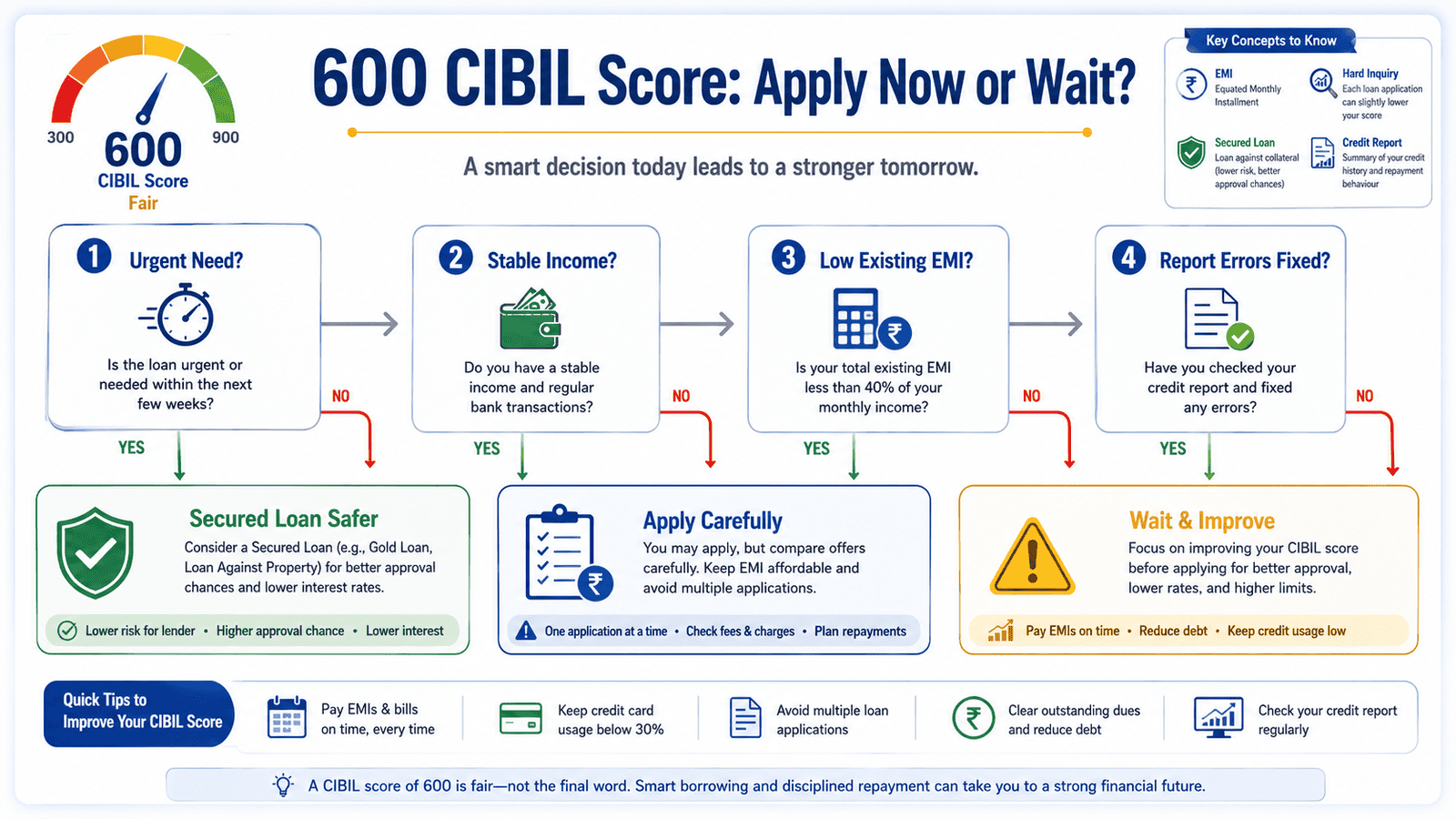
What to Do Before You Apply Again
Step 1 — Check your latest credit report
Pull your report directly from TransUnion CIBIL, or compare it with Experian India or CRIF High Mark. Lenders sometimes report to one bureau before another, so your score can look slightly different across them.
Step 2 — Identify what’s actually pulling the score down
Look for overdue amounts, DPD (days past due) markers, a settled or written-off account, or any entry tied to a loan you don’t recognise. Each of these affects approval differently — an old settled card is read differently by lenders than a live overdue.
Step 3 — Pause on fresh applications
Every loan or credit card application usually triggers a hard inquiry, which lenders can read as credit hunger. Applying to five NBFCs in a week can do more damage than the 600 score itself.
Step 4 — Dispute genuine errors
If you spot a wrong entry — a loan that isn’t yours, an account showing overdue after you’ve paid it off — raise it directly with the bureau and the lender. See the credit report dispute process for the exact steps.
Step 5 — Choose the safest realistic route before applying
Once your report is clean and you understand why your score is 600, apply to the loan type most likely to work for your situation — not the first app that shows up in an ad.
Key Takeaways
- A 600 CIBIL score is generally weak for unsecured personal loans, and most banks price or reject this band more cautiously than NBFCs do.
- Secured loans — gold loan, loan against FD — tend to be more realistic because the lender’s risk is covered by collateral, not just your score.
- A stable salary, low existing EMI burden, and clean repayment over the last 6–12 months can outweigh the score itself in a lender’s eyes.
- Loan apps and repeated applications across multiple NBFCs in a short window can trigger hard inquiries that push your score down further.
- If your need isn’t urgent, fixing report errors and clearing overdue amounts first is often the better move than applying immediately.
- FOIR (Fixed Obligation to Income Ratio) — how much of your income already goes to EMIs — matters as much to lenders as your CIBIL number.
Key Facts at a Glance
| Factor | Reality at 600 CIBIL | What This Means for You |
|---|---|---|
| Score level | Below most lenders’ comfort range for unsecured credit | Expect closer scrutiny, not automatic rejection |
| Unsecured personal loan | Difficult, lender-dependent | Banks are stricter; some NBFCs may still consider strong income profiles |
| Secured loan (gold, FD) | Comparatively more realistic | Collateral reduces lender risk, but you can still lose the asset on default |
| What lenders check beyond score | Income, FOIR, overdue status, hard inquiries | A clean recent profile can offset a weak score |
| Borrower risk | High — rejection, costly offers, debt-trap apps | Verify every lender and charge before signing |
Where you sit compared with stronger approval ranges matters too — see what counts as a good score for loans for the fuller picture.
What a 600 CIBIL Score Means to Lenders
Your CIBIL score is a three-digit summary, calculated by TransUnion CIBIL, of how you’ve handled credit — based on data lenders themselves report every month. It isn’t a government number, and it isn’t fixed: Experian India and CRIF High Mark can show a slightly different score for the same person, because not every lender reports to every bureau at the same time.
At 600, the report behind that number usually shows one or more of these: missed EMI payments, an overdue amount still outstanding, high credit utilisation (how much of your available credit limit you’re using), a settled account (where you paid less than the full due and the lender closed it as “settled” rather than “closed”), or a written-off account, where the lender gave up trying to recover the amount.
DPD — days past due — is the specific marker lenders look at closely. A 30-DPD entry from eight months ago reads very differently to an underwriter than a current 90-DPD overdue. The age and recency of the issue often matters more than the score itself.
Why unsecured lenders react differently than secured ones
An unsecured personal loan has nothing backing it except your promise to repay — so the lender’s entire risk assessment rests on your score and report. A secured loan is backed by gold, an FD, or property, so even with a 600 score, the lender has a fallback if repayment stops. This is why secured options tend to be more accessible.
CIBIL is not the only factor a lender weighs. Income stability, employer type, how your bank statement behaves month to month, and your current EMI burden are checked alongside the score — sometimes more heavily than the score itself.
Real Example: Ravi’s Situation in Pune
Ravi, 31, works in Pune and earns around ₹38,000 a month. His CIBIL score sits at 600 after he missed two credit card payments last year during a job transition. He’s since cleared the dues, but the entries are still on his report.
Ravi’s existing EMI burden is light — just a ₹3,000 monthly two-wheeler loan installment — which works in his favour. When he checked his report, he found the missed payments were marked but not overdue anymore, and there were no written-off or settled accounts. His mistake was applying to four loan apps within a week after his first rejection, which added four fresh hard inquiries to his report.
A more careful route for Ravi would have been: check the report first, avoid applying everywhere at once, and consider a gold loan or an NBFC personal loan backed by his salary slips and clean recent bank statement — rather than chasing instant-approval apps. [CONFIRM — verify current figure before publishing] applies to any specific interest rate or EMI figure used as an example here.
The key insight: Ravi’s score alone didn’t doom him — his panic applications afterward did more damage than the original missed payments.
Eligibility Checklist: Are You Ready to Apply?
| Document/Factor | Why It Helps | Caution |
|---|---|---|
| Salary slips (last 3 months) | Shows stable, verifiable income | Self-employed need ITR instead — rules vary by lender |
| Bank statement (last 6 months) | Shows real cash flow and spending behaviour | Frequent bounces or overdrafts can count against you |
| No current overdue | Signals you’re not actively defaulting | Even a small ₹500 overdue can flag your file |
| Low FOIR | Shows you can absorb a new EMI | Existing EMIs above ~50% of income concern most lenders |
| Collateral or co-applicant | Strengthens a weak unsecured profile | Co-applicant’s own credit history is checked too |
For a fuller view of what lenders typically expect, see minimum score for personal loans. Note that lender-specific cut-offs vary and change — don’t treat any single number as universal.
How to Calculate Whether a Loan Is Actually Affordable
Approval is only half the question. Take a ₹50,000 personal loan as an example. [CONFIRM — verify current figure before publishing] on the exact interest rate, but illustratively: at a reducing-balance rate, a 12-month tenure produces a higher EMI but less total interest, while a 24-month tenure lowers the EMI but increases what you pay overall.
EMI = [P × r × (1+r)^n] ÷ [(1+r)^n − 1]
Where: P = loan amount | r = monthly interest rate | n = number of months
| Tenure | Approx. EMI Pattern | Total Interest Pattern |
|---|---|---|
| 12 months | Higher monthly outflow | Lower total interest paid |
| 24 months | Lower monthly outflow | Higher total interest paid |
| 36 months | Lowest monthly outflow | Highest total interest paid |
Before signing anything, check whether your EMI still fits after rent, groceries, school fees, and any existing EMI — not just whether the lender approves the amount. Processing fees, late fees, and prepayment penalties all add to the real cost, and these must be confirmed from the lender’s Key Fact Statement, not assumed.
Comparison: Loan Routes at 600 CIBIL
| Route | Approval Reality | What to Verify |
|---|---|---|
| Bank personal loan | Difficult unsecured | Most banks prefer stronger score bands for unsecured credit |
| NBFC personal loan | Possible, often costlier | Compare APR, not just the advertised rate |
| Gold loan | More realistic | Asset is pledged — confirm valuation and auction terms |
| Loan against FD | Safer if FD exists | FD gets marked/liened until the loan is repaid |
| Loan apps | Check carefully | Confirm KFS, APR, and that the lender is RBI-regulated |
For more on the secured route specifically, see gold loan with bad credit.
Low-CIBIL Borrowing Safety Checklist
- Don’t trust any lender or app promising “guaranteed approval” regardless of your score — RBI-regulated lenders always assess your profile first.
- Don’t apply to multiple lenders in panic — each hard inquiry can compound the problem you’re trying to solve.
- Don’t accept a loan offer without reading the Key Fact Statement (KFS) and confirming the APR, not just the headline rate.
- Don’t borrow an amount whose EMI doesn’t comfortably fit your monthly cash flow.
- Don’t ignore a wrong entry on your report — a genuine error is fixable and worth disputing before you apply.
How to Decide What’s Right for You
your need is urgent and your existing EMI burden is low — applying now through a secured loan or a strong-income unsecured route may be realistic.
you have gold or an FD available and understand the collateral risk — a secured loan is usually the more accessible option at 600.
your report shows a fixable error or a recently cleared overdue — disputing or waiting a few months before applying can improve your odds.
you’re considering a co-applicant — make sure both of you understand that missed payments affect both credit histories, not just yours.
your need is urgent and you have unresolved overdue amounts — clearing those first will likely help more than applying immediately.
you already have high existing EMIs — taking on a new loan now adds risk rather than solving the underlying cash-flow problem.
For a deeper walkthrough of safer borrowing strategies at this score band, see low score borrowing tips.
Common Mistakes to Avoid
Applying to many lenders within days
Sending five applications in a week feels proactive but isn’t.
Each triggers a hard inquiry, and a cluster of recent inquiries signals credit hunger to underwriters — making the next application harder to approve, not easier. See multiple loan applications for how this plays out.
Space applications out, and apply only after you’ve assessed which route actually fits your profile.
Hiding existing EMI obligations
Some borrowers leave out an existing loan when applying, hoping it improves their FOIR on paper.
Lenders cross-check your credit report regardless — the omission gets caught and can read as an attempt to mislead, hurting trust more than the EMI itself would have.
Disclose every active obligation upfront.
Accepting a short-tenure, high-cost loan without checking APR
A “low” flat rate can translate to a much higher reducing-balance APR once fees are added.
A loan that looks like 12% can work out closer to 20%+ on an APR basis once processing fees and a short tenure are factored in.
Always ask for the APR figure, not just the advertised rate, before accepting.
Ignoring overdue or incorrect entries
Letting a small overdue sit unpaid, or assuming a wrong entry will “sort itself out,” rarely helps.
Unresolved overdue amounts keep your score depressed and can grow with penal charges; unfixed wrong entries continue dragging down every future application.
Clear genuine dues and formally dispute incorrect ones.
Borrowing to repay another loan without a plan
Taking a new loan purely to cover an existing EMI, without changing the underlying cash-flow problem, often just delays the issue.
This can spiral into a cycle where each new loan covers the last one’s repayment, with fees and interest compounding each time.
Address the income-versus-obligation gap directly, even if that means renegotiating terms with the existing lender first.
Trusting “guaranteed approval” loan app claims
Apps that promise approval regardless of score or documents are a red flag, not a convenience.
These often carry high processing fees, unclear APR, and aggressive recovery practices that can cause far more damage than a rejected application would.
Stick to RBI-regulated banks and NBFCs, and verify the lender’s identity before sharing any documents.
When This May Not Be the Right Choice
If your income is unstable or irregular right now, taking on a new EMI adds risk at the worst possible time.
If your existing EMI burden is already high relative to your income, a new loan — even if approved — can strain your monthly cash flow further.
If you have current overdue amounts still unpaid, clearing those first usually does more for your approval chances than applying elsewhere.
If the borrowing is for discretionary or lifestyle spending rather than a genuine need, waiting and improving your profile is often the safer path.
If a lender or app doesn’t clearly show the KFS, APR, charges, and repayment schedule upfront, that itself is a reason to walk away.
If any of these apply to your situation, it may be worth exploring other options before committing.
Official Rules and Where to Verify
Before applying anywhere, verify your standing and the lender’s legitimacy directly from official sources rather than relying on what an app or agent tells you.
- TransUnion CIBIL (transunioncibil.com) — for your credit score and full credit report
- Experian India (experian.in) — to cross-check your score, since bureau data can differ
- CRIF High Mark (crifhighmark.com) — another bureau reference for report verification
- RBI (rbi.org.in) — to confirm a lender is a regulated bank or NBFC, and to understand borrower grievance expectations
Credit reporting rules, lender assessment methods, and bureau processes can change. Always verify current details from the relevant bureau, lender, or official regulatory source before acting.
Expert Tips
Expert Tips
- Clear any current overdue amount first — even a small outstanding due can flag your file ahead of a clean but old missed payment.
- Keep your credit card utilisation below roughly 30% of your limit in the months before applying — high utilisation is read as financial stress.
- After a rejection, pause new applications for a few months rather than immediately trying elsewhere — let the inquiry cluster age out.
- Maintain a steady, bounce-free bank statement for at least 3–6 months before applying — lenders read this as a stability signal.
- If you choose a secured route, only pledge an asset you’re fully confident you can repay against — recovering a defaulted gold loan or FD is the lender’s right, not a formality.
- If you suspect a wrong entry, raise the dispute before you apply, not after — a pending dispute can itself raise questions during underwriting.
Frequently Asked Questions
Can I get a personal loan with a 600 CIBIL score?
It’s possible but difficult, especially unsecured. Some NBFCs may consider it if your income is stable and your existing EMI burden is low — approval always depends on the lender’s own assessment.
Is 600 CIBIL score good or bad?
600 is generally considered a weak score by most lenders, below the range banks typically prefer for unsecured lending. It isn’t the lowest possible, and it doesn’t make every loan impossible.
Which loan is easiest to get with a 600 CIBIL score?
Secured loans — like a gold loan or a loan against fixed deposit — tend to be more accessible, since the lender’s risk is backed by collateral rather than the score alone.
Can I get a home loan with a 600 CIBIL score?
It’s harder, since home loans are large, long-tenure commitments. A co-applicant with a stronger score, a higher down payment, or a smaller loan amount relative to income can improve your chances — but approval is lender-dependent.
Should I apply to many lenders if my CIBIL score is 600?
No. Applying to several lenders in a short window adds multiple hard inquiries, which can make your profile look riskier and reduce your approval chances further.
Can a gold loan be approved with a 600 CIBIL score?
Often yes, since the gold itself secures the loan. Lenders still verify your identity and the gold’s value, but the score plays a smaller role than it does for unsecured credit.
How long does it take to improve a 600 CIBIL score?
There’s no fixed timeline — it depends on what’s causing the low score, how consistently you repay going forward, and how lenders report your behaviour each month. Clearing overdue amounts and maintaining on-time payments over several months is the realistic path, not a guaranteed schedule.
Does checking my own CIBIL score lower it?
No. Checking your own score is a soft inquiry and does not affect your score. Only hard inquiries — triggered when a lender checks your report for a loan application — can have an impact.
Will a wrong entry on my CIBIL report fix itself over time?
Not reliably. A genuine error needs to be formally disputed with the bureau and the lender — it’s unlikely to be corrected automatically.
Final Verdict
A 600 CIBIL score loan isn’t automatically off the table, but it does mean every choice — which lender, which loan type, whether to wait — carries more weight than it would at a stronger score. Unsecured personal loans are the hardest and often costliest route. Secured options, a clean recent report, and a manageable EMI burden give you the most realistic shot at approval.
If your need is genuinely urgent and your income supports it, a secured loan or a carefully chosen NBFC option may work. If it isn’t urgent, spend a few months clearing overdue amounts, disputing errors, and keeping your report clean — that often does more than chasing approval at 600 right now. Always verify your latest credit report, lender requirements, and bureau process before making a credit-related decision.
This article is for educational purposes only and should not be treated as personalised financial, credit, or legal advice. Credit scores, credit reports, lender eligibility criteria, and bureau processes can vary and may change over time. Please verify current details with the relevant credit bureau, lender, official regulatory source, or a qualified professional before making any credit-related decision.

Neha Menon writes simple, borrower-first explainers on CIBIL scores, credit reports, bureau disputes, DPD, loan settlement impact, hard inquiries, and practical credit score recovery. She focuses on helping Indian borrowers understand lender-reported data, avoid credit mistakes, and take safer next steps without false promises.