

If you’ve never taken a loan or owned a credit card, lenders may treat you as invisible — not risky, just unreadable. You haven’t done anything wrong. You simply don’t have a credit history yet, and that’s exactly what makes how to build CIBIL score from zero one of the most common questions among students, new employees, and first-time freelancers in India.
This confusion is normal. A 23-year-old who just started her first job and a 35-year-old freelancer who has only ever paid bills in cash face the same wall: no repayment data, no score, no easy way in. The good news is that there’s a safe, structured way to start — one that doesn’t involve chasing “instant approval, no CIBIL required” loan apps or applying to ten lenders in a week.
This article won’t promise you a fixed score, a guaranteed approval, or a set number of months until you’re “credit-ready.” Your CIBIL score is generated from data that lenders report to the bureau, and that process varies. What this article will give you is a realistic, beginner-safe roadmap — the same one we’d want a younger sibling or new colleague to follow.
Quick Answer: How to Build CIBIL Score From Zero
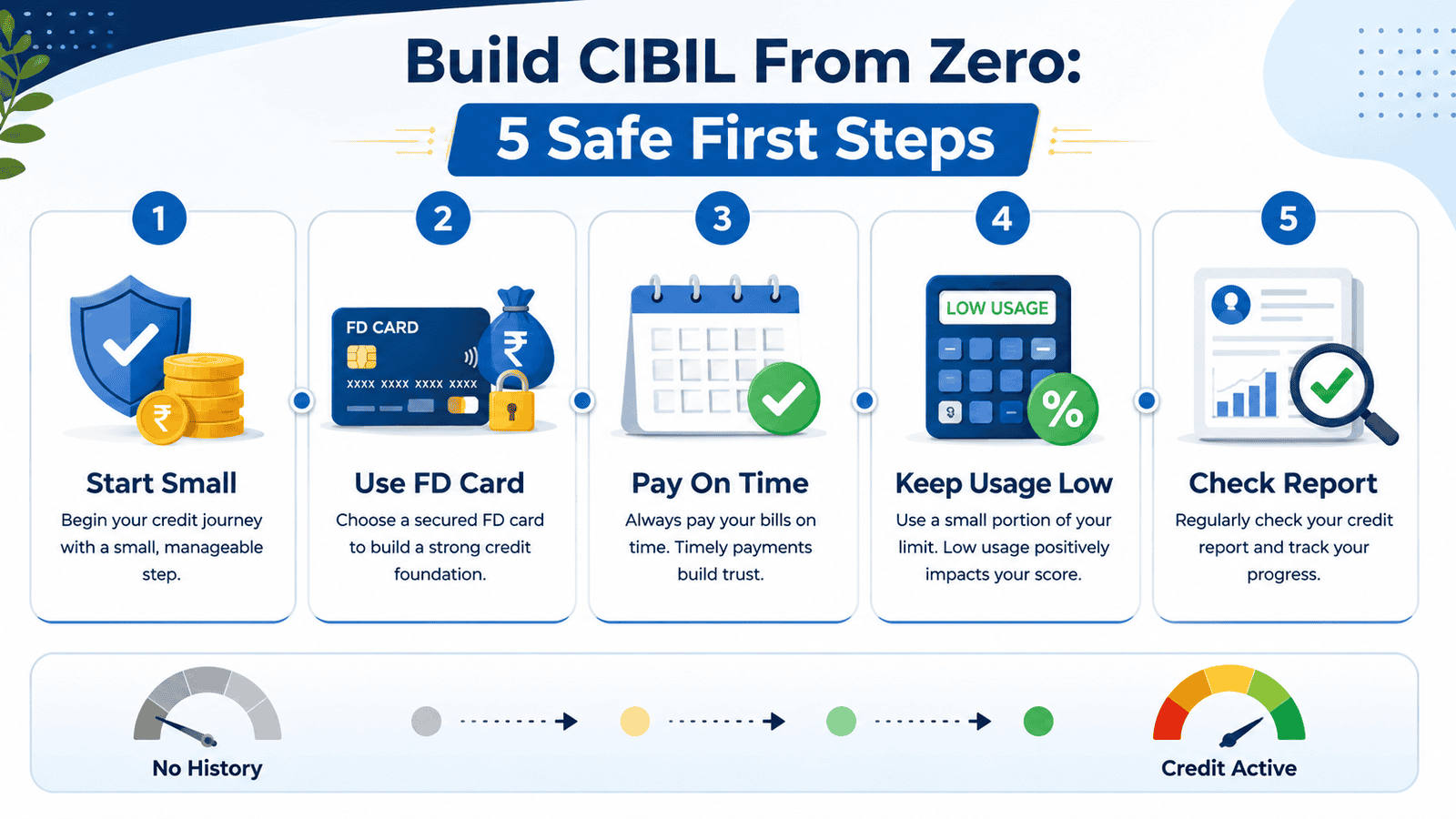
How to build CIBIL score from zero starts with creating a small, reportable credit history through safe products like an FD-backed credit card, starter credit card, or manageable small loan. Pay every bill before the due date, keep card usage low, avoid multiple applications, and check your credit report regularly.
Before You Apply: Readiness Checklist
Before you choose your first credit product, run through this checklist. Most first-time applications get delayed or rejected not because of credit history, but because of avoidable gaps like these.
| Step | Action | Why It Matters | Mistake to Avoid |
|---|---|---|---|
| 1 | Confirm KYC is complete (PAN, Aadhaar-linked bank account) | Lenders can’t process an application with mismatched or incomplete KYC | Applying with an old address or unlinked mobile number |
| 2 | Check income or FD availability | Income proof or an FD decides which first product you qualify for | Applying before you know what you can show as proof |
| 3 | Keep mobile number and email consistent across documents | Bureaus and lenders match your profile using these details | Using a number not linked to your bank or Aadhaar |
| 4 | Honestly assess your ability to pay each month | One missed first payment can set back your entire credit-building effort | Applying for a limit or EMI bigger than you’re sure you can repay |
| 5 | Read the fee structure before applying | Joining fees, annual fees, and charges affect whether the product is worth it | Applying without checking annual fee or renewal charges |
Among first-time options, a card against an FD is usually the easiest to get approved for, since it doesn’t depend on an existing credit history. If you’d rather see your other options first, this guide to credit card without score products is a useful next read.
Key Takeaways
- Having no CIBIL score is not the same as having a poor one — it usually means the bureau simply hasn’t received enough reported repayment data yet.
- You build credit history through small, reportable products — not by taking a large loan just to “prove” you can repay.
- Paying every bill on or before the due date is the single habit that influences your repayment history the most.
- Using too much of your available credit limit can hurt how new lenders view your application, even if you eventually pay in full.
- Applying to multiple lenders in a short span can lead to several hard inquiries, which may work against you instead of helping.
- Credit history takes time to show up — there’s no fixed number of days or months that applies to every borrower.
- Any offer promising a “guaranteed” CIBIL score or guaranteed loan approval without checks is a red flag, not a shortcut.
Key Facts at a Glance
| What You’re Wondering | What’s Actually True | What to Do |
|---|---|---|
| I have no CIBIL score — am I a risky borrower? | No. It usually means no lender has reported data on you yet | Start with one reportable product, not several risky ones |
| Can I get a credit card with zero history? | Yes, mainly through FD-backed or starter cards meant for first-timers | Compare FD card vs starter card eligibility before applying |
| Will a small loan “build” my score faster? | Only if the lender reports to a bureau and you repay fully and on time | Confirm bureau reporting before taking any loan for this purpose |
| Does using my full credit limit help show activity? | No — high utilisation is generally viewed as a risk signal | Keep usage well below your sanctioned limit |
| How do I know my data is now reported? | It shows only once the lender submits data and the bureau processes it | Check your report periodically through the official bureau site |
What “No CIBIL Score” Actually Means
A score of zero or a report that shows “NA” or “NH” (No History) doesn’t mean you’ve failed at anything financial. It usually means what a CIBIL score means in practice: it’s a number generated from your repayment behaviour on credit products, as reported by lenders to the bureau. If no lender has ever reported an account in your name, there’s nothing for the bureau to calculate a score from.
This is different from having a low score. A low score means the bureau has data — and that data shows missed payments, high utilisation, defaults, or other red flags. A missing score means there’s no data at all yet. Lenders read these two situations very differently, but both can lead to the same outcome on a loan application: hesitation or rejection, simply for different reasons.
How Lenders Actually Report Data to Bureaus
TransUnion CIBIL, Experian, CRIF High Mark, and Equifax don’t go out and collect your financial behaviour themselves. Banks, NBFCs, and credit card issuers report account-level data — your credit limit, balances, and payment history — to one or more of these bureaus, typically on a monthly cycle. If you’ve only ever borrowed informally — say, from family, or through an app that doesn’t report to any bureau — none of that activity builds a visible credit history, no matter how responsibly you repaid it.
This is also why your score may show as not generated even after you’ve used a credit product for a short while — the lender’s reporting cycle and the bureau’s processing time both take a few weeks to reflect in your file.
Why Building Credit History Matters
Future loan and credit card approvals lean heavily on this file. A thin or empty credit history makes it harder for a lender to assess you, which can mean smaller starting limits, more documentation requests, or straightforward rejection — not because you’re seen as risky, but because you’re unreadable. The habits you build now, particularly around your very first credit product, also tend to stay visible on your report for years, so starting carefully matters more than starting fast.
Real Example: Riya’s First Step Into Credit
Riya, 23, works her first salaried job in Pune, earning around ₹28,000 a month. She has never taken a loan or held a credit card, and when she tried applying for a regular credit card online, it was rejected — with no real explanation beyond “insufficient credit history.”
Instead of applying to five more lenders the same week, Riya opens a fixed deposit of ₹25,000 and applies for a credit card against that FD. She’s approved with a credit limit of around ₹20,000. For the first three months, she uses the card only for planned expenses — groceries, a phone recharge, an annual subscription — keeping her monthly spend under ₹6,000. She pays the full bill before the due date every time, never just the minimum amount due.
By month four, she checks her credit report directly through the bureau’s website and sees her first score has been generated. It’s not a high score yet — there isn’t enough history for that — but it exists, and her file now shows a clean, on-time repayment record. The insight: a small, boring, consistently repaid credit product builds more trust with future lenders than a flashy first loan ever could.
How to Calculate Your Safe Usage and Affordability
Two simple checks help you stay safe with your first credit product: how much of your limit you’re using, and whether an EMI actually fits your income.
Credit Utilisation % = (Amount Used ÷ Total Credit Limit) × 100
Where: Amount Used = your outstanding balance on the card | Total Credit Limit = your sanctioned limit
On a ₹20,000 FD-backed card, spending ₹6,000 in a billing cycle puts your credit usage ratio at 30% — generally considered a more comfortable range for a new credit profile than running close to your full limit. This isn’t an official bureau threshold you must hit; it’s a cautious, illustrative starting point.
For a small starter loan of ₹10,000–₹20,000, check that the EMI comfortably fits your monthly budget after rent, essentials, and existing commitments — not just that you can technically afford it on paper. And if you’re tempted to pay only the minimum due on a credit card instead of the full bill, understand that interest is usually charged on the entire outstanding balance from the transaction date, not just the unpaid minimum — which is why a small unpaid amount can grow expensive quickly.
Comparison: First Credit Options for No-History Borrowers
| Option | Suitable For | What to Check Before Using |
|---|---|---|
| FD-backed credit card | Students, homemakers, anyone with idle FD funds | Lower Risk — confirm bureau reporting and lien terms on the FD |
| Starter unsecured credit card | Salaried employees with a stable, verifiable income | Higher Risk — confirm annual fee, interest rate, and reporting |
| Small secured loan | Borrowers with a clear, planned expense and steady repayment ability | Higher Risk — confirm EMI affordability and whether lender reports to bureaus |
| BNPL / EMI card | Only disciplined repeat spenders who pay in full every cycle | Higher Cost Risk — many BNPL products don’t report to bureaus at all; verify first |
Be cautious with BNPL and EMI cards specifically: some do not report to credit bureaus at all, which means consistent repayment on them may not build any visible credit history — while a missed payment can still hurt you through penalty charges or collections. Confirm bureau reporting before assuming any product is “helping” your score.
If Your Credit Report Doesn’t Show What You Expect
It’s common for a first-time borrower’s report to lag behind reality. If you’ve used a credit product responsibly for a few months and still see no score or missing data, work through this sequence rather than assuming something is wrong with you.
Start by pulling your report directly from the bureau — see check your score free for the official channels. Next, confirm with your card issuer or lender whether they report your account to CIBIL, Experian, CRIF High Mark, or Equifax — not every smaller lender or app reports to all four. If your report shows incorrect information, such as a payment marked late when you paid on time, raise a dispute directly with the bureau, and keep your payment confirmations and statements as proof. This isn’t a full complaint process, but it’s the right first move before escalating further.
Safety Checklist: What to Avoid While Building Credit
Stay Safe While You Build History
- Treat any “guaranteed loan without CIBIL check” offer as a warning sign, not an opportunity.
- Don’t take an expensive loan purely to “create” credit history — the cost usually outweighs the benefit.
- Avoid granting unnecessary contact, gallery, or storage permissions to lending apps you’re not certain about.
- Borrow only what fits comfortably in your monthly budget, even if a lender offers you more.
- Limit how many lenders you approach in a short period — each hard inquiry is visible on your report.
How to Decide What’s Right for You
you’re a student with no income but have access to family funds for an FD — an FD-backed card is usually the most realistic starting point.
you’re newly salaried with a stable monthly income — you may qualify for a starter unsecured credit card; check eligibility before applying.
you’re a freelancer or gig worker with irregular income — an FD-backed card is often safer than an EMI-based loan product, since it doesn’t depend on proving steady income.
you’re self-employed and just starting out — confirm your income documentation is in order before applying anywhere, since this is the most common rejection reason.
you’re confident you can repay even a small monthly obligation on time — wait, and use this period to stabilise your income or savings instead of applying.
For a fuller breakdown of options by borrower type, see card without score.
Common Mistakes to Avoid
Common Mistakes to Avoid
Applying to Many Lenders at Once
Submitting several applications in the same week feels like increasing your chances.
Each application can trigger a hard inquiry, and multiple inquiries in a short span can make you look credit-hungry to future lenders — sometimes leading to more rejections, not fewer.
Apply to one well-suited product at a time, and wait to see the outcome before trying another.
Using the Full Credit Limit
Spending close to your entire sanctioned limit, even if you plan to pay it off in full.
On a ₹20,000 limit, regularly running a balance of ₹18,000–₹19,000 keeps your utilisation high, which can work against you even with on-time payment.
Keep your spending well below your limit, and treat the card as a tool for small, planned purchases.
Paying Only the Minimum Due
Treating the “minimum amount due” on your statement as if it’s the full payment.
Interest typically accrues on your full outstanding balance, not just the unpaid minimum, so a small gap can quietly become an expensive one over a few cycles.
Pay the full statement balance every cycle, especially while you’re establishing your first credit file.
Missing Your First EMI or Card Payment
Letting your very first payment slip, even by a few days.
Early missed payments on a thin file carry disproportionate weight, since there’s little other history to balance them out.
Set up autopay or a calendar reminder before your first billing cycle even begins.
Closing Your First Credit Product Too Soon
Shutting down your starter card or loan account as soon as it feels “done.”
This can shorten your average credit history length and remove a reporting account from your file just as it starts adding value.
Keep your first reportable product active and in good standing for a reasonable period before closing it.
Trusting “Guaranteed Score Improvement” Claims
Believing an app or agent that promises a specific score increase or timeline.
No third party controls bureau scoring — only your own reported repayment behaviour does, and such claims often lead to unnecessary fees or unsafe products.
Rely on consistent, verifiable habits instead of any promised shortcut.
Mixing Up Informal Borrowing With Credit Building
Assuming that repaying a friend, family member, or non-reporting app builds your credit file.
If the lender doesn’t report to a bureau, the activity — however responsible — stays invisible to your credit report.
Confirm bureau reporting before treating any product as a credit-building step.
When This May Not Be the Right Choice
When This May Not Be the Right Choice
Taking on your first credit product isn’t always the right move right now. It may be worth waiting if your income is unstable or irregular and you can’t confidently plan for a monthly payment. It may also not be the right time if you’re already relying on borrowed money to cover regular expenses, since adding another obligation compounds the risk rather than building a foundation.
If you don’t fully understand the fees, interest, or terms of a product you’re considering, that’s a sign to pause and ask more questions first — not to apply anyway. And if you find yourself drawn toward credit mainly for lifestyle spending, or feel pressured by aggressive loan-app marketing promising instant approval, it’s worth stepping back before committing to anything.
If any of these apply to your situation, it may be worth exploring other options before committing.
Official Rules and Where to Verify
Credit history and scoring concepts in this article draw on how Indian credit bureaus generally operate. For current, authoritative information, refer directly to:
- TransUnion CIBIL — transunioncibil.com
- Experian India — experian.in
- CRIF High Mark — crifhighmark.com
- Equifax India — equifax.co.in
- RBI — rbi.org.in, for regulated lending and borrower protection context
You can pull your own report directly using the steps in check report free.
Credit reporting rules, lender assessment methods, and bureau processes can change. Always verify current details from the relevant bureau, lender, or official regulatory source before acting.
Expert Tips
Expert Tips
- Use your first credit card only for purchases you’d already planned to make — not as extra spending money.
- Set up autopay for at least the full statement amount, with a backup reminder a few days before the due date.
- Keep your first credit product simple — one FD card or one starter card is enough; you don’t need three at once.
- Read the annual fee, renewal fee, and interest rate before applying, not after your first statement arrives.
- Check your credit report every few months, calmly — frequent self-checks through official channels don’t damage your score.
- If you take a small secured loan to build history, confirm in writing that the lender reports to at least one bureau.
Frequently Asked Questions
Can I build a CIBIL score from zero?
Yes. You build it by using a reportable credit product responsibly — paying on time and keeping usage low — so the lender has repayment data to report to the bureau.
Why is my CIBIL score not generated even though I have a credit card?
It usually means the lender hasn’t yet reported your account, or the bureau hasn’t finished processing it. This can take a few billing cycles to reflect.
Can I get a credit card without a CIBIL score?
Yes — FD-backed cards and some starter cards are designed for applicants with no prior credit history, since approval depends on factors other than an existing score.
Is a credit card against an FD good for building CIBIL?
It can be, since many FD-backed cards are reported to bureaus like any other credit card. Confirm reporting with the issuer, and use the card responsibly to see the benefit.
How long does it take for credit activity to appear in a credit report?
There’s no fixed timeline — it depends on the lender’s reporting cycle and the bureau’s processing, which commonly takes a few months to show clearly.
Can checking my own CIBIL score reduce it?
No. Checking your own report is a soft inquiry and does not affect your score, unlike a hard inquiry triggered by a lender when you apply for credit.
Can BNPL help build my CIBIL score?
Only if the BNPL provider reports your repayment data to a bureau — many do not. Verify this directly with the provider before relying on it for credit building.
What should I avoid when building credit for the first time?
Avoid applying to many lenders at once, using your full credit limit, paying only the minimum due, missing your first payment, and trusting any “guaranteed approval” or “guaranteed score” claims.
Is a small loan better than a credit card for building credit from zero?
Neither is automatically better — what matters is whether the lender reports to a bureau and whether you can repay comfortably and on time.
Will my score be the same across CIBIL, Experian, CRIF High Mark, and Equifax?
Not necessarily. Each bureau may receive slightly different reported data and use its own scoring model, so scores can vary between them.
Final Verdict
If you’re starting from zero, the safest path to building a CIBIL score is also the least dramatic one: pick one reportable, regulated credit product — an FD-backed card is usually the easiest entry point — use it for planned expenses, keep your usage well below the limit, and pay in full before every due date. Anyone tempted by a loan or app promising guaranteed approval or a guaranteed score boost should treat that as a reason to slow down, not speed up. There’s no fixed timeline here, and that’s normal — consistency matters more than speed.
Always verify your latest credit report, lender requirements, and bureau process before making a credit-related decision.
This article is for educational purposes only and should not be treated as personalised
financial, credit, or legal advice. Credit scores, credit reports, lender eligibility
criteria, and bureau processes can vary and may change over time. Please verify current
details with the relevant credit bureau, lender, official regulatory source, or a
qualified professional before making any credit-related decision.

Neha Menon writes simple, borrower-first explainers on CIBIL scores, credit reports, bureau disputes, DPD, loan settlement impact, hard inquiries, and practical credit score recovery. She focuses on helping Indian borrowers understand lender-reported data, avoid credit mistakes, and take safer next steps without false promises.