
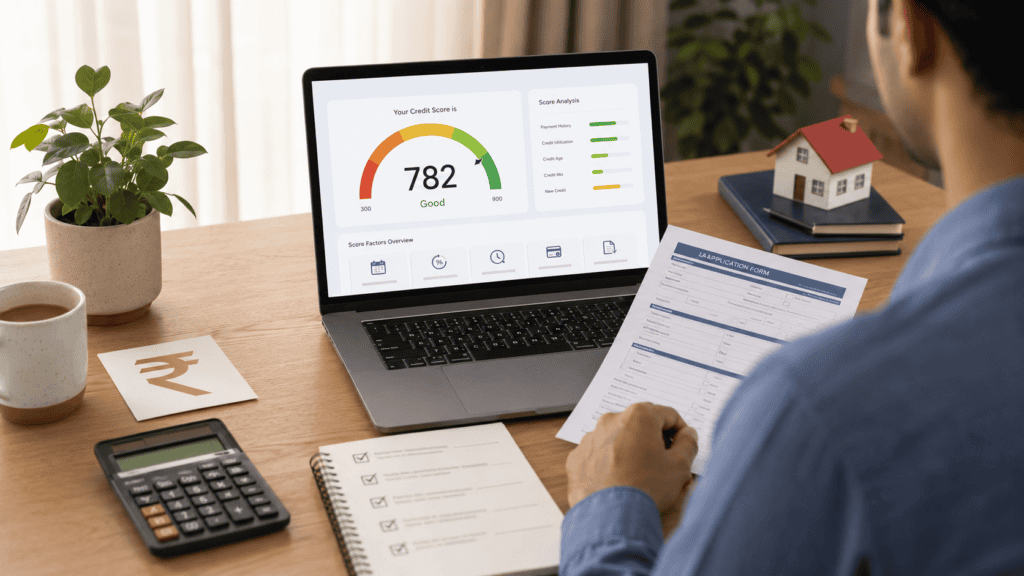
Before you apply for a personal loan, home loan, or credit card, one question almost every Indian borrower asks is: is my CIBIL score good enough? It is a fair question — and the honest answer is more nuanced than most websites will tell you. Your CIBIL score, calculated by TransUnion CIBIL using repayment history and credit behaviour reported by your lenders, is one of the first things most banks and NBFCs check. But it is not the only thing. Many borrowers with a decent score still face rejection because of high existing EMIs, unstable income, or a credit report with an uncorrected error. And many others hurt their own chances by applying to several lenders at once, creating multiple hard inquiries in quick succession. This article explains what score ranges generally mean, how different loan types may treat your score, and how to figure out whether you should apply now or wait.
Quick Answer: What Is a Good CIBIL Score for Loans in India?
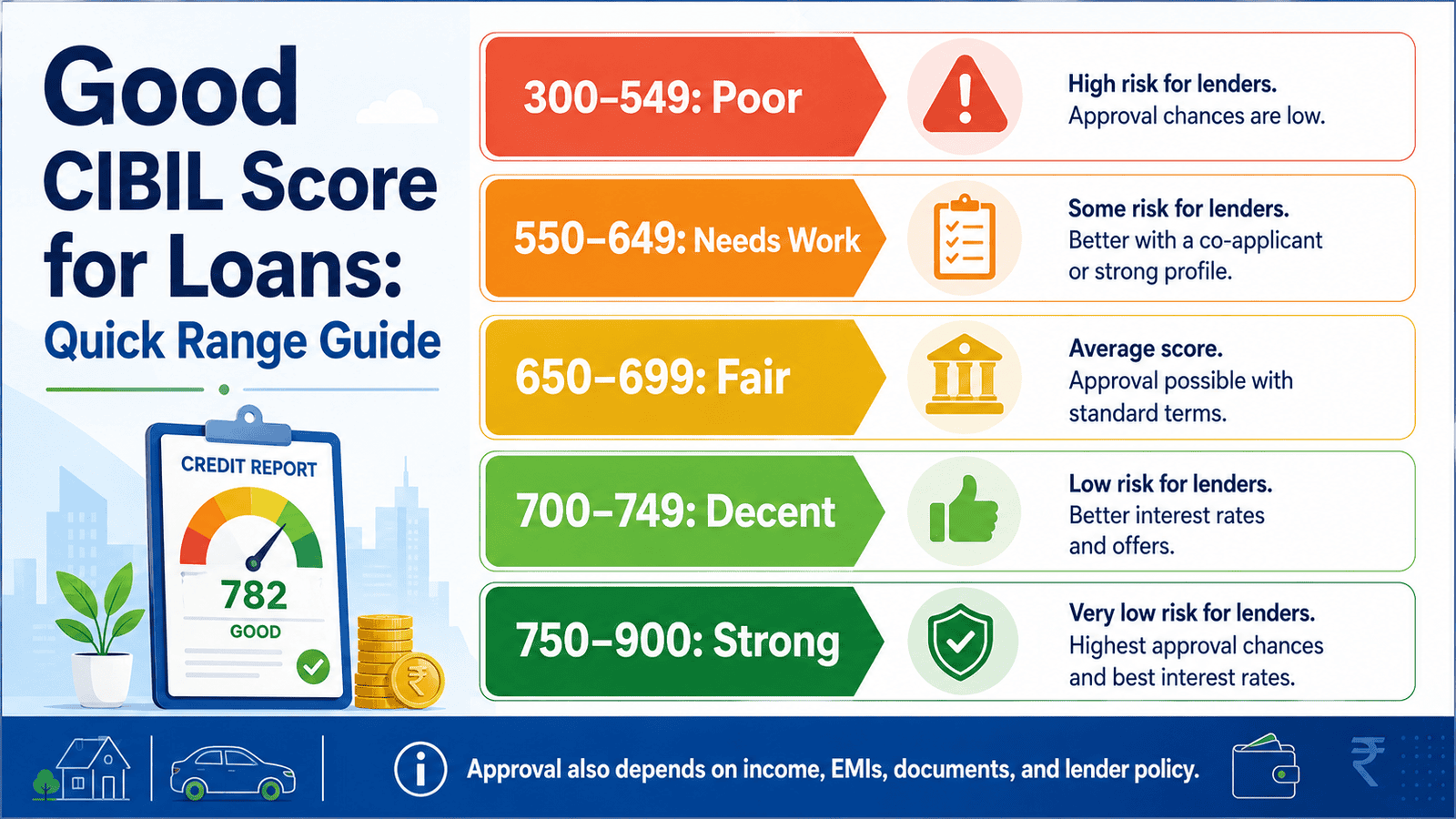
A good CIBIL score for loans is usually a score that makes lenders more comfortable with your repayment history. In India, many lenders prefer around 750 and above, but approval also depends on income, existing EMIs, credit utilisation, documents, employer profile, and lender policy. A strong score improves your profile — it does not guarantee approval on its own.
Key Takeaways
- A score of 750 and above is generally seen as stronger by many lenders across personal loans, home loans, and credit cards — but every lender sets its own cut-off, which can vary by product and borrower profile.
- A score in the 700–749 range may be acceptable with some lenders and NBFCs, particularly if your income is stable, your existing EMI burden is low, and your documents are clean — but it may still be insufficient for top-tier lenders or premium loan products.
- Borrowers with scores below 650 often find unsecured loan options limited; a gold loan, secured loan, or co-applicant arrangement may be a more realistic first step than applying directly for a personal or home loan.
- A good credit score does not cancel lender checks on income, FOIR (fixed obligations to income ratio), employer profile, or documents — all of these are reviewed alongside bureau data.
- Every loan application you submit triggers a hard inquiry on your credit report. Applying to multiple lenders in a short window can reduce your score and signal repayment risk to future lenders.
- Credit scores can vary across India’s four licensed credit bureaus — TransUnion CIBIL, Experian, CRIF High Mark, and Equifax. A lender may pull your report from any bureau, and the score may not be identical across all four.
Key Facts at a Glance
| Score Range | General Meaning | Possible Lender View | What Borrower Should Do |
|---|---|---|---|
| 300–549 | Poor credit profile | Most lenders are unlikely to approve unsecured loans; very high risk flag | Focus on repayment, reduce overdue, check for report errors before any application |
| 550–649 | Weak or risky profile | Unsecured loan approval difficult; NBFC or secured loan may be possible | Improve repayment discipline and reduce utilisation before applying |
| 650–699 | Fair but not ideal | Some NBFCs may consider; interest rate offered may be higher | Check report for errors; reduce card dues; consider co-applicant if applying for home loan |
| 700–749 | Decent — may be workable | Accepted by select lenders, particularly if income and EMI burden are healthy | Compare eligibility carefully; avoid applying to many lenders simultaneously |
| 750–900 | Strong score range | Many lenders view this positively; may support better terms discussions | Compare lenders on rate and charges; negotiate; avoid unnecessary new credit applications |
Note: Score-band interpretations above are general and illustrative. Actual lender cut-offs vary by bank, NBFC, product type, income band, and internal policy. Verify current eligibility criteria directly with your chosen lender before applying.
Not sure if your score and profile are loan-ready? Check before you apply.
Use the CIBIL Score Loan Readiness CheckerWhat a Good CIBIL Score Actually Means for Loan Approval
Your CIBIL score — calculated by TransUnion CIBIL on a scale of 300 to 900 — is a three-digit number that summarises your credit behaviour based on data reported by lenders. It reflects how consistently you have repaid loans and credit card dues, how much of your available credit limit you are currently using, how long you have had credit accounts, and how many new credit applications you have made recently. To understand the full scoring framework, read our guide on CIBIL score range.
How Lenders Actually Use Your Score
When you apply for a loan, the lender pulls your credit report from one or more of India’s four licensed credit bureaus — TransUnion CIBIL, Experian India, CRIF High Mark, or Equifax India. This pull is called a hard inquiry (also called a hard enquiry), and it is recorded on your report. The lender then checks your score, but also reads the full report: the payment history on each account, any Days Past Due (DPD) entries showing late or missed EMIs, the total outstanding balance, the number of recent credit applications, and the types of credit accounts you hold.
A higher score reduces the lender’s perceived risk of default. Lenders internally assign risk bands to score ranges and use those bands to decide whether to proceed, what interest rate to offer, and what loan amount to sanction. But the score is a starting filter, not a final decision. A borrower with a 780 score but a FOIR — fixed obligations to income ratio, meaning the percentage of monthly income already committed to existing EMIs — above the lender’s internal ceiling may still be declined or offered a lower loan amount.
Why Score Expectations Differ Across Lenders
A large public-sector bank with a conservative lending policy and a digital NBFC targeting salaried urban borrowers will not treat a 710 score the same way. The bank may require a stronger bureau score and will likely weigh employer profile, job stability, and salary account relationship heavily. The NBFC may accept a lower score if the applicant’s income is stable, the existing EMI burden is manageable, and the requested loan amount is modest. Neither approach is wrong — they reflect different risk appetites and business models. What this means for you: a single score threshold is not the whole picture. Checking your eligibility with a specific lender — using their soft-check or pre-approval tool where available — is always more accurate than relying on a generic number.
Same Score, Different Outcomes: A Real Indian Borrower Example
Real Example: Two Borrowers, One Score Band, Two Outcomes
Consider two salaried borrowers in Pune, both with scores in a similar range. This is a fictional illustrative scenario.
Borrower A — Priya, 34, HR Manager, ₹65,000 per month take-home: Priya has a score around 755. Her only EMI is a small two-wheeler loan of ₹4,800 per month, which she is closing in three months. Her two credit cards have a combined limit of ₹1,50,000, and her current outstanding balance is around ₹18,000 — a credit utilisation ratio of about 12%. She has no missed payments in the last three years, and she last applied for credit eighteen months ago. When Priya applies for a ₹5 lakh personal loan, her score, repayment history, low utilisation, and comfortable FOIR make her profile relatively straightforward for many lenders to evaluate.
Borrower B — Rahul, 33, Operations Executive, ₹55,000 per month take-home: Rahul also has a score around 750. But his existing EMIs — a car loan at ₹14,500 per month and a personal loan at ₹9,200 per month — already consume roughly ₹23,700 of his monthly income. His credit card utilisation is around 78% on a ₹80,000 limit. He applied to three lenders last month after an earlier rejection. Each application created a hard inquiry. When Rahul applies again, a lender checking his report sees high utilisation, recent multiple inquiries, and an EMI burden that leaves limited repayment headroom. Despite the similar score, Rahul’s profile is harder to approve.
The key insight: your score is the entry door. What the lender sees inside — utilisation, FOIR, payment history, recent inquiries — determines whether the loan is sanctioned, and on what terms.
Loan Readiness Checklist: Before You Apply
Your CIBIL score is one part of your loan application. Before submitting to any lender, go through this checklist. You can check your score safely without triggering a hard inquiry by using the bureau’s own consumer-facing portal — a self-check is a soft inquiry and does not affect your score.
| Check | Why It Matters | What to Do Before Applying |
|---|---|---|
| Download your credit report | Errors in the report — wrong DPD entries, ghost accounts, duplicate loans — can reduce your score and create rejection risk | Get your report from TransUnion CIBIL or another licensed bureau; review each account entry carefully |
| Check your existing EMI burden | Lenders check FOIR — high existing EMIs reduce the loan amount you can be offered or approved for | Total your monthly EMI commitments and divide by monthly income; if this ratio is high, consider repaying smaller dues first |
| Review credit card utilisation | Using a high proportion of your card limit is a negative signal in bureau data | Pay down card balances before applying; keep utilisation below a moderate level where possible |
| Count recent hard inquiries | Multiple recent applications create multiple hard inquiries, each recorded on your report | If you applied recently and were rejected, wait before applying again; check the reason first |
| Keep documents ready | Missing or mismatched salary slips, bank statements, or identity documents can delay or derail approval | Prepare last three months’ salary slips, six months’ bank statements, PAN, Aadhaar, and address proof |
How EMI Burden Can Limit Approval — Even With a Good Score
FOIR is the percentage of your monthly income that is already committed to existing loan EMIs and fixed obligations. Lenders use it to check whether you have enough repayment headroom to take on a new loan.
FOIR = (Total Existing Monthly EMIs ÷ Gross Monthly Income) × 100
Where: Total Existing Monthly EMIs = sum of all current loan and card minimum-due obligations | Gross Monthly Income = salary or declared income before deductions
Here is an illustrative example using fictional figures:
| Detail | Illustrative Figure |
|---|---|
| Monthly income (take-home) | ₹60,000 |
| Existing EMIs (car loan + personal loan) | ₹20,000 |
| Current FOIR | 33% (₹20,000 ÷ ₹60,000) |
| Proposed new EMI (₹4 lakh, 36 months, illustrative rate) | ₹13,000 (illustrative) |
| FOIR after new loan | Approximately 55% (₹33,000 ÷ ₹60,000) |
Many lenders apply an internal FOIR ceiling when assessing loan applications — if the combined FOIR after the new loan crosses that ceiling, the loan may be declined or the sanctioned amount reduced, regardless of credit score. The FOIR threshold itself is lender-specific and not publicly disclosed. Always verify current eligibility requirements directly with your chosen lender before applying.
Good CIBIL Score by Loan Type
Score expectations are not uniform across products. Here is how different credit products typically approach score requirements — keeping in mind that lender policy varies and the figures below are general guidance, not fixed approval thresholds. For a detailed breakdown of personal loan requirements, read our guide on minimum score for personal loan.
| Loan or Credit Type | How Score Is Typically Used | Other Key Factors Checked | Borrower Note |
|---|---|---|---|
| Personal Loan (unsecured) | Score is a primary filter; higher score may support better rate discussions | Income, FOIR, employer category, employment continuity, existing EMIs | Many lenders look for a stronger score given that the loan is unsecured; NBFCs may accept lower scores at higher rates |
| Home Loan | Score matters but lenders weigh income, property value, and LTV ratio heavily | Income, LTV (loan-to-value ratio), property documents, co-applicant profile, FOIR | Lower scores may still find home loan options, especially with a strong co-applicant or larger down payment |
| Credit Card | Score is reviewed but card issuers also check income level and card usage history | Income, existing card count, payment history on existing cards, employer profile | Entry-level and secured cards may be available at lower score ranges; premium cards typically require stronger profiles |
| Gold Loan or Secured Loan | Score is less central because the loan is backed by collateral | Gold purity, weight, LTV, income for some lenders | A gold loan can be a practical option for borrowers with a lower credit score who need urgent funds |
| BNPL or Small-Ticket Digital Credit | Bureau data used but many platforms use additional proprietary scoring models | UPI usage, digital transaction history, mobile data signals (where permitted by RBI guidelines) | Approval may be faster but interest costs and terms vary significantly; read the KFS (Key Fact Statement) carefully before accepting |
700 vs 750 CIBIL Score: The Practical Difference
| Factor | Around 700 | Around 750 and Above | Borrower Action |
|---|---|---|---|
| Lender comfort level | Accepted by select NBFCs and some banks, depending on income and profile | Generally viewed more positively by a wider range of lenders and products | At 700, compare carefully; at 750+, you still have room to negotiate |
| Interest rate offered | Rate offered may be higher, reflecting greater perceived risk | May support a stronger rate discussion, though no rate is guaranteed by score alone | Always compare the annual percentage rate (APR) and not just the headline rate |
| Loan amount headroom | Sanctioned amount may be lower than requested | Lender may be more comfortable with larger loan requests if income supports it | Do not over-apply; request an amount your income can realistically support |
| Rejection risk | Higher if income, FOIR, or documents are also weak | Lower, but not eliminated — income and EMI burden still matter | Check eligibility before applying rather than relying on score alone |
If Your Credit Report Has an Error That Is Hurting Your Score
A wrong entry on your credit report — an EMI marked overdue when you paid it on time, an account that should have been closed still showing as active, a loan you never took appearing under your name — can reduce your score and create rejection risk even if your actual repayment behaviour has been responsible. According to TransUnion CIBIL (transunioncibil.com), you have the right to raise a dispute if you find inaccurate data in your credit report.
Step 1 — Download Your Full Credit Report
Obtain your detailed credit information report (CIR) from TransUnion CIBIL or any of the other licensed bureaus — Experian India, CRIF High Mark, or Equifax India. You are entitled to one free report per year from each bureau. Review every account listed, the DPD (Days Past Due) entries, the account status (active, closed, written-off, settled), and the outstanding balance figures.
Step 2 — Identify the Incorrect Entry
Look specifically for: EMIs showing overdue or DPD that you have proof of paying on time; accounts listed as active that you have closed and for which you hold a No Dues Certificate (NDC) or closure letter; loans or credit cards you did not apply for; incorrect personal information linked to your PAN.
Step 3 — Raise a Dispute With the Bureau or Lender
Disputes can be raised directly through the bureau’s online dispute resolution portal or in writing. The bureau is required to take up the matter with the relevant lender (called the credit institution or CI). The lender then reviews and confirms or corrects the data. If the correction is confirmed, the bureau updates your report. Keep all proof — payment receipts, bank statements, closure letters — ready before initiating a dispute.
Step 4 — Wait Before Applying
If you have a genuine dispute in progress, it is generally better to wait for the correction to reflect before applying for a loan. Applying while an error is still on the report may lead to rejection, which itself becomes a hard inquiry record. Do not assume a dispute will be resolved quickly — verify the timeline directly with the bureau.
Safety Checklist: What Not to Do While Preparing to Apply
- Do not apply to multiple lenders at the same time. Every application triggers a hard inquiry — a lender-initiated pull of your credit report that is recorded and visible to future lenders. Multiple hard inquiries in a short period can reduce your score and signal desperation for credit. Understand the hard inquiry impact on your CIBIL profile before applying anywhere.
- Do not trust “guaranteed approval” or “instant loan without CIBIL” claims. No legitimate, RBI-registered lender guarantees loan approval to everyone. Platforms making such claims may be unlicensed, predatory, or operating outside RBI’s Digital Lending Guidelines. Verify the lender’s registration status at rbi.org.in before sharing any documents or paying any fee.
- Do not ignore credit report errors. A wrong DPD entry or an unclosed account can hurt your score. Check your report before applying, not after rejection.
- Do not max out your credit cards before applying. High credit card utilisation is recorded in bureau data and signals stretched finances. Pay down balances before applying for a significant loan.
- Do not close old credit accounts without understanding the impact. Closing a long-standing credit card can shorten your average credit age and reduce your available limit, both of which can affect your score. Think carefully before closing accounts you no longer actively use.
Your score is 750 or above, your existing EMI burden is low, your credit card utilisation is reasonable, your documents are in order, and your income is stable — apply after comparing lenders on APR and processing charges, not just the headline rate.
Your score is between 700 and 749 and your income and FOIR are strong — shortlist NBFCs and banks that openly accept this score range, check their soft-eligibility tool first, and apply selectively to one lender at a time.
Your score is below 700 but you need a secured loan urgently — a gold loan or loan against fixed deposit may be available at competitive terms without the same score pressure as an unsecured personal loan.
Your score dropped recently due to a missed EMI or a spike in credit card utilisation — wait one to two payment cycles, pay all dues on time, and reduce your card outstanding before applying. A recent dip in score can still show in bureau data even if you are now repaying regularly.
Your credit report contains an error that is reducing your score — raise a dispute with the bureau and wait for the correction to reflect before applying. A rejection during an active dispute adds a hard inquiry to the report without improving your chance of approval.
Your income is stable, your score is reasonable, and your FOIR is manageable — do not delay the application indefinitely trying to reach a round-number score target. A solid overall profile often matters as much as chasing a specific score band.
Common Mistakes to Avoid
Assuming a 750+ Score Guarantees Approval
A score of 750 or above is a positive signal, but lenders check income, FOIR, existing EMIs, employer profile, and documents alongside the score. A borrower with a 760 score and an EMI burden that leaves minimal repayment headroom may still be declined or offered a reduced loan amount.
Before applying, verify that your full profile — not just your score — meets the lender’s stated eligibility criteria.
Applying Repeatedly After Rejection
Each new application to a lender creates a hard inquiry. If you apply to five lenders after one rejection, your report may show five hard inquiries in a short window. Future lenders see this and may interpret it as credit hunger or financial stress. Read our full guide on multiple loan applications and their impact before applying again.
After a rejection, first find out the reason. Then address it — whether it is the score, the FOIR, or a document issue — before reapplying.
Ignoring Credit Card Utilisation
Using ₹90,000 of a ₹1,00,000 credit card limit is a 90% utilisation rate — a strong negative signal in bureau data. Even if you pay the full amount by due date, the utilisation figure recorded at the bureau reporting date may still be high. Compared to a borrower using ₹25,000 of the same ₹1,00,000 limit (25% utilisation), the high-utilisation borrower looks stretched, regardless of score.
Pay down card dues before applying for a major loan. If possible, time your application after the payment has been made and reported.
Not Reviewing the Credit Report Before Applying
Many borrowers discover a wrong DPD entry, a ghost account, or a duplicate loan only after a lender rejects their application. By then, the hard inquiry has already been recorded. Checking your own report is a soft inquiry — it has no impact on your score and is not visible to lenders.
Make it a habit to review your full credit report at least two to three months before any major loan application.
Comparing Only Interest Rate and Ignoring Total Cost
A lender quoting 10.5% per annum sounds cheaper than one quoting 11.2%. But if the first lender charges a processing fee of 3% plus GST on a ₹5 lakh loan — that is ₹15,000 plus tax upfront — and the second charges 0.5%, the total borrowing cost can reverse. Always calculate and compare the full cost: processing fee, prepayment charge, insurance requirement (if any), and the total interest outgo over the tenure.
Ask for the Key Fact Statement (KFS), which lenders regulated by RBI are required to provide, before signing any loan agreement.
Closing Old Credit Accounts to “Clean Up” the Profile
Closing a credit card you have held for seven years removes a long-standing positive account from your active credit history and reduces your total available credit limit. Both changes can negatively affect your score. Unless a card has a fee that is not worth paying, keeping older accounts open and occasionally using them is generally better for your credit age.
Accepting the First Loan Offer Without Comparing
A pre-approved loan offer from your salary bank may feel convenient, but convenience is not the same as a competitive rate. Even with a good score, rates and processing fees vary significantly across lenders. Use your score as leverage to compare — do not accept the first offer by default.
When This May Not Be the Right Choice
When your income is unstable or recently changed. If you are between jobs, recently moved to freelance, or changed employers within the last few months, many lenders will ask for continuity proof. A strong CIBIL score alone may not offset income instability in the lender’s assessment.
When your existing EMI burden is already high. If your FOIR is already at a level that leaves limited repayment headroom, taking on a new loan adds financial pressure and may not be sanctioned at the amount you need — even if your credit score is strong.
When your credit report has unresolved errors. Applying with a wrong active loan, a ghost DPD entry, or an unsettled dispute on your report increases rejection risk and adds hard inquiries without improving your position. Fix the error first.
When you have a recent default, settlement, or written-off account. A settled or written-off account stays on your credit report for several years and is a significant negative signal for most lenders. A good current score does not erase the history of a recent settlement — lenders read the full report, not just the score number.
If any of these apply to your situation, it may be worth exploring other options before committing.
Official Rules and Where to Verify
Credit score data, bureau processes, and lender eligibility policies can change. Do not rely on any single article — including this one — as a substitute for direct verification.
- TransUnion CIBIL (transunioncibil.com) — The primary source for your CIBIL score, full credit information report, dispute filing, and understanding of how bureau data is compiled.
- Experian India (experian.in) — One of India’s four licensed credit bureaus. Your score here may differ from your CIBIL score; some lenders pull Experian data.
- CRIF High Mark (crifhighmark.com) — Another licensed bureau. Particularly used by some cooperative banks and microfinance lenders in their assessment.
- Equifax India (equifax.co.in) — The fourth licensed bureau. Lenders may pull from any combination of the four bureaus.
- RBI (rbi.org.in) — The Reserve Bank of India regulates credit bureaus under the Credit Information Companies (Regulation) Act, 2005, and sets the framework for responsible lending. RBI’s Fair Practices Code and Digital Lending Guidelines apply to all regulated lenders.
- Your chosen lender’s website — Verify current eligibility criteria, score requirements, interest rate ranges, processing fees, and FOIR limits directly before applying.
Credit reporting rules, lender assessment methods, and bureau processes can change. Always verify current details from the relevant bureau, lender, or official regulatory source before acting.
Expert Tips
- Check your credit report from all four bureaus at least once a year — not just CIBIL. Your Experian or CRIF score may differ from your CIBIL score, and some lenders pull from bureaus other than CIBIL. Knowing your scores across all four bureaus gives you a more complete picture of your credit profile. Read our full guide to increase your score before your next loan application.
- Pay all EMIs and credit card bills by the due date — consistently. Repayment history is the single largest factor in credit score calculation. Even one missed payment can affect your score and remain visible to lenders in your payment history for an extended period. Set up auto-debit or calendar reminders to avoid accidental misses.
- Keep credit card utilisation at a moderate level before applying. There is no single universal “safe” threshold published by bureaus, but keeping utilisation lower — rather than consistently close to the card limit — is generally a positive habit. If you use your card heavily for business or cashback reasons, consider paying down the balance before the bureau reporting date, not just before the due date.
- Use the bureau’s own consumer portal to check your score — not a lender’s pre-check. A lender’s soft-check tool may only pull a summary, not your full report. The bureau’s direct portal gives you the complete credit information report with all account details, DPD records, and inquiry history.
- If you are building a plan to improve your score, think in quarters, not weeks. Credit scores reflect months of behaviour. Consistent on-time payments, reduced utilisation, and no new hard inquiries over several payment cycles will show up over time. Do not expect a score change within days of paying one bill — bureau data is reported by lenders on a monthly cycle, and updates take time to reflect.
- Before applying for any major loan, ask the lender if they can do a soft check or eligibility assessment first. Some banks and NBFCs offer pre-approval checks that do not trigger a hard inquiry. This lets you gauge your chances without the risk of a hard inquiry rejection being recorded on your report.
Frequently Asked Questions
What is a good CIBIL score for loans in India?
Many lenders in India view a score in the range of 750 and above as a stronger credit profile for loan and credit card applications. However, there is no single universal threshold that applies to every lender and every product. Approval also depends on income, existing EMI burden, credit card utilisation, employer profile, documents, and the lender’s internal policy. A good score improves your profile — it does not guarantee approval on its own.
Is 750 CIBIL score enough for loan approval?
A score of 750 is generally viewed positively by many lenders, but it does not automatically result in approval. Lenders also check your FOIR, total existing EMIs, income stability, and credit report for any negative entries such as late payments, settlements, or errors. If your score is 750 but your EMI burden is high or your documents are incomplete, approval is not guaranteed. Verify the current eligibility requirements with your specific lender before applying.
Can I get a loan with 700 CIBIL score?
A score around 700 may be acceptable with some NBFCs and select banks, particularly if your income is stable, your existing EMI burden is low, and your repayment history is clean. However, the interest rate offered may be higher than what a borrower with a 750+ score might receive, and the loan amount sanctioned may be lower than requested. Applying selectively and avoiding multiple simultaneous applications is important at this score level.
Is 650 CIBIL score good or bad?
A score around 650 is generally considered a weak profile for unsecured loans such as personal loans. Some NBFCs targeting this segment may still offer loans, but typically at higher interest rates and with tighter conditions. Secured options — such as a gold loan or loan against fixed deposit — are often more accessible at this score range. If possible, focus on improving your repayment record and reducing utilisation before applying for an unsecured loan.
Does a good CIBIL score guarantee a personal loan?
No. A good credit score improves your chances but does not guarantee approval. Lenders also assess your monthly income, FOIR (how much of your income is already committed to EMIs), employer category, job stability, and the completeness and accuracy of your documents. A borrower with an 800 score but an EMI burden above the lender’s internal threshold may still be declined or offered a smaller loan amount than requested.
Which loan is easier to get with a low CIBIL score?
Secured loans — where you pledge collateral — are generally more accessible with a lower credit score. A gold loan uses your gold jewellery or coins as security, and the lender’s risk is backed by the asset, so bureau score matters less. A loan against fixed deposit or a loan against property follows similar logic. Some digital lenders and NBFCs also cater to borrowers with lower scores for small-ticket personal loans, but interest rates at this profile tend to be higher.
Does checking my own CIBIL score reduce it?
No. When you check your own score through TransUnion CIBIL’s consumer portal or through any of the other bureaus, it is recorded as a soft inquiry. Soft inquiries are not visible to lenders and do not affect your score. Only a hard inquiry — triggered when a lender pulls your report after you submit a loan or credit card application — is recorded on your report and visible to other lenders. You can check your own score as many times as you like without any impact.
Does a higher CIBIL score reduce the interest rate offered?
A stronger score can support discussions around rate, but no lender publicly commits to a specific rate reduction for a specific score band. Lenders offer interest rates based on a combination of score, income, loan amount, tenure, lender margin, and their internal risk pricing policy. A higher score may put you in a better position to negotiate or choose among competitive lenders, but the rate is not automatically lower by a fixed amount for each score point gained.
How long does it take to improve a CIBIL score?
There is no guaranteed timeline. Credit scores reflect months of behaviour — consistent on-time payments, reduced utilisation, and no new hard inquiries — that build over multiple payment cycles. Bureau data is updated monthly as lenders report new information. A score improvement plan built around paying all dues on time, clearing existing EMIs, and keeping utilisation low may begin to show some change over several months, but the exact timeline depends on your current profile, the nature of any negative entries, and how quickly lenders report updated data to the bureaus. Do not trust any platform or service that promises a fixed score increase in a set number of days.
Final Verdict
A good CIBIL score for loans in India — generally considered to be in the stronger range of 750 and above by many lenders — improves your credit profile and can make the loan application process smoother. But it is not a guarantee of approval, and it is not the only factor that matters. Lenders check income, FOIR, existing EMI burden, credit card utilisation, employer profile, and the accuracy of your credit report alongside the score. A borrower with a strong score and a heavy EMI load may face the same rejection as someone with a slightly lower score and a clean, low-burden profile.
The most useful thing you can do before applying is to treat loan readiness as a checklist — score, EMIs, utilisation, report accuracy, and documents — rather than chasing a single number. Compare lenders based on APR and total cost, not just the headline rate. Apply selectively. And if your score or profile needs work, invest the time to improve it before creating hard inquiries that stay on your report. Always verify your latest credit report, lender requirements, and bureau process before making a credit-related decision.
This article is for educational purposes only and should not be treated as personalised financial, credit, or legal advice. Credit scores, credit reports, lender eligibility criteria, and bureau processes can vary and may change over time. Please verify current details with the relevant credit bureau, lender, official regulatory source, or a qualified professional before making any credit-related decision.

Neha Menon writes simple, borrower-first explainers on CIBIL scores, credit reports, bureau disputes, DPD, loan settlement impact, hard inquiries, and practical credit score recovery. She focuses on helping Indian borrowers understand lender-reported data, avoid credit mistakes, and take safer next steps without false promises.