

If a loan app is sending you abusive messages, threatening to contact your family, misusing your phone contacts, or sending fake court notices — you are dealing with loan app harassment. This is not a situation to panic about, and it is not one to ignore. Filing a loan app harassment complaint through the right official channel can make a real difference, but only if you act in the right order. Before you reply, block, delete, or uninstall anything, you need to preserve your proof. This guide gives you a calm, step-by-step path: what to save, where to complain, what mistakes to avoid, and how to separate a genuine repayment obligation from illegal recovery tactics or privacy abuse.
Quick Answer: Loan App Harassment Complaint
A loan app harassment complaint should start with saving proof, securing your phone, and identifying the RBI-regulated lender or NBFC behind the app. Use a 6-step evidence checklist before approaching the grievance officer, RBI, cybercrime portal, or police, based on the threat type and urgency.
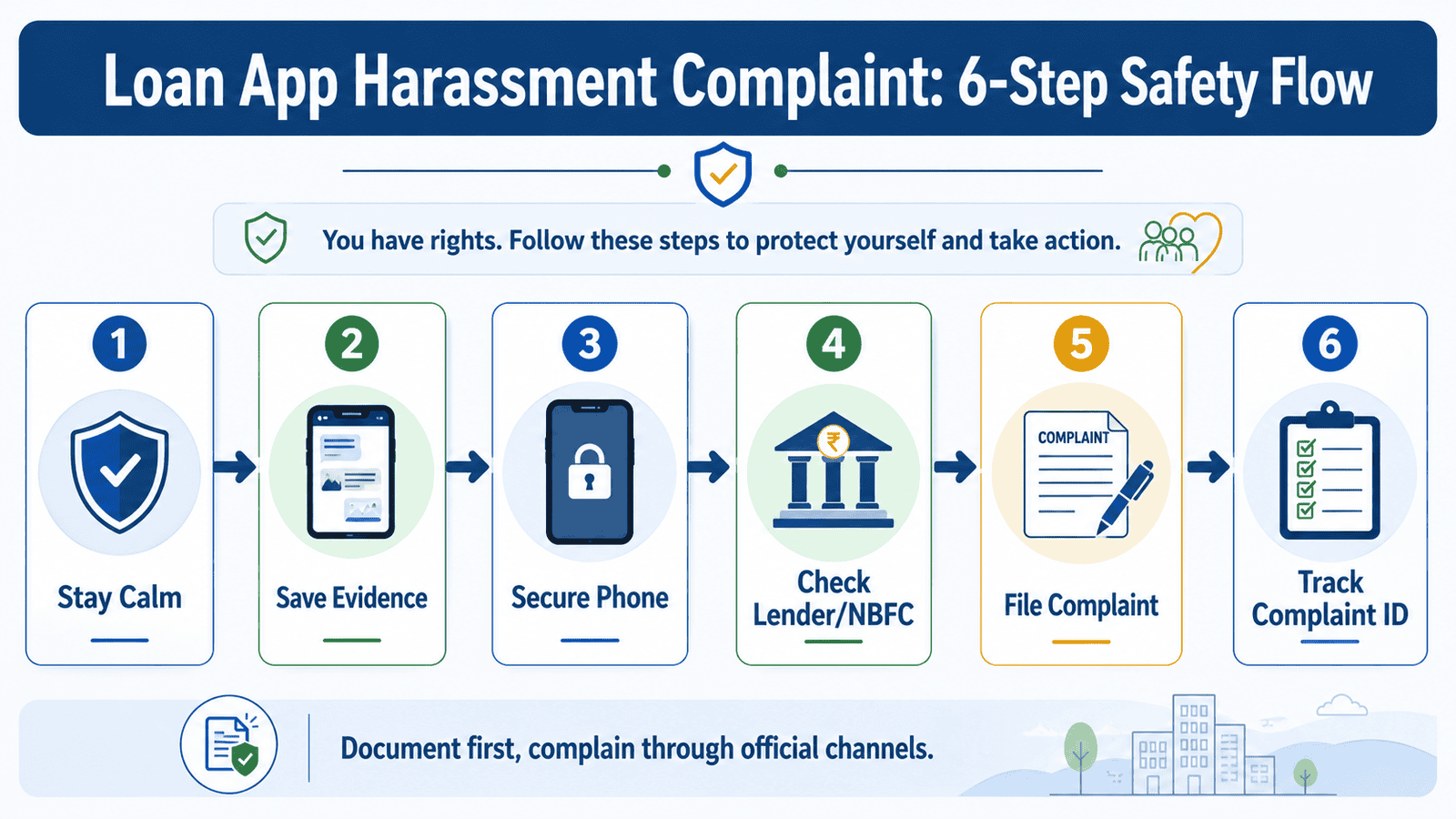
Step-by-Step Loan App Harassment Complaint Process
These six steps are the safest sequence to follow. Do not skip to Step 3 before completing Steps 1 and 2 — the complaint you file is only as strong as the evidence you submit with it.
Step 1 — Save All Proof Before Doing Anything Else
Take screenshots of every threatening message, WhatsApp chat, call log, and notification from the loan app. If your phone allows call recording and it is legally safe to do so in your state, save recordings of abusive calls. Do not delete anything, and do not uninstall the app yet. The evidence you save in the first few hours is the foundation of every complaint that follows.
Step 2 — Find the Actual Lender or NBFC Behind the App
Many loan apps are not lenders themselves. They operate as Loan Service Providers — third-party agents working on behalf of a regulated bank or NBFC. Open your loan agreement or Key Fact Statement (KFS) — the one-page summary every RBI-regulated lender must provide — and find the name of the actual regulated entity. This name determines your complaint route. If you cannot identify any regulated lender, treat the app as potentially unregulated and prioritise the cybercrime complaint route alongside a Sachet report.
Step 3 — File a Complaint with the Lender or NBFC Grievance Officer
Every RBI-regulated bank and NBFC is required to have a Grievance Redressal Officer (GRO). Visit the lender’s official website (not the app), find the grievance or complaint section, and submit a written complaint with your loan account details, the harassment description, and your evidence. Keep a copy of the complaint and note the complaint reference number and the date. This step is required before you can escalate to the RBI Ombudsman.
Step 4 — Escalate to RBI CMS or Ombudsman If Unresolved
If the lender’s grievance officer does not resolve your complaint within the time frame specified by the lender or does not respond at all, you can escalate to the RBI’s Centralised Complaint Management System at cms.rbi.org.in. According to the RBI’s Integrated Ombudsman Scheme, regulated entities are responsible for the conduct of their Loan Service Providers — so abusive recovery behaviour by an LSP is escalatable against the registered lender. The RBI route applies to regulated entities only; if the app is unregulated, move directly to the cybercrime and Sachet route.
Step 5 — File a Cybercrime Complaint for Threats, Data Misuse, or Blackmail
If the harassment involves threats to send morphed images, misuse of your contact list, blackmail, extortion, fake legal notices, or fraud, this is a cybercrime matter in addition to — or instead of — a lender grievance. Visit cybercrime.gov.in, the National Cyber Crime Reporting Portal, and file an online complaint. Save your complaint ID. You can also call the national cybercrime helpline. For WhatsApp loan app threats, preserve the full chat thread before filing.
Step 6 — Approach Local Police for Immediate Danger or Extortion
If you face an immediate physical threat, your personal safety is at risk, or an individual is demanding money through coercion, approach your local police station and file an FIR. Do not wait for the online complaint process in such cases. Bring all saved screenshots, call logs, and written communications with you.
Key Takeaways
- Save screenshots, WhatsApp chats, call logs, your KFS, and repayment receipts before you reply to any threat or uninstall the app — deleted evidence cannot be recovered.
- Your loan app may not be the actual lender. Find the RBI-registered bank or NBFC name in your KFS or loan agreement; this determines which complaint route works for you.
- Do not pay into any personal UPI ID, unknown bank account, or payment link sent by a recovery agent — only pay through the official repayment channel stated in your KFS.
- If recovery agents abuse you, share morphed images, or contact your family or employer, this is a cybercrime matter and should be reported at cybercrime.gov.in alongside your lender grievance.
- The RBI’s Integrated Ombudsman route applies only to regulated entities. If the app appears unregulated, report it on sachet.rbi.org.in and file a cybercrime complaint.
- Genuine dues should still be repaid through official channels — documenting harassment is separate from resolving the underlying loan repayment.
Key Facts at a Glance
| Harassment Type | First Complaint Route | Escalation / Additional Route |
|---|---|---|
| Abusive calls, recovery pressure from regulated lender’s agent | Lender/NBFC Grievance Officer | RBI CMS — cms.rbi.org.in |
| Threatening WhatsApp messages, fake legal notices | Lender grievance + Cybercrime portal | cybercrime.gov.in; local police if serious |
| Contact-list misuse, family/employer threats | Cybercrime portal — cybercrime.gov.in | RBI CMS if regulated lender is involved |
| Morphed images, blackmail, extortion | Cybercrime portal immediately | Local police FIR; lender grievance if regulated |
| Unregulated or suspicious app, no KFS available | Sachet portal — sachet.rbi.org.in | Cybercrime portal; local police |
| Harassment continues after full repayment | Lender grievance with repayment proof | RBI CMS; cybercrime if threats continue |
To check whether the app behind your loan is linked to an RBI-approved lender, check if loan app is RBI approved using the RBI’s registered entity list.
What Is Loan App Harassment — and What Is Not
Digital lending apps have grown rapidly in India. Millions of salaried and self-employed borrowers use them for small, short-tenure loans. But not every loan recovery communication is harassment — and not every loan app is regulated.
A Loan Service Provider (LSP) is a company that partners with a regulated bank or NBFC to disburse and manage loans through an app. The app may carry the LSP’s name, but the actual lender — the entity regulated by the Reserve Bank of India — may be a bank or NBFC you have never heard of. When harassment happens, your complaint rights depend on who the regulated lender is. The Key Fact Statement (KFS) — a summary document that RBI’s digital lending guidelines require every regulated lender to share before disbursement — must carry the regulated entity’s name, the Annual Percentage Rate (APR), and the grievance redressal details.
According to RBI’s guidelines on digital lending (rbi.org.in), regulated entities are responsible for the conduct of their LSPs. That means abusive recovery behaviour by an app-side recovery team is, in principle, attributable to the regulated lender behind it.
What Counts as Harassment
| Recovery Behaviour | Harassment Risk | Evidence to Save |
|---|---|---|
| Abusive or threatening calls, shouting, or intimidation | High — violates RBI Fair Practices Code | Call log, recording if legally permissible |
| Messages threatening to inform employer or family | High — contact shaming is prohibited | Screenshot with timestamp |
| Sending or threatening to send morphed photos | Very high — cybercrime territory | Screenshot; report immediately |
| Fake police notice or court summons via WhatsApp | High — impersonation and fraud | Screenshot; verify with local police |
| Demanding payment to a personal UPI ID or unknown account | Very high — possible fraud or extortion | Payment link screenshot; do not pay |
| Polite reminder calls, SMS about EMI due date | Low — standard recovery communication | Note date and content; no complaint needed |
Legitimate lenders may remind you of dues. That is allowed. What is not allowed is abuse, threats, public shaming, privacy invasion, or any tactic designed to coerce through fear rather than inform through communication. If a loan app is showing warning signs from the start, learning how to identify fake loan apps before applying can prevent this situation entirely.
Real Example: Ravi’s WhatsApp Threat Situation
Ravi, 29, works as a sales executive in Pune and earns ₹38,000 per month. He took a ₹15,000 short-tenure loan through a digital lending app. He missed one EMI because of a medical expense and started receiving abusive WhatsApp messages from an unknown number. The messages threatened to send his photo to his contacts and call his manager. A fake-looking “legal notice” arrived the next day.
Ravi did not reply or uninstall the app. He took screenshots of every message, noted the app name and the number sending threats, and opened his KFS document — which he had saved as a PDF when the loan was disbursed. The KFS named an NBFC registered with the RBI. Ravi noted the NBFC’s grievance email and submitted a complaint with his screenshots, the loan account number, and a short timeline of events. He simultaneously filed a cybercrime complaint at cybercrime.gov.in because the threats involved his photo and contacts.
He received a cybercrime complaint acknowledgement number and kept it with his other complaint records. He continued his genuine EMI repayment through the official channel listed in the KFS — not through any UPI link sent by the threatening number. His key insight: documenting everything before reacting gave him a strong, credible complaint and kept his genuine repayment record clean.
This example is fictional and illustrative. Outcomes vary by case.
Evidence Checklist: What to Save Before Filing a Complaint
| Evidence Type | Why It Matters | How to Save It |
|---|---|---|
| Screenshots of every threat, message, or abusive communication | Primary proof of harassment; dated timestamps are critical | Screenshot and save to secure folder or cloud backup |
| WhatsApp chat thread with recovery agent or unknown number | Shows message content and contact details | Export chat as PDF or take screenshot of full thread |
| Call log showing repeated or unusual call frequency | Demonstrates pattern of harassment | Screenshot call log; note time, date, and duration |
| Key Fact Statement (KFS) or loan agreement | Identifies regulated lender/NBFC and official repayment channel | Save original PDF; if not available, request from app |
| Loan account number and app name with developer details | Needed for all formal complaints | Note from app store listing and loan documents |
| Repayment receipts and bank statements | Proves what was paid, when, and through which channel | Download from bank app or UPI statement |
| Complaint acknowledgement numbers | Tracks escalation history and proves complaint was filed | Screenshot or email confirmation; note date filed |
Comparison: RBI Complaint vs Cybercrime vs Police vs Lender Grievance
| Complaint Channel | Best Suited For | Where to File |
|---|---|---|
| Lender / NBFC Grievance Officer | Unfair recovery practices, disputed outstanding amount, harassment by an agent linked to a regulated lender; required first step before RBI escalation | Lender’s official website grievance section |
| RBI CMS / Ombudsman — cms.rbi.org.in | Regulated bank or NBFC complaint that remains unresolved after lender’s grievance process; digital lending rule violations by a regulated entity | cms.rbi.org.in — file after lender fails to resolve |
| RBI Sachet — sachet.rbi.org.in | Unregulated or suspicious loan app with no identifiable regulated lender; reporting potentially illegal entity activity | sachet.rbi.org.in — online report form |
| National Cyber Crime Portal — cybercrime.gov.in | Online threats, blackmail, morphed images, contact-list misuse, data theft, fake legal notices, or fraud involving digital platform | cybercrime.gov.in — online complaint filing |
| Local Police / FIR | Immediate physical threat, extortion, or personal safety risk that cannot wait for online processes | Nearest police station; bring all saved evidence |
Some cases need more than one route simultaneously. A borrower facing both a regulated lender’s abusive agent and a threat to send morphed images should file a lender grievance and a cybercrime complaint in parallel. For a detailed guide on filing a cybercrime complaint for fraud involving loan apps, refer to the dedicated article.
Building Your Complaint File: Detailed Steps
Step 1 — Create a Complaint Folder
Set up a single folder — on your phone, email, or cloud storage — and save every piece of evidence there. Name files clearly: “Screenshot_Threat_01_Date,” “KFS_LenderName,” “Repayment_Receipt_Date.” Organised evidence makes a stronger complaint and helps the grievance officer or cybercrime team understand the timeline instantly.
Step 2 — Write a Short Complaint Summary
Before you contact anyone, write a plain-language summary of what happened: loan amount, app name, lender/NBFC name, dates of harassment, type of threat, repayment status, and what you are asking the receiving authority to do. Keep it factual and neutral — no emotional language, no accusations you cannot prove. A sample format:
| Date | Event | Proof Available |
|---|---|---|
| DD/MM/YYYY | Received abusive WhatsApp message from +91-XXXXXXXXXX threatening to contact employer | Screenshot saved |
| DD/MM/YYYY | Repayment of ₹X,XXX made via official app channel — reference number XXXXXX | Bank statement, repayment receipt |
| DD/MM/YYYY | Received fake court notice via WhatsApp | Screenshot saved; verified as unofficial with local police |
Step 3 — Submit to Lender/NBFC Grievance Officer
Send your complaint summary and key evidence attachments to the grievance officer email or portal listed on the lender’s official website. If you cannot find the grievance contact, call the lender’s official customer care and ask for the grievance officer’s details in writing. For WhatsApp loan app threats, the WhatsApp screenshot thread is usually the most useful attachment at this stage.
Step 4 — Escalate to RBI or File Cybercrime Complaint
If the lender does not resolve the complaint, escalate to cms.rbi.org.in for regulated lenders. For threats, data misuse, blackmail, or fraud, file a parallel complaint at cybercrime.gov.in. Both can be filed online and both generate acknowledgement numbers — keep these records carefully.
Step 5 — Approach Police If Needed
For extortion, morphed images, or immediate physical danger, visit your local police station with your complaint summary, screenshots, and any complaint reference numbers already filed. An FIR creates an official record that supports your cybercrime complaint if it is already in process.
Safety Checklist: What to Do and What to Avoid
Do This — Avoid This
Do: Save all screenshots and call logs before doing anything else
Evidence disappears when apps are uninstalled or messages are deleted. Secure your proof first, every time.
Do: Pay genuine dues through the official repayment channel only
Your KFS or loan agreement shows the official channel. Do not pay to any UPI ID, personal account, or payment link sent through WhatsApp or SMS by a recovery agent.
Do: Revoke unnecessary app permissions after saving your evidence
Go to your phone’s app settings and remove any permissions — contacts, camera, gallery, microphone — that the loan app should not need for basic loan management. Do this after screenshotting your evidence, not before.
Do not: Reply to threats with abuse or counter-threats
Emotional replies can weaken your complaint and may be used against you. Respond only through official written complaint channels.
Do not: Share OTPs, Aadhaar/PAN scans, or new documents with anyone who contacts you outside official channels
A common fraud pattern is to call the borrower pretending to be a resolution officer and ask for verification documents. No legitimate complaint process requires you to share OTPs.
Do not: Delete the app or chats before saving all evidence
Once the app is deleted and the chat is cleared, your primary evidence is gone. Uninstall only after every screenshot is secured and backed up.
Do not: Post personal loan or threat details publicly on social media
This can complicate your complaint, expose private information further, and may affect any official proceeding.
If the harassment specifically involves your contacts being accessed or threatened, the article on loan app accessed contacts explains how to check which permissions the app holds and how to document that access for a complaint.
How to Decide What’s Right for You
you can identify a regulated bank or NBFC in your KFS — start with the lender’s grievance officer, then escalate to RBI CMS if unresolved.
the app has no KFS, no lender name, and no verifiable NBFC — report it on sachet.rbi.org.in as a suspicious financial entity and file a cybercrime complaint simultaneously.
threats involve morphed images, contact-list shaming, blackmail, or demands for money to an unknown account — file a cybercrime complaint at cybercrime.gov.in as the first step, not the last.
your EMI is genuinely overdue — resolve repayment through the official channel in your KFS while separately documenting and escalating the harassment. These two actions do not cancel each other.
harassment has continued even after full repayment — submit your repayment receipts as proof with a grievance complaint to the lender and escalate to RBI CMS if the lender does not act.
you have saved any screenshots, call logs, or KFS before complaining — do that first. A complaint filed without evidence is harder to act on and harder to follow up. Pause and secure your proof before approaching any authority.
For a full understanding of your rights in this situation, the article on borrower rights against harassment explains what recovery agents can and cannot do under Indian regulations.
Common Mistakes to Avoid
Deleting WhatsApp Chats or Uninstalling the App Immediately
Many borrowers uninstall the app the moment harassment starts — and lose their primary evidence. Screenshots, chat threads, and call logs vanish with the app. Always save proof before you remove the app from your phone.
Paying Money to a Personal UPI ID or Unknown Account
Recovery agents sometimes demand payment to personal numbers or accounts, claiming it will stop the harassment faster. This is not a legitimate repayment channel and may constitute extortion. Any payment you make outside the official channel listed in your KFS will not be properly credited to your loan account and you may lose that money entirely.
Sharing OTPs, Aadhaar Copies, or Screen Access
Fraudulent recovery callers often ask for OTPs, documents, or remote access to your phone, claiming it is needed to “process” a complaint or settlement. No legitimate complaint process asks for this. Sharing it can lead to account fraud, identity misuse, or further financial loss.
Ignoring All Communication Because Harassment Makes You Avoid the App
If you have a genuine outstanding loan balance, ignoring all communication — including official repayment reminders — can worsen your credit report and increase the outstanding amount through interest and penalties. Document harassment and escalate it, but keep track of your genuine repayment obligations through the official KFS channel.
Posting Personal Details or Threats Publicly Online
Sharing screenshots of threats on social media, with full personal and financial details visible, can expose private data further and may complicate any official complaint process. Share evidence only with official complaint authorities.
Sending Abusive or Threatening Replies to Recovery Agents
Even if you are being harassed, abusive replies can be used to discredit your complaint or shift focus away from the recovery agent’s conduct. Respond through official written channels only, using neutral and factual language.
When This May Not Be the Right Choice
An online complaint guide like this one has limits. If you are facing an immediate physical threat, extortion involving large sums, or your personal safety is at risk — do not rely on online portals as your first step. Go to your local police station directly and bring your evidence with you. If you have received a genuine legal notice from a court — not a WhatsApp fake — it may require qualified legal assistance to respond to correctly; a complaint guide cannot substitute for that. If your mental distress from harassment is severe, speak to a trusted family member, colleague, or mental health professional before or alongside the complaint process. And if your outstanding loan dues are genuinely disputed — you believe you owe less than the app is claiming — ask the lender in writing for a full account statement and outstanding breakup before filing a complaint, so your claim is grounded in numbers you can verify. If any of these apply to your situation, it may be worth exploring other options before committing.
Official Rules and Where to Verify
All complaint routes, digital lending protections, and borrower rights mentioned in this article trace back to official regulatory sources. Verify every step through the following:
- RBI (rbi.org.in): The primary source for digital lending guidelines, regulated-entity responsibility, and the Fair Practices Code for lending. RBI’s digital lending framework establishes that regulated entities are accountable for their Loan Service Providers’ conduct.
- RBI CMS / Ombudsman (cms.rbi.org.in): The online escalation route for unresolved complaints against RBI-regulated banks and NBFCs. Use this after the lender’s grievance process has been exhausted.
- RBI Sachet (sachet.rbi.org.in): The portal for reporting suspicious or potentially unregulated financial entities including loan apps that cannot produce a KFS or identifiable regulated lender.
- National Cyber Crime Portal (cybercrime.gov.in): The central government portal for reporting online crimes including threats, blackmail, data misuse, morphed images, extortion, and digital fraud related to loan apps.
- Lender or NBFC official website: The only verified source for the grievance officer’s contact, official repayment channel, loan account details, and KFS. Do not use contact details from WhatsApp, SMS, or third-party sites for payments or complaints.
Credit reporting rules, lender assessment methods, and bureau processes can change. Always verify current details from the relevant bureau, lender, or official regulatory source before acting.
Expert Tips
- Build a one-page complaint chronology before contacting anyone. List each incident with date, time, type of contact, and threat made. Grievance officers and cybercrime officers act faster when a clear, dated timeline is presented — not a paragraph of emotions.
- Use neutral, factual language in every written complaint. State what happened, what was said, and what you are asking for. Avoid phrases like “they are criminals” or “I will sue everyone” — these weaken the factual credibility of your complaint without adding any legal force.
- Attach only the evidence directly relevant to the complaint. Do not send unrelated personal documents, bank statements from years ago, or large photo albums. A short, targeted evidence set is more effective and protects your own privacy in the process.
- Ask the lender in writing for a full outstanding breakup if the claimed amount seems wrong. Every RBI-regulated lender must provide this. If the app’s claimed outstanding differs significantly from your own repayment records, this written statement becomes the evidence base for your dispute complaint.
- Keep a log of every complaint ID and follow-up date. Note the platform, date filed, reference number, and the next expected response date. If the lender’s timeline passes without response, that non-response itself becomes part of your RBI escalation record.
- Check your phone’s permission settings after preserving all evidence. If the app has access to your contacts, gallery, microphone, or location beyond what the loan agreement authorised, revoke those permissions and document the revocation with a screenshot of the before and after settings.
Frequently Asked Questions
What should I do if a loan app is harassing me?
Stay calm and do not react emotionally. Save screenshots of every threat, abusive message, and call log. Find your KFS or loan agreement to identify the regulated lender or NBFC behind the app. Then file a written complaint with the lender’s grievance officer, and use the cybercrime portal for threats, data misuse, or blackmail in parallel. Do not delete the app or its messages before saving your evidence.
Where can I file a loan app harassment complaint in India?
Start with the grievance officer of the bank or NBFC named in your KFS. If unresolved, escalate to cms.rbi.org.in for regulated entities. For online threats, blackmail, data misuse, or fraud, use cybercrime.gov.in. For suspicious unregulated apps, report at sachet.rbi.org.in. For immediate physical danger or extortion, approach your local police station directly.
Can I complain to RBI against a loan app?
Yes, but the RBI CMS route applies specifically to complaints against RBI-regulated banks and NBFCs. If the loan app is the agent of a regulated NBFC, your complaint is filed against the NBFC, not the app itself. If no regulated lender is identifiable, the Sachet portal is the relevant RBI-linked route for reporting suspicious entities.
Should I file a cybercrime complaint for loan app threats?
Yes — if the harassment involves online threats, blackmail, fake legal notices, morphed images, contact-list misuse, or demands for money to unknown accounts, these fall under cybercrime in addition to financial harassment. File at cybercrime.gov.in and save the acknowledgement number. This can run alongside your lender grievance complaint.
What evidence is needed for a loan app harassment complaint?
At a minimum: screenshots of every threatening message with visible timestamps, WhatsApp or SMS thread exports, call logs, your KFS or loan agreement with the lender name, repayment receipts and bank statements, the loan app name and developer details from the app store, and complaint reference numbers from any steps already taken.
Can a loan app contact my family or phone contacts?
No regulated lender or its LSP is permitted to contact people from your phone’s contact list to pressure you into repayment. This is a clear violation of RBI’s digital lending guidelines and, if your phone’s contact data was accessed without proper consent or used to shame or threaten you, it is a cybercrime matter. Document the incident and report it at cybercrime.gov.in alongside a lender grievance.
What if I have already repaid the loan but harassment continues?
Gather your repayment receipts, bank statements, and loan closure confirmation if any. Submit these as proof to the lender’s grievance officer with a formal written complaint asking for an account closure statement and a stop to all recovery communications. If the lender does not respond or resolve this, escalate to the RBI CMS with your repayment proof attached.
What should I do if a loan app threatens me on WhatsApp?
Do not reply, do not delete the message, and do not block the number yet. Screenshot the full chat thread including the sender’s number and timestamp. Then file a cybercrime complaint at cybercrime.gov.in using those screenshots as evidence. Simultaneously, file a complaint with the lender’s grievance officer if you can identify the regulated lender behind the app.
Does having an overdue EMI mean a loan app can legally threaten or abuse me?
No. Even if you have a genuine overdue balance, recovery agents are not permitted to abuse, threaten, contact your employer, misuse your contacts, or use coercive tactics. Genuine dues should be repaid through official channels, but illegal recovery behaviour must be documented and reported regardless of your repayment status.
Final Verdict
If you are facing a loan app harassment complaint situation in India, the single most important thing you can do right now is preserve your evidence before you do anything else. Screenshots, call logs, WhatsApp threads, your KFS, and repayment receipts are the foundation of every complaint channel available to you. From there, the right route depends on who is behind the app and what kind of harassment you are facing: a regulated lender’s abusive agent calls for the grievance officer and RBI CMS path; blackmail, morphed images, or data misuse call for the cybercrime portal immediately; an unidentifiable or suspicious app needs a Sachet report. Genuine dues should still be resolved through the official repayment channel — that process and the harassment complaint process can run at the same time. Use the official sources listed in this article — rbi.org.in, cms.rbi.org.in, sachet.rbi.org.in, and cybercrime.gov.in — to verify every step before you file. Always verify your latest credit report, lender requirements, and bureau process before making a credit-related decision.
This article is for educational purposes only and should not be treated as personalised financial, credit, or legal advice. Credit scores, credit reports, lender eligibility criteria, and bureau processes can vary and may change over time. Please verify current details with the relevant credit bureau, lender, official regulatory source, or a qualified professional before making any credit-related decision.

Arjun writes clear borrower-safety guides on digital loan apps, RBI digital lending rules, KFS, APR, LSPs, loan app harassment, cybercrime complaints, CIBIL impact, and safer borrowing choices. He focuses on helping Indian borrowers understand risks, protect their data, compare lenders carefully, and use official complaint channels when needed.