
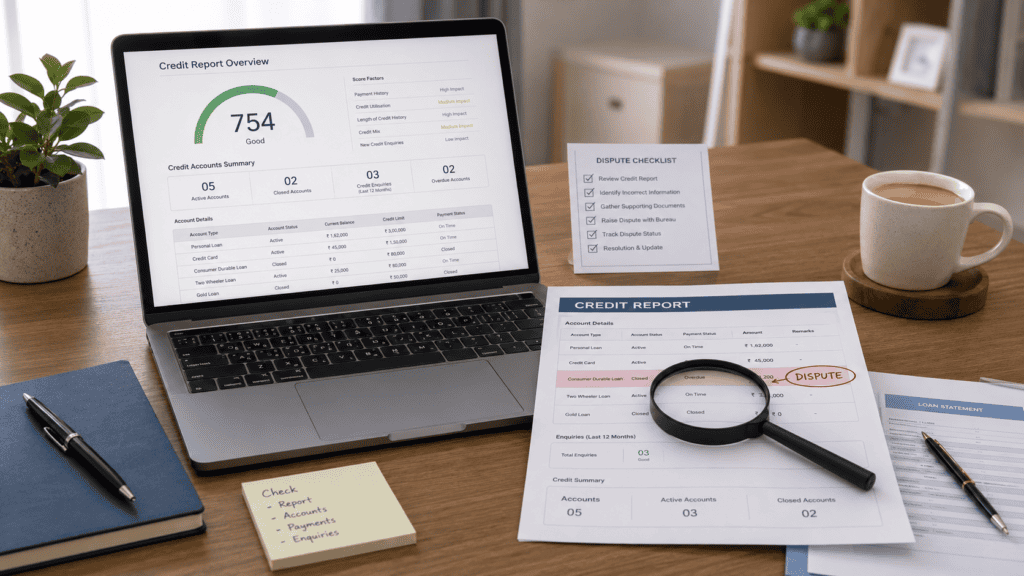
Finding a wrong entry in your credit report is unsettling — especially when you are about to apply for a personal loan, credit card, or home loan. A loan account that shows active after you closed it, an overdue status after you paid the final EMI, a hard inquiry from a lender you never approached, or a DPD entry on an account you settled properly: any of these can affect a lender’s assessment of your credit profile.
The good news is that the credit report dispute process in India is available to every borrower through all four credit bureaus — TransUnion CIBIL, Experian, CRIF High Mark, and Equifax. The process requires the right proof, the right channel, and the patience to follow up. Start by checking your CIBIL score and report from the relevant bureau — not from a screenshot or an old PDF — so you are working with current data before you raise any dispute.
This guide explains what can be disputed, what proof to collect, how to file and track a dispute, and what to do if the correction does not come through.
Quick Answer: Credit Report Dispute Process India
The credit report dispute process India borrowers should follow is: download the latest report, identify the wrong entry, collect proof, raise a dispute with the bureau, follow up with the lender, and track updates. Many disputes may take around 30 days, depending on lender verification — verify current timelines directly on the official bureau website before filing. Disputes must be evidence-backed; the bureau usually confirms data with the lender before making any correction.
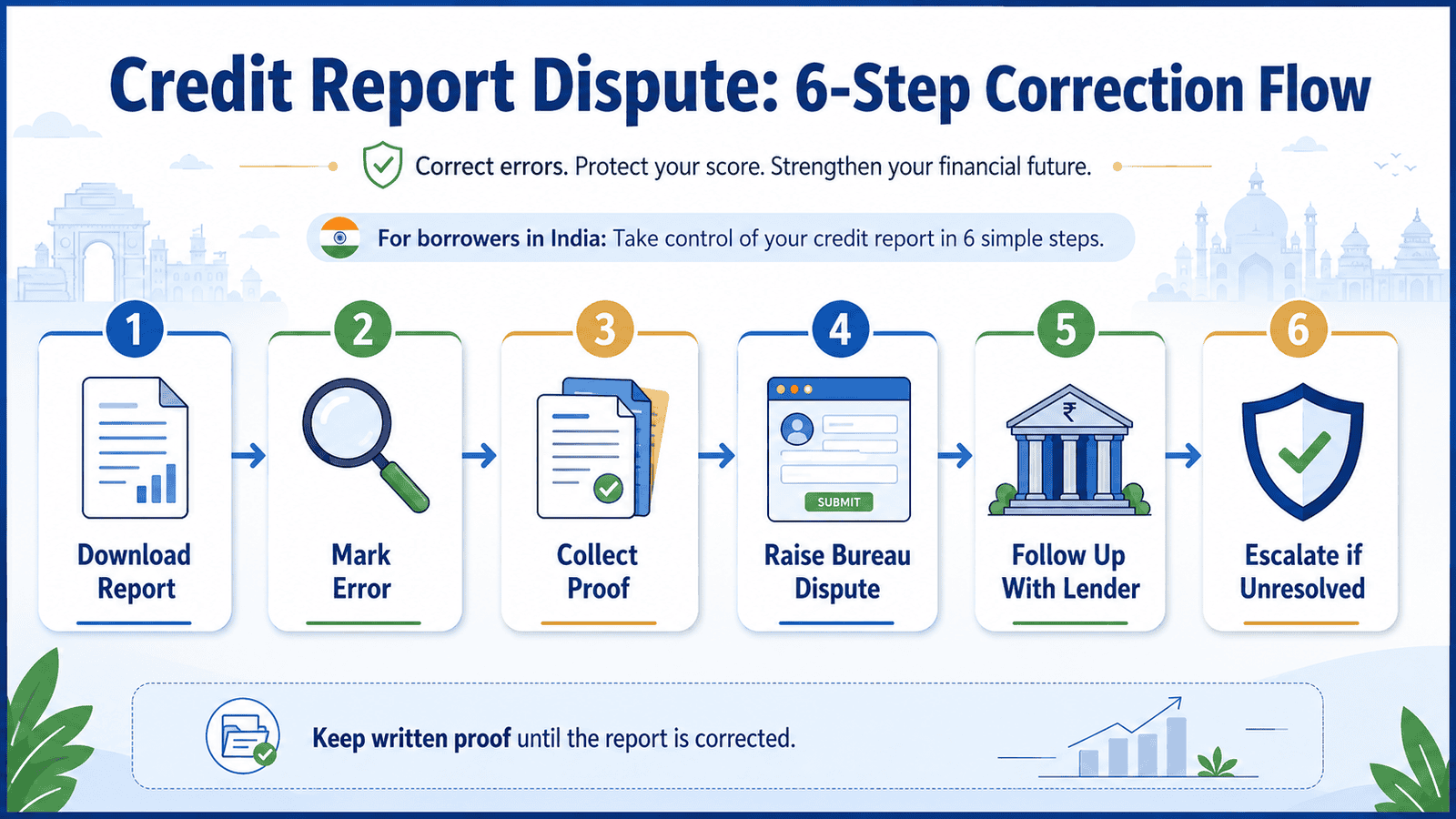
Step-by-Step Complaint and Action Process
Step 1 — Download the Latest Bureau Report
Do not rely on an old PDF or a screenshot from a loan aggregator app. Download a fresh credit report directly from the bureau where the error appears — TransUnion CIBIL (transunioncibil.com), Experian India (experian.in), CRIF High Mark (crifhighmark.com), or Equifax India (equifax.co.in). Note the report date, the control number or dispute reference number if displayed, and the exact account or inquiry that looks wrong.
Step 2 — Identify the Bureau, Account, Lender, Error Type, and Date
Write down: which bureau’s report shows the error, which lender reported the account, what the account number is (masked or full), what type of error it is — wrong status, wrong amount, wrong ownership, closed showing active, overdue after payment, wrong DPD, wrong inquiry — and since when the wrong data has been appearing. Being specific at this stage saves time when you fill the bureau dispute form.
Step 3 — Collect Proof Before Filing
The bureau will verify data with the lender. If your proof does not match what the lender holds on record, the correction may not go through. Collect your NOC or loan closure letter from the lender, payment receipts or bank account statements showing the final EMI, the lender’s official complaint acknowledgement if you already contacted them, and the bureau report itself showing the error. Keep copies in one folder — digital and physical.
Step 4 — Raise the Dispute on the Bureau Website
All four bureaus have an online dispute form. Log in or register on the bureau’s official website using your registered mobile number or PAN. Select the account or inquiry that is wrong, choose the dispute category (wrong status, wrong amount, ownership, personal details, enquiry, and so on), and upload the supporting documents. Note the dispute reference number the bureau assigns — this is your tracking ID. According to TransUnion CIBIL (transunioncibil.com), the bureau routes the dispute to the lender for verification before updating the report.
For readers dealing with a loan account that was never theirs, see the dedicated guide on removing a wrong loan entry from your CIBIL report for the specific steps and proof required.
Step 5 — Contact the Lender’s Grievance Team in Parallel
If the error is lender-reported data — a closed loan still showing active, an overdue after payment, a wrong DPD — write directly to the lender’s grievance redressal officer or customer care. Use email so you have a written trail. Include your loan account number, the specific error, and attach your proof. Ask the lender to update the bureau with the corrected data. This step often speeds up resolution because the bureau’s verification depends on the lender’s response.
Step 6 — Track and Escalate if Unresolved
Check your dispute status online using the reference number. If the bureau closes the dispute without correction, or if the lender does not respond within a reasonable time, escalate to the lender’s head of grievance redressal. If the lender is a bank or regulated NBFC and the issue remains unresolved, you may escalate to the RBI Integrated Ombudsman Scheme through the RBI’s official complaint portal (rbi.org.in) — but only after following the lender’s internal grievance process first.
Key Takeaways
- A wrong credit report entry — wrong loan ownership, closed loan active, overdue after payment, wrong DPD, or wrong hard inquiry — can be disputed directly with the bureau through an online form.
- The reporting lender usually has to confirm the correction before the bureau updates the report; bureau-only disputes may not resolve data that is still being reported incorrectly by the lender.
- Keep your NOC, payment receipts, bank statements, and all complaint emails — without documentary proof, your dispute may be rejected or closed without correction.
- Do not file a dispute for genuine missed EMIs, unpaid dues, or a legitimate settlement or written-off account; disputing accurate negative data is not the correct step and does not remove it.
- Avoid applying for fresh loans or credit cards while an unresolved credit report dispute is open — each new hard inquiry appears on the same report and can further reduce lender confidence.
- Credit scores are calculated using lender-reported data and may vary across bureaus; correcting the error on one bureau’s report does not automatically correct the same entry on another bureau’s report if all four bureaus received wrong data.
- Do not pay any agent, app, or service promising to “fix your CIBIL score” — there is no legitimate paid shortcut; the official dispute process is free at every bureau.
Key Facts at a Glance
| Fact | Detail |
|---|---|
| Who can raise a dispute | Any individual whose credit report contains an error — wrong entry, wrong status, wrong personal details, or wrong inquiry |
| Where to file | On the official website of the bureau whose report shows the error — CIBIL, Experian, CRIF High Mark, or Equifax |
| Cost to file | Free — no payment is needed to raise a dispute with any of the four bureaus |
| Proof required | NOC or loan closure letter, payment receipts, bank statement, lender complaint acknowledgement, bureau report showing the error |
| Expected resolution timeline | Typically around 30 days — verify current timeline directly on the bureau’s official website before filing |
| What the bureau does | Routes the dispute to the lender for verification; updates the report only if the lender confirms the correction |
| Escalation route | Lender’s grievance redressal officer → lender’s head of grievance → RBI Ombudsman Scheme (for regulated lenders, after internal process is exhausted) |
How Credit Report Disputes Work in India
A credit bureau — whether TransUnion CIBIL, Experian, CRIF High Mark, or Equifax — does not generate loan data on its own. Banks, NBFCs, credit card issuers, and other regulated lenders report your account status, payment history, outstanding balance, and loan details to the bureaus every month. The bureaus compile this lender-reported data into your credit report and calculate a score from it.
This means the bureau is the record-keeper, not the source. If a lender has reported wrong data — say, your loan account as “active” after you closed it, or an “overdue” status after you paid the last EMI — the bureau’s report will show that wrong data until the lender sends a correction. You can dispute the entry through the bureau, but the bureau typically needs the lender to confirm the correction before it updates your report.
Score Issue vs Report-Data Issue
Many borrowers confuse a low credit score with a credit report data error. These are different problems with different remedies. A low score without any wrong data is usually caused by repayment behaviour — missed EMIs, high credit utilisation, too many hard inquiries, or a short credit history. Disputing the report will not fix a score caused by actual behaviour. A credit report data error, on the other hand, is a factual inaccuracy: a loan you never took, a payment you made that is showing unpaid, a closure that has not been updated, or a wrong personal detail. Only the second type should trigger a dispute.
Understanding Key Status Labels
Your credit report uses specific account status labels. DPD in CIBIL — Days Past Due — shows how many days a payment was overdue in each reporting month; a “000” means on time, any other number means delayed. “Overdue” shows an outstanding amount past the due date. “Written-off” means the lender has treated the loan as an unrecoverable loss in their books. “Settled” means you paid a negotiated amount less than the full outstanding. “Active” means the account is open; “Closed” means it has been formally closed. Each label has a different impact on a lender’s assessment of your credit profile.
Not every negative label is an error. A genuine written-off account, a real missed EMI, or a legitimate settlement cannot be removed through a dispute. Only incorrect, outdated, duplicate, or unverifiable data is disputable.
Real Example: Amit’s Overdue Entry After Loan Closure
Note: This is a fictional, illustrative example. All figures and outcomes are for educational purposes only and do not represent a guaranteed result.
Amit, 34, a software analyst from Pune, earns around ₹65,000 per month. Six months ago, he paid the final EMI on a personal loan from a private sector bank and received an informal SMS confirmation, but never collected a formal NOC. When he pulled his latest credit report before applying for a home loan, he saw the personal loan account listed as “Active” with an overdue amount of ₹4,200.
Amit contacted the bank’s customer care and learned that a processing fee posted after his final EMI had not been picked up in his closure payment. He paid the outstanding amount, collected the NOC in writing, and also downloaded a bank statement showing the final EMI payment and the fee clearance. He then logged onto the bureau’s official website, raised a dispute under the “account status” category, and uploaded his NOC and bank statement. Simultaneously, he emailed the bank’s grievance redressal email ID with the same documents and a request to update the bureau. He kept both the bureau dispute reference number and the bank’s email complaint number in a single folder.
The bank confirmed the correction to the bureau after approximately three weeks, and Amit’s next credit report showed the account as “Closed” with no overdue. His credit profile was corrected — though by how much his score recovered, and over what timeline, depended on his full credit profile across all bureaus, not just this one entry. See the step-by-step guide on what to do when a closed loan still shows active for the full correction workflow.
Documents and Proof to Keep Ready
Weak or incomplete proof is the most common reason bureau disputes stall or get closed without correction. Before you file, confirm you have the relevant documents from this checklist.
| Dispute Type | Useful Proof | Where to Get It |
|---|---|---|
| Closed loan showing active or overdue | NOC or loan closure letter, final payment receipt, bank statement showing EMI debit | Lender’s branch, customer care email, or net-banking statement |
| Overdue after payment | Payment receipts, bank statement, lender’s written acknowledgement of payment received | Bank statement download, lender payment confirmation email or SMS |
| Wrong DPD entry | Bank statement showing EMI paid on or before due date, lender’s payment record | Net-banking statement, lender’s loan account statement |
| Wrong loan account (not yours) | Bureau report showing the account, identity proof, written denial that the account belongs to you | Bureau report, Aadhaar or PAN copy, complaint letter |
| Wrong hard inquiry | Bureau report showing the inquiry, written statement that you did not apply with that lender | Bureau report, complaint letter to lender |
| Personal detail mismatch (name, PAN, address) | PAN card, Aadhaar, passport or voter ID, proof of current address | Government-issued documents, utility bill for address proof |
Also keep a copy of your bureau report itself — including the control number or report reference number if shown — your dispute submission confirmation screenshot, and all complaint emails to the lender. According to TransUnion CIBIL (transunioncibil.com), having the report control number helps track the dispute through the bureau’s system.
Financial Impact: What a Wrong Entry Can Cost You
Consider an illustrative example: a salaried borrower applies for a ₹5 lakh personal loan from a bank. The lender’s credit assessment pulls the bureau report and finds an overdue entry of ₹8,500 on a loan the borrower believes is closed. The lender may flag this for manual review, ask the borrower to explain the overdue, offer a lower loan amount, quote a higher interest rate to reflect the perceived credit risk, or in some cases decline the application outright until the report is corrected.
Important: This Is Not a Credit Score Prediction
The example above is illustrative. Lender decisions depend on many factors beyond one overdue entry — total FOIR, income, existing EMI obligations, credit utilisation, credit history length, and the lender’s own internal policy. The bureau’s score calculation uses its own model and lender-reported data across all accounts. Correcting one wrong entry may improve your profile, but the exact score change and lender approval outcome cannot be predicted or guaranteed.
Comparison: Credit Report Error Types and the Right Action Path
For borrowers dealing with overdue status after making payment, the action path differs slightly from a completely wrong loan account. Use this table to match your error type to the right first step.
| Error Type | Proof Needed | First Step |
|---|---|---|
| Wrong loan account (not yours) | Identity proof, denial letter | Bureau dispute + lender complaint simultaneously |
| Closed loan still showing active | NOC, closure letter, payment receipt | Bureau dispute + email lender grievance team |
| Overdue or DPD after payment | Bank statement, payment receipt | Bureau dispute + lender written complaint |
| Wrong ownership or co-applicant status | Loan agreement, identity proof | Bureau dispute + lender written clarification |
| Wrong hard inquiry | Bureau report, denial letter to lender | Lender complaint first; bureau dispute if inquiry persists |
| Personal detail mismatch | PAN, Aadhaar, address proof | Bureau dispute with identity documents attached |
What Not to Do During a Credit Report Dispute
Filing a dispute without the latest bureau report
Many borrowers rely on a months-old PDF or an aggregator app’s score summary. The bureau’s dispute form typically requires the control number or report reference from the official bureau report. Without it, your dispute may be incomplete or misdirected.
Contacting only the bureau when the problem is lender-reported data
The bureau cannot correct lender-reported data on its own. If the lender is still reporting the wrong status every month, the bureau’s update will be overwritten at the next reporting cycle. You must also contact the lender and ask them to stop reporting wrong data.
Not saving the dispute reference number
The reference number is the only way to track your dispute. Bureaus may close a dispute after their verification period if you do not follow up. A missed follow-up can mean the dispute is marked resolved without correction.
Paying agents promising to fix your CIBIL score
There is no legitimate paid service that can remove correct negative data from a credit report. If an agent promises to fix your score for a fee, they are likely to take your money and do nothing — or worse, submit fabricated documents that could create legal problems. The official bureau dispute process is free.
Applying for new loans while the dispute is open
Each fresh loan or credit card application triggers a hard inquiry on the same report that is already showing wrong data. Multiple hard inquiries in a short period signal credit-seeking behaviour to lenders and can make the approval problem worse, not better.
Filing disputes for genuine dues or legitimate negative entries
A real missed EMI, a legitimate settlement, or an actual written-off account cannot be removed by disputing it. Bureaus are required to report accurate data as provided by lenders. Filing a false dispute wastes time, delays correction of actual errors, and does not remove genuine negative history.
How to Decide What’s Right for You
the wrong entry on your report is a loan account you never took — raise a dispute with the bureau immediately and simultaneously send a written complaint to the lender named in the report, asking them to confirm that the account is not yours and to correct the bureau data.
the entry is a loan you did take but which has been closed and is still showing active or overdue — contact the lender’s grievance team in writing first to request an update, and file a bureau dispute with your NOC and payment proof at the same time.
the overdue or DPD entry is from a payment you made on time and can prove with a bank statement — bureau dispute plus lender complaint is appropriate, with the bank statement and payment receipt as your primary evidence.
the entry is a wrong hard inquiry from a lender you never approached — write to that lender directly asking for a written explanation and requesting deletion of the inquiry; then raise a bureau dispute if the lender does not respond.
the error involves personal details — name spelling, PAN mismatch, wrong address — raise a bureau dispute with government-issued identity documents; lender contact may be needed only if the mismatch is in a specific account’s records.
you do not have documentary proof of the error — do not file a dispute yet; collect your NOC, bank statement, or lender confirmation first, because a dispute without proof is likely to be closed without correction and may delay your timeline.
the negative entry is genuinely accurate — missed EMIs, unpaid dues, a real settlement or written-off record — the dispute route is not the right remedy; focus on repaying outstanding dues, maintaining on-time payments going forward, and allowing time for the score to recover naturally.
Common Mistakes to Avoid
Using an old report to file a dispute
Credit bureau reports are updated periodically by lenders. If you are using a report from three months ago, the entry may have already changed — or a new wrong entry may have appeared. Always download a fresh report from the bureau’s official website before filing.
Disputing with only one bureau when the error is across multiple bureaus
If the lender has reported wrong data to all four bureaus, correcting it only on CIBIL’s report leaves the same error on Experian, CRIF High Mark, and Equifax. Lenders may pull from any bureau. File disputes with every bureau whose report shows the error — not just the one you checked first.
Not contacting the lender in parallel
If the lender continues reporting the same wrong data every month, a bureau correction from one dispute round may be overwritten at the next reporting cycle. The lender must stop the wrong monthly reporting — and only a direct written complaint to the lender can trigger that.
Expecting instant score recovery after correction
Even after the bureau updates the report, the score calculation uses the new data in the next cycle. The exact score change depends on the rest of your credit profile — credit utilisation, payment history, credit mix, and account age. Do not plan a loan application assuming a specific score recovery in a specific number of days.
Not keeping a written dispute trail
Verbal conversations with customer care do not count as complaints. Email the lender, attach your documents, and keep the sent-mail copy. Save the bureau dispute confirmation screenshot. If you need to escalate, you will need this paper trail to show that you followed the process.
Disputing with the wrong bureau
If the entry causing rejection is in an Experian report but you raised the dispute with CIBIL, the lender pulling the Experian report will see no change. Identify which bureau the rejecting lender actually pulled before filing.
Applying for urgent credit in between
Borrowers under loan-rejection pressure sometimes apply to multiple lenders while a dispute is pending. Each application adds a hard inquiry to the same report. A cluster of hard inquiries signals financial stress to the next lender who checks the report.
When This May Not Be the Right Choice
Filing a credit report dispute may not be the appropriate step in some situations:
Genuine unpaid dues or missed EMIs: If the overdue entry reflects a real missed payment, the dispute process cannot remove it. The correct path is to repay the outstanding amount, maintain on-time payments going forward, and allow your credit profile to improve over time.
Legitimate settlement or written-off record: If you negotiated a settlement or a lender wrote off your loan after prolonged default, this record is accurate. Disputing accurate negative data typically does not result in removal and uses up time that could be spent rebuilding credit behaviour.
Recent lender data not yet reflected: Lenders update bureau data periodically. If you closed a loan or made the final payment very recently, the bureau may not yet have received the updated status from the lender. Allow a full update cycle — verify the current update frequency with the lender or bureau — before filing a dispute.
Score drop from credit utilisation or hard inquiries: If your score has dropped but the report data is factually correct — high utilisation, multiple inquiries, a long repayment history of delays — disputing will not help. The remedy is behavioural: reduce utilisation, stop new applications, and pay on time.
If any of these apply to your situation, it may be worth exploring other options before committing.
Official Rules and Where to Verify
Credit reporting rules, lender assessment methods, and bureau processes can change. Always verify current details from the relevant bureau, lender, or official regulatory source before acting. Do not rely on any third-party site — including this article — for the current form links, timelines, or escalation steps.
- TransUnion CIBIL — transunioncibil.com — Official source for the CIBIL dispute form, control number guidance, and bureau-specific timelines. Verify all current steps here before filing.
- Experian India — experian.in — Official source for the Experian credit information dispute process in India. Form layout and steps may differ from CIBIL’s process.
- CRIF High Mark — crifhighmark.com — Official source for CRIF High Mark dispute resolution. Verify current dispute categories and upload requirements directly on the site.
- Equifax India — equifax.co.in — Official source for Equifax credit report dispute steps. Steps and timelines should be verified before filing.
- RBI — rbi.org.in — Relevant for understanding lender grievance redressal obligations and the RBI Integrated Ombudsman Scheme, where applicable after internal lender escalation is exhausted. See the full guide on the RBI ombudsman complaint process for loan issues for escalation steps.
Credit reporting rules, lender assessment methods, and bureau processes can change. Always verify current details from the relevant bureau, lender, or official regulatory source before acting.
Expert Tips
- Raise one dispute per error per bureau — if the bureau form allows it, separate a wrong DPD entry from a closed loan showing active into two individual disputes with individual reference numbers. Bundling issues into one complaint can make it harder to track resolution of each one separately.
- Upload clean, readable scans only — blurry mobile photos of payment receipts, screenshots with partial data, or documents in a language the bureau cannot verify often trigger a return or rejection. Use a flat, well-lit scan or a PDF from your bank’s net-banking portal.
- Use identical personal details across all complaints — the name, PAN, registered mobile number, and email you use in the bureau dispute form should exactly match the details on your credit report and your lender account. A mismatch in name spelling can delay verification.
- Ask the lender for written correction confirmation — once the lender says they have updated the bureau, ask them to confirm in writing (email) which bureau they updated, on what date, and to what status. This written confirmation is your follow-up evidence if the bureau report does not reflect the change.
- Recheck the report after the next full update cycle — verify the current update period with the bureau, because checking too early may show no change even if the lender has already sent the updated data. Wait for the next scheduled update before concluding that the dispute was unsuccessful.
- Check the same entry on all four bureaus — if your lender was reporting wrong data to CIBIL, it may have sent the same wrong data to Experian, CRIF High Mark, and Equifax. A lender with a systematic reporting error does not usually correct it on only one bureau unless you raise the issue bureau by bureau.
- If the lender’s grievance team does not respond in writing within their stated turnaround time — verify current turnaround requirements from the lender or RBI guidelines — escalate to the next internal tier and document the date of each escalation.
Frequently Asked Questions
Can I dispute a wrong entry in my CIBIL report online?
Yes. TransUnion CIBIL, Experian India, CRIF High Mark, and Equifax India all have online dispute portals on their official websites. You can log in with your PAN and registered mobile number, select the wrong entry, upload proof, and submit the dispute without visiting a branch or office. Verify the current process directly on the bureau’s official website before filing, as form layouts and steps may change.
How long does a credit report dispute take in India?
Many disputes are resolved within around 30 days, but this depends on how quickly the lender responds to the bureau’s verification request. Disputes where the lender is slow to respond, or where proof is incomplete, can take longer. Verify the current timeline directly on the relevant bureau’s official website before filing — the figure may have changed since this article was written.
Will raising a credit report dispute reduce my credit score?
Raising a dispute with a bureau is not itself a credit inquiry and does not trigger a score reduction. The dispute process is administrative — it does not add a hard inquiry to your report. However, the score can only improve after the wrong entry is actually corrected by the bureau, which requires lender confirmation.
Can a credit bureau remove a wrong entry without lender confirmation?
Generally, no. Credit bureaus receive data from lenders and are required to reflect that data. If the lender continues reporting the same wrong data, the bureau cannot permanently override it on the lender’s behalf. In some cases — such as a completely unverifiable inquiry — the bureau may remove an entry if the lender does not respond to verification within the stipulated period, but this depends on each bureau’s current process. Verify directly with the relevant bureau.
What documents are needed for a credit report dispute?
The documents needed depend on the error type. For a closed loan still active: NOC or loan closure letter and bank statement. For overdue after payment: payment receipt and bank statement. For a wrong loan account: identity proof and a written denial. For a DPD error: bank statement showing payment date vs EMI due date. For personal detail mismatch: government-issued identity proof. Always upload clear, readable copies.
What should I do if a closed loan still shows active in my credit report?
Collect your NOC or loan closure letter and the bank statement showing your final payment. Raise a dispute with the bureau whose report shows the active status, under the account status dispute category. Simultaneously, email the lender’s grievance team with the same documents and a clear request to update your account status to “Closed” in the next bureau reporting cycle. Track both reference numbers. See the dedicated guide on what to do if a closed loan still shows active.
Can I dispute a wrong DPD or overdue status after I have paid the EMI?
Yes, if the DPD or overdue entry is factually incorrect — meaning you paid on time and the lender or bureau reflected it incorrectly. Collect your bank statement showing the payment date against the EMI due date, raise a bureau dispute, and also inform the lender in writing. If the DPD reflects a real delay in your payment, even by a few days, the entry may be accurate and may not be removable. The guide on fixing an overdue entry after payment explains both scenarios.
Do I need to pay an agent or service to fix my CIBIL score?
No. The dispute process at all four bureaus is free. No agent, app, or paid service can legally remove accurate negative data from your credit report. Anyone who promises a guaranteed score fix for a fee is either going to do nothing or submit misleading documents on your behalf — both of which waste your money and can make your situation worse. Use the official bureau websites directly.
What if my dispute is rejected by the bureau?
Ask the bureau for a written explanation of the rejection. Usually, rejection means the lender confirmed the data as accurate during verification. In that case, escalate directly to the lender’s grievance redressal officer with your proof, ask for a written response explaining the data discrepancy, and if the lender is a bank or regulated NBFC and the issue remains unresolved, consider the RBI Ombudsman escalation route.
Will correcting a credit report error fix my loan rejection?
Correcting a wrong entry will remove an inaccurate negative data point from your report. Whether that changes a lender’s decision depends on the lender’s internal credit policy, your overall credit profile, income, FOIR, and the other data points the lender assesses. Correction is necessary if the data is wrong, but it does not guarantee approval — verify current lender requirements directly with the lender.
Final Verdict
A wrong entry in your credit report can hold back a personal loan, credit card, or home loan application through no fault of your own. The credit report dispute process India borrowers can use is practical, free, and available through all four bureaus — but it works best when you approach it with clear proof, a written trail, and realistic expectations about timelines.
File the dispute with the bureau whose report shows the error. Contact the lender’s grievance team in parallel whenever the error is lender-reported data. Keep every dispute reference number, every email, and every proof document in one place. If the bureau closes the dispute without correction because the lender did not update the data, escalate to the lender’s senior grievance channel — and if that does not work for a regulated lender, the RBI Ombudsman route may be appropriate.
Do not file a dispute for genuine dues, real missed payments, or a legitimate settlement. Dispute only what is factually wrong and what you can prove is wrong.
Always verify your latest credit report, lender requirements, and bureau process before making a credit-related decision.
This article is for educational purposes only and should not be treated as personalised financial, credit, or legal advice. Credit scores, credit reports, lender eligibility criteria, and bureau processes can vary and may change over time. Please verify current details with the relevant credit bureau, lender, official regulatory source, or a qualified professional before making any credit-related decision.

Neha Menon writes simple, borrower-first explainers on CIBIL scores, credit reports, bureau disputes, DPD, loan settlement impact, hard inquiries, and practical credit score recovery. She focuses on helping Indian borrowers understand lender-reported data, avoid credit mistakes, and take safer next steps without false promises.