
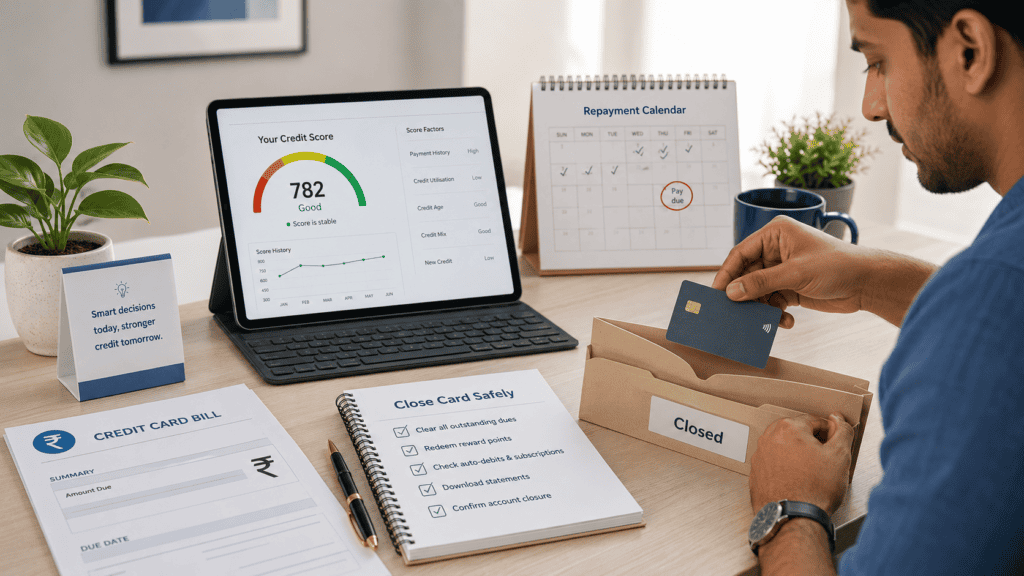
You have a credit card you no longer use — one that charges a fee every year, earns you nothing, and sits in a drawer collecting dust. Closing it seems like the obvious move. But then you read something about CIBIL scores dropping after card cancellation, and now you are not sure. Do you close it, downgrade it, or just keep paying the annual fee to protect your score?
The good news: closing a credit card does not automatically hurt your CIBIL score. The risk is not closure itself — it is doing it carelessly. Unpaid dues, active EMIs, forgotten auto-payments, sudden loss of credit limit, and incorrect bureau reporting are what cause real damage. This article gives you a step-by-step checklist so you can close your card safely, understand how CIBIL is affected, and verify that the closure is reported correctly.
Quick Answer: Can You Close a Credit Card Without Hurting CIBIL?
How to close a credit card without hurting CIBIL: clear all dues, redeem rewards, cancel auto-payments, and check utilisation before sending the closure request. If closure pushes your credit utilisation above 30%, consider paying down balances on remaining cards, requesting a limit increase on another card, or downgrading instead of closing. Always get written confirmation from the issuer and check your CIBIL report after the next bureau update to confirm the account shows as correctly closed.
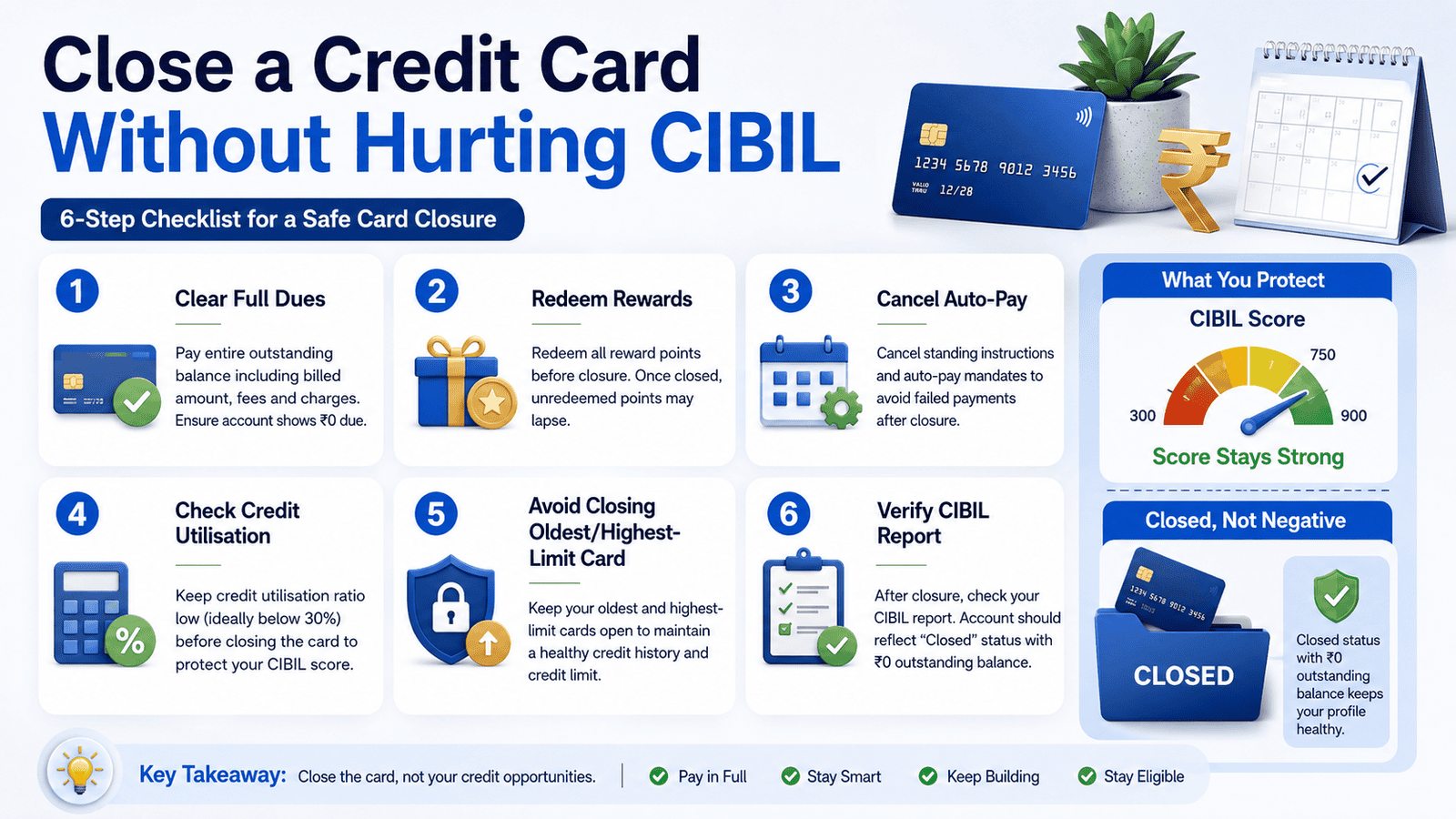
Before Closing Checklist: What to Do First
Before You Raise a Closure Request — Check Every Item Below
- Pay the full outstanding balance — not just the minimum amount due. Any unpaid amount will continue attracting interest and can appear as overdue in your credit report.
- Check for unbilled transactions — purchases made after your last statement date may not appear yet. Wait for the next billing cycle or call the issuer to confirm the full unbilled amount.
- Check for active EMIs or loans on card — if you converted a purchase to an EMI or took a loan on card, the outstanding amount must be cleared or transferred before closure.
- Redeem all reward points, cashback, or airmiles — most issuers expire unused points at closure. Redeem against statement credit, vouchers, or products before requesting cancellation.
- Cancel all subscriptions, UPI autopay, and standing instructions — any merchant auto-debit or recurring payment linked to the card will fail after closure, potentially creating overdue notices or disrupting services.
- Check for pending refunds or chargebacks — if any merchant refund or dispute is unresolved, wait until it is credited before closing the card.
- Download your last statement and save the closure request confirmation — you will need this if the issuer reports the card incorrectly later.
Key Takeaways
- Closing a credit card can raise your credit utilisation ratio if the removed limit is large — on a ₹3,00,000 total limit with ₹60,000 outstanding, closing a ₹1,00,000 card pushes utilisation from 20% to 30%.
- Paying only the minimum amount due before requesting closure is one of the most damaging mistakes — the remaining balance will still attract interest and overdue reporting.
- An older credit card contributes to the average age of your credit accounts — closing your oldest active card can reduce this, so weigh annual fee savings against that consideration.
- Downgrading to a lifetime-free variant of the same card preserves the credit limit and account age without the annual fee — ask the issuer before deciding on full closure.
- Never assume a card is closed because you stopped using it or cut it physically — formal closure requires a request, dues clearance, written confirmation, and credit report verification.
- If the closed card shows as active, overdue, or incorrectly reported in CIBIL after closure, you can dispute it with the lender and then with the bureau.
- Always verify issuer-specific closure rules, reward expiry timelines, annual fee reversal terms, and EMI handling before acting — these vary by lender and can change.
Key Facts at a Glance
| Factor | What Changes After Closure | Risk Level |
|---|---|---|
| Outstanding dues | Any unpaid balance continues attracting interest and overdue reporting | High Risk |
| Credit utilisation ratio | Total available limit falls; utilisation rises if outstanding stays the same | High Risk |
| Average age of credit accounts | Closing an old card can reduce credit history strength | Medium Risk |
| Annual fee or charges | Issuer may charge fee, GST, or interest for the current period — verify before closure | Medium Risk |
| Credit mix | Losing a credit card may reduce credit type variety for thin profiles | Lower Risk |
| Bureau reporting status | Card must show as “Closed” — not “Settled,” “Written Off,” or still active | Medium Risk |
| Active auto-payments or EMIs | Unresolved mandates continue hitting the closed card, creating failed payments | High Risk |
How Closing a Credit Card Can Affect Your CIBIL Score
Your CIBIL score is calculated using several factors — repayment history, credit utilisation, credit history length, credit mix, and recent enquiries. Closing a credit card can touch three of those.
Step 1 — Credit Utilisation Ratio
This is the most immediate and measurable impact. Your credit utilisation ratio is the percentage of your total available credit limit that you are currently using across all cards. When you close a card, that card’s credit limit is removed from the total. If your outstanding balances stay the same, your utilisation percentage rises.
A higher utilisation ratio signals to lenders and bureaus that you are more dependent on credit — and it can pull your score down. Keeping utilisation controlled is one of the most effective things you can do for your credit health.
Step 2 — Average Age of Credit Accounts
Credit bureaus look at how long you have been managing credit. An older account — even an unused one — contributes to your average account age. Closing your oldest credit card removes its history from this calculation over time. For borrowers with a thin credit profile or few active accounts, this can matter more.
That said, TransUnion CIBIL notes that closed accounts can remain visible in your credit report for years, so the impact is often gradual rather than immediate. The risk is higher if the closed card was your oldest active account.
Step 3 — Payment Record
This is actually where the bigger danger lies — not in the act of closure itself. If you close a card with unpaid dues, missed EMI instalments, or unresolved charges, those negative entries stay on your credit report. A missed payment damages your score far more directly than the closure of an account. Similarly, if a merchant auto-debit continues after closure and fails, the resulting overdue can hurt your repayment history.
Step 4 — Bureau Reporting After Closure
After you raise a closure request and the issuer confirms it, they must update your credit report status to “Closed.” If the update is delayed or incorrect — showing the account as still active, as “Settled,” or with an outstanding balance — it can affect how lenders read your profile. This is why verification after closure is not optional.
Real Example: Rohit’s Three-Card Decision
Rohit is 31, works as a software developer in Pune, and earns around ₹85,000 per month. He holds three credit cards:
- Card A — ₹2,00,000 limit, 6 years old, no annual fee, low usage
- Card B — ₹80,000 limit, 3 years old, ₹1,500 annual fee, minimal rewards, almost unused
- Card C — ₹20,000 limit, 1 year old, active rewards card, moderate monthly spend
His total outstanding across all three cards is ₹40,000. His total credit limit is ₹3,00,000. His current utilisation: 13% — well controlled.
He wants to close one card to simplify his finances. If he closes Card B (₹80,000 limit), his total limit drops to ₹2,20,000. With the same ₹40,000 outstanding, utilisation becomes about 18% — still reasonable. He also saves the annual fee. Card B is the logical candidate: newer, paid, low benefit.
If he instead closed Card A (the oldest, highest-limit card), his total limit would fall to ₹1,00,000, pushing utilisation to 40% — a meaningful jump that could affect his CIBIL score. He would also lose his longest-running credit account. The annual fee saving would not justify the trade-off.
The insight: when you have multiple cards, close the newest, lowest-limit, highest-fee, least-useful card first — not the oldest or highest-limit one.
How to Calculate: Before and After Utilisation
Credit Utilisation = Total Outstanding Balance ÷ Total Available Credit Limit × 100
Where: Outstanding = sum of balances across all active cards | Credit Limit = sum of limits across all active cards
| Scenario | Total Credit Limit | Outstanding Balance | Utilisation |
|---|---|---|---|
| Before closing any card (illustrative) | ₹3,00,000 | ₹60,000 | 20% |
| After closing a ₹1,00,000 limit card | ₹2,00,000 | ₹60,000 | 30% |
| After paying down ₹20,000 before closing | ₹2,00,000 | ₹40,000 | 20% |
These are illustrative figures. The key takeaway: if closing a card pushes your utilisation sharply higher, pay down your other card balances first. That way, the total outstanding drops even as the available limit falls — and utilisation stays controlled.
Close vs Downgrade vs Keep: Which Makes Sense?
| Option | Best When | Avoid When |
|---|---|---|
| Close | Card has annual fee, poor benefits, low limit, is relatively new, and no active EMIs or disputes | Card is your oldest account, highest-limit card, or has unresolved dues, refunds, or EMIs |
| Downgrade to lifetime-free variant | Card is old and high-limit but the annual fee is the main problem — ask issuer for a free variant | The card category or network does not offer a lifetime-free alternative |
| Keep and use lightly | Card is no-fee, old, and high-limit — keeping it improves total credit limit and account age with no cost | The card is causing overspending, debt stress, or security concerns |
| Pause and recheck | Upcoming home loan, car loan, or major credit application within 3–6 months — avoid changes to credit profile | There is no valid reason to delay and the card is actively costing money |
Before closing a card purely because of the annual fee, ask the issuer about a fee waiver or downgrade. Many issuers have lifetime-free variants. See how annual fee waiver requests work before taking a closure decision.
Step-by-Step Credit Card Closure Process in India
Step 1 — Confirm Zero Outstanding and Unbilled Balance
Log in to the issuer’s app or net banking and check: current outstanding amount, unbilled transactions, EMI on card, and any loan on card. Call the helpline if you are unsure — ask for the “exact closure balance” as of today.
Step 2 — Redeem Reward Points
Log in to the rewards portal and redeem all accumulated points, cashback, or airmiles. Most issuers will not allow redemption after the account is closed. Check the redemption minimum — some issuers require a minimum point balance to redeem.
Step 3 — Cancel All Mandates and Recurring Payments
Log in to each subscription, UPI autopay, or standing instruction linked to this card and update the payment method to another card or bank account. Common links to check: OTT subscriptions, insurance premiums, mobile or broadband bills, gym memberships, SIP or mutual fund mandates, and utility payments.
Step 4 — Raise the Closure Request Through an Official Channel
Contact the issuer through their official app, net banking, customer care helpline, email, or branch. According to RBI’s guidelines on credit card conduct (rbi.org.in), the issuer is required to act on a closure request — they cannot compel you to keep an account open simply by offering upgrades. Ask for a written acknowledgement, ticket number, or reference ID for the closure request.
Step 5 — Clear the Final Bill
After the closure request, you may receive one final statement covering the closure period. Pay this in full immediately. Do not ignore a final bill — unpaid amounts will continue accruing interest and can appear as overdue in your credit report.
Step 6 — Destroy the Physical Card Safely
Cut the card through the chip and magnetic strip. If it is a contactless card, ensure the contactless antenna area is also cut. Dispose of the pieces separately.
Step 7 — Get Written Closure Confirmation
Ask the issuer for a no-dues certificate or written closure confirmation via email or post. This is your proof that the account is closed with zero outstanding. Store it with your financial documents.
Step 8 — Check Your CIBIL Report After Closure
Wait 30–45 days after the issuer confirms closure, then check your credit report. The account should show as “Closed” with zero outstanding. If it shows as active, settled, written off, or still has a balance, you will need to dispute it. See the credit report dispute process for the exact steps.
Safety Checklist: What Not to Overlook
- Do not assume verbal confirmation is enough — a call centre agent telling you “it’s done” is not the same as a written closure confirmation with a reference number.
- Do not close an add-on card without checking the primary — if the primary card has dues or EMIs, closing the add-on does not resolve those obligations.
- Do not ignore the final statement — even after closure, one more billing cycle may generate interest, annual fee prorations, or GST charges. Check and pay in full.
- Do not stop tracking until the CIBIL report is updated — the lender must report the closure to the bureau. If they do not, it looks like an active account.
- Understand that late payment impact from an auto-payment that continues after closure can be more damaging than the closure itself.
the card charges an annual fee, earns no meaningful rewards, and has a low credit limit relative to your other cards — close it after clearing dues and confirming utilisation stays controlled.
the card is your oldest credit account or highest-limit card — consider downgrading to a lifetime-free variant rather than closing, to preserve credit history and total limit.
closing the card will push your utilisation above 30% — pay down balances on your remaining cards first, or request a limit increase on another card before proceeding.
you have a home loan, car loan, or personal loan application planned within the next few months — delay the closure until after the application is processed.
the card has active EMIs, balance transfers, unresolved disputes, or pending refunds — do not raise a closure request until all of these are fully settled.
the card is costing you money or causing spending problems — keeping a no-fee, unused, high-limit card open can actually help your credit profile. There is no obligation to close a card simply because you are not using it.
Common Mistakes to Avoid
Paying Only the Minimum Due Before Requesting Closure
Paying the minimum amount due clears only a small portion of your balance. The remaining outstanding continues attracting interest — often 30–42% per annum on credit cards — and any unpaid amount will show as overdue in your credit report. Always pay the total outstanding before raising a closure request. Verify with the issuer that the balance is truly zero, including any interest accrued since the last statement date.
Closing the Oldest or Highest-Limit Card Without Checking Impact
Many borrowers close their oldest card assuming it is fine since they do not use it. This is often the worst choice. Losing a high-limit old card can simultaneously raise your utilisation ratio and reduce your credit history strength. If an annual fee is the only reason, ask for a downgrade or fee waiver first.
Forgetting Annual Fee, GST, or Accrued Interest on the Final Bill
Even if your balance looks like zero, the issuer may generate a final bill covering interest from the last billing cycle, an annual fee for the current year, or GST on those charges. Ignoring a final bill creates an unpaid overdue entry on your credit report. Always request the exact zero-balance confirmation from the issuer after your last payment clears.
Not Redeeming Reward Points Before Closure
Most issuers cancel unredeemed reward points when a card is closed. If you have accumulated a significant balance — whether points, cashback, or airmiles — log in to the rewards portal and redeem before raising the closure request. Once the account is closed, these points are typically forfeited with no recourse.
Forgetting Linked Auto-Payments and Subscriptions
A subscription linked to the closed card will either fail — causing service disruption — or in some cases generate a charge attempt that shows as a missed payment. Cancel or update every linked mandate, UPI autopay, and standing instruction before or immediately after the closure request.
Not Checking the CIBIL Report After Closure
Closure confirmation from the issuer does not automatically guarantee correct bureau reporting. The issuer must update your record with the credit bureau. Check your credit report 30–45 days after confirmed closure. If the card still shows active, overdue, or with an outstanding balance, dispute it immediately — first with the lender, then with the bureau.
When This May Not Be the Right Choice
You are about to apply for a major loan. Closing a card within 3–6 months of a home loan, car loan, or personal loan application can raise your utilisation ratio and change your credit profile at the exact moment a lender is reviewing it.
Your credit utilisation is already high. If your existing cards are already near or above their limits, removing one card’s limit makes your profile look even more credit-dependent to lenders and bureaus.
The card is your only or oldest credit account. For borrowers with a thin credit profile — few accounts, short history — losing the oldest account removes a meaningful pillar of credit history.
The card has active EMIs, unresolved disputes, or pending refunds. Forcing closure before these are settled creates accounting gaps that can result in overdue entries or incorrect bureau reporting.
The card is lifetime-free and not causing any problems. If there is no annual fee and you are not overspending on this card, keeping it open preserves your total available credit limit at no cost.
If any of these apply to your situation, it may be worth exploring other options before committing.
Official Rules and Where to Verify
Credit card closure in India is governed by RBI guidelines on credit card conduct, available at rbi.org.in. The RBI’s directions require card issuers to close a card account promptly on request once dues are cleared, without forcing retention offers that delay the process. For grievances that the issuer does not resolve, the RBI Integrated Ombudsman Scheme provides an escalation path — details available at rbi.org.in.
For bureau-specific verification — including how to check your credit report status after closure and how to raise a dispute if the card is incorrectly reported — refer to TransUnion CIBIL at transunioncibil.com. The dispute process, timelines, and credit score education resources are available there directly. For the bureau dispute process step by step, see our guide on closed account reporting in CIBIL.
For issuer-specific closure rules — including reward point expiry, annual fee reversal, final bill timeline, add-on card handling, and EMI settlement on closure — refer to your card’s Most Important Terms and Conditions (MITC) document or contact the issuer directly. SBI Card, for example, publishes closure FAQ details at sbicard.com. Other lenders publish similar documentation on their own domains.
| Checkpoint | Where to Check | What Good Looks Like |
|---|---|---|
| Closure request acknowledged | Issuer app, email, or helpline | Written reference number or email confirmation |
| Final balance at zero | Issuer app or final statement | Zero outstanding, zero interest, no pending charges |
| No-dues certificate | Issuer email or post | Certificate or confirmation letter stating account closed |
| CIBIL account status | TransUnion CIBIL — transunioncibil.com | Account shows as “Closed,” not “Active,” “Settled,” or “Written Off” |
| Outstanding balance in report | TransUnion CIBIL | Zero outstanding, no overdue amount shown |
| Wrong status after closure | First: contact issuer. Then: raise bureau dispute | Status corrected within bureau dispute resolution timeline |
Card fees, interest rates, billing rules, eligibility criteria, rewards, and issuer terms can vary and may change over time. Always verify current terms directly with the card issuer, official regulatory source, or a qualified professional before applying for or using any credit card feature.
Expert Tips
- Pay down other card balances before closing a high-limit card — if closure is going to raise your utilisation, reduce the outstanding on your remaining cards first. Even ₹10,000–₹20,000 of pre-closure payments can keep utilisation controlled.
- Ask for a downgrade before agreeing to close — many issuers have a lifetime-free or low-fee variant of the same card. Downgrading preserves the account age and credit limit without the annual fee cost.
- Avoid closing multiple cards in a short window — if you have three unwanted cards, close them one at a time with several months between closures. Multiple simultaneous limit reductions can spike utilisation rapidly.
- Keep at least one active, well-used credit line — if you close cards and stop using credit altogether, your score can stagnate or weaken due to inactivity. One card used lightly and paid in full each month is better for CIBIL than no card at all.
- Save every document until the CIBIL report is correct — your closure confirmation, no-dues certificate, and final zero-balance statement are evidence. Keep them until your credit report shows “Closed” with correct details.
- Do not check your CIBIL score immediately after closure expecting an instant change — bureaus update periodically, and the lender must first report the status. Give it 30–45 days, then check. To understand whether checking your CIBIL itself affects your score, read the linked guide.
Frequently Asked Questions
Does closing a credit card reduce CIBIL score?
Not automatically. The main risks are a rise in credit utilisation if the closed card had a high limit, and a potential reduction in average account age if it was your oldest card. The bigger CIBIL risk is unpaid dues, missed auto-payments after closure, or incorrect bureau reporting — these damage score more directly than the act of closing an account. If you clear all dues, control utilisation, and verify the bureau status after closure, the impact is typically manageable.
Should I close my oldest credit card?
Generally, closing your oldest credit card carries more risk than closing a newer one. Older accounts contribute to the average age of your credit history, which influences your CIBIL score. If the annual fee is the main problem, ask the issuer for a downgrade to a lifetime-free variant first. Keep the oldest card open if it is free and not causing overspending — an unused but open card still supports your total credit limit and credit history.
Is it better to close or downgrade a credit card?
For cards that are old or high-limit, downgrading is usually worth exploring first. Downgrading to a lifetime-free variant preserves the account age and credit limit while eliminating the annual fee. Closing is better for cards that are newer, lower-limit, have poor rewards, and where the account age or limit impact is minimal. Ask your issuer if a downgrade option exists before deciding on full closure.
Can I close a credit card with outstanding balance?
Most issuers require you to clear the full outstanding — including unbilled transactions, EMIs, interest, and any fees — before they will process a closure request. You cannot formally close the account while a balance remains. Even if the issuer accepts the request, the outstanding amount will continue accruing interest and will show as overdue in your credit report until fully paid.
How long does it take for card closure to reflect in CIBIL?
After the issuer confirms closure, they are required to update your credit bureau record. The actual reflection in your CIBIL report depends on the issuer’s reporting cycle and bureau processing time. As a general guideline, check your credit report 30–45 days after the issuer’s written confirmation. If the account still shows as active after that period, contact the issuer first, then raise a dispute with the bureau if the issue is not resolved.
What happens to reward points after closing a credit card?
In most cases, unredeemed reward points, cashback, or airmiles are forfeited when a card account is closed. The issuer is not obligated to carry over or pay out unused rewards after closure. Redeem all points before raising the closure request — check the issuer’s rewards portal and note any minimum redemption balance. Some issuers may give a short redemption window after closure notice, but this varies and should not be relied upon.
Can a closed credit card show as active in CIBIL?
Yes — this happens if the issuer does not update the bureau correctly or if reporting is delayed. A closed card showing as active, overdue, or with an outstanding balance is an error that can affect how lenders read your profile. If you see this after closure, first send a written request to the issuer to update the bureau with the correct “Closed” status. If the issuer does not resolve it, raise a formal dispute through the credit bureau. See the guide on credit report dispute for step-by-step instructions.
Final Verdict
Closing a credit card is safe if you do it in the right order: clear dues fully, redeem rewards, cancel mandates, check the utilisation impact, get written confirmation, and verify the CIBIL report afterwards. The borrowers who see score damage are usually those who pay only the minimum due, forget auto-payments, or close a high-limit old card without checking the utilisation fallout.
If the card is your oldest account or highest-limit card, seriously consider downgrading to a lifetime-free variant instead of closing — it removes the fee without removing the credit limit or account history. Use the decision framework above to identify which card in your wallet is the right one to let go of first.
Do not close casually, and do not delay indefinitely out of fear. A well-executed closure causes far less CIBIL damage than years of unnecessary annual fees, overspending on an unwanted card, or a missed payment from a forgotten auto-debit.
Always verify the latest fees, interest rates, billing rules, and reward terms from the card issuer before applying or using a credit card feature.
This article is for educational purposes only and should not be treated as personalised financial, credit, or legal advice. Credit card fees, interest rates, billing rules, eligibility criteria, rewards, and issuer terms can vary and may change over time. Please verify current terms directly with the card issuer, official regulatory source, or a qualified professional before applying for or using any credit card feature.

Meera Nair writes practical credit card guides for Indian users, focusing on eligibility, fees, billing cycles, reward value, UPI credit cards, EMI conversion, CIBIL impact, fraud protection, and safer card usage. She explains card decisions in simple language without pushing readers toward risky borrowing.