
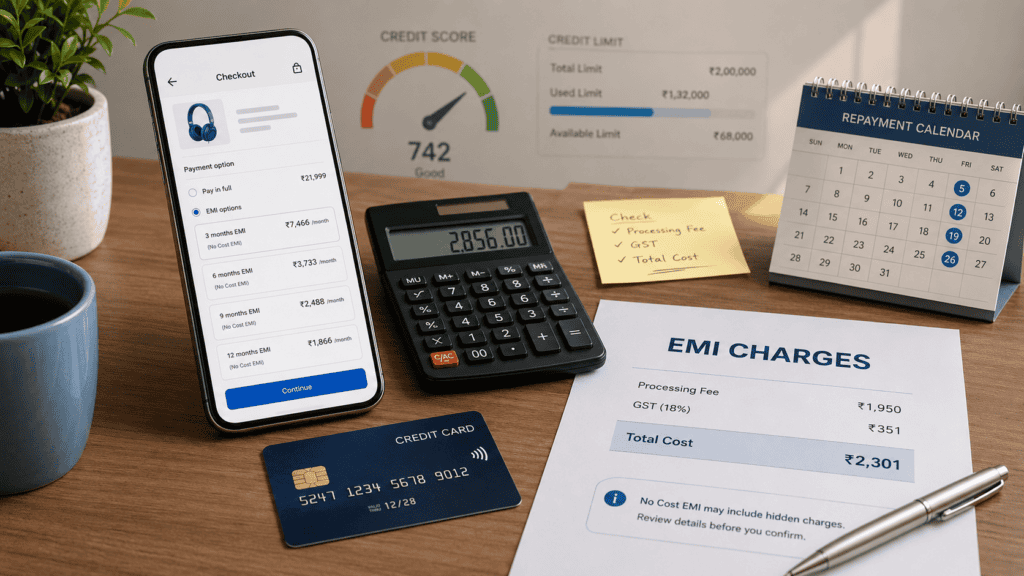
No-cost EMI has quietly become one of the most popular ways to buy a ₹50,000 smartphone, a ₹1.2 lakh laptop, or a ₹80,000 refrigerator in India. The offer sits right at checkout — split into six easy monthly payments, zero interest. It sounds like the bank is doing you a favour. Sometimes it is. But more often, the “zero” comes from somewhere: a merchant discount you did not get, a processing fee added to your bill, GST charged on top, reward points that quietly vanish, and a credit limit blocked for months. Before you tap “Convert to EMI,” this article walks you through exactly what no-cost EMI on credit card costs — in plain rupee terms — and how to decide whether it actually saves you money or silently costs you more.
Quick Answer: Is No-Cost EMI on Credit Card Really Free?
No-cost EMI on credit card means the purchase is split into EMIs, but the cost may be adjusted through merchant discount, processing fee, GST, or reward exclusion. On a ₹50,000 purchase, even a small fee or lost discount can change the real saving, so compare total payment before choosing EMI.
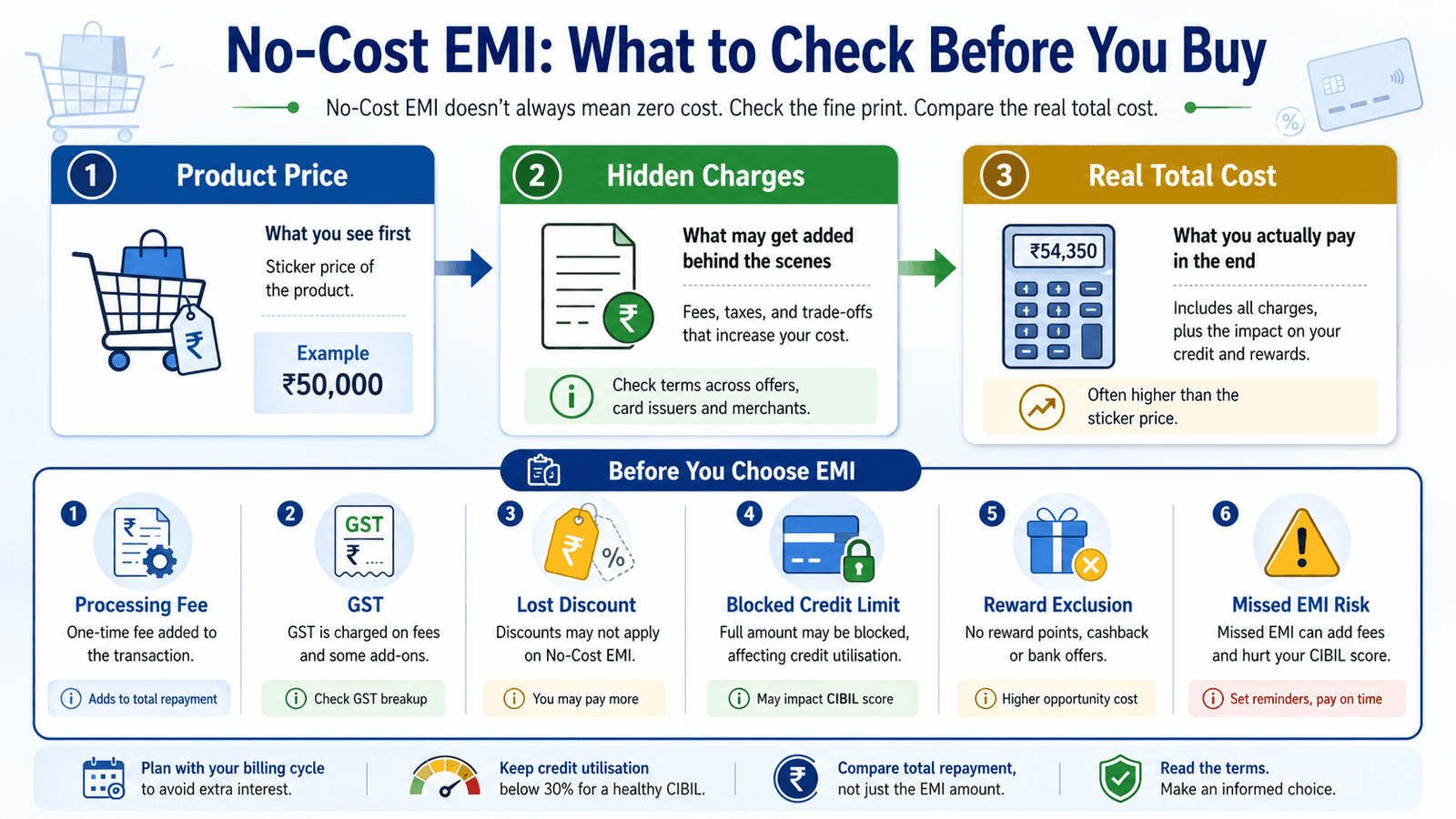
Key Takeaways
- No-cost EMI is not always zero-cost — processing fee (often 1–2% of the purchase amount, illustrative), GST at 18% on that fee, and lost upfront discounts can add up to hundreds or thousands of rupees on a mid-range product.
- Merchants often fund the “zero interest” by adjusting or removing a regular price discount — so the ₹2,000 discount you could have taken may effectively become the hidden interest you are paying.
- Your credit card limit gets blocked for the full purchase amount the moment EMI is created, which can reduce your available spending room for months until the balance is cleared.
- Reward points, cashback, and welcome offers are frequently excluded on EMI transactions — check the bank’s terms before assuming you will earn points on a ₹50,000 purchase.
- Missing even one credit card EMI payment can attract high interest charges and damage your CIBIL score; the EMI does not come with any special late-payment protection compared to regular card dues.
- Cancellations and returns on EMI purchases can be complicated — refunds may take longer, and processing fees already charged are not always returned. Verify the bank’s cancellation policy before buying.
- Always verify current fees, GST treatment, cancellation rules, and reward exclusion terms directly from the bank’s credit card EMI terms page and the merchant’s checkout conditions before confirming any EMI order.
Key Facts at a Glance
| Factor | What It Means | Key Risk |
|---|---|---|
| No-cost EMI definition | Purchase split into monthly instalments with visible interest set to zero | Costs may be hidden in fees or price adjustments |
| Processing fee | One-time charge by the bank for EMI conversion, typically a percentage of the purchase amount (illustrative range: 1–2%) | Adds real rupee cost even if interest is zero |
| GST on processing fee | 18% GST charged on the processing fee, making the effective fee higher | Often overlooked at checkout |
| Merchant discount subsidy | Merchant foregoes a regular discount to fund the zero-interest offer | Buyer misses a cash saving they could have taken upfront |
| Credit limit impact | Full purchase amount is blocked on card limit until EMI is repaid | Reduces available credit for other spending or emergencies |
| Reward/cashback status | Many banks exclude EMI transactions from reward points or cashback programmes | Expected benefit may not arrive |
| CIBIL impact | Timely payments help; missed payments hurt credit score like any card due | Missing an EMI can damage credit history |
| Cancellation and refund | Refunds on EMI orders may be delayed; fees already paid may not be returned | Buyer bears the cost even if item is returned |
Note: Processing fee percentages, minimum transaction amounts, and tenure options vary by bank, card, and merchant. Verify current terms from the bank’s official credit card EMI page before purchase.
How No-Cost EMI on Credit Card Actually Works
When you see “no-cost EMI” at an online or offline checkout, three parties are involved: the merchant, your bank, and you. Understanding how they each play a role is the fastest way to spot where the cost is hiding.
To understand how card EMI works at the bank level, it helps to know that credit card EMI is not a separate product — it is a conversion of your credit card purchase into a structured instalment plan, charged to your existing card limit.
Step 1 — The Merchant Funds the “Zero Interest”
A standard credit card EMI carries an interest rate — often 12–24% per annum on a reducing balance, depending on the bank and card. For a “no-cost” offer, someone has to pay that interest to the bank. In most cases, that someone is the merchant. The merchant pays the bank an interest subvention — essentially a subsidy — so that you see zero interest on the EMI. But the merchant does not absorb this silently. In many cases, the regular discount that the product would have carried is adjusted or removed to offset the subsidy cost. So the “free” EMI is funded by reducing your discount.
Step 2 — Your Bank Converts the Purchase
Once you select EMI at checkout and confirm, your bank converts the purchase amount into monthly instalments. The full purchase amount is deducted from your available credit limit immediately. You now owe the bank that amount, spread over 3, 6, 9, or 12 months depending on the tenure you selected. A processing fee is charged by many banks for this conversion — this is a real out-of-pocket cost. GST at 18% applies to that processing fee. So even with zero interest, you may pay a few hundred rupees in fees on a ₹50,000 purchase.
Step 3 — Credit Utilisation Is Affected
Your credit card’s available limit drops by the full purchase amount the moment EMI is created. On a ₹1 lakh credit limit card, a ₹50,000 EMI means only ₹50,000 of usable limit remains for the entire EMI tenure. High credit utilisation ratio can affect your credit score if utilisation consistently stays above 30% of your total limit. On smaller-limit cards, a single large EMI purchase can push utilisation to uncomfortable levels.
Step 4 — Rewards and Cashback May Be Excluded
Many banks explicitly exclude EMI transactions from their reward points programmes or cashback offers. This is written in the fine print of the offer terms. On a ₹50,000 purchase, losing reward points worth ₹500–₹1,000 (illustrative) is a real opportunity cost that does not show up anywhere at checkout.
Real Example: Rohit’s ₹50,000 Smartphone Decision
Rohit, 31, is a software professional in Pune earning ₹65,000 per month. He wants to buy a ₹50,000 smartphone during a sale. The product page shows two options: a flat ₹2,000 instant discount if he pays in full, or a no-cost EMI over 6 months with a processing fee of ₹749 plus 18% GST — making the fee approximately ₹884 (illustrative — verify from bank’s current terms).
If Rohit pays upfront with the discount: he pays ₹48,000 total. Done.
If Rohit takes no-cost EMI: he pays ₹50,000 in EMIs over 6 months, plus ₹884 in fees. Total payment: approximately ₹50,884 (illustrative). His credit limit of ₹75,000 gets blocked by ₹50,000, leaving him only ₹25,000 of usable limit for 6 months. Reward points on the transaction may not apply.
The “no-cost” EMI effectively costs Rohit approximately ₹2,884 more than the upfront discount option (illustrative). The monthly EMI of about ₹8,333 looked manageable — but the total-cost picture tells a different story. Rohit also needs to track his billing cycle timing carefully, because the first EMI will post on his next statement and must be paid in full by the due date to avoid any late payment interest.
The key insight: monthly EMI affordability and total cost are two different questions. Always check both before confirming.
No-Cost EMI Eligibility: What to Check Before You Select at Checkout
| Eligibility Factor | What to Verify | Where to Check |
|---|---|---|
| Card eligibility | Not all credit cards qualify; debit card no-cost EMI has different rules | Bank’s EMI terms page or checkout eligibility indicator |
| Eligible merchant or platform | Offer is merchant-specific; same bank card may not get EMI on another platform | Merchant checkout or bank’s partner merchant list |
| Minimum purchase amount | Typically a minimum transaction threshold applies (illustrative: ₹3,000–₹10,000; verify at bank) | Bank website or checkout terms |
| Available tenure options | Tenures offered vary by product and merchant — commonly 3, 6, 9, or 12 months (verify) | Checkout screen or bank EMI portal |
| Processing fee applicable | Fee amount, if any, and GST on it — shown at checkout or in bank’s fee schedule | Bank’s credit card fees and charges page |
| Reward/cashback exclusion | Check if EMI purchase earns points or cashback on your specific card and offer | Bank’s reward programme terms for the card |
| Cancellation and return rules | Whether fee is refunded on cancellation, and refund timeline for EMI orders | Merchant return policy and bank’s EMI cancellation terms |
| Foreclosure charges | Whether early closure of EMI attracts a fee (illustrative: some banks charge 1–3% of outstanding amount; verify) | Bank’s credit card EMI terms and conditions |
How to Calculate the Real Cost of No-Cost EMI
The formula is simple and takes about two minutes to apply before any checkout.
Real Cost = Total EMI Paid + Processing Fee + GST on Fee − Benefits Received (discount, cashback, reward value)
Where: Total EMI Paid = monthly EMI × number of months | Processing Fee = bank’s one-time conversion fee | GST = 18% of processing fee | Benefits Received = upfront discount foregone or cashback lost
Worked Example: ₹50,000 Purchase — Pay Full vs No-Cost EMI
| Option | Pay Upfront (with discount) | No-Cost EMI (6 months) |
|---|---|---|
| Product price | ₹50,000 | ₹50,000 |
| Upfront discount | −₹2,000 | Not available (offer excluded) |
| Processing fee | Nil | ₹749 (illustrative — verify) |
| GST on processing fee (18%) | Nil | ₹135 (illustrative) |
| Monthly EMI | Not applicable | ≈ ₹8,333 |
| Total payment | ₹48,000 | ≈ ₹50,884 (illustrative) |
| Extra cost vs upfront | — | ≈ ₹2,884 |
| Credit limit blocked | No | ₹50,000 for 6 months |
| Reward points earned | Usually yes | Often excluded — verify |
All figures above are illustrative. Verify processing fee, GST, and discount terms from the bank and merchant before purchase.
The monthly EMI of ₹8,333 looks comfortable on a ₹65,000 salary. But the total payment of ₹50,884 versus the upfront option of ₹48,000 is a difference of ₹2,884 — the real cost of “zero interest.”
No-Cost EMI vs Regular EMI vs Upfront Discount: Full Comparison
| Payment Option | Interest/Charges | Cash Flow | Credit Limit Impact | Best For |
|---|---|---|---|---|
| Pay upfront with discount | Lowest Cost | Full amount out immediately | No limit blocked after payment clears | When discount saving is large and funds are available |
| No-cost EMI | Low (fee + GST only) | Spread over 3–12 months | Full purchase amount blocked for EMI tenure | When cash flow matters, fee is small, and no better discount exists |
| Regular credit card EMI | Higher Cost | Spread over tenure | Full purchase amount blocked for EMI tenure | When no-cost offer is unavailable and cash flow is the priority |
| Pay full on card (no EMI) | Zero if paid in full on due date | Full amount due in current billing cycle | Frees up after payment | When you can pay in full and want to earn rewards without fee |
For a deeper comparison on when the upfront discount beats the EMI offer, see discount versus EMI — which saves more money.
What to Do If Your EMI Amount, Charge, or Refund Looks Wrong
Step 1 — Save Every Document First
Before contacting anyone, save the merchant invoice, the EMI confirmation message from your bank (usually sent by SMS or email at time of conversion), and the credit card statement showing the EMI charge. Without these, it is difficult to establish what was agreed at checkout.
Step 2 — Identify Whether the Issue Is with the Merchant or the Bank
If the product was not delivered, is defective, or you want to return it — that is a merchant issue. Contact the merchant’s customer service first and request a return or refund as per their return policy. If the EMI amount on your card statement does not match what was shown at checkout, or the processing fee was charged at a different rate — that is a bank issue. Contact the card issuer’s customer care directly.
Step 3 — Escalate Formally If Unresolved
If the bank does not resolve a legitimate dispute within a reasonable timeframe, you can raise a formal grievance through the bank’s official complaint channel. If that does not resolve it, the RBI Integrated Ombudsman Scheme (rbi.org.in) provides an escalation path for unresolved credit card complaints. Do not expect the ombudsman to intervene before you have first exhausted the bank’s own grievance process.
Step 4 — Understand What Happens to an EMI on Cancellation
If a merchant accepts a return and processes a refund on an EMI purchase, the bank typically reverses the outstanding EMI amount. However, the processing fee already charged may or may not be refunded — this varies by bank and by whether the cancellation is merchant-initiated or customer-initiated. Always check the bank’s EMI cancellation terms before placing an order, especially for large-ticket items you might want to return.
No-Cost EMI Safety Checklist Before You Confirm
Repayment Safety: What to Check Before You Tap “Confirm EMI”
| Check | What to Look For | Risk If Skipped |
|---|---|---|
| Total cost vs upfront option | Is fee + GST + lost discount lower than the upfront saving? | Paying more than needed |
| Credit limit after blocking | Will remaining limit cover upcoming expenses and emergencies? | Card declined when needed |
| Monthly EMI vs monthly budget | Can you comfortably pay the EMI inside your regular card bill every month? | Late payment charges and CIBIL damage |
| Due date awareness | When will the first EMI post? Can you pay it by the due date? | Interest on unpaid card balance |
| Reward exclusion | Will you lose cashback or reward points you were expecting? | Lower card value than assumed |
| Cancellation terms | Can the fee be recovered if you return the item? | Paying a fee on something you no longer own |
The strongest warning is on repayment: never plan to pay only the minimum amount due on a credit card that has an active EMI. The minimum amount due on your statement is the bank’s floor — it does not clear your EMI balance. Paying only the minimum due means the remaining outstanding attracts high credit card interest — often 36–42% per annum on a reducing balance (illustrative — verify from card terms). That is how a “zero-interest” EMI becomes very expensive. For details on what a late payment can cost, see late payment impact on credit score and charges.
TransUnion CIBIL and other credit bureaus in India receive repayment data from banks every month. A missed EMI payment is reported as a late payment on your credit card account and can reduce your credit score. Multiple missed payments can significantly affect loan and card eligibility for months or years.
How to Decide What’s Right for You
the no-cost EMI fee plus GST is clearly lower than the upfront cash discount — AND you genuinely need the product now — choosing EMI is financially reasonable, especially if cash flow in the next 3–6 months is a concern.
the upfront discount is equal to or greater than the EMI processing fee plus GST — pay upfront. You will save more money, free your credit limit, and avoid the risk of missed payments.
your current credit card balance is already significant — or the new EMI would push credit utilisation above 30–40% of your total card limit — avoid the EMI. High utilisation can affect your CIBIL score and reduce limit availability in an emergency.
you are uncertain whether you can pay the full card bill each month for the next 3–12 months — do not take the EMI. A missed payment costs far more than any convenience the EMI provides.
the purchase is a large-ticket item above ₹1–2 lakh and you are comparing card EMI with other borrowing — read the comparison on EMI versus personal loan before deciding, as personal loan rates can sometimes be more competitive for very large amounts and longer tenures.
you have verified the processing fee, GST, discount forfeiture, reward exclusion, and cancellation policy from the bank’s current terms — do not confirm the EMI. The checkout screen may not show all costs. Spend two minutes verifying before you tap confirm.
Common Mistakes to Avoid
Mistake 1: Judging No-Cost EMI Only by Monthly EMI Amount
The monthly instalment is the least useful number for a cost comparison. ₹8,333 per month on a ₹50,000 purchase over 6 months sounds easy, but it tells you nothing about the processing fee, lost discount, reward exclusion, or credit limit impact. Always calculate the total payment and compare it with the upfront alternative.
Mistake 2: Ignoring the Processing Fee and GST
A 1.5% processing fee (illustrative) on a ₹50,000 purchase is ₹750, plus ₹135 GST — totalling approximately ₹885. On a ₹1 lakh product, the same rate costs nearly ₹1,770. These amounts are not shown prominently at most checkouts. Check the fee schedule from your bank’s credit card page before selecting EMI (verify current rates at hdfcbank.com or icicibank.com as applicable).
Mistake 3: Assuming the Upfront Price Is the Same as the EMI Price
Merchants often list a higher MRP for EMI buyers and show the discount only on the “buy now” full-payment option. If you compare the EMI option against the full MRP, you miss the ₹2,000–₹5,000 discount you could have taken. Always find the lowest available upfront price first, then compare it with the EMI total including all fees.
Mistake 4: Assuming Rewards and Cashback Will Apply
Many banks explicitly exclude no-cost EMI transactions from reward point accumulation and cashback programmes. The exclusion may apply both to the conversion and to the individual monthly instalment payments. On a ₹50,000 spend, losing reward points worth ₹500–₹1,000 (illustrative) is a cost you did not plan for. Check your card’s reward terms before the purchase.
Mistake 5: Not Reading the Cancellation and Foreclosure Terms
If you return a product or want to pre-close the EMI, charges may apply. A foreclosure fee of 1–3% of the outstanding EMI amount (illustrative — verify from bank) can reduce or eliminate any saving from early repayment. On a refund, the processing fee already charged may not be returned by all banks. Check these terms before placing an EMI order, especially for items like furniture or appliances that you might exchange or return.
Mistake 6: Using No-Cost EMI for Non-Essential Purchases
The ease of a small monthly number can make unnecessary purchases feel affordable. If you would not have bought the product at its full upfront price, the EMI is not making it cheaper — it is making it easier to spend money you do not have. EMI is a cash-flow tool, not a discount.
When This May Not Be the Right Choice
When you cannot comfortably pay the full card bill each month: A no-cost EMI still appears on your credit card statement. If you are already stretching to pay your card dues, adding a large EMI will increase that monthly burden. Missing the payment means high interest charges and a credit score impact that can persist for years.
When the upfront discount is larger than the total EMI cost saving: If a ₹2,000 cash discount is available and the EMI fees total ₹885, paying upfront puts ₹2,000 back in your pocket with zero credit risk.
When the credit limit block will affect important upcoming spending: A ₹50,000 EMI on a ₹75,000-limit card leaves only ₹25,000 for 6 months. If you expect travel, medical, or other large expenses during that period, the blocked limit may leave you exposed. High utilisation can also affect your credit profile — see how credit utilisation ratio affects your score.
When the product is not immediately essential: No-cost EMI is a cash-flow tool, not a reason to buy something you do not need now. If you can save up and buy in 2–3 months, you avoid all fees, keep your credit limit free, and stay in control of your repayment.
If any of these apply to your situation, it may be worth exploring other options before committing.
Official Rules and Where to Verify
No-cost EMI terms, fees, eligibility conditions, GST treatment, cancellation rules, and reward exclusions are set by individual banks and merchants — not a single uniform regulation. Always verify current terms from these sources before confirming any EMI purchase:
- RBI (rbi.org.in): Provides the framework for fair practices, customer transparency, and credit card regulation. Useful context for understanding your rights on billing disputes and grievance escalation.
- HDFC Bank (hdfcbank.com): Verify current EasyEMI terms, processing fee applicable to your card, foreclosure charges, and reward programme exclusions for EMI transactions.
- ICICI Bank (icicibank.com): Verify current EMI conversion terms, processing fee, cancellation policy, and cashback programme applicability for EMI purchases.
- TransUnion CIBIL (transunioncibil.com): Understand how credit card repayment behaviour, including EMI payments, is reported to credit bureaus and affects your credit score.
- Merchant checkout terms: Read the EMI terms displayed at checkout carefully — the processing fee, discount forfeiture, and cancellation conditions are often disclosed there.
Card fees, interest rates, reward rules, and billing terms can change by issuer. Always verify the latest terms from the card issuer and official regulatory sources before applying or converting dues.
Expert Tips
- Screenshot the checkout breakdown before confirming. Capture the screen showing the EMI amount, processing fee, GST, and tenure. This is your primary record if the charge posts incorrectly on your statement.
- Find the lowest upfront price first, then compare. Search for the product on the merchant site after removing EMI filters. The price with the cash or bank discount applied is the number to compare against your total EMI cost including fees.
- Check reward exclusions for your specific card, not just the bank. Banks often apply different reward rules to different card variants. A super-premium card may earn points on EMI while a basic variant does not. Read the card’s reward terms page, not just the bank’s general EMI FAQ.
- Keep EMI below 30% of your card limit if possible. On a ₹1 lakh limit card, a ₹30,000 EMI keeps utilisation around 30%. Going above this consistently can start to affect your credit score in bureau reporting cycles.
- Set a calendar reminder for every EMI due date. Credit card due dates are fixed, but your billing cycle date affects when the first EMI appears on your statement. Know when the first instalment will post and treat it as a fixed monthly commitment, not an optional payment.
- Never treat a foreclosure option as a money-saver without checking the fee. Pre-closing an EMI can make sense if you receive a bonus or windfall, but if the bank charges a foreclosure fee of 1–3% of the outstanding amount (illustrative — verify from bank), the saving may be smaller than expected.
- Avoid stacking multiple large EMIs on the same card at the same time. Each EMI blocks a portion of your limit. Two or three simultaneous EMI purchases can push utilisation above 50–60% and reduce your financial flexibility significantly.
Frequently Asked Questions
Is no-cost EMI on a credit card really free?
Not always. While you pay zero visible interest, the purchase may still cost more through a processing fee, 18% GST on that fee, the loss of an upfront cash discount, or exclusion from reward points. Compare the total amount paid under EMI against the best upfront price before deciding.
What hidden charges are there in credit card no-cost EMI?
The main charges to check are: processing fee (typically a percentage of the purchase amount — verify from the bank’s fee schedule), GST at 18% on the processing fee, loss of an upfront or instant discount offered on the same product, reward point exclusions, and potential foreclosure charges if you want to pre-close the EMI before the tenure ends. Cancellation and return fees may also apply depending on the bank and merchant terms.
Does GST apply on no-cost EMI?
GST at 18% applies to the processing fee charged by the bank for EMI conversion. It does not apply on the product price itself (which carries the applicable GST for that product category). So if the processing fee is ₹749, the GST on it is ₹135, making your total fee cost ₹884 (illustrative — verify current rates from the bank).
Is no-cost EMI better than an upfront discount?
It depends on the numbers. If the upfront discount is ₹2,000 and the no-cost EMI fee plus GST is ₹884, the upfront payment saves you more money. If there is no upfront discount available and your cash flow is tight, no-cost EMI may make more sense. Always calculate the total paid under each option before deciding.
Does no-cost EMI affect my CIBIL score?
The EMI itself does not harm your CIBIL score if you pay on time. However, missed or delayed credit card payments — including EMI instalments — are reported to credit bureaus and can damage your credit history. Additionally, a large EMI blocking a significant portion of your card limit can increase your credit utilisation ratio, which may affect your credit score if it stays elevated over multiple reporting cycles.
Does no-cost EMI block my credit card limit?
Yes. When a purchase is converted to EMI, the full purchase amount is deducted from your available credit limit immediately. On a ₹75,000-limit card with a ₹50,000 EMI, only ₹25,000 of limit remains usable until the EMI is repaid. This can affect other planned purchases or emergency spending capacity for the entire EMI tenure.
Do I get reward points or cashback on no-cost EMI purchases?
This varies by bank, card, and the specific offer. Many banks exclude no-cost EMI transactions from reward point programmes or cashback offers — either entirely or for the EMI portion. Some cards may still earn limited points. Check your specific card’s reward terms and the offer’s fine print before assuming you will earn on the EMI purchase.
What happens if I cancel a no-cost EMI order?
If you cancel before dispatch, the merchant typically initiates a refund. The bank then reverses the EMI. However, the processing fee already charged may or may not be refunded — this depends on the bank’s cancellation policy. For returns after delivery, the timeline for EMI reversal can be longer, and fees may still apply. Always check the bank’s EMI cancellation terms before buying, especially for large items.
Can I pre-close a credit card no-cost EMI early?
Most banks allow early closure of credit card EMI, but may charge a foreclosure fee on the outstanding balance (illustrative range: 1–3% of outstanding amount — verify from the bank’s credit card terms). Calculate whether the interest saving from closing early exceeds the foreclosure fee before pre-paying.
Final Verdict
No-cost EMI on credit card is a genuinely useful tool for managing cash flow on large purchases — but it is not automatically free, and it is never risk-free. On a ₹50,000 smartphone, the processing fee, GST, lost upfront discount, and reward exclusion can collectively cost ₹2,000–₹3,000 more than simply paying upfront when a discount is available. That is not a reason to always avoid EMI — it is a reason to always calculate before you confirm. Use no-cost EMI when cash flow matters more than the fee cost, when no meaningful upfront discount exists, and when you are confident about paying every monthly instalment in full and on time. Avoid it when the discount saving is larger than the total EMI cost, when your credit limit is already stretched, or when you are uncertain about future repayment. Always verify the latest rates and fees from the card issuer and the merchant before confirming any no-cost EMI purchase.
Always verify the latest fees, interest rates, billing rules, and reward terms from the card issuer before applying or using a credit card feature.
This article is for educational purposes only and should not be treated as personalised financial, credit, or legal advice. Credit card fees, interest rates, billing rules, eligibility criteria, rewards, and issuer terms can vary and may change over time. Please verify current terms directly with the card issuer, official regulatory source, or a qualified professional before applying for or using any credit card feature.

Meera Nair writes practical credit card guides for Indian users, focusing on eligibility, fees, billing cycles, reward value, UPI credit cards, EMI conversion, CIBIL impact, fraud protection, and safer card usage. She explains card decisions in simple language without pushing readers toward risky borrowing.