

Every month, your credit card statement shows two numbers that look similar but mean very different things: the total amount due and the minimum amount due. Most Indian cardholders assume that paying the minimum amount due means the bill is handled — that they are safe from charges, safe from their credit score taking a hit, and free to swipe again next month. That assumption is one of the most expensive mistakes in personal finance. The credit card minimum amount due is designed to keep your account active and prevent an immediate late-payment mark — but it does not protect you from interest. Paying only the minimum due, month after month, can quietly turn a manageable credit card bill into a high-interest debt trap that takes years to escape. This article explains exactly what minimum due means, what interest it leaves behind, how it can affect your CIBIL score over time, and what you can actually do if you cannot pay the full amount right now.
Quick Answer: What Is Credit Card Minimum Amount Due?
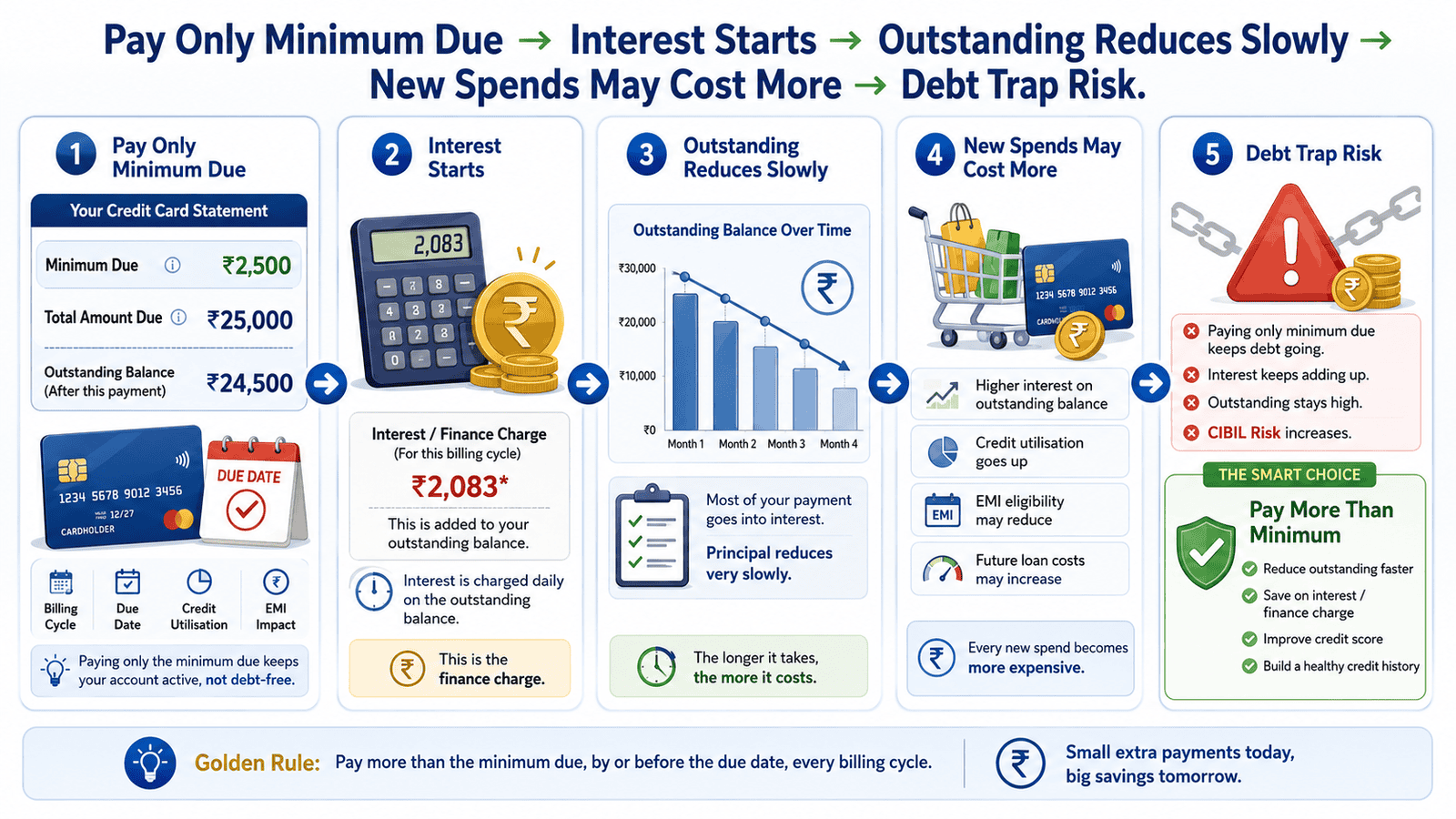
Credit card minimum amount due is the smallest payment needed to avoid being treated as unpaid for that billing cycle, but it does not clear your bill. On a ₹50,000 balance, paying only the minimum can still trigger finance charges on the unpaid amount and increase debt stress. Paying the minimum avoids a late-payment mark for that cycle, but the remaining outstanding balance continues to attract finance charges — meaning your actual debt may grow even while you make regular payments.
Key Takeaways
- The minimum amount due is only the smallest payment your issuer requires to keep your account in good standing for that billing cycle — it does not clear your outstanding balance or stop interest from accruing on the unpaid portion.
- Paying the total amount due before the payment due date is the only way to avoid finance charges on your credit card for that cycle — paying the minimum due is not the same thing as paying your bill.
- Repeating minimum-due payments each month means your outstanding balance reduces very slowly while finance charges can accumulate — this is how a ₹50,000 bill can stay close to ₹50,000 even after several months of payments.
- Missing even the minimum due amount can trigger a late payment fee, the loss of your interest-free period, and a negative mark on your repayment history as reported to credit bureaus such as TransUnion CIBIL — making it harder and more expensive to borrow later.
- High credit utilisation from a persistently large unpaid balance can weaken your credit score over time, even if you are technically paying the minimum on time every cycle.
- If paying the full amount is not possible this month, the safest approach is to pay as much above the minimum as you can manage, immediately stop new spending on the card, and make a plan to clear the balance within a realistic timeline.
Key Facts at a Glance
| Term | What It Means | Risk If You Only Meet This |
|---|---|---|
| Minimum Amount Due | The smallest payment required to avoid a late-payment mark for this billing cycle — typically a percentage of the outstanding balance or a flat minimum, whichever is higher, as per the issuer’s MITC | Finance charges continue on the unpaid balance; interest-free period may be lost for new purchases; debt can grow slowly |
| Total Amount Due | The full amount billed in the current statement, including all transactions, fees, and any carried-over balance from the previous cycle | No interest risk if paid in full on or before the payment due date |
| Outstanding Balance | The total amount you owe on the card at any given moment — may be higher than the statement’s total amount due if new transactions have been made after the statement date | Interest applies on outstanding balance when full payment is not made |
| Statement Date | The date your billing cycle closes and your statement is generated — all transactions before this date appear in the current statement | Transactions after this date appear in the next statement |
| Payment Due Date | The deadline by which at least the minimum amount due must be paid to avoid late fees and a missed-payment mark | Missing this date even by one day can trigger a late payment fee and affect repayment history |
| Finance Charge | The interest charged on unpaid balances after the interest-free period — expressed as a monthly or annualised rate in the card’s MITC; varies by issuer | Applied on the full outstanding amount from the transaction date when the total due is not paid; confirm current rate with your issuer |
| Interest-Free Period | The window between your transaction date and the payment due date during which no interest is charged — only available when the previous month’s total due was paid in full | Lost entirely if any balance was carried over from the previous cycle |
How the Credit Card Minimum Amount Due Actually Works
Step 1 — Where You See It on Your Statement
Every credit card statement in India shows at least three payment-related numbers: the total amount due, the minimum amount due, and the payment due date. The minimum amount due appears prominently — sometimes more prominently than the total — because it is the floor the issuer needs you to pay to keep your account active. It is not a suggestion. It is a contractual requirement, and missing it has immediate consequences.
Step 2 — How Issuers Calculate Minimum Due
Different issuers calculate the minimum amount due differently, and the exact formula is set out in each card’s Most Important Terms and Conditions, commonly called the MITC. A common approach is to charge a percentage of the total outstanding balance — for example, a certain percentage or a flat floor amount, whichever is higher — but this varies. Some issuers also include overdue amounts, EMI instalments, and overlimit amounts in the minimum due calculation. Because the formula is issuer-specific, you must check your own card’s MITC or statement for the exact method used. Do not assume what one issuer does applies to another.
Step 3 — What Remains When You Pay Only the Minimum
If your statement shows a total amount due of ₹50,000 and a minimum amount due of ₹2,500, paying ₹2,500 before the due date will keep your account in good standing for that cycle — meaning no late payment fee and no immediate missed-payment mark. But ₹47,500 remains unpaid. That unpaid portion is called the revolving balance or carried-over balance. It does not sit quietly. Finance charges apply to it, often from the transaction date itself rather than the due date. This is a crucial detail that most cardholders miss.
Step 4 — Why the Billing Cycle and Grace Period Matter
Every credit card operates on a billing cycle explained basis — typically a monthly window during which all transactions are tracked and then summarised in your statement. Within that cycle, you also have a grace period — usually 20 to 50 days after the statement date — during which you can pay the total amount due with no interest. But that card grace period basics only applies when you paid your previous statement’s total due in full. If you carried a balance — even by paying just the minimum — the interest-free benefit disappears for new purchases too. Fresh transactions start attracting finance charges from the date they are made, not from the due date.
Real Example: Rohit’s ₹50,000 Credit Card Bill
Rohit, 29, works as a software tester in Pune and earns ₹55,000 per month. In March, a combination of a medical emergency and end-of-month groceries pushed his credit card outstanding to ₹50,000. His salary arrives on the 5th of the following month, but his card payment is due on the 2nd. He decides to pay only the minimum amount due — illustratively assumed here at ₹2,500, or 5% of the outstanding — to avoid an immediate late-payment mark.
What Rohit does not realise is that ₹47,500 now sits as a revolving balance. His card issuer will apply a finance charge on this amount. When April’s statement arrives, Rohit has also made ₹8,000 in new purchases — groceries, fuel, and a streaming subscription. Because he did not pay March’s total due in full, those new purchases may also be subject to finance charges from the date of each transaction, not just the outstanding. His April bill is now larger than his March bill, even though he made a payment. And if he pays only the minimum again in April, the cycle deepens.
The key insight: paying the minimum amount due does not reset your credit card balance. It only prevents one immediate consequence — the late-payment fee — while leaving the underlying debt to grow.
Credit Card Bill Checklist Before Paying Minimum Due
Five Things to Check on Your Statement Before Deciding to Pay Minimum Due
- Total amount due: This is what you owe for the current cycle. If you can pay this in full, do so. Finance charges will not apply for this cycle.
- Minimum amount due: This is the contractual floor. Pay at least this amount before the due date to avoid a late fee and a missed-payment mark. But treat it as the floor, not the target.
- Payment due date: Mark this date prominently. Even one day late can trigger a late payment fee and affect repayment history reporting. Confirm the current late payment fee with your issuer as it varies and can change.
- Finance charges and GST on those charges: Your statement should show any finance charges applied to a carried-over balance. These are subject to GST. Confirm the current finance charge rate and GST treatment with your issuer or in your MITC, as these can change.
- Old balance carried forward: If any balance was unpaid from a previous cycle, it appears here. New purchases made while an old balance is pending may lose their interest-free status. Check your statement carefully before making new transactions.
How to Calculate the Real Cost of Paying Only Minimum Due
The numbers below are simplified illustrations to show the cost logic. Finance charge rates vary by issuer, card type, and RBI guidelines in effect at the time of billing. Confirm your card’s actual finance charge rate from your MITC or issuer website before using any specific figure for planning.
Finance Charge (illustrative) = Outstanding Balance × Monthly Finance Charge Rate
Where: Outstanding Balance = Total unpaid amount carried forward | Monthly Finance Charge Rate = As per your card’s MITC (confirm with issuer) | GST = Applied on top of the finance charge at the prevailing rate
| Scenario | Pay Full ₹50,000 | Pay Only Minimum (Illustrative ₹2,500) |
|---|---|---|
| Amount paid this month | ₹50,000 | ₹2,500 |
| Balance carried forward | ₹0 | ₹47,500 |
| Finance charge next cycle (illustrative — confirm rate with issuer) | ₹0 | Finance charge applied on ₹47,500 at issuer’s prevailing rate — verify in MITC |
| GST on finance charge | ₹0 | Applied at prevailing rate — confirm with issuer |
| Interest-free period on new purchases | Available in full | Lost — new purchases may attract charges from transaction date |
| CIBIL repayment history | Reported as fully paid | Reported as minimum paid; high utilisation persists |
| Credit utilisation impact | Returns to low | Remains high — can affect credit score over time |
For a deeper breakdown of how finance charges are structured, see how card interest works on IndiLoan.
Repayment Options Compared: What Each Choice Costs You
| Repayment Action | Late Fee Risk | Finance Charge Risk | CIBIL Risk |
|---|---|---|---|
| Pay total amount due in full before due date | None | None | Low — reported as paid |
| Pay more than minimum but less than full amount | None | Moderate — finance charge on remaining balance | Moderate — utilisation stays elevated |
| Pay only the minimum amount due | Avoided for this cycle | High — finance charge on most of the balance | High if repeated — high utilisation, slow balance reduction |
| Pay less than minimum but something | Late fee may apply | High | High — reported as partial/missed payment |
| Pay nothing by due date | Late fee applies | High — finance charge on full balance | High — missed payment mark on credit report |
| Convert to EMI (via issuer) | None if done before due date | Moderate — EMI interest applies; compare total cost | Lower risk if EMIs paid on time |
| Balance transfer to lower-rate card or personal loan | None if executed correctly | Depends on new rate and fees — compare total cost | Moderate — new enquiry; watch utilisation |
What to Do If You Cannot Pay the Full Bill This Month
Being short of cash in a given month does not mean you are in a crisis — but it does mean you need to act deliberately, not passively. Here is a practical action process when paying the full total amount due is not possible:
Step 1 — Pay at least the minimum due before the due date
This prevents a late payment fee and avoids a missed-payment mark being sent to bureaus like TransUnion CIBIL for that cycle. Check your statement for the exact due date and the exact minimum amount. Do not assume. A single missed minimum payment can affect your repayment history, which is one of the most significant factors in your credit score. See how late payment CIBIL impact works for a full breakdown.
Step 2 — Pay as much above the minimum as you can manage
Even an extra ₹1,000 or ₹2,000 above the minimum reduces the balance on which finance charges are calculated. Every rupee above the minimum goes directly toward reducing the principal outstanding, which slows the interest accumulation in the next cycle.
Step 3 — Stop all fresh spending on the card immediately
Using the card for new purchases while a balance is outstanding can extend your repayment timeline and eliminate any chance of recovering the interest-free period. Freeze the card’s use until the balance is manageable or cleared.
Step 4 — Contact the issuer before you default, not after
If repayment difficulty is serious — not just a one-month cash crunch but a sustained income problem — contact your card issuer through their official customer service channel. Some issuers offer EMI conversion options, temporary hardship arrangements, or restructuring. Ask specifically what options are available. Keep records of all communication. According to RBI’s guidelines on customer service and fair practices (rbi.org.in), credit card issuers are expected to follow fair collection and customer grievance practices — so if you are facing harassment or receiving misleading information, you have recourse through the RBI Integrated Ombudsman Scheme.
Step 5 — If charges look wrong, raise a dispute promptly
If your statement shows a transaction, fee, or finance charge you do not recognise or believe is incorrect, raise a formal dispute with the issuer through the written channel — email or registered post — and keep proof. Do not ignore suspicious entries. Unresolved disputes can compound interest if left unaddressed.
Safety Checklist: Do Not Make These Decisions Passively
- Stop fresh spending on the card the moment you decide you will pay only the minimum this month. New transactions while a balance is outstanding mean more interest exposure.
- Pay more than the minimum whenever possible — even ₹500 extra reduces the compounding base and shortens the repayment timeline.
- Avoid credit card cash withdrawals unless there is no alternative. Cash advances typically have no interest-free period from the moment of withdrawal, carry a separate withdrawal fee, and attract finance charges immediately — confirm the exact fee and rate from your issuer’s MITC.
- Do not take a new high-cost personal loan or another credit card simply to pay this one — unless you have compared the full APR, all fees, and total repayment cost, and the new option is clearly cheaper. Debt shifting without cost comparison can worsen the situation.
- Avoid credit card settlement unless you are facing severe financial distress. A settled account is reported to credit bureaus and can damage your credit profile for years, making future borrowing difficult and expensive.
You can pay the total amount due in full before the due date — pay it in full. No finance charges will apply for this cycle, and your interest-free period is restored for new transactions.
You can pay more than the minimum but not the full amount — pay as much as you can above the minimum, stop new card spending, and plan to clear the remaining balance within two to three billing cycles if possible.
You can only pay the minimum this month — pay it on time to prevent a late fee and missed-payment mark, but treat this as an emergency measure. Build a repayment plan immediately and stop new spending.
Your balance is large relative to your income and minimum payments are not reducing it meaningfully — compare EMI conversion through your issuer, a balance transfer to a lower-rate card, or a personal loan. Only switch if the total cost — including fees, interest, and tenure — is lower than continuing on the current card. Use escape card debt as a practical guide.
You have already missed the minimum due payment — do not ignore it. Pay the overdue amount as soon as possible, contact the issuer to understand what late fees and finance charges have been applied, and check your credit report after 30 to 45 days to see whether the missed payment has been reported. You cannot undo a reported missed payment, but consistent on-time payment from this point forward is the most effective long-term repair.
Common Mistakes to Avoid
Treating the Minimum Amount Due as the “Safe” Payment
The most common and costly mistake is assuming that paying the minimum due means your bill is handled for the month. It is not. You have only avoided one consequence — the late payment fee. Finance charges on the unpaid balance continue, and the interest-free period for future purchases is lost until the full outstanding is cleared.
Continuing to Swipe the Card While Old Dues Remain Unpaid
Using the card for new purchases while carrying a revolving balance is one of the fastest ways to deepen the debt trap. Each new transaction may lose its interest-free window because the previous cycle’s total due was not cleared. The result is that both the old balance and the new purchases attract finance charges simultaneously, making the monthly statement grow larger even when you are paying the minimum consistently.
Ignoring the Finance Charge Line on the Statement
Many cardholders scan for the total amount due and the minimum amount due, then skip the rest of the statement. The finance charge line tells you exactly how much interest you are already being charged. If this number is growing month on month while your outstanding balance stays roughly the same, you are in a minimum-payment trap. Reading this line is essential for understanding whether your current payment behaviour is actually reducing your debt.
Paying After the Due Date Because “It’s Just a Day or Two”
Late fees are triggered by the due date, not by how late you are. A payment made one day after the due date can attract the same late payment charge as a payment made a week late. More importantly, missed-payment behaviour may be reported to credit bureaus like TransUnion CIBIL on a monthly basis — a single late payment can show on your credit report and affect your score for up to three years.
Taking a High-Cost New Loan to Pay the Card Without Comparing Costs
In desperation, some cardholders take a new personal loan or use another credit card to make minimum payments on the original card. This can make sense if the new loan’s total cost — interest rate, processing fee, tenure — is genuinely lower than the credit card’s finance charge. But without that comparison, you may simply be moving expensive debt around while adding new fees. Always calculate the total repayment cost before switching.
Assuming Settlement Is a Safe Exit
Credit card settlement — where you negotiate to pay less than the full outstanding amount — is reported to credit bureaus as “settled” rather than “closed.” A settled account signals to future lenders that the full debt was not repaid and can significantly reduce your chances of loan or card approval for several years. Settlement should only be considered in genuine financial distress, with full awareness of the credit impact.
When Paying Only Minimum Due Is Especially Dangerous
There are situations where minimum-due behaviour moves from a short-term coping mechanism to a genuine financial risk. Be especially cautious in these scenarios:
When your unpaid balance is large relative to your monthly income. If your outstanding credit card balance is close to or exceeds your monthly salary, minimum payments alone are unlikely to reduce the principal in any meaningful way before interest compounds further.
When you are already using one card to make payments on another. This is a warning signal that the total debt burden has exceeded what your income can sustain. Using revolving credit to service other revolving credit is not a repayment strategy — it is a delay.
When your card balance is close to your credit limit. High credit utilisation — the ratio of your balance to your total credit limit — is one of the factors that can negatively affect your credit score over time, even if every minimum payment is made on time. Consistently high utilisation signals financial stress to lenders and credit bureaus.
When your repayment plan depends on a future bonus, salary hike, or borrowing from family. Plans dependent on uncertain events can leave you in a deeper minimum-payment cycle if those events do not materialise on time. Build a repayment plan based on your current confirmed income.
If any of these apply to your situation, it may be worth exploring other options before committing.
Official Rules and Where to Verify
Because credit card interest rates, finance charges, minimum due formulas, late payment fees, and GST treatment can change — and because they differ by issuer — there is no single figure in this article that can be relied upon without verification. Before making any repayment decision, confirm the following from official sources:
- RBI (rbi.org.in): The Reserve Bank of India regulates credit card issuance, fair practices, customer grievance redressal, and collection norms. If you believe your issuer is applying charges incorrectly or engaging in unfair practices, the RBI Integrated Ombudsman Scheme is the official escalation channel. RBI also publishes guidelines on credit card interest disclosure and billing transparency that issuers must follow.
- TransUnion CIBIL (transunioncibil.com): Your credit report reflects your repayment history, credit utilisation, and account status as reported by your card issuer. Check your free annual credit report to see how your payment behaviour is being recorded. Dispute any inaccuracies through the bureau’s official dispute process.
- Your card issuer’s MITC and tariff schedule: Every card’s Most Important Terms and Conditions document — available on the issuer’s website and provided at card issuance — contains the exact minimum due formula, finance charge rates, late payment fees, and GST treatment for that card. Refer to your specific card’s MITC, not a generic guide. HDFC Bank cardholders can check hdfcbank.com; SBI Card users can refer to sbicard.com. Other issuers publish their tariff schedules similarly.
- Your monthly statement: The statement itself is a primary source of truth for your actual charges, outstanding balance, minimum due, total due, and payment due date. Read it in full each month, including the finance charge section. For details on the card grace period basics that affect when interest begins, verify the terms in your own MITC.
Credit card fees, interest rates, billing rules, and billing terms can change by issuer. Always verify the latest terms from the card issuer and official regulatory sources before applying or converting dues.
Expert Tips
- Set autopay for at least the minimum due — but pay the total due manually. An autopay for the minimum prevents a missed-payment mark if you forget. But do not rely on autopay alone — manually pay the total amount due before the due date whenever your finances allow. The autopay floor is a safety net, not a repayment strategy.
- Keep your card spending below a firm monthly budget you set in advance. Before the billing cycle opens, decide the maximum you will spend on the card that month — not based on your credit limit, but based on what you can comfortably pay in full at month end. Credit limit is not a spending budget.
- Track your credit utilisation ratio actively. According to TransUnion CIBIL (transunioncibil.com), your credit utilisation — the ratio of your card balance to your total credit limit — is a significant component of credit health. Keeping utilisation below 30% of your limit is generally considered a sound habit; higher utilisation for extended periods can weaken your credit profile even when you are paying on time.
- If you have dues on multiple cards, use a structured repayment method. The debt avalanche method — paying off the highest-interest balance first while making minimum payments on others — typically minimises total interest cost. The debt snowball method — clearing the smallest balance first — can provide psychological momentum. Compare both approaches using debt repayment methods to choose what fits your situation.
- Review your complete statement every single month — not just the minimum due and due date. Checking your statement in full takes under five minutes and can surface billing errors, unauthorised transactions, and growing finance charges before they compound. Most issuers allow you to dispute transactions within a limited window, so catching problems early matters.
- Never assume one issuer’s terms apply to another. Minimum due formulas, finance charge rates, late payment fees, and GST treatment differ by issuer and can change with regulatory updates. If you switch cards or hold multiple cards, check the MITC of each one separately.
Frequently Asked Questions
What is minimum amount due in a credit card?
The minimum amount due is the smallest payment your card issuer requires you to make by the payment due date to keep your account active and avoid a late payment fee for that billing cycle. It is typically a percentage of your total outstanding balance or a flat floor amount — whichever is higher — as defined in your card’s MITC. Paying only this amount does not clear your full bill and does not stop finance charges from applying to the unpaid balance. Check your specific card’s MITC for the exact formula your issuer uses.
Is it okay to pay only the minimum amount due?
Paying only the minimum due can help in a genuine one-time cash crunch because it prevents a late payment fee and avoids an immediate missed-payment mark. But it is not okay as a regular habit. The unpaid balance attracts finance charges each cycle, and the interest-free period on new purchases disappears. Over several months, a ₹50,000 balance paid at only the minimum can remain close to ₹50,000 while your cumulative payments add up. Treat minimum payment as a floor, not a target.
Will paying minimum due affect my CIBIL score?
Paying the minimum due on time means your account is not reported as a missed payment for that cycle. However, your CIBIL score can still be affected in other ways: high credit utilisation from a persistently large outstanding balance can weaken your credit profile over time, and repeated minimum payments signal financial stress to lenders who review your detailed repayment history. TransUnion CIBIL (transunioncibil.com) and other bureaus reflect your full repayment pattern, not just whether you crossed the minimum threshold.
Do new purchases get the interest-free period if I paid only the minimum due last month?
Generally, no. The interest-free period — the window between your transaction date and the payment due date during which no finance charge applies — is typically available only when you paid the previous billing cycle’s total amount due in full. If you carried a balance by paying only the minimum, new purchases may attract finance charges from the date of each transaction, not from the due date. Verify this condition in your specific card’s MITC, as the exact terms are issuer-specific.
What happens if I pay less than the minimum amount due?
If you pay less than the minimum amount due before the due date, your issuer will typically treat the payment as a partial payment. A late payment fee may be applied, your interest-free period is lost, and the shortfall may be reported to credit bureaus as a missed or partial payment. Even a payment that is ₹100 short of the minimum due can trigger these consequences. Always confirm the exact minimum from your current statement and pay at least that amount before the due date.
Should I convert my credit card bill into EMI if I cannot pay in full?
EMI conversion through your card issuer can be useful if it locks in a lower effective interest rate than the revolving finance charge and provides a structured repayment timeline. But it is not automatically cheaper — you must compare the EMI interest rate, processing fee, and total repayment cost against your card’s finance charge rate. Some issuers also cancel the interest-free period on converted balances. Ask your issuer for the full cost disclosure before converting. EMI conversion is one option among several — it is not always the cheapest or fastest path out of debt.
Can I use a balance transfer to a lower-rate card to escape the minimum payment trap?
A balance transfer to a card with a lower finance charge rate can reduce the interest cost on the outstanding balance — but only if the total cost, including the balance transfer fee and any promotional period terms, is genuinely lower than continuing on the existing card. Balance transfer offers often carry limited-period low rates that revert to standard rates after a few months. Read all terms carefully, avoid making new purchases on the transfer card, and have a plan to clear the transferred balance before any promotional period ends.
What is MITC and why does it matter for minimum due?
MITC stands for Most Important Terms and Conditions — a document every card issuer is required to provide to cardholders. It contains the exact formula used to calculate the minimum amount due, the current finance charge rate, late payment fees, cash advance fees, GST treatment, and other key card terms. Because these vary by issuer and can change over time, your card’s MITC is the most reliable single source for understanding what your card actually costs. Download or request yours from your issuer’s official website or customer service.
Final Verdict
The credit card minimum amount due solves exactly one problem: it prevents a late payment fee and an immediate missed-payment mark for the current billing cycle. It does not solve your debt. It does not stop finance charges. It does not restore your interest-free period. If you rely on minimum payments as a regular habit, the unpaid balance grows through finance charges even while you are making monthly payments — a slow-motion debt trap that can take years to escape once it gains momentum.
If paying the full total amount due is not possible this month, pay as much above the minimum as you can, freeze new card spending immediately, and build a concrete repayment plan based on your current income. If the balance is large, compare your options — EMI conversion, balance transfer, or a lower-cost personal loan — carefully and completely, with total cost as the deciding factor, not the monthly instalment alone. Always verify the latest fees, interest rates, billing rules, and reward terms from the card issuer before applying or using a credit card feature.
This article is for educational purposes only and should not be treated as personalised financial, credit, or legal advice. Credit card fees, interest rates, billing rules, eligibility criteria, rewards, and issuer terms can vary and may change over time. Please verify current terms directly with the card issuer, official regulatory source, or a qualified professional before applying for or using any credit card feature.

Meera Nair writes practical credit card guides for Indian users, focusing on eligibility, fees, billing cycles, reward value, UPI credit cards, EMI conversion, CIBIL impact, fraud protection, and safer card usage. She explains card decisions in simple language without pushing readers toward risky borrowing.