

You’re paying ₹18,000 a month on your car loan and another lender is promising ₹15,500 — same car, lower EMI, sounds straightforward. But before you fill out that transfer application, there’s a calculation most borrowers never do: will the actual savings after all charges be positive, or will you end up paying more over the full loan life? A car loan balance transfer moves your outstanding loan from your current lender to a new bank or NBFC at a different — usually lower — interest rate. That part is simple. What borrowers often miss is the foreclosure charge on the old loan, the processing fee on the new one, vehicle valuation costs, documentation charges, and the risk of accepting a longer tenure that reduces your EMI while quietly increasing your total interest outgo. This guide gives you a complete cost-comparison framework — with real rupee examples, a charges checklist, CIBIL impact explained, and a clear decision test — so you can calculate whether a car loan balance transfer is actually worth it before you apply.
Quick Answer: Is a Car Loan Balance Transfer Worth It?
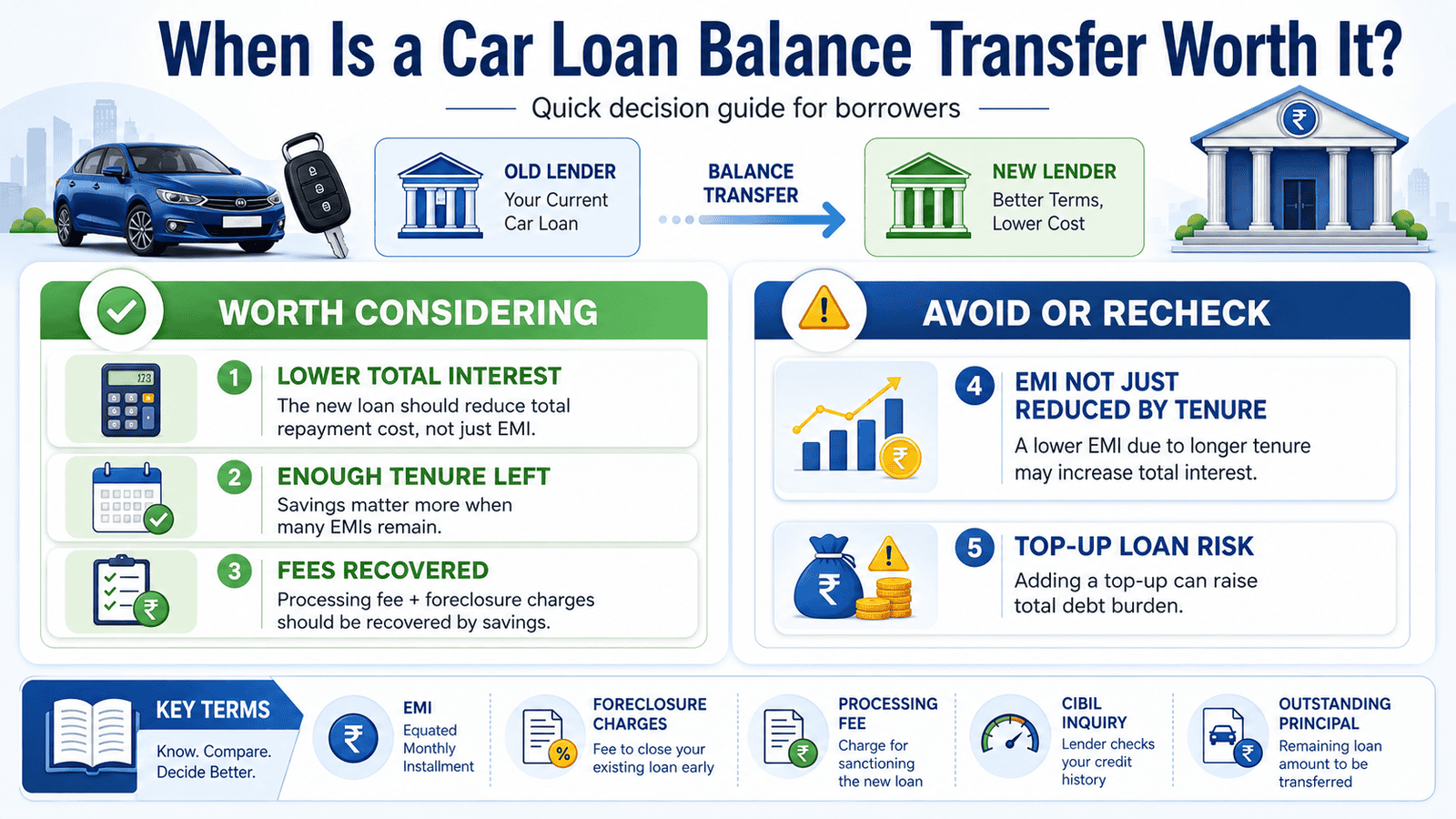
A car loan balance transfer is worth it only when the interest saving is higher than foreclosure, processing, valuation, documentation, and hypothecation-related costs. For example, on a ₹5 lakh outstanding loan, compare total interest saved, not just lower EMI. It may not help if only a few EMIs are left or tenure is extended.
Key Takeaways
- A car loan balance transfer saves money only when the total interest reduction is greater than all transfer-related charges — foreclosure, processing, valuation, and documentation combined. On a ₹5 lakh outstanding loan at 12%, even a 2.5% rate cut can save roughly ₹37,000 over 3 years before charges, so the maths must include every fee.
- Your EMI can fall for two very different reasons: a genuinely lower interest rate, or a longer repayment tenure. If the new lender extends your tenure from 3 years to 5 years, your EMI drops but your total interest paid will likely increase — confirm which is happening before accepting any offer.
- Foreclosure or prepayment charges on your existing car loan can range from 0% to around 5% of the outstanding principal, depending on the lender and loan agreement. On a ₹5 lakh balance, even a 2% charge equals ₹10,000 — a significant chunk of any potential saving.
- Every new car loan application triggers a hard inquiry on your credit report. A single inquiry has a small and temporary impact on your credit score, but applying to several lenders simultaneously can pull your score down more noticeably — space out your applications.
- A top-up loan offered alongside a balance transfer increases your total debt burden. If you are taking it for non-essential spending, the additional interest cost can wipe out any saving from the rate reduction and leave you more indebted than before.
- Approval for a car loan balance transfer depends on your current income, repayment history, credit score, existing EMI obligations, and the vehicle’s age and condition — not just the rate difference. An older car or a weak credit profile can lead to rejection or a worse rate than expected.
- After the transfer is complete, collect the No Objection Certificate (NOC) from the old lender and ensure the hypothecation record on the vehicle registration certificate (RC) is updated to the new lender. Missing this step can create complications if you sell the car later.
Current Loan vs New Loan: Compare Before You Apply
Use this table to map your numbers against a potential transfer offer. The key column is “Total Interest + Charges” — not EMI. A deal that looks attractive on EMI can be neutral or negative when all costs are included. Foreclosure charges from your existing lender must be added to the new lender’s processing fee before you can calculate real savings.
| Parameter | Current Loan (Example) | New Loan Offer (Example) |
|---|---|---|
| Outstanding Principal | ₹5,00,000 | ₹5,00,000 |
| Interest Rate (Reducing Balance) | 12% p.a. | 9.5% p.a. |
| Remaining / New Tenure | 36 months | 36 months (same tenure) |
| EMI | ₹16,607 | ₹15,990 |
| Total Interest Payable | ₹97,852 | ₹75,640 |
| Gross Interest Saving | — | ₹22,212 |
| Foreclosure Charge (est. 2%) | ₹10,000 | — |
| Processing Fee (est. 1%) | — | ₹5,000 |
| Valuation + Documentation (est.) | — | ₹2,000–₹4,000 |
| Total Transfer Charges | ₹17,000–₹19,000 | |
| Net Saving After Charges | ₹3,000–₹5,000 — marginal |
These are illustrative figures, not lender offers. Verify actual rates, foreclosure charges, and processing fees directly with your current and prospective lenders before applying. At a 2.5% rate difference over 3 years on ₹5 lakh, the net saving after realistic charges is modest. At a wider rate gap — say 4% or more — or on a larger outstanding amount, the saving becomes more meaningful.
Key Facts at a Glance
| Factor | What It Means | Why It Matters |
|---|---|---|
| Balance Transfer | New lender pays off outstanding car loan; you repay new lender at a different rate | Core mechanism of the product |
| Foreclosure Charge | Fee charged by old lender to close the loan early | Directly reduces your net saving |
| Processing Fee | Fee charged by new lender to sanction the takeover loan | Adds to transfer cost |
| Hypothecation | The lender’s charge on your vehicle registered in the RC book | Must be updated from old lender to new lender after transfer |
| Hard Inquiry | Credit check by new lender on your CIBIL or bureau report | Temporarily impacts credit score |
| Top-Up Loan | Additional loan amount offered during balance transfer | Increases total debt if not planned carefully |
| NOC | No Objection Certificate from old lender after loan closure | Required for hypothecation update and future car sale |
| Vehicle Valuation | New lender assesses current market value of the car | Determines eligibility and loan-to-value limit |
If your vehicle is older or the outstanding amount is small relative to the car’s current market value, also check used car loan rates and eligibility — some lenders may classify an older financed vehicle differently when assessing a takeover application.
How a Car Loan Balance Transfer Works
Step 1 — What Actually Happens
A car loan balance transfer is a refinancing arrangement between two lenders — not a transfer of the vehicle itself. Your car stays with you. What changes is who you owe money to. The new lender pays the outstanding principal amount to your old lender on your behalf, closes the existing loan, and opens a fresh loan account in its own books at the agreed new rate and tenure. From that point, you repay the new lender.
Step 2 — Hypothecation and the Vehicle Record
When you took the original car loan, your lender registered a hypothecation on your vehicle’s Registration Certificate (RC) — essentially a legal note that the vehicle is pledged as security for the loan. After a balance transfer, the old lender’s hypothecation must be removed and the new lender’s hypothecation must be added. This process typically involves the Regional Transport Office (RTO) or through Vahan portal updates, and may involve a small charge and paperwork. Until this is complete, the new lender technically holds the loan but the old lender’s name may still appear on the RC. Follow this step through to completion — it affects the vehicle’s sale or insurance claim process later.
Step 3 — This Is Not a Transfer to Another Person
Car loan balance transfer (lender to lender) is different from transferring a car loan to another person. The latter — where someone assumes your loan liability — is rarely permitted by lenders without full re-underwriting and is a separate product. This article deals entirely with refinancing your own loan at a new lender for a better rate. According to RBI’s guidelines on lending conduct and consumer protection (rbi.org.in), borrowers must receive a Key Fact Statement (KFS) from any regulated lender before signing any loan agreement — use this to compare total costs across lenders before committing.
Step 4 — Outstanding Amount Settlement
The new lender does not simply give you a cheque — it settles the old loan directly, or you may be required to close the old loan first and submit the closure proof. The exact process varies by lender. Always get a written foreclosure quote — the outstanding principal plus applicable charges as of a specific date — before proceeding. The quote is typically valid for 5 to 15 days, after which it may be recalculated as more interest accrues.
Real Example: Rohit’s Balance Transfer Decision
Rohit, 34, works at an IT services firm in Pune and earns ₹75,000 per month. He took a car loan of ₹7 lakh two years ago at 13% reducing-balance interest for 5 years. After 24 EMIs, his outstanding principal is approximately ₹4,80,000 and he has 36 months remaining. A new lender has offered him a takeover at 9.75%.
At 13% for 36 months on ₹4,80,000, his current EMI is roughly ₹16,183 and remaining interest is about ₹1,02,600. At 9.75% for the same 36 months, the EMI drops to approximately ₹15,469 — a saving of ₹714 per month — and total interest comes to around ₹77,000. Gross interest saving: ₹25,600.
Now the charges. Rohit’s old lender quotes a foreclosure charge of 2% on outstanding principal: ₹9,600. The new lender’s processing fee is 1%: ₹4,800. Vehicle valuation and documentation add another ₹2,500 (illustrative). Total transfer cost: ₹16,900.
Net saving: ₹25,600 minus ₹16,900 equals approximately ₹8,700 over 3 years. That works out to ₹242 per month in real benefit — meaningful but not dramatic. If Rohit’s old lender charges a higher foreclosure fee, or if the new lender extends his tenure to 48 months to show a better EMI, that saving shrinks or disappears entirely. Because Rohit’s existing EMI burden is well within his income, the new lender’s approval is likely — but he should confirm his FOIR position before applying. All figures above are illustrative examples, not live lender offers.
Eligibility: What the New Lender Will Check
A car loan balance transfer is treated as a fresh loan application by the new lender. The lender will assess multiple factors before approving the takeover — and eligibility can vary significantly between banks and NBFCs.
- Income and employment stability: Salaried borrowers typically need at least 6 to 12 months of continuous employment with their current employer. Self-employed borrowers may need 2 to 3 years of ITR history. Income level determines the EMI capacity the new lender will assign you.
- Repayment history on the existing loan: The new lender will review whether you have paid your current car loan EMIs on time. A clean repayment record significantly improves your chance of approval and the rate you are offered.
- Credit score and credit report: Most lenders require a credit score of 700 or above for a car loan balance transfer, though exact cutoffs vary. A weak credit profile may result in rejection or a rate that is not meaningfully better than your current one.
- Vehicle age and condition: Newer vehicles in good condition are easier to refinance. If your car is more than 5 to 7 years old at the time of transfer, some lenders may decline or cap the loan amount. The lender may conduct a physical inspection and valuation.
- FOIR (Fixed Obligation to Income Ratio): The new lender will add the proposed new EMI to all your existing loan and credit card obligations and check whether the total is within acceptable limits — typically below 50% to 55% of gross monthly income. Your car loan eligibility depends heavily on this ratio.
Eligibility norms, interest rate cutoffs, vehicle age limits, and FOIR thresholds vary by lender and can change. Verify directly with the new lender before applying.
How to Calculate Your Actual Savings
The EMI comparison is just the starting point. Here is the complete calculation to determine whether a car loan balance transfer makes financial sense for your situation. Use ₹5 lakh outstanding as a worked example — replace with your own figures.
Net Saving = (Old Total Interest − New Total Interest) − Total Transfer Charges
Where: Old Total Interest = EMI × Remaining Months − Outstanding Principal | New Total Interest = New EMI × New Tenure − Outstanding Principal | Total Transfer Charges = Foreclosure Fee + Processing Fee + Valuation + Documentation + Hypothecation Update Cost
Step-by-Step Worked Example (Illustrative)
| Calculation Item | Old Loan (12% / 36 months) | New Loan (9.5% / 36 months) |
|---|---|---|
| Outstanding Principal | ₹5,00,000 | ₹5,00,000 |
| Monthly EMI | ₹16,607 | ₹15,990 |
| Total Repayment | ₹5,97,852 | ₹5,75,640 |
| Total Interest | ₹97,852 | ₹75,640 |
| Gross Interest Saving | ₹22,212 | |
| Foreclosure Charge (2%) | ₹10,000 | |
| Processing Fee (1%) | ₹5,000 | |
| Valuation + Documentation | ₹2,500 (est.) | |
| Total Transfer Charges | ₹17,500 | |
| Net Saving | ₹4,712 | |
| Break-Even Month | Month 29 (out of 36) |
The break-even month tells you how long it takes for your accumulated monthly savings to cover the upfront transfer charges. In this example, you only start genuinely saving in month 29 of 36 — leaving just 7 months of real benefit. If you plan to sell the car before month 29, the transfer makes no financial sense at all. For the exact charges applicable to your loan, refer to your lender’s schedule of charges and also check foreclosure charges explained for how prepayment fees are typically structured.
Car Loan Balance Transfer Charges Checklist
| Charge Type | Paid To | Why It Reduces Savings |
|---|---|---|
| Foreclosure / Prepayment Charge | Old lender | Direct deduction from gross interest saving; can be 0%–5% of outstanding amount depending on loan agreement |
| Processing Fee | New lender | Usually 0.5%–2% of loan amount; reduces take-home benefit |
| Vehicle Valuation / Inspection Fee | New lender / third party | Charged if new lender conducts physical vehicle assessment; amount varies |
| Documentation Charges | New lender | Covers agreement stamping, processing paperwork; small but adds up |
| Hypothecation Endorsement | RTO / Vahan portal | Cost of updating the RC to reflect the new lender; varies by state |
| NOC Processing (if charged) | Old lender | Some lenders charge a small fee for issuing the No Objection Certificate |
All charge ranges above are illustrative. Actual figures vary by lender, loan agreement, and state. Verify every charge in writing before signing the new loan agreement.
The Car Loan Transfer Process: Step by Step
| Step | What to Do | Key Caution |
|---|---|---|
| 1. Get foreclosure quote | Ask your current lender for an outstanding statement and foreclosure amount as of a specific date | The quote has a validity period — usually 5–15 days; confirm validity window |
| 2. Compare new lender offers | Approach 2–3 banks or NBFCs; ask for the rate, processing fee, tenure, and total repayment amount in writing | Do not apply to all simultaneously — multiple hard inquiries reduce your credit score |
| 3. Run the net savings calculation | Use the formula above: gross interest saving minus all transfer charges = net saving | If net saving is below ₹5,000–₹10,000 for 3 years, reconsider whether transfer is worth the effort |
| 4. Apply with the chosen new lender | Submit income proof, identity documents, loan statement, vehicle RC, and insurance papers | The new lender will pull a hard inquiry on your credit report |
| 5. New lender settles old loan | The new lender pays the outstanding amount to the old lender directly or you close it and submit proof — process varies by lender | Get written confirmation of old loan closure from the old lender |
| 6. Collect NOC and update hypothecation | Collect the No Objection Certificate from the old lender and update the RC hypothecation to the new lender via RTO or Vahan | Do not skip this step — incomplete hypothecation records can complicate insurance claims and car sale |
Before You Sign: Safety Checklist
Use this checklist to protect yourself from transfer offers that reduce your EMI but increase your total cost or create administrative problems later. When reviewing your credit report as part of this process, understanding your CIBIL score will help you assess how the new lender may evaluate your application and what the hard inquiry impact means for your credit profile (TransUnion CIBIL — transunioncibil.com).
- Is the EMI lower because of a rate reduction, a tenure extension, or both? Ask the new lender to show you the amortisation schedule with the new rate at the same remaining tenure. If the EMI only drops because tenure increases, your total interest outgo may be higher — not lower.
- Have you received all charges in writing? Do not accept a verbal estimate of foreclosure or processing fees. Get the complete schedule of charges from both lenders in writing before signing.
- Is the top-up loan optional? If the new lender is offering a top-up on top of the balance transfer, clarify whether you need it, and calculate the additional interest cost separately. See the top-up risk block below.
- Have you confirmed the hard inquiry impact? Each lender you formally apply to will pull a hard inquiry. One or two is typically manageable; five applications in a week can noticeably affect your credit score.
- Is the NOC and hypothecation follow-through plan clear? Confirm with the new lender who is responsible for the hypothecation update — you or them — and what documents you need to collect. Do not consider the process complete until you hold the NOC and the updated RC copy.
Top-Up Loan During Balance Transfer: Benefit vs Risk
| When a Top-Up May Be Useful | When a Top-Up Is a Risk |
|---|---|
| You have a specific, planned expense — such as a car repair or mandatory insurance renewal — and the top-up rate is lower than a personal loan rate | You are taking the top-up for discretionary spending — a holiday, electronics, or home renovation — with no clear repayment plan |
| The additional EMI from the top-up fits comfortably within your FOIR without stressing monthly cash flow | The top-up amount pushes your total EMI obligations above 50%–55% of monthly income, increasing the risk of EMI stress |
| The top-up tenure matches the balance transfer tenure so both loans close at the same time | The top-up has a longer tenure than the car loan transfer, meaning you are paying interest long after the car loan closes |
| You have compared the total cost (top-up interest + processing) against a personal loan alternative and it is genuinely cheaper | You are accepting the top-up because it was packaged conveniently alongside the transfer — not because you independently planned to borrow |
How to Decide What’s Right for You
The decision depends on your specific numbers — outstanding principal, rate gap, remaining tenure, charges, and plans for the vehicle. Check your FOIR and loan eligibility position before submitting any application, since a high existing EMI burden could affect both approval and the rate you are offered.
your outstanding principal is above ₹3 lakh, you have more than 24 months remaining, and the interest rate difference is 2% or more — then the gross saving is likely large enough to exceed transfer charges. Run the net savings calculation and proceed if positive.
your new lender offers the same interest rate but a longer tenure to show a lower EMI — then the transfer is not saving you money; it is rescheduling your debt and increasing total interest. Do not transfer for this reason alone.
you have fewer than 12 EMIs remaining on your current loan — then the total interest left is already small. Even a good rate cut will not generate enough gross saving to cover foreclosure and processing charges. Skip the transfer.
your credit score has improved significantly since you took the original loan — say from 680 to 760 — then you may qualify for a meaningfully better rate today. Get a rate quote from two or three lenders and compare the net saving calculation before deciding.
you plan to sell the car within the next 12 to 18 months — then a balance transfer creates additional administrative complexity with hypothecation updates, NOC collection, and new lender paperwork. The benefit is unlikely to outweigh the effort and cost.
you have confirmed the total net saving in writing — including all charges, the exact foreclosure amount, and the new lender’s processing fee — do not proceed. A verbal quote or an EMI comparison alone is not enough to make this decision.
| Situation | Likely Outcome | Borrower Action |
|---|---|---|
| Large principal, long tenure, meaningful rate gap | Likely to save | Run net saving calculation; proceed if positive |
| Lower EMI offered through tenure extension | Higher total cost | Ask for same-tenure quote; compare total interest |
| Small outstanding, few EMIs left | Charges exceed saving | Skip transfer; continue current loan |
| Improved credit score, same tenure available | Possible saving | Get written rate quote; verify net saving |
| Planning to sell car within 1–2 years | Complex with low benefit | Avoid transfer; close loan via foreclosure if selling |
Common Mistakes to Avoid
Comparing Only the Monthly EMI
The new EMI looks ₹1,000 lower, and that seems like a win. But if the tenure has been extended by 12 months, your total repayment is higher, not lower.
Ask the lender for the total repayment amount — EMI multiplied by the number of months — not just the monthly figure.
Ignoring the Foreclosure Charge
Many borrowers assume closing an existing car loan is free. It is not. Foreclosure or prepayment charges can range from 0% to 5% of the outstanding balance depending on your loan agreement.
Collect the exact foreclosure quote from your current lender before comparing transfer offers.
Not Calculating the Break-Even Month
If your net saving is ₹8,000 over 36 months but the transfer charges are ₹15,000 upfront, you will be in deficit for most of the remaining loan period. If you sell the car or foreclose before the break-even month, you lose money on the transfer.
Always calculate the break-even month and compare it to your realistic plans for the vehicle.
Accepting a Top-Up Without a Clear Plan
A ₹1 lakh top-up at 11% for 3 years adds ₹17,958 in interest. If you use it for a discretionary purchase, you have borrowed at a cost that likely outweighs the interest you saved on the car loan transfer.
Treat the top-up as a completely separate borrowing decision with its own cost-benefit assessment.
Applying to Multiple Lenders Simultaneously
Submitting five applications in a week triggers five hard inquiries on your credit report. Each inquiry can reduce your credit score by a few points, and the cumulative effect can push you into a lower score band — ironically reducing the rate you qualify for.
Shortlist two or three lenders based on eligibility and rate conversations, then apply formally to the most promising one first.
Not Collecting the NOC After Closure
After the old loan is closed, many borrowers forget to collect the No Objection Certificate from the old lender. Without it, the hypothecation update at the RTO cannot be completed properly, and selling the car later becomes unnecessarily complicated.
Collect the NOC in writing and keep it safely with your vehicle documents.
Accepting Verbal Rate or Charge Quotes
A loan agent may tell you the processing fee is “only 0.5%” verbally, but the actual sanction letter shows 1% plus GST. The difference on ₹5 lakh is ₹2,500 plus tax — not a trivial amount.
Get every charge confirmed in the sanction letter or schedule of charges before signing.
When This May Not Be the Right Choice
Only a few EMIs remain: If you have 6 to 12 months left on your car loan, the total interest remaining is already small. Transfer charges will exceed any possible interest saving. Finish the loan as is.
The rate difference is less than 1.5%: At a narrow rate gap, the gross saving on a typical outstanding balance is modest. After foreclosure and processing charges, the net figure is often negligible or negative.
Transfer charges are unusually high: If your existing loan has a steep foreclosure clause — say 4% to 5% of outstanding — the breakeven point can fall in the final months of the loan, leaving almost no benefit window.
Your car is more than 5 to 7 years old: Older vehicles attract lower valuations and some lenders impose age-based loan-to-value restrictions. You may find that the new lender approves a significantly lower amount than your outstanding balance, or declines outright. Some lenders treat an older car refinance as a used vehicle loan with different terms — verify this before applying.
You plan to sell the car soon: If you intend to sell the vehicle within the next 12 to 18 months, adding a hypothecation change and new lender paperwork to that process creates cost and complexity that is unlikely to be worth the modest saving.
If any of these apply to your situation, it may be worth exploring other options before committing.
Official Rules and Where to Verify
Car loan balance transfer involves regulated lending, credit bureau records, and vehicle ownership documentation. Verify all changeable figures from the sources below — do not rely on any article, comparison site, or agent for current rates, charges, or regulatory limits.
- RBI (rbi.org.in): The Reserve Bank of India regulates banks and NBFCs that offer car loans and balance transfer products. For questions about lender conduct, Key Fact Statements, and consumer protection rights, refer to rbi.org.in.
- TransUnion CIBIL (transunioncibil.com): Your credit report and credit score are maintained by credit bureaus including TransUnion CIBIL. Check your credit report before applying for a balance transfer to confirm it is accurate and to understand what the new lender will see.
- Your current lender’s official website: Foreclosure or prepayment charges, outstanding statement process, NOC procedure, and closure timelines — always verify from the lender’s schedule of charges or loan agreement, not from a third-party estimate.
- The new lender’s official website: Processing fee, eligibility norms, vehicle age limits, top-up policy, documentation requirements, and interest rates — verify directly from the lender’s car loan or balance transfer product page, confirmed on the publishing date.
- RTO / Vahan portal: Hypothecation update procedures and associated fees vary by state. Contact your local RTO or check the Vahan portal for the current process applicable to your vehicle registration state.
Rules, rates, and charges on this topic can change with RBI policy or lender updates. Always verify current figures directly from the official source or the lender before making any borrowing decision.
Expert Tips
- Try negotiating with your current lender first. Before starting the balance transfer process, call your existing lender and tell them you have a lower-rate offer from a competitor. Lenders sometimes reduce your rate to retain a good customer — and you avoid all transfer charges entirely. This is especially effective if you have a clean repayment record and more than 2 years of relationship with the lender.
- Ask for the total repayment amount, not just the EMI. Any lender showing you an offer should be able to tell you the total amount you will pay over the full new tenure — principal plus total interest. Compare this number against your current loan’s total remaining repayment. That is your real comparison.
- Compare total cost like APR, even if the lender does not call it that. Indian lenders quote reducing-balance rates, but the effective annual cost including processing fee, documentation, and other charges can be higher than the stated rate. Add all fees to the total interest and compare the combined figure across lenders.
- Avoid applying to multiple lenders in the same week. According to TransUnion CIBIL (transunioncibil.com), multiple hard inquiries in a short window signal credit-hungry behaviour to lenders and reduce your score. Get a rate indication — sometimes lenders can give a soft quote without a hard pull — before submitting a formal application.
- Store all closure documents permanently. The NOC, old loan closure letter, and your updated RC copy showing the new lender’s hypothecation are vehicle ownership documents, not just loan paperwork. Keep them with your car’s permanent file — not in a temporary email folder.
- Check whether GST applies to processing and valuation charges. Processing fees and certain other charges attract 18% GST. A ₹5,000 processing fee becomes ₹5,900 after GST. Factor this into your total transfer cost calculation.
Frequently Asked Questions
What is a car loan balance transfer?
A car loan balance transfer is a refinancing arrangement where the outstanding principal of your existing car loan is taken over by a new lender — a different bank or NBFC — at a different interest rate, tenure, or both. The new lender pays off the old loan and you repay the new lender under the revised terms. The vehicle itself does not change ownership — only the lender does.
Is a car loan balance transfer worth it in India?
It depends on the size of your outstanding principal, the interest rate difference, the remaining tenure, and the total transfer charges. As a rough rule: if your outstanding balance is above ₹3 lakh, you have more than 2 years remaining, and the rate reduction is 2% or more, there is a reasonable chance the gross saving exceeds transfer charges. But you must calculate net saving — gross interest saving minus all charges — before deciding. A lower EMI alone is not enough to confirm it is worth it.
How much interest can I save by transferring a car loan?
Savings depend on the outstanding amount, the rate difference, and the remaining tenure. On an illustrative ₹5 lakh outstanding at 12% for 36 months, shifting to 9.5% at the same tenure saves approximately ₹22,000 in gross interest. After typical transfer charges of ₹15,000 to ₹18,000, the net saving is around ₹4,000 to ₹7,000. On a larger outstanding balance or a wider rate gap, the saving scales up proportionally. Always run your own figures using the formula in this article.
What charges apply on a car loan balance transfer?
You may face: a foreclosure or prepayment charge from the old lender (0%–5% of outstanding principal, depending on your loan agreement), a processing fee from the new lender (typically 0.5%–2% of the loan amount), vehicle valuation or inspection charges, documentation charges, and RTO or Vahan portal charges for updating the hypothecation on your RC. All ranges are illustrative — verify the exact figures from your current and prospective lenders before applying.
Does a car loan balance transfer affect my CIBIL score?
Yes, in two ways. First, the new lender will pull a hard inquiry on your credit report when you formally apply — this can temporarily reduce your score by a small amount. Second, once the old loan is closed and the new one is opened, both actions are recorded on your credit report. If you have a clean repayment record on the old loan, closing it properly does not harm your score. Multiple hard inquiries from applying to several lenders in a short period can have a more noticeable negative effect.
Can I transfer a used car loan to another bank?
Yes, in many cases — but the eligibility depends on the vehicle’s age, condition, and market value at the time of the transfer. Some lenders impose an upper age limit on vehicles they will refinance — typically 5 to 7 years from the original manufacturing date. If the car is older, fewer lenders may be willing to take over the loan, or the loan-to-value ratio they offer may be lower than your outstanding balance.
Can I get a top-up loan with a car loan balance transfer?
Many lenders offer a top-up loan — additional funding beyond the outstanding balance — as part of a balance transfer package. Whether to take it depends entirely on your purpose and repayment capacity. If you have a specific, necessary expense and the top-up rate is lower than a personal loan, it may be worth considering. If you are taking it because it was conveniently offered alongside the transfer, calculate the total additional interest cost first. A ₹1 lakh top-up at 11% for 3 years adds nearly ₹18,000 in interest — a cost that may exceed the saving from the balance transfer itself.
What documents are typically needed for a car loan balance transfer?
Most lenders require identity and address proof, income proof (salary slips or ITR for self-employed), bank statements, your existing car loan account statement and outstanding balance certificate, the vehicle’s Registration Certificate (RC), valid insurance certificate, and the current loan sanction letter. Some lenders may also require a vehicle inspection. Requirements vary — verify the exact document list directly with the new lender before applying.
Can I transfer a car loan to another person instead of another bank?
This is a different product and is rarely permitted in India. Transferring a car loan to another person — where that person assumes your repayment liability — requires the new borrower to be fully underwritten and approved by the lender, and the lender must consent to the substitution of borrower. It is not the same as a balance transfer to a new lender, and most lenders either do not offer it or impose very strict conditions. If you want to sell the car and the loan is outstanding, the standard approach is to foreclose the loan first.
Final Verdict
A car loan balance transfer is a genuine money-saving tool in the right circumstances — but only when the total interest saving clearly exceeds all transfer charges after a proper calculation. If you have a meaningful outstanding balance, more than 24 months remaining, and can access a rate that is at least 2% lower, the maths is likely to work in your favour. If the new offer reduces your EMI primarily by extending the tenure, the transfer will cost you more over the loan life, not less. Borrowers with improved credit profiles since taking the original loan are the strongest candidates — a better score translates directly to a better rate offer. Before applying, get the foreclosure quote from your existing lender, the processing fee and total repayment amount from the new lender, and run the net savings calculation from this article. If your vehicle is old, your remaining tenure is short, or your outstanding balance is below ₹2 lakh, skip the transfer and finish the existing loan. Always verify the latest rates and terms from the lender or official RBI sources before applying for any loan.
This article is for educational purposes only and should not be treated as personalised financial, credit, or legal advice. Interest rates, processing fees, eligibility criteria, and loan terms vary by lender and can change with RBI policy or lender updates. Please verify current rates and terms directly with the lender or from official RBI sources, or consult a qualified professional, before applying for or accepting any loan.

Arjun writes clear borrower-safety guides on digital loan apps, RBI digital lending rules, KFS, APR, LSPs, loan app harassment, cybercrime complaints, CIBIL impact, and safer borrowing choices. He focuses on helping Indian borrowers understand risks, protect their data, compare lenders carefully, and use official complaint channels when needed.