
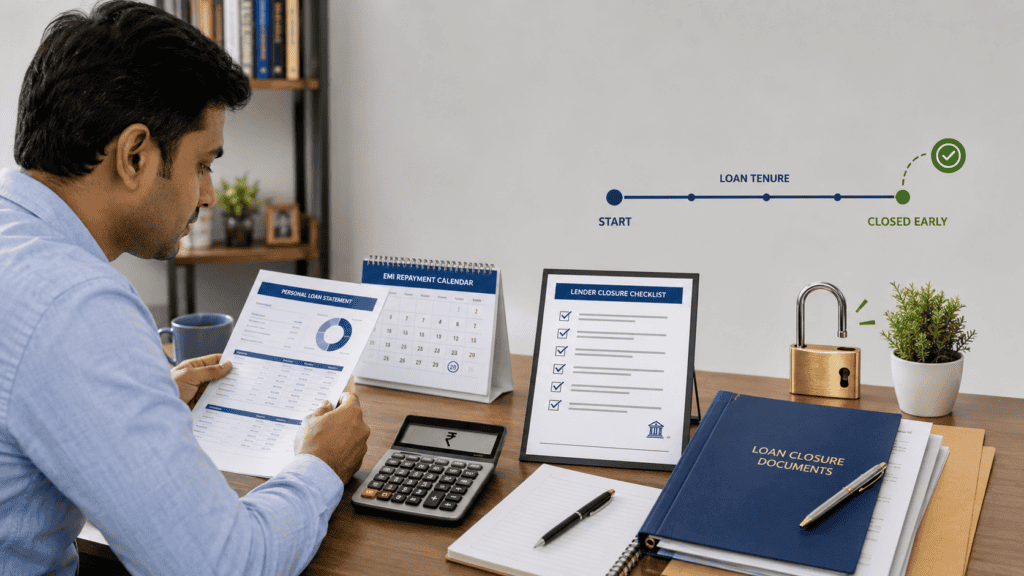
You’ve received a bonus — or finally saved enough — and you’re wondering whether to close your personal loan early. The math sounds simple: pay off the loan now, stop paying interest. But personal loan foreclosure isn’t always the clear winner it appears to be. Foreclosure charges, GST, a lender-imposed lock-in period, and the way interest is front-loaded on your how personal loans work repayment schedule can quietly shrink — or erase — the saving you expected. Before you transfer that lump sum, this article will walk you through what foreclosure and part-prepayment actually mean, how to calculate the real net saving, what charges to check, how to close safely, and what documents to collect so there’s no dispute later.
Quick Answer: Personal Loan Foreclosure Charges
Personal loan foreclosure charges are fees some lenders apply when you close the loan before the original tenure. The real saving depends on outstanding principal, remaining EMIs, interest saved, foreclosure fee, GST, and lock-in rules. Lender policies vary — always compare the net saving before paying.
Key Takeaways
- Foreclosure means closing your entire personal loan before the scheduled end date — the payoff amount includes outstanding principal, any accrued interest, applicable charges, and taxes.
- Part-prepayment is different: you reduce the outstanding principal by a lump sum but the loan stays active, and your future EMIs or remaining tenure adjust accordingly.
- Foreclosure saves the most interest when done early in the tenure — in the first year of a ₹5 lakh, 14% loan over 3 years, roughly 60% of each EMI goes toward interest, so there is more to save by closing early.
- Charges, lock-in periods, and GST on foreclosure fees vary by lender — always request an official written foreclosure quote before paying, and confirm the quote’s validity date.
- Closing the loan is not the final step: collect a No Objection Certificate (NOC), closure letter, and final loan statement from the lender, and check your credit report after the lender completes bureau reporting — this update may take 30–45 days and is not instant.
- If foreclosure or prepayment will leave you with no emergency fund, reconsider the timing — liquidity risk can cost more than the interest you save.
Key Facts at a Glance
| Term / Check | What It Means | What to Verify |
|---|---|---|
| Foreclosure / Preclosure | Full early repayment of the outstanding loan before original tenure ends | Whether lender permits it after the lock-in period |
| Part-Prepayment | Lump-sum payment that reduces outstanding principal; loan stays active | Whether lender allows it and minimum amount per part-payment |
| Foreclosure Charge | Fee charged by lender on outstanding principal at the time of closure — percentage varies by lender | Lender’s schedule of charges; verify at lender’s official website |
| Lock-In Period | Minimum number of EMIs after which foreclosure is permitted | Loan agreement, KFS, or lender’s schedule of charges |
| GST on Charges | Tax levied on the foreclosure or prepayment fee — rate applicable as per current GST law | Current GST rate at gstn.gov.in and lender’s quote |
| NOC / No Dues Certificate | Written proof from lender that all dues are cleared and the loan is closed | Collect within 7–15 working days of final payment |
| Credit Report Closure | Lender updates TransUnion CIBIL and other bureaus to mark loan as “Closed” | Check credit report 30–45 days after closure; dispute if still showing active |
What Is Personal Loan Foreclosure — and How Is It Different from Prepayment?
Foreclosure (also called preclosure — lenders use both terms interchangeably) means you pay the entire outstanding loan balance in one go before the scheduled last EMI date. Once you pay the foreclosure amount, the loan account is closed, and no further EMIs are due.
The payoff amount is not simply “whatever is left on paper.” It typically includes:
- Outstanding principal — the portion of the original loan not yet repaid
- Accrued interest — interest accumulated from your last EMI date to the foreclosure date
- Foreclosure charge — a fee calculated as a percentage of the outstanding principal (varies by lender)
- GST — applied on the foreclosure fee, not on the principal
- Pending dues — any unpaid EMI, bounce charge, or late fee still outstanding
Part-prepayment is different. You pay a lump sum — say ₹1 lakh toward a ₹4 lakh outstanding balance — and the loan remains active. After part-payment, the lender adjusts either your remaining tenure (shorter) or your EMI amount (lower), depending on lender policy and your preference. Part-payment charges may also apply.
The key distinction: foreclosure closes the loan entirely. Part-prepayment reduces the principal and future interest burden, but you continue repaying.
On reducing balance interest — which is the standard method for personal loans in India — your EMI is split between principal and interest in a ratio that changes every month. In the early months, a larger share of the EMI is interest. This is why closing a loan early in the tenure saves meaningfully more than closing it in the final few months when most of the interest has already been paid.
According to RBI’s Fair Practices Code for lenders (rbi.org.in), banks and NBFCs are required to be transparent about charges applicable on loans, including any foreclosure or prepayment fees. For floating-rate personal loans from banks, RBI guidelines restrict lenders from levying prepayment charges — but most personal loans in India are fixed-rate, where charges may apply. Always check the loan agreement and Key Fact Statement (KFS) you received at disbursement.
Real Example: Rohit’s ₹5 Lakh Loan After One Year
Rohit, 32, a software support analyst in Pune earning ₹75,000 per month, took a ₹5 lakh personal loan at an illustrative 14% annual interest rate for a 3-year tenure. His EMI works out to approximately ₹17,089 per month (illustrative figure — actual EMI depends on lender’s calculation).
After paying 12 EMIs, Rohit has received an annual bonus of ₹2 lakh and wants to foreclose.
At the 12-month mark, his outstanding principal is approximately ₹3,64,000 (illustrative — actual figure from lender’s amortisation statement). His remaining 24 EMIs would cost him roughly ₹1,00,000 in total interest (illustrative).
Now Rohit’s lender quotes a foreclosure charge of 4% on outstanding principal (illustrative — verify at lender’s schedule of charges), which on ₹3,64,000 works out to approximately ₹14,560. With 18% GST on that charge, the tax adds roughly ₹2,621. Total closure cost beyond the principal: approximately ₹17,181 in charges and taxes.
His estimated net saving: ₹1,00,000 (interest saved) minus ₹17,181 (charges and taxes) = approximately ₹82,819 — a meaningful saving if the numbers hold after the official quote. But this is only illustrative. Rohit must request an official foreclosure quote from his lender before making any payment. The actual outstanding principal, charge percentage, and applicable taxes in his quote may differ.
What to Check Before You Request Foreclosure
Before you call the lender or log into the app, run through this checklist:
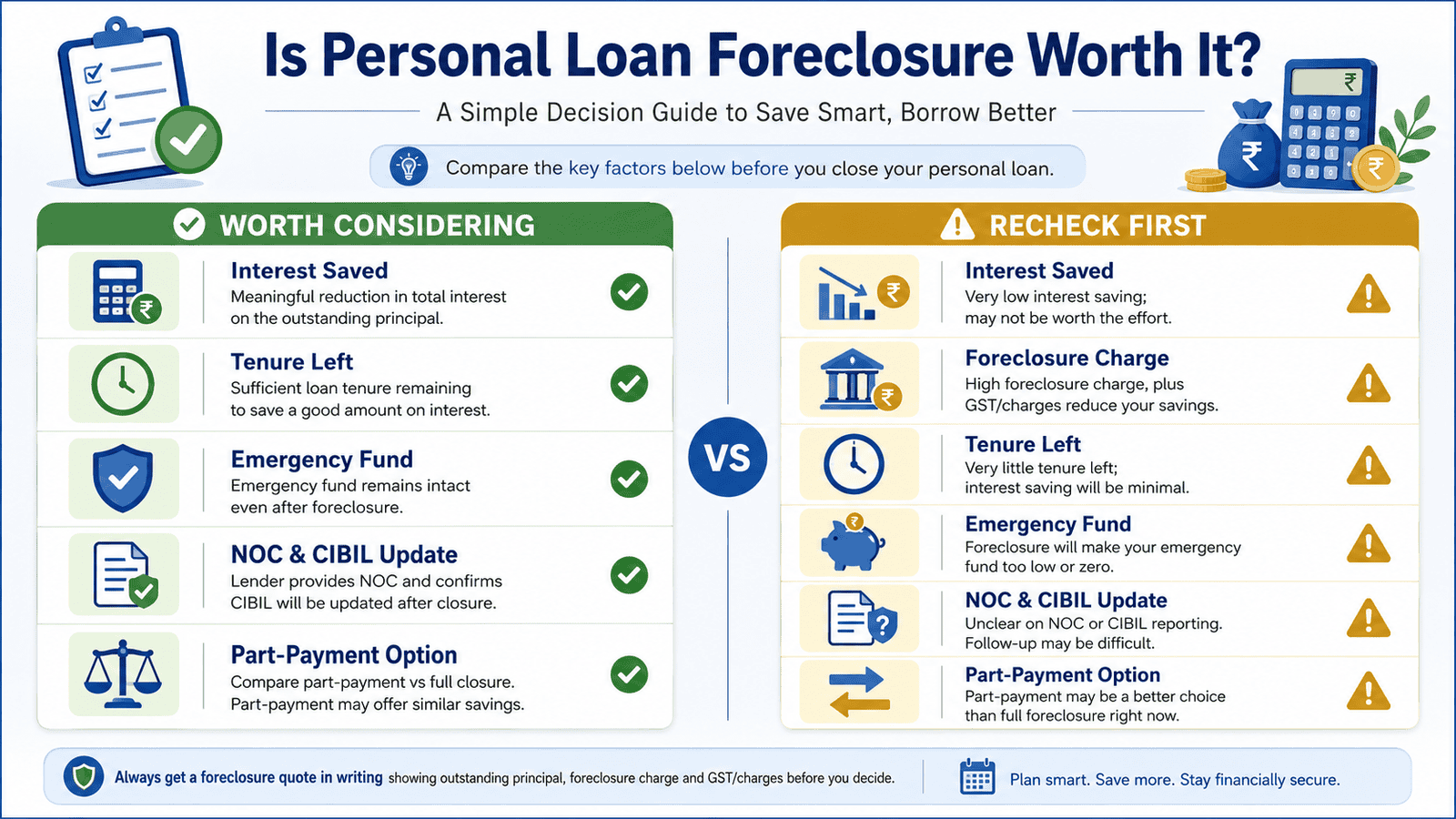
- Lock-in period: Has your loan crossed the minimum EMI count after which foreclosure is allowed? Some lenders require 6 or 12 EMIs before they permit foreclosure. Check your loan agreement or KFS. (Verify at lender’s official website — rules vary.)
- Foreclosure charge rate: Is the charge calculated on outstanding principal or on the original loan amount? This affects the total closure cost significantly. (Verify at lender’s schedule of charges.)
- Part-prepayment option: Does your lender allow partial prepayment? What is the minimum amount? Are there part-payment charges? If part-payment charges are lower, compare both routes before deciding.
- GST on charges: Tax is levied on the fee, not on the principal. Confirm the applicable GST rate in the foreclosure quote. (Verify at gstn.gov.in and in the lender’s written quote.)
- Pending dues: Check your latest loan statement for any unpaid EMI, bounce charge, or penal interest. These must be cleared before or along with the foreclosure payment.
- Emergency fund check: After paying the foreclosure amount, will you have at least 3–6 months of expenses set aside? If not, reconsider the timing before depleting your savings.
HDFC Bank’s personal loan section (hdfcbank.com) is one example of where you can find the lender’s schedule of charges, but if your loan is with a different bank or NBFC, check the corresponding lender’s official website or your loan agreement.
How to Calculate Whether Foreclosure Is Worth It
The decision comes down to one number: net benefit. Here is the framework — use it with your actual lender quote, not with assumed figures.
Net Benefit = Future Interest Saved − Foreclosure Charge − GST on Charge − Any Pending Dues
Where: Future Interest Saved = total interest remaining on your amortisation schedule | Foreclosure Charge = lender’s rate × outstanding principal | GST = applicable tax rate × foreclosure charge
To find future interest remaining, ask your lender for an updated loan statement or amortisation schedule. You can also use an interest calculation method tool to estimate remaining interest based on outstanding principal, rate, and remaining months.
Interest Saved vs Foreclosure Cost — Illustrative Table
| Item | Illustrative Amount | Notes |
|---|---|---|
| Outstanding principal after 12 EMIs | ₹3,64,000 | Illustrative — request actual figure from lender |
| Future interest if EMIs continue | ₹1,00,000 | Illustrative — verify from amortisation statement |
| Foreclosure charge (illustrative 4% on outstanding) | ₹14,560 | Rate varies by lender — verify at schedule of charges |
| GST on foreclosure charge (illustrative 18%) | ₹2,621 | Confirm applicable GST rate in lender’s official quote |
| Total closure cost (charges + tax) | ₹17,181 | Excludes principal — this is the “cost of closing early” |
| Net saving (interest saved minus closure cost) | ₹82,819 | Positive — but verify with actual lender quote before paying |
All figures above are illustrative only. A loan at a different rate, with a different foreclosure charge, or at a different point in tenure will produce different numbers. The formula stays the same — only the inputs change. Use this framework with your lender’s official foreclosure quote.
Foreclosure vs Part-Prepayment vs Regular EMI: What’s the Difference?
| Feature | Full Foreclosure | Part-Prepayment | Regular EMI Continuation |
|---|---|---|---|
| Loan status after payment | Closed — no further EMIs due | Active — EMI or tenure adjusts | Active — no change |
| Interest impact | All remaining interest eliminated | Reduces future interest on lower principal | Full interest cost continues |
| Charges to check | Foreclosure charge + GST | Part-payment charge + GST (if applicable) | None for regular EMIs |
| Cash outflow | Large lump sum required | Partial lump sum — more manageable | Monthly EMI only |
| Best when | Large lump sum available, high remaining interest, manageable charges | Partial funds available, want to reduce interest without full closure | Charges are high, few EMIs left, or emergency fund is thin |
| Credit report outcome | Loan marked “Closed” after lender reports to bureau | Loan remains active — updated balance reported | Loan continues — on-time payment history continues |
Read more on part-payment rules to understand how individual lenders handle tenure reduction versus EMI reduction when you make a partial payment.
Step-by-Step: How to Foreclose a Personal Loan Safely
Step 1 — Request an official foreclosure quote
Contact your lender — through the app, net banking, branch, or customer care — and ask for a written foreclosure quote. This document should state the outstanding principal, accrued interest as of the quote date, foreclosure charge, applicable GST, any pending dues, and the total payoff amount. It should also state the validity date — the date until which this quote is accurate.
Step 2 — Review the quote carefully
Check that the outstanding principal matches your latest loan statement. Verify the charge rate against the lender’s published schedule of charges. Note the validity date — if you miss it, you may need a new quote. Do not pay based on a verbal or WhatsApp figure from a call centre agent.
Step 3 — Pay only through official channels
Use net banking, RTGS/NEFT to the lender’s official account, lender’s app, or pay at the branch. Never transfer money to a personal account or an unofficial link. Save the payment receipt immediately.
Step 4 — Collect all closure documents
After payment, follow up for: (a) Payment receipt / acknowledgement, (b) Final loan account statement showing zero balance, (c) NOC / No Objection Certificate or No Dues Certificate, (d) Closure letter or foreclosure certificate. If the lender does not issue these proactively, request them in writing via email or the official grievance channel. See close a loan early for a detailed guide on the closure process.
Step 5 — Verify credit report update
After the lender updates the bureau, the loan account status should change from “Active” to “Closed.” This may take 30–45 days. Check your credit report from TransUnion CIBIL (transunioncibil.com) or any other bureau. If the loan still shows as active after 45 days, raise a dispute with the bureau and contact the lender’s grievance redressal officer.
According to RBI guidelines (rbi.org.in), lenders are required to report accurate credit information to bureaus in a timely manner. If a lender consistently fails to update the closed status, you may escalate using the RBI Integrated Ombudsman Scheme.
Personal Loan Closure Document Checklist
| Document | Why You Need It | When to Collect |
|---|---|---|
| Official foreclosure quote | Confirms payoff amount, charges, and validity date before payment | Before making the final payment |
| Payment receipt / transaction reference | Proof that full amount was paid on a specific date through official channel | On the day of payment — save immediately |
| Final loan account statement | Confirms zero outstanding balance after payment | Within 3–7 working days of payment |
| NOC / No Dues Certificate | Written confirmation from lender that no dues remain on the loan | Within 7–15 working days of payment |
| Closure letter / Foreclosure certificate | Formal record that the loan is closed — needed for any future dispute or lender query | Within 7–15 working days of payment |
| Updated credit report | Confirms bureau reflects “Closed” status — protects future loan eligibility | 30–45 days after payment; raise dispute if not updated |
For a full explanation of what the NOC means and how to follow up if the lender delays issuing it, read our guide on loan NOC after closure.
Borrower Safety Checklist: Before You Pay
- Never pay on a verbal quote. Get the foreclosure amount in writing — on letterhead, by email, or through the lender’s app — before transferring any money.
- Never transfer to a personal account or unofficial link. Fraudsters sometimes pose as lender representatives and share “settlement” account numbers. All personal loan payments must go to the lender’s official designated account.
- Do not foreclose if it empties your emergency fund. A broken emergency fund can force you into a new, more expensive loan later. Foreclosure saves interest, but liquidity protects you in a crisis.
- Do not assume CIBIL updates instantly. Paying the foreclosure amount does not update your credit report the same day. The lender files the update in their next reporting cycle — typically within 30–45 days. Check the report yourself after that window.
- Do not skip collecting your NOC and closure letter. Without these documents, a future lender or employer background check may flag the loan as unresolved — even if you paid in full.
How to Decide What’s Right for You
your remaining tenure is long (more than 12–18 months) and the future interest payable is significantly higher than foreclosure charges plus taxes — foreclosure may offer a meaningful net saving. Verify with the official quote before deciding.
you have enough funds to foreclose but want to keep monthly cash flow flexible — part-prepayment may be a better fit. It reduces interest on the remaining principal while keeping the loan active and your emergency fund intact.
only 3–5 EMIs remain on the loan — the interest saving is likely small, and foreclosure charges may exceed the benefit. In this case, continuing regular EMIs until the natural end date may cost you less overall.
the foreclosure charge percentage is high and you are in the latter half of the tenure — most of the interest has already been paid through earlier EMIs. A net saving calculation may show that foreclosure is not worthwhile.
you are carrying revolving credit card dues at a higher effective interest rate than your personal loan — clearing the credit card debt first is likely the higher-priority financial move before foreclosing the loan.
you have an emergency fund covering at least 3 months of expenses after the prepayment — do not foreclose, regardless of the interest saving on paper. Depleting savings for foreclosure can create a liquidity risk that costs more than the interest you save.
Common Mistakes to Avoid
Focusing only on EMI relief, not total interest saving
Some borrowers foreclose a loan primarily to “feel debt-free” without checking whether the remaining interest is significant. If only 4–5 EMIs are left, the total interest saved may be small — but you still pay the full foreclosure charge. Always calculate net benefit first.
Ignoring the lock-in period
Many lenders apply a lock-in period — often 6 to 12 months — during which foreclosure is not permitted. Requesting closure before this period lapses can lead to rejection or a penalty clause. Check your loan agreement or KFS before making plans.
Missing the quote validity date
A foreclosure quote is valid for a fixed window — often 3 to 7 days. If you pay after the validity date, the outstanding principal and accrued interest will have changed, and your payment may not cover the full amount. Request a fresh quote if the original has expired.
Paying without collecting written confirmation
Paying the foreclosure amount is step one. Without a closure letter, NOC, and final statement, you have no documented proof the loan is closed. Future lenders, landlords, or employers checking your credit profile may see an unresolved loan account — even after full payment.
Assuming the credit report updates automatically and immediately
Bureau reporting is done by the lender in their scheduled reporting cycle — not on the day you pay. Check your credit report 30–45 days after closure. If the loan status still shows “Active,” raise a dispute with the bureau and follow up with the lender’s nodal officer.
Treating part-payment and foreclosure charges as identical
Some lenders charge differently for a full foreclosure versus a partial prepayment. If you plan to part-pay ₹1 lakh and foreclose the balance six months later, the total charge across both transactions may exceed the charge for a single foreclosure — check both routes before deciding.
Not keeping a copy of the original loan agreement and KFS
In a dispute about foreclosure charges, the loan agreement and Key Fact Statement are your primary evidence. If you do not have a copy, request one from the lender before initiating closure — it establishes what charge rate you agreed to at disbursement.
When This May Not Be the Right Choice
Foreclosure or early prepayment may not be the best move right now if:
You would have no emergency fund remaining after paying the foreclosure amount. A thin cash buffer is a bigger financial risk than the interest you save on the loan.
Only 3–6 EMIs remain and the outstanding principal is small. At this stage, most of the interest has already been paid through earlier EMIs. Foreclosure charges could exceed the remaining interest, leaving no real saving.
The lender’s foreclosure charge is high relative to the interest left — for example, a 5% charge on a large outstanding balance may wipe out most of what you would save in interest over the remaining months.
You are carrying higher-interest revolving debt — such as credit card dues that compound at 36–42% annually — that would cost you more per rupee than the personal loan interest you are trying to eliminate.
You have a near-term financial commitment — medical expense, school fee, home repair — where you may need the lump sum within the next 3–6 months. Once paid to the lender, that money cannot be recalled.
If any of these apply to your situation, it may be worth exploring other options before committing.
Official Rules and Where to Verify
Before acting on any foreclosure decision, verify the following from official sources:
- RBI (rbi.org.in): General regulatory context for lender conduct, Fair Practices Code, Digital Lending Guidelines, and the RBI Integrated Ombudsman Scheme if you need to escalate a closure dispute.
- Your lender’s official website — Schedule of Charges: HDFC Bank (hdfcbank.com), Bajaj Finance (bajajfinserv.in), or your specific lender’s equivalent page — this is where current foreclosure charge rates, lock-in period rules, and part-payment terms are published. Verify before assuming any rate applies to your loan.
- Your loan agreement and Key Fact Statement (KFS): The charges you agreed to at disbursement are documented here. If there is a dispute, this is your primary reference.
- TransUnion CIBIL (transunioncibil.com): Check your credit report 30–45 days after the lender confirms closure. Loan status should read “Closed.” If it still reads “Active,” raise an online dispute on the CIBIL website.
Rules, rates, and charges on this topic can change with RBI policy or lender updates. Always verify current figures directly from the official source or the lender before making any borrowing decision.
Expert Tips
- Request both a foreclosure quote and a part-payment quote at the same time. Comparing both side-by-side takes 10 minutes and can reveal which route gives you a better net saving — especially if part-payment charges are lower than full foreclosure charges at your lender.
- If part-payment is allowed, ask whether the lender will reduce tenure or EMI. Tenure reduction typically saves more total interest than EMI reduction for the same prepaid amount. Understanding reducing balance interest helps you see why the split matters.
- Always verify the quote validity date and pay before it expires. Outstanding principal and accrued interest change daily after your last EMI. A stale quote means the payment may fall short, leaving a residual balance the lender will continue billing.
- Screenshot and archive every digital transaction and lender communication. Keep payment receipts, chat confirmations, and email acknowledgements in a folder you can access for at least 5 years — credit report disputes and future loan applications may require them.
- Do not take a new loan at a higher rate to close a personal loan at a lower rate. This is sometimes suggested as “debt consolidation,” but the math only works if the new loan’s all-in cost (rate, processing fee, GST) is clearly lower than the personal loan’s remaining interest and charges. Run the numbers before acting.
- Check your credit report before foreclosure, not just after. If your loan account already shows any irregularity — missed EMI, wrong balance — resolve it with the lender before closing. Closure will lock in the status as reported.
Frequently Asked Questions
What are personal loan foreclosure charges?
Foreclosure charges are fees a lender applies when you pay off the full outstanding personal loan balance before the original tenure ends. The charge is typically calculated as a percentage of the outstanding principal at the time of closure. GST applies on this fee. The exact percentage, and whether it applies at all, depends on the lender and your loan agreement — verify at the lender’s official schedule of charges.
Is personal loan prepayment allowed in India?
Most banks and NBFCs allow prepayment on personal loans, but conditions vary. Some lenders require a minimum number of EMIs before permitting foreclosure or part-prepayment. RBI guidelines restrict prepayment charges for floating-rate personal loans from banks, but most personal loans are fixed-rate — where charges may apply. Check your loan agreement and the lender’s current schedule of charges before requesting prepayment.
Is foreclosure better than part-prepayment?
It depends on your cash flow, the charges at your lender, and how much tenure remains. Full foreclosure eliminates all future interest but requires a large lump sum and typically attracts foreclosure charges. Part-prepayment reduces principal and future interest without closing the loan, and part-payment charges may be lower. If you cannot foreclose the entire balance without affecting your emergency fund, part-prepayment is often the more sustainable first step.
Does personal loan foreclosure affect CIBIL score?
Closing a personal loan in good standing — with all EMIs paid on time — typically marks the account as “Closed” in your credit report, which is a positive signal. Your credit score is unlikely to drop from a well-managed closure. However, the closed account does reduce your active credit mix, which can have a minor, temporary effect. The lender must update the bureau within their reporting cycle — check TransUnion CIBIL (transunioncibil.com) after 30–45 days to confirm the status.
What documents should I collect after foreclosing a personal loan?
Collect: (1) payment receipt with transaction reference, (2) final loan account statement showing zero balance, (3) NOC or No Dues Certificate from the lender, (4) closure letter or foreclosure certificate. After 30–45 days, also download your updated credit report to confirm the loan is marked “Closed.” Retain all documents for at least 5 years.
Can a bank legally charge foreclosure fees on a personal loan?
Yes, for fixed-rate personal loans — which is the standard in India — lenders are generally permitted to charge a foreclosure or prepayment fee. RBI guidelines restricting such charges apply to floating-rate loans from banks. The fee amount and structure must be disclosed in your loan agreement and KFS at disbursement. If a lender charges more than what is stated in your original agreement, you can raise a dispute through the lender’s grievance channel or the RBI Integrated Ombudsman Scheme (rbi.org.in).
When is it not worth closing a personal loan early?
Early closure may not be worth it when: only a few EMIs remain and the interest saving is negligible; foreclosure charges are high relative to remaining interest; paying would deplete your emergency fund; you are carrying higher-interest debt such as credit card dues that should be cleared first; or you have a near-term cash need that would require borrowing again at a higher rate.
Can the lender refuse a foreclosure request?
A lender can decline a foreclosure request during the lock-in period stated in the loan agreement. Outside the lock-in period, lenders are generally required to process foreclosure requests in line with RBI guidelines and their own published policy. If a lender refuses or delays without valid reason, escalate through the lender’s nodal officer and, if unresolved, through the RBI Integrated Ombudsman Scheme.
Final Verdict
Personal loan foreclosure charges can significantly reduce — and sometimes eliminate — the interest saving you expect from early closure. The decision is worth making only after you have the official foreclosure quote in hand and have confirmed that net saving (future interest minus charges and taxes) is meaningfully positive and that your emergency fund stays intact after payment.
Foreclosure makes the most sense when a substantial portion of the tenure remains, the remaining interest is large relative to the foreclosure fee, and you have a lump sum available without compromising cash reserves. If cash flow is the constraint, part-prepayment may be a better intermediate step — it reduces future interest without requiring full closure.
Whichever route you take, the loan is not truly closed until you have the NOC, closure letter, and a credit report showing “Closed” status. Collect those documents. Do not skip this step.
Use the personal loan prepayment savings calculator to estimate your net saving, then request a formal quote from your lender before making any payment. Always verify the latest rates and terms from the lender or official RBI sources before applying for any loan.
This article is for educational purposes only and should not be treated as personalised financial, credit, or legal advice. Interest rates, processing fees, eligibility criteria, and loan terms vary by lender and can change with RBI policy or lender updates. Please verify current rates and terms directly with the lender or from official RBI sources, or consult a qualified professional, before applying for or accepting any loan.

Rohan writes practical personal loan guides for Indian borrowers, focusing on eligibility, EMI planning, lender charges, CIBIL impact, borrower rights, and safer borrowing choices. His writing helps readers compare options calmly, avoid costly mistakes, and understand loan terms before applying.