

Getting a car loan rejected stings — especially when you had already imagined the drive home. But rejection is not a dead end. Every lender evaluates your credit score, monthly income, existing EMI burden, documents, job profile, down payment, and vehicle details before approving a loan. If any of these fall below their internal threshold, the application gets declined. The most common car loan rejected reasons and fixes are knowable, and most of them are solvable — if you take the right steps before applying again. This guide explains exactly why car loans get rejected in India, what to do in the first 7 to 30 days, how each problem can be fixed, and how to reapply safely without making your credit profile worse.
Quick Answer: Car Loan Rejected Reasons and Fixes
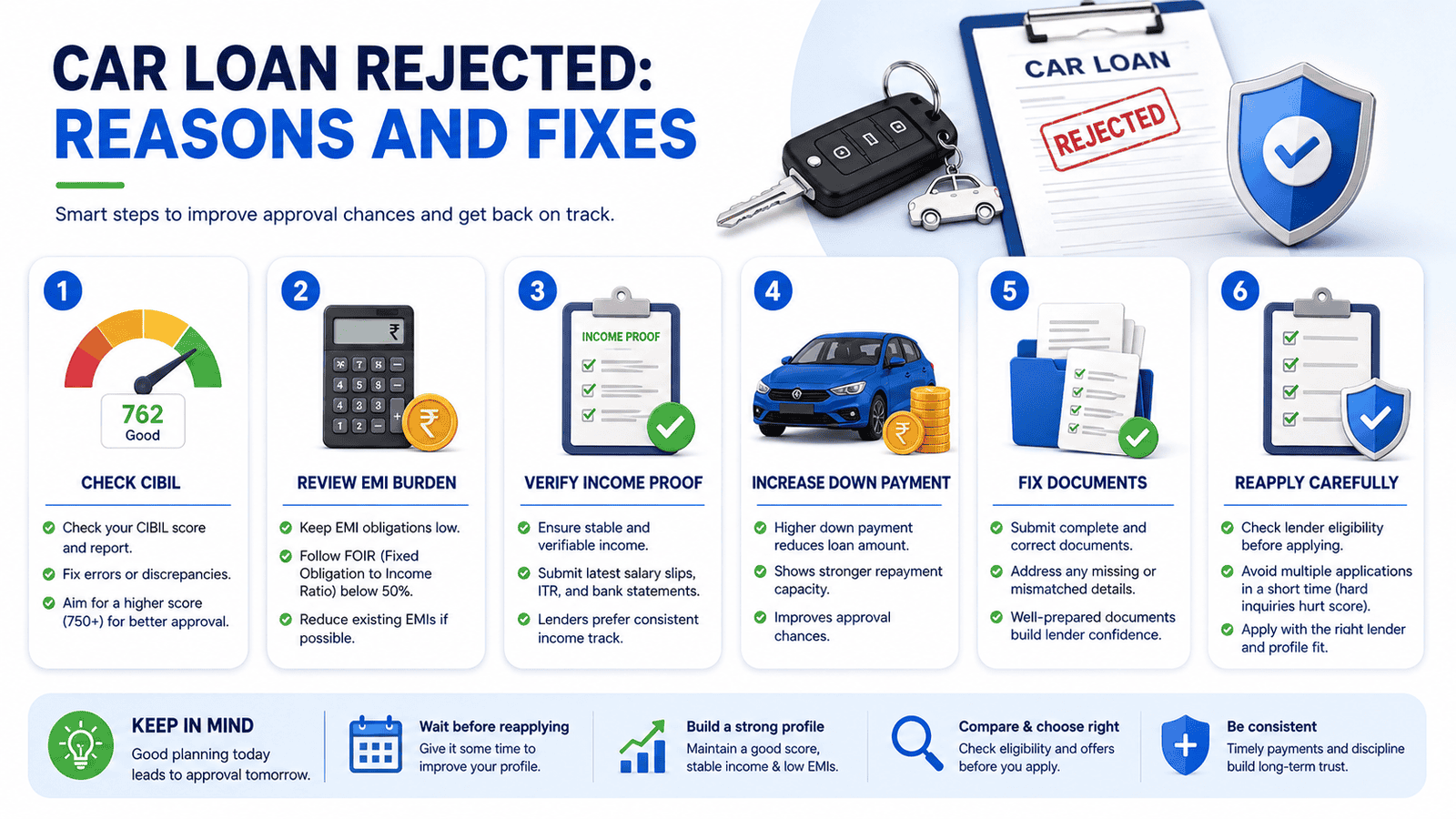
Car loan rejected reasons and fixes usually include low CIBIL score, high existing EMI burden, low salary, unstable job profile, document mismatch, insufficient down payment, or vehicle eligibility issues. Before reapplying, check your credit report, calculate FOIR, correct documents, compare EMI affordability, and avoid multiple hard inquiries.
What to Do Immediately After Car Loan Rejection
The first 48 hours after rejection matter. What you do — or do not do — can protect your credit profile or quietly damage it further. Follow these steps before touching another loan application.
Step 1 — Ask for the Broad Rejection Reason
Contact the lender or dealer finance desk and ask for the main reason your application was declined. Lenders are not always required to share the full assessment, but many will indicate whether it was credit score, income, EMI burden, or documentation. Note this in writing.
Step 2 — Do Not Apply to Multiple Lenders Immediately
Every car loan application triggers a hard inquiry on your credit report. Multiple hard inquiries in a short window signal financial stress to lenders and can reduce your credit score over time. Applying to five lenders in one week after rejection is one of the most common mistakes — and one of the most damaging. Pause, diagnose first.
Step 3 — Check Your Credit Report from Official Bureaus
Pull your credit report from TransUnion CIBIL at transunioncibil.com. You can check your credit report for free once a year from each bureau. Look for missed EMI entries, incorrect account statuses, wrong addresses, or accounts you do not recognise. Any of these can quietly push a borderline profile into rejection territory.
Step 4 — Review Your Income, EMI Burden, Down Payment, and Documents
Go through salary slips, bank statements, Form 16, and your existing EMI schedule. Check if your total EMI obligations — existing EMIs plus the proposed car EMI — would cross 40–50% of your net monthly income. Verify that all identity and address documents match your current KYC records.
Step 5 — Use EMI and FOIR Calculators Before Reapplying
Calculate your likely car EMI and total EMI burden ratio before submitting any fresh application. If the numbers show you are already stretched, fix the underlying issue first. Applying again with the same profile will produce the same result.
7-Day and 30-Day Action Plan After Rejection
| Timeline | Action | Expected Result | Caution |
|---|---|---|---|
| Day 1–2 | Ask lender for rejection reason. Do not apply elsewhere. | Know the root cause before acting. | Do not panic-apply; each application creates a hard inquiry. |
| Day 3–5 | Pull credit report from CIBIL, Experian, or CRIF. Review every entry. | Identify wrong entries, missed payments, or high utilisation. | Use only official bureau websites. Do not pay third-party score services. |
| Day 6–7 | Calculate FOIR using income and all existing EMIs. Check down payment readiness. | Understand whether EMI burden is the real issue. | Do not use indicative online calculators as final lender benchmarks. |
| Week 2–4 | Fix documents, raise dispute for wrong credit report entries, close smallest EMI if feasible, increase down payment savings. | Strengthen profile systematically. | Credit report corrections and bureau disputes take 30–45 days to reflect — do not reapply before the fix shows up. |
| Day 30+ | Recheck credit report. Recalculate FOIR. Choose suitable lender. Apply once, with complete documents. | Stronger, more targeted application. | No approval is guaranteed regardless of profile improvement. |
Key Takeaways
- Rejection does not mean you can never get a car loan — but reapplying immediately with the same profile and same loan amount almost always produces the same outcome.
- Every fresh car loan application generates a hard inquiry on your credit report. Multiple hard inquiries in a short window can reduce your credit score and signal financial stress to the next lender. Read more about multiple loan applications and how they affect your credit score.
- Your Fixed Obligation to Income Ratio (FOIR) — the share of monthly income already committed to EMIs — is one of the most important but least-discussed rejection triggers. Many lenders decline applications where total EMIs, including the proposed car EMI, would exceed roughly 40–50% of net monthly income.
- A low CIBIL score below 700 (indicative — verify with each lender before applying) reduces approval chances significantly and often leads to higher interest rates even if approved.
- Document mismatches, incorrect KYC, and address inconsistencies are fixable in days — and often overlooked as rejection reasons.
- NBFCs and dealer finance may approve applications that banks decline, but they often charge higher interest rates and fees — evaluate total cost, not just approval probability.
- Increasing your down payment by ₹1–2 lakh reduces the loan amount the lender needs to sanction, which can meaningfully improve approval chances and reduce your EMI.
Key Facts at a Glance
| Rejection Reason | Immediate Fix | Risk if Ignored |
|---|---|---|
| Low CIBIL score (below indicative threshold — verify with lender) | Clear overdue EMIs, dispute wrong entries, reduce credit utilisation | Repeated rejection, higher interest rates, hard inquiry accumulation |
| High FOIR / existing EMI burden | Close small loans, increase down payment, choose cheaper car, extend tenure carefully | Continued rejection; lenders see overextension risk |
| Low or unstable income | Add a co-applicant with stable income, reduce car price, improve ITR documentation | Rejection across lenders; limited options without address |
| Document mismatch / KYC error | Update Aadhaar, PAN, address proof; match records across all documents | Rejection even with a healthy credit and income profile |
| Insufficient down payment | Save toward 20–25% down payment; evaluate LTV norms of each lender | Higher EMI, lower approval probability, higher interest risk |
| Used car valuation, age, or RC issues | Verify RC, hypothecation clearance, insurance continuity, and vehicle valuation report | Lender may reject based on vehicle risk, not borrower profile |
| Employer category or job instability | Build income proof with ITR, Form 16, or bank statements covering 6–12 months | Banks especially may decline non-listed employer or short-tenure profiles |
| Existing default, settlement, or write-off | Settle outstanding, request NOC, wait for credit report to reflect correction | Very high rejection risk across all lenders until entry is resolved |
For a deeper look at how existing EMI burden affects loan approval across all loan types, that linked guide covers the mechanics in full.
Main Reasons Your Car Loan May Be Rejected
Low CIBIL Score or Poor Repayment History
Most lenders in India check your credit score from one or more of the four bureaus — TransUnion CIBIL, Experian, CRIF High Mark, and Equifax — before processing a car loan. A low score, typically below a lender-specific threshold that varies by institution, signals higher default risk. A pattern of late or missed EMI payments, even on old accounts, can drag the score down and trigger rejection. What matters is not just the score number but the underlying behaviour it reflects: late payments, written-off accounts, or debt settlements appear directly in the credit report and are visible to every lender who pulls it.
High Existing EMI Burden or FOIR
FOIR — Fixed Obligation to Income Ratio — is the share of your monthly take-home pay already committed to EMI repayments. Most lenders work with an internal FOIR ceiling, commonly in the range of 40–50% of net monthly income (verify with each lender), beyond which they consider the applicant overextended. If you already have a personal loan, a home loan, or a credit card EMI, and the new car loan EMI would push your total obligations above this ceiling, the application is very likely to be declined — regardless of your salary level.
Low Salary or Unstable Income
Each lender sets a minimum net monthly income threshold for car loan applicants. These thresholds vary by lender, city, loan amount, and vehicle segment — always verify directly with the lender. Beyond the minimum salary number, lenders also look at income stability. Applicants on probation, with gaps in employment, or with income that varies sharply month to month may be considered higher risk even if their average salary appears adequate.
Insufficient Down Payment
Car loans in India are typically offered as a percentage of the vehicle’s on-road price or ex-showroom price, with lenders expecting the borrower to fund the rest as a down payment. The loan-to-value (LTV) ratio — the share of the vehicle cost the lender will finance — varies by lender and vehicle type. If you are requesting a very high LTV loan, or if your down payment is funded from a fresh personal loan rather than savings, some lenders will flag this and decline. A higher down payment directly reduces the loan amount you are asking for, which improves the lender’s risk comfort.
Document Mismatch or Address Inconsistency
Lenders cross-check all submitted documents — Aadhaar, PAN, salary slips, bank statements, Form 16, and address proof — for consistency. A mismatch in name spelling, an outdated address on Aadhaar that does not match your current bank account, or missing pages in bank statements can result in rejection even when the income and credit profile is otherwise acceptable. This is one of the easiest rejection reasons to fix and one of the most commonly overlooked.
Used-Car Age, Valuation, RC, and Hypothecation Issues
Used-car loan applications carry additional vehicle-side eligibility checks. Lenders typically have maximum vehicle age limits — commonly 8 to 10 years from manufacturing date at the time of loan closure, though this varies by lender. The vehicle also needs a clean Registration Certificate (RC) with no hypothecation listed from a previous lender, valid insurance, and a valuation that justifies the loan amount. If the RC shows an existing hypothecation that has not been formally cleared, or if the vehicle’s valuation is lower than the loan requested, the application may be declined on vehicle grounds alone — even if the borrower’s credit profile is strong. According to RBI guidelines at rbi.org.in, regulated lenders are required to follow fair lending practices, and borrowers can refer to RBI’s grievance mechanisms if they believe a rejection was handled improperly.
Employer Category or Job Instability
Banks in particular maintain internal lists of preferred employers — large corporates, public sector units, and listed companies. If your employer is small, unlisted, or in a sector perceived as higher risk, some banks may apply stricter income or credit score thresholds. Recent job changes, short tenure at the current employer (often below six months to one year — verify with the specific lender), or self-employment without adequate ITR documentation can also increase rejection risk.
Existing Default, Settlement, or Written-Off Account
If any loan or credit card account in your credit report shows a default, a settlement (where the lender accepted less than the full outstanding), or a written-off entry, this is one of the most serious rejection triggers. Most lenders consider active or recent defaults as near-automatic disqualifiers, regardless of your current income or CIBIL score. Clearing the overdue, obtaining a No Objection Certificate (NOC) from the lender, and waiting for the credit report to reflect the correction is the path forward — but this takes time.
Real Example: How EMI Burden Triggered Rejection for Priya
Priya, 34, works as an HR executive in Bengaluru and takes home approximately ₹50,000 per month. She has an existing personal loan EMI of ₹12,000 and a credit card minimum due of ₹3,000, giving her existing monthly obligations of ₹15,000. She applied for a car loan of ₹8 lakh at an indicative rate of 9.5% per annum for 60 months — which, using the standard EMI formula, works out to a monthly EMI of approximately ₹16,766 (illustrative; actual EMI depends on lender’s sanctioned rate and tenure).
Her total monthly EMI obligations after the car loan: ₹15,000 + ₹16,766 = ₹31,766. As a share of her ₹50,000 net income, this equals approximately 63.5% — well above the 40–50% FOIR range that most lenders use as their ceiling.
The bank declined her application citing EMI burden. Priya had three practical options:
- Close her personal loan early, reducing existing obligations to ₹3,000 and bringing FOIR down to approximately 39.5% with the car EMI — within acceptable range.
- Increase her down payment from ₹1 lakh to ₹2 lakh, reducing the loan amount to ₹7 lakh and lowering the car EMI to approximately ₹14,670 (illustrative), bringing total FOIR to approximately 55.3% — still high, but a better negotiating position with NBFCs.
- Choose a car with an ex-showroom price ₹1.5–2 lakh lower, reducing the loan amount further.
Priya chose to close the personal loan first, waited for the credit report to update, and reapplied two months later with a stronger FOIR. For a full salary-based breakdown of car loan eligibility by salary across income brackets, that guide covers the numbers in detail.
Before Reapplying: Eligibility Checklist
| Task | Why It Matters | Document / Proof Needed |
|---|---|---|
| Check credit report from all four bureaus | Different lenders pull from different bureaus; errors on one may not appear on another | CIBIL report, Experian report (experian.in), CRIF report, Equifax report |
| Review all existing EMI obligations | FOIR is calculated on total obligations, not just the largest loan | Bank statements, loan account statements for last 6 months |
| Update KYC and address proof | Address mismatch between Aadhaar and bank records triggers rejection | Aadhaar, PAN, utility bill or rent agreement with current address |
| Gather income proof | Lender needs to verify stable, documented income | Last 3 salary slips, latest Form 16, last 6 months bank statements, ITR if self-employed |
| Confirm down payment amount | Higher down payment reduces loan request and improves lender comfort | Bank balance proof or fixed deposit statement (do not use a personal loan as down payment) |
| For used cars: verify vehicle documents | RC, hypothecation clearance, insurance, and valuation affect lender’s vehicle eligibility check | RC copy, NOC from previous lender if hypothecation exists, valid insurance certificate |
Document requirements vary by lender — always confirm the exact list directly with the institution before applying. Experian India at experian.in also provides guidance on credit report access and dispute processes. For a complete look at used car loan eligibility including vehicle age and valuation norms, that guide covers the specifics.
How EMI Burden and Down Payment Affect Approval
Understanding your FOIR before reapplying can save you another hard inquiry and another rejection. The calculation is straightforward.
FOIR = (Total Monthly EMI Obligations ÷ Net Monthly Income) × 100
Where: Total Monthly EMI Obligations = all existing EMIs + proposed car EMI | Net Monthly Income = take-home salary after deductions
| Scenario | Numbers (Illustrative) | Approximate FOIR |
|---|---|---|
| Base case — ₹50,000 income, ₹15,000 existing EMI, ₹8 lakh car loan at 9.5% / 60 months | Existing EMI ₹15,000 + Car EMI ~₹16,766 = ₹31,766 | ~63.5% — likely too high for most lenders |
| Higher down payment — increase down payment by ₹1 lakh, car loan reduces to ₹7 lakh | Existing EMI ₹15,000 + Car EMI ~₹14,670 = ₹29,670 | ~59.3% — still high, but improved |
| Close personal loan — reduce existing obligations to ₹3,000, ₹8 lakh car loan retained | Existing EMI ₹3,000 + Car EMI ~₹16,766 = ₹19,766 | ~39.5% — within range for many lenders |
| Cheaper car — loan amount drops to ₹6 lakh, existing ₹15,000 EMI continues | Existing EMI ₹15,000 + Car EMI ~₹12,574 = ₹27,574 | ~55.1% — still elevated; may need NBFC or higher down payment |
All EMI figures above are illustrative and calculated using an indicative interest rate. Actual EMI will depend on the lender’s sanctioned rate, processing approach, and tenure — always verify. For a full explanation of FOIR in loan approval and how lenders apply it across different loan types, that guide covers the concept in depth.
Bank vs NBFC vs Dealer Finance After Rejection
| Option | Approval Flexibility | Typical Cost | Key Risk |
|---|---|---|---|
| Bank (PSU or private) | Stricter — higher credit score, lower FOIR, preferred employer often required | Potentially lower interest rate for eligible borrowers (verify with lender) | Rejection more likely if profile is borderline; hard inquiry still recorded |
| NBFC | More flexible — may consider lower credit scores and non-listed employers | Often higher interest rate and processing fee than banks (verify with lender) | Total cost over tenure can be significantly higher; check foreclosure charges before signing |
| Dealer finance desk | Convenient — dealer submits to multiple lenders at once | Variable and opaque — bundled insurance, add-on products may inflate cost | Multiple simultaneous applications mean multiple hard inquiries; dealer may prioritise commission over your best rate |
All interest rates, processing fees, and eligibility criteria vary significantly by lender and change over time — verify current terms directly with the lender before applying. RBI at rbi.org.in publishes guidelines on fair lending practices and the borrower rights framework that all regulated lenders must follow.
Safety Checklist: What Not to Do After Rejection
Do Not Submit Applications to Multiple Lenders Simultaneously
Each application triggers a hard inquiry. Five applications in one week creates five hard inquiries on your credit report — all visible to every subsequent lender you approach. This pattern alone can push a borderline credit profile below the approval threshold. Understanding multiple loan applications and their CIBIL impact before reapplying is important.
Do Not Hide Existing EMIs or Defaults in the Application
Lenders pull your credit report and bank statements independently. Omitting an existing EMI from your application form does not remove it from the lender’s view — it only adds a mismatch between what you declared and what the credit report shows, which can flag the application for additional scrutiny or decline.
Do Not Accept an Unaffordable EMI Just Because Approval Is Available
An NBFC or dealer finance arrangement may approve a loan that a bank declined, but at a rate 2–4 percentage points higher (indicative — verify with lender). On a ₹7 lakh loan over 60 months, even a 2% rate difference can add ₹30,000–40,000 to your total repayment (illustrative). Approval is only good news if the EMI fits your monthly cash flow comfortably.
Do Not Rely on Dealer Verbal Promises
If a dealer finance executive tells you “your loan is as good as approved” without a formal sanction letter, do not pay a booking amount or take delivery. Get every term — rate, tenure, processing fee, insurance, prepayment charge — in writing before signing.
Do Not Ignore Credit Report Errors Before Reapplying
An incorrect late-payment entry, a duplicate account, or a closed loan still showing as active can reduce your score without reflecting your actual repayment behaviour. These entries can be disputed directly with the respective bureau — CIBIL at transunioncibil.com, Experian at experian.in, CRIF High Mark at crifhighmark.com, or Equifax at equifax.co.in — and corrections typically reflect within 30–45 days.
How to Decide What’s Right for You
your credit report shows missed EMIs, overdue amounts, or a default — fix the underlying payment issue and raise a bureau dispute for any incorrect entries before reapplying. Reapplying without this fix will produce the same outcome.
your FOIR is above 50% — either close a small existing loan first, increase your down payment to reduce the requested loan amount, or choose a car priced ₹1–2 lakh lower than your original target.
your income is below the lender’s minimum threshold — consider adding a co-applicant with stable income, or apply to lenders with lower income requirements for the specific car segment you are targeting.
the rejection was linked to a used car’s vehicle documents, age, or hypothecation issue — resolve the RC and insurance issues first, or consider a new car loan where vehicle eligibility checks are simpler.
your employer is not on a bank’s preferred list — approach NBFCs that assess income from bank statements rather than employer category, but compare the total interest cost carefully before signing.
you have identified the specific rejection reason and a concrete fix for it — do not reapply yet. A second application with the same profile and the same loan amount is very likely to result in another rejection and another hard inquiry on your credit report.
your down payment is very low relative to the car’s on-road price — save toward at least 20–25% before approaching a lender again. A lower loan-to-value ratio materially improves the lender’s risk calculation.
Common Mistakes to Avoid
Applying Immediately After Rejection Without Identifying the Root Cause
Submitting a fresh application to a different bank within days of rejection — without understanding why the first application failed — repeats the same mistake. It adds another hard inquiry and often ends in another rejection. Each inquiry is timestamped on your credit report and visible to every subsequent lender.
Ignoring Credit Report Errors Before the Next Application
A wrong “overdue” entry or an account wrongly shown as active can quietly hold your score below a lender’s threshold. Bureau dispute processes exist precisely for this. Skipping this step and reapplying means the error stays on record and continues to trigger rejections. Disputes typically take 30–45 days to resolve — plan your reapplication timeline around this.
Choosing a Car Beyond What Your Current Profile Can Support
Aiming for a ₹12 lakh car when your income and FOIR can support a ₹7–8 lakh loan creates a gap between what you want and what you qualify for. Narrowing the car budget is not a defeat — it is a practical path to approval. You can always move to a higher loan amount once your income and credit profile strengthen.
Accepting Bundled Insurance, Add-Ons, or Extended Warranties Without Comparison
Dealer finance desks sometimes bundle insurance, extended warranties, or accessories into the loan amount. This inflates your principal, increases your total interest outgo, and may include products you do not need or could source cheaper elsewhere. Always ask for the loan amount and the insurance/add-on cost as separate line items.
Treating NBFC Approval as Automatically Affordable
An NBFC may approve an application that multiple banks declined, but at a rate that is 2–4 percentage points higher (indicative — verify with each lender). Before signing, calculate total repayment across the full tenure and compare it with what you would pay at a bank rate. If the gap is significant, consider whether waiting and strengthening your profile to qualify for a bank rate would save meaningful money.
Using a Personal Loan to Fund the Down Payment
Taking a personal loan to generate a down payment for a car loan creates two EMI obligations simultaneously and often pushes FOIR above acceptable limits. It also appears in bank statements and credit reports, which lenders check. Use only genuine savings for down payment.
When This May Not Be the Right Choice
Reapplying for a car loan may not be the right move right now if your existing EMI burden already consumes more than 45–50% of your monthly income and closing a smaller loan is not immediately feasible. If your credit report shows a recent settlement, default, or written-off entry from the last 12–24 months, most lenders — banks and NBFCs alike — will view this as a significant risk flag, and approval odds remain low until the entry ages or is formally resolved. If your income is on probation, contractual, or significantly variable, lenders who require stable income documentation may continue to decline until you have 6–12 months of uninterrupted, documented earnings. If your down payment amount requires taking another loan to arrange, the combined EMI burden will likely create the same eligibility problem you are trying to solve. And if the car purchase can realistically be deferred by 3–6 months — and using that time to close a small loan, build down payment savings, or allow credit report corrections to reflect — waiting is often the stronger financial decision. CRIF High Mark at crifhighmark.com provides credit report access that some lenders specifically use; checking it can reveal issues that a CIBIL-only review might miss. If any of these apply to your situation, it may be worth exploring other options before committing.
Official Rules and Where to Verify
Before reapplying for a car loan, verify your credit data directly from the official credit bureaus — not from third-party aggregator apps:
- TransUnion CIBIL — transunioncibil.com — Credit score, credit report, and bureau dispute process.
- Experian India — experian.in — Credit report access and bureau-level dispute guidance.
- CRIF High Mark — crifhighmark.com — Used by several NBFCs and smaller banks; check this report if a non-bank lender was involved in the rejection.
- Equifax India — equifax.co.in — Fourth bureau; some lenders pull from Equifax; compare your report across bureaus for consistency.
- RBI — rbi.org.in — Regulated lending framework, borrower rights, fair practices guidelines, and grievance escalation mechanisms. If you believe a lender has treated your application improperly, RBI’s Integrated Ombudsman Scheme provides a formal complaint route.
For lender-specific rules — minimum income thresholds, CIBIL score requirements, maximum vehicle age, down payment norms, processing fees, and foreclosure charges — always verify directly on the lender’s official website or through a branch visit. These figures change with lender policy updates and cannot be treated as permanent. Rules, rates, and charges on this topic can change with RBI policy or lender updates. Always verify current figures directly from the official source or the lender before making any borrowing decision.
Expert Tips
- Get your credit report before any lender does. Pulling your own credit report is a soft inquiry and does not reduce your score. Every lender inquiry is a hard inquiry and does. Reviewing your own report first costs nothing and gives you a chance to fix errors before a lender sees them.
- Calculate your FOIR before filling in any application form. Use a FOIR calculator with your current net income, every existing EMI, and the proposed car EMI. If the total exceeds 45%, the numbers are already against you — fix the burden first, then apply.
- Compare total repayment cost, not just monthly EMI. A ₹500 lower EMI at a higher rate over 60 months can cost you ₹20,000–30,000 more in total (illustrative). Ask every lender for the APR and the total amount payable at signing — not just the monthly figure.
- Get every loan term in writing before paying any booking amount. Interest rate, tenure, processing fee, insurance amount (separate line item), foreclosure charge after 12/24 months, and part-prepayment terms — all in the sanction letter before you sign.
- Keep your down payment savings entirely separate from your emergency fund. Draining your emergency savings for a down payment leaves you financially exposed if an unexpected expense arises in the first year of the car loan. These are different buckets.
- If you are considering a co-applicant, check their credit report first. Adding a co-applicant with a low credit score or high EMI burden may not improve your application — it may weaken it further. Verify the co-applicant’s credit profile before including them.
- Use the 30-day window after rejection productively. Credit report corrections, small loan closures, and document updates can genuinely shift your profile within a month. A targeted application after 30 days of deliberate preparation is far more likely to succeed than a reactive application within 48 hours of rejection.
Frequently Asked Questions
Why was my car loan rejected?
Car loan rejection in India typically happens because of one or more of the following: a credit score below the lender’s threshold, existing EMI burden that pushes FOIR above the lender’s ceiling, income below minimum eligibility, document mismatch, insufficient down payment, used-car vehicle eligibility issues, unstable employment, or an existing default or settlement in the credit report. The lender will usually indicate a broad reason — ask for it directly after rejection to know where to start fixing.
Does car loan rejection reduce my CIBIL score?
The rejection decision itself does not directly reduce your CIBIL score. However, the hard inquiry that the lender generated when they pulled your credit report does create a record on your report. One or two hard inquiries have minimal impact on most scores. The real problem arises when multiple lenders pull your report in quick succession — each inquiry is recorded, and a cluster of hard inquiries in a short period signals financial stress to lenders and can reduce your score meaningfully. The bigger credit score factors remain repayment behaviour and credit utilisation, not the rejection label itself.
Can I apply again immediately after car loan rejection?
You can, but it is rarely advisable. If the rejection reason has not been addressed — whether that is a low credit score, high FOIR, document mismatch, or vehicle issue — a fresh application to another lender is very likely to produce the same result, while adding another hard inquiry. The better path is to identify the rejection reason, fix it, and reapply only when your profile has genuinely improved. In most cases, 30–60 days is a reasonable minimum waiting period to allow credit report updates, EMI closures, or documentation corrections to reflect.
What CIBIL score is usually needed for a car loan in India?
Different lenders use different score thresholds from different bureaus, and these thresholds are not publicly disclosed in full. As a general indication, a CIBIL score above 700–750 is commonly considered a starting point for car loan eligibility at most banks, while NBFCs may work with lower scores at higher interest rates (indicative — verify current thresholds directly with each lender before applying). A score below 650 makes bank approval significantly harder. The score alone is not the only factor — recent repayment behaviour, open default entries, and credit utilisation matter too.
Can high existing EMI burden cause car loan rejection?
Yes — and it is one of the most common causes. If your existing EMIs already consume 35–40% of your net monthly income, and the new car EMI would push the total above 50%, most lenders will decline the application on FOIR grounds regardless of your credit score or salary level. The fix is to either close an existing loan, increase the down payment to reduce the car loan amount, choose a cheaper car, or add a co-applicant with additional income to bring the combined FOIR within the lender’s range.
Can I get a car loan with a co-applicant after rejection?
Adding a co-applicant — typically a spouse, parent, or sibling — can improve your combined income eligibility and reduce FOIR. However, the co-applicant’s credit profile is also evaluated. If the co-applicant has a low credit score, existing defaults, or high EMI obligations of their own, their inclusion may not improve and could weaken the combined application. Always verify the co-applicant’s credit report before adding them to an application.
Why was my used car loan rejected?
Used car loan rejections can happen because of borrower-side factors (credit score, income, FOIR, documents) or vehicle-side factors. Vehicle-side causes include: the vehicle exceeding the lender’s maximum age limit, valuation being lower than the requested loan amount, RC showing an existing hypothecation from a previous lender that has not been formally cleared, insurance lapse, or the vehicle failing the lender’s physical inspection. Check both dimensions before reapplying. Lenders may also be more restrictive on LTV for used cars than for new ones.
What should I check before applying for another car loan?
Before reapplying: check your credit report from at least one official bureau (Equifax India at equifax.co.in is a useful one to compare alongside CIBIL); calculate your FOIR including all existing EMIs and the proposed new car EMI; confirm that all KYC documents match your current address and bank records; verify that your down payment comes from savings, not a new loan; and if your previous application was for a used car, confirm RC status, hypothecation clearance, insurance continuity, and valuation. Apply to one lender at a time, with complete documents, rather than submitting to multiple lenders simultaneously.
Final Verdict
A car loan rejection is a signal — not a verdict. It tells you that the lender saw a specific risk in your profile on that day: your credit score, your EMI burden, your documents, your down payment, your vehicle, or your income. All of these are diagnosable and most are fixable. The borrowers who recover most effectively are the ones who pause, identify the actual rejection reason, make a targeted fix, and reapply once — to the right lender, with a complete application, and a genuinely stronger profile. The ones who make it worse are the ones who apply to five lenders in the same week, hoping one will say yes. When you are ready to reapply, start by checking car loan rejected reasons and fixes against your own profile honestly: credit report checked, FOIR recalculated, documents updated, down payment in savings, and vehicle documents verified if used. Always verify the latest rates and terms from the lender or official RBI sources before applying for any loan.
This article is for educational purposes only and should not be treated as personalised financial, credit, or legal advice. Interest rates, processing fees, eligibility criteria, and loan terms vary by lender and can change with RBI policy or lender updates. Please verify current rates and terms directly with the lender or from official RBI sources, or consult a qualified professional, before applying for or accepting any loan.

Arjun writes clear borrower-safety guides on digital loan apps, RBI digital lending rules, KFS, APR, LSPs, loan app harassment, cybercrime complaints, CIBIL impact, and safer borrowing choices. He focuses on helping Indian borrowers understand risks, protect their data, compare lenders carefully, and use official complaint channels when needed.