
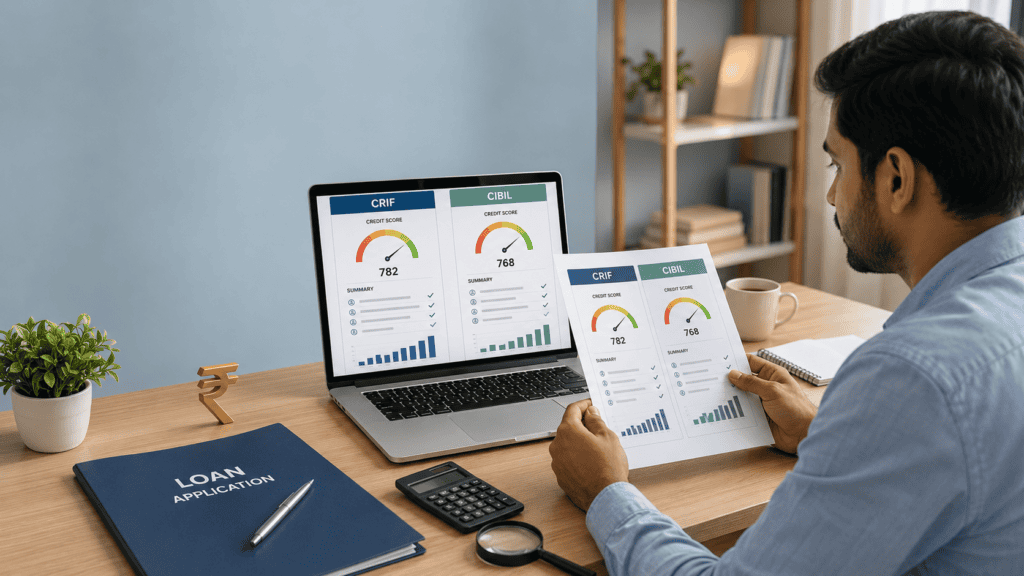
Most Indian borrowers have heard of CIBIL — but many discover CRIF High Mark for the first time only when a lender mentions it during a personal loan or credit card application. Suddenly there are two scores, two reports, and often two different numbers, and no one has explained why. CRIF High Mark and CIBIL are both credit bureaus operating in India, not lenders, not government agencies, and not apps. They collect repayment data from banks and NBFCs, build credit reports, and generate credit scores. The confusion most borrowers face is real: a CIBIL score of 760 and a CRIF score of 710 can coexist, and a lender may use either or both. This article explains what each bureau does, why your scores can differ, which one a lender is likely to check, and what you should do before applying for any credit.
Quick Answer: CRIF High Mark vs CIBIL
CRIF High Mark vs CIBIL means comparing two credit bureaus used in India to assess borrower credit history. Both may show credit scores in a 300–900 range, but scores can differ because lender reporting, update dates, account matching, and scoring models are not identical. Loan approval depends on lender policy, not only one score.
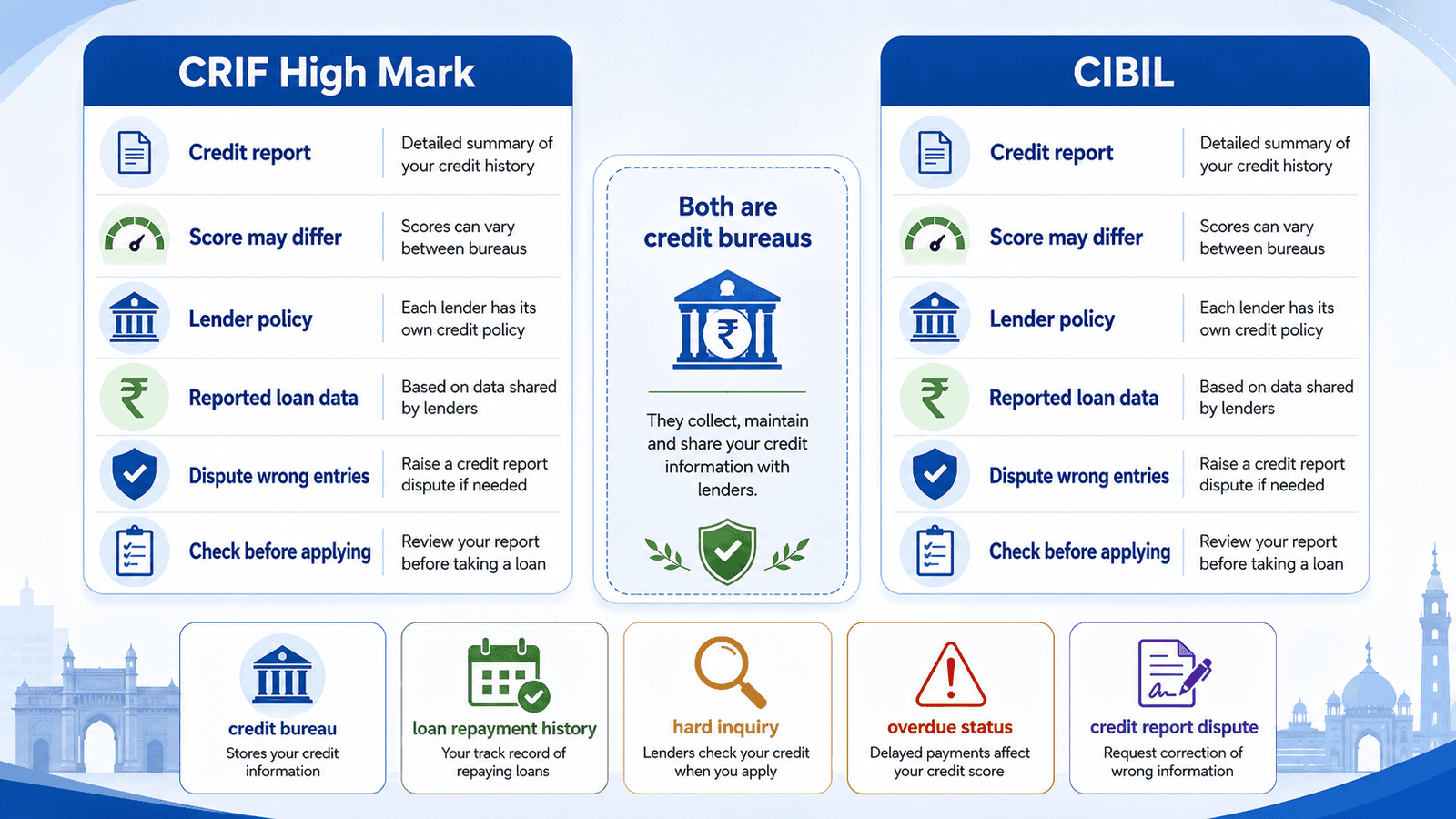
Key Takeaways
- CIBIL is not the only credit bureau in India — CRIF High Mark, Experian, and Equifax are also licensed credit information companies, and any one of them may be used by your lender.
- Your CRIF score and your CIBIL score can be different numbers even for the same person — this is normal and does not mean either report is wrong by default.
- A score difference between two bureaus can happen because your lenders may not report to both bureaus, reporting dates may differ, or the bureaus may use different scoring models on the same underlying data.
- Lenders in India — banks, NBFCs, fintech platforms — each decide which bureau or bureaus to check, so a good CIBIL score does not guarantee the same outcome if the lender pulls a CRIF report.
- Report accuracy matters far more than obsessing over one score number: a wrong active loan, an uncleared overdue amount, or a settled-but-unpaid remark in either report can cost you an approval regardless of the score shown.
- Before applying for any major credit — personal loan, home loan, or credit card — check your report on the bureau your lender is likely to use, verify all account statuses, and dispute wrong entries first.
CRIF High Mark vs CIBIL: Quick Comparison
| Factor | CRIF High Mark | TransUnion CIBIL |
|---|---|---|
| Full name | CRIF High Mark Credit Information Services Pvt. Ltd. | TransUnion CIBIL Limited |
| Licensed by | RBI as a Credit Information Company | RBI as a Credit Information Company |
| Credit score range | 300–900 (verify at crifhighmark.com before publishing) | 300–900 (verify at cibil.com before publishing) |
| Primary data source | Lender-reported repayment data: loans, cards, overdue amounts | Lender-reported repayment data: loans, cards, overdue amounts |
| Known lender coverage | Wide coverage including microfinance and NBFC lenders | Wide coverage including major banks and credit card issuers |
| Scores may differ? | Yes — due to reporting gaps and model differences | Yes — same reason |
| What borrower should check | Full report: open loans, overdue entries, closed-but-showing-active accounts | Full report: same checks, plus hard inquiries from recent applications |
| Official website | crifhighmark.com | cibil.com |
Key Facts at a Glance
| Fact | What It Means for You |
|---|---|
| Both are credit information companies | They collect and store your repayment history — they do not lend money and do not approve or reject your loan. |
| Both depend on lender-reported data | If a lender does not report to a bureau, that bureau will not have the account on your record. This is a common reason scores differ. |
| Checking your own report is a soft inquiry | Downloading your own credit report from CRIF or CIBIL does not reduce your credit score. Only lender-initiated hard inquiries affect it. |
| Wrong entries must be disputed with the correct bureau | A wrong entry in your CRIF report must be disputed with CRIF; a CIBIL error with CIBIL. One bureau cannot correct another bureau’s record. |
| Score alone does not guarantee loan approval | A lender checks your score, income, existing EMI burden, account-level data, and internal credit policy before deciding. |
To understand your CIBIL score — what the numbers mean and how the range works — see our full explainer before comparing across bureaus.
How Credit Bureaus Work in India
A credit information company — the formal term under the Credit Information Companies (Regulation) Act, 2005 — collects repayment data from its member lenders and uses that data to generate a credit report and a credit score for each borrower. Think of it as a centralised record-keeping system that banks and NBFCs feed data into.
Every time you take a loan, a credit card, or miss an EMI, your lender reports the event to one or more credit bureaus. The bureau stores it at the account level — not just as a headline score, but as a detailed record showing loan amount, outstanding balance, payment history, Days Past Due (DPD), overdue amount, written-off status, and whether the account is currently active or closed.
What goes into a credit report
Your credit report is not just a three-digit number. It contains your personal details, a list of every credit account the bureau has on record, payment history month by month, any defaults or settlements, and a log of hard inquiries made by lenders who have pulled your report. The credit score is a summary — a single number calculated by the bureau’s scoring model from all this underlying data.
According to RBI’s regulatory framework at rbi.org.in, all four licensed credit information companies in India — CRIF High Mark, TransUnion CIBIL, Experian, and Equifax — must follow the same data collection and reporting standards. That does not mean their records will be identical for every borrower, because not every lender reports to all four bureaus.
The difference between a score and a full credit report matters — to explore that further, read our guide on credit score vs CIBIL, which breaks down what is and is not captured in a score alone.
What is CRIF High Mark?
CRIF High Mark Credit Information Services is a licensed credit information company in India. It is part of the CRIF Group, an international credit bureau and analytics company. CRIF High Mark is particularly known for its coverage of microfinance loans, rural lending, and NBFC borrower data — segments where many smaller lenders report repayment information to CRIF but not necessarily to CIBIL.
As a borrower, you can request your own credit report and score from CRIF High Mark directly through their official website at crifhighmark.com. The report shows the same types of information any bureau report would: your personal details, credit accounts, payment history, overdue amounts, inquiries, and a credit score derived from that data. Fees, access methods, and free report entitlement details should be verified directly at crifhighmark.com before acting, as these can change.
What is TransUnion CIBIL?
TransUnion CIBIL Limited is one of India’s most widely recognised credit information companies. “CIBIL score” has become so common in Indian lending conversations that many borrowers use it as a generic term for any credit score — but CIBIL is one specific bureau, not a synonym for all credit bureaus.
CIBIL has historically had strong lender coverage among major banks and credit card issuers, which means most large bank loans and credit card repayment histories are likely to appear in a CIBIL report. Borrowers can check their CIBIL score and report through cibil.com. As with CRIF, access fees and free report eligibility should be confirmed at the official source, as terms can change.
Why Your CRIF and CIBIL Scores May Be Different
This is the question that most confuses borrowers who see two different numbers. The short answer: both scores are calculated from reported data, and the reported data may not be identical across bureaus.
| Reason for Difference | Example | What to Check |
|---|---|---|
| Lender reports to only one bureau | Your NBFC home loan appears in CRIF but not in CIBIL because the NBFC only reports to CRIF | Check which bureaus your key lenders report to |
| Different reporting dates | Your last EMI payment appears in CRIF already but has not yet been reflected in CIBIL this month | Check both reports within the same week for accuracy |
| Account status mismatch | A loan you closed 6 months ago is showing as active in CRIF but closed in CIBIL | Get NOC from lender and raise a dispute with CRIF |
| Overdue data difference | A missed payment from 3 years ago was reported to CIBIL but not to CRIF, or vice versa | Check DPD history in both reports |
| Different scoring models | Both bureaus have the same underlying data but score it differently using their own proprietary algorithm | Focus on report accuracy, not just the score number |
| Bureau update cycle | One bureau updates account data faster than the other after a dispute or payment | Recheck after waiting for the bureau’s standard update cycle |
Which Score Matters More for Loan Approval?
The honest answer is: it depends entirely on which bureau or bureaus your lender uses — and lenders are not required to tell you in advance. Different banks, NBFCs, and fintech platforms use different bureau subscriptions as part of their credit assessment process.
Larger banks that have been operational for decades and primarily serve salaried employees in urban centres tend to have strong CIBIL coverage in their loan origination systems. Newer NBFCs, microfinance institutions, and fintech lenders may rely more heavily on CRIF High Mark, particularly if their borrower base includes self-employed individuals, rural borrowers, or applicants with thin credit files on CIBIL.
Some lenders pull reports from more than one bureau and use the combination to make a credit decision. This means a clean CIBIL score does not protect you if CRIF shows an unresolved overdue amount or a loan that appears active but was closed years ago.
The practical implication: do not apply blindly based on one app’s score. Before submitting a formal application, verify the actual report data on at least the two most relevant bureaus for the lender you are approaching.
Real Example: Ravi’s Score Mismatch Before a ₹5 Lakh Loan
Ravi is 34 years old, works as a senior accounts executive in Nagpur, and earns ₹52,000 per month. He has no active defaults and has been repaying a credit card on time for three years. When he checks his score on a popular financial app, it shows a CIBIL score of 760 — well into the comfortable range for personal loans.
When Ravi approaches an NBFC for a ₹5 lakh personal loan, the lender informs him that his CRIF score is coming up as 710. The 50-point gap surprises him. After downloading his full CRIF report, Ravi finds a personal loan he closed 18 months ago still showing as active with an outstanding balance listed. The lender had not updated the account closure status to CRIF High Mark at the time.
Ravi contacts the original lender, obtains the loan closure certificate and NOC, and raises a dispute with CRIF High Mark through crifhighmark.com. While waiting for the update, he holds off on submitting the formal loan application. Once the account status is corrected, his CRIF score improves and he applies with a cleaner profile.
The key insight here is not that one bureau is better than the other — it is that report accuracy matters more than chasing a higher score number. Ravi’s CIBIL was not wrong; his CRIF report had stale data. Fixing the report, not the score, was the correct action.
How Bureau Differences May Affect Your Loan Terms
Credit bureaus do not set your interest rate or EMI — lenders do. But the credit report a lender pulls can influence the risk assessment they apply to your application, which in turn can affect whether you are approved, the interest rate you are offered, and the loan amount sanctioned.
Consider a hypothetical ₹5 lakh personal loan application. If a lender’s internal risk model rates you as a lower-risk borrower based on a strong report, you may be offered a lower interest rate. If the same lender pulls a report showing an unresolved overdue amount — even a small one — the offer may come at a higher rate, a shorter tenure, or a lower sanction amount. In some cases, the application may be referred for additional verification.
The exact rate, tenure, processing fee, and EMI for any personal loan depend entirely on the lender’s policy, your income, existing obligations, and the credit data they hold. Any specific figures you receive from a lender should be verified directly with that lender before accepting an offer. This article does not calculate or guarantee a loan offer.
CRIF Score vs CIBIL Score: Detailed Comparison
| Comparison Point | CRIF High Mark Score | CIBIL Score |
|---|---|---|
| Score source | CRIF High Mark’s proprietary scoring model applied to lender-reported data held by CRIF | TransUnion CIBIL’s proprietary scoring model applied to lender-reported data held by CIBIL |
| Data basis | Loans, credit cards, and repayment history reported by CRIF’s member lenders — includes strong NBFC and microfinance coverage | Loans, credit cards, and repayment history reported by CIBIL’s member lenders — includes strong bank and credit card issuer coverage |
| Possible lender use | NBFCs, fintechs, microfinance lenders, and some banks — lender choice varies | Major banks, credit card issuers, housing finance companies — lender choice varies |
| Score range (verify) | 300–900 — verify at crifhighmark.com before publishing | 300–900 — verify at cibil.com before publishing |
| Common mismatch reasons | Lender does not report to CRIF, closed loan still showing active, different update cycle | Same reasons apply in reverse — NBFC data missing, older settlement data not yet updated |
| Borrower action for errors | Raise dispute at crifhighmark.com; contact source lender if lender-reported data is wrong | Raise dispute at cibil.com; contact source lender if lender-reported data is wrong |
| Which is “better”? | Neither is universally better. Report accuracy and lender usage decide what matters for your specific application. |
What to Do If a Bureau Shows Wrong or Outdated Information
Finding an error in a credit report is more common than most borrowers expect. Closed loans still showing as active, paid overdues not cleared, or a loan linked to your name that was never yours — each of these can drag down your score and affect a loan application, regardless of which bureau holds the error.
Step 1 — Download your full credit report
Go directly to crifhighmark.com for your CRIF report or cibil.com for your CIBIL report. Do not rely on third-party apps for dispute-related decisions — always use the bureau’s official platform. Self-checks are soft inquiries and do not reduce your credit score.
Step 2 — Identify the exact error
Look for these items in the account-level data: a loan showing as active that you closed, an overdue amount that you have cleared, a written-off or settled remark on an account you fully paid, a loan that does not belong to you, or incorrect personal details such as a wrong address or duplicate PAN entry.
| Item to Check | Why It Matters | Action |
|---|---|---|
| Closed loan showing active | Inflates apparent outstanding debt — lender may read your FOIR as higher than it is | Get closure certificate or NOC from lender, raise dispute with bureau |
| Overdue amount not cleared after payment | DPD entry or overdue balance lowers score even after you have paid | Collect payment receipt and lender confirmation, raise dispute |
| Written-off or settled remark | Settlement remarks stay on record and signal credit risk to lenders | Confirm with lender that full payment is reflected; dispute incorrect remarks |
| Unknown loan in your name | May indicate identity fraud — requires urgent escalation | Raise dispute with bureau, contact lender, and report to cybercrime portal if fraud is suspected |
| Wrong personal details | PAN or address mismatches can create account-matching errors across bureaus | Update details with bureau using official identity documents |
Step 3 — Raise the dispute with the correct bureau
A CRIF error must be disputed with CRIF High Mark. A CIBIL error must be disputed with TransUnion CIBIL. One bureau cannot access or update another bureau’s records. Submit the dispute through the bureau’s official online dispute resolution process and keep a copy of your submission and any reference number provided.
Step 4 — Contact the source lender if needed
If the error is lender-reported data — for example, a lender has not updated a loan closure — the bureau will typically verify with the lender before correcting the record. You may need to contact your lender directly and request them to send a correction to the bureau. Keep all communication in writing.
Step 5 — Recheck after the bureau’s update cycle
Bureaus update records periodically. After raising a dispute, wait for the bureau’s standard processing timeline — verify the current timeline at crifhighmark.com or cibil.com before applying, as these timelines can change — and then redownload your report to confirm the correction. Do not apply for new credit while a significant dispute is pending.
For a detailed walkthrough of the dispute process, see our guide on the credit report dispute process in India. If your CIBIL report specifically shows a loan that was closed but appears active, read how to remove a wrong loan entry from your CIBIL report.
Safety Checklist Before Applying for Credit
- Do not apply to five different lenders at the same time because one app showed a high credit score — each formal loan application triggers a hard inquiry that is visible to other lenders and can signal credit-seeking behaviour.
- Do not trust loan apps that say “90% approval chances” based on a score they showed you — they do not know the lender’s internal credit policy or which bureau the lender will pull.
- Before any major application — personal loan, home loan, credit card — download the full report from at least the bureau your lender is likely to use, and check every account entry, not just the score.
- Verify that all closed loans are marked closed, all overdue amounts are cleared, and there are no written-off or settled remarks that should not be there.
- Keep digital copies — PDF or screenshot — of your bureau reports, dispute submissions, payment receipts, and loan closure certificates. You may need them quickly if a lender queries your profile.
- Understand that multiple loan applications in a short period can affect how lenders read your profile — read about hard inquiry impact on credit score before submitting several applications.
How to Decide What’s Right for You
you are applying for a loan from a large nationalised or private sector bank — check your CIBIL report first, as major banks have historically relied heavily on CIBIL data in their loan origination systems.
you are applying to an NBFC, fintech lender, or microfinance institution — check your CRIF High Mark report as well, since many of these lenders use CRIF as their primary or co-primary bureau.
you are unsure which bureau your lender uses — check both CRIF and CIBIL reports before applying for any loan above ₹1 lakh. The cost of checking is far lower than the risk of a rejection triggered by a correctable data error.
you find any error — closed loan still active, incorrect overdue, wrong personal details — raise the dispute and wait for it to be resolved before submitting a formal loan application.
your scores differ by more than 30–40 points across bureaus — investigate the report-level data rather than ignoring the gap. A meaningful score difference almost always has a traceable cause in the account-level entries.
you have not checked your full credit report in the last 3 months — do not assume your score app is showing a clean profile. Download the full report, review every account entry, and only then decide whether you are ready to apply.
You can check your score free through the official CIBIL platform — the guide explains exactly how to access a full report without paying.
Common Mistakes to Avoid
Treating CIBIL as the only credit score that matters
Many borrowers check only their CIBIL score and assume they are fully prepared for a loan application. If your target lender uses CRIF High Mark — and many NBFCs and fintech platforms do — a CIBIL-only check leaves you blind to what the lender will actually see. Always verify which bureau your lender is likely to use.
Ignoring the full report and focusing only on the score number
A score of 760 does not mean your report is clean. Lenders review account-level entries — active loan balances, Days Past Due history, written-off or settled remarks — not just the headline score. A borrower with a 760 score but an active-looking closed loan may face more scrutiny than one with a 740 score and a completely clean account history.
Applying to multiple lenders immediately after a rejection
Every formal loan application creates a hard inquiry on your credit report. Multiple hard inquiries in a short window signal credit-seeking behaviour to lenders and can reduce your score, making the next application harder. After a rejection, first understand the reason before reapplying anywhere.
Assuming a score difference between bureaus means fraud
Most CRIF vs CIBIL score differences are explained by lender reporting coverage, update timing, or account status mismatches — not fraud. Before panicking, download both full reports and compare the account-level data to identify the specific cause.
Disputing with the wrong bureau
A CRIF error cannot be fixed by raising a dispute with CIBIL. Each bureau holds its own records and handles its own corrections. If you find errors in both reports, raise separate disputes with each bureau — they are independent processes.
Waiting until you urgently need a loan to check your report
Dispute resolution with a bureau takes time. If you discover a wrong entry only after a rejection, you may wait weeks for the correction before you can reapply. Check your reports 2–3 months before any planned loan application so errors can be resolved without time pressure.
Believing that a high score guarantees approval
A credit score is one input into a lender’s decision. Income adequacy, FOIR (Fixed Obligation to Income Ratio), employment stability, loan purpose, and internal credit policy all play a role. A borrower with a 780 score but an EMI burden already at 55% of income may still be declined by a conservative lender.
When This May Not Be the Right Choice
Comparing CRIF High Mark and CIBIL scores is a useful preparation step, but it may not address your real credit problem in these situations:
If you have active loan defaults or a recent settlement remark on any report, fixing the default or the settlement is far more important than understanding score differences between bureaus. No bureau comparison will change what the lender sees in your account history.
If your existing EMI burden is already above 50% of your monthly income, a cleaner credit report alone will not make a new loan affordable or easily approvable — the FOIR issue must be addressed first.
If your rejection reason was income-related — insufficient salary slips, informal income not accepted, or business vintage too short — bureau comparison will not resolve it. The lender’s eligibility criteria, not just the score, is the barrier.
If you are using bureau comparison only to find which score is “better” in order to apply immediately without fixing real report errors, you are optimising the wrong thing. Lenders see what the report says, not which bureau you chose to show them.
If any of these apply to your situation, it may be worth exploring other options before committing.
Official Rules and Where to Verify
For anything related to your credit report, score, or dispute process, use only official sources. Third-party apps and aggregator websites may show scores for convenience, but for disputes, corrections, and regulatory questions, go directly to:
- CRIF High Mark — crifhighmark.com — official source for your CRIF credit report, credit score, dispute submission, and information on report access fees and processes. Fees, access methods, and dispute timelines can change — verify directly before acting.
- TransUnion CIBIL — cibil.com — official source for your CIBIL score, CIBIL credit report, dispute process, and borrower education resources. As with CRIF, access fees and timelines should be confirmed at the official site.
- Reserve Bank of India — rbi.org.in — the regulator that licenses credit information companies in India under the Credit Information Companies (Regulation) Act, 2005. The RBI also sets the framework for borrower rights, fair lending practices, and complaint escalation through the RBI Integrated Ombudsman Scheme.
Why official sources matter more than app screenshots: a score shown on a financial aggregator app may be derived from bureau data but is not a bureau-generated credit report. It may not reflect the most recent update cycle, and it cannot be used as documentation for a dispute or a lender query.
Credit reporting rules, lender assessment methods, and bureau processes can change. Always verify current details from the relevant bureau, lender, or official regulatory source before acting.
Expert Tips
- Download your full credit report — not just your score — from the bureau’s official site at least once every 3–4 months. A score app gives you a number; the full report shows you what lenders actually see: account status, DPD history, hard inquiries, and any written-off or settled remarks.
- When you close a loan, collect the loan closure certificate or No Objection Certificate (NOC) from the lender in writing and keep it. If the bureau takes time to update the account status — or the lender delays reporting the closure — you have proof to submit with a dispute.
- Match your account entries across both CRIF and CIBIL reports. If a loan appears in one report and is missing from the other entirely, note it — this is usually a lender reporting gap, not an error, but it explains why the scores differ.
- Raise disputes early — ideally 2–3 months before any planned loan application — not after a rejection. Dispute resolution takes time, and applying while a dispute is pending means the lender sees the uncorrected data.
- Avoid submitting multiple loan applications at the same time. Each application creates a hard inquiry. Instead, research eligibility criteria in advance — many lenders publish minimum score and income requirements — and apply to one or two lenders you genuinely qualify for. Use wrong loan entry guidance if any accounts in your report need correction before you apply.
- If a lender informs you that your CRIF score was checked and it affected your application, ask for the specific reason in writing if possible. Understanding whether the issue was score-related or account-level helps you target the right fix.
Frequently Asked Questions
Is CRIF High Mark the same as CIBIL?
No. CRIF High Mark and TransUnion CIBIL are two separate credit information companies licensed by the RBI in India. They independently collect repayment data from their member lenders, maintain separate credit records, and generate credit scores using their own scoring models. Your CRIF report and your CIBIL report are different documents, held by different companies.
Which is better — CRIF High Mark or CIBIL?
Neither is universally better. Both are regulated credit bureaus. What matters is which bureau your lender uses — and that depends on the lender’s internal credit policy, not the bureau itself. Major banks tend to have strong CIBIL coverage, while many NBFCs and fintech lenders use CRIF High Mark. Some lenders check more than one bureau.
Why is my CRIF score different from my CIBIL score?
Score differences are common and usually explained by one or more of these factors: your lenders do not all report to both bureaus, reporting dates differ between bureaus, one bureau has an account status that the other has not yet updated, or the two bureaus use different scoring models on the same data. Investigate the account-level entries in both reports to find the specific cause.
Do banks check CRIF or CIBIL for personal loans?
It depends on the bank or NBFC. Large nationalised and private sector banks commonly use TransUnion CIBIL. Many NBFCs, fintech lenders, and microfinance institutions rely on CRIF High Mark. Some lenders pull reports from both bureaus. There is no single universal answer — check with the specific lender or look at their terms and conditions for credit assessment details.
Can a loan be rejected because of a CRIF score even if my CIBIL score is good?
Yes. If the lender uses CRIF High Mark as their primary bureau and your CRIF report shows an unresolved overdue amount, an active-looking closed loan, or a settlement remark, that data can affect the decision regardless of what your CIBIL report shows. A good score on the bureau the lender does not check does not protect your application.
How do I correct wrong information in my CRIF or CIBIL report?
For CRIF errors, raise a dispute through crifhighmark.com. For CIBIL errors, raise a dispute through cibil.com. Each bureau handles its own correction process independently. Gather supporting documents — payment receipts, loan closure certificate, lender confirmation — and submit them with your dispute. If the error is lender-reported data, you may also need to contact the lender directly to ask them to send a correction to the bureau. Do not apply for credit while a significant dispute is pending.
Does checking my CRIF or CIBIL score reduce my credit score?
No. Downloading your own credit report — whether from crifhighmark.com or cibil.com — is a soft inquiry and does not affect your credit score. Only lender-initiated hard inquiries, triggered when you apply for a loan or credit card, are recorded on your report and may have a minor impact on your score if too many occur in a short period.
How often should I check both my CRIF and CIBIL reports?
For most borrowers, checking both reports once every 3–4 months is practical — and always before any major loan application. If you are actively disputing an entry, recheck the relevant bureau’s report after the dispute resolution period to confirm the correction has been applied.
Final Verdict
CRIF High Mark and CIBIL are both legitimate, RBI-licensed credit bureaus, and both can affect your loan approval depending on which one your lender uses. The borrower who understands CRIF High Mark vs CIBIL differences is better prepared — not because one score is more important than the other, but because knowing that both exist prevents the common mistake of preparing only one report before applying.
If you are a salaried borrower applying to a major bank, prioritise your CIBIL report. If you are approaching an NBFC or fintech lender, check your CRIF report as well. If you are planning a large loan — home loan, personal loan above ₹3 lakh, or business loan — check both reports, resolve any data errors, and apply only when the account-level data is clean and accurate. The score is the summary; the report is the evidence.
Always verify your latest credit report, lender requirements, and bureau process before making a credit-related decision.
This article is for educational purposes only and should not be treated as personalised financial, credit, or legal advice. Credit scores, credit reports, lender eligibility criteria, and bureau processes can vary and may change over time. Please verify current details with the relevant credit bureau, lender, official regulatory source, or a qualified professional before making any credit-related decision.

Neha Menon writes simple, borrower-first explainers on CIBIL scores, credit reports, bureau disputes, DPD, loan settlement impact, hard inquiries, and practical credit score recovery. She focuses on helping Indian borrowers understand lender-reported data, avoid credit mistakes, and take safer next steps without false promises.