

Your annual appraisal just came through, or maybe you finally cleared a big expense and there’s ₹10,000 sitting in your account every month with nowhere obvious to go. The question almost every salaried Indian reaches eventually: should I prepay this loan, or should I start a SIP? Both feel like the right thing to do. Both have people on the internet swearing by them. And the honest answer is that it genuinely depends — on what kind of loan you have, whether you have an emergency fund, how stable your income is, and how much financial stress you can handle. This guide gives you a practical, borrower-first framework to decide whether to pay off loan or start SIP — or do both, in the right order.
Quick Answer: Pay Off Loan or Start SIP?
Pay off loan or start SIP depends first on debt cost, emergency fund and risk comfort. If the loan is high-interest debt like credit card dues or a personal loan, repayment usually deserves priority. If EMIs are comfortable and the goal is long-term, a SIP or split approach may work better.
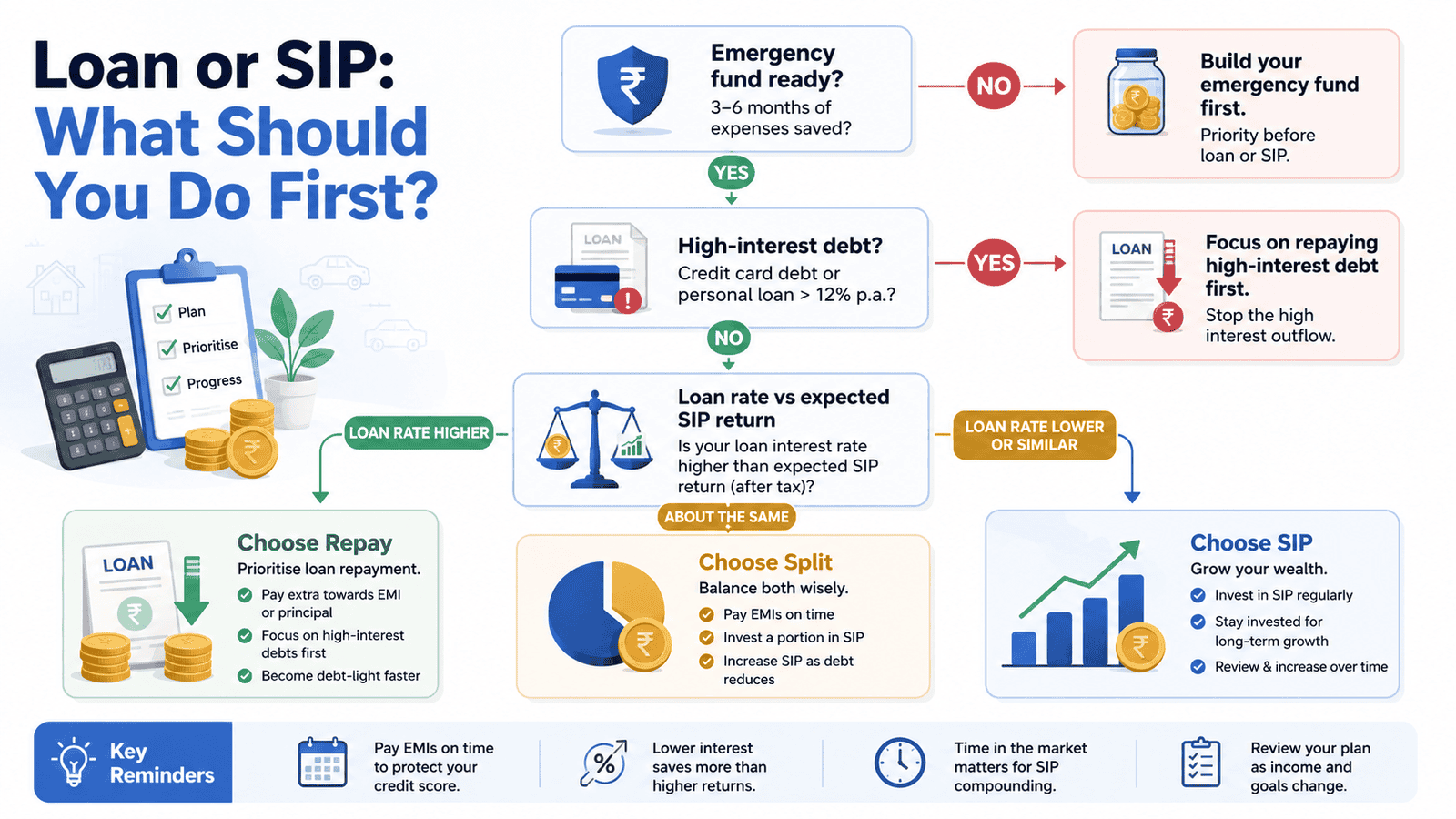
Key Takeaways
- High-interest debt — especially revolving credit card dues and personal loans — usually deserves repayment priority before any SIP is started, because the interest cost compounds faster than most investors expect.
- SIP investing can make sense when your existing EMI-to-income ratio is comfortable, your emergency fund is in place, and your loan carries a relatively low interest rate — such as a standard home loan.
- Your emergency fund should not be sacrificed for either prepayment or SIP; without 3–6 months of expenses in a liquid account, any financial shock can force you back into expensive borrowing.
- A hybrid split — part surplus to loan prepayment, part to SIP — can work well for borrowers who are unsure, or who have a manageable loan and want to build long-term wealth alongside repayment discipline.
- Prepayment charges and foreclosure charges on your existing loan must be checked before making any lump-sum payment; these can reduce or eliminate the benefit of early repayment.
- SIP returns are market-linked and not guaranteed — any comparison with your loan interest rate should treat the SIP return as an assumption, not a certainty.
Loan Prepayment vs SIP: Comparison at a Glance
| Factor | Loan Prepayment | SIP Investing |
|---|---|---|
| Certainty of benefit | Predictable — interest saved is fixed at your loan rate | Market-linked — returns depend on fund performance |
| Liquidity after action | Low — money goes to lender and reduces your buffer | Higher — mutual fund SIP units can be redeemed (subject to exit load and tax) |
| Risk level | Low risk — guaranteed reduction in debt burden | Variable risk — equity markets can fall, especially short-term |
| Psychological benefit | Strong — reduces EMI stress, improves cash flow, improves credit utilisation | Moderate — wealth-building is gradual and may not feel immediate |
| Tax angle | Home loan principal repayment may qualify under Section 80C; interest under Section 24(b) — verify current limits at incometax.gov.in | ELSS SIPs may qualify under Section 80C; long-term capital gains and short-term capital gains tax apply on redemption — verify current rates at incometax.gov.in |
| Borrower note | Best when loan rate is high or EMI burden is stressful | Best when loan rate is low, tenure is long, and goal is wealth accumulation |
Debt Priority at a Glance: Which Loan to Tackle First
| Loan Type | Prepayment Priority | SIP Suitability Alongside |
|---|---|---|
| Credit card revolving balance | Highest — clear this before anything else | Avoid SIP until revolving balance is cleared; the interest cost typically far exceeds expected SIP returns |
| Personal loan (unsecured) | High — attack aggressively if EMI is stressful | Possible in small amounts once EMI burden is below 40–50% of income, but check prepayment charges first |
| Vehicle loan (car / two-wheeler) | Medium — worthwhile if early in tenure | SIP alongside is reasonable if EMI is comfortable and emergency fund is in place |
| Home loan | Lower priority — manageable interest, long tenure, tax benefit possible | SIP alongside prepayment is a widely used strategy; check Section 24(b) and Section 80C impact before large prepayments |
| Education loan | Medium — rate varies widely; moratorium period is common | Build SIP after moratorium ends and EMI is manageable; interest may be deductible under Section 80E — verify at incometax.gov.in |
You can repay debt faster using several strategies once you have identified your highest-priority loan.
The Core Trade-Off: Guaranteed Saving vs Market-Linked Return
Here is the one idea that changes how most people think about this decision: prepaying a loan is not the same as earning an investment return.
When you make a part-payment or prepayment on a loan, you are reducing the outstanding principal. Every rupee of principal you eliminate today saves you future interest — at your exact loan interest rate, with complete certainty. If your personal loan charges 15% per annum on a reducing balance, every rupee you prepay saves you 15 paise per year in future interest. That saving is locked in. It does not depend on the market.
A SIP — a Systematic Investment Plan in a mutual fund — works differently. You invest a fixed amount every month into a fund. Over time, markets move up and down, and your corpus grows (or shrinks) based on net asset value changes. According to SEBI (sebi.gov.in), mutual funds are market-linked instruments and past performance does not guarantee future returns. Any number you see online about “12% average equity returns” is a historical illustration, not a promise.
This is why comparing a 15% personal loan rate with a “12% SIP return” is misleading. The 15% loan saving is guaranteed the moment you prepay. The 12% SIP return is an assumption about what may happen over many years — and equity markets can fall 30–40% in a bad year, which a short-term investor may not recover from in time.
Why the headline rate comparison is incomplete
Even when comparing loan rates with SIP returns, you need to factor in several other variables. Prepayment charges — often called foreclosure charges — can eat into the benefit of early repayment, especially on personal loans and vehicle loans. Tax treatment matters: home loan interest has a potential deduction under Section 24(b), and principal under Section 80C, which reduces the effective cost of the loan. ELSS mutual funds may also qualify under Section 80C. Long-term capital gains on equity mutual funds are taxed, which reduces net SIP returns.
The EMI burden — the share of your monthly income going to EMIs — is another lens. If your EMIs consume more than 40–50% of your take-home income, your financial flexibility is already stretched. In that position, adding a SIP means managing too many obligations simultaneously. Bringing the EMI burden down first gives you breathing room.
Opportunity cost also runs both ways: money used for prepayment cannot be invested; money invested in a SIP does not reduce your interest outgo. The question is which opportunity cost is more expensive for your specific situation right now.
Real Example: Three Borrowers, the Same ₹10,000 Surplus
Meera, Arjun, and Priya each earn similar salaries and each has ₹10,000 of surplus money every month. They face very different decisions — because their loan situations are different. (All figures below are illustrative. Actual savings and returns will vary based on loan terms, market conditions, and individual circumstances.)
Case A — Meera, 29, Bengaluru, software analyst, personal loan at a higher interest rate: Meera has an outstanding personal loan balance of ₹3.5 lakh with a remaining tenure of 2 years. Her loan carries a high interest rate on a reducing balance. Using her ₹10,000 monthly surplus for part-payments would reduce her remaining principal, shorten her tenure, and save her a meaningful amount in total interest — a guaranteed benefit. Starting a SIP with the same amount offers an uncertain return over just 2 years, with no guarantee of beating her loan rate. For Meera, loan repayment comes first.
Case B — Arjun, 36, Mumbai, marketing manager, manageable home loan: Arjun has a home loan of ₹42 lakh at a lower interest rate on a reducing balance with 17 years remaining. His EMI-to-income ratio is comfortable. He already has 4 months of expenses in a liquid savings account. His surplus is ₹10,000 per month. Arjun is in a position where starting a SIP alongside moderate home loan repayment may make sense over a long horizon. However, he should verify the current tax deduction position on his home loan under Section 24(b) before deciding how aggressively to prepay. A 50:50 split is a reasonable starting point for him.
Case C — Priya, 31, Hyderabad, accounts executive, no emergency fund: Priya has a moderate personal loan EMI but no emergency savings. She wants to start a SIP with her ₹10,000. The problem: if Priya faces a sudden medical expense, job disruption, or family emergency, she will have no buffer and may be forced to either stop her SIP, take a top-up loan, or use a credit card — all of which are more expensive than simply building a ₹2–3 lakh emergency buffer first. For Priya, the right answer is to build her emergency fund before prepayment or any SIP.
Checklist: Before You Decide, Answer These Five Questions
Run through this checklist with your own numbers before committing your surplus to either option.
Your Pre-Decision Checklist
- Do you have 3–6 months of monthly expenses in a liquid account? If not, build this before prepaying aggressively or starting a SIP. This is the foundation, not optional.
- Are you currently revolving credit card dues? If yes, clear the outstanding balance before directing any surplus elsewhere. Credit card revolving interest is typically the most expensive debt an ordinary Indian salaried borrower carries.
- Is your total EMI burden below 40–50% of your take-home income? If yes, you may have room to start a SIP alongside your regular EMIs. If not, reducing EMI stress comes first.
- Does your loan carry a prepayment or foreclosure charge? Check your loan agreement before making any lump-sum payment. On some personal loans and floating-rate home loans, RBI guidelines restrict foreclosure charges for individual borrowers — but always verify in your specific agreement. Read about personal loan prepayment charges before acting.
- Is your financial goal short-term (under 3 years) or long-term (5 years or more)? Equity SIPs are better suited to long-term goals. If the goal is 2–3 years away, market-linked instruments carry higher timing risk.
How to Compare: The ₹10,000 Monthly Surplus Example
The table below compares three approaches for a borrower with ₹10,000 monthly surplus and a remaining personal loan tenure of 3 years. All figures are illustrative and assume a mid-range personal loan rate for reference; actual outcomes depend on your loan agreement, prepayment charges, market conditions, and fund selection. Do not treat any SIP return figure as guaranteed.
| Option | What you do with ₹10,000/month | Likely benefit |
|---|---|---|
| Full prepayment | Apply entire ₹10,000 as monthly part-payment on loan | Reduces principal faster, shortens tenure, saves interest — predictable and guaranteed at your loan rate. Check foreclosure charges first. |
| Full SIP | Invest entire ₹10,000 in a mutual fund SIP | Potential for corpus growth over 3 years — but equity returns are market-linked and not guaranteed. Short tenure increases timing risk. |
| 50:50 split | ₹5,000 toward loan part-payment + ₹5,000 SIP | Reduces debt burden while starting a long-term investment habit. Works best when loan rate is moderate and EMI burden is manageable. |
For home loan part prepayment, the tax and tenure implications add another layer — always run the numbers with your current outstanding balance, remaining tenure, and any applicable Section 80C or Section 24(b) benefit before making a large lump-sum payment.
Interest saved by prepayment = Outstanding principal × Loan rate × Remaining tenure impact
This is a simplified illustration. Actual interest saved depends on whether your prepayment reduces tenure or EMI, whether your lender applies the payment immediately to principal, and any charges. Use your lender’s amortisation schedule for exact figures.
Safety Checklist: Decisions That Can Hurt You
Do not invest while carrying revolving credit card dues
If you are paying only the minimum amount due on your credit card and carrying a balance month to month, you are likely incurring interest on the revolving balance at a very high effective rate. Starting a SIP while this balance grows is counterproductive — the interest compounding on the card almost always outpaces expected SIP returns. Understand how the credit card debt trap works before making any investment decision.
Do not empty your emergency savings for prepayment
Prepaying a loan with your emergency buffer feels satisfying — until a medical bill, car repair, or job disruption forces you to borrow again at a higher rate. The interest saved by prepayment can be wiped out quickly if you have to take a fresh personal loan to cover an emergency.
Do not stop all long-term protection goals to chase SIP growth
If you have a life insurance premium, a health cover, or a small provident fund contribution, do not redirect all of that toward SIP in the hope of higher returns. Protection and liquidity come before optimisation.
Do not take a new loan to invest in SIP
Borrowing to invest — sometimes called leveraged investing — is a high-risk approach that can damage your financial position significantly if markets fall. SEBI (sebi.gov.in) cautions investors about the risks of using borrowed funds for market investments.
Do not assume past mutual fund returns will repeat
All mutual fund communications in India are required to display “mutual fund investments are subject to market risks.” Historical returns from equity funds, while encouraging over long periods, are not a guarantee of future performance.
How to Decide What’s Right for You
you have no emergency fund covering 3–6 months of expenses — build that first, before either aggressive prepayment or SIP investing.
you are carrying revolving credit card dues — clear that balance before directing any surplus elsewhere; the effective interest rate on revolving credit card balances is typically the most expensive debt in your financial life.
you have a high-interest personal loan or vehicle loan and your EMI burden is stressful — consider directing surplus toward prepayment to reduce the principal and shorten your tenure.
you have a manageable home loan, a stable income, an adequate emergency fund, and a long-term goal — a SIP alongside regular EMIs may be a sensible approach; start small and review annually.
your financial goal is 5 years or more away and your EMI-to-income ratio is comfortable — a split approach (part surplus to prepayment, part to SIP) may balance debt reduction with wealth building. Review your monthly salary budgeting to confirm your surplus number is reliable.
your goal is less than 3 years away — be cautious about equity SIP, where short-term market volatility increases the risk of not having the corpus you need when you need it.
you are confident about your income stability, existing loan charges, and tax position — do not commit a large lump sum to either aggressive prepayment or a large SIP increase until you have verified your loan agreement, current prepayment charges, and tax rules. A conservative split approach may be safer while you gather that information.
Common Mistakes to Avoid
Comparing your fixed loan rate with an aggressive SIP return assumption
This is the most common error. A loan at 14% gives you a guaranteed 14% benefit per rupee prepaid. A SIP “at 12%” is an expectation, not a fact. When borrowers assume SIP returns will always be higher than their loan rate, they sometimes delay repayment — and the loan keeps compounding.
Ignoring prepayment and foreclosure charges
Some personal loans and vehicle loans carry prepayment charges of 2–5% of the outstanding amount. If you prepay ₹2 lakh and pay ₹4,000–₹10,000 in charges, your effective benefit is lower. Always read the loan agreement before making a lump-sum payment. RBI guidelines restrict floating-rate home loan foreclosure charges for individual borrowers, but personal loans on fixed rates may carry charges — verify in your agreement.
Investing while rolling over credit card dues every month
This behaviour quietly drains wealth. A borrower who invests ₹5,000 in SIP while paying only the minimum due on a credit card is likely paying more in card interest than they are growing in the fund. Clear the revolving balance first, then invest.
Using emergency savings for a large prepayment
Emptying a savings account to make a bulk prepayment reduces interest cost on paper — but it leaves the borrower without any buffer. The next emergency typically results in a new loan at a higher rate, reversing any benefit of the prepayment.
Stopping SIP permanently after deciding to prepay
Some borrowers pause SIP to focus on loan repayment — which is reasonable when the loan is expensive. The mistake is never restarting. Compounding in equity investments requires time. A long pause can set back long-term wealth accumulation significantly, especially if it happens in the borrower’s 30s when compounding years are most valuable.
Making a one-time permanent decision instead of reviewing annually
The right split between repayment and SIP can change every year — with salary growth, a change in loan outstanding, a market correction, or a change in family obligations. A decision made at 30 may not still be optimal at 33. Review your allocation at every annual appraisal cycle.
When This May Not Be the Right Choice
Job instability or variable income: If your income is uncertain — contract work, commission-heavy roles, or a business going through a slow phase — neither aggressive prepayment nor a high SIP commitment may be wise. Protecting liquidity should come first.
Upcoming large medical or family expense: If you anticipate a significant expense in the next 12–18 months — a medical procedure, a child’s school admission, a family event — committing your surplus aggressively to either option reduces your ability to meet that expense without borrowing.
Unclear prepayment charges in your loan agreement: If you have not read your loan agreement carefully and do not know whether prepayment charges apply, making a large lump-sum payment before verifying can reduce the financial benefit significantly.
Very short remaining loan tenure: In the final months of a loan, the interest component of each EMI is already very small. Prepaying at this stage gives limited benefit. The same money in a SIP may have more potential use over the longer term.
If any of these apply to your situation, it may be worth exploring other options before committing.
Official Rules and Where to Verify
The factors that influence this decision — loan rates, prepayment charges, tax deductions, mutual fund taxation, and lender terms — are all subject to change. Before acting on any figure or rule, verify from these sources:
- RBI (rbi.org.in): For borrower protection guidelines, Fair Practices Code applicable to lenders, and any restrictions on foreclosure or prepayment charges. RBI’s regulations provide context for what lenders are permitted to charge individual borrowers.
- SEBI (sebi.gov.in): For mutual fund regulatory context, investor protection framework, and published risk classifications for fund categories. SEBI oversees all registered mutual funds and AMCs in India.
- AMFI (amfiindia.com): For SIP and mutual fund education, fund NAV information, and investor-education material. AMFI (Association of Mutual Funds in India) is the industry body for the Indian mutual fund sector.
- Income Tax Department (incometax.gov.in): For current deduction limits under Section 80C (home loan principal and ELSS), Section 24(b) (home loan interest), and Section 80E (education loan interest). Tax rules for mutual fund capital gains — both long-term and short-term — should also be verified here before making redemption decisions.
- Your lender or bank directly: For the specific prepayment/foreclosure charges on your own loan, the process for making a part-payment, and whether your lender reduces tenure or EMI on part-payment.
Rules, rates, charges, and eligibility conditions can change. Always verify current details from the official source, lender, or relevant regulator before making a financial decision.
Expert Tips
- Use your surplus in sequence, not simultaneously: Emergency fund first — 3 to 6 months of expenses in a liquid account. Then high-interest debt. Then planned long-term investing. Trying to do all three at once with a small surplus often means doing none of them well.
- When the math and the emotions conflict, consider a split: If prepaying feels right but you do not want to give up on starting a SIP, a 50:50 or 60:40 split is a reasonable starting point. It reduces the psychological cost of the decision while making progress on both fronts.
- Review your EMI-to-income ratio after every salary revision: A salary increment is often the best time to redirect additional surplus. If your EMI burden drops below 30% of take-home after an increment, the additional capacity may go toward SIP. If your loan balance is still large, consider using a portion of the increment for a faster prepayment schedule.
- Recheck your SIP amount every year instead of making one permanent decision: SIP amounts can be increased (step-up SIP) or paused during a debt-reduction phase. No decision you make today has to be permanent — the best approach is one you review and adjust annually.
- Keep proof of every loan part-payment or closure: Always obtain a written acknowledgement or account statement from your lender confirming any part-payment made. When you fully close a loan, obtain a No Dues Certificate (NOC) and keep it permanently. This protects your CIBIL record and avoids future disputes.
- Do not confuse SIP discipline with the direction of the money: SIP is a method — investing a fixed amount regularly. Whether the SIP goes into equity, debt, or hybrid funds matters for risk. For a borrower with 2–3 years to a goal, starting a large equity SIP while carrying a high-interest loan may be riskier than it appears on paper.
Frequently Asked Questions
Should I pay off my loan before starting a SIP?
It depends on the loan type and cost. If you have high-interest debt — credit card revolving balance or a personal loan at a higher rate — clearing that first is usually the better financial decision. If your only debt is a manageable home loan, starting a SIP alongside regular EMIs is widely practised. In all cases, an emergency fund should exist before either decision is made aggressively.
Is SIP better than loan prepayment?
Neither is universally better. Loan prepayment gives a predictable, guaranteed benefit equal to your loan interest rate. SIP returns are market-linked and not guaranteed. If your loan rate is higher than what your SIP could realistically earn after tax and risk, prepayment is more efficient. If your loan is low-cost and your time horizon is long, SIP may build more wealth over time — but this comparison is always conditional, not absolute.
Which loan should I close first before investing?
Prioritise in this order: credit card revolving balance first, then high-interest unsecured personal loans, then vehicle loans, then home loans and education loans. Home loans and education loans typically carry lower rates and may offer tax deductions, so they can often coexist with SIP investing for borrowers with stable income and adequate liquidity.
Should I stop my SIP to repay a loan?
Pausing a SIP temporarily to direct more money toward high-interest debt is a reasonable short-term decision. The risk is never restarting. If you pause a SIP, set a specific date to resume — for example, once the personal loan balance falls below a target amount or after the loan is fully closed. A long unplanned SIP pause can reduce long-term compounding significantly.
Is a 50:50 split between SIP and loan prepayment a good idea?
A split approach can work well for borrowers with a manageable loan, a stable income, an emergency fund, and a long-term investment goal. It is not suitable for borrowers with high-interest debt, revolving credit card dues, or no emergency buffer. If you choose a split, review it annually — as your loan balance decreases, you may shift more toward SIP over time.
Should I prepay my home loan or start a SIP?
For a home loan specifically, the decision is more nuanced. Home loans typically carry lower rates than personal loans, and the principal and interest may offer tax deductions under Section 80C and Section 24(b) respectively — reducing the effective cost of borrowing. Verify current deduction limits at incometax.gov.in before making a large prepayment. Many borrowers choose to run a SIP alongside home loan EMIs and make occasional lump-sum prepayments from bonuses.
Can I invest in SIP while having a personal loan?
You can, but evaluate your EMI burden first. If your personal loan EMI, rent, and other fixed obligations consume more than 40–50% of your take-home income, adding a SIP further stretches your monthly cash flow. It may be more prudent to bring the loan balance down, reduce the EMI burden, and then start a SIP with a realistic monthly amount.
What happens if I use my emergency fund to prepay a loan?
You save on interest in the short term — but you lose your financial safety net. If a medical expense, job disruption, or urgent repair arises, you will likely need to borrow again, often at a higher rate than the loan you just prepaid. The net financial outcome is usually worse than if you had kept the emergency fund intact and prepaid more gradually from monthly surplus.
Final Verdict
The decision to pay off loan or start SIP is not a single answer — it is a sequence. Start with your emergency fund: if 3–6 months of expenses are not sitting in a liquid account, build that first. Next, address high-interest debt: credit card revolving balances and expensive personal loans almost always deserve priority over SIP investing, because the interest cost is typically higher than realistic long-term investment returns and the benefit of eliminating it is guaranteed. Once those are handled and your EMI burden is manageable, a SIP alongside regular loan repayment is a reasonable strategy — especially for long-term goals and when your primary debt is a low-rate home loan.
Borrowers with a bonus or lump sum should check prepayment charges before acting, verify the tax impact of home loan prepayments, and consider splitting the surplus rather than committing it entirely to one option when uncertain. A 50:50 split is a starting point, not a permanent formula — review it every year as your loan outstanding and income change.
Always verify the latest rules, charges, and terms from the relevant official source or provider before making a financial decision.
This article is for educational purposes only and should not be treated as personalised financial, credit, tax, or legal advice. Rules, rates, charges, eligibility criteria, and product terms can vary by provider and may change over time. Please verify current details from official sources, the relevant provider, or a qualified professional before making any financial decision.

Priya Raman writes simple, borrower-first guides on UPI issues, banking problems, savings habits, debt repayment, emergency funds, borrower insurance, and everyday money decisions. Her writing helps Indian readers understand practical next steps, avoid avoidable charges, and make safer financial choices without jargon or pressure.