

You settled an old loan or credit card. The recovery calls stopped. You assumed the matter was closed — until you applied for a new loan and the lender hesitated over your credit report. Settled vs closed loan status looks like a small detail, but credit bureaus and lenders read them very differently.
A “closed” account tells a lender you repaid exactly what you owed. A “settled” account tells them you didn’t — and that the lender accepted less to end the matter. That difference can shape whether your next loan application moves forward or gets a second look.
This article walks through what each status actually means in your credit report, how it affects future borrowing, what documents protect you either way, and what you can realistically do if your status needs correcting. No shame, no guesswork — just what to check and what to do next.
Quick Answer: Settled vs Closed Loan
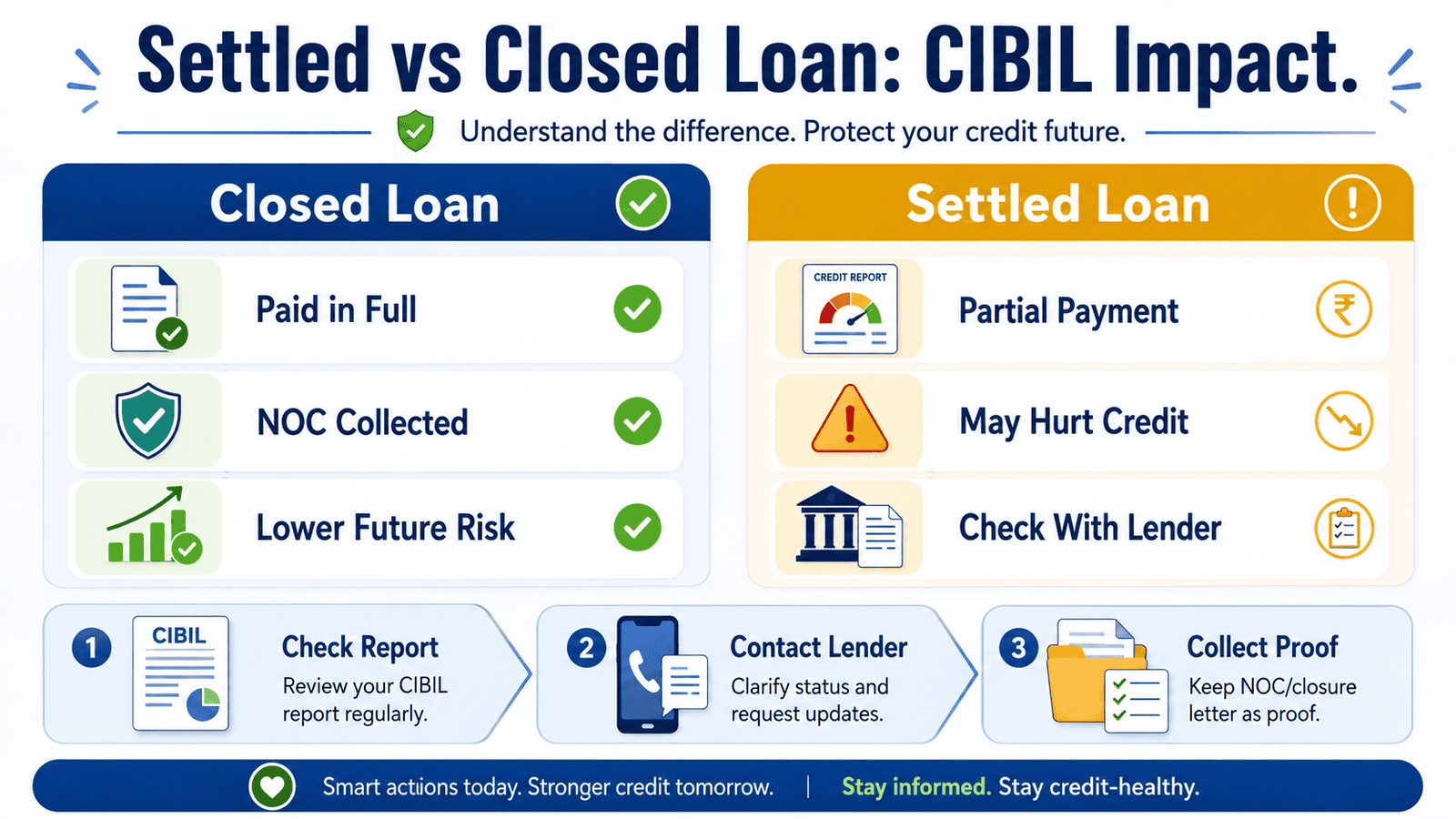
Settled vs closed loan means two very different credit report outcomes. A closed loan usually means the borrower repaid dues fully as agreed, while a settled loan means the lender accepted a lower amount. Settlement may hurt future loan approval, especially if DPD, overdue, or written-off history also appears in the report.
Key Takeaways
- A settled account and a closed account are reported very differently — settlement means you paid less than what you owed, while closure means the full repayment behaviour was completed as agreed.
- After full repayment, always collect a No Dues Certificate (NOC) or closure letter from the lender — this is your proof that the account is genuinely closed.
- Settled status can raise questions during future loan underwriting, particularly when applying for a home loan or a large-ticket loan where lenders review repayment history closely.
- A credit bureau dispute is meant for incorrect reporting only — if your settlement was genuine, the bureau cannot simply remove it because you’d prefer it gone.
- Applying for several new loans right after a settlement tends to add fresh hard inquiries on top of an already cautious profile — space out applications instead.
- Settled, written-off, overdue, and closed are four distinct statuses with different risk signals — knowing which one applies to your account changes what action makes sense.
Settled vs Closed Loan: Quick Difference
A closed loan means you paid back everything you originally owed — principal, interest, and applicable charges — exactly as the loan agreement required. The lender has nothing more to collect, and the account is reported as fully repaid.
A settled loan means you and the lender agreed to end the account for less than the full outstanding amount. The lender accepted a one-time reduced payment instead of continuing to chase the full balance — often after missed EMIs, overdue notices, or a recovery process.
Lenders treat these differently because they are measuring different things. A closed account confirms you repay what you commit to. A settled account confirms the opposite — that under pressure, a portion of your debt went unrecovered. The next lender evaluating your application is essentially asking: did this person honour the full commitment, or did the previous lender have to compromise to get paid?
| Factor | Closed Loan | Settled Loan |
|---|---|---|
| What happened | Full outstanding amount repaid as agreed | Lender accepted a reduced amount to close the account |
| CIBIL report label | Closed | Settled |
| Future loan approval | Generally viewed as a clean repayment record | May prompt extra scrutiny, especially for large loans |
| Borrower action needed | Collect NOC/closure letter and verify report reflects it | Collect settlement letter, payment proof, and check exact reported status |
Settlement isn’t automatically disqualifying — but it’s a flag that future lenders weigh alongside the rest of your written-off status meaning and overall credit behaviour, not in isolation.
Key Facts at a Glance
| Status | What It Usually Means | What to Check |
|---|---|---|
| Closed | Account fully repaid as per original terms | NOC/closure letter, report shows ₹0 balance |
| Settled | Lender accepted a reduced payment to end the account | Settlement letter, exact wording lender used to report it |
| Written-off | Lender treated the unrecovered amount as a loss internally | Whether status later changed to settled after partial recovery |
| Overdue | Payment is due and unpaid as of the reporting date | Days Past Due (DPD) count and current outstanding |
Read your CIBIL report basics guide if any of these terms are unfamiliar — knowing how to read your own report is the first step before deciding what to do about a settled or closed entry.
How Lenders and Credit Bureaus Read Settled vs Closed Status
Credit bureaus like TransUnion CIBIL don’t independently decide whether your loan is settled or closed — they report what the lender submits. Every bank and NBFC sends monthly account-level data: outstanding balance, payment status, DPD count, and final account status when a loan ends.
Closed status reflects completed repayment
When a lender reports an account as closed, it’s confirming the loan ran its full course — every EMI or due amount was paid, and nothing remains outstanding. This is the cleanest possible outcome on a credit report for a loan that’s no longer active.
Settled status reflects a compromise
When a lender reports an account as settled, it’s recording that the loan ended through a negotiated reduced payment, not full repayment. The bureau’s report typically shows the original outstanding amount alongside the lower amount actually recovered — making the gap visible to anyone reviewing your file.
What future lenders actually look at
A lender assessing your next application doesn’t review settled status in isolation. They typically look at the full account history: repayment record across all accounts, current DPD, overdue amounts, written-off entries, and your existing EMI burden relative to income. One settled account from years ago, sitting alongside a otherwise clean repayment history, reads very differently from a settled account that’s recent and sits next to other red flags.
It’s also worth knowing that credit bureaus operate independently of each other. Experian India and TransUnion CIBIL may not show identical scores or identical formatting for the same account, since each compiles data from the lenders that report to them. This is one reason it’s worth checking more than one bureau report if you want a complete picture.
Real Example: Two Borrowers, Two Outcomes
Meena, 29, works as a school administrator in Nagpur earning around ₹38,000 a month. She took a ₹1,00,000 personal loan for a medical expense and repaid every EMI on schedule over two years. When the loan ended, she emailed her lender, received a closure letter and NOC within a few weeks, and her credit report now shows the account as closed with zero outstanding.
Rohit, 33, a salaried employee in Pune earning roughly ₹55,000 a month, had taken a similar ₹1,00,000 personal loan but lost income for several months after a job change. After missing EMIs and facing recovery calls, he negotiated a settlement — paying ₹60,000 as a final amount instead of the full outstanding balance plus accumulated charges.
Both loans are now “finished” in the sense that neither owes the lender anything further. But Meena’s report shows a closed account with a complete repayment history. Rohit’s report shows a settled account — and the next lender reviewing his file will see that ₹40,000 of the original commitment went unrecovered. [CONFIRM — verify current figure before publishing] on how individual lenders weight settled accounts when assessing a fresh application, since underwriting practices vary by institution.
Neither outcome is permanent or disqualifying on its own — but it illustrates why the two statuses carry different weight when a future lender is deciding whether to extend credit.
Why the Unpaid Portion in a Settlement Still Matters
This isn’t an EMI calculation — it’s a simple way to see why settlement leaves a visible gap that full closure doesn’t.
Settlement Gap = Original Outstanding − Amount Actually Paid
Where: Original Outstanding = ₹1,00,000 | Amount Paid in Settlement = ₹60,000 | Gap = ₹40,000
In Rohit’s case, ₹40,000 of the original ₹1,00,000 was never recovered by the lender. That gap is what gets reflected in the account status and is what future lenders are reacting to — not the fact that a payment was made at all, but the fact that the full agreed amount wasn’t.
Contrast this with Meena’s outcome: she paid the complete ₹1,00,000, the lender has nothing further to claim, and her NOC documents that in writing. There’s no gap for a future lender to question. This example is illustrative — actual settlement terms, percentages accepted, and lender responses vary by case and by lender policy.
Comparing All Common Account Statuses
Settled and closed aren’t the only statuses you’ll encounter on a credit report. Here’s how they sit alongside written-off, overdue, and active accounts.
| Status | Risk Signal | Borrower Action |
|---|---|---|
| Closed | Lowest Risk | Keep NOC/closure proof on file |
| Settled | Higher Risk | Keep settlement letter; check if upgrade to closed is possible |
| Written-off | High Risk | Understand if it later became settled after partial recovery |
| Overdue | High Risk | Pay or contact lender immediately to stop DPD from climbing |
| Active/Current | Neutral | Continue on-time payments through full tenure |
Written-off and settled are sometimes confused, but they’re not the same. A written-off account means the lender internally treated the unrecovered amount as a loss — often after a long period of non-payment — without necessarily reaching any settlement agreement with you. Our written-off status meaning guide covers this distinction and what to do if your report shows one.
What to Do If Your Status Looks Wrong or Needs Updating
If your report shows a status you believe is incorrect — for example, a fully paid account still showing overdue, or a settled tag on a loan you closed in full — there’s a process to follow before assuming the bureau will simply remove it.
| Step | Action | Proof Needed |
|---|---|---|
| 1 | Download your latest report from TransUnion CIBIL or another bureau | Recent report copy with account-level detail |
| 2 | Check lender name, account number, status, DPD, and closure date carefully | Cross-check against your own payment records |
| 3 | Contact the lender in writing first if the status appears wrong | Email or written letter, not a phone call alone |
| 4 | Ask the lender to confirm and update the bureau-reported data | Written confirmation from the lender |
| 5 | Raise a bureau dispute only if the lender-reported data is genuinely inaccurate | Lender confirmation plus your own payment proof |
It’s worth being clear-eyed here: a credit bureau dispute exists to correct inaccurate reporting — not to remove a genuine settlement because you’d prefer your report to look different. If you fully repaid a loan but it still shows as settled or overdue, that’s a correction case. If you settled for less than the full amount and the report accurately reflects that, the path forward is usually requesting an updated status from the lender, not disputing the bureau. See the full credit report dispute process for how this works step by step. If your concern is specifically about a paid-off account still showing as active or unpaid, our guide on a wrong loan entry walks through that scenario directly.
Protecting Yourself: A Safety Checklist Before You Settle
If you’re currently being approached for a settlement — whether by the original lender or a recovery agent — a few precautions protect you regardless of what you eventually decide.
Documents to Collect — Closure or Settlement
- NOC / No Dues Certificate — needed for full closure; provided by the lender once the full amount is repaid.
- Settlement letter — needed for any settled account; should state the agreed reduced amount and confirm what status will be reported.
- Payment receipt or UTR reference — proof of the actual transaction, kept regardless of closure or settlement.
- Closure/settlement confirmation email — written lender communication, useful if a dispute is needed later.
- Updated credit report copy — collected a few weeks after closure or settlement to confirm the report reflects what was agreed.
Do not agree to settlement terms over a phone call alone, no matter how much pressure a recovery agent applies. Ask for the settlement offer in writing before you pay anything. Confirm explicitly whether the account will be reported as “settled” or whether the lender will report it as “closed” after the reduced payment — this varies by lender and is worth asking directly rather than assuming. Keep every piece of payment proof, correspondence, and the final letter somewhere safe; these are what protect you if the report doesn’t update correctly months later. Avoid making repeated fresh loan applications immediately after a settlement, since each application typically triggers a hard inquiry that adds to an already cautious-looking profile. The Reserve Bank of India’s Fair Practices Code sets expectations for how regulated lenders should communicate loan terms and recovery practices — a useful reference point if a lender or agent’s conduct feels out of line.
How to Decide What’s Right for You
you can realistically repay the full outstanding amount, even on a slightly extended timeline — full closure is usually the cleaner long-term outcome for your credit report.
you have no realistic path to repaying the full amount due to genuine income loss or hardship — a settlement may be a reasonable last resort, but go in with full awareness of the report impact.
you’re planning to apply for a home loan or another large-ticket loan in the near future — know that a recent settled account is likely to draw extra scrutiny during that underwriting.
the lender is willing to put settlement terms in writing before you pay — do not proceed with the payment until you have that confirmation.
your lender offers a restructuring or revised repayment plan instead of settlement — it’s worth asking about this option, since it may let you complete repayment without a settled tag.
you’re considering taking a new, possibly expensive loan purely to settle an old one — understand the full cost of the new loan first; this can sometimes create a bigger problem than the one it solves.
Common Mistakes to Avoid
Assuming Settled Automatically Means Closed
Many borrowers believe that once a settlement payment clears, the account is simply “done” the same way a fully repaid loan is.
This isn’t accurate — the two statuses are reported differently, and a settled tag remains visible to future lenders reviewing your file, separate from a closed tag. Confusing the two can mean walking into a future loan application unprepared for the questions it raises.
Check your actual report status after settlement rather than assuming the matter is fully resolved.
Not Collecting an NOC After Full Repayment
Borrowers sometimes assume the lender will automatically update the bureau the moment the final EMI clears.
Without a written NOC or closure letter in hand, you have no proof if the report shows an error later — and correcting that without documentation is far harder. This can delay a future loan approval by weeks while you chase down old paperwork.
Request the NOC proactively as soon as your final payment is made, even if the lender doesn’t offer it first.
Trusting Verbal Settlement Promises from Recovery Agents
A recovery agent on the phone offering a “special one-time settlement” can sound urgent and final.
Verbal terms aren’t enforceable and give you nothing to point to if the lender later reports something different from what was promised. Borrowers have paid settlement amounts only to find the account still shows overdue months later.
Insist on written settlement terms before making any payment, regardless of the urgency conveyed.
Raising a Bureau Dispute Without Lender Proof
Some borrowers file a credit bureau dispute hoping a settled status will simply be removed.
Without documentation from the lender confirming an error, the dispute is unlikely to succeed, since the bureau is reporting what the lender submitted. This wastes time that could go toward the more effective step — contacting the lender directly.
Get lender confirmation of any error first, then use the dispute process to formalise the correction.
Applying for Multiple New Loans Right After Settlement
Some borrowers, eager to “rebuild,” apply to several lenders in quick succession after a settlement.
Each application typically generates a hard inquiry, and a cluster of recent inquiries on top of a recent settled account can make a profile look more, not less, risky to an underwriter. This can also lead to rejections that themselves become visible on the report.
Space out applications and consider strengthening other parts of your credit profile first.
Ignoring the Difference Between Lender Correction and Bureau Dispute
Borrowers sometimes go straight to a bureau dispute for issues that actually need to be resolved with the lender first.
If the lender hasn’t yet updated their internal records, a bureau dispute filed before that correction often gets rejected or delayed, since the bureau is simply reflecting what the lender last reported.
Always confirm correction with the lender first, and use the bureau dispute route only once you have written lender confirmation of an error.
When This May Not Be the Right Choice
When This May Not Be the Right Choice
Settlement isn’t the right path in every situation. If you can realistically repay the full outstanding amount, even with some extra time or a revised schedule from the lender, full closure is generally the better long-term outcome for your credit profile.
If you’re planning to apply for a home loan or another large loan in the near future, settling an existing account first may create exactly the scrutiny you’re trying to avoid — it’s worth discussing timing with the lender before proceeding.
If a lender or recovery agent refuses to put settlement terms in writing before asking for payment, that’s a reason to pause rather than proceed.
If your report shows incorrect data rather than a genuine settlement, the correction route — through the lender and then the bureau if needed — is the right path, not a settlement negotiation.
If any of these apply to your situation, it may be worth exploring other options before committing.
Official Rules and Where to Verify
Credit account status, scoring methodology, and dispute handling are governed by the credit bureaus and the lenders that report to them. For verification, refer to:
- TransUnion CIBIL (transunioncibil.com) — primary source for your credit report, account status, and dispute filing
- Experian India (experian.in) — for cross-checking report data, since formatting and scoring can differ across bureaus
- CRIF High Mark (crifhighmark.com) — an additional bureau worth checking for a fuller picture
- Equifax India (equifax.co.in) — another bureau that may hold lender-reported data on your accounts
- RBI (rbi.org.in) — for general fair lending practice standards and borrower grievance context
Credit reporting rules, lender assessment methods, and bureau processes can change. Always verify current details from the relevant bureau, lender, or official regulatory source before acting.
Expert Tips
Expert Tips
- Keep every active EMI and credit card payment on time going forward — consistent recent behaviour can carry real weight alongside an older settled account.
- If you use credit cards, keep utilisation low rather than running balances close to your limit, since this is a factor lenders watch closely.
- Avoid applying for multiple new loans or cards in a short window — each hard inquiry adds up and can make a profile look credit-hungry.
- Build a longer track record of on-time payments before applying for a large loan like a home loan — time and consistency can help your case more than any single action.
- Re-check your credit report a few weeks after the lender confirms an update, rather than assuming the change reflected immediately.
- If pursuing a settlement, ask directly whether the lender will report it as “closed” after the reduced payment — this isn’t guaranteed, but it’s worth asking before you pay.
- Once your situation stabilises, see our guide on recovery after default for a realistic, non-guaranteed roadmap.
Frequently Asked Questions
Is a settled loan the same as a closed loan?
No. A closed loan means you repaid the full outstanding amount as agreed. A settled loan means the lender accepted a reduced amount to end the account. Both stop further collection, but they’re reported very differently and carry different weight with future lenders.
Does loan settlement permanently damage my CIBIL score?
Settlement is a negative signal that can affect how future lenders assess your application, but its weight depends on your full credit history — how recent it is, your other accounts, and your repayment behaviour since. It’s not accurate to call any single status permanently disqualifying.
Can I get a personal loan after a settled account?
It’s possible, but not guaranteed — approval depends on the lender’s own assessment of your full profile, not the settled account alone. Building a clean repayment record on other accounts since the settlement can support a future application.
How can I change a settled loan to closed?
This isn’t automatic and isn’t always possible. Some lenders allow you to pay the remaining agreed difference and request a status update; this depends entirely on the lender’s policy. If they agree, get written confirmation and check your updated report afterward.
Should I raise a CIBIL dispute for a settled loan?
Only if the reporting is genuinely inaccurate — for example, if you actually paid in full but it still shows as settled. A dispute isn’t meant to remove an accurate record of a real settlement; that correction path starts with the lender, not the bureau.
What documents should I collect after loan closure?
For full closure, collect the NOC or closure letter, your final payment receipt, and any written confirmation email from the lender. Keep these even after the report updates, since they’re your proof if a discrepancy appears later.
What is worse: settled or written-off status?
Written-off status is generally viewed as a stronger risk signal than settled, since it typically reflects the lender treating the amount as an unrecovered loss, often after a longer period of non-payment. Some written-off accounts later become settled if a partial recovery is agreed — check your specific report wording carefully.
How long does a settlement stay visible on my credit report?
Account history, including settled status, typically remains visible on your report for an extended period as part of your credit history record. [CONFIRM — verify current figure before publishing] on the exact retention period, since this can vary and is best confirmed directly with the bureau.
Can a recovery agent legally force me into a settlement?
No agent can force payment through threats or harassment. You’re entitled to ask for written terms and to verify any settlement offer with the lender directly before paying. If conduct feels coercive, that’s a separate concern worth raising with the lender or relevant regulatory channel.
Final Verdict
In the settled vs closed loan comparison, closed is almost always the cleaner outcome for your credit report — it shows a completed repayment with nothing left in question. Settlement can offer genuine relief during real financial hardship, but it leaves a visible gap that future lenders may weigh carefully, especially for larger loans.
If you’re currently facing this decision, check your latest report first, get everything in writing before you pay anything, and keep every document — NOC, settlement letter, or payment proof — safely. If your status looks wrong, start with the lender before escalating to a bureau dispute. For a deeper look at your report fundamentals, see our CIBIL score basics guide.
Always verify your latest credit report, lender requirements, and bureau process before making any credit-related decision.
This article is for educational purposes only and should not be treated as personalised financial, credit, or legal advice. Credit scores, credit reports, lender eligibility criteria, and bureau processes can vary and may change over time. Please verify current details with the relevant credit bureau, lender, official regulatory source, or a qualified professional before making any credit-related decision.

Neha Menon writes simple, borrower-first explainers on CIBIL scores, credit reports, bureau disputes, DPD, loan settlement impact, hard inquiries, and practical credit score recovery. She focuses on helping Indian borrowers understand lender-reported data, avoid credit mistakes, and take safer next steps without false promises.