

You logged in to check your credit report before applying for a home loan, and there it is — an old personal loan account marked “written-off.” Your stomach drops. Does this mean you still owe the money? Is the loan still active? Will this block every future application you make?
A written off loan in CIBIL report is one of the more serious entries you can see on a credit file, but it does not mean what most borrowers fear. It is not automatically the same as a closed loan, and it is not automatically proof that you are a defaulter today. It is a status the lender has reported — and like any reported status, it can be correct, outdated, or simply wrong.
This article walks through what written-off actually means, how it differs from settled and closed, why it shows up, how it affects your borrowing future, and the exact steps to take next — whether the entry is genuine or a reporting error. One thing before we go further: if anyone offers to “instantly clean” your CIBIL report for a fee, that is not how credit reporting works, and you should not pay them.
Quick Answer: What Does Written-Off Loan Mean in CIBIL Report?
A written off loan in CIBIL report means the lender has marked the account as a serious unpaid or loss account in its credit reporting. It can hurt future loan or credit card approval, but the fix depends on whether the entry is genuine, settled, fully repaid, or wrongly reported.
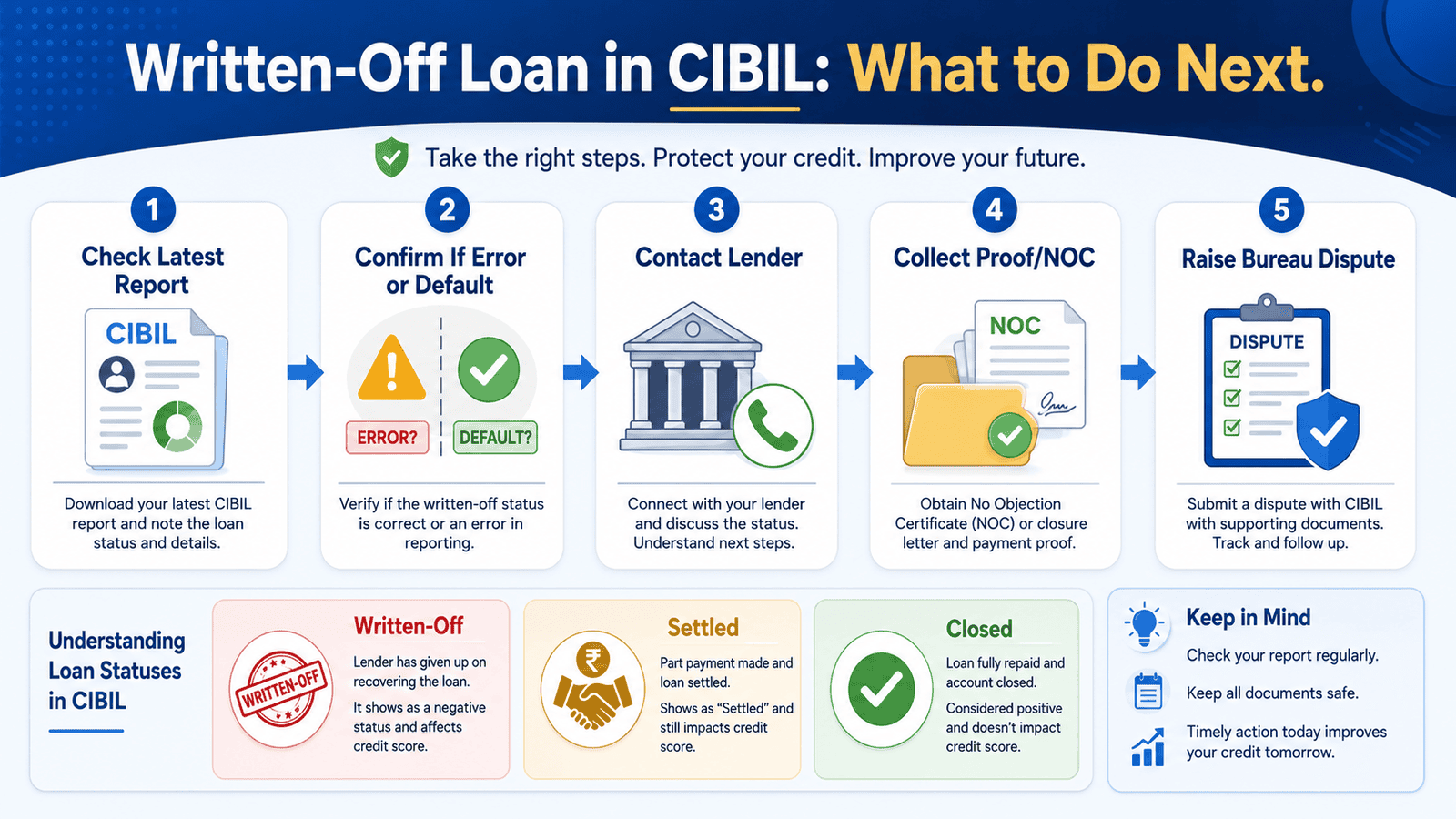
What to Do Right Now
Before you do anything else, take these steps in order. They apply whether the written-off entry turns out to be accurate or a mistake.
Step 1: Pull your latest credit report
Download your current report directly from TransUnion CIBIL or another bureau you use. Do not rely on an old report or a screenshot someone else showed you — status entries get updated, and you need to see exactly what is on file today.
Step 2: Note down every detail of the account
Write down the lender name, account number, loan type, the written-off amount shown, any overdue amount, and the date the status was last reported. You will need all of this when you contact the lender.
Step 3: Contact the lender — not the bureau — first
The bureau only reflects what the lender reports. If the status looks wrong, outdated, or unclear, your first call should go to the lender’s customer service or grievance desk, not credit report dispute filing. Ask them directly: is this loan still outstanding, was it settled, or was it fully closed and not updated?
Step 4: Collect documentary proof
Ask for a No Objection Certificate (NOC), a no-dues certificate, a loan closure letter, or a settlement letter — whichever applies. If you have old payment receipts or bank statements showing the EMIs you paid, keep those too.
Step 5: Raise a bureau dispute only if the lender confirms an error
If the lender confirms the loan was closed or settled correctly but the report still shows it incorrectly, that is when you raise a formal dispute with the bureau, supported by the lender’s documents. [CONFIRM — verify current dispute resolution timeline before publishing]
Key Takeaways
- Written-off is a serious negative status on your credit report — it reflects how the lender has internally treated an unpaid account, not a clean slate for you.
- Written-off, settled, and closed are three different statuses with three different consequences for future borrowing.
- A genuine written-off entry — one where dues are actually outstanding — cannot be removed simply by asking the bureau; it generally stays on record for a defined period and fades as your repayment history improves.
- A wrongly reported written-off status — for example, a loan you fully repaid years ago — can be corrected, but only with lender confirmation and supporting documents.
- Future loan or credit card approval becomes harder with a written-off entry on file, though outcomes always depend on the specific lender’s risk assessment.
- No agent, app, or “CIBIL cleaning” service can guarantee removal of an accurate negative entry — that claim itself is a warning sign.
Key Facts at a Glance
| Question | Short Answer | What This Means for You |
|---|---|---|
| What does written-off mean? | Lender has booked the account as an unpaid loss in its own records | You may still owe the money — write-off is not loan forgiveness |
| Who reports this status? | The lender, to the credit bureau | Bureaus display lender-reported data; they don’t decide your status |
| Does it affect your credit score? | Generally yes, negatively | The exact impact varies by bureau model and your full credit history |
| Can it be removed? | Only if genuinely incorrect or outdated | A real write-off typically stays on record; an error can be disputed with proof |
| What’s the first action? | Check your latest report, then contact the lender | Don’t skip straight to a bureau dispute without lender confirmation |
What Written-Off Actually Means in Your CIBIL Report
When a lender stops expecting to recover a loan after a long period of non-payment, it can write off the outstanding amount in its own books. This is primarily an accounting and risk-management decision by the lender — a way of marking the loan as a loss for internal financial reporting, often required under prudential norms set by the Reserve Bank of India for regulated entities.
Here’s the part that surprises most borrowers: write-off is an internal lender decision, not a waiver of your repayment obligation. The lender can — and often does — still pursue recovery, sell the debt to a recovery agency, or report it as written-off in your credit history while the underlying liability technically remains. Your legal responsibility to repay genuine dues does not disappear just because the lender’s books call it a loss.
Once a lender reports this status, it flows into your Credit Information Report through the credit bureau. The bureau itself does not investigate or judge whether the write-off was fair — it reflects what the lender submits. That single fact is the key to everything else in this article: corrections almost always have to start with the lender, because the lender is the source of the data.
Check these details on your report
Look specifically for: the reported written-off amount, the date of last reported activity, whether any “settled” tag also appears alongside written-off, and the lender’s contact details listed on the report. These four data points tell you whether you’re dealing with a live dispute, an old settlement, or a genuine reporting gap.
Written-Off vs Settled vs Closed Loan
Borrowers often use these three words as if they mean the same thing. They don’t, and the difference matters for every future loan application you make.
A closed account means you repaid the full principal and interest as originally agreed, and the lender has confirmed there are no further dues. This is the cleanest possible outcome and the one future lenders read most favourably.
A settled account means you and the lender agreed on a reduced amount to close the account — usually because you couldn’t pay the full outstanding sum. The account is closed, but the “settled” tag remains visible and signals to future lenders that the original terms weren’t fully honoured. Read more on how settled vs closed status affects your credit report.
A written-off account means the lender gave up on recovering the dues through normal repayment and booked it as a loss — without necessarily closing the legal claim against you. It generally signals the most serious level of repayment trouble among the three.
| Status | What It Usually Means | General Credit Impact |
|---|---|---|
| Closed | Full repayment as agreed, account formally closed | Most Favourable |
| Settled | Reduced amount accepted to close the account | Caution Flag |
| Written-Off | Lender booked the unpaid amount as a loss | Most Serious |
| Active Overdue | Loan still running with missed payments | Ongoing Risk |
Real Example: Ramesh’s Old Personal Loan
Ramesh, 34, works in IT support in Pune on a monthly salary of around ₹55,000 (illustrative figure). Six years ago, he took a ₹2 lakh personal loan and, after a job change left him short on income for a few months, missed several EMIs in a row. Eventually, the lender’s recovery team contacted him and they agreed on a one-time settlement for a reduced amount.
Years later, applying for a home loan, Ramesh pulled his credit report and found the old account showing as “written-off” rather than “settled” — even though he believed he had paid the agreed settlement amount in full. Confused and worried this would block his home loan, he contacted the original lender’s grievance cell with his old payment receipt.
The lender’s records showed the settlement payment was received, but the account had not been updated to “settled” or “closed” status with the bureau — an internal reporting gap, not a sign that Ramesh still owed money. Once the lender issued a written confirmation and the bureau updated the record, the entry changed to reflect the settlement accurately.
The key insight: the written-off label didn’t mean Ramesh had a current unpaid debt — it meant the lender’s reporting hadn’t caught up with what had actually happened, and only the lender could fix that.
How to Calculate What You Might Actually Owe
If your written-off account is genuine and unresolved, the amount you see on your credit report is rarely the full story. Three different figures can apply, and it matters which one any settlement conversation is based on.
Total Possible Dues = Original Principal Outstanding + Accrued Interest + Late Payment Charges
Where: Original Principal Outstanding = the unpaid loan amount at the time payments stopped | Accrued Interest = interest the lender may continue to apply on the outstanding amount | Late Payment Charges = penal charges for missed EMIs, where applicable
For illustration only: suppose the original outstanding principal was ₹1,50,000 when payments stopped. With accrued interest and late charges added over time, the lender’s total claim might be shown as ₹2,10,000 (illustrative figure — [CONFIRM — verify current figure before publishing]). A lender might then offer a one-time settlement at, say, ₹1,40,000 — lower than the total claim but possibly still above the original principal.
This is exactly why getting settlement terms in writing matters before you pay anything. Paying ₹1,40,000 against a verbal promise of “account closure” with nothing on paper leaves you with no proof if the report isn’t updated correctly afterward. The gap between payment and the bureau reflecting it can also take time [CONFIRM — verify current reporting update timeline before publishing] — another reason to keep every document from the transaction.
Comparison: Written-Off vs Settled vs Closed vs Active Overdue
| Status | Credit Report Impact | Can It Be Disputed? |
|---|---|---|
| Closed | Lower Risk | Only if data is wrong |
| Settled | Moderate Risk | Only if data is wrong |
| Written-Off | Higher Risk | Only if genuinely inaccurate |
| Active Overdue | Higher Risk | Rarely — usually reflects current reality |
In every case, a dispute only succeeds when the data is factually wrong or outdated — not simply because the status is unfavourable to you.
Safety Checklist Before You Pay or Dispute Anything
Protect Yourself First
- Do not pay any “CIBIL cleaning” agent or website promising instant removal of a genuine written-off entry — this is not how credit bureaus work, and such promises are a red flag for fraud.
- Do not make any payment to a recovery agent without written confirmation from the lender of the exact amount and what it will settle.
- Do not accept a phone-call promise as final — insist on an email or letter before transferring money.
- Keep every receipt, email thread, NOC, settlement letter, and closure letter — you may need them years later.
- Once corrected, check your report again after a reasonable interval, and consider checking with more than one bureau if you have credit history with multiple institutions.
How to Decide What’s Right for You
your loan is genuinely unpaid and you can verify the outstanding amount — contact the lender directly to understand your options before any third party gets involved.
you previously settled the loan but the report shows written-off — request written confirmation from the lender and ask them to update the status with the bureau.
you fully repaid the loan and have proof, but it still shows written-off — gather your closure documents and raise a bureau dispute backed by lender confirmation.
you don’t recognise the loan account at all — verify the lender and account details carefully, since this could indicate a reporting mix-up or, in rare cases, identity fraud.
you have any written proof of payment, settlement, or closure — do not raise a bureau dispute yet; start by requesting documentation from the lender first.
Common Mistakes to Avoid
Assuming written-off means the debt is forgiven
This is the single most damaging misunderstanding borrowers carry.
Write-off is an internal accounting step for the lender — it does not erase your legal obligation to repay genuine dues, and recovery action can still follow.
Confirm directly with the lender whether the account is still considered payable before assuming you’re in the clear.
Paying a third-party agent for “guaranteed CIBIL removal”
Some agents promise to erase negative entries for a fee.
No legitimate process guarantees removal of accurate data — paying such agents can cost you money with nothing to show for it, and some of these arrangements are outright scams.
Deal only with the lender’s official grievance channel and the credit bureau directly.
Accepting a verbal settlement without written terms
Agreeing to “pay ₹X and we’ll close it” over a phone call, with nothing in writing.
Without a written settlement letter specifying the exact amount and what it covers, you have no recourse if the lender later disputes the payment or the report isn’t updated.
Always get settlement terms in an email or letter before you pay.
Not collecting an NOC or no-dues certificate
Paying off a loan but walking away without formal closure documentation.
Years later, when a discrepancy appears on your report, you’ll have no proof of closure to support a correction request.
Request a No Objection Certificate or no-dues certificate the moment your account is settled or closed.
Raising a bureau dispute without supporting proof
Filing a dispute simply because the status is unfavourable, without documentation.
Disputes without lender-verifiable proof are likely to be rejected, wasting time you could have spent gathering the right documents first.
Contact the lender first and collect confirmation before involving the bureau.
Treating an old written-off loan as “closed” when you’re unsure
Assuming, without checking, that enough time has passed and it no longer matters.
Lenders evaluating a new application can still see the historical entry and may ask direct questions about it during underwriting.
Be prepared to explain the situation honestly, with documents in hand, rather than be caught off guard.
Applying for multiple new loans while the issue is unresolved
Trying to “test” approval odds with several lenders at once while a written-off entry sits on the report.
Each application can trigger a hard inquiry, which adds another negative signal on top of an already weakened profile.
Resolve or at least clarify the written-off status before submitting fresh applications.
When This May Not Be the Right Choice
Raising a dispute or expecting quick correction is not appropriate in every situation. Consider these scenarios:
The written-off status is accurate and lender-confirmed. If the lender confirms dues are genuinely outstanding, a dispute won’t change that — your priority should be resolving the actual debt.
You only have partial payment proof, not closure proof. A receipt for one EMI doesn’t establish that the full account was settled or closed — gather complete documentation first.
Settlement terms were agreed but not fully completed. If you haven’t paid the full settled amount, the written-off status may still be accurate until the agreement is honoured.
The lender hasn’t yet updated records after a recent payment. Reporting updates take time to reflect on your bureau file — a dispute filed too early may simply be rejected for lack of current data.
If any of these apply to your situation, it may be worth exploring other options before committing.
Official Rules and Where to Verify
Use only official, verified channels when checking your status or raising a correction request:
- TransUnion CIBIL — for your Credit Information Report and the formal dispute resolution process.
- Reserve Bank of India (rbi.org.in) — for the regulatory framework governing how regulated lenders must report and handle credit information.
- Experian India and CRIF High Mark — for cross-checking your report, since data can occasionally differ between bureaus.
- Your lender’s grievance redressal officer — for account-level correction, since the lender is the original source of the reported data.
Credit reporting rules, lender assessment methods, and bureau processes can change. Always verify current details from the relevant bureau, lender, or official regulatory source before acting.
Expert Tips
Expert Tips
- Build a single document file — payment receipts, settlement letters, NOC, and report screenshots — before contacting anyone. It makes every conversation faster.
- Where you have a choice, aim for full closure rather than settlement; a settled tag, while better than written-off, still reads as a caution flag to future lenders.
- Avoid submitting multiple fresh loan applications while your written-off status is unresolved — each hard inquiry adds to an already strained profile.
- After lender confirmation, follow up to confirm the bureau record has actually been updated rather than assuming it happened automatically.
- Rebuild your credit profile gradually with on-time payments on whatever credit lines remain active — there’s no shortcut that replaces a steady track record. Read more on default recovery timeline.
- If you find a similar issue on a different account — say, a loan that’s closed loan still active on your report — the same lender-first approach applies.
Frequently Asked Questions
Frequently Asked Questions
What does written-off mean in a CIBIL report?
It means the lender has booked the outstanding amount as a loss in its own accounting records and reported this status to the credit bureau. It does not automatically mean your repayment obligation has ended.
Can I remove written-off status from my CIBIL report?
Only if the entry is genuinely incorrect or outdated. A correction generally requires the lender to confirm the actual status — full removal of an accurate, currently-outstanding written-off entry is not something you can simply request and receive.
Does written-off mean I do not need to repay the loan?
No. Write-off is an internal lender decision and does not waive your legal responsibility for genuine dues. The lender may still pursue recovery or assign the debt to a collection agency.
Is written-off worse than settled in CIBIL?
Generally, yes — written-off is typically viewed as more serious than settled, since it usually reflects an account the lender gave up trying to recover through normal repayment, while settled at least reflects a closed agreement, even at reduced terms.
How long does a written-off loan stay in a credit report?
Retention periods are governed by bureau and regulatory rules that can change, so you should verify the current applicable period directly with the bureau rather than rely on a fixed figure here.
Can I get a personal loan after a written-off account?
It’s possible, but it depends entirely on the lender’s risk assessment, your current income, your overall credit history, and whether the written-off entry has been resolved or explained. There’s no guaranteed outcome either way.
What documents are needed to correct a written-off loan entry?
Typically a No Objection Certificate, no-dues certificate, loan closure letter, or settlement letter from the lender, along with any payment receipts or bank statements you have retained.
Should I settle the loan or try to repay it in full?
This depends on your finances and what the lender is willing to offer — there’s no single right answer. What matters most is getting any agreement in writing before you pay, regardless of which route you choose.
What happens if the lender refuses to correct a wrong entry?
If you have documentary proof and the lender still doesn’t update the record, you can escalate through the lender’s grievance redressal officer or raise a formal dispute with the credit bureau, supported by your documents.
Final Verdict
A written off loan in CIBIL report is not something to ignore, but it’s also not the dead end it can feel like at first glance. The right next step depends entirely on whether the entry is genuine or a reporting gap — and you won’t know which until you check your latest report and talk to the lender directly. Borrowers with real outstanding dues should focus on understanding what’s actually owed before agreeing to anything. Borrowers who believe the entry is wrong should gather proof — NOC, settlement letters, payment receipts — and work through the lender first, the bureau second. Avoid anyone who promises instant removal for a fee; that promise itself is the warning sign. Always verify your latest credit report, lender requirements, and bureau process before making a credit-related decision.
This article is for educational purposes only and should not be treated as personalised financial, credit, or legal advice. Credit scores, credit reports, lender eligibility criteria, and bureau processes can vary and may change over time. Please verify current details with the relevant credit bureau, lender, official regulatory source, or a qualified professional before making any credit-related decision.

Neha Menon writes simple, borrower-first explainers on CIBIL scores, credit reports, bureau disputes, DPD, loan settlement impact, hard inquiries, and practical credit score recovery. She focuses on helping Indian borrowers understand lender-reported data, avoid credit mistakes, and take safer next steps without false promises.