
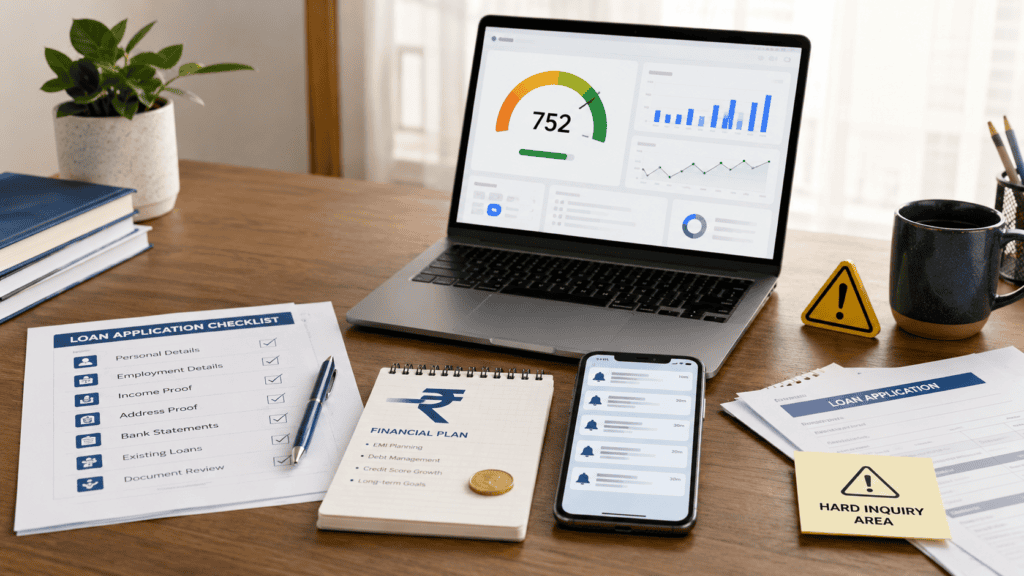
When you need money urgently, applying to every bank, NBFC, and loan app that shows up in a Google search feels like the sensible thing to do. More applications — higher chance of approval, right? Not quite. Every time a lender formally checks your credit report to process your application, it creates an entry called a hard inquiry. That inquiry stays visible in your report. And when several appear within days of each other, lenders do not see a determined borrower — they see someone who may be in financial trouble and is being repeatedly turned away. The damage is not just to your CIBIL score. It is to your approval chances at the very next lender you approach. This article explains exactly how multiple loan applications impact on CIBIL score, what hard inquiries actually are, and what to do before you submit your next application.
Quick Answer: Do Multiple Loan Applications Affect CIBIL Score?
multiple loan applications impact on CIBIL score when formal applications create hard inquiries in your credit report. One inquiry may have limited effect, but 5 applications in 10 days can make lenders see you as credit-hungry. Compare eligibility first, then apply only where your profile fits.
Key Takeaways
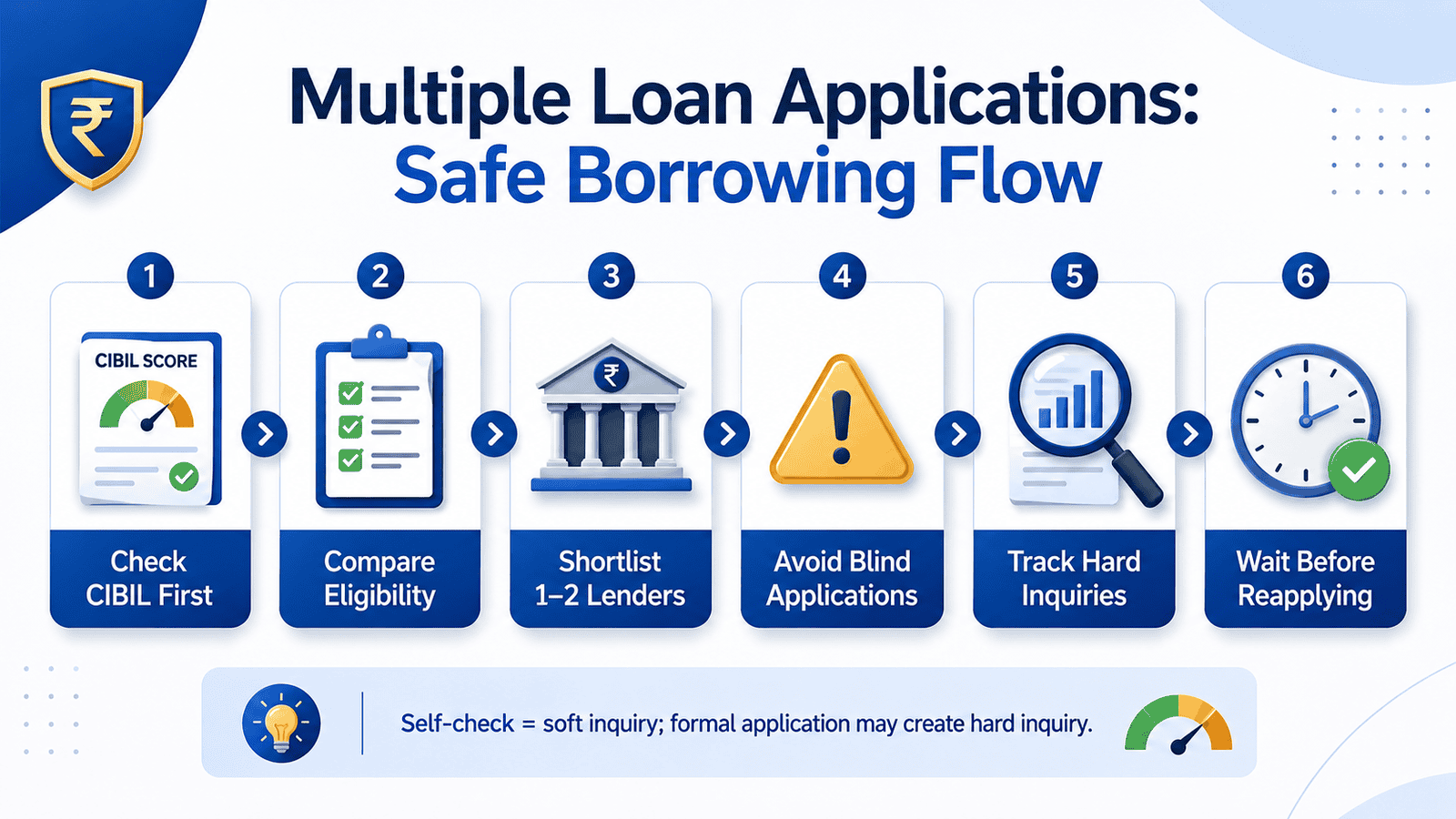
- Checking your own CIBIL score is a soft inquiry and does not reduce your score — only a lender pulling your report for a formal application creates a hard inquiry.
- Multiple hard inquiries within a short period — say, five applications across ten days — can signal credit hunger to lenders and make approval less likely at the next lender you approach.
- Loan rejection itself does not appear as a missed EMI or default in your credit report; the hard inquiry from the application is what remains visible to future lenders.
- Your repayment history on existing loans and credit cards carries far more weight in your CIBIL score than any single inquiry — protecting that record matters more than racing to apply everywhere.
- Before submitting a formal application, check your credit report, review your existing EMI burden, and compare eligibility criteria so you apply only where your profile reasonably fits.
- Indian lenders use your income, existing EMIs, repayment history, employer profile, and loan type — not just your CIBIL score — when making an approval decision.
Key Facts at a Glance
| Concept | What It Means | Borrower Action |
|---|---|---|
| Soft inquiry | Credit report check triggered by you checking your own score or pre-approved offer screening by a lender — does not affect CIBIL score | Check your own report freely and regularly |
| Hard inquiry | Credit report pull triggered when you formally apply for a loan or credit card — visible to future lenders in your report | Apply only after confirming eligibility |
| Self-checking your score | Counts as a soft inquiry — no impact on score regardless of how often you check | Check from official bureau sources before applying |
| Formal loan application | May trigger a hard inquiry once the lender pulls your credit report with your consent — can affect how future lenders read your profile | Read the consent screen before submitting PAN and OTP |
| Multiple applications quickly | Several hard inquiries in a short window may indicate financial stress to lenders reviewing your report | Shortlist 1–2 suitable lenders before applying |
| After rejection | The rejection itself is not recorded as a default — but the hard inquiry from that application remains visible | Wait and fix the root issue before reapplying |
How Multiple Loan Applications Impact on CIBIL Score
Every time you formally apply for a personal loan, home loan, or credit card, the lender is permitted — with your consent — to pull your credit report from a credit bureau such as TransUnion CIBIL, Experian, CRIF High Mark, or Equifax India. This pull is recorded in your credit report as an inquiry. The type of inquiry matters enormously.
What Is a Hard Inquiry?
A hard inquiry — sometimes called a hard enquiry — is a credit report pull made by a lender when you submit a formal loan or credit card application. According to TransUnion CIBIL (transunioncibil.com), lender-initiated inquiries appear in the enquiries section of your credit information report. These are visible to any lender who later pulls your report. A hard inquiry signals that you actively sought credit. One hard inquiry in isolation typically has a modest effect on your score. Several hard inquiries close together can have a more noticeable combined effect and — more critically — change how lenders interpret your financial behaviour.
To understand more about how hard inquiry meaning differs from a soft inquiry and how each affects your credit profile, the linked guide covers both in detail.
What Is a Soft Inquiry?
A soft inquiry is a credit report check that does not affect your score. When you check your own CIBIL score or credit report through the bureau’s official website, it counts as a soft inquiry. When a lender pre-screens you for a pre-approved loan offer without you submitting a formal application, that too is generally a soft inquiry. You can check checking your own score as often as you need to without any concern about score impact.
The Difference Between Comparing and Applying
This is where many borrowers go wrong. Using a loan eligibility calculator on a bank or aggregator website, checking your indicative offer, or reviewing rates is not the same as formally applying for a loan. The risk begins when you submit your PAN number, mobile number, and income details — and give consent for the lender or platform to check your credit report. At that point, a hard inquiry may be triggered. Read the consent screen carefully before you proceed. If it says the lender or its partner will access your credit report from a bureau, that is where the formal application begins.
Why Credit Hunger Matters to Lenders
Lenders do not just look at your CIBIL score when deciding whether to approve your loan. They look at your entire credit report — including the inquiry section. Several hard inquiries within a short period, say two to four weeks, can suggest to a lender that you have been applying for credit at multiple places and may have been rejected. This perception — sometimes called credit hunger — can make a lender more cautious even if your score itself has not moved dramatically. Your credit score is one input. Your repayment history, existing EMI burden, employer profile, loan type, and the lender’s internal policy are also part of the decision.
Real Example: Rohit’s Loan Application Strategy
Rohit, 31, is a salaried software tester in Pune earning ₹55,000 per month. He needed ₹3 lakh for a family medical expense. He applied to five lenders — two private sector banks, one PSU bank, and two NBFCs — over ten days, using loan aggregator forms, each of which collected his PAN and income details and submitted a formal application with bureau consent.
By the time the fifth lender checked his credit report, they could see five hard inquiries in the past ten days. Rohit also had existing EMIs totalling ₹18,000 per month — already about 33% of his income. Even though his CIBIL score was 718, the lender’s credit team noted the cluster of recent inquiries alongside his existing EMI burden. His application was declined. Each rejection added no default to his report — but each application added another hard inquiry.
A safer approach: Rohit could have checked his own credit report first through an official bureau website — a soft inquiry, no score impact. He could then have compared lender eligibility criteria before committing to a formal application and shortlisted one or two lenders where his profile fit — salary band, existing EMI, and score range. That would have meant one or two hard inquiries instead of five, and a much cleaner picture for the lender reviewing his report. If Rohit noticed a sudden score drop after those applications, the linked guide explains all the common reasons a score can move after credit activity.
Before You Apply: A Readiness Checklist
This checklist is not a guarantee of loan approval. It is a practical pre-application process to reduce unnecessary hard inquiries and improve the quality of your application.
| Step | What to Check | Why It Matters |
|---|---|---|
| 1 — Check your credit report | Download your report from TransUnion CIBIL, Experian, CRIF High Mark, or Equifax India | Identify errors, existing inquiries, and your actual score before any lender sees it |
| 2 — Review your EMI burden | Add up all current EMIs as a percentage of monthly income | Most lenders prefer total EMIs (including the new loan) to stay below 40–50% of income — this threshold varies by lender |
| 3 — Compare eligibility criteria | Check the lender’s minimum credit score, minimum income, and loan amount range before applying | Applying where your profile clearly does not fit wastes an inquiry |
| 4 — Read consent screens carefully | Before submitting PAN and OTP on any platform, check whether bureau consent is being collected | This is where a soft check becomes a hard inquiry |
| 5 — Shortlist 1–2 lenders | Choose lenders where your credit score, income, and EMI load match the stated criteria | One or two targeted applications create far fewer inquiries than five scattered ones |
| 6 — Apply | Submit your complete application with salary slips, bank statements, and existing EMI details ready | Incomplete applications often require resubmission, which can create additional pulls |
Use the Loan Application Readiness Checklist before submitting another application.
Check Your ReadinessDoes Your EMI Burden Affect the Risk?
Your CIBIL score is not the only thing lenders review. Your Fixed Obligations to Income Ratio — commonly called FOIR — is the proportion of your monthly income already committed to loan EMIs and other fixed payments. FOIR thresholds vary by lender and loan type, but many lenders become cautious when the ratio is high.
Take Rohit’s situation. His ₹55,000 salary and ₹18,000 in existing EMIs means his FOIR is already around 33%. If he applies for a ₹3 lakh personal loan over 3 years at an assumed interest rate, the new EMI could add another ₹9,000–₹10,000 per month (the exact figure depends on the lender’s rate and terms), bringing his total obligation close to 50% of income. Add five hard inquiries on top of that profile, and any lender’s credit review team has a complicated picture to assess. The lesson here is not about score alone — it is about the complete borrower profile. Applying again without reducing the EMI burden or increasing income does not fix the root issue; it only adds more inquiries to a report that already signals stress.
Safe vs Risky Loan Application Behaviour
| Behaviour | Safe or Risky? | Why It Matters |
|---|---|---|
| Checking your own CIBIL score before applying | Safe | Soft inquiry — no score impact, helps you know where you stand |
| Using eligibility calculators on bank websites | Safe | Usually indicative tools, not formal applications — confirm before submitting PAN |
| Reading the bureau consent screen before submitting PAN | Safe | Lets you decide whether a hard inquiry will be triggered |
| Applying to 1–2 well-matched lenders | Safe | Limits hard inquiries, keeps the inquiry section of your report clean |
| Applying to 5+ lenders in 10 days | Risky | Multiple hard inquiries signal credit hunger; future lenders see the pattern |
| Applying again immediately after rejection without fixing the root issue | Risky | Adds another hard inquiry with the same weak profile — reduces chances further |
| Skipping the consent screen and submitting PAN on unknown loan apps | Risky | May trigger bureau checks without full understanding; also a data security risk |
| Comparing eligibility criteria before applying | Lower Risk | Reduces chance of applying where your profile clearly does not match |
| Waiting 30–60 days after rejection to reapply | Lower Risk | Gives time to fix the root issue and reduces inquiry cluster in the report — actual wait time depends on your specific situation |
What to Do If You See a Suspicious Inquiry in Your Credit Report
Sometimes borrowers find inquiries in their credit report that they do not recognise — lenders they never approached, applications they never made. This warrants attention. According to TransUnion CIBIL (transunioncibil.com), the credit information report has a dedicated enquiries section that lists who pulled your report, when, and for what purpose.
Step 1 — Download Your Credit Report
Request your credit report directly from TransUnion CIBIL, Experian India, CRIF High Mark, or Equifax India through their official websites. Under RBI guidelines, you are entitled to one free credit report per year from each bureau.
Step 2 — Identify the Inquiry
Look at the enquiries section and note the lender name, date of the inquiry, and the loan or credit type it was pulled for.
Step 3 — Check Whether You Consented
Did you submit a formal application to that lender? Did you give bureau consent on any aggregator platform that may have routed your details to that lender? Sometimes borrowers give blanket consent on comparison platforms without realising their details were shared with multiple lenders.
Step 4 — Raise a Dispute If the Inquiry Is Genuinely Unauthorised
If you are certain you did not apply to or authorise a bureau check from that lender, raise a dispute through the relevant bureau’s official dispute resolution process. Each bureau has an online dispute portal. You may also contact the lender directly with proof that you did not apply. Note that valid inquiries — those from applications you actually made, even if rejected — are generally not removable simply because you no longer want them there. The question of loan rejection impact on your credit report is a separate topic covered in the linked guide.
Safety Checklist: Protect Your Credit Profile When Applying
Do not enter PAN and OTP on unknown loan forms
Several unofficial loan apps and websites collect PAN, Aadhaar, and OTP under the pretence of checking eligibility. Submitting these on platforms not clearly linked to a registered bank or NBFC is a data security and potential fraud risk — separate from the credit inquiry risk.
Do not apply on multiple unknown loan apps at once
Some unregistered lending apps pull credit bureau data and charge processing fees without disclosing full loan terms. Applying on several at the same time can trigger multiple hard inquiries from sources that may not even be regulated lenders.
Read the consent language before you tick the bureau-check box
Aggregator and loan app forms often include bureau consent within the general terms. Look for phrases such as “I authorise access to my credit information report” or “I consent to credit bureau checks.” This is the moment a soft check can become a hard inquiry.
Avoid platforms that promise “guaranteed approval”
No regulated lender guarantees approval before assessing income, credit history, existing EMIs, and documents. Any platform that makes this claim is misrepresenting the lending process and may not be operating within RBI’s Digital Lending Guidelines.
Keep records of applications you submit
Take screenshots or save email confirmations for every formal application. If an inquiry appears that you do not recognise, your own records become your evidence when raising a dispute with the bureau or the lender.
How to Decide What’s Right for You
your CIBIL score is above the minimum threshold the lender requires, your existing EMIs leave enough room for a new loan within the lender’s FOIR limit, and your repayment history has no recent missed payments — apply to one or two well-matched lenders now.
you were rejected recently and the reason was a high EMI burden — wait, reduce existing debt where possible, and reapply only after your EMI-to-income ratio improves. For practical timelines, see wait after rejection.
your credit report has errors — an account you did not open, a missed payment incorrectly recorded, or an inquiry you never authorised — fix those errors through the bureau’s dispute process before applying. A corrected report can materially improve how a lender reads your profile.
you do not know your current CIBIL score or have not seen your credit report in the past six months — check your report first, before submitting any formal application. You cannot plan a safe application strategy without knowing what lenders will see.
your income is stable enough to service the new EMI, or your employment situation has recently changed — this may not be the right time for a formal application. A rejection under these conditions adds a hard inquiry without a resolution.
What to Do After Loan Rejection
| Situation | Possible Reason | Next Step |
|---|---|---|
| Rejected by one lender despite a reasonable CIBIL score | High existing EMI burden, employer not on lender’s approved list, or insufficient income for the loan amount requested | Ask the lender for the reason, review your EMI-to-income ratio, and consider a lower loan amount |
| Rejected by two or more lenders in quick succession | Multiple hard inquiries compounding an underlying profile issue — high FOIR, recent missed payment, or low score | Stop applying immediately; fix the root cause before reapplying |
| Rejected because of a low CIBIL score | Missed EMIs, high credit card utilisation, or an error in the credit report | Check your credit report for errors, improve repayment behaviour, and wait for your score to recover before reapplying |
| Rejected for incomplete documentation | Missing salary slips, bank statements, or address proof | Gather complete documents and reapply to the same lender or a comparable one — the inquiry already exists, so fixing the document issue costs no additional hard inquiry at that lender |
Common Mistakes to Avoid
Applying to Every Lender on the Same Day
Submitting five or more applications in 24 hours creates a cluster of hard inquiries that is immediately visible in your credit report. Lenders reviewing your profile even one week later can see all of those inquiries. This pattern — not the score movement — is often the primary reason a lender hesitates.
Confusing a Pre-Approved Offer With Guaranteed Approval
A pre-approved personal loan offer in your banking app or SMS is a preliminary screening — not a final sanction. The lender still reviews your current income, existing EMIs, and credit report before disbursing. Applying to a pre-approved offer still creates a hard inquiry in most cases.
Ignoring Existing EMIs When Choosing a Loan Amount
Applying for a loan amount that, combined with existing EMIs, exceeds the lender’s FOIR limit is a common rejection reason that has nothing to do with your CIBIL score. Calculate your available EMI capacity before choosing the loan amount.
Not Checking the Credit Report Before Applying
Applying without knowing your current score or what errors may be in your report is avoidable. A simple bureau check — soft inquiry, no score impact — gives you the information you need to choose the right lender. Many borrowers discover incorrect entries only after a rejection, by which time an unnecessary hard inquiry already exists.
Believing Loan Rejection Is the Main Score Killer
Loan rejection itself does not appear in your credit report as a missed payment or default. It does not carry the same weight as a DPD (Days Past Due) marker. The inquiry from the application — not the rejection — is what other lenders see. The long-term score damage from missed EMIs or loan settlement is far more significant than any inquiry cluster.
Applying on Unknown Loan Apps Under Pressure
When a borrower needs money urgently, apps that promise fast approvals with no documentation requirements can seem attractive. Many of these are unregistered or operate as loan service providers without transparent lender disclosure. Applying on several of these at once can trigger bureau checks from multiple entities and expose your personal data.
When This May Not Be the Right Choice
Applying for another loan right now may not be the right decision if you have received two or more rejections in the last 30 days and have not identified and resolved the underlying reason — whether that is a high FOIR, a low CIBIL score, or a credit report error. If your credit card dues are at or near the credit limit and you are paying only the minimum amount due each month, adding a new loan application to that profile can further reduce your approval chances. If you have a missed EMI or an overdue account in the last 12 months, most lenders will view that as a significantly more negative signal than the number of inquiries in your report. If your income is irregular, recently reduced, or your employment has recently changed, this may not be the right time to apply regardless of your credit score. If you are under pressure from a loan app or agent claiming you must apply immediately to secure a rate, that urgency itself is a warning sign. If any of these apply to your situation, it may be worth exploring other options before committing.
Official Rules and Where to Verify
Credit reporting, inquiry rules, and bureau dispute processes in India are governed by the credit bureaus operating under RBI licensing. Each bureau maintains its own credit information report format, dispute resolution portal, and consumer support process. For inquiries, scores, and report disputes, verify directly from these official sources:
- TransUnion CIBIL — transunioncibil.com — primary source for CIBIL score, credit information report, enquiries section explanation, and online dispute filing
- Experian India — experian.in — credit score, bureau report, and inquiry-related credit education
- CRIF High Mark — crifhighmark.com — relevant because lenders may pull reports from multiple bureaus, and your score may vary across them
- Equifax India — equifax.co.in — credit data and dispute process for Equifax-reported accounts and inquiries
Credit reporting rules, lender assessment methods, and bureau processes can change. Always verify current details from the relevant bureau, lender, or official regulatory source before acting.
Expert Tips
- Before you apply anywhere, download your credit report from an official bureau source — it is a soft inquiry, costs nothing to your score, and tells you exactly what a lender will see. This single step prevents the most common application mistakes.
- If a lender or aggregator platform asks for your PAN and OTP and includes bureau-consent language in the form, treat that as a formal application — not a quick eligibility check. Read before you proceed.
- After a rejection, ask the lender or platform for the stated reason before applying elsewhere. Many lenders are required to communicate the reason under RBI’s Fair Practices Code. Knowing whether the issue is your score, your FOIR, your employer category, or your documents helps you target the fix — not spray more applications.
- If you must apply to more than one lender, space your applications by a few weeks rather than submitting all at once. This prevents a visible cluster of inquiries in the same short window.
- Keep salary slips for the last three months, bank statements for the last six months, and a list of your existing loan accounts and EMIs ready before you apply. Incomplete applications often require resubmission, which can create additional bureau pulls at the lender’s discretion.
- Use the loan application checklist to confirm your profile, documents, and lender fit before submitting any formal application.
- Do not give bureau consent casually on platforms you found through an ad or an unknown WhatsApp link. Verify that the platform is linked to an RBI-registered bank or NBFC before proceeding.
Frequently Asked Questions
Do multiple loan applications reduce my CIBIL score?
Formal loan applications can trigger hard inquiries in your credit report, and multiple hard inquiries within a short period may have a combined effect on your score. More importantly, several recent inquiries can make lenders more cautious when reviewing your profile — independent of any score movement. The exact impact varies by bureau model, your overall credit history, and how many inquiries appear in what timeframe. Verify your current score and report directly with TransUnion CIBIL (transunioncibil.com) or another bureau.
How many loan inquiries are too many?
There is no universal rule for a specific number. What matters is the pattern — several hard inquiries from different lenders within a few days or weeks can look like credit hunger to a lender reviewing your report. One or two well-spaced inquiries from applications where your profile fits is a very different picture from five inquiries in ten days.
Does loan rejection affect my CIBIL score?
Loan rejection itself is not recorded as a missed payment or default in your credit report. The hard inquiry from the application is what remains visible. The real concern after rejection is applying again immediately without fixing the root issue — which adds another inquiry without improving the underlying profile. Read more in the guide on loan rejection impact.
Does checking my own CIBIL score reduce it?
No. When you check your own CIBIL score or credit report through an official bureau website, it is recorded as a soft inquiry. Soft inquiries do not affect your credit score. You can check your own report as often as you need to — particularly before submitting any formal application.
How long do loan inquiries stay in my CIBIL report?
Inquiries are retained in the credit information report for a period as defined by bureau rules and RBI guidelines. The standard retention period is typically around two years from the date of the inquiry, though this can vary. Verify the current retention timeline directly with TransUnion CIBIL (transunioncibil.com) or the relevant bureau before relying on a specific figure.
Should I apply to many lenders to improve my approval chances?
This approach often has the opposite effect. Applying to many lenders at once creates multiple hard inquiries that become visible to each subsequent lender. A lender seeing five recent inquiries — possibly alongside existing EMIs — may be less willing to approve than a lender who sees a borrower who applied once, to a lender where the profile fit. Compare eligibility criteria first, then apply to one or two lenders where your profile is most likely to be approved.
Can I remove loan inquiries from my CIBIL report?
Valid inquiries — from applications you actually made and consented to — generally cannot be removed simply because you no longer want them in your report. If an inquiry appears that you did not authorise — that is, you did not apply to that lender or give consent for a bureau check — you can raise a dispute through the bureau’s official dispute process. The bureau will investigate with the lender. There is no guarantee of removal for authorised inquiries; for genuinely unauthorised ones, the dispute process is the correct route.
Do loan apps check my CIBIL report when I fill out their form?
Some do — but not all at the same stage. Many loan apps and aggregator platforms collect your PAN, mobile number, and income details at the eligibility stage and may route this to partner lenders for screening. Some of those partners may pull your credit report even before final application confirmation, depending on the platform’s process. Look for bureau consent language in the form before you submit your details. If consent is not clearly disclosed, ask or do not proceed on that platform.
What is the difference between a hard inquiry and a lender’s internal credit assessment?
A hard inquiry is the formal pull of your credit information report from a registered bureau — it is recorded in your report and visible to future lenders. A lender’s internal credit assessment may also include income verification, document checks, employer categorisation, and banking behaviour analysis, which are done separately and do not appear in your bureau report. Both happen as part of a loan application, but only the bureau inquiry is visible to other lenders.
Final Verdict
Multiple formal loan applications can hurt your approval chances — not primarily because of a dramatic CIBIL score collapse, but because lenders can see every hard inquiry in your credit report and may interpret a cluster of recent inquiries as financial stress or credit hunger. The risk is real, but it is also entirely manageable with a simple change in approach. Check your own credit report before you apply — it is a soft inquiry and has no score impact. Then compare lender eligibility criteria against your actual profile: your CIBIL score, income, existing EMI burden, and repayment history. Apply only to one or two lenders where your profile fits. That deliberate approach will almost always produce a better outcome than applying everywhere and hoping something sticks. The multiple loan applications impact on CIBIL score is a secondary concern compared to the lender perception issue — and both are solved by the same strategy: apply less, apply smarter. Always verify your latest credit report, lender requirements, and bureau process before making a credit-related decision.
This article is for educational purposes only and should not be treated as personalised financial, credit, or legal advice. Credit scores, credit reports, lender eligibility criteria, and bureau processes can vary and may change over time. Please verify current details with the relevant credit bureau, lender, official regulatory source, or a qualified professional before making any credit-related decision.

Neha Menon writes simple, borrower-first explainers on CIBIL scores, credit reports, bureau disputes, DPD, loan settlement impact, hard inquiries, and practical credit score recovery. She focuses on helping Indian borrowers understand lender-reported data, avoid credit mistakes, and take safer next steps without false promises.