
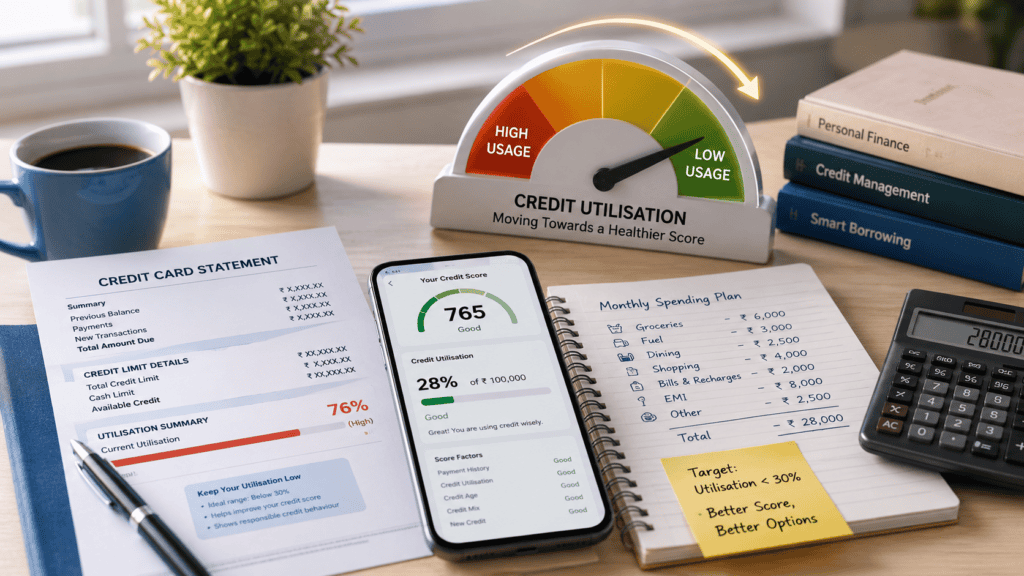
You paid your credit card bill in full. On time. Every single month. And yet your CIBIL score showed movement — or a lender asked why your card usage looked high. If this sounds familiar, you are not alone. Millions of Indian card users are disciplined about repayment but still unclear about one thing: credit utilisation ratio. Paying on time matters a great deal, but lenders and credit bureaus also look at how much of your available card limit you are using at any point — not just whether you paid. This article explains what credit utilisation ratio means, how to calculate it for one card and multiple cards, why it can affect your credit profile, what the billing cycle has to do with it, and what you can safely do to manage it. No fixed score improvement is promised — bureau scoring models vary and lender judgement is not a single number.
Quick Answer: What Is Credit Utilisation Ratio?
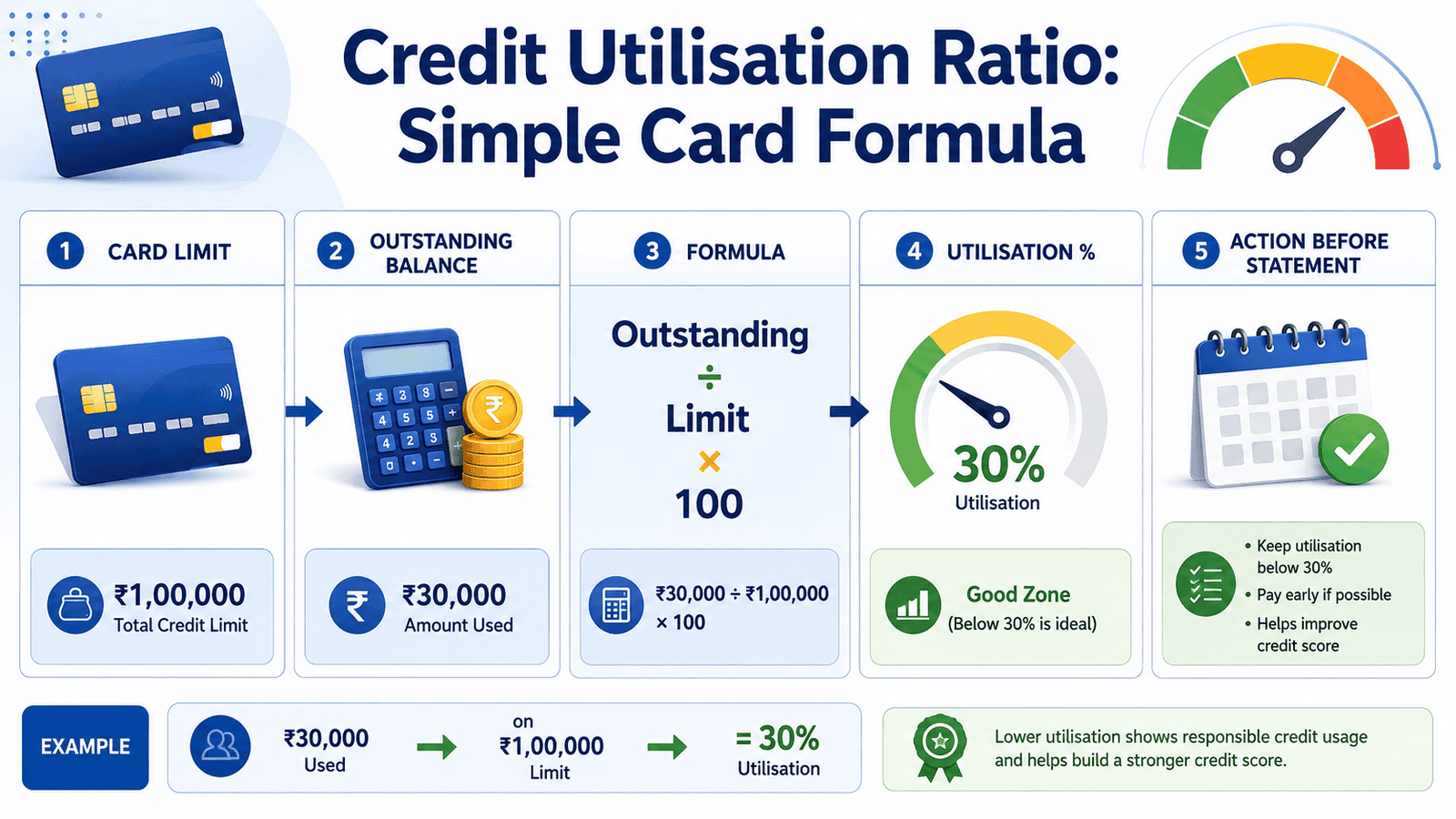
Credit utilisation ratio is the percentage of your total credit card limit currently used. For example, ₹30,000 outstanding on a ₹1,00,000 limit equals 30% utilisation. It can influence how lenders read your credit behaviour, but no bureau or lender guarantees a fixed CIBIL score change.
How to Calculate Your Credit Utilisation Ratio
The formula is straightforward. Divide your outstanding card balance by your total credit limit and multiply by 100.
Credit Utilisation Ratio = (Outstanding Card Balance ÷ Total Credit Limit) × 100
Where: Outstanding Balance = amount you owe on your card(s) | Total Credit Limit = sum of all your card limits | Result = utilisation percentage
Here are three practical examples to make this concrete.
Example 1 — Single card, moderate usage: You have one card with a ₹1,00,000 limit and an outstanding balance of ₹30,000 when your statement is generated. Your utilisation is (₹30,000 ÷ ₹1,00,000) × 100 = 30%.
Example 2 — Two cards, combined calculation: You hold two cards. Card A has a ₹1,00,000 limit with ₹60,000 outstanding. Card B has a ₹50,000 limit with ₹15,000 outstanding. Your overall utilisation is (₹75,000 ÷ ₹1,50,000) × 100 = 50%. Card A’s individual utilisation is 60%, even though the total picture looks different.
Example 3 — Paying before statement date: Your outstanding balance on a ₹1,00,000 card is ₹80,000 before statement generation. You pay ₹55,000 before the statement is cut. The balance that appears on the statement — and may be reported to credit bureaus by the lender — drops to ₹25,000, giving a utilisation of 25%. Note: bureau reporting practices can vary by lender, so the timing and method of balance reporting may not be identical across all issuers.
| Card | Credit Limit | Outstanding Balance | Card-wise Utilisation |
|---|---|---|---|
| Card A | ₹1,00,000 | ₹60,000 | 60% |
| Card B | ₹50,000 | ₹15,000 | 30% |
| Total (both cards) | ₹1,50,000 | ₹75,000 | 50% overall |
Both card-wise and total utilisation can matter. Even if your overall ratio looks comfortable, a single card running close to its limit may still register as high usage in a lender’s assessment.
You can use the credit utilisation ratio calculator to check your card-wise and total utilisation before your next statement date.
Key Takeaways
- Credit utilisation ratio measures how much of your total card limit you are currently using — a ₹30,000 balance on a ₹1,00,000 limit equals 30% utilisation, which is generally considered moderate.
- Lower utilisation typically looks more comfortable to lenders than a card running near its limit — but no bureau publishes an exact score-impact formula, so treat commonly cited guidelines as reference points, not guarantees.
- Paying before your statement is generated — not just before the due date — may reduce the balance your lender reports to credit bureaus, though reporting practices can vary by issuer.
- Both individual-card utilisation and your overall utilisation across all cards can matter — Card A at 85% usage does not look safe simply because Card B is unused.
- A higher credit card limit reduces your utilisation ratio only if your spending stays the same — spending up to fill the new limit eliminates the benefit.
- Timely full repayment of your card dues remains the strongest credit habit — utilisation management works best alongside consistent, on-time payment, not as a substitute for it.
Key Facts at a Glance
| Parameter | What It Means | Illustrative Example |
|---|---|---|
| Credit utilisation ratio | Percentage of your card limit currently used | ₹30,000 used on ₹1,00,000 limit = 30% |
| Formula | Outstanding ÷ Limit × 100 | (₹30,000 ÷ ₹1,00,000) × 100 = 30% |
| Scope | Applies card-wise and across all cards combined | One card at 80% can look high even if total is 40% |
| Why it matters | High usage may signal credit dependence to lenders and bureaus | Lenders may view a consistently maxed-out card cautiously |
| What to monitor | Statement balance, not just due-date payment | Pay before statement date if balance is unusually high that month |
| Who reports it | Your card issuer reports balance data to credit bureaus | TransUnion CIBIL, Experian, CRIF High Mark, Equifax India |
What Is Credit Utilisation Ratio and Why Does It Matter?
Credit utilisation ratio — also called credit card utilisation ratio or credit card limit usage — is the share of your available revolving credit that you have drawn down at any given time. Revolving credit means credit that resets each billing cycle, unlike an EMI loan with a fixed repayment schedule.
Every credit card comes with a sanctioned credit limit — say ₹1,00,000. If your outstanding balance on that card is ₹45,000 on the date your lender reports to credit bureaus, your utilisation on that card is 45%. Your lender — whether it is a bank or NBFC — typically reports this data to one or more of India’s four credit bureaus: TransUnion CIBIL (transunioncibil.com), Experian India (experian.in), CRIF High Mark (crifhighmark.com), and Equifax India (equifax.co.in). Each bureau then factors this data into your credit score using its own proprietary model.
To understand your CIBIL score fully, it helps to know that payment history is generally considered the most significant factor — but utilisation is one of the recognised contributors to how a bureau sees your credit behaviour. High utilisation over multiple billing cycles may suggest to a lender that you are regularly dependent on borrowed funds, which they may weigh alongside your income, existing EMI obligations, and repayment track record. No bureau has published an exact formula, so the impact on your score from a given utilisation percentage is not predictable to a fixed number.
For more detail on how billing cycle and statement generation work in practice, see the section on billing cycle basics.
Real Example: Rohit’s Festival-Month Spending
Rohit, 29, works at a software services company in Pune and earns around ₹65,000 a month. He uses two credit cards — one with a ₹1,00,000 limit and another with a ₹50,000 limit. During October’s festival sales, Rohit spent heavily on his primary card: a new laptop, household items, and online grocery orders, taking the outstanding balance to ₹78,000 just before his statement date.
Rohit’s statement was generated on the 15th of the month. He planned to pay the full amount by the due date — the 5th of the following month — which he always does. What he did not realise is that the ₹78,000 balance appearing on his statement may be the figure his card issuer reported to credit bureaus that cycle. His card-wise utilisation for that period: 78%. Even though he paid in full by the due date, the reported balance for that billing cycle reflected the high festival spending.
The following month, Rohit was more aware. When his outstanding balance crossed ₹60,000 on the 10th — five days before his statement date — he made an early part-payment of ₹40,000. His statement was cut at ₹20,000 outstanding, giving a card-wise utilisation of 20% for that cycle. His repayment habit was identical — full payment by due date — but the reported balance was significantly lower. This is the practical difference between managing your due-date payment and managing your statement-date balance. Whether the earlier payment changes his bureau-reported data depends on when and how his specific card issuer reports to bureaus — Rohit would need to check his credit report to confirm.
What You Need to Check to Calculate Your Utilisation
Before you can track or manage your credit utilisation ratio, you need six pieces of information. These are not complex — they are available in your card statement, the card issuer’s app, or your credit report.
- Total card limit across all your cards — Add up the sanctioned limit on each card you hold. This is the denominator in your utilisation calculation.
- Outstanding balance on each card — This is the amount you owe on each card at any given date, not just the statement amount. Check this in the card app or net banking.
- Statement date for each card — This is the date your billing cycle closes and your statement is generated. This is typically when your lender finalises the balance for the month.
- Due date for each card — This is the last date by which you must pay at least the minimum amount due to avoid late payment charges. The due date is usually 15–25 days after the statement date.
- Reported balance in your credit report — Your credit report from TransUnion CIBIL, Experian, CRIF High Mark, or Equifax India shows what your lender has reported as your outstanding balance. This may reflect the statement-date balance.
- Minimum amount due on each statement — Know this number, but do not rely on it as your monthly target. Paying only the minimum amount due means the remainder accrues interest and keeps your utilisation elevated.
Utilisation Levels: What They May Signal
| Usage Level | Illustrative Example | What It May Signal |
|---|---|---|
| Low (up to ~30%) | ₹25,000 used on ₹1,00,000 limit | Comfortable credit use; spending appears controlled relative to limit. Often seen as a positive credit behaviour signal by lenders — though not a guarantee of any score outcome. |
| Moderate (30–50%) | ₹45,000 used on ₹1,00,000 limit | Usage is noticeable. Worth monitoring, especially if consistently at this level across multiple cycles. Repayment discipline remains more important than the ratio alone. |
| High (50–80%) | ₹70,000 used on ₹1,00,000 limit | May be read as greater dependence on revolving credit. Lenders looking at your credit profile alongside a loan application may view this cautiously. Not permanently damaging if it is a one-off month. |
| Very High / Near Limit (80%+) | ₹88,000 used on ₹1,00,000 limit | Consistently maxed-out usage can create concern around overlimit risk, interest accumulation, and repayment capacity. Minimum-due traps are most common in this band. |
These bands are commonly referenced in credit education material — but they are not official thresholds published by any bureau. The actual impact on your credit score depends on your full credit profile, the bureau’s scoring model, and how your lender interprets your application. To understand how your score may affect future borrowing, see what counts as a good score for loans.
Safe Ways to Reduce Your Credit Utilisation Ratio
- Pay part of your bill before the statement date — if cash flow allows. If your spending in a particular month is unusually high, making a partial payment before your statement is generated can reduce the balance your lender reports. Do this only if you have the funds — do not delay other payments or dip into emergency savings to manage a utilisation ratio.
- Spend within a comfortable portion of your limit as a habit. If your card limit is ₹1,00,000, aim to keep monthly usage well below the full amount across most billing cycles. This is more effective than one-off early payments.
- Do not use the minimum amount due as your monthly goal. Paying only the minimum keeps your outstanding balance high and can push utilisation up month after month while interest compounds.
- Spread spending across multiple cards only if you track both cards separately. Using two cards instead of one does not automatically lower utilisation unless you genuinely stay within comfortable limits on each card — not just in total.
- Request a credit limit increase only when your repayment discipline is strong. A higher limit reduces your utilisation ratio on paper — but only if spending does not increase proportionally. A limit increase followed by higher spending produces no benefit and may create a debt burden.
- Avoid taking a personal loan to pay down card dues unless you have compared total borrowing cost. This shifts debt from one form to another and may not improve your overall credit profile if the loan increases your total obligations.
How to Decide What’s Right for You
Your utilisation is temporarily high this month because of one large purchase — and your normal usage is well within limits — then no immediate action may be needed. Monitor the next billing cycle and ensure full repayment by the due date.
Your utilisation is high across multiple billing cycles and you are relying on revolving credit to cover routine expenses — then reducing spending is the priority before adjusting when you pay. High utilisation caused by overspending is not resolved by timing alone.
You have a loan or new card application coming up in the next one to two months — then checking and if possible reducing your reported card balance before the statement date may be worth considering, as lenders often pull credit reports during this window.
You are using multiple cards to manage monthly cash flow and struggling to pay full dues on both — then this pattern may be raising utilisation and creating an interest burden simultaneously. Address the debt load before focusing on utilisation ratio.
You have strong repayment discipline and simply had one high-usage month — then do not panic or make hasty financial decisions. One month of higher utilisation is unlikely to cause a permanent problem when paired with a long record of timely full payments.
Common Mistakes to Avoid
Confusing the due date with the statement date
Many cardholders know their due date — the last day to pay without a late fee. But the statement date — when the billing cycle closes and your balance is finalised — is often earlier by 15 to 25 days. If you spend heavily between those two dates and pay only after the statement is generated, the higher balance may already have been reported to credit bureaus. Tracking both dates is essential, not just one.
Assuming full payment always means low reported utilisation
Paying your full outstanding balance by the due date is excellent repayment behaviour and reduces interest to zero. But if your statement was generated at a high balance — say ₹85,000 on a ₹1,00,000 card — that figure may have already been reported to the bureau for that cycle. Full payment after statement generation clears your dues; it may not retroactively change the reported balance for that cycle. If you notice a score dropped suddenly despite paying in full, this timing gap could be a contributing factor.
Using almost the full card limit every month as a habit
A ₹1,00,000 limit used at ₹90,000 every month signals a pattern of heavy credit reliance, regardless of whether you pay the full amount each cycle. Consistently running close to the limit may be seen unfavourably in a lender assessment, particularly when applying for a loan or a new card. The solution is not a higher limit — it is lower monthly spending relative to the limit you have.
Treating a limit increase as permission to spend more
A limit increase from ₹1,00,000 to ₹2,00,000 reduces your utilisation on paper — if spending stays the same. If you spend up to the new limit, your utilisation is unchanged and your total outstanding balance is now higher. Request limit increases to create headroom, not to unlock a higher spending capacity.
Paying only the minimum amount due
The minimum amount due — typically 5% of the outstanding balance or a small fixed amount — protects you from a late payment penalty, but it does not reduce your outstanding balance meaningfully. On ₹80,000 outstanding, a 5% minimum payment of ₹4,000 leaves ₹76,000 accruing interest at credit card rates. This keeps utilisation high and can compound into a debt trap quickly. Always aim for full payment; if not possible, pay as much above the minimum as your cash flow allows.
Not checking your credit report to confirm what was reported
You may believe your utilisation is low based on your own calculations — but what matters to a lender is what your credit report actually shows. Bureau data depends on when and how your lender reports. Check your report periodically from official bureau sources to verify that the balance shown matches what you expect.
When This May Not Be the Right Choice
Focusing on credit utilisation ratio management makes sense only within a stable financial picture. If you are already revolving a credit card balance — carrying forward dues month after month and paying interest — then managing the utilisation percentage is a secondary concern. The interest accruing on the unpaid balance is a more urgent problem.
If you cannot pay your full card dues this month, managing the reported balance through early payments should not take priority over covering your essential expenses or emergency fund. Similarly, if you are considering converting a large card balance into an EMI plan, or if late payments have already occurred, those issues affect your credit profile more significantly than any utilisation adjustment.
Utilisation optimisation is a useful discipline for a card user who is financially stable and paying full dues regularly. It is not a rescue strategy for someone managing a growing card debt burden. If any of these apply to your situation, it may be worth exploring other options before committing.
Official Rules and Where to Verify
Credit utilisation ratio is not governed by a single regulatory rule — it is a credit behaviour factor that each bureau incorporates into its own proprietary scoring model. India has four licensed credit information companies, and each may calculate and present credit score data differently.
- TransUnion CIBIL (transunioncibil.com) — The most widely referenced bureau in India. Provides credit reports and CIBIL scores. Credit bureau scoring models are proprietary and not fully disclosed.
- Experian India (experian.in) — Licensed credit bureau in India. Provides credit reports and Experian scores. Guidance on credit utilisation is available in their consumer education section.
- CRIF High Mark (crifhighmark.com) — Another RBI-licensed bureau. Report formats and scoring may differ from CIBIL and Experian.
- Equifax India (equifax.co.in) — Fourth licensed bureau in India. Useful to check if your lender reports to Equifax, as the score shown here may differ from CIBIL.
You are entitled to one free credit report per year from each bureau. It is worth checking your report periodically — not just before a loan application — to verify that the balances reported match your actual usage. You can check your score for free through bureau websites and authorised platforms. Credit reporting rules, lender assessment methods, and bureau processes can change. Always verify current details from the relevant bureau, lender, or official regulatory source before acting.
Expert Tips
- Add your statement date to your calendar as a recurring reminder. Most card users remember the due date. The statement date — when your billing cycle closes — is equally important and often overlooked. Set a reminder three to five days before it to check your outstanding balance.
- If one month’s spending is unusually high, consider a part-payment before your statement date. This is not a hack — it is simply managing your reported balance. Pay only what you can genuinely spare without affecting your EMIs, rent, or emergency reserves. Never borrow from another source to reduce a utilisation number.
- Avoid treating all card limits as spending capacity. A total card limit of ₹2,00,000 across two cards does not mean you have ₹2,00,000 to spend monthly. Your available credit is a safety buffer, not a spending ceiling.
- Request a credit limit increase only when your repayment history is strong — not when your finances are stretched. A limit increase at the right time can create useful headroom and lower your utilisation ratio without increasing debt. The safest way to increase your card limit is to apply when you have 12+ months of full, on-time payment and no recent missed dues.
- Review your credit report at least once every six months. Bureau data is only as accurate as what your lender reports. Errors in reported balance, payment status, or credit limit can affect your score without any mistake on your part. Catching these early gives you time to raise a dispute with the bureau before a loan application.
- Treat utilisation as one part of a larger credit health picture. According to guidance from Experian India (experian.in), payment history is the most significant factor in credit scoring — utilisation matters, but it does not override a strong repayment track record. The most durable approach is full, timely payment plus controlled monthly card spending.
Frequently Asked Questions
What is credit utilisation ratio in simple words?
Credit utilisation ratio is how much of your total credit card limit you are currently using, expressed as a percentage. If your card limit is ₹1,00,000 and you have spent ₹30,000, your utilisation is 30%. It reflects your credit usage pattern and can be one factor in how lenders assess your credit behaviour — alongside repayment history, income, and existing obligations.
How do I calculate my credit utilisation ratio?
Divide your total outstanding card balance by your total card limit and multiply by 100. For a single card: ₹40,000 outstanding on ₹1,00,000 limit = 40%. For multiple cards: add all outstanding balances and divide by the sum of all card limits. A ₹60,000 balance across ₹1,50,000 total limit = 40% overall utilisation. Check each card individually as well — one card at high usage can matter even if the total looks comfortable.
Does high credit utilisation reduce CIBIL score?
High utilisation consistently over multiple billing cycles can be a negative signal in credit scoring — but no bureau publishes a formula that converts a specific utilisation percentage to a specific score change. The impact depends on your full credit profile, your repayment history, and the bureau’s proprietary scoring model. A single high-usage month with an otherwise clean history is treated very differently from a pattern of maxed-out card usage across many cycles.
Is 30% credit utilisation always necessary to maintain a good score?
No. The “keep utilisation below 30%” figure is a commonly referenced guideline in credit education material — it is not an official rule set by any bureau or regulator. Some credit profiles remain healthy at higher utilisation levels, particularly when repayment history is long and strong. Treat 30% as a practical reference point for comfortable card usage, not as a mandatory threshold to hit every month.
Is credit utilisation calculated card-wise or across all cards?
Both can matter. Your overall utilisation is calculated across all cards combined — total outstanding divided by total limit. But bureau models and lender assessments may also look at individual card utilisation. A single card running at 85% usage can raise concern even if your second card is unused and your overall ratio appears moderate. Check both figures when reviewing your card usage.
Should I pay my credit card bill before the statement date?
It depends on your situation. If your outstanding balance is unusually high in a particular month and you have the funds available, paying a portion before your statement is generated can reduce the balance your lender reports to credit bureaus for that cycle. This is most relevant when a loan application is coming up soon. However, paying before the statement date is not mandatory for every month — consistent full payment by the due date is the core habit. Do not delay other obligations or dip into emergency savings to manage the statement balance.
Does a higher credit card limit improve my credit score?
A higher limit can reduce your utilisation ratio if your spending stays the same — and lower reported utilisation may support your credit profile over time. But a limit increase does not directly improve your score in isolation. If spending rises to fill the new limit, the utilisation benefit disappears. There is also the question of whether a hard inquiry is raised when you apply for a limit increase — which can briefly affect your credit report. A limit increase works in your favour only when repayment discipline is already strong and spending is genuinely controlled.
What happens if I pay only the minimum amount due?
Paying only the minimum due protects you from a late payment charge, but it means the remaining balance carries forward to the next billing cycle with interest applied. On a ₹70,000 outstanding balance, a 5% minimum of ₹3,500 leaves ₹66,500 accruing interest — typically at a high annual rate. Your utilisation stays high, interest compounds each month, and the total amount you owe can grow quickly. The minimum amount due is a floor, not a target.
Final Verdict
Credit utilisation ratio is one of the clearest windows into your card-usage behaviour — not because it is the only thing that matters, but because it reflects something lenders care about: whether you are using credit as a tool or leaning on it as a crutch. The formula is simple. Outstanding balance divided by total card limit, multiplied by 100. Track it monthly, particularly before a loan or card application, and particularly in months when spending is higher than usual.
The most effective action you can take is not complicated: pay your full dues consistently, keep monthly card spending comfortably within your limit, and check your statement balance — not just your due date. If you carry two cards, check each one individually, not just the combined total. And review your credit report periodically to confirm what has actually been reported to the bureau — not just what you believe your usage was.
Utilisation management is not a score-improvement shortcut. It is a credit discipline habit that works best alongside timely full repayment and controlled borrowing. Always verify your latest credit report, lender requirements, and bureau process before making a credit-related decision.
This article is for educational purposes only and should not be treated as personalised financial, credit, or legal advice. Credit scores, credit reports, lender eligibility criteria, and bureau processes can vary and may change over time. Please verify current details with the relevant credit bureau, lender, official regulatory source, or a qualified professional before making any credit-related decision.

Neha Menon writes simple, borrower-first explainers on CIBIL scores, credit reports, bureau disputes, DPD, loan settlement impact, hard inquiries, and practical credit score recovery. She focuses on helping Indian borrowers understand lender-reported data, avoid credit mistakes, and take safer next steps without false promises.